• 검색 결과가 없습니다.

IEG 환경지질연구정보센터

N/A
N/A
Protected

Academic year: 2021

Share "IEG 환경지질연구정보센터"

Copied!
4
0
0

로드 중.... (전체 텍스트 보기)

전체 글

(1)

A STUDY ON THE CALCULATING THE AMOUNT OF UPDATING DIGITAL MAP USING REMOTELY SENSED DATA

Yeo-Sang, Yoon 1) , Hong-Beom, Cho 2) and In-Gu, Kang 3)

1) Korea Aerospace Research Institute, Researcher (E-mail: [email protected] ) 2) E&G Information Technology co., Ltd. Manager (E-mail: [email protected] ) 3) National Geographic Information Institute (E-mail: [email protected] )

ABSTRACT:

The digital map expresses natural topographies and artificial things with 3D position coordinates in the computer such as the road, railway, building, river, mountain, paddy and dryland. Therefore, the digital map is regarded as an important factor in the information-oriented society. However, it is difficult to maintain the most recent topographic information all the times because of restricted budget and time. For that, the efficient method corresponded with the digital map should be presented. This study aims to suggest the way to make an estimate of updating cost for 1:5,000 scale digital map by using remotely sensed data. To predict updating area of the digital map, the screen digitizing method was applied to the overlapped images and digital maps.

KEY WORDS: digital map, remotely sensed data, updating

1. INTRODUCTION

The demand of spatial data had been increased since the map was digitalized and the usage of GIS(Geographic Information System) technology increased rapidly.

Besides, the rapid growth of the field of internet and mobile telecommunications makes it possible to create and supply a variety of information. Therefore, the digital map is particularly regarded as an important factor in the information-oriented society.

Currently, the digital map is made and managed by National Geographic Information Institute and related institute if necessary. Although the digital map is legally expected to update each urban, rural and others every 2, 5 and 7 years, the digital map is not updated systematically because of budget, time and so on.

To make up for the weak points and build more efficient updating system, National Geographic Information Institute had separated the whole country into 5 parts and then has updated each part of digital map every year. However, this solution also included budget problem and National Geographic Information Institute didn’t update digital map totally. Consequently, more efficient and useful expenditure for updating digital map is required imperatively.

Updating digital map requires many processes such as aerial photography, drawing, geographic survey, field check data editing, structured editing, etc. Each process requires enormous money for a good performance.

To make a budget efficiently, more accurate topographical classification and change detection is essential because the cost of each process depends on the degree of difficulty of work.

The objectives of this study are to analyze merits and demerits of the current updating method for 1:5,000 scale

digital maps and to propose more suitable method for making a budget using remotely sensed data. Initially we focus on our analysis to classify satellite images (OrbView-3 and SPOT-4 images) and to detect change factors between satellite images and digital map. Base on the results obtained from the analysis, updating cost for 1:5,000 scale digital map was estimated

2. CURRENT METHODS

To update digital map, as stated above, requires many processes such as aerial photography, drawing, geographic survey, field check data editing, structured editing, etc. The cost of each process was calculated by increasing and decreasing parameters of topography, which was related to the degree of difficulty of work. So, it is important to analyze exactly topographical classification and change detection of each digital map first.

To analyze topographical classification and change detection of digital maps for calculating the cost of updating digital maps, National Geographic Information Institute has performed with 1:5,000 scale paper maps and regular grid board. The area of 1:5,000 scale paper maps is divided into 100 even parts.

First, paper map is overlapped by regular grid board and next step is to count amount of grids which were classified categories such as urban, rural, farmland, hill and mountain with the naked eye.

Second, the ratio of area of each category was

calculated. The case of calculating the cost of whole

updating digital map was estimated by the ratio of area

and standard costs. The case of calculating the cost of

partial updating digital map was estimated by the ratio of

(2)

changed area which was analyzed by air-photo and basic knowledge and standard costs.

Table 1. Topographical classification categories.

Class Description

(ref. construction standard costs)

Urban A built-up area include in street networks, houses, factories, apartments, etc.

Rural In area the houses, factories, apartments stand close together relatively to others

Farmland In crop area such as rice field, form, fruit garden, etc.

Hill Out of crop area or gentle slop area within a slop of five degrees

Mountain Large area where trees grow close together Analysis methods have been used in National Geographic Information Institute. This is able to calculate the cost of updating digital map easily and quickly.

However, overall validity and integrity of the results are low because one cell size of regular grid board is very large(0.06Km

2

). If one cell contains more than one category, small area would be ignored. Besides, calculated ratio’s reliability of changed area is also low because change detection process is analyzed by only printed air-photo images and basic knowledge. Last, current methods don’t have shape data because of using regular grid board only.

3. METHODS 3.1 Study Area

The scope of this study contained 64 scenes of 1:5,000 scale digital maps. This area includes Sokcho city, Mt.

Seorak, sea and so on. It is also attached to Kang-Won part that National Geographic Information Institute intends to update digital map in 2006. This area is expected to have various changed factors because it hasn’t been updated since 1998.

3.2 Data

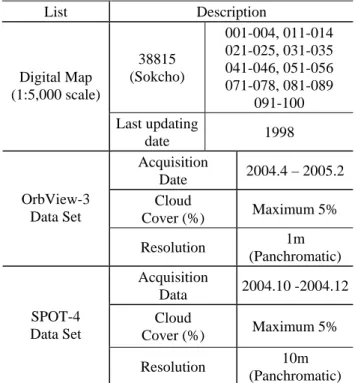
The scope of this study contained only 64 scenes of 1:5,000 scale digital maps, but the process of this study was basically analyzed to consider whole area of Kang- Won part. Besides, the necessary time and cost are also very important factors because one of the objectives of this study is to make a budget for updating digital map.

Therefore, used data of this study was selected under limited conditions. For the urban area, containing various change factors relatively, it was used that OrbView-3 image with 1m ground resolution. For other area, containing forest relatively, it was used that SPOT-4 image with 10m ground resolution

Table 2. Using data characteristics.

List Description

38815 (Sokcho)

001-004, 011-014 021-025, 031-035 041-046, 051-056 071-078, 081-089

091-100 Digital Map

(1:5,000 scale)

Last updating

date 1998

Acquisition

Date 2004.4 – 2005.2 Cloud

Cover (%) Maximum 5%

OrbView-3 Data Set

Resolution 1m

(Panchromatic) Acquisition

Data 2004.10 -2004.12 Cloud

Cover (%) Maximum 5%

SPOT-4 Data Set

Resolution 10m (Panchromatic)

3.3 Processing Algorithm

OrbView-3 images, having 1m ground resolution should be rectified using precise GCPs (Ground Control Point) such as GPS (Global Positioning System) surveying data in principle, but we used GCPs extracted from 1:5,000 scale digital maps because of processing time and cost. The RMSE of corrected images permitted within 5m to consider the allowable error of 1:5,000 digital maps. SPOT-4 images, having 10m ground resolution, were rectified using commercial ortho- rectification module. For ortho-rectification, we used GCPs extracted from 1:5,000 scale digital maps and DEM (Digital elevation model), having 10m ground resolution, which was created using points extracted from 1:25,000 scale digital maps. And then the corrected each image rearranged the size of 1:5000 scale digital maps.

3.3.1 Whole updating digital maps

To calculate the cost of whole updating digital maps, we classified 5 topographical classification categories (urban, rural, farmland, hill and mountain) and water class using screen digitizing method.

We used screen digitizing method, manual

classification method. Supervise or unsupervised

classification method, general classification method,

wasn’t applied because used images are high resolution

and panchromatic data. Therefore, to make up for weak

points and upgrade quality for results, we made

guidebook for screen digitizing classification. We

calculated the ratio of area based on classified results and

then applied it to standard cost finally. So, we can get

updating cost of each scene.

(3)

3.3.2 Partial updating digital maps

To calculate the cost of partial updating digital maps, we extracted the change area with screen digitizing method after overlapping rectified image and current digital map. We made a guidebook about change detection in order to improve accuracy of manual method as whole updating digital maps. Following this guidebook made it possible to minimize errors. Extracted change area recomposed change area according to each classification category by using results of topography classification. We calculated the ratio of area based on classified results and then applied it to standard cost finally. So, we can get updating cost of each scene.

Preparation

To Obtain Satellite Image

Geometric correction / Ortho Rectification

To rearrange the size of 1:5,000 scale digital maps

classification (screen digitizing)

To overlap rectified images and digital maps

To calculate area and ratio each class

Change detection (screen digitizing)

To calculate area and ratio each class

Whole updating

Partial updating To apply to the

standard costs

To apply to the standard costs

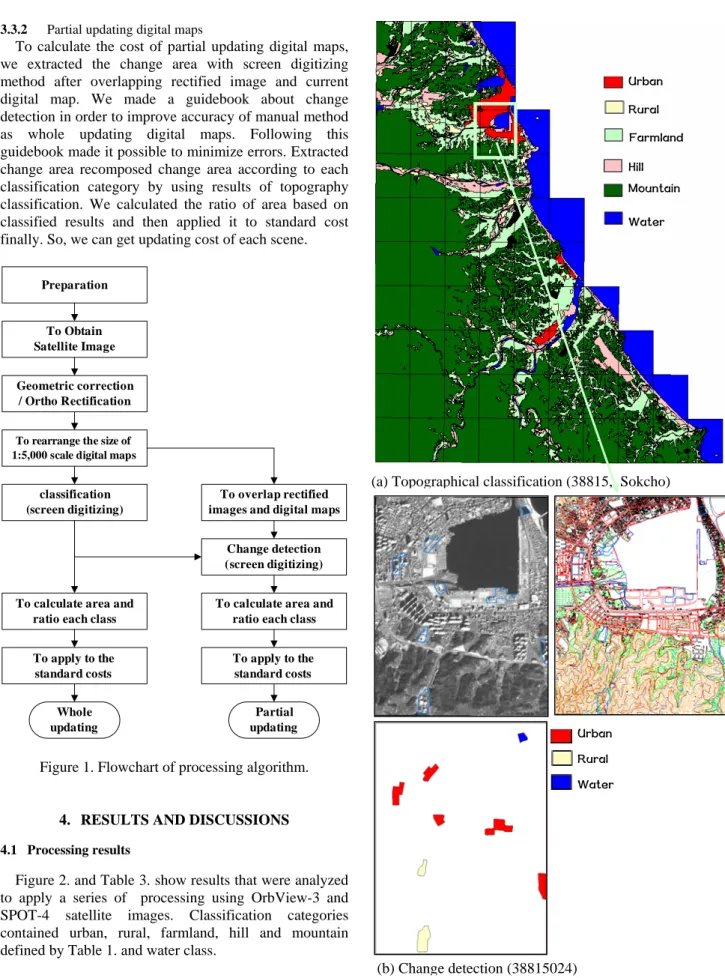
Figure 1. Flowchart of processing algorithm.

4. RESULTS AND DISCUSSIONS 4.1 Processing results

Figure 2. and Table 3. show results that were analyzed to apply a series of processing using OrbView-3 and SPOT-4 satellite images. Classification categories contained urban, rural, farmland, hill and mountain defined by Table 1. and water class.

Figure 2. Results of topographical classification and change detection using satellite images and digital maps.

Urban Rural Water

Urban Rural Farmland Hill Mountain

Water

(a) Topographical classification (38815, Sokcho)

(b) Change detection (38815024)

(4)

Table 3. Data processing results.

Data NO. urban rural farmland hill mountain water total

area(Km

2

) 2.22 0.21 0.75 0.66 1.13 0.94 6.09

classification

rate (%) 36.45 3.45 12.32 10.84 21.51 15.44 100

area(Km

2

) 0.12 0.05 - - - 0.01 0.18

38815024

change

detection rate (%) 1.97 0.82 - - - 0.16 2.96

4.2 Making a budget

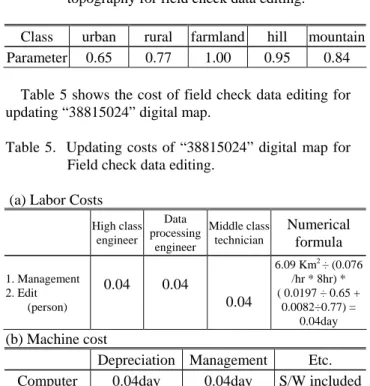
Base on the topographical classification and change detection results, we calculated the cost of field check data editing for updating “38815024” digital map. The required parameters are Increase and decrease parameters of topography, labor hour per unit and manpower per unit for calculating the cost based on the construction standard costs.

Table 4. Increase and decrease parameters of topography for field check data editing.

Class urban rural farmland hill mountain

Parameter 0.65 0.77 1.00 0.95 0.84

Table 5 shows the cost of field check data editing for updating “38815024” digital map.

Table 5. Updating costs of “38815024” digital map for Field check data editing.

(a) Labor Costs

High class engineer

Data processing

engineer

Middle class technician

Numerical formula

1. Management 2. Edit

(person)

0.04 0.04

0.04

6.09 Km

2

÷ (0.076 /hr * 8hr) * ( 0.0197 ÷ 0.65 +

0.0082÷0.77) = 0.04day

(b) Machine cost

Depreciation Management Etc.

Computer 0.04day 0.04day S/W included

5. CONCLUSIONS

In this study, we proposed more suitable methods using remotely sensed data in order to improve current methods of calculating updating costs of 1:5,000 scale digital maps at National Geographic Information Institute. So, we can get updating costs of 1:5,000 scale digital maps. From this study, the following conclusions can be inferred.

1. We proposed new methods for calculating updating cost of digital map using remotely sensed data. The proposed methods are more systematic and scientific than old methods. So, we expect to

calculate reasonable updating cost using new methods.

2. The high resolution satellite images are excellent data for topographical classification and change detection. However, if study area is so large, it spends a lot of money and time to process satellite images. Therefore, it is important to select proper resolution data in accordance with topographical condition.

3. Rectified the latest satellite images are essential data in various field of study. So, it is necessary to archive rectified images and then those data will be used various field.

4. We expect that topographical classification and change detection results, the results of this study, will be used monitoring system for national changes with various data in GIS technology.

REFERENCES

Lee, S. H., 1997. A study on the digital mapping, Korean Journal of Cadastral Survey , 13(1), pp.47-60.

Jeong, J.J., 2005, Developments of Urban Change Detection Methods According to Spatial Resolution of Satellite Images -Application of Kompsat 1 Images into Urban Area-, Journal of the Korean Association Of Professional Geographers, 39(1), pp.161-170.

Jensen, J. R, 1996, Introduction Digital Image Processing : A Remote Sensing Perspective, Prentice- Hall, Inc., Second Edition.

Lunetta, R. S and Elvidge C. D, 1998, Remote Sensing Change Detection : Environmental Monitoring Method and Application, Sleeping Bear Press, Inc.

Ministry Construction & Transportation, 2003, A Study on the Real-time Revision Method for GIS DB.

http://www.ngi.go.kr

ACKNOWLEDGEMENTS

This study was supported by National Geographic

Information Institute.

수치

Table 1. Topographical classification categories.
Figure 2. and Table 3. show results that were analyzed  to apply a series of  processing using OrbView-3 and  SPOT-4 satellite images
Table 4.  Increase and decrease parameters of  topography for field check data editing

참조

관련 문서

The purpose of this study was to provide primary material in discussing methods to activate the treatment effects of diabetes and reduce the rate of

To understand the current status of education, this study compared the 2015 Curriculum to the 2009 Curriculum whose teaching methods and evaluation standards

As shown in the results of this study through research methods and data processing described above, since customer service is increasingly important, dance

So, The purpose of this thesis is to study English teaching methods and materials, to elevate communicative competence, to apply them in our educational

 The simplest method of storing a raster layer in the memory of the computer is using a data structure called an array..  We consider alternative methods for searching through

We have implemented and developed a virtual angioscopy system based on the proposed methods, and tested it using several actual data sets of human blood

In this study, we developed a non-toxic titanium alloy with low elastic modulus in order to improve biocompatibility, and the surface characteristics of

Therefore, in order to make advanced composite pallet on digital display production line, this study will analyze stress of the composite pallet according to the