© Copyright
Keimyung University School of Medicine 2015
Department of Anesthesiology and Pain Medicine, Kangbuk Samsung Hospital, Sungkyunkwan University School of Medicine, Seoul, Korea
Tae Hee Kim, M.D., Dong Chan Ko, M.D., Jung Woo Pin, M.D., Won Jun Choi, M.D., Kyoung Ho Ryu, M.D.
Received: March 20, 2015
Accepted: April 22, 2015
Corresponding Author: Kyoung Ho Ryu, M.D.,
Department of Anesthesiology and Pain Medicine,
Kangbuk Samsung Hospital, Sungkyunkwan
University School of Medicine,
29 Saemunan-ro, Jongno-gu,
Seoul 110-746, Korea
Tel: +82-2-2001-2316
E-mail: [email protected]
• The authors report no conflict of interest in this
work.
A Case of Laryngeal Web Injury during Intubation in Pediatric Patient
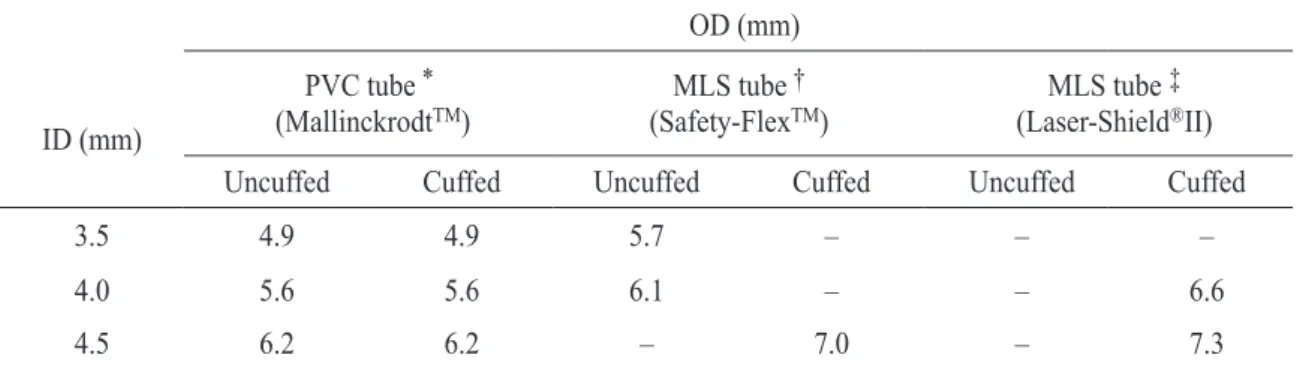
Laryngeal web is a rare congenital disease, and its incidence has been estimated to be 1 in 10,000 live births. A 4-year-old female child with laryngeal web was scheduled for laryngeal web removal. Smooth intubation without causing damages to the laryngeal web is important during induction. Also, it is very important to select the appropriate tube size during pediatric anesthesia. There is lack of a registered cuffed micro-laryngeal surgery (MLS) tube 3.5 mm inner diameter (ID) in Korea, and also our hospital did not have an uncuffed MLS tube 4.0 mm ID. Therefore we could not select the appropriate size of the laser tube. The patient’s laryngeal web was slightly injured during intubation. We report a case of laryngeal web injury caused by intubation for laryngeal web removal and wish to state that there is lack of a registered laser tube in the size, such as a cuffed MLS tube 3.5 mm ID.
Key Words : CO
2 laser, Laryngeal web, Pediatric, Uncuffed laser tube
Introduction
Laryngeal web is a rare congenital disease, and its incidence has
been estimated to be 1 in 10,000 live births [1,2]. Generally, surgery is
performed after growth. If the symptoms are severe, emergency
surgery is performed during the neonatal period [2,3]. During
intubation, laryngeal web injury may occur, and if it occurs, it may
increase the risk of laryngeal spasm and recurrence of laryngeal web
[4]. Therefore, when we give anesthesia for laryngeal web surgery,
smooth intubation is required, and this can be achieved by using the