고상반응법을 이용한 BaTiO 3 합성 및 특성 평가
김용진
1,2
, 최문희2
, 신효순2
, 주병권1
, 전명표2
1 고려대학교 전기전자공학과
2 한국세라믹기술원 나노소재공정센터
Synthesis and Characterization of BaTiO 3 Powder by Solid State Method
Yong Jin Kim
1,2, Moon Hee Choi
2, Hyo Soon Shin
2, Byeong-Kwon Ju
1, and Myoung Pyo Chun
21 Department of Electrical and Electronic Engineering, Korea University, Seoul 02841, Korea
2 Nanometerials and Nanotechnology Center, Korea Institute of Ceramic Engineering & Technology, Jinju 52851, Korea
(Received August 26, 2020; Revised September 14, 2020; Accepted September 14, 2020)
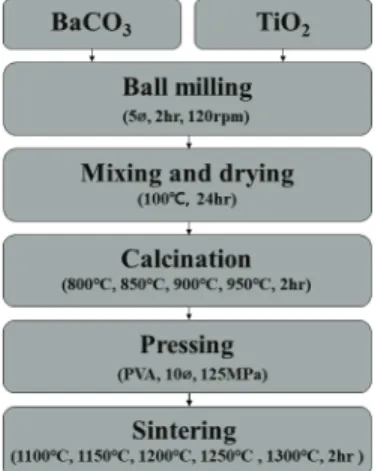
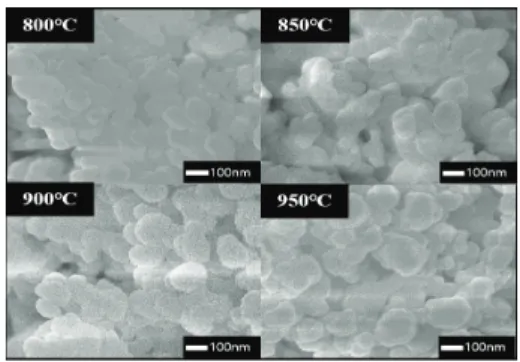
Abstract: BaTiO3 powder was synthesized by a solid-state reaction using BaCO3 and TiO2. Different calcination temperatures (800℃, 850℃, 900℃, and 950℃) were set to investigate their effects on the properties of BaTiO3 powder.
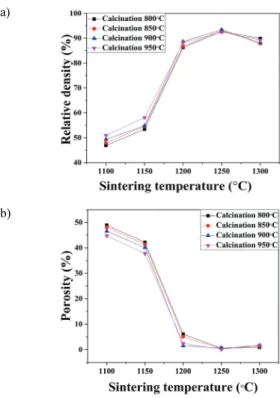
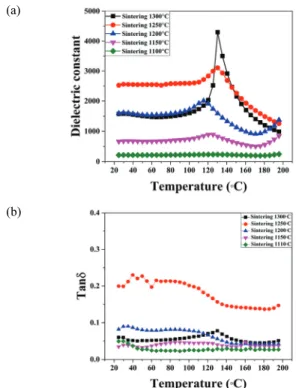
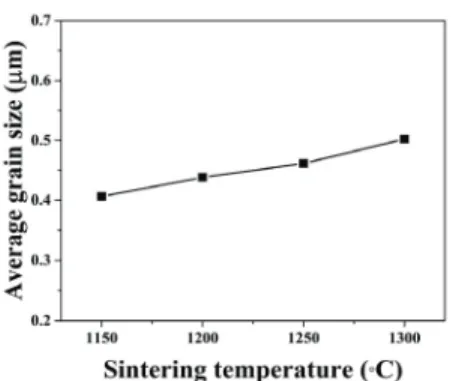
The synthesized BaTiO3 phase was confirmed to be a single phase by XRD, and the tetragonality (c/a) and crystallite size were calculated. Thereafter, each calcinated BaTiO3 was sintered at five different sintering temperatures (1,100℃, 1,150℃, 1,200℃, 1,250℃, and 1,300℃), and the tetragonality, density, porosity, dielectric constant, and grain size were measured. As the calcination temperature increased, the tetragonality and crystallite size also increased, to 1.008 and 66 nm, respectively, at 950℃. Moreover, most pellets showed increased density, dielectric constant, and tetragonality as the sintering temperature increased up to 1,250℃; the same parameters slightly decreased at 1,300℃. It is noteworthy that the tetragonality of BaTiO3 at 1,250℃ exhibits a very high c/a value of 1.0084. In addition, the grain size and dielectric constant measured near the Curie temperature increased as the sintering temperature increased.
Keywords: BaTiO3, Calcination, Sintering, Tetragonality, Dielectric constant, Grain size