Print ISSN: 1738-3110 / Online ISSN 2093-7717 http://dx.doi.org/10.15722/jds.18.6.202006.37
Factors Influencing Consumer’s Purchase Intention on Beauty Products in Youtube*
Nadia Annisa ROSARA 1 , Amia LUTHFIA 2
Received: May 04, 2020. Revised: May 14, 2020. Accepted: June 05, 2020.
Abstract
Purpose: This research aims to explain the influence of social media influencer (SMI), electronic word of mouth (EWOM), and perceived quality (PQ) on purchase intention (PI) of beauty products on YouTube. Youtube as the number 1 social media in Indonesia, has an important role as a promotional strategy media for beauty products. Research design, data and methodology: This study used the online survey to 210 female respondents aged 17-30 years who became a subscriber of an Indonesian beauty influencer. Simple regression and multiple regressions were performed to analyze the independent variables towards the dependent variable. Results: The results show that social media influencer, electronic word of mouth, and perceived quality simultaneously have a significant influence on purchase intention. Nevertheless, only two variables individually have a significant influence on purchase intention, which is social media influencer and perceived quality. Conclusions: Perceived quality and social media influencer could be the best strategies to increase consumers when promoting through the influencer's Youtube channel by utilizing a subscriber. While e-WOM can be influential on other social media platforms rather than on the Youtube platform. Therefore, suggested that digital marketer must use multiple social media platforms to increase consumers' purchase intention.
Keywords : Social Media Influencer, Electronic Word of Mouth, Perceived Quality, Purchase Intention, Youtube.
JEL Classification Code : L66, L88, M30, M31, M37
1. Introduction 78
Social media is considered one of the best promotional strategy media in this new media era. This is a great opportunity for cosmetics businesses to place their products without having to pay a large fee to do advertising. One of the social media that is currently popular is YouTube.
* This Reasearch was financially supported by Bina Nusantara University.
1 First Author, Magister Student, Communication Department, Faculty of Economics & Communication, Bina Nusantara University, Indonesia. Email: [email protected] 2 Corresponding Author, Senior Lecturer, Communication
Department, Faculty of Economics & Communication, Bina Nusantara University, Indonesia, Email: [email protected]
ⓒ Copyright: The Author(s)
This is an Open Access article distributed under the terms of the Creative Commons Attribution Non-Commercial License (http://Creativecommons.org/licenses/by-nc/4.0/) which permits unrestricted noncommercial use, distribution, and reproduction in any medium, provided the original work is properly cited.
Youtube is the most popular video-sharing platform since 2005. A year later in 2006, Youtube first opened up opportunities for companies to utilize the platform as an effective marketing strategy with several advertising concepts (Schwemmer & Ziewiecki, 2018). The results of WeAreSocial and Hootsuite research in January 2019, Youtube is the number one social media in Indonesia with a percentage of 88% of 150 million social media users in Indonesia (Riyanto, 2019).
Youtube can collect information and data through search engine features. When we look for video content on beauty products on Youtube, there will be many reviews of beauty products from various beauty Influencers. Influencers can be used as valuable partners for companies to promote their products. Influencers are considered valuable because with the status of YouTubers who started his career from an amateur to professional, they will influence other social media users for commercial purposes (Schwemmer &
Ziewiecki, 2018).
Moreover, product recommendations from social media influencer received a higher trust rate compared to products recommended by families or friends, resulting in 40% of consumers purchased the products used by social media influencer (Sekhon & Cartwright, 2016). Consumers also often received more messages about the product from social media influencer than from companies (De Veirman, 2017).
Consumers could willingly exchange ideas about the product being discussed through the beauty influencer's YouTube channel comments section. This process can be referred to as word of mouth (WOM), but it is called an electronic word of mouth (e-WOM) when the process through the internet. Word of Mouth (WOM) is an idea that defines the sharing of information between consumers about products and services (Durmaz & Yüksel, 2017). E- WOM is considered effective because the origin of trust comes from people who do not get their approval. If influencers are trusted through their credibility, e-WOM is more trustworthy because the information is voluntarily given by others and is not based on any brand. Therefore, companies need to understand the factors that can affect electronic word of mouth on purchase intention in beauty products on Youtube.
Despite getting product information online, consumers also consider the quality of the product being promoted, which will later lead to perceived quality. Perceived quality is an overall assessment of the advantages of a product or service based on the user of the product or service (Cheng, 2017). Perceived quality is needed because by searching for information online, consumers certainly have a perception of the value and benefits of beauty products. Perceived quality is very influential in determining consumer‘s purchase intention. When the perceived quality possessed by consumers is good, then there will be an opportunity to generate purchase interest, and vice versa. Thus, perceived quality play an important role in the creating purchase intention.
For the beauty industry which overgrew in Indonesia.
The role of social media (Youtube) is unavoidable and important. Therefore, influencer, e-WOM, and perceived quality help in promoting the beauty product of a brand in order to create a purchase intention and increase sales.
Based on Dailymail.co.uk, Pixability, states that 61 percent of women will see a beauty guide video uploaded by vloggers on YouTube, and 38 percent of women say they will buy the product featured in the video they see (Beauty Vlogger Semakin Populer, 2016). This shows that the cosmetics industry has not only good prospects but also has intense competition due to increase the type of cosmetics.
Cosmetics companies are demanded to be able to develop and create innovations in order to maintain their existing market and win the competition.
Seeing that the market is increasing quite large each year
and purchase intention from consumers is increasing, several online shopping platforms are also rife in selling beauty products. Plus, this very fast and aggressive digital world has made producers have to be able to maintain their business performance. At the same time, there is still very little research, especially in Indonesia, which specifically studies social media influencer, e-WOM, and perceived quality in the beauty industry. Therefore, the objective of this study is to examine the influence of social media influencer, e-WOM, and perceived quality for promoting beauty products on Youtube.
2. Literature Review
2.1. Social Media Influencer on Purchase Intention
The term influencer arises from the realm of marketing when a brand engages a specific figure to be able to touch the target consumer, convey the message and the purpose of the brand. Influencers are individuals who have the power to influence the decisions of others because of their authority, knowledge, position, or relationship (real or perceived) (Sigala & Gretzel, 2018). Social media influencer work "to generate" celebrity capital "by growing as much attention as possible and creating authentic" private brands "through social networks, which can then be used by companies and advertisers to reach consumers. (Sigala & Gretzel, 2018). It can be concluded that an influencer is someone who has an influence on terminating the purchase of others. In general, influencers use social media and have a significant number of subsriber.
Regarding the previous study showed that Irish millennial generation males in Ireland are not accustomed to traditional advertising because they live in an age where the internet and social media are very influential in daily activities. Consumers in the millennial generation differ in their opinions, ideas, and interests in engaging with social media influencer. Through this involvement, it will imply a deeper relationship between the millennia that are deeply connected by social media influencer (Kalu, 2019).
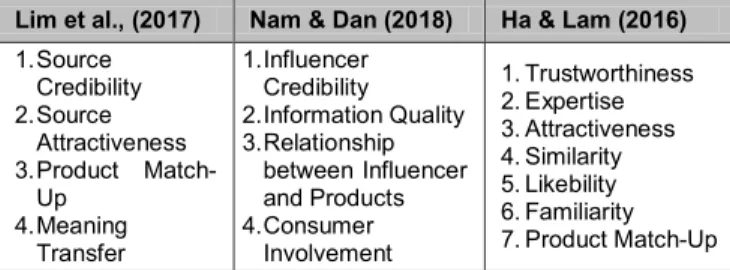
Tabel 1: Elaboration of the Dimensions of Social media Lim et al., (2017) Nam & Dan (2018) Ha & Lam (2016) 1. Source
Credibility 2. Source
Attractiveness 3. Product Match-
Up 4. Meaning
Transfer
1. Influencer Credibility 2. Information Quality 3. Relationship
between Influencer and Products 4. Consumer
Involvement
1. Trustworthiness
2. Expertise
3. Attractiveness
4. Similarity
5. Likebility
6. Familiarity
7. Product Match-Up
Source: Data Processing Results, 2020
Based on the results of the elaboration, the dimensions used in this study are as follows:
1. Source Credibility 2. Product Match-Up 3. Meaning Transfer
Heriyati and Siek (2011) study shows that the role of credibility in informational influence has been found to most significantly adjust a recipients‘ opinion in the bearing pushed by the communicator when the material was attributed to high-credibility source than when it was attributed to a low-credibility source. Then, the match-up hypothesis explores the fit between an endorser and the brand (Kamins, 1990). Shimp (2008) stressed that a match- up between an endorser and the brand is the most fundamental goal in achieving consumers' purchase intention. Thus, a perfect match between social media influencer and the product will significantly strengthen the advertising results.
McCracken recommended that an endorsement effect is driven through meaning transfer process, whereby an endorser's effectiveness often relies on his abilities to convey product meanings alongside the endorsement process (McCracken, 1989). This construct frames endorsement as a movement of meaning, which is transferred from the endorser's personal and professional world to a particular product and is consequently influential in building consumers' self-image through consumption (McCracken, 1989). Empirical study has validated that meaning transfer exhibits a correlation on consumer attitude and also influences purchase intentions (Peetz, Parks, &
Spencer, 2004).
2.2. Electronic Word of Mouth on Purchase Intention
Electronic Word of Mouth (WOM) is a message about an organization's product or service or about the organization itself via the internet. Comments about the product, service quality, trust, and modus operandi, taken from one person to another involved in WOM. 'Sender' who has personal experience with products or services from a particular organization is considered a source of information that is entirely objective by the 'recipient.' The information delivered by delivery can be positive, negative, or complete (Alfred, 2016). The most significant factors in encouraging electronic word-of-mouth approval are ownership, winning, and willingness to help (Cheung & Lee, 2012). It can be concluded that e-WOM is a form of marketing communication that contains positive and negative statements made by potential consumers through internet media.
Cheung and Lee (2012) argue that there are several advantages of electronic word of mouth that have a greater influence than traditional word of mouth, namely:
1. Electronic word of mouth is more modern, namely the use of technology in disseminating information 2. Electronic word of mouth is more accessible than
traditional WOM.
3. The attitude of the electronic word of mouth which can not do credibility assessment of the sender and message.
In measuring the effect of electronic word of mouth, Goyette, Ricard, Bergeron, and Marticotter (2010) argues that there are three dimensions that can be used, namely as follows (Goyette et al., 2010):
1. Intensity
2. The Valence Of Opinion
3. Content.
Previous studies showed that the main factors that could influence e-WOM were trustworthiness; expertness;
informational influence, and high fashion involvement. The results of this study can help companies that use Facebook's social media to promote their products by targeting factors that have a significant influence on purchase intention (Anum, Saleem, & Ellahi, 2017). The other study from Erkan and Evans shows that quality, credibility, usability, information adoption, information needs, and attitudes towards information are the main factors of electronic word of mouth on social media that can influence consumer purchase intention (Erkan & Evans, 2016). According to Cheung, Luo, Sia, and Chen (2009), the degree to which one perceives a recommendation or review as genuine, true, believable, or factual is defined as the consumer-perceived credibility of eWOM. Proposed that perceived credibility is a prime determinant in a consumer‘s decision-making process, and reduces uncertainty in both social and business interactions (Awad & Ragowsky, 2008). Thus, the more comprehensive and belief on the products or services‘
eWOM credibility will be, the higher the purchase intention the consumers will have.
2.3. Perceived Quality on Purchase Intention
Product quality is the ability of a product to perform its functions properly, which includes the reliability and accuracy of the product (Philip & Gary, 2012). Meanwhile, perception is a process carried out by individuals to choose, organize, and interpret stimuli into meaningful and reasonable images of the world (Schiffman & Kanuk, 2008).
Based on the above understanding, it can be concluded that
perceived quality is a process carried out by an individual to create a picture of the ability of a product.
There are eight dimensions of quality perception, namely (Hoe & Mansori, 2018):
1. Performance 2. Features 3. Reliability 4. Conformity 5. Durability
6. Service or Repair Capability 7. Aesthetics
8. Perceived Quality
According to previous research, it revealed a significant moderate relationship between perceived quality and emotional value to purchase intention (Asshidin, Abidin, &
Borhan, 2016). Another research showed a significant effect between perceived quality on profitability. Then, the results further showed the significant influence of brand awareness, perceived quality, and loyalty to purchase intention. The Sobel test conducted in this study also shows that purchase intention only mediates the relationship between perceived quality and profitability (Yaseen & Tahira, 2011). Perceived quality directly influences to purchase intention. Customers have some perceptions about the product quality, price and styles before going to purchasing the product. After seeing the product information, purchase intention increases as well as decreases, because it has direct relations which affect each other‘s. If the quality is high, purchase intention of customer is also high (Saleem, Ghafar, Ibrahim, Yousuf, &
Ahmed, 2015).
2.4. Theoretical Framework
This research uses associative hypothesis, which is a temporary answer to the formulation of associative problems that asks the relationship between two or more variables (Sugiyono, 2016). The hypothesis is as follows:
H1 : Social media influencer has a significant influence on purchase intention.
H2 : Electronic word of mouth has a significant influence on purchase intention.
H3 : Perceived quality has a significant influence on purchase intention.
H4 : Social media influencer, electronic word of mouth, and perceived quality simultaneously have a significant influence on purchase intention.
3. Research Methods and Materials
This study uses a quantitative method with an explanatory survey and using non-probability sampling with a sampling technique that is purposive sampling. The population in this study are female who subscribed beauty influencers on Youtube, with ages ranging from 17 years to 30 years. The data testing technique uses simple and multiple regression, which aims to determine the direct effect of independent variables on the dependent variable and processed using SPSS 22 software.
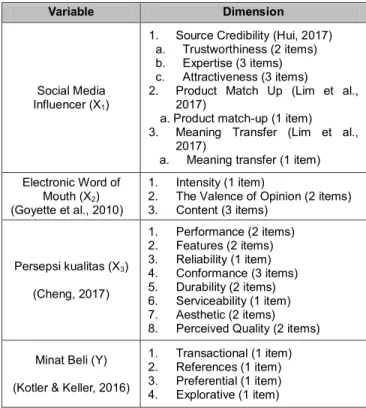
Table 2: Variables and Dimensions
Variable Dimension
Social Media Influencer (X
1)
1. Source Credibility (Hui, 2017) a. Trustworthiness (2 items) b. Expertise (3 items) c. Attractiveness (3 items) 2. Product Match Up (Lim et al.,
2017)
a. Product match-up (1 item) 3. Meaning Transfer (Lim et al.,
2017)
a. Meaning transfer (1 item) Electronic Word of
Mouth (X
2) (Goyette et al., 2010)
1. Intensity (1 item)
2. The Valence of Opinion (2 items) 3. Content (3 items)
Persepsi kualitas (X
3) (Cheng, 2017)
1. Performance (2 items) 2. Features (2 items) 3. Reliability (1 item) 4. Conformance (3 items) 5. Durability (2 items) 6. Serviceability (1 item) 7. Aesthetic (2 items) 8. Perceived Quality (2 items) Minat Beli (Y)
(Kotler & Keller, 2016)
1. Transactional (1 item) 2. References (1 item) 3. Preferential (1 item) 4. Explorative (1 item)
The data collection technique used a questionnaire that measured using a Likert scale type. The questionnaire consisted of 35 items. The items stated in the statement were measured using 5-point Likert scale (1 = strongly disagree, 2
= disagree, 3 = neutral, 4 = agree, 5 = strongly agree).
Observations were also made through social media Youtube.
Of the 250 questionnaires distributed, 239 questionnaires
Electronic Word of Mouth (X
2)
Perceived Quality (X
3)
Purchase Intention
(Y) Social Media Influencer
(X
1)
received responses from respondents. Of the 239 questionnaires, 29 of them could not be processed because they did not meet the requirements of the population. A total of 210 questionnaires will be processed for this study.
4. Results
4.1. Validity Test
The total sample (n) in this study is 210 respondents. By using the formula df = n - 2, then the result of df is 210 - 2 = 208. In the calculations performed using SPSS, it can be seen in the Corrected item-Total Correlation column, with the formula t/sqrt (df + t**2) obtained r table = 0.11.
Based on the results of the validity test data processing shows that all items in the statement of influencer social media variables ( x
1); electronic word of mouth (x
2);
perceived quality ( x
3); and purchase intention (y) contained in the questionnaire declared valid because it has a value of Corrected item-Total Correlation ≥ 0.11
4.2. Reliability Test
Table 3: Reliability Test Results
Variables Cronbach's Alpha N of Items Social Media Influencer (x
1) 0.602 10 Electronic Word of Mouth ( x
2) 0.694 6
Perceived Quality (x
3) 0.670 15
Purchase Intention (y) 0.626 4
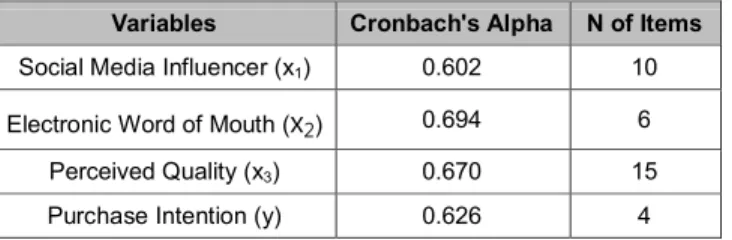
The reliability test in this study was conducted by looking at the Cronbach's Alpha values obtained from calculations through SPSS. If Cronbach's Alpha ≥ 0.6, then the statement item is declared reliable, and if Cronbach's Alpha <0.6, then the statement item is declared unreliable (Priyatno, 2014).
Table 3 shows that the scale of social media influencer has reliability Cronbach's alpha at 0.602; an electronic word of mouth has reliability Cronbach's alpha at 0.694; perceived quality has reliability Cronbach's alpha at 0.670; purchase intention has reliability Cronbach's alpha at 0.626. Then, it can be concluded that all variables are reliable, so all measured variables are considered reliable in this study.
4.3. Correlation Analysis
According to Sugiyono (2016), guidelines for interpreting the results of the correlation coefficient include the following (Sugiyono, 2016):
Table 4: Correlation Index
Interval Correlation Level
0,00-0,199 Very Low
0,20-0,399 Low
0,40-0,599 Moderate
0,60-0,799 Strong
0,80-1,000 Very Strong
Source: Sugiyono (2016)
Table 5: Correlation Analysis Results Social Media Influencer
Electronic Word of
Mouth
Perceived Quality
Purchase Intention
Pearson
Correlation 0.384
**0.334
**0.458
**Sig.
(2 Tailed) 0.000 0.000 0.000
Table 4 shows that social media influencer has a Pear son Correlation at 0.384 on purchase intention, and electr onic word of mouth has a Pearson Correlation at 0.334 o n purchase intention. This means that there is a low direc t relationship between social media influencer with purch ase intentions, and so does the electronic word of mouth with purchase intentions. However, different from perceiv ed quality that has a Pearson Correlation at 0.458 on pur chase intention, that means perceived quality and purchas e intention have an moderate direct relationship. Then, th e results show that the relationship of all variables is sign ificant, as seen fro Sig. 000 < 0.05.
4.4. Regression Analysis
The multiple-regression analysis was used with the three factors as independent variables to test the model for purchase intention. In this study, the regression equation used in conducting regression analysis is as follows (Priyatno, 2014):
4.4.1. Coefficient of Determination
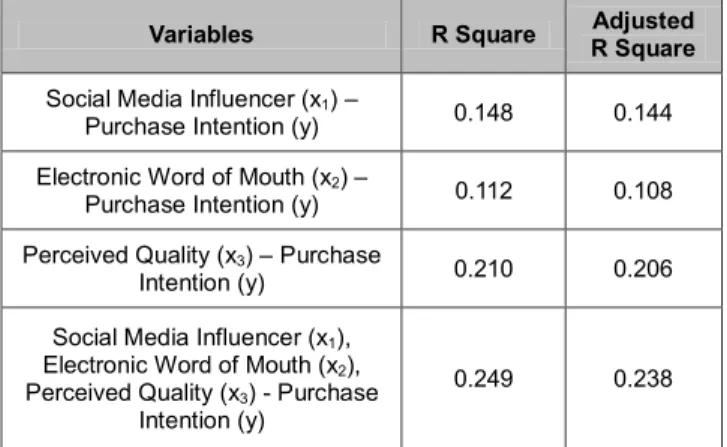
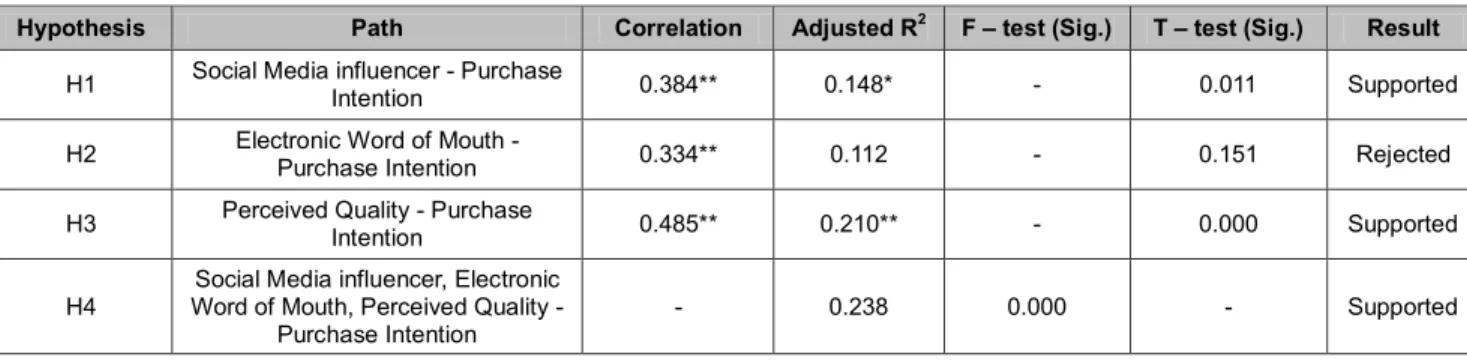
Results of linear regression analysis indicate that the contribution of social media influencers variables to the purchase intention variable can be seen in table 6 with an R
2value of 0.148 = 14.8%, which means contributing 14.8% to the purchase intention. Then, it appears that the e-WOM variable has a contribution that is R
2of 0.112 = 11.2%, which means it contributes 11.2% to the purchase intention.
In the perceived quality variable, R
2value of 0.210 = 21%, which means it contributes 21% to the purchase intention.
Y = a + b
1
X
1
+ b
2
X
2
+ b
3
X
3