63
and Safety
Available online at http://www.foodhygiene.or.kr
원유시료에서 분리한 장구균 속 세균의 tetracycline 내성 유전자형 분석
김지훈1·최성숙2*
1삼육대학교 동물과학부, 2삼육대학교 약학대학
Prevalence and Molecular Characterization of Tetracycline Resistance in Enterococcus Isolates from Raw Milk Samples in Korea
JiHoon Kim1 and SungSook Choi2*
1Division of Animal Science, Sahmyook University, Seoul 139-742, Korea,
2College of Pharmacy, Sahmyook University, Seoul 139-742, Korea (Received November 21, 2011/Revised January 6, 2012/Accepted March 16, 2012)
ABSTRACT - Antibiotic resistance in animal isolates of enterococci is a public health concern, because of the risk of transmission of antibiotic-resistant strains or resistance genes to humans through the food chain. This study investigated phenotypic and genotypic resistances profile of tetracycline in 245 Enterococcus isolates from bovine milk. A total of 245 enterococci were isolated from 950 milk samples. The predominant strain was E. faecalis (n = 199, 81.2%) and E. faecium (n = 25, 10.2%). E. avium (n = 7, 2.9%), E. durans (n = 6, 2.5%), E. gallinarum (n = 4, 1.6%), and E. raffinosus (n = 4, 1.6%) were also isolated. Of the 245 enterococcal isolates 76.3% (n = 187) displayed tetracycline resistance (≥ 16 µg/ml). Of the 187 tetracycline-resistant isolates, 83.4% (n = 156), 16.1%
(n = 30), and 26.7% (n = 50) possessed the genes tet(M), tet(L), tet(S) respectively. While 3.2% (n = 6) of the tetracy- cline-resistant isolates possessed all three genes tet(M) + tet(L) + tet(S), 8.6% (n = 16), 16.0% (n = 30), and 2.7%
(n = 5) of them possessed two genes tet(M) + tet(L), tet(M) + tet(S), and tet(L) + tet(S) respectively. The tetracycline resistance pattern investigated in this study was attributable mainly to the presence of tet(M).
Key words: antibiotic resistance, enterococci, bovine milk, tetracycline
장구균속 세균은 사람과 동물에 정상적으로 상재하는 세 균의 일종으로 보통 사람과 동물의 소화관, 야채류 및 유 제품 등에서 쉽게 검출되는 균이다1,2). 건강한 사람에게는 질병의 위험이 없으나 최근 들어 면역성이 약한 만성 질 환자등을 대상으로 원내 감염을 일으켜 수술 후 감염, 비 뇨기 감염 및 균혈증의 주요 원인균으로 알려지기 시작하 였다3). 장구균 감염치료를 어렵게 하는 원인 중 하나는 대 다수 장구균이 여러 항생제에 저항성을 나타내는 것과 무 관하지 않다4). 즉 장구균이 여러 항생제에 저항성을 나타 내다 보니 환자에게 사용할 경우 적절한 항생제를 선택하 는데 제약이 된다. 한편 항생제 내성의 문제는 사람뿐만 아니라 축산분야에서도 내성 증가로 인한 가축의 질병 치 료의 어려움을 겪고 있고 내성균의 사람에게로의 전달 가 능성이 제기 되고 있어 공중보건학적으로 중요하게 대두
되고 있다5,6). 전세계적으로 항생제의 전체 사용량 중 1/2 이 동물의 치료, 예방 및 성장촉진제로 사용되고 있는 실 정임을 감안할 때 동물성 식품 유래 세균의 항생제 내성 균의 증가 경향을 연구하는 것은 항생제 사용을 관리하는 데 있어 중요한 단서가 될 것이다7,8). 식품위생상 동물 및 축산물 유래 오염의 지표 세균 중 하나인 장구균속 세균 의 경우 지역에 따라 약간의 차이는 있으나 다양한 종류 의 항생제 및 살균제에 높은 내성을 나타내고 있으며 특 히 우리나라의 경우 tetracycline 에 대한 내성이 가장 높은 것으로 알려져 있다9,10). 단백질 생합성 과정을 방해하므로 항균력을 나타내는 tetracycline에 대한 세균의 내성발현의 기전으로는 1) active efflux system에 의한 약물의 유출과 2) ribosomal protection 에 의한 target site에 약물이 결합 하지 못하도록 하여 내성을 나타내는 두 가지 기전이 대 표적이다11). 장구균에서 발현되는 tetracycline 내성 기전중 active efflux system 에 의한 내성의 발현은 tet(K) 과 tet(L) 두 유전자에 기인하며, tet(M), tet(O) 및 tet(S) 유전자는 ribosomal protection 에 의한 내성 발현 유전자로 알려졌
*Correspondence to: SungSook Choi, College of Pharmacy, Sah- myook University, Seoul 139-742, Korea
Tel: 82-2-3399-1606, Fax 82-2-3399-1617 E-mail: [email protected]
다11-13). 장구균에 존재하는 tetracycline 내성 연구는 축산 식품 유래 균주를 중심으로 꾸준히 연구되어 왔으며14-16) 최근 우리나라 유방염 소의 원유시료에서 분리된 장구균 을 중심으로한 항생제 내성 유형에 대한 연구도 보고되었 다17). 하지만 남등의17) 연구 결과의 경우 각 항생제에 대 한 내성 비율에 대한 보고는 있지만 원인 유전자에 대한 분석은 미흡한 것으로 사료되었다. 따라서 본 연구자 등 은 축산물 유래 장구균이 가장 높은 내성율을 나타내는 항생제인 tetracycline에 대한 내성의 원인 유전자형을 분 석하고자 본 연구를 수행하였다. 경기북부지역 축산농가 에서 수집한 원유시료로부터 축산물 오염의 지표 세균의 하나인 장구균속 세균을 분리 동정하여 원유시료에서 장 구균의 종별 분리빈도를 확인하고 tetracycline 내성율 및 내성관련 유전자형의 분포를 장구균 종별 비교 분석하였다.
재료 및 방법
원유시료의 수집 및 장구균 분리
2008년부터 2010년 5월까지 경기 북부에 위치한 15개 젖소 사육 농가로부터 총 950개의 원유시료를 공급받아 실험에 사용하였으며 착유시 알코올 소독을 실시하여 2차 감염의 기회를 최소화 하였다. 수집한 원유는 잘 혼화 후 SF medium (Difco, Sparks, MD, USA) 에 0.1 ml을 도말 후 37oC에서 24~48시간 배양하였다. 배양 후 형성된 집락 중 장구균 특유의 집락을 순수배양 후 임상검사센터인 세 강 (서울)에 의뢰하여 Vitek2 system을 이용한 균 동정을 실시하였다. 동일한 원유 시료에서는 1개의 집락만을 선 택하여 같은 균주의 반복적인 선택을 피하였다.
최소저지농도(minimum inhibitory concentration, MIC) 의 측정
분리된 장구균을 대상으로 tetracycline (Sigma Co. St.
Louis MO, USA)에 대한 감수성 검사를 실시하였다. 감수 성 실험은 Clinical Laboratory Standards Institute (CLSI, USA)의 고체배지 희석법으로18) 실시하였으며 배지는 Mueller-Hinton 배지(Difco, MD, USA)를 사용하였다. 항생 물질은 최고 농도 64 µg/ml 농도가 되도록 하여 이 농도 에서 2배 계열 희석하여 최종 농도가 0.03 µg/ml 되도록 항생물질 희석 계열을 만들었다. 여기에 전 배양한 균액을 희석하여 106CFU/ml되도록 희석한 후 5 µl씩 항생제 배 지에 접종하여 37oC에서 16~20시간 배양하고 균주의 성 장을 확인할 수 없는 가장 낮은 tetracycline 의 농도를 최 소저지농도(MIC)로 결정하였다. 표준 균주로는 E. faecalis ATCC29212를 사용하였다.
중합효소연쇄반응에 의한 tetracycline 내성 유전자의 검색 장구균의 genomic DNA는 GeneAll Cell SV kit(진올바 이오테크놀로지, 서울)을 이용하여 분리하였으며 장구균의 세포벽의 분해를 용이하게 하기 위하여 lysozyme(30 mg/
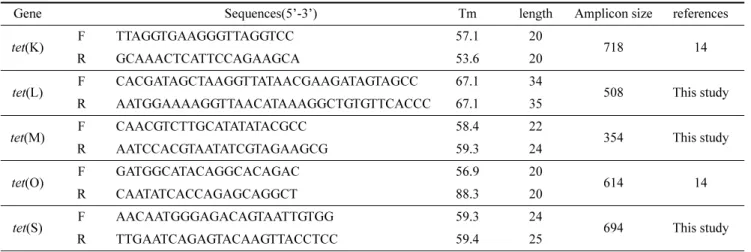
ml, Sigma Co. MO. USA)을 첨가하였다. 내성 관련 유전 자로는 tet(K), tet(L), tet(M), tet(O), tet(S) 를 후보 유전자 로 PCR반응을 하였으며 이때 사용한 primer는 Genotech (대전)에서 제작하여 사용하였다. 본 실험에 사용한 primer 의 염기서열과 반응조건은 Table 1에 나타내었다. PCR반 응은 Bioneer 사의 AccuPowerTM premix(대전)를 사용하여 95oC에서 5분간 denaturation 실시 후 95oC, 30초, Table 1 에 표시된 annealing 조건에서 30초, 72oC 1분간 extension 반응을 30회 반복 후 마지막 72oC 10분간 elongation 하 였다.
내성 유전자의 염기서열 분석
증폭된 tetracycline 내성 유전자는 Genotech(대전) 사에 의뢰하여 염기서열을 결정하고 GeneBank의 염기서열과 비교하였다.
Table 1. Sequences of primers used in this study
Gene Sequences(5’-3’) Tm length Amplicon size references
tet(K) F TTAGGTGAAGGGTTAGGTCC 57.1 20
718 14
R GCAAACTCATTCCAGAAGCA 53.6 20
tet(L) F CACGATAGCTAAGGTTATAACGAAGATAGTAGCC 67.1 34
508 This study
R AATGGAAAAGGTTAACATAAAGGCTGTGTTCACCC 67.1 35
tet(M) F CAACGTCTTGCATATATACGCC 58.4 22
354 This study
R AATCCACGTAATATCGTAGAAGCG 59.3 24
tet(O) F GATGGCATACAGGCACAGAC 56.9 20
614 14
R CAATATCACCAGAGCAGGCT 88.3 20
tet(S) F AACAATGGGAGACAGTAATTGTGG 59.3 24
694 This study
R TTGAATCAGAGTACAAGTTACCTCC 59.4 25
결과 및 고찰
원유 시료중에 존재하는 장구균속 세균을 분리하기 위 하여 경기 북부지역에 위치한 15개의 축산 농가에서 950 개의 원유 시료를 분양 받아 Difco SF medium (Difco, MD, USA) 배지에 도말하여 장구균 속 세균을 분리하였다. SF 배지에서 장구균 특유의 노란색 색소를 생성하는 집락중 245개의 집락이 균 동정 결과 장구균속 균주로 확인되었 으며 분리된 균의 종별 분포를 보면 Table 2에 나타난 것 처럼 E. faecalis 가 199(81.2%) 균주로 대부분을 이루고 있으며 그 외에 E. faecium 이 25(10.2%)균주, E. avium 이 7(2.9%)균주, E. durans가 6(2.5%)균주, E. gallinarum 이 4(1.6%) 균주, 및 E. raffinosus 가 4(1.6%) 균주의 비율로 분리되었다. 총 245개의 장구균 속 세균의 tetracycline 에 대한 내성을 보면 Table 2에 나타난 것처럼 MIC50과 MIC90 은 모두 > 64 µg/ml이었으며 CLSI의 판단 기준에 따른 (≥ 16 µg/ml) 내성 균주의 분포 비율은 76.3%(n = 187) 였 다. 최근 tetracycline 내성 장구균에 대한 국내 자료를 살 펴보면 식육에서 분리된 장구균의 경우 85.1%19) 돼지 분 변에서 분리된 장구균의 경우 80.7%20)의 내성을 나타낸 보고와 비교할 때 돼지에서 분리된 균 보다는 약간 낮지 만 여전히 tetracycline에 높은 내성 비율을 나타내고 있는 것을 알 수 있었다. 내성에 관련된 유전자 종류를 분석한 결과 tet(L), tet(M) 및 tet(S) 유전자가 확인되었으며 이 유 전자의 염기서열은 GeneBank의 reference 유전자인 tet(L) (AY081910.1), tet(M) (DQ223244.1) 및 tet(S) (DQ295784.1)
와 그 염기서열을 비교한 결과 일치도가 98% 이상임을 확인할 수 있었다. 내성 균주 187주 중 156주가 ribosomal protection에 관여하는 tet(M)을 보유한 것으로 확인되었으 며 종별 분포를 보면 분리된 6종의 장구균종 모두에 tet(M) 유전자가 분포함을 알 수 있었다. 그외 tet(S)를 보유한 경 우도 50주로 분리된 6종의 장구균속 세균 모두에서 관찰 되었다. Active efflux에 관여하는 tet(L)의 경우 30주에서 관찰되었으며 분리된 6종의 장구균중 E. avium과 E.
raffinosus에서는 관찰되지 않았다. 그 외 ribosomal protection 에 의한 내성에 관련된 tet(O)와 efflux system 에 관련된 tet(K) 유전자는 본 실험에서는 관찰되지 않았다. 이러한 결과는 벨기에 연구팀의 치즈유래 장구균을 재료로 실험 한 결과13)와도 일치하는 것으로 식품유래 장구균의 tetracycline 내성중 ribosomal protection에 기인한 내성은 주로 tet(M) 및 tet(S) 유전자에, active efflux system 에 기 인한 내성은 tet(L) 유전자에 기인한 것으로 판단된다. 한 편 총 6균주가 3개의 유전자 [tet(L) + tet(M) + tet(S)]를 동 시에 보유하고 있었으며 30개의 균주가 tet(M) + tet(S), 16 균주가 tet(L) + tet(M), 5개의 균주가 tet(L) + tet(S)두개의 유전자를 동시에 보유하고 있는 것으로 확인되어 내성에 관련된 유전자를 두개 이상 보유하고 있는 균주의 분포가 높은 것을 알 수 있었다. 본 실험 결과 원유시료에서 분 리된 장구균의 경우 E. faecalis가 전체 분리 장구균의 81%
로 다빈도로 분리되었으며 tetracycline에 대한 내성은 70%
가 넘어 아직도 tetracycline에 대한 내성이 높은 것을 알 수 있었다. tetracycline에 대한 내성유전자 분석 결과는 전 Table 2. Identification of Enterococci spp and susceptibility against tetracycline
Strains No. of isolates (%)
Phenotypic charactericic
Range MIC50 MIC90
Resistance rate (%) (µg/ml)
E. faecasli 199 (81.2) 0.5 ~ > 64 > 64 > 64 149 (74.9)
E. faecium 25 (10.2) 0.25 ~ > 64 > 64 > 64 18 (72.0)
E. avium 7 (2.9) 64 ~ > 64 64 > 64 7 (100)
E. durans 6 (2.5) 16 ~ > 64 > 64 > 64 6 (100)
E. gallinarum 4 (1.6) > 64 > 64 > 64 4 (100)
E. raffinosus 4 (1.6) 1 ~ > 64 64 > 64 3 (75.0)
Total 245 (100) 0.25 ~ > 64 > 64 > 64 187 (76.3)
Genotypic characteristic
tet(L) tet(M) tet(S) tet(L) + tet(M) + tet(S) tet(L) + tet(M) tet(M) + tet(S) tet(L) + tet(S)
E. faecasli 24 124 31 4 14 16 3
E. faecium 4 15 8 1 2 6 1
E. avium 0 7 6 0 0 6 0
E. durans 1 4 1 0 0 0 1
E. gallinarum 1 4 2 1 0 1 0
E. raffinosus 0 2 2 0 0 1 0
Total 30 156 50 6 16 30 5
체 내성 균주중 83% 가 tet(M)유전자를 보유한 것을 확 인할 수 있었으며 이는 원유 시료 유래 장구균의 tetracycline 내성에 tet(M) 유전자가 가장 크게 기여함을 알 수 있었 다. 본 연구는 우리나라 동물성 식품 유래 장구균의 tetracycline 내성 기전을 표현형 및 유전형 분석을 통해 분 석하였다는 점에서 의미 있는 연구 결과로 판단된다. 특 히 2011년 7월 이후 우리나라에서는 배합사료제조용 성장 촉진용 항생제 사용을 전면금지 하였기에21) 앞으로 내성 균주의 비율 및 내성 유전자형의 분포에도 변화가 있을 것으로 판단되어 지속적인 모니터링 작업이 이루어 져야 할 것으로 사료된다.
감사의 글
본 연구는 2011년도 삼육대학교 교비 연구비 지원에 의 해 진행되었으며 이에 감사드립니다
요 약
동물성 식품 유래 장구균의 항생제 내성은 내성균주 또 는 내성 유전자가 먹이사슬을 통해 인체로 전달될 수 있 다는 가능성 때문에 공중보건학적으로 중요하게 대두되고 있다. 본 연구는 원유 시료에서 분리된 장구균의 tetracycline 에 대한 내성을 표현형 및 유전형 수준에서 분석하였다.
원유 시료에서 총 245주의 장구균을 분리하였으며 그 중 E. faecalis 가 199주로 전체의 81.2%를 차지 하였으며 그 외에 E. faecium 이 25주(10.2%), E. avium 이 7주(2.9%), E.
durans 이 6주(2.5%), E. gallinarum 이 4주(1.6%), E. raffinosus 이 4주(1.6%)의 비율로 분리되었다. 분리 균주중 76.3%에 해당하는 187주가 tetracycline에 내성을 나타내었으며 내 성균주의 83.4%에 해당하는 156주가 tet(M)을 26.7%에 해 당하는 50주가 tet(S)를 16.1%에 해당하는 30주가 tet(L)을 3.2%에 해당하는 6주가 tet(M) + tet(L) + tet(S)의 3개의 유 전자를 동시에 소유하고 있는 것으로 분석되었다.
참고문헌
1. Devriese, L.A., Collins, M.D. and Wirt, R.: The genus Entero- coccus. In: Ballows, A., Truper, H. G., Dworkin, M., Harder, W., Schleifer, K. H., (Eds.) The Prokaryotes, 2nded., vol. 2, pp.
1465-1478 (1992), Springer-Verlag. New York.
2. Flahaut, S., Boutibonnes, P. and Auffray, Y.: Les entero- coques dans I’environnement proche de I’homme. Canad. J.
Microbio. 43, 699-708 (1997).
3. Malani, P.N., Kauffman, C.A. and Zervos, M.J: Enterococcal disease, epidemiology and treatment. In: Gilmore, M. S.
(Ed.) The Enterococci: pathogenesis, molecular biology and antimicrobiotic resistance. PP. 385-408 (2002). Amercan Soci-
ety for Mcirobiology. Washington, DC
4. Mannu, L., Paba, A., Daga, E., Comunian, R., Zanetti, S., Duprè, I. and Sechi L.A.: Comparison of the incidence of vir- ulence determinants and antibiotic resistance between Entero- coccus faecium strains of dairy, animal and clinical origin. Int.
J. Food Microbiol. 88, 291-304 (2003).
5. NORM. NORM-VET: Usage of antimicrobial agents and occurrence of antimicrobial resistance in Norway, pp. 1-72 (2003).
6. OIE. European Scientific Conference: The use of antibiotics in animal ensuring the protection of public health. pp. 8-142 (2001).
7. Sørensen, T.L., Blom, M., Monnet, D.L., Frimodt-Møller, N., Poulsen, R.L. and Espersen, F.: Transient intestinal carriage after ingestion of antibiotic-resistant Enterococcus faecium from chicken and pork. N. Engl. J. Med. 345, 1161-1166 (2001).
8. Witte, W., Klare, I. and Werner, G.: Selective pressure by anti- biotics as feed additives. Infection. 29, suppl2, S35-38 (1999).
9. Lim, S.K., Lee, H.S., Byun, J.R., Park, S.Y. and Jung, S.C.:
Antimicrobial resistance of commensal bacteria isolated from food-producing animals 1. Antimicrobial resistance of Escherichia coli and Enterococcus spp. isolated from cattle fecal samples. Kor. J. Vet. Pub. Health. 31(1), 21-29 (2007).
10. Kim, A.R., Cho, Y.M., Lim, S.K., Her, M., Jeong, W.S., Jung, S.C. and Kwon, J.H.: Antimicrobial resistance of com- mensal bacteria isolated from food-producing animals 3.
Antimicrobial resistance of Escherichia coli and Enterococ- cus spp. isolated from chicken fecal samples. Kor. J. Vet.
Pub. Health. 31(1), 41-49 (2007).
11. Roberts, M.C.: Tetracycline resistance determinants: mecha- nisms of action, regulation of expression, genetic mobility, and distribution. FEMS Microbiol. Rev. 19(1), 1-24 (1996).
12. Chopra, I. and Roberts, M.C.: Tetracycline antibiotics: mode of action, applications, molecular biology, and epidemiology of bacterial resistance. Microbiol. Mol. Biol. Rev. 65(2), 232- 260 (2001).
13. Huys, G., D'Haene, K., Collard, J.M. and Swings, J.: Preva- lence and molecular characterization of tetracycline resis- tance in Enterococcus isolates from food. Appl. Environ.
Microbiol. 70, 1555-1562 (2004).
14. Aarestrup, F.M., Hasman, H., Jensen, L.B., Moreno, M., Her- rero, I.A., Domínguez, L., Finn, M. and Franklin, A.: Antimi- crobial resistance among enterococci from pigs in three European countries. Appl. Environ. Microbiol. 68, 4127-4129 (2002).
15. Barbosa, J., Ferreira, P. and Teixeira, P.: Antibiotic suscepti- bility of enterococci isolated from traditional fermented meat products. Food. Micorbiol. 26, 527-532 (2009).
16. Hershberger, E., Oprea, S.F., Donabedian, S.M., Perri, M., Bozigar, P., Bartlett, P. and Zervos, M.J.: Epidemiology of antimicrobial resistance in enterococci of animal origin. J.
Antimicrob. Chemother. 55, 127-130 (2005).
17. Nam, H.M., Lim, S.K., Moon, J.S., Kang, H.M., Kim, J.M., Jang, K. C., Kim, J.M., Kang, M.I., Joo, Y.S. and Jung, S.C.:
Antimicrobial resistance of enterococci isolated from mas- titic bovine milk samples in Korea. Zoonoses Public Health.
57(7-8):e59-64 (2010)
18. CLSI.: Performance standards for antimicrobial susceptibil- ity testing: seventeenth informational supplement. Clinical and Laboratory Standards Institute. ASM press, Washington DC, USA. (2007)
19. Kim, C.M., Kang, S.J., Lee, B.J., Lee, S.J. and Yuk, D.S.:
Prevalence and molecular characterization of tetracycline-
resistant Enterococcus isolates from live stock. Kor. J. Vet.
Serv. 33(2) 143-149 (2010).
20. Jeong, K.O., Heo, J.H., Lee, J.M., Yun, I.R., Choi Y.J. and Kim, J.S.: Surveillance of antimicrobial resistance ratio of E.
coli and Enterococcus spp. isolated from fecal and carcasses of pigs in slaughterhouse. Kor. J. Vet. Serv. 33(3), 241-248 (2010).
21. Korea Animal Health Products Association, http://www.
kahpa.or.kr/