―
ISSN 1229-3350(Print) ISSN 2288-1867(Online)
―
J. fash. bus. Vol. 24,
No. 6:109-119, December. 2020 https://doi.org/
10.12940/jfb.2020.24.6.109
Materialism/Voluntary Simplicity on Attitudes Toward Eco-Friendly Fashion Products
-A Study of College Students in Seoul-
Hyun-Jeong Jin†
Dept. of Science & Technology Education for Life, Seoul National University of Education, Korea
Corresponding author
―
Hyun-Jeong Jin Tel : +82-2-3475-2514 Fax : +82 2-3475-2263 — E-mail : [email protected]
Keywords Abstract
attitude, consumption value, materialism, purchase intention, voluntary simplicity
As interest in the environment increases, consumers increasingly choose to buy
products with eco-friendly production processes. The purpose of this study was
to determine the effect of consumption values and materialism/voluntary
simplicity on the attitudes and purchase intentions toward eco-friendly fashion
products. A survey of university students in Seoul was conducted and 203
questionnaires were analyzed using SPSS 23.0. The consumption values
consisted of six factors: subjective value, novelty value, social value, brand
value, practical value, and health/safety value. Materialism/voluntary simplicity
was grouped into two factors of materialism pursuit and voluntary simplicity
pursuit. Brand values were found to negatively affect attitudes toward
eco-friendly fashion products. The more one pursued brand names, the more
negative was one’s attitude toward eco-friendly fashion products. Health/safety
values had a positive effect on purchase intentions for eco-friendly fashion
products and voluntary simplicity pursuit had a positive effect on both attitudes
and purchase intentions. The materialist group had high subjective value,
novelty value, social value, and brand value among the consumption values,
and the voluntary simplicity-seeking group tended to pursue the value of health
and safety. This study was meaningful in that it identified the characteristics of
consumers showing favorable attitudes toward eco-friendly fashion products.
. Introduction
Ⅰ
As concerns about the environment increases, consumers are striving to reduce waste, conserve water and energy, and, increasingly buy products made in an eco-friendly manner. Following this trend, fashion companies are showing interest in the production and marketing of eco-friendly fashion products, are producing clothing products made of eco-friendly materials, and are becoming concerned about how clothing is disposed (Oh, 2020). A fashion-related company is even offering sewing classes on making sustainable rather than disposable goods (Oh, 2018).
Consumption values are beliefs that influence individual decision-making and behavior regarding consumption (Sheth, Newman, & Gross, 1991). They affect the evaluation and judgment of various products as well as consumer attitudes and behaviors because they are ongoing beliefs that provide the criteria for behavior and judgment, transcending specific situations and goals (Kwon & Lee, 2000). Consumers assign different values to diverse types of product, which in turn affects purchase motives (Sheth et al., 1991). Thus, the consumption value of general fashion products may differ from that of eco-friendly fashion products. The study of consumption behavior related to eco-friendly products has found that the value of universality/harmony affects sustainable consumption behavior (Suk & Lee, 2013) and that environmental-conservation values, social altruistic values, and egocentric values affect repurchase intention (Hong, Lee, & Chu, 2010).
Materialism, by which one expresses oneself through possessions, is a factor influencing a range of consumer behaviors in modern society (Richins & Dawson, 1992).
It is related to extrinsic values, such as appearance, reputation, and social status, and contradicts self-transcendent and intrinsic values, which are related to good interpersonal relationships and behaviors for a better world (Kim & Seol, 2018). In recent years, as a reaction to materialism, increasing numbers of people are trying to live simple lives and limit their consumption, a kind of asceticism that is becoming an important trend.
The movement toward a simple life is called voluntary simplicity in the West (Alexander & Ussher, 2012), dansari ( 斷捨離 ) in Japan, and minimal life in Korea. As the term is commonly used in Korea, the minimal life is one that possesses only necessary items, reduces consumption, and simplifies (Rhie, 2020). Voluntary simplicity tends to be an alternative to consumption-oriented living as it allows people to live at a lower cost than otherwise, and it can result in an eco-friendly consumer life.
Materialism is related to ethical consumption (Hong &
Shin, 2010; Muncy & Eastman, 1998), and voluntary simplicity is related to an eco-friendly life, but few studies have comprehensively looked at these variables and consumption values in relation to eco-friendly fashion products. This study therefore aims to determine the effect of consumption values and materialism/voluntary simplicity on attitudes and purchase intentions toward eco-friendly fashion products. The study focuses on college students in Seoul, where many students come from diverse backgrounds.
. Literature Review
Ⅱ
1. Eco-Friendly Fashion Products
An eco-friendly product is one whose manufacturing does not produce substances that are harmful to the environment and that does not burden the environment in use or disposal. Choi and Kim (2000) describe as eco-friendly (green) those fashion products that put less burden on the environment during production, products made of recycled materials (such as polyester using PET bottles), and fashion products produced by recycling other, discarded products.
Hong et al. (2010) found that the more seriously consumers take environmental concerns, the lower their satisfaction with the purchase of eco-friendly fashion products and the greater their repurchase intention.
Therefore, although current eco-friendly fashion products
do not meet consumer expectations, consumers who are
interested in the environment tend to continue to
purchase eco-friendly fashion products.
College students were aware of the seriousness of the environmental pollution problem but felt an economic burden in purchasing eco-friendly products. The more they were conscious of others, the less they recycled clothing or preferred environmentally friendly behaviors and the lower their awareness of participation in community pollution prevention activities. It has been found that college students who are not conscious of others lead a sustainable consumer life while being aware of environmental issues (Park, 2016). The tendency to show off economic power had no effect on environmentally conscious consumer attitudes and eco-friendly clothing behavior (Park, 2016).
In a study by Kim and Yu (2011), women with a high gross income considered that the use/management of eco-friendly fashion products was important, and consumers purchased eco-friendly products in the order of underwear, outerwear, bags, shoes, and accessories.
2. Consumption Value
Value is an important psychological factor in decision-making and plays a central role in the process of changing perceptions, attitudes, and behaviors toward objects (Carman, 1978). Zeithaml (1988) defines perceived value as a consumer’s utility evaluation based on the difference between the value that a consumer obtains from using a product and the cost paid to obtain it, that is, the difference in perception between what he or she gained and paid for a product. Won and Chung (2015) define consumption value as “an expression of basic desires and goals that consumers want to achieve, and a constant belief that leads consumers’ individual thoughts and actions (2015, p.76).”
Holbrook and Hirshman (1982) divide consumption value into two values: hedonic value and utilitarian value. Sheth et al. (1991) expanded this and classify it into five consumption values: functional value, social value, emotional value, epistemic value, and conditional value. Functional value is the physical and practical value related to the price, quality, and function of a product.
Emotional value is associated with negative or positive emotions arising from product consumption. Social value involves a sense of belonging to a group, and epistemic value refers to the value related to the novelty that causes curiosity. Conditional value describes the consumption value related to the product-consumption situation in which the value of the alternative is perceived differently depending on the situation (Sheth et al., 1991).
In Suk and Lee’s (2018) study of male consumers, consumption value was divided into epistemic value, brand/conspicuous value, and economic value. The epistemic value and brand/conspicuous value had high eigenvalues for consumption value, indicating that male consumers demonstrated conspicuous consumption through clothing and tended to be brand oriented. In a study of middle-aged people by Park and Lee (2015), consumption value was divided into social value, emotional value, and functional value. They found that social value and emotional value influence the purchase intention of eco-friendly clothing. Cho (2015) studied college students’ consumption values on eco-friendly fashion products and found that functional value, emotional value, and social value were all positively related to purchase intention.
3. Materialism/Voluntary Simplicity
Materialism, by which one expresses oneself through possessions, is a factor that influences a range of consumer behaviors in modern society. Materialism can be defined as the tendency to value the possession of material goods and to pursue one’s happiness through such possession (Belk, 1985). Richins and Dawson (1992) describe the three sub-dimensions of materialism as
“acquisition centrality (1992, p.304),” “acquisition as the pursuit of happiness (1992, p.304),” and
“possession-defined success (1992, p.304).” It has been
shown that materialists continue to have a craving for
material even when they possess the material they want
and that they remain dissatisfied when their dreams of
wealth come true (Belk, 1985; Richins & Dawson,
1992). Materialistic values are associated with depression and with low satisfaction and happiness. Studies on ethical consumption have shown that materialism negatively influences ethical consumption (Hong & Shin, 2010; Muncy & Eastman, 1998).
In recent years, as a reaction to materialism, increasing numbers of people are trying to live simply while limiting their consumption, and this asceticism is becoming an important trend. The movement to reduce consumption and ownership by breaking away from reckless materialism is termed voluntary simplicity in Western countries and the minimal life in Korea. As voluntary simplicity was influenced by Henry David Thoreau’s (1817~1862) life at Walden Pond in the 1800s and is related to a nature-friendly life, voluntary simplicity can naturally lead to an eco-friendly consumer life (Kim, 2019).
4. Attitude/Purchase Intention
According to the theory of reasoned action (Ajzen &
Fishbein, 1980), attitude toward behavior and subjective norms are the preceding variables that can predict behavioral intention and behavior. Attitude is a response to a given stimulus, is expressed favorably or unfavorably for a specific object, and does not easily change once formed (Fishbein & Ajzen, 1975). Attitudes consist of cognition, emotions, and actions (Ajzen, 1991).
In general, attitudes can be measured as the sum of an individual’s utility value for the predicted outcome.
Purchase intention has been identified as an antecedent of purchase behavior under the influence of attitude (Ajzen, 1991; Ajzen & Fishbein, 1980). Because consumer purchases are often determined by consumers’
attitudes toward products, attitudes have been accepted as an important variable in consumer behavior.
A study on attitude and purchase intention toward eco-friendly products found that the more selfish consumers are, the less favorable is their attitude toward eco-friendly products; by contrast, the greater their altruism and innovativeness, the better their attitude toward eco-friendly products (Yang, Han, & Lee, 2014).
It has also been found that consumers’ altruism, collectivism, and tolerance positively influence their attitudes toward eco-friendly products (Yang & Park, 2012). In addition, high school students’ environmental interests and subjective norms about the environment had a significant effect on their attitudes toward eco-friendly products and services (Jung & Cho, 2019), and high school students’ experience in clothing education had an effect on eco-friendly clothing life attitudes (Jeon &
Koo, 2013). Also, the greater consumers’ tendency to patience, the greater their intention to purchase eco-friendly products (Im & Chu, 2019).
. Research Methods
Ⅲ 1. Research Questions
This study analyzed the effect of consumption values and materialism/voluntary simplicity on attitudes and purchase intentions toward eco-friendly fashion products. Five key research questions were proposed:
First, what are the factors of consumption value?
Second, what are the factors of materialism/voluntary simplicity?
Third, how do consumption values affect attitude and purchase intention toward eco-friendly fashion products?
Fourth how does materialism/voluntary simplicity affect attitude and purchase intention toward eco-friendly fashion products?
Fifth, how does the consumption value differ between the group characterized by materialism and the group pursuing voluntary simplicity?
2. Instruments
To measure consumption value, this study extracted 18
items from the work of Koo, Kim, Kim, Rha, Yeo and
Choe (2015) that measure consumption value. To
measure materialism, the study employed 18 items from
the scale of Kim (2015), which translated into Korean
the material values scale developed by Richins and
Dawson (1992).
The items to measure attitude and purchase intention were derived by modifying those developed by Engel, Blackwell, and Miniard (1995). The three-item attitude measure assessed how much the respondents liked the eco-friendly fashion products, how good they felt about them, and how positively they thought of them. The Cronbach’s α reliability of attitude was found to be .817. The three items to assess purchase intention included, “I am willing to purchase eco-friendly fashion products” and “I am highly likely to purchase eco-friendly fashion products.” The Cronbach’s α reliability of purchase intention was found to be .854.
Each item was measured using a 5-point Likert scale (1: strongly disagree, 5: strongly agree). Demographic items included gender and age.
3. Subjects
Because the number of college students in the Seoul area makes it easier to investigate subjects with diverse backgrounds there than in other areas, the selected study subjects were college students in Seoul. The survey was conducted from October 16 through October 25, 2018 with 208 students. A total 203 questionnaires were analyzed (excluding responses with many missing values or invalid responses). The average age of the respondents was 21.37 years.
4. Data Analysis
The collected data were analyzed using SPSS ver. 23.0.
The descriptive statistics and Cronbach’s α reliability were conducted. Factor analysis was conducted to determine the sub-dimensions of consumption value and materialism/voluntary simplicity, and regression analysis was conducted to determine the effects of consumption value and materialism/voluntary simplicity on attitudes toward eco-friendly fashion products and purchase intentions. A t -test was conducted to determine the consumption value of the group characterized by materialism and the group pursuing voluntary simplicity.
. Results and Discussion
Ⅳ
1. Dimensions of Consumption Value
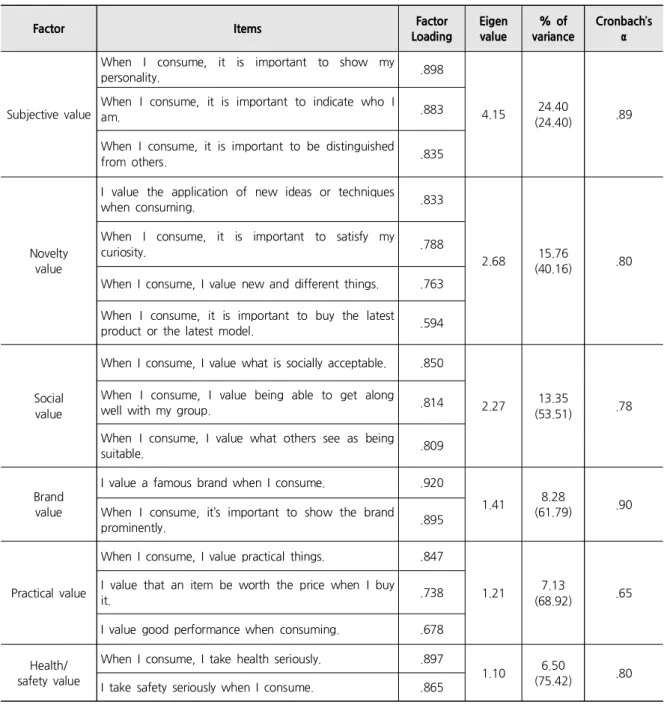
To find the sub-dimensions of consumption values, principal component analysis with varimax rotation was performed on 17 items (excluding one item that showed low factor loading for every factor). Six factors with an eigenvalue of 1 or more were extracted. The total explanatory power was 75.42%, and the Cronbach’s α for each factor ranged from .65 to .90 (Table 1).
Factor 1 was termed “subjective value” and consisted of items such as “When I consume, it is important to show my personality” and “When I consume, it is important to indicate who I am.” The eigenvalue was 4.14, which accounted for 24.40% of the total variance.
Factor 2, termed “novelty value,” comprised items such as “I value the application of new ideas or techniques when consuming” and “When I consume, it is important to satisfy my curiosity.” The eigenvalue of this factor was 2.68, accounting for 15.76% of the total variance.
Factor 3, “social value,” consisted of items such as
“When I consume, I value what is socially acceptable”
and “When I consume, I value being able to get along well with my group.” The eigenvalue was 1.41, which accounted for 8.28% of the total variance. Factor 4
“brand value,” comprised items such as “I value a famous brand when I consume” and “When I consume, it’s important to show the brand prominently.” The eigenvalue was 1.04, which accounted for 5.76% of the total variance. Factor 5, “practical value,” consisted of items such as “When I consume, I value practical things”
and “I value that an item be worth the price when I
buy it.” The eigenvalue was 1.21, which accounted for
7.13% of the total variance. Factor 6, “health/safety
value,” comprised items such as “When I consume, I
take health seriously” and “I take safety seriously when I
consume.” The eigenvalue was 1.10, which accounted for
6.50% of the total variance.
Table 1. Dimensions of Consumption Values
Factor Items Factor
Loading
Eigen value
% of variance
Cronbach’s α
Subjective value
When I consume, it is important to show my
personality. .898
4.15 24.40
(24.40) .89
When I consume, it is important to indicate who I
am. .883
When I consume, it is important to be distinguished
from others. .835
Novelty value
I value the application of new ideas or techniques
when consuming. .833
2.68 15.76
(40.16) .80
When I consume, it is important to satisfy my
curiosity. .788
When I consume, I value new and different things. .763
When I consume, it is important to buy the latest
product or the latest model. .594
Social value
When I consume, I value what is socially acceptable. .850
2.27 13.35
(53.51) .78
When I consume, I value being able to get along
well with my group. .814
When I consume, I value what others see as being
suitable. .809
Brand value
I value a famous brand when I consume. .920
1.41 8.28
(61.79) .90
When I consume, it’s important to show the brand
prominently. .895
Practical value
When I consume, I value practical things. .847
1.21 7.13
(68.92) .65
I value that an item be worth the price when I buy
it. .738
I value good performance when consuming. .678
Health/
safety value
When I consume, I take health seriously. .897
1.10 6.50
(75.42) .80
I take safety seriously when I consume. .865
2. Dimensions of Materialism/Voluntary Simplicity
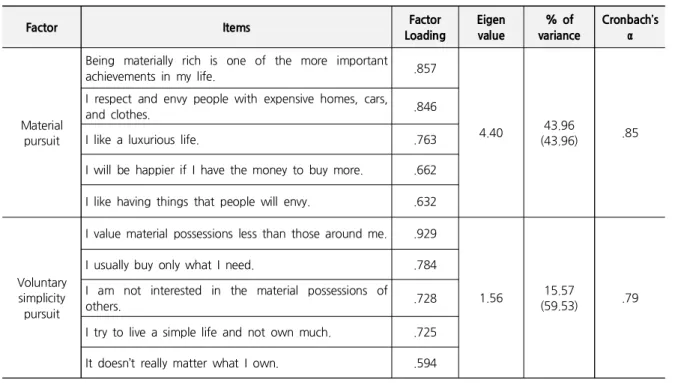
To classify items that access materialism/voluntary simplicity, principal component analysis with varimax rotation was performed on 10 items (excluding items that showed low factor loading for every factor). Two
factors with an eigenvalue of 1 or more were extracted.
The total explanatory power was 59.53%, and the Cronbach’s α of each factor ranged from .79 to .85 (Table 2).
Factor 1, termed “material pursuit,” consisted of items
such as “Being materially rich is one of the more
important achievements in my life” and “I respect and envy people with expensive homes, cars, and clothes.”
The eigenvalue was 4.40, which accounted for 43.96% of the total variance. Factor 2, “voluntary simplicity pursuit,” comprised items such as “I value material possessions less than those around me” and “I usually buy only what I need.” The eigenvalue of this factor was 1.56, which accounted for 15.57 of the total variance.
3. The Effects of Consumption Value on Attitude toward Eco-Friendly Products
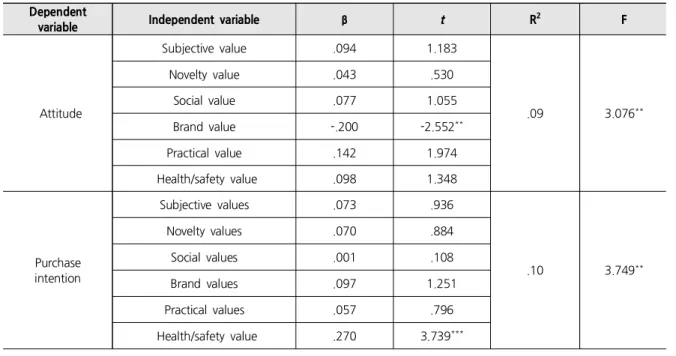
Multiple regression analysis was conducted to determine the effect of consumption value on attitudes and purchase intentions toward eco-friendly fashion products;
the results are shown in Table 3. Brand values were found to have a negative effect on attitude toward eco-friendly fashion products ( =-.200, β p <.05); the more one pursues brand names, the more negative one’s attitude toward eco-friendly fashion products.
Health/safety values had a positive effect on purchase
Table 2. Dimensions of Materialism/Voluntary Simplicity
Factor Items Factor
Loading
Eigen value
% of variance
Cronbach’s α
Material pursuit
Being materially rich is one of the more important
achievements in my life. .857
4.40 43.96
(43.96) .85
I respect and envy people with expensive homes, cars,
and clothes. .846
I like a luxurious life. .763
I will be happier if I have the money to buy more. .662 I like having things that people will envy. .632
Voluntary simplicity pursuit
I value material possessions less than those around me. .929
1.56 15.57
(59.53) .79
I usually buy only what I need. .784
I am not interested in the material possessions of
others. .728
I try to live a simple life and not own much. .725 It doesn’t really matter what I own. .594
intention for eco-friendly fashion products ( =.270, β p <.001). Contradicting previous research findings that social value influences the purchase intention of eco-friendly products (Cho, 2015; Park & Lee, 2015), social value in this study did not affect the purchase intention of eco-friendly fashion products.
4. The Effects of Materialism/Voluntary Simplicity on Attitude toward Eco-Friendly Products
Multiple regression analysis was conducted to determine the effect of materialism/voluntary simplicity on attitudes and purchase intentions toward eco-friendly fashion products; the results are shown in Table 4. Voluntary simplicity pursuit had a positive effect on both attitude ( =.196, β p <.05) and purchase intention ( =.196, β p <.05).
This result shows that, even if people who pursue
voluntary simplicity try to buy and own fewer products,
their attitudes and purchase intentions toward
eco-friendly fashion products remain high.
Table 3. The Effects of Consumption Values on Attitudes toward Eco-friendly Products Dependent
variable Independent variable β t R
2F
Attitude
Subjective value .094 1.183
.09 3.076
**Novelty value .043 .530
Social value .077 1.055
Brand value -.200 -2.552
**Practical value .142 1.974
Health/safety value .098 1.348
Purchase intention
Subjective values .073 .936
.10 3.749
**Novelty values .070 .884
Social values .001 .108
Brand values .097 1.251
Practical values .057 .796
Health/safety value .270 3.739
****
p <.05,
***p <.001
Table 4. The Effects of Materialism/Voluntary Simplicity on Attitudes toward Eco-Friendly Products
Dependent
variable Independent variable β t R
2F
Attitude
Materialism pursuit -.017 -.216
.042 4.382
*Voluntary simplicity pursuit .196 2.479
*Purchase intention
Materialism pursuit .100 1.256
.030 3.042
Voluntary simplicity pursuit .196 2.456
**
p < 0.05
5. Consumption Value in the Materialism Group and Voluntary Simplicity Group
Based on the response to materialism/voluntary simplicity, K-means cluster analysis was conducted, and the respondents were classified into two groups. The first group had a high average for pursuing materialism (mean of group 1 =3.93; mean of group 2 =2.63;
t =16.67; p <.001), and the second group had a high average for pursuing simplicity (mean of group 1 =2.76;
mean of group 2 =3.56; t =-9.33, p <.001), so the first group was labeled the materialist group, and the second group was labeled the voluntary simplicity pursuit group.
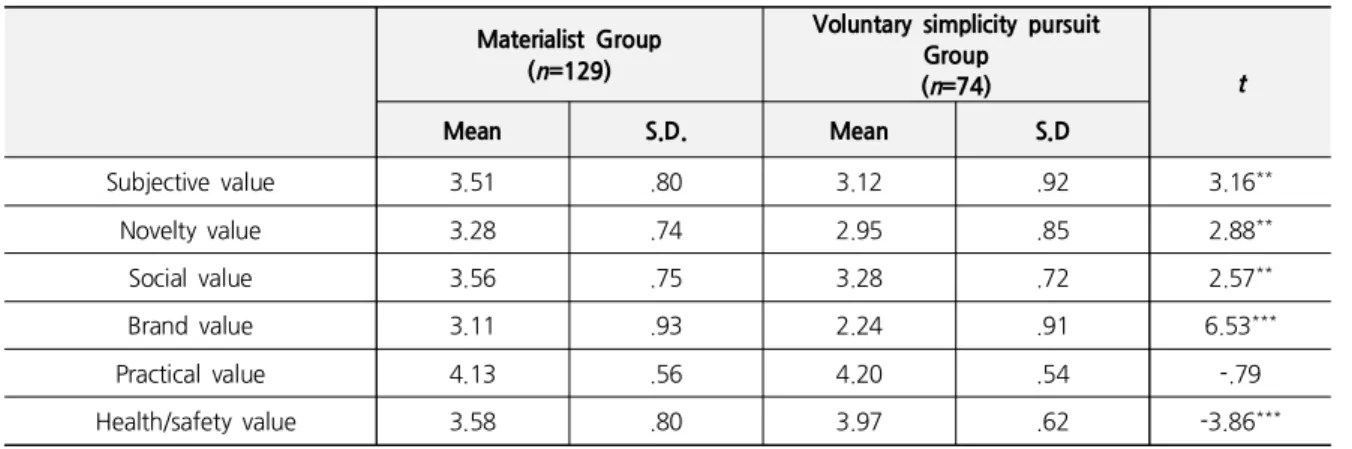
The result of a t -test for the six sub-dimensions of
consumption value showed that there were differences
between the groups for five values (Table 5). The
materialist group had high subjective value, novelty value,
social value, and brand value among the consumption
values while the voluntary simplicity group tended to
pursue the value of health and safety.
Table 5. Consumption Values in the Materialist and Voluntary Simplicity Group
Materialist Group ( n =129)
Voluntary simplicity pursuit Group
( n =74) t
Mean S.D. Mean S.D
Subjective value 3.51 .80 3.12 .92 3.16
**Novelty value 3.28 .74 2.95 .85 2.88
**Social value 3.56 .75 3.28 .72 2.57
**Brand value 3.11 .93 2.24 .91 6.53
***Practical value 4.13 .56 4.20 .54 -.79
Health/safety value 3.58 .80 3.97 .62 -3.86
*****