• 검색 결과가 없습니다.

Effect of Pressure on Edge Delamination in Chemical Mechanical Polishing of SU-8 Film on Silicon Wafer

N/A
N/A
Protected

Academic year: 2021

Share "Effect of Pressure on Edge Delamination in Chemical Mechanical Polishing of SU-8 Film on Silicon Wafer"

Copied!
6
0
0

로드 중.... (전체 텍스트 보기)

전체 글

(1)

DOI https://doi.org/10.9725/kstle.2017.33.6.282

Effect of Pressure on Edge Delamination in Chemical Mechanical Polishing of SU-8 Film on Silicon Wafer

Sunjoon Park

1

, Seokyeon Im

2,4

and Hyunseop Lee

3,4,†

1

DMS Inc., Korea

2

Department of Automotive Engineering, Tongmyong University, Korea

3

School of Mechanical Engineering, Tongmyong University, Korea

4

Center for Mechanical Convergence Engineering, Tongmyong University, Korea (Received October 28, 2017; Revised November 17, 2017; Accepted November 18, 2017)

Abstract − SU-8 is an epoxy-type photoresist widely used for the fabrication of high-aspect-ratio (HAR) micro- structures in micro-electro-mechanical systems (MEMS). To fabricate highly integrated structures, chemical mechanical polishing (CMP) has emerged as the preferred manufacturing process for planarizing the MEMS structure. In SU-8 CMP, an oxidizer decomposes organic impurities and particles in the CMP slurry remove the chemically reacted surface of SU-8. To fabricate HAR microstructures using the CMP process, the adhesion between SU-8 and substrate material is important to avoid the delamination of the SU-8 film caused by the mechanical-dominant material removal characteristic. In this study, the friction force during the CMP process is measured with a CMP monitoring system to detect the delamination phenomenon and investigate the delam- ination of the SU-8 film from the silicon substrate under various pressure conditions. The increase in applied pressure causes an increase in the frictional force and wafer-edge stress concentration. The frictional force mea- surement shows that the friction force changes according to the delamination phenomenon of the SU-8 film, and that it is possible to monitor the delamination phenomenon during the SU-8 CMP process. The delamination at a high applied pressure is explained by the effect of stress distribution and pad deformation. Consequently, it is necessary to control the pressure of polishing, which can avoid the delamination in SU-8 CMP.

Keywords − delamination, SU-8, chemical mechanical polishing(CMP), applied pressure

1. Introduction

SU-8 is an epoxy-type photoresist widely used for fabricating high-aspect-ratio (HAR) microstructures in micro-electro-mechanical systems (MEMS) [1]. The SU-8 can be used for microstructures as itself such as the micro-components for piezoelectric motor applications [2], embedded micro-channels for micro-fluidic devices [3] and many more because of the viability of creating high aspect ratio features, chemical inertness, good dimen- sional controllability, and thermal stability [4].

Chemical mechanical polishing (CMP) has emerged

as the preferred manufacturing process for planarizing MEMS structure [5]. The CMP of SU-8 was studied by Zhong et al. [6] and Kourouklis et al. [7]. Kourouklis applied SU-8/permalloy combination for MEMS device by using CMP. Zhong also shows the application of CMP for MEMS fabrication. In SU-8 CMP, an oxidizer decomposes organic impurities and particles in CMP slurry remove the chemically reacted surface of SU-8 [8].

However, the effect of mechanical removal with slurry particle on the material removal is higher than that of chemical reaction because of the chemically inert characteristic of SU-8. In order to fabricate HAR microstructure with CMP process, the adhesion between SU-8 and substrate material is important to avoid the delamination of SU-8 film caused by mechanical-dom- inant material removal characteristic in SU-8 CMP.

Corresponding author : [email protected] Tel: +82-51-629-1597, Fax: +82-51-629-1589

This paper was presented at 4th ITS-IFToMM/1st K-TIS

2017(March 19-22,2017, Jeju Ramada Plaza Hotel).

(2)

In this paper, we measured the friction force during CMP process with CMP monitoring system to detect the delamination phenomenon and investigated the effect of polishing pressure on the delamination of SU-8 film from silicon substrate.

2. Experiment

SU-8 film was coated on a 4-inch silicon wafer through spin-coating, soft bake, exposure, and hard bake. Thickness of the film was 2 ± 0.2 µm. A rotary- type of polisher, POLI400 (G&P Technology, Korea), was used for CMP experiments. IC1400 pad (Nitta Haas Inc.) and H

2

O

2

-based alumina slurry was pre- pared for this study. The mean particle size was 225 nm and the particle concentration was 6.9 wt%. Pol- ishing pressure was varied from 1 psi to 4 psi under constant rotational velocity of head and platen (80 rpm). Slurry flow rate was 150 ml/min. CMP monitor- ing system was used to detect the delamination phe- nomenon of SU-8 film. A piezoelectric quartz sensor (Type 9135B, Kistler) was prepared to detect dynamic friction during the SU-8 CMP process. The extremely flat circular sensor, with dimensions of 24 mm exter- nal diameter and 3.5 mm height had a maximum force range of 42 kN, sensitivity of -3.8 pC/N, and dynamic signal range of ~75 kHz. The piezoelectric sensor was imbedded on the back of the polishing head. The elec- trical signals measured by the piezoelectric sensor were amplified and converted with a charge amplifier

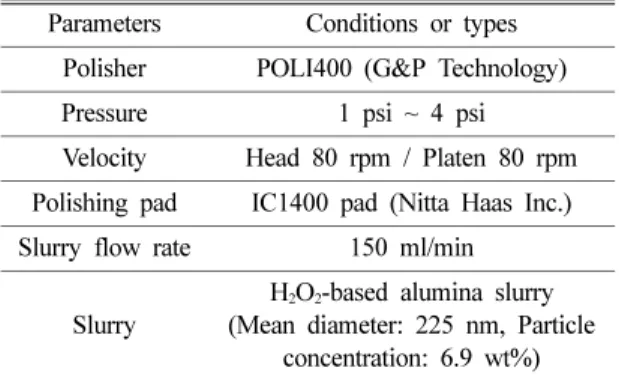
and an A/D converter. Fig. 1 shows the schematic of CMP monitoring system. Table 1 shows the experi- mental conditions.

3. Results and Consideration

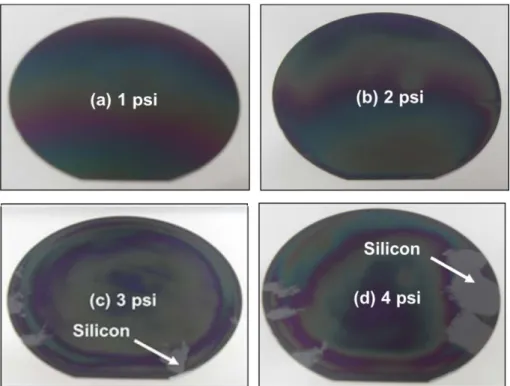
Fig. 2 shows the images of SU-8 coated silicon wafers after CMP process with various pressure con- ditions. It is observed that the delamination occurs after polishing with 3 psi and 4 psi of pressures.

From energy-dispersive X-ray spectroscopy (EDX) results in Fig. 3, it is confirmed that the silicon sub- strate is exposed after SU-8 delamination. The Si con- centration at the delaminated area shows higher value.

On the other hand, the concentrations of C and O are higher at SU-8 film.

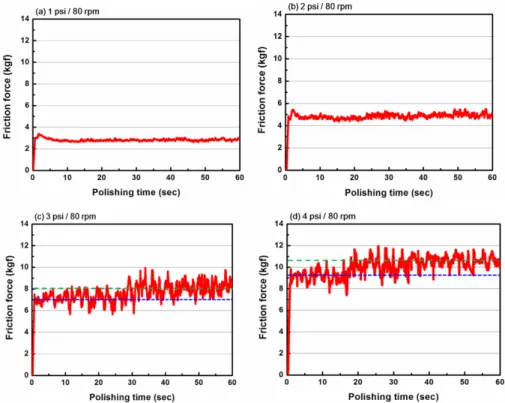
Fig. 4(a)-(d) show the dynamic friction forces as a function of polishing time (1 min). The magnitude of friction force increases with the increase in applied pressure. In Fig. 4(a) and (b), the friction force does not be changed with polishing time. The average fric- tion forces for 1 psi and 2 psi of pressures are 2.84 kgf and 4.87 kgf, respectively. Under 1 psi and 2 psi of pressures, the delamination did not occur during pol- ishing. However, In Fig. 3(c) and (d), the friction force is changed during CMP when the delamination occurs because the friction force is determined by the mate- rial properties of film. The average friction forces at 3 psi and 4 psi are changed from 7.17 kgf and 7.96 kgf to 9.15 kgf and 10.45 kgf, respectively. As higher pressure is applied to the wafer, the delamination Fig. 1. Schematic of CMP monitoring system.

Table 1. Experimental conditions

Parameters Conditions or types Polisher POLI400 (G&P Technology)

Pressure 1 psi ~ 4 psi

Velocity Head 80 rpm / Platen 80 rpm Polishing pad IC1400 pad (Nitta Haas Inc.) Slurry flow rate 150 ml/min

Slurry

H

2

O

2

-based alumina slurry (Mean diameter: 225 nm, Particle

concentration: 6.9 wt%)

(3)

occurs faster.

Fig. 5 shows the deviation of friction force at 3 psi of pressure and 80 rpm of rotational velocity for 130

sec. In the friction force signal, there are 3 stages; SU- 8 film removal (blue line), delamination(green line), and silicon exposure (black line). Our experimental results show that the high applied pressure results in high probability of SU-8 delamination.

The deformation of polishing pad with respect to the applied pressure was shown in Fig. 6. A 2D axisym- metric static model was considered for a finite element analysis (FEA). The numbers of nodes and elements were 185,429 and 60,313, respectively. The elastic moduli of top-pad and sub-pad were 21 MPa and 2.1 MPa, respectively. Poisson’s ratios of top-pad and sub- pad were both 0.1. The elastic modulus and Poisson’s ratio of silicon wafer were 160 GPa and 0.3. The elas- tic modulus and Poisson’s ratio of SU-8 film were 4.02 GPa and 0.22. When the wafer is pressed against polishing pad, the wafer is bent because of the defor- mation of polishing pad as shown in Fig. 6. More bending occurs at the edge of wafer with the increase in pressure.

The stress concentration near the edge makes the film susceptible to delaminate from the substrate.

Fig. 2. Pictures of SU-8 coated silicon wafers after various conditions of CMP; (a) 1 psi, (b) 2 psi, (c) 3 psi, and (d) 4 psi.

Fig. 3. Picture of silicon wafer after CMP under 3 psi/80

rpm for 130 sec and EDX analysis results ((a) and (b)).

(4)

When the stress in the film is compressive, buckling above an initial interface flaw may provide enough driving force to delaminate the film. When the film is in tension, delamination can initiate preferentially along the film edge [9].

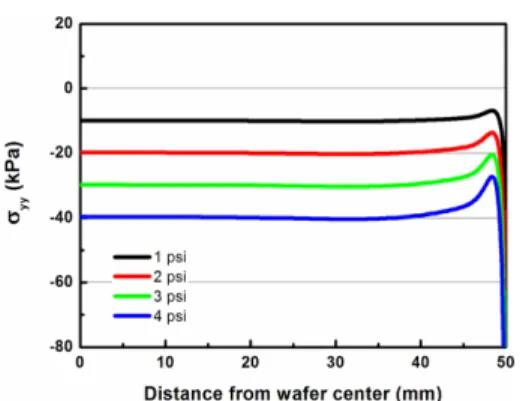
Fig. 7 shows the normal stress ( σ

yy

) distribution at the interface of the film and substrate. High friction force results in the increasing possibility of delamina-

tion. Furthermore, the pad deformation amount by applied pressure is larger than the film thickness that the film is likely to delaminate from the substrate by the slid- ing of polishing pad. Leduc et al. [10] revealed that the delamination area has a relationship with the frictional energy. And, high friction force may propagate the film delamination faster. Fig. 8 illustrates the schematic of delamination phenomenon during CMP process.

Fig. 4. Dynamic friction force as a function of polishing time; (a) 1 psi, (b) 2 psi, (c) 3 psi, and (d) 4 psi.

Fig. 5. Dynamic friction force for 3 psi / 80 rpm during delamination of SU-8 film from silicon wafer and the picture of silicon wafer after CMP.

Fig. 6. Polishing pad deformation in accordance with

applied pressure.

(5)

The results in this paper indicate that low-stress CMP process is needed to avoid edge delamination.

And, it is likely that the bending of wafer caused by pad deformation should be controlled for delamina- tion-free CMP process. Furthermore, more researches on the effect of the CMP conditions (e.g. rotational velocity and type of polishing pad, etc.) and SU-8 film deposition condition (e.g. baking temperature and bak- ing time, etc.) may be needed for further understand- ing of the delamination phenomenon in SU-8 CMP.

5. Conclusion

In this paper, we present a correlation between pres-

sure and delamination during SU-8 CMP with various pressure conditions. The results show that the delami- nation starts at 3~4 psi pressure during SU-8 CMP. In low applied pressure, the friction force signal was sta- ble, and delamination was not occurred. On the other hands, high friction force is exerted at high applied pressure, and the friction force is changed due to the edge delamination. The result of FEA shows that pres- sure applied on the back of a wafer causes the defor- mation of polishing pad. The deformation of the polishing pad increased the stress at the wafer edge.

Thus, the delamination at high applied pressure was explained by the effect of stress distribution and pad deformation. Consequently, it is necessary to control the pressure of polishing which is able to avoid the delamination in SU-8 CMP.

Acknowledgements

This research was supported by Basic Science Research Program through the National Research Foundation of Korea (NRF) funded by the Ministry of Education (NRF-2015R1D1A1A01059266).

References

[1] Campo, A.D., Greiner, C., “SU-8: a photoresist for high-aspect-ratio and 3D submicron lithography”, J.

Micromech. Microeng, Vol. 17, pp. R81-R95, 2007.

[2] Dellmann, L., Roth, S., Beuret, C., Racine, G.-A., Lorenz, H., Despont, M., Renaud, P., Vettiger, P., de Rooij, N. F., “Fabrication process of high aspect ratio elastic and SU-8 structures for piezoelectric motor applications”, Sens. Actuators A phys., Vol. 70, pp. 42-47, 1998.

[3] Madou, M. J., Lu, Y., Lai, S., Koh, C. G., Lee, L. J., Wenner, B. R., “A novel design on a CD disc for 2- point calibration measurement”, Sens. Actuators A phys., Vol. 91, pp. 301-306, 2001.

[4] Khoo, H. S., Liu, K.-K., Tseng, F.-G., “Mechanical strength and interfacial failure analysis of cantile- vered SU-8 microposts”, J. Micromech. Microeng., Vol. 13, pp. 822-831, 2003.

[5] Lee, H., Joo, S., Kim, H., Jeong, H., “Chemical Mechanical Planarization Method for Thick Copper Films of Micro-Electro-Mechanical Systems and Integrated Circuits”, Jpn. J. Appl. Phys., Vol. 47, Fig. 7. Normal stress (σ

yy

) distribution at the interface of

SU-8 and substrate in accordance with applied pressure.

Fig. 8. Schematic drawing of the SU-8 film delamination.

(6)

No. 7, pp. 5708-5711, 2008.

[6] Zhong, Z. W., Wang, Z. F., Tan, Y. H., “Chemical mechanical polishing of polymeric materials for MEMS applications”, Microelectron. J., Vol. 37, pp. 295-301, 2006.

[7] Kourouklis, C., Kohlmeier, T., Gatzen, H. H., “The application of chemical-mechanical polishing for planarizing a SU-8/permalloy combination used in MEMS devices”, Sens. Actuators A Phys., Vol. 106, pp. 263-266, 2003.

[8] Lee, H. S., Jeong, H. D., “Chemical and mechanical

balance in polishing of electronic materials for defect-free surfaces”, CIRP Ann. Manuf. Technol., Vol. 58, pp. 485-490, 2009.

[9] Yu, H. H., He, M. Y., Hutchinson, J. W., “Edge effects in thin film delamination”, Acta Mater., Vol. 49, pp. 93-107, 2001.

[10] Leduca, P., Savoye, M., Maitrejeana, S., Scevolab,

D., Jousseaume, V., Passemard, G., “Understanding

CMP-induced delamination in Ultra Low-k/Cu inte-

gration”, Proc. IEEE Int. Intercon. Technol. Conf.,

pp. 209-211, 2005.

수치

Fig. 2 shows the images of SU-8 coated silicon wafers after CMP process with various pressure  con-ditions
Fig. 5 shows the deviation of friction force at 3 psi of pressure and 80 rpm of rotational velocity for 130
Fig. 7 shows the normal stress ( σ yy ) distribution at the interface of the film and substrate
Fig. 8. Schematic drawing of the SU-8 film delamination.

참조

관련 문서