• 검색 결과가 없습니다.

A Study on the Impact of Employee's Awareness about Corporate Social Responsibility on Innovative Behavior ; Targeting Frontline Employees in the Hotel Industry

N/A
N/A
Protected

Academic year: 2021

Share "A Study on the Impact of Employee's Awareness about Corporate Social Responsibility on Innovative Behavior ; Targeting Frontline Employees in the Hotel Industry"

Copied!
9
0
0

로드 중.... (전체 텍스트 보기)

전체 글

(1)

¶ Corresponding Author: Hyun-Jung, Choi, Dept. of Hotel Management, Tourism Division, Baekseok University. Munam-ro, Dongnam-gu, Cheonan-si, Chungcheongnam-do, Korea, Tel. +82-10-5425-5829, Fax. +82-41-550-2528, E-mail: [email protected]

Culinary Science & Hospitality Research. 2016;22(1):78-86.

https://cshr.jams.or.kr/ ISSN  2466‐0752  (Print) ISSN  2466‐1023  (Online)

A Study on the Impact of Employee's Awareness about Corporate Social Responsibility on Innovative Behavior

; Targeting Frontline Employees in the Hotel Industry

Hyun-Jung Choi

Dept. of Hotel Management, Tourism Division, Baekseok University

ABSTRACT: This study is designed to investigate the impact of employee's awareness about corporate social responsibility on innovative behavior among frontline employees in the hotel industry. In addition, the present study seeks to demonstrate whether employees awareness about corporate social responsi- bility or innovative behavior varies according to gender, age, education level and employment type. In order to achieve the study goal, the data were obtained from frontline employees(Rooms division, F&B division) working in the 5-star hotels. And the data were analyzed by frequency analysis, factor analysis, reliability analysis, t-test, ANOVA and regression analysis were undertaken using SPSS(18.0). The results showed that gender, age and employment type were not significant factors to generate differences on awareness about corporate social responsibility. But the higher educated employee was likely to perceive the awareness about corporate social responsibility better. Employee's innovative behavior varied on all of gender, age, education level and employment type. In other words, employee who is male, in the older age group, in the higher educated level and the full-time position tends to do more innovative behavior. Implications based on the study results are also discussed.

Keywords: corporate social responsibility, innovative behavior, demographic characteristics, frontline em- ployee, hotel

INTRODUCTION

Innovation has long been embraced by organi- zations seeking to remain viable, effective and com- petitive in a dynamic business environment[22]. An organization cannot remain viable if it keeps on pro- ducing products or services in the same way over time[2] and the continuing of such behavior would lead to the decline or demise of the organization[8].

Therefore, an organization's ability to innovate is recognized as one of the determinant factors for it to survive and succeed[23,32].

In special, the hospitality industry which includes the restaurant, accommodation, entertainment and

transportation businesses[4] faces increasing com- petition. Those who are working in this industry must be able to keep and attract new customers by satisfying their increasingly sophisticated demands.

Customers in the hospitality industry, in particular, are looking for new and unique experiences[10].

That means the hospitality industry needs to keep trying to develop a new and attractive service pro- duct constantly. Meanwhile, the key to achieve ser- vice innovation in the hospitality industry is employ- ees' innovative behavior[16].

One of factors which is very effective to promote

employee's innovative behavior is the adaption of

corporate social responsibility(CSR). CSR defines as

(2)

discretionary business practices and contributions of corporate resources intended to improve societal well-being[17]. CSR has been considered as a source to build a long-term competitive advantage and to lead a better performance by obtaining a good ima- ge from the customers. It is not a mere tool for re- solving punctual image problems derived from in- appropriate behaviors. In order to maximize CSR performance, management should make employees perceive well about CSR values and activities done by the company[20].

Focusing on these important aspects of employ- ees's awareness about CSR and innovative behavior, this paper addresses the following questions: Is em- ployees' awareness about CSR able to enhance em- ployee's innovative behavior, especially in the case of frontline employees working in the hotel in- dustry? Is there any difference in the level of aware- ness about CSR and innovative behavior depends on the demographic characteristics such as gender, age and education? This idea has been derived from the past studies[e.g., 5,25,29] arguing about the depen- dence on the demographic characteristics on CSR and innovation climate. In other words, the aim of this study is to contribute to a better understanding of the complex relationship between employees's awareness about CSR and innovative behavior tar- geting on hotel frontline employees. In addition, this study also will find out if employees's awareness about CSR and employee's innovative behavior de- pends on the demographic characteristics such as gender, age and education.

Based on the findings of this research, this empiri- cal study is going to suggest an useful knowledge about the relationship between employees's aware- ness on CSR and innovative behavior to the hotel managers. Moreover, it will provide some new ideas to build useful policies about CSR and employees in- novative behavior depending on gender, age, edu- cation level and employment type.

LITERATURE REVIEW AND HYPOTHESES

Corporate Social Responsibility(CSR)

Corporate Social Responsibility (CSR) has received greater attention in the past decade since lots of re- searches suggest that corporations of the 21 century

can derive enormous benefits when they are per- ceived as being socially responsible by their stake- holders[11,28].

In the past, CSR was just thought as a responsible and obligatory way to solve social issues[34]. How- ever in modern society, through the enormous stud- ies, the concept of CSR has been more expanded than before. One wider concept of CSR is a four-part conceptualization including economic, legal, ethical, and philanthropic responsibilities. Economic and le- gal responsibilities are the basic level of CSR which must be carried out by corporations with no doubt.

Ethical responsibilities is activities that reflect a con- cern for stakeholders like the environmental, civil rights, and many other forms. Philanthropic respon- sibilities encompass those corporate actions that are in response to society’ expectation including busi- ness contributions to the arts, education, or the community[28]. CSR activities are more telling of a company’ values than product information, financial statements, or job contracts[1]. This is the very im- portant reason that companies should determine which way of CSR they do.

CSR has been considered as an very effective way to build a long-term competitive advantage and to obtain a good image from the customers. These re- sults of CSR can lead a better business performance and more profits to a company. Meanwhile, in order to maximize performance of CSR, company should make employees aware well about CSR values and activities done by a company[20].

Innovative Behavior

Innovation has become imperative for many com- panies since it has been identified as a key source of higher profits and market share. The question is no longer one of whether or not to innovate but rather how to strategize for innovation so as to ach- ieve competitive advantage for organization[21].

Innovation is required in the service industry more

than manufacturing since customers are looking for

a new experience as well as customer's request are

rapidly change. In addition, service products are like-

ly to be imitated more easily than any other type

of products like manufactured goods. So service in-

dustry needs to focus more on service innovation

with constantly developing new service products

(3)

[31]. In this point of view, service innovation is es- sential in the hotel industry. Even if there are various factors to facilitate innovation, the most important point is how to make employees do innovative be- havior as much as they can[16].

Innovative behavior is defined as an employee's efforts to develop a new idea and put it in practice in order to maximize achieving company goal and profits[24]. This includes all such activities to pro- pose a new strategy to achieve the goal of the en- terprise, providing a new way of working activity, obtaining the support to run the new ideas and de- veloping new technologies[15,7,19]. In order to pre- empt a competitive advantage in a highly com- petitive era of innovation services, employee's active innovative behavior is necessary[16].

Frontline Employees in the Hotel Industry The best thing that hotel has to achieve is to de- liver the best service with customer satisfaction. In this point of view, frontline employee is playing a key role in hotel facing customers at the forefront of customer contact and plays a crucial role in deli- vering a quality service[6]. The value of frontline em- ployee in terms of the hotel management is very high[13]. Frontline employees in hotel are employ- ees who know customers' needs best because they contact them closely so as that they can listen to customers requirements directly. In other words, they are the best staff to develop new services that customers may want. Therefore, in order to promote service innovation in the hotel industry, Enhancing frontline employee's innovative behavior is very im- portant. This is the reason why this study targets ho- tel frontline employees.

RESEARCH METHODOLOGY AND DESIGN

Hypothesis

The aim of this study is to contribute to the better understanding of the complex relationship between employees's awareness about CSR and innovative behavior targeting on hotel frontline employees. In addition, this study also will test if employees's awareness about CSR and employee's innovative be- havior varies on the demographic characteristics such as gender, age and education.

Borger & Kruglianskas[3] provided the study re- sults that sharing values and activities about corpo- rate social responsibility with employees has a posi- tive impact on employee's innovative behavior. Sch- wab[26] also presented the empirical evidence that when the company actively engage in CSR activities, innovative behavior of employees increased[33]. The above research findings lead to the following hy- pothesis for this study:

Hypothesis 1; Frontline employee's awareness about CSR has a positive effect on innovative behavior.

Recent research evidence shows that corporate charitable behavior is viewed more favorable by women than men[29,27] argued that life long learn- ing is an important condition to facilitate the activi- ties of the corporate social responsibility. Education level is considered as another significant factor to af- fect employee's acceptance of corporate social re- sponsibility[30]. Based on these researches, this study designed hypothsis 2,3,4 and in addition, this study adds to test one more demographic variable of employment type. In these backdrop, the present study suggests hypothesis as followings:

Hypothesis 2; Awareness of corporate social responsibility depends on gender.

Hypothesis 3; Awareness of corporate social responsibility depends on age.

Hypothesis 4; Awareness of corporate social responsibility depends on the level of educa- tion.

Hypothesis 5; Awareness of corporate social responsibility depends on the employment type.

Some previous studies tested how different in- novation climate is according to employee's gender, age and education level. Almost of researchers[e.g., 25,2,29] noted there were no any differences or very weak relationships between innovative climate and demographic characteristics of gender, age and edu- cation level. On those academic ground, this study builds the following hypothesis:

Hypothesis 6; Innovative behavior depends on

(4)

Variables Frequency % Variables Frequency %

Gender Education

Male Female

149 132

53 47

Collage graduate University graduate Graduate school graduate

98 167 16

34.9 59.4 5.7

Age Employment type

20~29 30~39 Over 40

135 96 50

48.0 34.2 17.8

Irregular Regular

72 209

25.6 74.4

Total 281 100 Total 281 100

Table 1. Characteristics of the respondents (N=277) gender.

Hypothesis 7; Innovative behavior depends on age.

Hypothesis 8; Innovative behavior depends on education level.

Hypothesis 9; Innovative behavior depends on employment type.

Measurement Tools

The questionnaire was adopted based on the liter- ature in which measurement scales were already empirically tested. Responses to all scale items were rated on a 7-point scale (1=strongly disagree to 5=strongly agree). Awareness of corporate social re- sponsibility was measured using 3 items developed by[18]. In order to measure innovative behavior, items were adapted from[10] using a five-items scale.

Demographic characteristics were asked with 3 questions. Participants were asked to answer ques- tions on gender which was coded as a binary vari- able(1. male 2. female). Age was coded a three-point scale(1. 20-29, 2. 30-39, 3. over 40). Education level was coded a three-point scale too(1. collage gradu- ate, 2. university graduate, 3. graduate school gradu- ate). Employment type was coded a two-point scale (1. irregular, 2. regular(full-time)).

The Sample and Analyzing Methods

To comply with objectives and test research hy- potheses, data for this study were obtained from frontline employees(rooms division, F&B division) working in five-star hotels located in Seoul, Busan and Daejeon in Korea. The data collection was car-

ried out between Sep, 1 and Sep, 30, 2015. Before the survey was administered, its academic purpose was explained to the human resource managers in every hotel. The questionnaires were then distri- buted to employees with a full explanation of the goals of the study. A total of 300 self-administrated questionnaires were distributed. After discarding un- usable responses, 281 useful responses were coded for analysis.

In order to analyze data, frequency analysis, factor analysis, reliability analysis, t-test, ANOVA and re- gression analysis were undertaken using SPSS(18.0) software program.

RESULTS

Sample Characteristics

The demographic profile of the respondents was presented in Table 1 as follows;

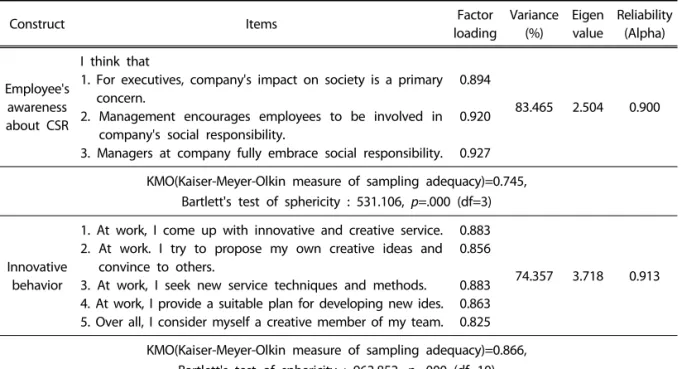
Testing Validity and Reliability

Exploratory factor analysis using SPSS's principle

component analysis with varimax rotation was uti-

lized to check the dimensionality[12] of the employ-

ee's awareness of CSR and innovative behavior. The

analysis revealed each construct was found to be as

a single factor with eigenvalues greater than 1.0. In

particular, all items with loading over than 0.5 and

reliability Cronbach's alpha scores for all factors are

over 0,90, above the minimum threshold of accep-

tance 0.70 as suggested by[9]. Therefore, construct

validity and reliability of measurement items were

verified.

(5)

Construct Items Factor loading

Variance (%)

Eigen value

Reliability (Alpha)

Employee's awareness about CSR

I think that

1. For executives, company's impact on society is a primary concern.

2. Management encourages employees to be involved in company's social responsibility.

3. Managers at company fully embrace social responsibility.

0.894

0.920

0.927

83.465 2.504 0.900

KMO(Kaiser-Meyer-Olkin measure of sampling adequacy)=0.745, Bartlett's test of sphericity : 531.106, p=.000 (df=3)

Innovative behavior

1. At work, I come up with innovative and creative service.

2. At work. I try to propose my own creative ideas and convince to others.

3. At work, I seek new service techniques and methods.

4. At work, I provide a suitable plan for developing new ides.

5. Over all, I consider myself a creative member of my team.

0.883 0.856

0.883 0.863 0.825

74.357 3.718 0.913

KMO(Kaiser-Meyer-Olkin measure of sampling adequacy)=0.866, Bartlett's test of sphericity : 962.852, p=.000 (df=10) Table 2. Scale items and exploratory factor analysis results

Variables entered

Regression coefficients

Sig.

B Std. error β t

Constant 2.490 0.232 10.741 0.000

Employee's awareness about CSR 0.434 0.047 0.480 9.145 0.000

R

2

=0.231, Adjusted R

2

= 0.228, F=83.626***

Notes : ** p<0.001.

Table 3. Predictor from employee's awareness about CSR to innovative behavior Test Results for the Hypotheses

To test hypothesis 1 which stated an positive ef- fect of employee's awareness about CSR on in- novative behavior, simple regression analysis was fulfilled. The result showed that the direct effect of employee's awareness about CSR on innovative be- havior was significantly positive (β=0.480 / p<0.001).

This supports H1. It is presented in Table 3.

In order to test hypotheses 2, 3, 4, and 5, t-test and ANOVA were performed to verify differences de- pends on gender, age, education level and employ- ment type. Results in Table 4 indicates that employ- ee's awareness about CSR is varied by only educa- tion level. Therefore, hypothesis 2,3 and 5 was re- jected and only hypothesis 4 was supported.

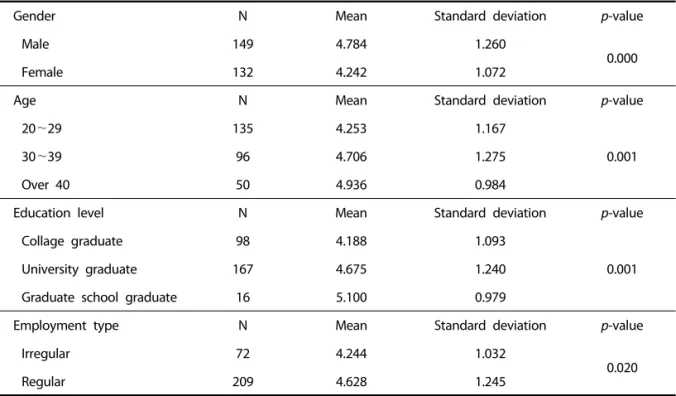
In order to test hypotheses 6, 7, 8, and 9, t-test

and ANOVA were performed to verify differences de- pends on gender, age, education level and employ- ment type. Results in Table 5 indicates that inno- vative behavior depends on gender, age, education level and employment type. These results supports hypothesis 6,7,8, and 9 which is presented in Table 5.

DISCUSSION AND IMPLICATIONS

In today's global and strict competitive environ-

ment, the aim of the hospitality industry is to create

and retain profitable customers. In order to accom-

plish this goal, the role of frontline employees who

do the direct service to customers is of great im-

portance in the hotel industry[14]. In this point of

(6)

Gender N Mean Standard deviation p-value

Male 149 4.758 1.436

0.416

Female 132 4.629 1.208

Age N Mean Standard deviation p-value

20~29 135 4.516 1.299

0.073

30~39 96 4.816 1.395

Over 40 50 4.960 1.248

Education level N Mean Standard deviation p-value

Collage graduate 98 4.350 1.234

0.002

University graduate 167 4.838 1.369

Graduate school graduate 16 5.354 1.015

Employment type N Mean Standard deviation p-value

Irregular 72 4.565 1.223

0.328

Regular 209 4.743 1.367

Table 4. Differences of awareness about CSR according to demographic characteristics

Gender N Mean Standard deviation p-value

Male 149 4.784 1.260

0.000

Female 132 4.242 1.072

Age N Mean Standard deviation p-value

20~29 135 4.253 1.167

0.001

30~39 96 4.706 1.275

Over 40 50 4.936 0.984

Education level N Mean Standard deviation p-value

Collage graduate 98 4.188 1.093

0.001

University graduate 167 4.675 1.240

Graduate school graduate 16 5.100 0.979

Employment type N Mean Standard deviation p-value

Irregular 72 4.244 1.032

0.020

Regular 209 4.628 1.245

Table 5. Differences of innovative behavior according to demographic characteristics view, the sample of the current study consisted of

frontline employees working in the five-star hotels in Korea. Sampling with hotel frontline employees, the purpose of this study is to test the impact of

employee's awareness about corporate social re-

sponsibility on innovative behavior. In addition, the

present study seeks to demonstrate whether em-

ployees awareness about corporate social responsi-

(7)

bility and innovative behavior varies on gender, age, education level and employment type.

The study results showed that gender, age and employment type were not significant factors to generate differences on the level of awareness ab- out corporate social responsibility. But the results provided the fact that the higher educated employ- ee perceived corporate social responsibility better than the lower educated one. Employee's innovative behavior varied on all of demographic variables such as gender, age, education level and employment type. In other words, employee who is male, in the older age group, the higher educated person and at the regular(full-time) position showed more in- novative behavior.

The empirical investigation of this study provides some useful guidelines for managerial action. First, frontline employee's awareness about corporate so- cial responsibility is investigated as a significant pre- dictor of innovative behavior. This result is con- sistent with the previous research studied by Allen

& Husted[1]. That means, when frontline employes get more informations and participate more in CSR activities, they report more innovative behaviors.

This positive link between employee's awareness about corporate social responsibility and innovative behavior makes managers realize that CSR is not on- ly a long-term market strategy, but also one way to improve employee's performance such as innovative behavior. With this realization, the hotel manage- ment needs to share the idea how important CSR is with employees as much as possible. And the company should seek further attempt to engage employees in CSR activities. For example, at the time of training for new recruits, introducing CSR activ- ities done by the company can make employees un- derstand well about CSR. And when a company holds CSR activities, it can encourage employees to participate CSR activities so that they can have strong feelings of participation and mission. Through such participation, employees could gain more rec- ognition about CSR in their work life. These efforts will let employees become more conscious about the CSR and they will also make employees' inno- vative behavior enhance.

Second, gender, age and employment type are not significant factors to generate differences on

awareness about corporate social responsibility. But the higher educated employee is likely to perceive corporate social responsibility better than the lower educated one. Employee's innovative behavior de- pends on all of demographic variables like gender, age, education level and employment type. The em- ployee who is male, in the older group, the higher educated and on the regular position tends to try more innovative behavior.

Hence, the management should pay more atten- tion to ensure all employees to understand CSR in- formation better despite of the different educational levels. In addition, the managers need to know that women, the younger, the lower educational, and the irregular workers do the less innovative behavior than men, the older, the higher educational and the regular employees. Previous studies[e.g.,16] noted that innovative behavior done by employees is an crucial factor to achieve successful innovation. In this point of view, managers should make further ef- forts to find out the better way to promote in- novative behavior of the employee who is woman, younger age, in the lower educational level and in the temporary position of the hotel industry.

ACKNOWLEDGEMENTS

This work was supported by 2015 Research Fund of Baekseok University in Korea.

REFERENCES

[1] Allen DB, Husted, BW (2006). Corporate social re- sponsibility in the multinational enterprise: stra- tegic and institutional approaches. Journal of International Business Studies 37(6):838-849.

[2] Amabile TM (1997). Motivating creativity in or- ganizations: On doing what you love and loving what you do. California Management Review 40 (1):39-58.

[3] Borger FG, Kruglianskas I (2006). Corporate social responsibility and environmental and techno- logical innovation performance: case studies of Brazilian companies. International Journal of Te- chnology, Policy and Management 6(4):399-412.

[4] Brotherton B (1999). Towards a definitive view

of the nature of hospitality and hospitality mana-

(8)

gement. International Journal of Contemporary Hospitality Management 11(4):165-173.

[5] Bull L, Thomas H, Willard, G (1995). Entrepreneur- ship: Perspectives on Theory Building. Oxford:

Elservier.

[6] Choi HJ (2012). A study on core-self evaluation, service recovery performance, job satisfaction and turnover intention among hotel frontline staff. The Korean Journal of Culinary Research 18 (2):118-133.

[7] Choi WS, Lee SB (2014). The effects of the emo- tional leadership perceived by hotel cuisine em- ployees on empowerment, trust and innovative behavior. The Korean Journal of Culinary Research 20(2):1-15.

[8] Drucker PF (1989). The New Realities. New York:

Harper and Row.

[9] Hair JFJr, Black WC, Babin BJ, Anderson RE, Ta- tham RL (2006). Multivariate Data Analysis. 6th Edition. Pearson International Edition, Inc., New Jersey.

[10] Hu MM, Horng J, Sun YC (2009). Hospitality teams: Knowledge sharing and service innova- tion performance, Tourism Management 30:41- 50.

[11] Idowu SO, Towler BA (2004). Comparative study of the contents of corporate social responsi- bility reports of UK companies’ management of environmental quality. An International Journal 15(4):420-437.

[12] Jung HS, Hwang YH, Yoon HH (2015). The ef- fects of consumers's corporate association on self-image congruence, and satisfaction in food company: Moderating role of consumer's trust.

Culinary Science and Hospitality Research 21(5):

1-13.

[13] Karatepe OM (2010). The effect of positive and negative work-family interaction on exhaustion- Does work-social support make a difference?.

International Journal of Contemporary Hospitality Management 22(6):836-856.

[14] Karatepe OM, Sockmen A (2006). The effects of work role and family role variables on psycho- logical and behavioral outcomes of frontline employees. Tourism Management 27:266-268.

[15] Kheng YK, Mahmood R (2013). The relationship between pro-innovation organization climate,

leader-member exchange and innovative work behavior: A study among the knowledge work- ers of the knowledge intensive business service in Malaysia. Business Management Dynamics 2 (8):15-30.

[16] Kim TG, Lee KH (2012). Hotel employees' know- ledge sharing behavior and service innovative behavior : A modified and extended triandis model. Journal of Tourism Sciences 36(8):25-49.

[17] Kotler P, Lee N (2005). Corporate Social Respon- sibility: Doing the Most Good for Your Com- pany and Your Cause. Hoboken, NJ: John Wiley

& Sons.

[18] Korschun D, Bhattacharya CB, Swain SD (2014).

Corporate social responsibility, customer ori- entation and the job performance of frontline employees. American Marketing Association 78 :20-37.

[19] Lee CO, Cho EH, Cho YB. (2013). Effects of the personality traits of hotel chefs and LMX on in- novative behavior. The Korean Journal of Culi- nary Research 19(5):59-75.

[20] Neville BA, Bell SJ, Meng B (2005). Corporate reputation, stakeholders and the social per- formance-financial performance relationship.

European Journal of Marketing 39(9/10):1184- 1198.

[21] Oke A, Prajogo D, Jayaram J (2013). Strengthen- ing the innovation chain: the role of internal in- novation climate and strategic relationships with supply chain partners. Journal of Supply Chain Management 49(4):43-58.

[22] Peters TJ, Waterman RH (1982). In Search of Excellence: Lessons from America's Best-run Companies (1st ed.). New York: Harper & Row.

[23] Quinn JB (2000). Outsourcing innovation: the new engine of growth. Sloan Management Re- view 41(4):13-28.

[24] Scott SG, Bruce RA (1994). Determinants of in- novative work behavior: a path model of in- dividual innovation in the workplace. Academy of Management Journal 38:1442-1165.

[25] Sonfield M, Lussier R (1997). The entrepreneurial strategy matrix: strategies for new and ongoing ventures. Business Horizons 40(3):73-77.

[26] Schwab, K. (2008). Global corporate citizenship.

Foreign Affairs 87(1):107-118.

(9)

[27] Strautmanis J (2007). Acquiring Corporate Social Responsibility Approach through Business Stu- dy Process. Riga: University of Latvia.

[28] Tian Z, Wang R, Yang W (2011). Consumer re- sponse to corporate social responsibility(CSR) in China. Journal of Business Ethics 101(2):197-212.

[29] Ubis U, Alas, R (2012). The impact of corporate social responsibility on the innovative climate.

Inzenerine Ekonomika-Engineering Economics 23 (3):310-318.

[30] Vidnere M, Strautmanis J (2006). Conditions of corporate social responsibility in organizational culture. Europe's Journal of Psychology 2(8):86- 90.

[31] Waranantakul O, Ussahawanitchakit P, Jhundra- indra P (2013). Service innovation creation ca- pability of spa business in thailand: An empiri- cal investigation of the antecedents and con- sequences. Review of Business Research 13(4):

39-76.

[32] Wang CL, Ahmed PK (2004). The development and validation of the organizational innovative- ness construct using confirmatory factor analy- sis. European Journal of Innovation Management 7(4):303-313.

[33] Wu TC (2009). The Influence of the Fulfillment of Social Responsibility from an Enterprise on the Job Satisfaction. Organizational Commit- ment and Work Performance of the Employee.

National Central University, Taoyuanm Twai- wan.

[34] You CS, Huang C, Wang H, Liu K, Lin C, Tseng J (2013). The relationship between corporate social responsibility, job satisfaction and orga- nizational commitment. International Journal of Organizational Innovation 5(4):66-77.

Received: 30 DEC, 2015

Revised: 8 JAN, 2016

Accepted: 13 JAN, 2016

수치

Table 1. Characteristics of the respondents (N=277)gender.
Table 3. Predictor from employee's awareness about CSR to innovative behaviorTest Results for the Hypotheses
Table 5. Differences of innovative behavior according to demographic characteristicsview, the sample of the current study consisted of

참조

관련 문서