• 검색 결과가 없습니다.

Redundancy operation method for a distributed public address system

N/A
N/A
Protected

Academic year: 2021

Share "Redundancy operation method for a distributed public address system"

Copied!
7
0
0

로드 중.... (전체 텍스트 보기)

전체 글

(1)

Redundancy operation method for a distributed public address system

Taeha Ryu

1

, Seungcheon Kim

2*

1

Ph.D. Course, Division Of Smart Convergence Consulting, Hansung University

2

Professor, Division Of IT Convergence Engineering, Hansung University

분산형 전관방송 시스템의 이중화 운영 방법

류태하

1

, 김승천

2*

1

한성대학교 스마트융합컨설팅학과 박사과정

2

한성대학교 IT융합공학과 교수

Abstract In the case of a failure due to equipment deterioration in the public address system or a worker's mistake during construction, broadcasting becomes impossible. In this situation, we have designed a more advanced management broadcast system that can broadcast. The broadcasting service is operated using main broadcasting device, and local broadcasting device operates separately only in the local area. If the main broadcasting device becomes inoperable, the procedure for transferring the control activates the device with the local broadcasting devices based on data backed up by the main controller. This paper proposes an improved method of the conventional emergency broadcasting device duplication method. The existing method could not use the standby equipment in the normal state, but in the proposed method, the standby equipment can be used as local broadcasting equipment in usually. This method enables stable system operation while minimizing resource waste due to redundant configuration of expensive devices.

Key Words : Redundancy, Public Address, Fault Tolerant System, Network Audio, Active-Standby 요 약 전관 방송 시스템에서 장비 노후화나 건물 공사 시 작업자의 실수 등의 원인으로 고장이 발생한 경우 방송이 불가능 하게 된다. 본 연구에서는 이러한 상황에서도 방송 할 수 있는 시스템을 설계하였다. 방송 서비스는 메인 방송 장치를 사용하여 작동하며, 로컬 방송 장치는 로컬 지역에서만 별도로 작동한다. 메인 방송 장치가 작동 불가능하게 되면, 메인 컨트롤러에 의해 백업 된 데이터에 기초하여 로컬 방송 장치 중에서 가장 우선순위가 높은 장치를 활성화시 킨다. 본 논문은 기존의 비상 방송 장치 이중화 방법보다 개선 된 방법을 제안한다. 기존 방식은 정상 상태에서 대기 장비를 사용할 수 없었으나 제안 된 방법에서는 대기 장비를 정상 상태에서 로컬 방송 장비로 사용할 수 있다. 이 방식 은 값 비싼 장치의 중복 구성으로 인한 자원 낭비를 최소화하면서 안정적인 시스템의 운영이 가능하다.

주제어 : 이중화, 전관방송, 결함허용 시스템, 네트워크 오디오, 액티브-스텐바이

*Corresponding Author : Seungcheon Kim([email protected]) Received June 16, 2020

Accepted August 20, 2020 Revised July 15, 2020

Published August 28, 2020

(2)

1. Introduction

A public address system (PA system) is a broadcasting system that transmits one-sided audio information to an unspecified number of people. It is an electronic system comprising microphones, amplifiers, loudspeakers, and related equipment. PA systems are used in any public venue that requires that an announcer or performer should be sufficiently audible at a distance or over a large area. Typical applications include sports stadiums, public transportation vehicles and facilities, and live or recorded music venues and events [1-3].

It is also used as an emergency broadcasting system to send evacuation guidance voice in emergency situations such as earthquakes and fires to minimize property loss and loss of life. In an emergency situation, the exact transmission of the broadcasting information must be performed promptly. If an emergency broadcasting is performed while there is a system failure, it will not be able to play any role. Therefore, much effort should be made to ensure reliability such as redundancy of equipment and duplication of lines [4-6]. Commonly used reliability assurance methods include line duplication and equipment duplication. However, this method does not use during normal operation even if expensive equipment is equipped for the usual. As a result, the cost of building the system increases as much as the cost of the prepared equipment. The proposed method seems to be economically and industrially meaningful as it can be duplicated without the provision of separate preparation device [7].

In this paper, even if a failure occurs in the main broadcasting equipment of the public address system, state synchronization between the equipment is possible and the state between the main broadcasting equipment and the local broadcasting equipment is updated. Therefore,

we propose a new method to improve the redundancy of existing equipment so that even if a main broadcasting equipment failure occurs, local broadcasting equipment can be used to broadcast without problems.

2. The Public Address Systems 2.1 The Architecture of Public Address

System and System Components

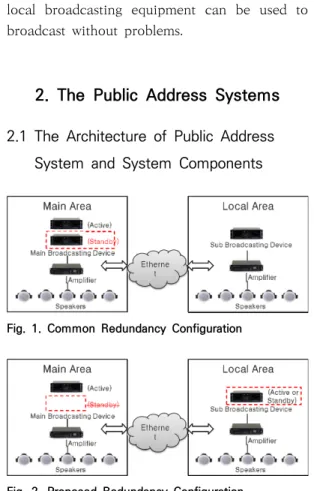
Fig. 1. Common Redundancy Configuration

Fig. 2. Proposed Redundancy Configuration

Redundancy method in general PA system is to operate the system by installing standby device with the same performance as Active device.

Standby devices will continue to stand by in normal conditions (as shown Fig. 1).

In our proposed method, instead of having a separate standby device in the main area, we use the device in the local area as the standby device of the main broadcasting device (as shown Fig.

2).

For development, we have in mind the popular open source hardware like Arduino and Raspberry Pi. In order to control broadcasting device, it has to be controlled by SNMP protocol.

That is why we chose Raspberry Pi equipped

(3)

with Operating System, which is advantageous for development [8].

In the experiment, the open source hardware, 'Raspberry Pi 3 Model B+', was used to make the main controller. This model adopts ARM Coretex-A53 MP4 CPU in hardware and has built-in 1GB LPDDR2 memory and Gigabit Ethernet. Operating system used Raspbian, an OS of the Debian family, and DBMS used MySQL, and monitoring software was implemented by SNMP Protocol [9].

The sound transmission and control method of broadcasting device used in the experiment is CobraNet-based network audio system [10, 13].

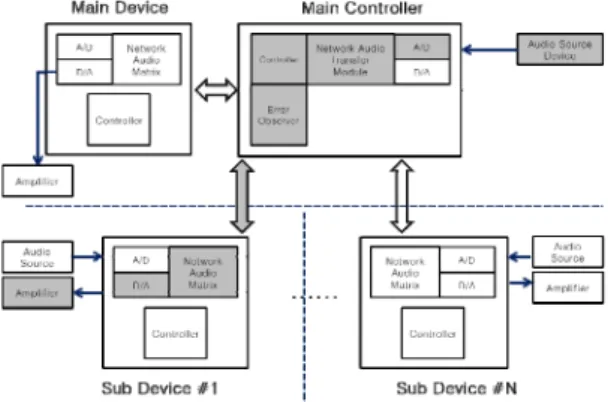
2.2 Configuration and operation of device Main broadcasting device and sub(auxiliary) broadcasting device are built and operated in the same network (as shown Fig. 3). In general, the main broadcasting device is used to transmit the broadcasting, and the sub broadcasting device is operated locally as a broadcasting device dedicated to the region. At this time, the fault monitoring unit of the main control device which checks the status of the main broadcasting device and the sub broadcasting device is continuously checked.

Fig. 3. Conceptual Diagram

Step 1: In normal operation state, broadcast to the main broadcasting device (as shown Fig. 4). If the sub device fails, the status of the sub broadcasting device is transmitted to the main control device. The main controller does not take any action with respect to the control

Fig. 4. Normal operating state

Step 2: When the main broadcasting device fails, the main control unit blocks the control right of the main broadcasting device and transfers the control right to the sub device (as shown Fig. 5). From this point on, all important events, such as emergency broadcasts, are delivered to the sub broadcast device to enable operation.

Fig. 5. Abnormal operating state

Step 3: If there are the main broadcast device and a large number of auxiliary devices the sub broadcast device has priority in order of # 1, # 2.

If there is a problem with the device by assigning the priority in order, the priority is assigned to the next device.

2.3 Operation method

How to transfer authority to auxiliary

(4)

broadcasting device is described in Fig. 4. And detail procedures are as follows.

1) Criteria for determining failure of main broadcasting device

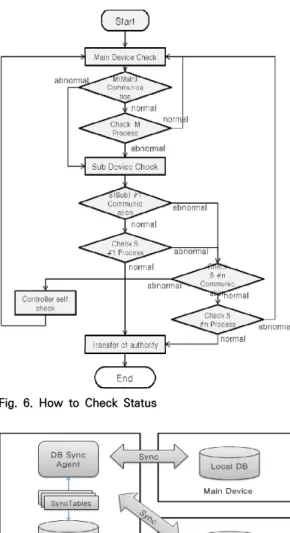
The main control device is located in the same network as the main broadcasting device and sub broadcasting device, and sends and receives Hello Packet for network monitoring periodically and performs status monitoring. If it is determined that network communication with main broadcasting device not available or communication is possible but data transmission with processor is not possible, check communication status with auxiliary broadcasting device. If there are a large number of auxiliary broadcasting devices, it is required to check them according to a predetermined priority. If communication with the main broadcasting device does not occur for a certain period of time, it is determined that the main broadcasting device has failed and the authority is transferred to the sub broadcasting device.

2) How to transfer authority to auxiliary broadcasting device in case of failure of main broadcasting device

The main control device maintains Synchronous by periodically backing up the database and broadcasting status while the main broadcasting device is in normal operation (as shown Fig. 7). At this time, the main control device should keep the status of the auxiliary broadcasting device and keep the status value for each DB table. This is to restore the state of the auxiliary broadcasting device to its original state after the authority is transferred to the sub broadcasting device when the main broadcasting device has failed, and then after the failure is restored [11].

If the main broadcasting device is incapable of broadcasting, the procedure for transferring authority is as follows (as shown Fig. 6). Based on the data backed up by the main control device,

control priority is assigned to the highest priority among the sub broadcast device to activate the broadcast status.

Fig. 6. How to Check Status

Fig. 7. Database synchronization method

First, we need to check the RX Channel ID of

the sub broadcasting device. This is similar to the

process of identifying a channel for radio use. In

case of the main broadcasting device, it receives

audio input from the control device and receives

it through the designated network RX channel,

and the network amplifier connected to the

network receives the broadcasting device

broadcasting by synchronizing the RX channel.

(5)

Fig. 8. Change audio channel

If the main broadcasting device cannot receive audio from the control device due to network or device problems, the control device synchronizes with its RX channel of the sub broadcasting device using its own TX channel. After that, the RX Routing path of the network audio matrix of the sub broadcasting device directly receives the analog audio signal and changes the path of the digital audio router to accept the A/D converted path or the network audio (as shown Fig. 8) [12-14].

Fig. 9. Audio routing

The RX channel of the network amplifiers is also changed from the TX channel of the existing main broadcasting device to the TX channel of the auxiliary broadcasting device. In order for the device to receive audio, it is necessary to synchronize the TX and RX channels on the network audio (as shown Fig. 9) [15].

3. Operation and Discussion 3.1 Routing Method of Network Audio in

Normal State.

Fig. 10. Normal Status

It receives up to 8 sound sources from the sound source device and converts them to network audio after A / D conversion. If this is transmitted through TX channel 11 of the control device, the network audio amplifier with RX channel set to 1 through TX channel 1 finally receives network audio from RX Channel 11 of the main broadcasting device (as shown Fig. 10).

3.2 Routing Method of Network Audio in Fault State

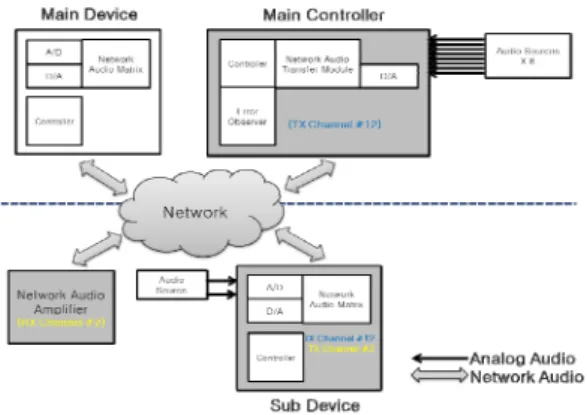
Fig. 11. Fault Status

(6)

The control unit receives up to 8 sound sources from the sound source device and converts them to network audio after A / D conversion. If the TX channel value of the control device is changed to the RX channel value of the higher priority device among the available auxiliary broadcasting devices when the main broadcasting device fails (as shown Fig. 11), and the audio is transmitted, the RX channel 12 of the sub broadcasting device can be received at once. By the predetermined control, the Network Audio Amplifier finally receives the audio.

In case of failure, the control device changes the TX channel to the RX channel of the auxiliary broadcasting device while TX and RX channels of each broadcasting device are fixed in normal condition. Subsequently, TX Routing information of the auxiliary broadcast device is converted from Analog to Digital in the network audio matrix. After changing the RX Channel of all Network Audio Amplifiers to the RX, TX Channel ID of the Auxiliary Broadcasting Device, the control device receives the audio automatically.

When the system is configured in this way, it is not necessary to configure the standby device separately for the duplication of the main device, thereby reducing the economic cost.

3.3 Implementation

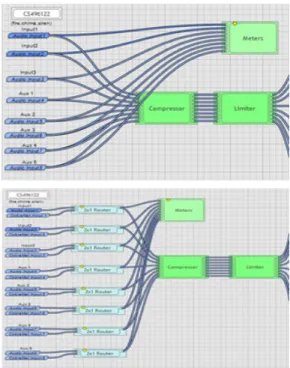
The following is the screen composed of the audio matrix of the actual main controller and sub device (as shown Fig. 12). In the case of the Main Controller, there are only Audio1~8 where the audio input is input through the A / D converter. On the other hand, in addition to Audio1~8 for audio input used in local broadcasting, Sub Device also has CobraNet Auido1~8, which enables network audio input by a 2x1 router when the main device fails.

Fig. 12. Audio Matrix Structure

The overall broadcasting using local broadcasting equipment did not differ from broadcasting through the main broadcasting equipment. However, it is necessary to define a response method when an important broadcast is conducted locally.

4. Conclusion

The redundancy method presented in this paper is a more advanced form of the existing emergency broadcasting device duplication method, which can minimize the waste of resources device due to duplication. Standby device other than active device is used in the local area as usual. In this way, the waste of resources caused by the redundant configuration of expensive device can be minimized.

Therefore, the study is meaningful from the viewpoint of economic advantages in addition to the purpose of stable system operation.

In terms of configuration, inexpensive open

(7)

source hardware was used to construct a cheap and stable system. In the future, it may be applicable to systems other than emergency broadcasting. In this study, research on how to cope with the situation after equipment failure occurred, but in the next study, a monitoring method and preemptive measures for failure will be studied [16].

REFERENCES

[1] Wikipedia.org. (2020, May 12). Public Address System.

http://en.wikipedia.org/wiki/Public_address_system [2] J. S. Kim. (2012). Development of a Digital Integrated

and Minimized Public Address System with Central Control. International Journal of Control and Automation, 5(3), 267-276.

[3] J. Kim. (2015). A study for the improvement of the emergency broadcast equipment. Masters Dissertation, Hanyang University, Seoul.

[4] K. S. Choi. (2016). A Study on Improvement of Protection and Support System for Vulnerable People to Disaster. Doctoral Dissertation, Wonkwang University, Iksan.

[5] B. E. Jeon. (2017). A Study on safety management plan of disater broadcasting facility. Incheon National University, Incheon.

[6] T. H. Ryu. (2012). A Study on the Redundant system to Reduce the Transmission Delay in a Ring Topology Network. Masters Dissertation, Korea Polytechnic University, Siheung.

[7] K. W. Kim & J. P. Cho. (2016). Development of Digital/Analog Redundancy System for Audio Mixer.

The Journal of The Institute of Internet, Broadcasting and Communication, 16(5), 63-68.

DOI : 10.7236/JIIBC.2016.16.5.63

[8] Patil, A. R., Mandlik, S. A., Khedkar, P. D., & Pujari, A.

M. SNMP Based Discovery Tool on Raspberry pi 2.

http://www.ijariie.com/AdminUploadPdf/SNMP_Based _Disovery_tool_on_Raspberry_pi_2_ijariie10456.pdf [9] Tools.ietf.org. (1990, May). A Simple Network

Management Protocol(SNMP).

http://tools.ietf.org/html/rfc1157

[10] Currus logic. (2006). CobraNet Programmer's Reference.

http://www.cirrus.com/en/pubs/manual/CobraNet_Pr ogrammer_Manual_PM25.pdf

[11] J. S. Kim. (2011). A knowledge Conversion Tool for Expert Systems. International Journal of Fuzzy Logic and Interlligent System, 11(1), 1-7.

DOI : 10.5391/IJFIS.2011.11.1.001

[12] J. H. Lee. (2019). Implementation of Novel Anchor (Audio Network & Control Hierarchy Over peer to peer) Audio System Using the Internet Protocol Based OAC(On-site Audio Center). Doctoral dissertation, Kwangwoon University, Seoul.

[13] S. B. Lee. (2017). A Study on the Application Criteria through Case Analysis of Digital network Audio.

Masters Dissertation, Seoul National University of Science&Technology, Seoul.

[14] The Yamaha Commercial Audio team. (2006). An introduction to networked audio.

http://www.cobranet.info/sites/default/files/Yamaha WP_-_Intro_to_networked_audio_-_012507.pdf [15] Kevin Gross. (n.d.). Digital Audio Distribution Systems.

http://www.cobranet.info/support/design/digital_audi o_distrib

[16] Y. G. Jeon. (2018). Research on error prevention through system error log analysis. Masters Dissertation, Yonsei University, Seoul.

류 태 하(Taeha Ryu) [정회원]

․ 2000년 2월 : 성공회대학교 전산정보 학과(이학사)

․ 2012년 8월 : 한국산업기술대학교 전 자제어공학과(공학석사)

․ 2019년 2월 ~ 현재 : 한성대학교 일반 대학원 스마트융합컨설팅학과 박사과 정

․ 관심분야 : 네트워크 오디오, 신호처리, HCI, 딥러닝

․ E-Mail : [email protected]

김 승 천(Seungcheon Kim) [정회원]

․ 1994년 2월 : 연세대학교 전자공학과 (공학사)

․ 1996년 2월 : 연세대학교 전자공학과 (공학석사)

․ 1999년 8월 : 연세대학교 전기컴퓨터 공학과(공학박사)

․ 2000년 1월 ~ 2001년 1월 : Univ.

of Sydney Research Fellow

․ 2001년 2월 ~ 2003년 8월 : LG전자 DTV/DA 연구소 선 임연구원

․ 2009년 7월 ~ 2010년 7월 : Univ of Oregon 방문교수

․ 2003년 3월 ~ 현재 : 한성대학교 IT융합공학부 교수

․ 관심분야 : 네트워크 보안, 블록체인 서비스, 사물인터넷 보 안, 5G 이동통신망 서비스

․ E-Mail : [email protected]

수치

Fig.  1.  Common  Redundancy  Configuration
Fig.  4.  Normal  operating  state
Fig.  6.  How  to  Check  Status
Fig.  11.  Fault  Status
+2

참조

관련 문서