• 검색 결과가 없습니다.

Preparation and characterization of nanosized hollow silica in the presence of aluminum isopropoxide

N/A
N/A
Protected

Academic year: 2021

Share "Preparation and characterization of nanosized hollow silica in the presence of aluminum isopropoxide"

Copied!
7
0
0

로드 중.... (전체 텍스트 보기)

전체 글

(1)

http://dx.doi.org/10.12925/jkocs.2016.33.3.421

Preparation and characterization of nanosized hollow silica in the presence of aluminum isopropoxide

Nguyen Ngoc Anh Thu․Hyun-Ik Kim․Sang Hern Kim

Department of Chemical & Biological Engineering, Hanbat National University,

Youseonggu Duckmyungdong San 16-1, Daejon, 34158, Korea

(Received July 5, 2016; Revised August 3, 2016; Accepted August 25, 2016)

Abstract : Nanosized hollow silica was prepared by Stӧber method in the presence of aluminum isopropoxide. The mixture of polyelectrolytes such as poly(sodium 4-styrene sulfonate)(PSS) and polyacrylic acid(PAA) were used as templates. Tetraethylorthosilicate(TEOS) and aluminum isopropoxide were used as precursors for silica and alumina, respectively. The function of aluminum isopropoxide is to increase the porosity of silica shell. The characterizations of hollow silica were examined by TEM(transmission electron microscopy), TGA(thermogravimetric analysis), BET(Brunauer Emmett Teller), Energy-dispersive X-ray spectroscopy(EDS), and FT-IR spectrum. It was found that the shell thickness of hollow silica was around 8 nm and the core diameter was around 20 nm by TEM.

Keywords : hollow silica, Stӧber method, polyelectrolyte, aluminum isopropoxide

1. Introduction

The synthesis of hollow nanoparticles has attracted much attention in the chemistry and material communities because of their low density, large specific area, low coefficients of thermal expansion, low refractive index, mechanical and thermal stabilities, surface permeability [1]. Such hollow nanoparticles have a wide variety of potential application in cosmetic, catalysis, coating, composite materials, dyes, ink, artificial cells, and filler[2-6]. Furthermore, their hollow structure can be used as a microencapsulate for drugs in the pharmaceutical fields [7]. The fast



Corresponding author (E-mail: [email protected])

development in hollow nanoparticles synthesis has greatly helped to tune their optical properties [8-9], catalytic properties [10] and superparamagnetic behavior [11] and so on.

The nanosized materials with hollow structure

are also a very good candidate in storage

devices and charge carriers [12]. The hollow

nanoparticles have properties of both hollow

structure and nanosized particles. They possess

many special properties, as low density, large

specific area, low coefficients of thermal

expansion, surface permeability [1], low

refractive index, thermal stabilities, thermal

insulation and prominent optical activities

[8-12]. Depending on the kinds of materials,

they can provide more unique properties like

highly biocompatible, optical stability, good

environment endurance, which are useful for

(2)

some special fields of industry.

Recently, most of reported inorganic hollow spheres are focused on hollow silica because hollow silica is not only possess properties like another hollow nanoparticles but also exhibit a number of special characteristics such as nontoxic, highly biocompatible, and mechanically stable material [13-16], so they have more attractive applications in many fields of science. There are many papers which reported about the method of making hollow silica and diverse hollow silica spheres have been fabricated with various sizes and geometries. Most of these hollow spheres need the calcinations at high temperature to remove the templates or organic components, which makes it difficult to retain their intact spherical structures. Furthermore, the calcinations will lead to an obvious decrease in the number of silanol groups in silicate materials. In this work, we used aluminum isopropoxide to increase the porosity of silica shell, therefore the core materials leak out easily. By using Stӧber method, PSS and PAA were used to make templates. TEOS and aluminum isopropoxide were used as precursors for silca and alumina, respectively.

2. Experimental

2.1. Materials

Tetraethylorthosilicate(TEOS), aluminum isopropoxide, acetylacetone, ethanol(95 %), ammonia solution(28 %), poly(sodium 4-styrene sulfonate)(PSS, M

w

= 70,000, 30 wt. % solution in H

2

O), polyacrylic acid (PAA, M

w

= 1,800), and MTMS (methyltrimethoxysilane) were purchased from Sigma Aldrich. Distilled water was used through all of the processes.

2.2. Characterization

TEM observations were performed on a JEOL Model JEM-1200EX, working at 200 kV. All samples subjected to TEM measurements were dispersed in ethanol

ultrasonically and were dropped on copper grids. Thermogravimetric analysis(TGA) was carried out using a Diamond TG/DTA thermal analyzer(STAR

e

SW10.00) with a heating rate of 10

o

C min

-1

from room temperature to 900

o

C in an air flow. The composition of particles were investigated by using Energy- dispersive X-ray spectroscopy(EDS, JEOL Model JEM-1200EX). The samples were prepared by the same way with TEM analysis.

Fourier transform infrared(FTIR) spectra of FT-IR spectrometer(Nicolet iS5). Nitrogen adsorption and desorption isotherms were measured on a TriStar 3000 with operation manual V6.07. A sorption analyzer at 77.3K.

Specific surface area was calculated by BET(Brunauer-Emmett-Teller) method.

2.3. Preparation of hollow silica

At room temperature, 0.042 g PSS and 0.022 g PAA were dissolved in 1.5 mL of ammonia hydroxide and mixed with 90 mL ethanol in 250 mL glass global flask. This solution is called template solution. The precursor solutions were prepared separately by 2 parts. The first part was prepared by TEOS and diluted in ethanol. The second part was prepared by aluminum isopropoxide mixed with acetylacetone and also diluted in ethanol.

The composition of precursors is described in

Table 1. Two precursors were added in the

template solution at the same time, same

adding speed of syringe pump(90 mL/hr) by 2

injections separately. The reaction was kept in

12 hours before adding of 0.1 mL(0.698

mmol) of MTMS(methyltrimethoxysilane) to

modify the surface of silica spheres. After 5

hours, the half of product was transferred to

500 mL beaker and stirred by magnetic bar

and washed by adding 100 mL of distilled

water at room temperature for 2 hours. By

using the centrifuge the supernatant from the

centrifuged product was decanted. The

centrifuge tube containing centrifuged product

was refilled by the distilled water and

centrifuged slurry refilled by fresh water was

(3)

Sample

Precursor 1 Precursor 2

mole ratio Si:Al

TEOS Ethanol Al(iPr)

3

Acetyl-

acetone Ethanol Al 4.47 mmol

(1mL) 20mL 0.894 mmol

(0.1824 g) 0.09 mL 20 mL 5:1

Table 1. Synthesis of hollow silica with aluminum isopropoxide

(a)

(b)

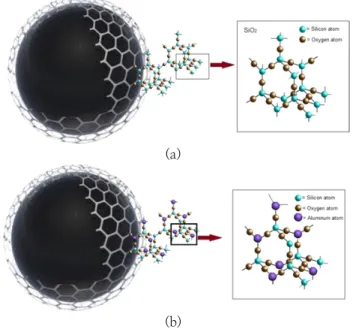
Fig. 1. The formation of (a) silica and (b) both alumina and silica on the surface of polyelectrolyte template

stirred by spatula and centrifuged again. These operations were repeated at least 10 times.

Another half of product was transferred to 500 mL beaker and stirred and washed by adding 100 mL of 0.01 M NaOH at room temperature for 2 hours. The same procedure as the washing process by distilled water was applied to washing process by 0.01 M NaOH.

By using the centrifuge the supernatant was decanted at least 10 times to confirm whether pH of the supernatant was reached pH 7. The products washed by distilled water and 0.01 M NaOH were dried at 50

o

C for several hours without calcination. To explain for the

function of aluminum alkoxide in this work, a

formation mechanism of hollow silica in the

presence of aluminum isopropoxide is

proposed. Taking a look at (a) in Fig. 1, we

can understand the formation of silica shell

with TEOS as precursor. The (b) in Figure 1

describe the formation of hollow silica shell in

the presence of aluminum isopropoxide. The

bonding -O-Si-O-, -O-Al-O- or

– O-Si-Al-O- might be exist together. By

washing with NaOH, alumina was dissolved

completely. So that the distance between the

bonding of silica getting bigger, it mean the

pore size of shell becomes larger. By this way,

(4)

alumina as well as polyelectrolytes inside the spheres will leak out easily. In this study, no further calcination is necessary.

3. Results and Discussion

The thermogravimetric analysis(TGA) curve of silica after washing by water from (a) in Fig. 2 indicates that there are two stages of weight loss. The first weight-loss stage around 100

o

C is due to the evaporation of physical adsorbed water and residual solvent; the relatively pronounced weight loss occurs at 350-600

o

C, due to the decomposition of remained PSS and PAA and silica bonded groups. The mass loss at second stage is over 10 %. The residual mass is about 70 %.

Whereas the TGA curve of the hollow silica spheres after washing by NaOH from (b) in Fig. 2 also exhibits the first weight loss stage around 100

o

C but the second weight loss stage occurs at 350-600

o

C getting smaller. The mass loss at this stage is around 5 % and the residual mass is about 77 %. These results demonstrate that by washing with NaOH, the polyelectrolyte almost moves out.

Fig. 2. TGA curve of hollow silica which was washed by (a) H

2

O and (b) NaOH.

In addition, the chemical composition of samples was determined by EDS analysis. By elemental analysis, it was clearly confirm that the sample which was washed by water still remains 1.88 atom % of aluminum and 16.38

atom % of silica. It is almost respective the mole ratio of aluminum isopropoxide and TEOS as reactants(10 : 1). Whereas the sample which was washed by NaOH only remains 0.15 atom % aluminum compare to 19.71 atom % of silica. So by using NaOH, aluminum is almost dissolved(Fig. 3). The composition of shell is for silica only. Na does not appear in EDS analysis of the sample which was washed by 0.01 M NaOH under the conditions that the pH of supernatant reached pH 7 and supernatant was removed at least ten times. Also element existing less than 0.05 atom % was ignored during the EDS analysis.

(a)

(b)

Fig. 3. EDS of hollow silica which was washed by (a) H

2

O and (b) NaOH.

FT-IR spectrum a in Fig. 4 exhibits the

FT-IR spectra of the sample which was

washed by H

2

O. The peak appearing at 1070

(5)

Fig. 5. N

2

adsorption isotherms of hollow silica which was washed by (a) H

2

O and (b) NaOH.

cm

-1

is ascribed to the stretching vibrations of Si-O-Si bond. The peak at 1130 cm

-1

belongs to the Al-O bond. The peak at 1743.60 exhibits C=O stretch vibration of carboxyl group. The bands around 2352.98, 2880.71 and 2925.91 cm

-1

are correspond to the C-H bending. These results indicate that alumina and polyelectrolyte template still remain in the sample. FT-IR spectrum b in Fig. 4 describes the FT-IR spectra of the sample which was washed by NaOH. The FT-IR spectrum of the resulting silica spheres only shows the stretching vibration of the Si-O-Si bond at 1070 cm

-1

, so that alumina and polyelectrolyte template were completely removed by base dissolution treatments.

Fig. 4. FT-IR spectra of hollow silica (a) before and (b) after washing by NaOH.

The N

2

absorption isotherms of the hollow silicas are shown in (a) and (b) in Fig. 5

which were washed by H

2

O and NaOH, respectively. Hollow silica which was washed by NaOH provides much big volume for N

2

than hollow silica which was washed by H

2

O.

These data exhibit type I isotherms which is obtained when P/Po<1 and C > 1 in the BET equation, where P/Po is the partial pressure value and C is the BET constant, which is related to the adsorption energy of the first monolayer and varies from solid to solid. This type of isotherm belongs to the microporous materials which possess pore diameter less than 2 nm. By analyzing the absorption isotherms, it is found that the BET surface area of sample which was washed by water is 41.4437 ± 0.4353 m

2

/g; whereas the BET surface area of sample which was washed by NaOH is 241.7334±4.0875 m

2

/g. The higher surface area of the sample which was washed by NaOH demonstrates the its higher porosity.

The TEM images in Fig. 6 show the hollow

structures of silica spheres after washing by

NaOH(a) and H

2

O(b). The core diameter is

around 20 nm and the shell thickness is

around 8 nm. The shape of hollow silica is

uniform and silica shell seems to be very clear

whereas the hollow structure of silica spheres

after washing by H

2

O(b) is not uniform and

silica shell seems not to be very clear.

(6)

Properties a: washed by H

2

O b: washed by NaOH BET surface area 41.4437 ± 0.4353 m

2

/g 241.7334 ± 4.0875 m

2

/g

C(BET constant) 227.574576 547.270717

Qm(Monolayer capacity) 9.5203 g/cm

3

55.5301 g/cm

3

Table 2. BET data of samples which were synthesized in the presence of aluminum isopropoxide

Fig. 6. TEM images of hollow silica spheres after washing by NaOH (a) and water (b).

4. Conclusions

Here in this study, the hollow silica nanospheres were synthesized using Stӧber method with some modifications to optimize the reaction conditions. Poly(sodium 4-styrene sulfonate)(PSS) and polyacrylic acid(PAA) were used to make the template and easily removed by washing without calcination.

Tetraethylorthosilicate(TEOS) and aluminum

isopropoxide were used as precursors for silica and alumina, respectively. The silica by washing NaOH has the core diameter of 20 nm and the shell thickness of 8 nm. In this study, PSS and PAA were used together as water-soluble polymers to promote the formation of well-defined core templates. This route involves the formation of spherical colloid aggregates in ethanol solution, hydrolysis of TEOS under the control of ammonia, sodium hydroxide and the removal of polyelectrolytes by washing or calcination.

The interaction between aminated groups of polyelectrolyte chains and silanol groups of silica particles is driving force for the deposition of silica nanoparticles on polyelectrolyte template during the hydrolysis and condensation process of TEOS. To avoid the inconvenience from calcination, the aluminum alkoxide was used to increase the porosity of hollow silica. By washing with NaOH, alumina was dissolved completely, so that the distance between the bonding of silica getting bigger, it mean the pore size of shell becomes larger. By this way, the polyelectrolytes inside the spheres will leak out easily. In this study, no further calcination is necessary. This method opens up a promising route for the synthesis of other inorganic material with core-shell or hollow structure.

Acknowledgements

This work was supported by the research

fund of the Hanbat National University in 2014.

(7)

References

1. F. Caruso, "Nanoengineering of Particle Surfaces", Advanced Matererials , 13, 11(2001).

2. Y. Du, L. E. Luna, W. S. Tan, M. F.

Rubner, and R. E. Cohen, "Hollow Silica Nanoparticles in UV−Visible Antireflection Coatings for Poly(methyl methacrylate) Substrates", ACS Nan o, 4(7), 4308 (2010).

3. N. E. Botterhuis, Q. Sun, P. C. M. M.

Magusin, R. A. Van Santen, N. and A.

J. M. Sommerdijk, "Hollow silica spheres with an ordered pore structure and their application in controlled release studies", Chemistry A European Journal . 12, 1448 (2006).

4. J. Zhu, J. W. Tang, L. Z. Zhao, X. F.

Zhou, Y. H. Wang, and C. Yu, ,

"Ultrasmall, Well-Dispersed, Hollow Siliceous Spheres with Enhanced Endocytosis Properties", Small , 6, (2010), 276-282.

5. A. Jitianu, J. Doyle, G. Amatucci, and L.

C. Klein, "Methyl modified siloxane melting gels for hydrophobic films", J.

Sol-Gel. Sci. Technolog y, 53, 272 (2010).

6. X. Yu, S. Wu, C. Wang, Z. Li, J. Guan, and Q. Kan, J. "Non-crystalline surface- modified hollow nanospheres of silica (HNS): Synthesis, characterization and catalytic application", Non-crystal. Solid , 358, 47 (2012).

7. T. Ameller, V. Marsaud, P. Legrand, R.

Gref, and J. M. Renoir, "In vitro and in vivo biologic evaluation of long-circulating biodegradable drug carriers loaded with the pure antiestrogen RU 58668", Int. J.

Cancer , 106, 446 (2003).

8. W. H. Green, K. P. Le, J. Grey, T. T. Au, and M. J. Sailor, "White Phosphors from a Silicate-Carboxylate Sol-Gel Precursor That Lack Metal Activator Ions", Science , 276, 1826 (1997).

9. J. Zeng, J. Huang, W. Lu, X. Wang, B.

Wang, S. Zhang, and J. Hou,

"Necklace-like Noble-Metal Hollow Nanoparticle Chains: Synthesis and Tunable Optical Properties", Adv. Mater . 19, 2172 (2007).

10. S. Ikeda, S. Ishino, T. Harada, N.

Okamoto, T. Sakata, H. Mori, S.

Kuwabata, T. Torimoto, and M.

Matsumura, "Ligand-Free Platinum Nanoparticles Encapsulated in a Hollow Porous Carbon Shell as a Highly Active Heterogeneous Hydrogenation Catalyst", Angew. Chem Int. Ed. 45, 7063 (2006).

11. Y. Vasquez, A. K. Sra, and R. E.

Schaak,"One-Pot Synthesis of Hollow Superparamagnetic CoPt Nanospheres", J.

Am. Chem. Soc ., 127. 12504 (2005).

12. G. D. Moon, and U. Jeong, "Decoration of the Interior Surface of Hollow Spherical Silica Colloids with Pt Nanoparticles", Chem. Mater , 20, 3003 (2008).

13. H. Y. Fan, "Nanocrystal-micelle: synthesis, self-assembly and application", Chem.

Commun ., 12, 1383 (2008).

14. M. J. Jr., M. R. Davolos, F. J. Santos, and S. J. Andrade, "Hollow silica particles from microemulsion", J. of Non-crystalline Solids , 247, 98 (1999).

15. F. J. G. Müller, M. S. Stürzel, and R.

Mülhaupt, "Silica nanotubes and hollow silica nanofibers: Gas phase mineralization, polymerization catalysis and in-situ polyethylene nanocomposites", Polymer , 55, 465 (2014).

16. J. Peng, L. Zhao, X. Zhu, Y. Sun, W.

Feng, Y. Gao, L. Wang, and F. Li,

"Hollow silica nanoparticles loaded with

hydrophobic phthalocyanine for near-

infrared photodynamic and photothermal

combination therapy", Biomaterials , 34,

7905 (2013).

수치

Fig.  1.  The  formation  of  (a)  silica  and  (b)  both  alumina  and  silica  on  the  surface  of  polyelectrolyte  template
Fig.  2.  TGA  curve  of  hollow  silica  which  was  washed  by  (a)  H 2 O  and  (b)  NaOH.
Fig. 4. FT-IR  spectra  of  hollow  silica  (a)  before  and  (b)  after  washing  by  NaOH.
Fig.  6.  TEM  images  of  hollow  silica  spheres  after  washing  by  NaOH  (a)  and  water  (b).

참조

관련 문서