http://dx.doi.org/10.12925/jkocs.2016.33.3.560
산성백토를 이용한 저온압착 유채유의 탈색 평가
이영화
a✝․박 원
a․이태성
b․김광수
a․장영석
a․이경보
a 농촌진흥청 국립식량과학원 바이오에너지작물연구소a, 영광군농업기술센터b (2016년 5월 23일 접수; 2016년 9월 20일 수정; 2016년 9월 28일 채택)Bleaching of cold-pressed rapeseed oil using activated clay
Yong-Hwa Leea✝․Won Parka․Tae-Sung Leeb․Kwang-Soo Kima Young-Seok Janga․Kyeong-Bo Leea
a
Bioenergy Crop Research Institute, National Institute of Crop Science, Rural Development Administration, Muan 58545, Republic of Korea
b
Yeonggwang-Gun Agricultural Technology Center, 1481, Baeksu-ro, Gunseo-myeon, Yeonggwang-gun, Jeollanam-do, Republic of Korea
(Received May 23, 2016; Revised September 20, 2016; Accepted September 28, 2016)
요 약 : 최근 건강기능성 식용유에 대한 선호도가 높아지면서 저온압착(cold-pressing) 유채유에 대한 관심이 증대되고 있다. 저온압착 유채유는 정제유에 비해 기름 고유의 맛과 향을 느낄 수 있는 장점이 있다. 본 연구에서는 산성백토를 이용한 저온압착 유채유의 탈색과정에서 산성백토의 첨가량, 처리시간 및 반응온도에 따른 탈색 후 이화학적 특성과 품질특성을 분석하고자 하였다. 이화학적 특성으로 색차 (명도, 적색도, 황색도)를 조사하였고, 품질특성은 chlorophyll-A 와 carotenoid 함량, 지방산 조성, 토코 페롤(α, β, γ, δ), 및 식물성 스테롤(β-sitosterol, campesterol, stigmasterol)을 분석하였다.
먼저 산성백토(DC-SUPER)의 첨가량(1, 2, 3%)에 따른 저온압착 유채유의 색도변화를 관찰한 결과, DC-SUPER 첨가량 2%에서 탈색 1시간 후 유채유의 색도가 갈색에서 연노랑으로 옅어졌다. 본 결과를 바탕으로 총 3종의 산성백토(DC-SUPER, DC-A3, 및 P1)에 대해 첨가량 2%를 기준으로 처리시간(20, 40, 60, 80분) 증가에 따른 색차를 조사한 결과, 처리시간 20분 경과 후부터 대조구 대비 명도(L)는 증 가하였고, 적색도(a)와 황색도(b)는 감소하는 경향을 보였다. 또한 산성백토 DC-SUPER 2% 첨가 후, 반응온도(40, 80, 120℃) 증가에 따른 색차를 조사한 결과, L값과 a값은 큰 변화를 보이지 않았으나, b 값은 급격히 감소하는 경향을 보였다. 특히, 반응온도 40℃에서 처리시간 20분 이내에 클로로필 A와 카 로티노이드는 대부분 제거되었고, 토코페롤 함량도 현저히 감소하였다. 탈색 전 저온압착 유채유의 총 토코페롤 함량은 46.62mg/100g이나, 탈색 후 총 토코페놀은 12.67mg/100g(20분 탈색), 15.31mg/
100g(40분 탈색), 13.56mg/100g(60분 탈색)로 나타나, 약 50% 이상 감소하였다. 탈색 후 α-토코페롤 과 δ-토코페롤의 함량 감소가 매우 컸고, γ>β>α>δ-토코페롤의 순으로 포함되어 있었다. 하지만 탈 색 전·후에 저온압착 유채유의 식물성 스테롤 함량은 큰 변화가 없었다.
✝
Corresponding author
(E-mail: [email protected])
따라서 본 연구에서는 산성백토 이용 저온압착 유채유 탈색시 색도를 향상시킴을 확인하였으며, 영양 학적으로 우수한 총 토코페롤 등이 감소한 바 향후 이를 보완 할 수 있는 연구가 필요하다.
주제어 : 저온압착, 유채유, 색차, 토코페롤, 식물성 스테롤
Abstract : Acid-activated clays (SUPER-DC, DC-A3, and P1) are used for the bleaching of cold-pressed rapeseed oil. In this study we tested the bleaching performance of cold-pressed rapeseed oil according to the different reaction time (20, 40, 60, 80 min) and temperature (40, 80, 120℃). Oil color (lightness, redness, yellowness), pigments (chlorophyll A and carotenoid content) and quality properties (fatty acid composition, tocopherols (α, β, γ, δ), and plant sterols (β-sitosterol, campesterol, stigmasterol) content) were analyzed.
The results showed that bleaching of cold-pressed rapeseed oil with 2% acid-activated clays at 40℃ for 20 min, brightness (L) increased, but redness (a) and yellowness (b) decreased. Bleaching of cold-pressed rapeseed oil with 2% DC-SUPER at 40℃ removed chlorophyll A and carotenoids pigments significantly. In addition, about 50% of total tocopherol content in cold-pressed rapeseed oil was reduced by bleaching. Originally total tocopherol content was 46.62mg/100g in cold-pressed rapeseed oil. But after bleaching, total tocopherol content was 12.67mg/100g (20 min bleaching), 15.31mg/100g (40 min bleaching), and 13.56mg/100g (60 min bleaching). However plant sterols content in cold-pressed rapeseed oil remained unchanged by bleaching. Overall, acid-activated clays were useful for the bleaching of pigmented rapeseed oil.
Keywords : cold-pressed; rapeseed oil; oil color; tocopherol; plant sterol
1. 서 론
식용유는 제조법에 따라 원재료를 압착해서 짜 내는 압착유와 원재료를 압착해서 짜낸 후 정제 과정을 거치는 정제유로 크게 두 가지로 나눌 수 있다. 대표적인 압착유에는 참기름, 들기름, 엑스 트라 버진 올리브유가 있고, 정제유에는 대두유, 옥수수유, 포도씨유, 카놀라유 등이 있다. 압착유 는 기름 추출수율이 적지만, 원재료가 가진 향을 그대로 간직하고 있고, 발연점이 비교적 낮은 편 이다 [1]. 반대로 정제유는 여러 가지 화학처리 과정을 거치므로 기름 본연의 향과 영양분의 소 실이 많고, 발연점은 압착유 보다 높다[2-4]. 식 용유는 일반적으로 정제유가 대부분이나, 최근 친 환경 식물성 기름에 대한 선호도가 높아지면서 압착유에 대한 관심이 많아지고 있다 [5-7].
식물성 유지는 식용유뿐만 아니라 바이오연료 로도 사용 된다 [8]. 식물성 유지는 물, 먼지, FFA(Free fatty acids), 인지질(Phosphatides), 산 화물, 색소 및 구리, 철, 황, 할로겐 등과 같은 미 량의 요소가 오일을 어두운 색으로 착색·발연시키
거나, 기포를 발생시키는 원인이 된다. 유지의 정 제과정은 탈검(degumming), 탈산(neutralization), 탈색(bleaching), 탈취(deodorization)의 4가지 단 계를 포함하며, 상업적 측면에서 가장 중요한 요 소는 기름의 색으로서, 탈색 단계가 잔여 불순물 을 비롯하여 일반적으로 색소를 제거하는데 있어 서 매우 중요하다. 활성백토는 유지의 탈색과정에 서 흡착 능력을 향상시키기 위해서 몬모릴로나이 트(montmorillonite) 등 점토를 황산이나 염산으 로 산처리하여 생산하고, 보통 활성백토 (activated-clay)를 산성백토(Acid-clay)라고 한다 [9-12]. 본 연구에서는 유채씨를 볶지 않고 저온 압착(cold-pressing) 방식으로 착유한 유채유를 산성백토를 이용하여 탈색(bleaching)한 후, 기름 의 색차(명도, 적색도, 황색도)와 클로로필 A, 카 로티노이드, 토코페롤(α, β, γ, δ), 및 파이토 스테롤(β-sitosterol, campesterol, stigmasterol) 함량과 지방산 조성을 분석하여 기름의 이화학적 특성과 품질특성을 평가 하였다.
2. 재료 및 실험
2.1. 시험재료
2015년산 유채씨(품종명: 탐미유채)를 풍건, 세 척, 및 건조한 후, 착유 시 유채씨를 볶지 않고 스크류 압착식 착유기(National ENG)의 착유부 위 온도를 80~85℃에서 조정하여 저온압착 (cold-pressing) 방식으로 착유하였다. 착유한 저 온압착 유채유를 탈색하기 위해 총 3종의 산성백 토(DC-SUPER, DC-A3(동해화학공업) 및 P1(대 일화학))를 이용하였다.
2.2. 저온압착 유채유의 이화학적 특성 (명도, 적색도 및 황색도)
저온압착 유채유 및 탈색한 유채유의 색차는 Super color SP-80 Colormeter(Tokyo Denshoku Co., Japan)를 이용하여 측정하였으 며, 명도(lightness, L), 적색도(redness, a), 황색 도(yellowness, b)를 측정하였다.
2.3. 클로로필 A 및 카로티노이드 분석
UV-Vis Spectrophotometer(Biochrom Libra S22)를 이용하여 470nm, 648nm과 664nm 파장 에서의 흡광도를 측정한 후 클로로필 A와 카로티 노이드 함량을 산출하였다 [13].
2.4. 지방산 조성 분석
지방산 분석은 탈색한 유채유(50 μL)를 pear-shaped flask에 넣고, methanol(15 mL)과 sodium methoxide(1 mL)을 넣은 후, 100℃에서 2시간 동안 반응시켰다. 반응물을 상온에서 냉각 시킨 후, n-hexane(15 mL)을 첨가, 혼합한 후 추출하고 상층액을 필터링하여 가스크로마토그래 피(Agilent 7890)를 이용하여 분석하였다. 지방산 조성 분석 시 칼럼은 HP-Innowax(30m x 0.32mm x 0.25μm)를 사용하였고, 주입부 및 검지부 온도는 200℃와 250℃로 하였으며, 오븐 온도는 150℃에서 1분간 유지한 후, 분당 5℃씩 250℃ 까지 상승시켰다.
2.5. 토코페롤 분석
전남식품산업연구센터(전남 나주시 소재)에 의 뢰하여 식약처 식품공전 1.2.2.6 비타민E 정량방 법에 의해 분석하였다.
2.6. 파이토스테롤 분석
저온압착 유채유의 식물성 스테롤의 함량은 GC (gas chromatography, Agilent 7890A)-MS (mass spectrometer, Agilent 5975C)를 조합하여 표준물질과 함께 분석한 후, 정량하였다. 분석조 건은 DB-5 cross linked 5% phenylmethyl silicone column(J&W Scientific)과 헬륨(He) 가 스를 carrier로 사용하였으며, split ratio는 40:1 로 하였다.
3. 결과 및 고찰
3.1. 산성백토 첨가량 및 반응시간에 따른 저온 압착 유채유의 탈색
저온압착 유채유의 탈색 특성을 조사하기 위해 먼저 산성백토 DC-SUPER의 첨가량(1~3%) 및 처리시간(1~7 시간)을 달리한 후, 저온압착 유채 유의 색도변화를 조사하였다(Fig. 1). DC-SUPER 첨가량 2%와 처리시간 1시간 이상의 반응조건에 서 저온압착 유채유의 색도가 황갈색에서 연노랑 으로 옅어지는 것을 확인하였다(Fig. 1). 본 결과 로부터 저온압착 유채유의 탈색은 산성백토의 첨 가량에 크게 좌우되는 것을 확인하였다.
3.2. 산성백토 종류별 저온압착 유채유의 탈색에 따른 색차 변화
총 3종의 산성백토(DC-SUPER, DC-A3, P1) 에 대해 2% 첨가 후, 처리시간 경과에 따른 명도(L), 적색도(a), 황색도(b)를 측정하였다 (Table 1). 산성백토 처리시간 20분 이후부터 대 조구(L=65.19, b=-2.47, b=19.27) 대비 L값은 증가하였고, a와 b값은 감소하는 경향을 보였다.
산성백토 처리시간 40분 이상의 경우 저온압착 유채유의 색차 값은 큰 변화가 없었다. 한편 산 성백토 종류별 처리시간 증가에 따른 b값의 감소 경향에는 차이가 나타난 것으로 보아 산성백토 종류별 탈색능도 다소 차이가 있는 것으로 보인 다.
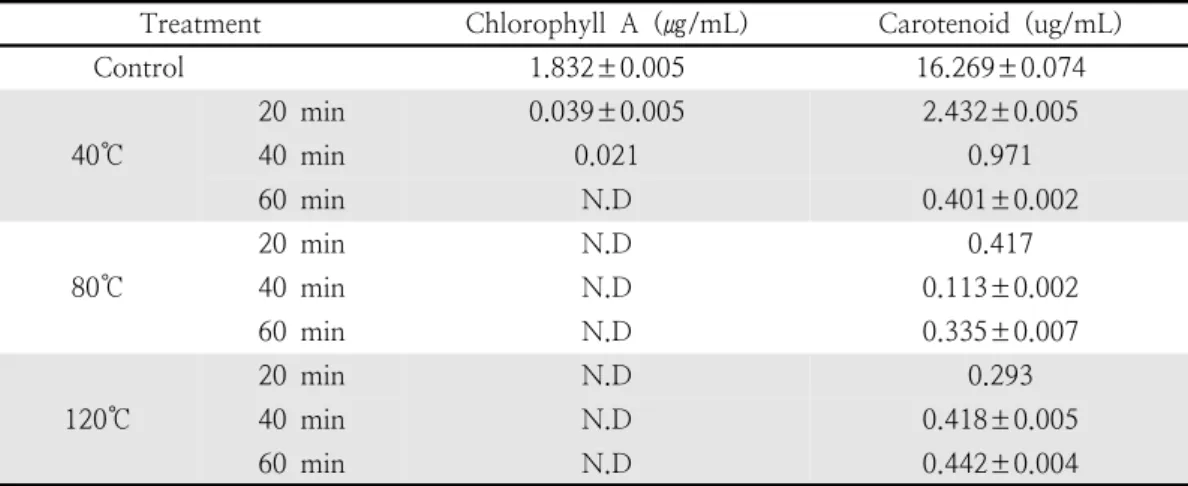
3.3. 산성백토 이용 저온압착 유채유의 탈색에 따른 클로로필 A와 카로티노이드 제거율 Fig. 1과 Table 1의 실험결과를 바탕으로 산성 백토 DC-SUPER에 대해 첨가량 2%와 반응시간 을 20분으로 고정하고, 반응온도 증가(40, 80, 120℃)에 따른 색도변화를 조사하였다(Table 2).
Control 1h 3h 5h 7h 1h 3h 5h 7h 1h 3h 5h 7h 1% 2% 3%
Fig. 1. Color change of cold-pressed rapeseed oil by bleaching with acid-activated clay according to the amount of acid-activated clay and reaction time (rapeseed oil 50g; acid-activated clay DC-SUPER 1~3%; reaction temp. 40℃; reaction time 1~7 hour; unbleached cold-pressed rapeseed oil was used as a control).
Table 1. Chromaticity change of cold-pressed rapeseed oil by bleaching with acid-activated clay under different reaction time (rapeseed oil 300g, acid-activated clays 2%; reaction temp.
40℃; reaction time 20~80 min).
Activated-clay Color 20 min 40 min 60 min 80 min
DC-SUPER L 70.3 67.99 68.61 68.71
a -5.16 -3.5 -3.21 -2.81
b 16.24 6.79 6.45 5.29
DC-A3 L 69 69.27 68.48 68.75
a -5.09 -4.69 -3.81 -3.63
b 19.33 14.04 9.07 8.23
P1 L 68.23 68.26 67.88 67.44
a -5.06 -5.4 -4.58 -4.78
b 17.44 20.86 14.98 18.49
L : Degree of Lightness (white +100 ~ 0 black).
a : Degree of redness (red +100 ~ -80 green).
b : Degree of yellowness (yellow +70 ~ -80 blue).
Table 2. Chromaticity change of cold-pressed rapeseed oil by bleaching with acid-activated clay under different reaction temperature (rapeseed oil 300g; acid-activated clay DC-super 2%; reaction temp. 40~120℃; reaction time 20 min).
Activated-clay Temperature (℃) L a b
Control 25 65.19 -2.47 19.27
DC-SUPER 40 70.30 -5.16 16.24
80 69.92 -4.07 7.18
120 69.60 -3.97 6.5
L : Degree of Lightness (white +100 ~ 0 black).
a : Degree of redness (red +100 ~ -80 green).
b : Degree of yellowness (yellow +70 ~ -80 blue).
Treatment Chlorophyll A (㎍/mL) Carotenoid (ug/mL)
Control 1.832±0.005 16.269±0.074
40℃
20 min 0.039±0.005 2.432±0.005
40 min 0.021 0.971
60 min N.D 0.401±0.002
80℃
20 min N.D 0.417
40 min N.D 0.113±0.002
60 min N.D 0.335±0.007
120℃
20 min N.D 0.293
40 min N.D 0.418±0.005
60 min N.D 0.442±0.004
N.D. : Not detected.
Table 3. Effect of cold-pressed rapeseed oil bleaching with acid-activated clay on chlorophyll A and carotenoid contents according to the reaction temperature and time (rapeseed oil 300g; acid-activated clay DC-SUPER 2%; reaction temp. 40~120℃; reaction time 20~60 min)
L값은 큰 차이를 보이지 않았으나, a값은 소폭으 로 감소하는 경향을 보였고, b값은 급격히 감소 하는 경향을 보였다. 또한 이러한 색도 값의 변 화와 저온압착 유채유에 함유된 색소의 함량변화 와의 상관관계를 조사하기 위해 UV-Vis Spectrophotometer를 이용하여 클로로필 A와 카 로티노이드 함량을 조사하였다(Table 3). 클로로 필 A와 카로티노이드는 반응온도 40℃에서 20분 동안 처리 시 대부분이 제거되었고, 온도가 높아 질수록 제거율이 현저히 높았다. 클로로필 색소는 L값과 a값에, 카로티노이드 색소는 b값에 상대적 으로 큰 상관관계가 있다고 알려져 있다[14-16].
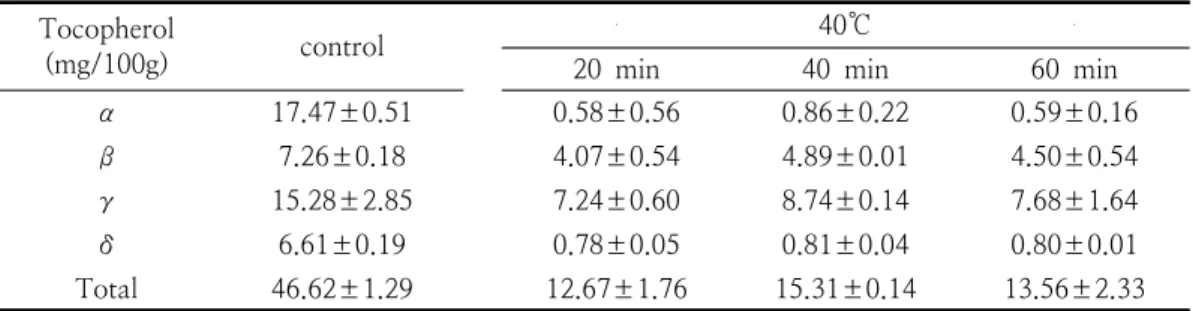
3.4. 산성백토 이용 저온압착 유채유의 탈색에 따른 토코페롤과 식물성 스테롤 함량변화 저온압착 유채유를 산성백토 DC-SUPER(2%) 로 탈색 후 토코페롤 함량을 분석한 결과를 Table 4에 나타내었다. 탈색 전 저온압착 유채유 는 총 토코페롤 함량이 46.62 mg/100g이며, 토 코페롤 성분 중 α-토코페롤과 γ-토코페롤이 각각 17.47 mg/100g과 15.28 mg/100g으로 높 게 함유되어 있고, β-토코페롤과 δ-토코페롤이 7.26 mg/100g, 6.61 mg/100g으로 낮게 함유되 어 있었다. 하지만 산성백토로 40℃에서 20분, 40분, 및 60분 동안 탈색한 후, 총 토코페놀 함
량을 보면 12.67mg/100g, 15.31mg/100g, 13.56mg/100g로 나타났으며, 탈색 전과 비교해 약 50% 이상 감소하였다. 특히 탈색 후 α-토코 페롤과 δ-토코페롤의 함량 감소가 매우 컸고, γ>β>α>δ-토코페롤의 순으로 탈색된 유채유 에 함유되어 있었다. 한편 탈색 시, 처리시간 증 가에 따른 총 토코페놀 함량 변화에는 큰 차이가 없었다. 일반적으로 토코페롤의 항산화력은 δ>
γ>β>α 순으로 크다고 알려져 있다.
식물성 스테롤은 식물의 세포막, 호르몬 및 몇 몇 비타민의 주요 요소로서 이용이 되고, 인체에 서 LDL 콜레스테롤 수치를 낮춰주는 효과가 있 다고 알려져 있다. 저온압착 유채유를 산성백토로 탈색 후 파이토스테롤 함량을 Table 5에 나타내 었다. 토코페롤의 함량 감소와는 대조적으로 식물 성 스테롤 함량은 탈색 전과 후에 함량 변화에는 차이가 없었다.
3.5. 산성백토 이용 저온압착 유채유의 탈색에 따른 지방산 조성
산성백토(DC-SUPER)로 탈색한 저온압착 유 채유의 지방산 조성 변화를 알아보고자 GC 분석 을 수행하였다(Fig. 2, Table 6). 탈색과정 시 반 응온도와 처리시간 변화에 따른 지방산 조성에는 대조구와 비교해 변화를 보이지 않았다(Table 6).
Table 4. Effect of cold-pressed rapeseed oil bleaching with acid-activated clay on tocopherol contents according to the reaction time (rapeseed oil 300g; acid-activated clay DC-SUPER 2%; reaction temp. 40℃; reaction time 20~60 min)
Tocopherol
(mg/100g) control 40℃
20 min 40 min 60 min
α 17.47±0.51 0.58±0.56 0.86±0.22 0.59±0.16
β 7.26±0.18 4.07±0.54 4.89±0.01 4.50±0.54
γ 15.28±2.85 7.24±0.60 8.74±0.14 7.68±1.64
δ 6.61±0.19 0.78±0.05 0.81±0.04 0.80±0.01
Total 46.62±1.29 12.67±1.76 15.31±0.14 13.56±2.33 Table 5. Effect of cold-pressed rapeseed oil bleaching with acid-activated clay on phytosterol
contents according to the reaction temperature and time (rapeseed oil 300g;
acid-activated clay DC-SUPER 2%; reaction temp. 40℃; reaction time 20~60 min) Phytosterol
(ppm) control 40℃
20 min 40 min 60 min
β-sitosterol 1538±219 1582±179 1688±126 1641±144
campesterol 1188±234 1151±139 1230±51 1431±163
stigmasterol 79±4 75±2 77 78±2
Total 2805±457 2807±321 2994±178 3149±20
Fig. 2. GC Chromatogram of fatty acid compositions in bleached and unbleached cold-pressed rapeseed oils. (A) unbleached cold-pressed rapeseed oil; (B) bleached cold-pressed rapeseed oil at 40℃ for 20 min; (C) bleached cold-pressed rapeseed oil at 80℃ for 20 min; (D) bleached cold-pressed rapeseed oil at 120℃ for 20 min.
Fatty acid control 40℃ 80
℃
120℃
20 min 40 min 60 min 20 min 40 min 60 min 20 min 40 min 60 min
Palmitic acid 3.55 3.65 3.51 3.67 3.60 3.66 3.65 3.64 3.64 3.52 Stearic acid 1.93 1.92 1.88 1.97 2.10 1.84 1.90 1.89 1.94 1.89 Oleic acid 63.39 62.98 62.42 62.33 61.47 62.50 62.70 62.46 62.68 62.67 Linoleic acid 17.50 17.54 17.58 17.46 17.48 17.54 17.34 17.46 17.43 17.44 Linolenic acid 6.37 6.38 6.40 6.33 6.37 6.39 6.21 6.30 6.29 6.22 Eicosenoic acid 2.67 2.67 2.61 2.89 2.64 2.87 2.74 2.89 2.73 2.79 Erusic acid 4.67 4.34 4.90 4.41 5.55 4.08 4.61 4.24 4.44 4.60 Table 6. Effect of cold-pressed rapeseed oil bleaching with acid-activated clay on fatty acidcomposition (rapeseed oil 300g; activated clay DC-SUPER 2%; reaction temp. 40~12 0℃; reaction time 20~60 min; unbleached cold-pressed rapeseed oil was used as a control)
불포화지방산이 93.3~94.1%, 포화지방산은 5.6~
6.1%로 구성 되어있으며, 그 중 올레인산과 리놀 레익산이 80%이상을 차지하고 있었다.
4. 결 론
1. 산성백토(DC-SUPER) 첨가량(1, 2, 3%)에 따른 저온압착 유채유의 탈색능을 관찰한 결과 첨가량 2%와 처리시간 1시간에서 저 온압착 유채유의 색도가 진노랑에서 연노랑 으로 옅어졌다.
2. 총 3종의 산성백토(DC-SUPER, DC-A3, 및 P1)에 대해 첨가량 2%를 기준으로 처리 시간(20, 40, 60, 80분) 증가에 따라 탈색 한 후 색차를 조사한 결과, 처리시간 20분 경과 후부터 대조구 대비 명도(L)는 증가하 였고, 적색도(a)와 황색도(b)는 감소하는 경 향을 보였다.
3. 산성백토 DC-SUPER(첨가량 2%)를 이용하 여 반응온도(40, 80, 120℃)에 따른 색차를 조사한 결과, L값과 a값은 큰 차이를 보이 지 않았으나, b값은 급격히 감소하는 경향 을 보였다. 특히 반응온도 40℃에서 20분 이내에 클로로필 A와 카로티노이드는 대부 분 제거되었고, 온도가 높아질수록 제거율이 높았다.
4. 산성백토 DC-SUPER(첨가량 2%) 및 반응 온도 40℃ 조건하에서 반응시간(20, 40, 60 분)에 따른 저온압착 유채유를 탈색한 경우, 무처리 대비 토코페롤 함량은 현저히 감소 하였으나, 반응시간 증가에 따른 토코페롤 함량은 감소는 나타나지 않았다. 탈색 전 저온압착 유채유의 총 토코페롤 함량은 46.62mg/100g이나, 탈색 후 총 토코페놀은 12.67mg/100g(20분 탈색), 15.31mg/100g (40분 탈색), 13.56mg/100g(60분 탈색)로 나타나, 약 50% 이상 감소하였다. 탈색 후 α-토코페롤과 δ-토코페롤의 함량 감소가 매우 컸고, γ>β>α>δ-토코페롤의 순으로 포함되어 있었다.
5. 산성백토 DC-SUPER(첨가량 2%) 및 반응 온도 40℃ 조건하에서 반응시간(20, 40, 60 분)에 따른 식물성 스테롤 함량은 탈색 전 과 후에 큰 변화가 없었다.
따라서 본 연구에서는 산성백토 이용 저온압착 유채유 탈색시 색도를 향상시킴을 확인하였으며, 영양학적으로 우수한 총 토코페롤의 함량이 감소 한 바 이를 보완 할 수 있는 연구가 필요하다.
감사의 글
본 논문은 농촌진흥청 연구사업(세부과제번호:
PJ01109802)의 지원에 의해 이루어진 것임
References
1. Kania M., Michalak M., Gogolewski M., and Hoffmann A., Antioxidative potential of substances contained in cold pressed soybean oil and after each phase of refining process.
Acta Scientiarum Polonorum. Technologia Alimentaria
, 3(1), 113 (2004).2. Lee Y.H., Shin J.A., Zhang H., Lee K.T., Kim K.S., Jang Y.S., and Park K.G., Improvement of low temperature property of biodiesel from palm oil and beef tallow via urea complexation.
Journal of the Korean society for New and Renewable Energy,
8(4), 38 (2012).3. Choe E., and Min D.B., Mechanisms and factors for edible oil oxidation.
Comprehensive reviews in food science and food safety
, 5(4), 169 (2006).4. Gee P.T., Analytical characteristics of crude and refined palm oil and fractions.
European journal of lipid science and technology,
109(4), 373 (2007).5. Sionek B., Cold pressed oils.
Roczniki Panstwowego Zakladu Higieny,
48(3), 283 (1997).6. Sawamura M., THI MINH TU N., Onishi Y., Ogawa E., and Choi H.S., Characteristic odor components of Citrus reticulata Blanco (Ponkan) cold-pressed oil.
Bioscience, biotechnology, and biochemistry
, 68(8), 1690 (2004).7. Siger A., Nogala-Kalucka M., and Lampart-Szczapa E., The content and antioxidant activity of phenolic compounds in cold-pressed plant oils.
Journal of Food Lipids
, 15(2), 137 (2008).8. Kim J.K., Park J.Y., Jeon C.H., Min K.I., Yim E.S., Jung C.S., and Lee J.H., Fuel Properties of Various Biodiesels Derived Vegetable Oil.
Journal of the Korean Oil Chemists' Society,
30(1), 35 (2013).9. Stout L.E., Chamberlain D.F., and McKelvey J.M., Factors influencing vegetable oil bleaching by adsorption.
Journal of the American Oil Chemists’
Society
, 26(3), 120 (1949).10. Taylor D.R., Ungermann C.B., and Demidowicz Z., The adsorption of fatty acids from vegetable oils with zeolites and bleaching clay/zeolite blends.
Journal of the American Oil Chemists’ Society
, 61(8), 1372 (1984).11. Bayari O.R., Musleh S.M., Tutungi M.F., and Derwish G.W., Bleaching of some vegetable oils with acid-activated jordanian bentonite and kaolinite.
Asian Journal of Chemistry,
20(3),
2385 (2008).12. Makhoukhi B., Didi M.A., Villemin D., and Azzouz A., Acid activation of bentonite for use as a vegetable oil bleaching agent. G
rasas y Aceites
, 60(4), 343 (2009).13. Vernon L.P., Spectrophotometric determination of chlorophylls and pheophytins in plant extracts.
Analytical Chemistry
, 32(9), 1144 (1960).14. Rahmani M., and Csallany A.S., Chlorophyll and β-carotene pigments in Moroccan virgin olive oils measured by high-performance liquid chromatography.
Journal of the American Oil Chemists Society,
68(9), 672 (1991).15. Nam H.Y., and Lee K.T., Analysis of characterization in commercial extra virgin olive oils.
Journal of the Korean Society of Food Science and Nutrition
, 36(7), 866 (2007).16. Lee M.H., Kim M.S., Lee L.G., Shin H.G., and Sohn H.Y., Evaluation of biological activity and characterization of taste and function-enhanced yam chips.