http://dx.doi.org/10.14405/kjvr.2015.55.2.117
117
<Original Article>
Antibacterial activities of bark extracts from Fraxinus rhynchophylla Hance and Geranium koreanum Kom. against clinical strains
of Clostridium perfringens in chickens
Jae-Young Oh
1, Kwang-Jae Lee
2, Bai Wei
1, Jae-Hee Roh
1, Min Kang
1, Se-Yeoun Cha
1, Hyung-Kwan Jang
1,*
1
Department of Infectious Diseases and Avian Diseases, College of Veterinary Medicine and Korea Zoonosis Research Institute, Chonbuk National University, Iksan 570-752, Korea
2
Gangwon Agricultural Research and Extension Services, Chuncheon 200-701, Korea (Received: January 22, 2015; Revised: April 16, 2015; Accepted: April 22, 2015)
Abstract : Necrotic enteritis (NE) caused by Clostridium (C.) perfringens commonly occurs in domestic broiler farms since antibiotic supplementation in poultry feed has been banned. We evaluated the antibacterial activities of medicinal plant extracts against C. perfringens isolates to select alternative compounds for preventing NE. We compared antibacterial activities using two methods and evaluated susceptibilities of the isolates based on minimum inhibitory concentration (MIC) and minimum bactericidal concentration (MBC). Two (Fraxinus rhynchophylla Hance [FRH] and Geranium koreanum Kom. [GKK]) of the 30 plant extracts had potent antibacterial activities against C. perfringens ATCC 13124 in two assays. The MIC values for FRH and GKK against 20 C. perfringens isolates were 128~256 µg/mL and 32~128 µg/mL, respectively. The geometric MIC mean values for the two extracts were 147.2 µg/mL and 68.8 µg/mL, respectively. The MBCs for the two extracts against the same strains were 1,024~2,048 µg/mL and 256~1,024 µg/mL, respectively. The geometric mean MIC and MBC for GKK were about two-fold lower than those of FRH. The modified spot-on-lawn assay may be useful for measuring primary antibacterial potential. FRH and GKK are expected to be used as feed additives to prevent or treat NE in veterinary practice.
Keywords : Clostridium perfringens, feed additives, Fraxinus rhynchophylla Hance, Geranium koreanum Kom., necrotic enteritis
Introduction
Clostridium (C.) perfringens causes a variety of economi- cally significant diseases in the broiler industry [28] but other bacterial diseases as well as C. perfringens are controlled with antibiotics. The intestinal microflora inhabiting the chicken digestive track has inevitably changed since the ban on antibiotic use in poultry feed, which has increased the prevalence of health problems in chicken flocks, particularly disease caused by C. perfringens, the causative agent of necrotic enteritis (NE) in broiler chickens [13]. The occur- rence of necrotic lesions in the small intestine is associated with proliferation of C. perfringens and thus might result in more severe lesions [22]. NE commonly occurs in broiler chicken about 4 weeks after hatching and is found in all poultry production facilities worldwide [2, 30]. Many pro- phylactic agents, such as probiotic, prebiotic, mineral, and plant extracts made of various materials, have been used on poultry farms to prevent NE. However, these agents are being
released without results from in vitro and in vivo experi- ments; the antimicrobial activities against C. perfringens strains and the treatment effects of these products have not properly evaluated in an animal disease model.
Fraxinus rhynchophylla Hance is a tree in the Lamiales family. It is commonly known as Korean ash and is widely cultivated throughout Asia, Europe, and North America. The stem bark of F. rhynchophylla Hance has been used as an ori- ental medicine for various diseases, including shigellosis, enteritis, diarrhea, and conjunctivitis [8, 14]. The phytochem- ical components of the F. rhynchophylla Hance bark consist of daucosterol, caffeic acid, 6,8-dihydroxy-7-methoxycou- marin, and conifer aldehyde glucoside [32]. Of these, caffeic acid has superior pharmacological efficacy as well as antivi- ral, antioxidant, antimicrobial, and anti-inflammatory activi- ties. Coumarin compounds protect against fungi and bacteria [3, 25].
Geranium koreanum Kom. is a herbaceous plant in the Geraniaceae family that grows throughout the Korean penin-
*Corresponding author
Tel: +82-63-850-0945, Fax: +82-63-858-9155 E-mail: [email protected]
sula and northeast China. Similar to F. rhynchophylla Hance, G. koreanum Kom. has been traditionally used as a Chinese herbal medicine to treat various diseases, such as itching, bruising, shigellosis, enteritis, and chronic diarrhea. G. kore- anum Kom. contains widely known chemicals, such as tan- nins, quercetin, succinic acid, and gallic acid in the hay. Few studies have evaluated the antimicrobial activities of these plant extracts against clinical pathogens. The main objec- tives of this study were to investigate the in vitro antibacte- rial activity of F. rhynchophylla Hance and G. koreanum Kom. against C. perfringens strains isolated from broiler chick- ens with NE and to examine their practicality as feed addi- tives in the poultry industry.
Materials and Methods
Strain collection, identification, and clostridial toxin genes
Our laboratory performs primary avian disease diagnoses as an animal disease diagnostic institute approved from the Ministry of Agriculture, Food, and Rural Affairs. Commer- cial chickens with various clinical signs are transferred from poultry farms to our diagnostic laboratory. C. perfringens was isolated from a chicken with suspected small intestinal NE by necropsy. Briefly, swab samples of the internal organs (liver and small intestine) were streaked on blood agar plates and incubated at 37
oC under anaerobic conditions for 18 h to isolate C. perfringens. Beta hemolytic colonies growing on the medium were purified on the Clostridium-selective medium Shahidi-Ferguson Perfringens (SFP) agar enriched with 50%
egg yolk (w/v), 30,000 units/L polymyxin B sulfate, and 12 mg/L kanamycin (Becton, Dickinson and Company, USA).
The C. perfringens strains were identified and the toxins were typed by multiplex polymerase chain reaction (PCR) using five previously described toxin gene primer sets (cpa, cpb, etx, iap, and cpe) [31]. C. perfringens ATCC 13124 was used as the positive control to identify the field strains.
Preparation of the plant extracts
Thirty wild plants, collected from Gangwon and Gyeonggi provinces on the Korean peninsula during 2011~2012, were dried in a dark at room temperature and ground to a fine powder. The powder was mixed with 95% ethanol and stirred with a magnetic stirrer for 24 h at room temperature. After removing the residue by funnel filtration using filter paper, the mixed solutions were concentrated using a rotary vac- uum evaporator (EYELA N-21NS; Tokyo Rikakikai, Japan), and the samples were dried in a lyophilizer (PVTFD 10R;
Ilshin Biobase, Korea). Ten g of dried powder was sus- pended in 100 mL of sterile deionized water and vortexed vigorously for 10 min at room temperature. After filtration through a 0.45 µm syringe filter (Minisart; Sartorius Stedim Biotech, Germany), the solvents were stored at 4
oC [18]. The paper disc diffusion and modified spot-on-lawn assays were conducted with 10% filtered plant water extract to select the
plant extract exhibiting a strong inhibitory effect against C.
perfringens. The paper disc diffusion and the modified spot- on-lawn assays were conducted by measuring inhibition zones around paper discs and clear inhibition zones of the dropped plant extract on culture medium, respectively.
Comparative study to screen the plant extract with antibacterial potential
We applied two methods to more efficiently select the plant extract with antibacterial potential against C. perfrin- gens. First, the paper disc diffusion assay was conducted as described by the Clinical and Laboratory Standards Institute (CLSI) [5]. Approximately 10
5colony forming units/mL bac- terial culture refreshed in Mueller-Hinton (MH) broth (Bec- ton, Dickinson and Company) were lawned onto MH agar (Becton, Dickinson and Company) using a sterile swab. Six mm sterile paper discs (Advantec, Japan) were placed on the inoculated medium, and 10 µL of serially diluted (0.125~4%, v/v) plant water extract in sterile deionized water was dropped onto each disc using a micropipette. A 10 µg ampi- cillin disc (Becton, Dickinson and Company) and deionized distilled water were used as positive and negative controls, respectively. The plant extract concentration ranges were set arbitrarily to compare the two experiments. Second, the spot- on-lawn assay was used as described previously [12] with a slight modification. Briefly, 1 mL bacterial culture refreshed in MH broth was dropped to moisten the cultures on MH agar, and the remaining cultures were removed and placed in medium to dry for 10 min on a clean bench. A 10 µL aliquot of each extract was spotted at regular intervals onto this lawn using the same concentration ranges as described above, and incubated at 37
oC under anaerobic conditions for 18 h.
MICs and MBCs
MICs and MBCs were evaluated using a CLSI method [5]
to determine the antimicrobial susceptibility of the two plant extracts. The MIC is the smallest concentration of an antibac- terial agent that will inhibit growth of bacteria after an over- night incubation, and the MBC is the smallest concentration of antimicrobial that prevents growth of bacteria after subcul- ture on antibiotic-free medium. MICs are used to determine in vitro activity of new antimicrobial or natural antibiotic materials. The two plant extracts were incorporated into MH agar plates containing double dilutions of the plant extracts at concentrations of 16~8,192 µg/mL. The bacterial cultures that were refreshed in MH broth were dropped on the MIC medium containing the plant extract using Steers multiple inoculator apparatus, and the media were incubated at 37
oC for 18 h under anaerobic conditions. The MBC test was per- formed to determine bactericidal activity. Briefly, 100 µL of plant extract was added to a 96-well microplate containing two-fold serial dilutions from 64 to 4,096 µg/mL. Two mL of C. perfringens inoculum was centrifuged for 10 min at 3,300
× g, and the supernatant was removed and suspended with an
equal volume of 2× MH broth. Optical density at 600 nm
was adjusted to 0.3. The inoculum was added to a 96-well microplate containing 100 µL of diluted plant extract and incubated at 37
oC under anaerobic conditions for 18 h. A 10 µL aliquot of each cultured mixture was enumerated on SFP agar (Becton, Dickinson and Company) to determine bacteri- cidal activity and the MBC. The antimicrobial susceptibility tests were performed in duplicate. Three standard strains with the clostridial toxin gene, such as C. perfringens ATCC 13124 (Type A), ATCC 12916 (Type A), and ATCC 3628 (Type C) were used to determine MICs and MBCs together with the wild strains.
Results
Identifying the plant extract with outstanding antibac- terial activity
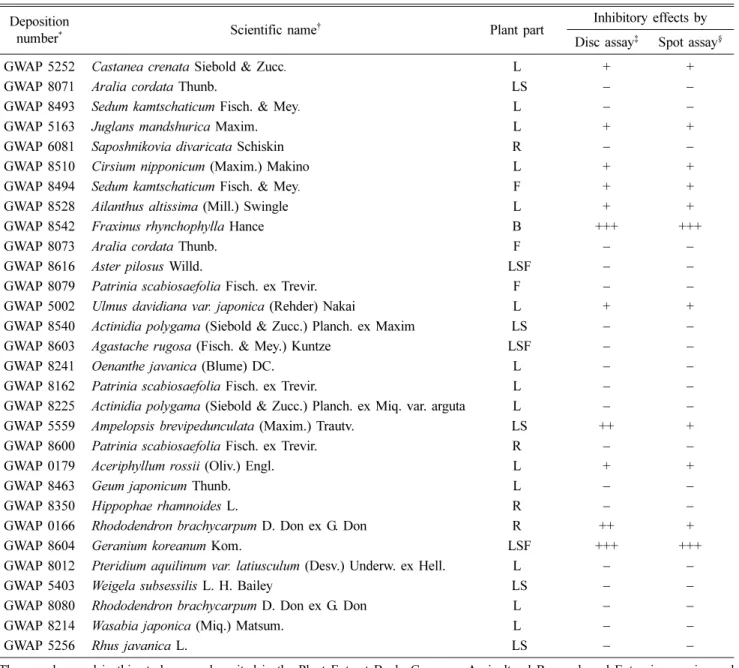
The antibacterial activities of the 30 plant ethanol extracts against C. perfringens ATCC 13124 were determined using the paper disc diffusion and the modified spot-on-lawn assays (Table 1). The inhibition zones shown by the paper disc dif- fusion assay were 6~10 mm, and the inhibitory effect was evaluated by diffusion diameter. Differences in the clear inhi- bition zones caused by the plant extracts on culture medium
Table 1. Inhibitory effect of 30 wild plant extracts against Clostridium perfringens ATCC 13124 using the paper disc diffusion and the modified spot-on-lawn assays
Deposition
number* Scientific name† Plant part Inhibitory effects by
Disc assay‡ Spot assay§
GWAP 5252 Castanea crenata Siebold & Zucc. L + +
GWAP 8071 Aralia cordata Thunb. LS − −
GWAP 8493 Sedum kamtschaticum Fisch. & Mey. L − −
GWAP 5163 Juglans mandshurica Maxim. L + +
GWAP 6081 Saposhnikovia divaricata Schiskin R − −
GWAP 8510 Cirsium nipponicum (Maxim.) Makino L + +
GWAP 8494 Sedum kamtschaticum Fisch. & Mey. F + +
GWAP 8528 Ailanthus altissima (Mill.) Swingle L + +
GWAP 8542 Fraxinus rhynchophylla Hance B +++ +++
GWAP 8073 Aralia cordata Thunb. F − −
GWAP 8616 Aster pilosus Willd. LSF − −
GWAP 8079 Patrinia scabiosaefolia Fisch. ex Trevir. F − −
GWAP 5002 Ulmus davidiana var. japonica (Rehder) Nakai L + +
GWAP 8540 Actinidia polygama (Siebold & Zucc.) Planch. ex Maxim LS − −
GWAP 8603 Agastache rugosa (Fisch. & Mey.) Kuntze LSF − −
GWAP 8241 Oenanthe javanica (Blume) DC. L − −
GWAP 8162 Patrinia scabiosaefolia Fisch. ex Trevir. L − −
GWAP 8225 Actinidia polygama (Siebold & Zucc.) Planch. ex Miq. var. arguta L − −
GWAP 5559 Ampelopsis brevipedunculata (Maxim.) Trautv. LS ++ +
GWAP 8600 Patrinia scabiosaefolia Fisch. ex Trevir. R − −
GWAP 0179 Aceriphyllum rossii (Oliv.) Engl. L + +
GWAP 8463 Geum japonicum Thunb. L − −
GWAP 8350 Hippophae rhamnoides L. R − −
GWAP 0166 Rhododendron brachycarpum D. Don ex G. Don R ++ +
GWAP 8604 Geranium koreanum Kom. LSF +++ +++
GWAP 8012 Pteridium aquilinum var. latiusculum (Desv.) Underw. ex Hell. L − −
GWAP 5403 Weigela subsessilis L. H. Bailey LS − −
GWAP 8080 Rhododendron brachycarpum D. Don ex G. Don L − −
GWAP 8214 Wasabia japonica (Miq.) Matsum. L − −
GWAP 5256 Rhus javanica L. LS − −
*The samples used in this study were deposited in the Plant Extract Bank, Gangwon Agricultural Research and Extension service and renewed every 2 years for preservation. †Each plant water extract (10%) was loaded on a paper disc and agar medium, respectively. ‡Blank disc zone diameters: 6 mm, −; > 6 to < 7 mm, +; ≥ 7 to < 9 mm, ++; ≥ 9 mm, +++. §No inhibition zone, −; low zone of inhibition, +; strong zone of inhibition, +++. B: bark, F: flower, L: leaf, LS: leaf and stem, LSF: leaf, stem, and flower, R: root.
were macroscopically observed using the modified spot-on- lawn assay. Eleven plant water extracts showed antibacterial activities in two experiments. Of these, two medicinal plant extracts (F. rhynchophylla Hance and G. koreanum Kom.) had strong inhibitory effects against C. perfringens ATCC 13124 compared with that of the other plant extracts (Table 1).
Useful technique for analyzing antimicrobial activity A comparative study was conducted to evaluate the anti- bacterial activity of F. rhynchophylla Hance against four C.
perfringens strains using the paper disc diffusion assay in the range 0.0625~4% at a double diluted concentration of plant water extract. The modified spot-on-lawn assay was used at 0.125~4% (Fig. 1). The paper disc diffusion assay showed inhibitory effects of 1~3 mm with 2% and 4% plant water extracts dropped on the growth medium, whereas the mini- mum inhibitory effect in the modified spot-on-lawn assay was 0.5 or 1.0% based on the size of the clear zones of the tested strains. Accordingly, we selected the optimal method for evaluating antibacterial activity between the two experi- ments.
Antimicrobial activity against chicken NE strains Twenty C. perfringens strains were collected from domes- tic broiler chickens with NE at 12 farms in three provinces
(Jeonbuk, Jeonnam, and Chungbuk) of South Korea during 2013. Most of these isolates, except one, had the cpa and cpb2 genes, as determined by multiplex PCR, and were named C. perfringens Type A (Table 2). These strains were applied to the antimicrobial susceptibility tests to determine the MIC and MBC values. MIC values of the F. rhyncho- phylla Hance and G. koreanum Kom. extracts were 128~256 µg/mL and 32~128 µg/mL, respectively. The geometric mean MIC values of the two extracts were 147.2 µg/mL and 68.8 µg/mL, respectively. The MBCs of the two extracts were 1,024~2,048 µg/mL and 256~1,024 µg/mL, respectively. The geometric mean MBC values of the two extracts were 1,382.4 µg/mL and 716.8 µg/mL, respectively. The geometric mean MIC and MBC values against the G. koreanum Kom. extract was about two-fold lower compared to those of the F. rhyn- chophylla Hance extract (Table 2). MIC and MBC values against the C. perfringens Type A strain ATCC 13124 pro- ducing alpha toxin (CPA), ATCC 12916 producing entero- toxin (CPE), and C. perfringens ATCC 3628 Type C strain also with the cpa gene showed similar antibacterial effects and were consistent with the wild-type strains tested. The geometric MBC value against the wild-type C. perfringens strains was more than three-fold higher than the geometric MIC value.
Fig. 1. Antibacterial activities of Fraxinus rhynchophylla Hance against Clostridium perfringens ATCC 13124 and three clinical strains using two methods. Paper disc diffusion assay (top): Bacterial inoculums were lawned onto MH agar using a sterile swab. Six mm sterilized paper discs were placed on the inoculated medium, and 10µL of the plant water extract serially diluted from 0.125 to 4%
(v/v) was dropped on each disc. A 10µg ampicillin disc (AM10) and deionized distilled water were used as positive and negative controls, respectively. The modified spot-on-lawn assay (bottom): One mL of bacterial culture was dropped to moisten the cultures on MH agar and the remaining inocula were removed and placed in medium to dry for 10 min on a clean bench. Ten µL of each seri- ally diluted plant extract was spotted on MH agar and incubated at 37oC under anaerobic conditions for 18 h.
Discussion
We compared the antibacterial activities of plant extracts using two experiments, paper disc diffusion and modified spot-on lawn assays. We confirmed that the modified spot- on-lawn assay is a practical tool for screening potential anti- bacterial effects of plant water extracts against bacteria.
Some reports show that the method used to determine anti- bacterial activity can produce different results from a variety of substances or their concentrations [16, 17]. These two experiments have been commonly used as a useful way to evaluate antibacterial effects against pathogenic bacteria iso- lated from humans and animals with clinical signs. The inhibitory effect indicated by the paper disc diffusion assay is also used to calculate the antibacterial activities of various materials, such as antibacterial substances from lactic acid, herbal extracts, chemical compounds, and antimicrobial pep- tides against clinically important bacteria [19, 24, 27, 29, 33].
However, this method is not extremely effective for evaluat- ing concentrations of a substance required in comparison with the spot-on-lawn assay. Recent studies suggest that the spot-on-lawn assay is a practical and suitable technique to
evaluate antibacterial activities of various materials. The spot-on-lawn assay is more reproducible, rapid, and easier to score than those of other methods and is superior to other methods in studies of three bacteriocin-producing strains against a large panel of food borne pathogens [16, 29]. In the present study, the modified spot-on-lawn method, which is very simple to observe with the naked eye, was used to iden- tify the inhibition zones at various concentrations of a sub- stance, and was useful to evaluate the in vitro inhibitory effect against pathogenic strains from plant water extracts.
Antibiotics have been used as feed additives with a bacte- ricidal effect on livestock farms for the last century. Since the South Korea ban on antibiotic feed additives in 2011, research and development of natural materials or synthetic com- pounds are proceeding to prevent and treat animal diseases.
However, opportunistic pathogens inhabiting the chicken digestive tract have caused significant damage to the poultry industry through representative gastrointestinal diseases, such as NE by C. perfringens, coccidiosis by Eimeria spp., and co-infection with C. perfringens and Eimeria spp. Control of chicken diseases resulting from Eimeria infection on poultry farms has been studied using various herbal extracts (green
Table 2. Minimum inhibitory concentration (MIC) and minimum bactericidal concentration (MBC) values (µg/mL) of the two plantextracts against 20 Clostridium perfringens strains isolated from broiler chickens with necrotic enteritis C. perfringens
Strains
Toxin types
(toxin-associated genes) Sources Fraxinus rhynchophylla Hance Geranium koreanum Kom.
MIC MBC MIC MBC
ATCC 13124 A (cpa) – 128 2,048 64
1,512
ATCC 12916 A (cpa-cpe) – 128 2,048 32
1,256
ATCC 3628 C (cpa) – 256 1,024 64 1,024
ACP13-01 A (cpa-cpb2) Jejunum 128 2,048 64 1,024
ACP13-04 A (cpa-cpb2-netB-tpeL) Liver 128 1,024 64 1,024
ACP13-05 A (cpa-cpb2) Jejunum 128 1,024 32
1,512
ACP13-07 A (cpa-cpb2) Jejunum 128 1,024 32
1,512
ACP13-10 A (cpa-cpb2) Jejunum 128 1,024 64 1,024
ACP13-11 A (cpa-cpb2-netB-tpeL) Jejunum 128 1,024 32
1,512
ACP13-12 A (cpa-cpb2) Liver 128 1,024 64 1,024
ACP13-15 A (cpa-cpb2) Jejunum 256 1,024 128
1,512
ACP13-18 A (cpa-cpb2) Jejunum 128 2,048 64
1,512
ACP13-19 A (cpa-cpb2-netB) Jejunum 128 2,048 64
1,512
ACP13-22 A (cpa-cpb2) Jejunum 256 2,048 128
1,512
ACP13-23 A (cpa) Jejunum 128 1,024 64
1,512
ACP13-28 A (cpa-cpb2-netB-tpeL) Jejunum 128 2,048 64
1,512
ACP13-29 A (cpa-cpb2-netB-tpeL) Liver 128 1,024 64
1,512
ACP13-30 A (cpa-cpb2) Jejunum 128 2,048 64
1,512
ACP13-31 A (cpa-cpb2) Jejunum 256 1,024 128 1,024
ACP13-35 A (cpa-cpb2-netB) Jejunum 128 1,024 64 1,024
ACP13-36 A (cpa-cpb2-netB) Jejunum 128 1,024 64 1,024
ACP13-37 A (cpa-cpb2) Jejunum 128 1,024 64 1,024
ACP13-38 A (cpa-cpb2-netB) Jejunum 128 2,048 64
1,512
Geometric mean of MIC and MBC 147.2 1,382.4 68.8
1,716.8
tea-based diets, Galla rhois, Dichroa febrifuga Lour., Mor- inga oleifera, and Morinda lucida) [6, 15, 20, 21, 34]. Fur- thermore, Eimeria-infected chickens supplemented with natural herbal extracts show improvement in oocyst excretion, body weight, fecal scores, bloody diarrhea, and intestinal lesions.
Unfortunately, Chinese medicinal plants or wild plant extracts with antibacterial effects against C. perfringens causing necro- hemorrhagic enteritis in animals and humans are almost unknown. An extract of F. rhynchophylla Hance bark has antimicrobial activities against Staphylococcus aureus, Shi- gella dysenteriae, and nine food-poisoning pathogens except C. perfringens [9]. Our results show that the antibacterial activities of plant extracts from F. rhynchophylla Hance and G. koreanum Kom. against C. perfringens strains isolated from domestic commercial chickens with clinical NE were highly effective. The pharmacological actions and antioxidant activ- ities of F. rhynchophylla bark and leaves have been studied [8, 23], but G. koreanum Kom. is little known for its antibac- terial activity or relevant properties. Several studies have demonstrated that essential oils isolated from Geranium mac- rorrhizum and Pelargonium graveolens (family Geraniaceae) have high antimicrobial potential against of Bacillus subtilis, Pseudomonas aeruginosa, and S. aureus strains [1, 7]. A recent South Korean study (PJ907105) demonstrated that a G.
koreanum Kom. extract highly inhibits growth of C. perfrin- gens. Furthermore, proliferation of Bifidobacterium bifidum, which is a beneficial intestinal bacterium, increased > 20% in an in vitro assay [11]. Therefore, we used plant extracts instead of antibiotics to determine MIC and MBC values.
Thus, we verified the antibacterial potential of two plant medicinal extracts. Although the MIC values of the plant extracts against C. perfringens strains in the present study were somewhat higher than the MIC breakpoints for most antibiotics (ampicillin, erythromycin, tylosin, florfenicol, vir- giniamycin, and narasin) which are used as therapeutic agents in poultry [4, 10, 26], these two extracts could be additives to prevent clostridial NE on poultry farms.
In summary, F. rhynchophylla Hance and G. koreanum Kom. showed antibacterial potential against clostridial strains from poultry; thus, these two medicinal plants are expected to be used as a feed additive to prevent or treat NE in veter- inary practice. For these medicinal herbal extracts, in-depth experimental studies are needed to find out their precise active components and evaluate their protective effect in NE model.
Acknowledgments
This study was carried out with support of the "Coopera- tive Research Program for Agriculture Science and Technol- ogy Development (PJ009314, PJ907105)" Rural Develop- ment Administration and Animal Disease Management Tech- nology Development (311007-5), Ministry of Agriculture, Food, and Rural Affairs, Korea.
References
1. Bigos M, Wasiela M, Kalemba D, Sienkiewicz M. Antimi- crobial activity of geranium oil against clinical strains of Staphylococcus aureus. Molecules 2012, 17, 10276-10291.
2. Dahiya JP, Wilkie DC, Van Kessel AG, Drew MD.
Potential strategies for controlling necrotic enteritis in broiler chickens in post-antibiotic era. Anim Feed Sci Technol 2006, 129, 60-88.
3. de Souza SM, Delle Monache F, Smânia A Jr. Antibacterial activity of coumarins. Z Naturforsch C 2005, 60, 693-700.
4. Gholamiandehkordi A, Eeckhaut V, Lanckriet A, Timbermont L, Bjerrum L, Ducatelle R, Haesebrouck F, Van Immerseel F. Antimicrobial resistance in Clostridium perfringens isolates from broilers in Belgium. Vet Res Commun 2009, 33, 1031-1037.
5. Clinical and Laboratory Standards Institute. Performance Standards for Antimicrobial Susceptibility Testing; Twenty- first Informational Supplement. CLSI document M100-S21.
Clinical and Laboratory Standards Institute, Wayne, 2011.
6. Jang SI, Jun MH, Lillehoj HS, Dalloul RA, Kong IK, Kim S, Min W. Anticoccidial effect of green tea-based diets against Eimeria maxima. Vet Parasitol 2007, 144, 172- 175.
7. Jeon JR. Water extract of ash tree (Fraxinus rhynchophylla) leaves protects against paracetamol-induced oxidative damages in mice. Food Sci Biotechnol 2006, 15, 612-616.
8. Jeon JR, Choi JH. Protective effect of water extract of Fraxinus rhynchophylla leaves on acetaminophen-induced nephrotoxicity in mice and its phenolic compounds. Food Sci Biotechnol 2007, 16, 988-993.
9. Bae JH. Antimicrobial effect of Fraxinus rhynchophylla extracts on food-borne pathogens. Korean J Microbiol Biotechnol 2004, 32, 277-281.
10. Johansson A, Greko C, Engström BE, Karlsson M.
Antimicrobial susceptibility of Swedish, Norwegian and Danish isolates of Clostridium perfringens from poultry, and distribution of tetracycline resistance genes. Vet Microbiol 2004, 99, 251-257.
11. Jung H, Jung E, Kim H, Ahn M, Jang H, Lee K.
Antimicrobial activity and stability of Fraxinus rhynchophylla Hance extract. Planta Med 2013, 79, PL9.
12. Kim CH, Ji GE, Ahn C. Purification and molecular characterization of a bacteriocin from Pediococcus sp.
KCA1303-10 isolated from fermented flatfish. Food Sci Biotechnol 2000, 9, 270-276.
13. Knarreborg A, Simon MA, Engberg RM, Jensen BB, Tannock GW. Effects of dietary fat source and subtherapeutic levels of antibiotic on the bacterial community in the ileum of broiler chickens at various ages. Appl Environ Microbiol 2002, 68, 5918-5924.
14. Kwon YS, Kim CM. A study on the chemical constituents from leaves of Fraxinus rhynchophylla. Korean J Pharmacogn 1996, 27, 347-349.
15. Lee JJ, Kim DH, Lim JJ, Kim DG, Min W, Kim GS, Lee HJ, Rhee MH, Park H, Kim SC, Chang HH, Kim S. Anticoccidial effect of supplemental dietary Galla Rhois against infection with Eimeria tenella in chickens. Avian Pathol 2012, 41, 403-407.
16. Lewus CB, Montville TJ. Detection of bacteriocins produced by lactic acid bacteria. J Microbiol Methods 1991, 13, 145-
150.
17. Lima ET, Andreatti Filho RL, Okamoto AS, Noujaim JC, Barros MR, Crocci AJ. Evaluation in vitro of the antagonistic substances produced by Lactobacillus spp. isolated from chickens. Can J Vet Res 2007, 71, 103-107.
18. Odey MO, Iwara IA, Udiba UU, Johnson JT, Inekwe UV, Asenye ME, Victor O. Preparation of plant extracts from indigenous medicinal plants. Int J Sci Technol 2012, 1, 688-692.
19. Ohmomo S, Murata S, Katayama N, Nitisinprasart S, Kobayashi M, Nakajima T, Yajima M, Nakanishi K.
Purification and some characteristics of enterocin ON-157, a bacteriocin produced by Enterococcus faecium NIAI 157.
J Appl Microbiol 2000, 88, 81-89.
20. Ola-Fadunsin SD, Ademola IO. Anticoccidial effects of Morinda lucida acetone extracts on broiler chickens naturally infected with Eimeria species. Pharm Biol 2014, 52, 330- 334.
21. Ola-Fadunsin SD, Ademola IO. Direct effects of Moringa oleifera Lam (Moringaceae) acetone leaf extract on broiler chickens naturally infected with Eimeria species. Trop Anim Health Prod 2013, 45, 1423-1428.
22. Olkowski AA, Wojnarowicz C, Chirino-Trejo M, Drew MD. Responses of broiler chickens orally challenged with Clostridium perfringens isolated from field cases of necrotic enteritis. Res Vet Sci 2006, 81, 99-108.
23. Radulovi NS, Zlatkovi D, Deki M, Stojanovi -Radi Z. Further antibacterial Geranium macrorrhizum L. metabolites and synthesis of epoxygermacrones. Chem Biodivers 2014, 11, 542-550.
24. Rattanachaikunsopon P, Phumkhachorn P. A bacteriocin produced by Lactobacillus lactis subsp. lactis isolated from Thai fermented foods. Sci Asia 2000, 26, 195-200.
25. Hahn DR, Kim CJ, Kim JH, Hong SK. Coumarin glycoside of Fraxinus chiisanensis. Korean J Pharmacogn
1976, 7, 195-198.
26. Slavi D, Boerlin P, Fabri M, Klotins KC, Zoethout JK, Weir PE, Bateman D. Antimicrobial susceptibility of Clostridium perfringens isolates of bovine, chicken, porcine, and turkey origin from Ontario. Can J Vet Res 2011, 75, 89-97.
27. Song KD, Lee WK. Antibacterial activity of recombinant pig intestinal parasite cecropin P4 peptide secreted from Pichia pastoris. Asian-Australas J Anim Sci 2014, 27, 278- 283.
28. Songer JG. Clostridial enteric diseases of domestic animals.
Clin Microbiol Rev 1996, 9, 216-234.
29. Spelhaug SR, Harlander SK. Inhibition of foodborne bacterial pathogens by bacteriocins from Lactococcus lactis and Pediococcus pentosaceus. J Food Prot 1989, 52, 856- 862.
30. Timbermont L, Haesebrouck F, Ducatelle R, Van Immerseel F. Necrotic enteritis in broilers: an updated review on the pathogenesis. Avian Pathol 2011, 40, 341-347.
31. van Asten AJAM, van der Wiel CW, Nikolaou G, Houwers DJ, Gröne A. A multiplex PCR for toxin typing of Clostridium perfringens isolates. Vet Microbiol 2009, 136, 411-412.
32. Yang EJ, Lee DG, Lee JW, Kim YS, Lim SH, Song KS.
The chemical constituents of the stem barks of Fraxinus rhynchophylla. J Korean Soc Appl Biol Chem 2007, 50, 348-351.
33. Yurdugül S, Bozoglu F. Studies on an inhibitor produced by lactic acid bacteria of wines on the control of malolactic fermentation. Eur Food Res Technol 2002, 215, 38-41.
34. Zhang DF, Sun BB, Yue YY, Zhou QJ, Du AF.
Anticoccidial activity of traditional Chinese herbal Dichroa febrifuga Lour. extract against Eimeria tenella infection in chickens. Parasitol Res 2012, 111, 2229-2233.
c
í
cí
cí
cí
cí
c