OPEN ACCESS Journal of Korean Tunnelling and Underground Space Association 20(4)731-742(2018)
https://doi.org/10.9711/KTAJ.2018.20.4.731
eISSN: 2287-4747 pISSN: 2233-8292
Received May 10, 2018 Revised June 15, 2018 Accepted June 21, 2018
This is an Open Access article distributed under the terms of the Creative Commons Attribution Non-Commercial License (http://creativecommons.org/
licenses/by-nc/4.0/) which permits unrestricted non- commercial use, distribution, and reproduction in any medium, provided the original work is properly cited.
Copyright ⓒ2018, Korean Tunnelling and Underground Space Association
터널 및 주변지반의 거동
차석규
1ㆍ이상덕
2*1
정회원, 아주대학교 대학원 건설시스템공학과 박사과정
2
정회원, 아주대학교 건설시스템공학과 교수
The behavior of tunnel and ground according to the loading of building construction on the ground
Seok-Kyu Cha
1ㆍSang Duk Lee
2*1
Graduate Student, Dept. of Civil System Engineering, Ajou University
2
Prof. Dr-Ing., Dept. of Civil System Engineering, Ajou University
*Corresponding Author : Sang Duk Lee, [email protected]
Abstract
Recently, the construction of the urban area has been rapidly increasing, and the excavation work of the ground has been frequently performed at the upper part of the existing underground structure. Especially, when the structure is constructed after the excavation of the ground, the loading and unloading process is repeated in the lower ground of the excavation so that it can affect existing underground structures.
Therefore, in order to maintain the stability of the existing underground structure due to the excavation of the ground, it is necessary to accurately grasp the influence of the excavation and the structure load in the adjoining part. In this study, the effects of the ground excavation and the new structure load on the existing tunnel were investigated by large - scale experiment and numerical analysis. For this purpose, a large model tester with a size reduced to 1/5 of the actual size was constructed, and model tests and numerical analyzes were carried out to investigate the effects of the excavation of the body ground by maintaining the distance between the excavation floor and the tunnel ceiling constant, The impacts were identified. As a result of the study, it was confirmed that the deeper the excavation depth, the larger the influence on the existing tunnel. At the same distance, it was confirmed that the tunnel displacement increased with the increase of the building load, and the ground stress increased up to 2.4 times. From this result, it was confirmed that the effect of the increase of the underground stress on the existing tunnel is affected by the increase of the building load, and the influence of the underground stress is decreased from the new load width above 3.0D.
Keywords: Existing tunnel, Load width, Load influence distance, Test model
초 록
최근 도심지에서 기존터널 상부에 구조물을 신설하는 경우가 증가하고 있다. 특히 지반굴착 후 구조물이 시공되는 경우 굴착 저면 하부 지반 내에서는 하중 제하, 재하 과정이 반복되므로 기존 터널에 영향을 미칠 수 있다. 따라서 지반굴착으 로 인한 기존 터널의 안정을 유지하기 위해서는 인접부에서의 굴착 및 구조물 하중에 의한 영향을 정확히 파악하여야 한 다. 본 연구에서는 기존터널 상부지반 굴착 및 신설 구조물로 인한 하중이 기존터널에 미치는 영향을 대형 모형시험과 수 치해석으로 통하여 파악하였다. 이를 위해 실제 크기의 1/5로 축소한 모형시험과 수치해석을 수행하여 굴착저면과 터널 천단 간의 거리를 일정하게 유지하고 지반굴착, 구조물 하중의 폭을 변화하여 그에 따른 영향을 파악하였다. 연구 결과, 동일 하중 크기에 대하여 굴착 깊이가 깊어져 굴착 저면과 기존터널이 가까울수록 더 큰 영향이 작용하는 것을 확인하 였다. 동일 이격 거리에서 기존터널에 영향은 건물하중 폭 증가에 따라 터널 내공변위가 증가하는 것을 확인하였고, 지중 응력은 최대 2.4배까지 증가하는 것을 확인하였다. 이로부터 건물하중 폭이 증가하면 지중응력의 증가 영향으로 기존 터 널에 영향을 주는 것을 확인하였고, 기존터널을 중심으로 신규하중의 재하 폭이 터널직경의 3배 이상으로 이격되면 지 중응력의 영향이 감소하는 것을 확인하였다.
주요어: 기존터널, 하중 폭, 영향범위, 모형시험
1. 서 론
최근 도심지 개발이 확대되어 대형 신축 구조물이 시공되는 경우가 많다. 이러한 경우 도시 지하터널 및 지하매 설물 등의 존재하는 경우가 많아 구조물 안전성에 영향을 미치게 되므로 신규 하중에 대한 영향을 정확히 파악하 여 지중 구조물의 안전성을 확보하여야 한다. 근접시공이 기존터널에 미치는 영향에 대한 연구로는 기존 터널에 근접하여 하부에 신설되는 터널에 대한 거동에 관한 연구(Kim, 2005), 기존 터널에 근접한 흙막이 굴착 시 선행 하중 재하에 대한 연구(Kim and Lee, 2007), 신규 구조물 시공 시 보강범위에 관한 연구(Lee et al., 2009) 등이 있 다. 또한 기존터널에 근접하여 신규구조물을 시공하는 경우 기존터널 안전보호권과 터널 상부의 구조물 기초에 대한 제한사항이 지침(Seoulmetro, 2001)으로 제시되어 있다.
본 연구는 실제 터널을 1/5로 축소한 모형터널을 설치하고, 터널의 직상부에 지상 11층, 지하1층 규모의 신축 건물이 시공되는 경우를 모사한 대형 모형시험 연구(Cha and Lee, 2018)와 연계하여 수치해석을 수행하여 터널 직상부의 신규 구조물의 재하 범위에 따른 기존터널 주변지반의 거동과 터널의 거동을 파악하고자 하였다.
2. 모형시험
본 연구의 선행연구인 모형시험과 연계하여 수행되었으며, 본 연구와의 연계를 위하여 선행연구(Cha and Lee,
2018) 내용을 요약하면 다음과 같다. 모형시험은 터널상부 지반에서 지하 굴착 공사 후 신축 구조물의 하중재하
로 인한 지반의 거동과 기존터널의 영향을 파악하기 위하여 실제 터널 크기의 1/5 축척으로 진행되었다. 모형시
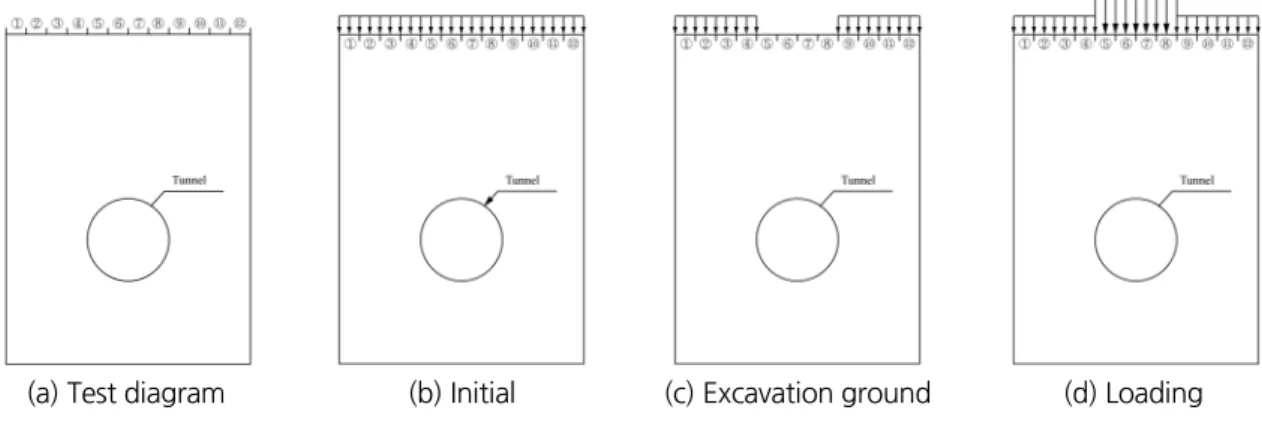
험은 대형 토조에 사질토로 지반을 조성하고, 모형터널을 매설하고 그 위에 하중 재하를 할 수 있도록 폭 2.0 m, 길이 4.0 m, 높이 6.0 m 크기의 제작되었다. 모형지반은 모래로 이용하여 모형 터널 상부로 일정한 토피고를 가지 도록 조성하였다. 모형지반 조성 후 일정 토피고, 즉 굴착 깊이에 해당하는 등분포하중을 재하하였다. 지반 굴착 은 소정의 위치에서 재하된 하중을 제거하는 방법으로 구현하였으며, 하중이 제거된 위치에 다시 하중을 재하하 여 구조물 시공에 따른 하중 증가를 모사하였다(Fig. 1).
대형 모형시험에서는 기존터널 상부의 하중재하 범위에 따른 영향과 기존 터널과 이격하여 하중이 재하되는 경우에 대하여 총 15개 조건으로 실험하였고, 실험 Case는 Table 1과 같다.
(a) Test diagram (b) Initial (c) Excavation ground (d) Loading
Fig. 1. Loading positions of the model tests (Cha and Lee, 2018)
Table 1. Cases of model tests
Category Test case Loading position Loading width
Case 1
1-1 Excavation 5 m, Load 11 story 5~8 1.0D
1-2 Excavation 10 m, Load 11 story 5~8 1.0D
1-3 Excavation 15 m, Load 11 story 5~8 1.0D
Case 2
2-1 Excavation 5 m, Load 11 story 3~10 2.0D
2-2 Excavation 10 m, Load 11 story 3~10 2.0D
2-3 Excavation 15 m, Load 11 story 3~10 2.0D
Case 3
3-1 Excavation 5 m, Load 11 story 1~12 3.0D
3-2 Excavation 10 m, Load 11 story 1~12 3.0D
3-3 Excavation 15 m, Load 11 story 1~12 3.0D
Case 4
4-1 Excavation 5 m, Load 11 story 3~6 1.0D
4-2 Excavation 10 m, Load 11 story 3~6 1.0D
4-3 Excavation 15 m, Load 11 story 3~6 1.0D
Case 5
5-1 Excavation 5 m, Load 11 story 9~12 1.0D
5-2 Excavation 10 m, Load 11 story 9~12 1.0D
5-3 Excavation 15 m, Load 11 story 9~12 1.0D
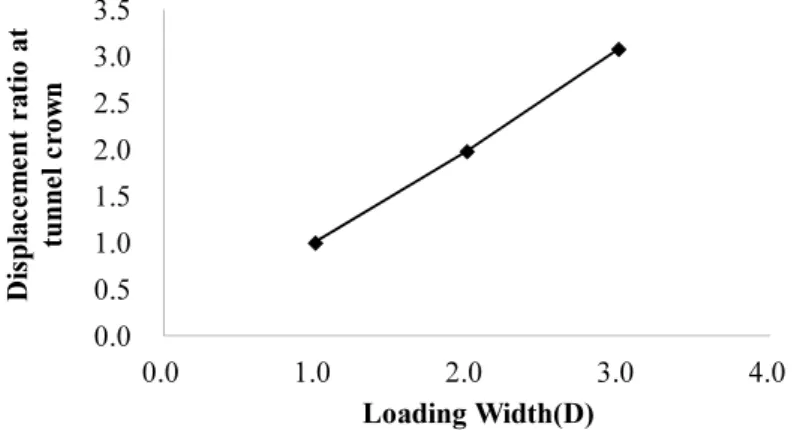
모형시험결과 신축 구조물 하중 재하 폭이 증가함에 따라 터널내공변위가 최대 50% 정도 증가하는 것을 확인 할 수 있었고, 지하굴착 깊이 증가에 따른 터널내공변위는 5~20% 증가하였다(Fig. 2).
0.0 0.5 1.0 1.5 2.0 2.5 3.0 3.5
0.0 1.0 2.0 3.0 4.0 D is pl acem en t ra tio at tunne l c ro w n
Loading Width(D)
Fig. 2. Displacement ratio at tunnel crown according to loading width (Cha and Lee, 2018)
본 논문에서는 대형 모형시험 결과를 바탕으로 재하 하중과 기존 터널간의 이격 거리에 따른 영향보다 하중 재 하 폭에 대하여 추가적인 영향을 분석하기 위해 수치해석을 수행하였다.
본 논문에서는 수치해석을 수행하여 기존터널 상부에 신축 구조물 시공으로 인한 하중재하 범위에 대한 영향 을 고찰하려고 한다.
3. 수치해석
본 연구에서는 터널상부 지반에서 지하 터파기 공사를 시행한 후 신축구조물 시공을 모사하여 구조물의 완공 시 기존 터널이 받는 영향을 분석하였으며, 이를 위하여 수치해석을 수행하였다. 터널상부 지반에서 지하 굴착 공 사로 인한 하부지반 내 지중 응력 및 굴착 공사 후 신축구조물 시공에 따른 하부 지반의 응력 증가로 인한 기존 터 널의 거동을 파악하였다.
3.1 수치해석 개요
터널 상부 지하터파기 공사 후 신축구조물이 건설될 경우에 수치해석을 수행하였으며, 구조물 하중 작용 폭에
따른 기존터널이 받는 영향을 분석하기 위하여 수행한 대형 모형시험 단면을 기준으로 Fig. 3과 같이 모델링하여
수치해석을 수행하였다. 해석프로그램으로는 유한요소 해석프로그램인 Plaxis를 사용하였으며, 기존 터널 상부
에 작용하는 하중 폭을 변화시켜 수치해석을 수행하였다.
(a) Initial stage (b) Initial loading
(c) Ground excavation (unloading) (d) Loading of new building Fig. 3. Sequences of numerical analysis
3.2 수치해석 조건
터널 상부 근접 시공에 의한 기존터널의 역학적 거동을 분석하기 위한 수치해석 모델 및 경계조건은 Fig. 3과 같으며 수치해석단면의 높이는 6.0 m로 대형 모형시험의 토조 높이와 같고, 좌우 및 하부경계는 해석 시 영향을 최소화하기 위하여 터널 직경의 3배 이상으로 설정하였다. 터널의 직경과 두께는 모형시험과 같은 조건을 적용하 였고, 하중 재하 폭과 크기 또한 모형시험과 동일한 조건으로 모사하였다.
수치해석 순서는 ① 기존터널이 시공된 상태의 지반조건 모사, ② 원지반에 토피하중을 재하하여 초기조건모
사, ③ 원지반에 재하된 초기하중 중 일부를 제하하여 굴착을 모사, ④ 지반굴착이 완료되면 하중을 단계적으로
재하하여 최종하중(165 kPa)을 모사하는 순으로 수행하였다(Fig. 3).
실험변수는 대형 모형시험 Case 중 1-1, 2-1, 3-1과 같은 3가지 경우와 하중 재하 폭을 4.0D와 5.0D의 범위로 재하하는 경우를 추가하여 수치해석을 수행하였다(Table 2).
Table 2. Cases of analysis
Category Test cases Loading width Remarks
Case 1 Excavation 5 m, Load 11 story 1.0D Case 1-1
Case 2 Excavation 5 m, Load 11 story 2.0D Case 2-1
Case 3 Excavation 5 m, Load 11 story 3.0D Case 3-1
Case 4 Excavation 5 m, Load 11 story 4.0D
Case 5 Excavation 5 m, Load 11 story 5.0D
3.3 입력정수
수치해석은 탄소성 모델인 Mohr-Coulomb 모델을 적용하였고, 모형지반의 물리, 역학적 특성은 모형시험과 같은 물성 값을 적용하였다(Table 3).
Table 3. Results of laboratory tests of the soil
Particle size distribution
Maximum dry unit weight (
, kN/m
3)
Minimum dry unit weight (
, kN/m
3)
Unit weight
(
)
Relative density (
, %)
Specific gravity
(
)
Internal friction angle
( , °)
Cohesion (kPa)
= 2.68
= 2.68 SP
16.86 13.82 15.39 56 2.63 38 6.0
모형지반은 습윤 상태의 모래를 사용하여 균질하여 등방성인 지반을 조성하여 수행하였다. 상대밀도를 일정 하게 유지하기 위해 30 cm씩 단계별로 포설하고 진동기로 층별 다짐하여 조성하였다.
Table. 4 와 같이 모형터널은 실제 터널의 크기로부터 1/5 축적의 모형터널을 제작하고, 상대강비(α)를 이용하 여 결정하였다(Duddeck and Erdmann, 1985; Soilman et al., 1993).
Table 4. Relative stiffness
Category Young’s modulus (MPa)
Width (m)
Thickness (m)
Relative stiffness (α)
Prototype lining 200,000 1.0 0.3 -
Model lining 20,000 1.0 0.006 1,920
4. 수치해석 결과 분석
4.1 기존터널 주변지반의 거동
기존 터널 상부 신축구조물의 하중 폭에 따른 지반의 거동에 대하여 분석하였다. 기존터널이 없는 경우에 대한 수치해석 결과 하중 재하 폭이 커지면 하중이 재하된 하부지반의 지중응력이 하중 재하 폭에 따라 원지반 하부로 영향범위가 커지는 것을 확인할 수 있다. 이는 Boussinesq (1885)의 이론과 부합하여 하중 폭이 커짐에 따라 지중 응력의 영향이 커짐을 확인하였다. 그러나 지중에 구조물이 존재하는 경우는 기존 이론식으로 구하기 어려움이 있기 때문에 본 연구와 같이 수치해석을 이용하여 구하는 경우가 많다(Lee, 2017). 신축구조물의 하중 작용에 따 른 지중응력의 변화는 초기 지중응력을 제외하고 분석하였다. 기존터널이 존재하는 경우에 하중이 재하되는 경우 는 원지반에서 터널을 굴착할 때 초기 수평압력이 초기 연직압력보다 작은 조건에서 터널 측벽 배후지반이 전단 파괴되는 조건(Rabcewicz and Sattler, 1965)과 유사한 형상으로 나타났다(Lee, 2013). 이는 원지반 상태의 연직 응력보다 하중재하에 따른 연직응력의 증가로 인한 영향이라고 판단된다. 하중재하 폭이 커지면 터널 상부에서
(a) Loading width 1D (without tunnel) (b) Loading width 1D (existing tunnel) Fig. 4. Ground stress distribution of analysis results (Case 1, loading width 1D)
(a) Loading width 2D (without tunnel) (b) Loading width 2D (existing tunnel)
Fig. 5. Ground stress distribution of analysis results (Case 2, loading width 2D)
작용하던 지중응력은 지중에 영향을 미치는 범위가 넓어지고 원지반의 수평압력보다 크게 작용하여 기존터널 측 벽에까지 영향을 미치기 때문이라고 판단된다(Fig. 4~8).
(a) Loading width 3D (without tunnel) (b) Loading width 3D (existing tunnel) Fig. 6. Ground stress distribution of analysis results (Case 3, loading width 3D)
(a) Loading width 4D (without tunnel) (b) Loading width 4D (existing tunnel) Fig. 7. Ground stress distribution of analysis results (Case 4, loading width 4D)
(a) Loading width 5D (without tunnel) (b) Loading width 5D (existing tunnel)
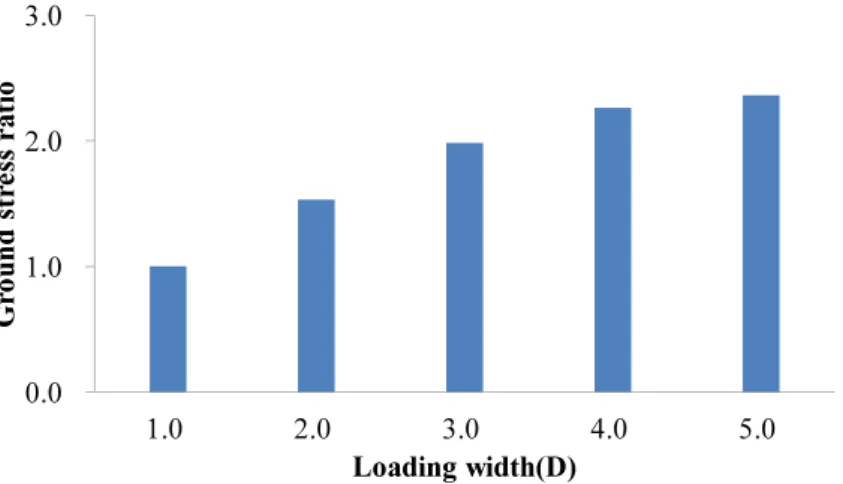
수치해석 결과 하중재하 폭이 증가할수록 기존터널 상부에 작용하는 지중응력은 하중재하 폭이 3.0D 이상에 서는 감소하는 추세를 보이는 것으로 나타났다(Fig. 9~10). 이는 하중재하 폭이 크게 작용하는 것은 연직응력 증 가로 수평응력 또한 증가하여 터널 측벽에 작용하는 응력이 커진 것으로 판단된다.
0.0 20.0 40.0 60.0 80.0 100.0
0.0 1.0 2.0 3.0 4.0 5.0
G ro und s tr es s (k P a)
Loading width (D)
Fig. 9. Ground stress distribution according to the loading width
0.0 1.0 2.0 3.0
1.0 2.0 3.0 4.0 5.0
G ro und s tr es s ra ti o
Loading width(D)
Fig. 10. Ground stress ratio according to the loading width
4.2 터널의 거동