AN ASSOCIATION OF GESTATIONAL WEIGHT GAIN AND PREPREGNANCY BODY MASS INDEX WITH PERINATAL OUTCOMES
Jeong Yi Ha, MD, Hyo Jin Kim, MD, Chang Seong Kang, MD, PhD, Sung Chul Park, MD
Department of Obstetrics and Gynecology, Han-il Hospital, Seoul, Korea
Objective
To investigate an association of gestational weight gain (GWG) and prepregnancy body mass index (BMI) with perinatal outcomes.
Methods
The sample included 3,428 Korean patients who had uncomplicated singleton term pregnancy from 2001 to 2009. The patients were categorized into four groups according to prepregnancy BMI; underweight (< 18.5 kg/m
2), normal weight (18.5-22.9 kg/m
2), overweight (23.0-24.9 kg/m
2) and obese (≥ 25.0 kg/m
2) and were also categorized into four groups according to the 25th, 50th, 75th percentile of GWG. Adjusted associations of GWG and prepregnancy BMI with perinatal outcomes were estimated by logistic regression analyses.
Results
The greater GWG and the heavier prepregnancy BMI decreased the risk of small for gestational age and increased the risk of cesarean section for nulliparas and large for gestational age.
Conclusion
There was an association of GWG and prepregnancy BMI with perinatal outcomes. To prevent maternal or neonatal complications associated with excessive or inadequate GWG, a multicenter study is needed to establish a Korean standard value for the recommended range of GWG.
Keywords: Body mass index; Gestational weight gain; Perinatal outcome
Received: 2011. 5.17. Revised: 2011. 7.13. Accepted: 2011. 8.11.
Corresponding author: Chang Seong Kang, MD, PhD Department of Obstetrics and Gynecology, Han-il Hospital, 388-1 Ssangmun-dong, Dobong-gu, Seoul 132-703, Korea Tel: +82-2-901-3129 Fax: +82-2-901-3244
E-mail: [email protected] 1990년 Institute of Medicine (IOM) [1]에서 임신중 권장체중 증가치를
발표한 이후 임신전 체질량지수와 임신중 체중증가는 각각 임신 결과와 연관있는 것으로 이해됐다. 임신전 체질량지수가 큰 경우 임신중 태아 사망, 임신중독증, 임신성 당뇨, 거대아 및 분만 합병증과 연관이 있었다 [2-5].
임신중 체중증가 역시 수태이후 잠재적으로 조절 가능하다는 점 때문 에 임신 합병증의 예측인자로서 연구되어 왔다. 과다한 임신중 체중증 가는 임신성 당뇨, 유도분만 실패, 분만 열상, 분만후 감염[6], 임신중독 증[7,8], 아두골반불균형[9,10], 기구분만[7,11], 조산[12], 제왕절개수술 [6-10,13,14], 거대아[7,8,13-15], 낮은 5분 아프가 점수[15], 과다한 출 산후 체중저류[16-18] 등과 연관이 있었으며, 과소한 임신중 체중증가 는 자궁내 태아사망[19], 조기진통[20], 조산[12,19-21], 저체중 출산아 [15,19,21] 등과 연관있었다.
한편 이들 두 변수(임신전 체질량지수, 임신중 체중증가)가 결합된 형 태로 태아와 산모 측 임신 결과에 미치는 영향을 분석한 연구는 해외에
Korean J Obstet Gynecol 2011;54(10):575-581 http://dx.doi.org/10.5468/KJOG.2011.54.10.575 pISSN 2233-5188 · eISSN 2233-5196
서 수행되었고[8,13,22-25], 특히 유리한 임신 결과를 얻기 위해, 임신 전 비만한 산모는 임신중 적은 체중증가를 권하였다[8,22,24]. 하지만 이들 연구는 서양 여성을 대상으로 한 연구로 임신전 체질량지수 및 임
Th is is an Open Access article distributed under the terms of the Creative Commons Attribution Non-Commercial License (http://creativecommons.org/licenses/
by-nc/3.0/) which permits unrestricted non-commercial use, distribution, and reproduction in any medium, provided the original work is properly cited.
Copyright © 2011. Korean Society of Obstetrics and Gynecology
신중 체중증가 수치를 국내에 바로 적용하기에는 다소 무리가 있다.
임신중 체중증가와 임신전 체질량지수가 주산기 예후에 미치는 영향 에 관한 국내 연구는 Choi [26]의 연구 외에는 찾아보기 힘든 실정으로, 저자 등은 International Obesity Task Force (IOTF) [27]의 분류에 따른 임신전 체질량지수와 한국 산모의 임신중 체중증가가 주산기 예후에 미 치는 영향을 파악하기 위해 본 연구를 시행하였다.
연구대상 및 방법
2001년 1월 1일부터 2009년 8월 31일까지 본원 산부인과에서 분 만한 4,696예 중 산전검사 자료가 불충분한 851예를 제외한 3,845예 의 의무기록을 조사하여 후향적으로 분석하였다. 임신기간 260일 이상 294일 이하인 만삭분만 3,632예 중에서 연구 제외군으로 임신중 체중 증가에 영향을 줄 수 있는 신장 145 cm 미만 4예, 중증 자간전증 48예,
쌍태아 29예, 현성 및 임신성 당뇨 83예, 양수과다증/과소증 44예, 자궁 내 태아사망 1예 등 중복 포함 204예를 제외한 3,428예의 자료를 최종 대상으로 하였다.
임신전 체중은 처음 진찰 시 산모의 진술에 근거했으며, 임신중 체중 증가는 분만 시 측정한 체중에서 임신전 체중을 뺀 수치로 정의하였고, 전체 산모의 임신전 체질량지수는 IOTF [27] 기준에 따라 저체중(18.5 kg/m2 미만), 정상체중(18.5-22.9 kg/m2), 과체중(23.0-24.9 kg/m2), 비 만(25.0 kg/m2 이상) 산모군 등 4개의 군으로 나누었다. 또 출산력을 기 준으로 임신 20주를 초과한 태아를 분만한 적이 없으면 미산모군, 분만 한 적이 있으면 초·경산모군으로 나누었다. 임신중 체중증가는 전체 산모의 임신중 체중증가의 제1, 제2, 제3 사분위수를 구하여서 제1 사 분위수 미만군, 제1 사분위수 이상 제2 사분위수 미만군, 제2 사분위수 이상 제3 사분위수 미만군 및 제3 사분위수 이상군 등 4개의 군으로 나 누었다. 신생아 출생체중에 대한 평가를 위해 재태기간에 따른 적정체 중과 비교는 Lee [28]의 연구에 근거하여 각 임신 주수별 출생체중이 Table 1. Prepregnancy body mass index (BMI) categories by gestational weight gain categories
Prepregnancy BMI (kg/m2)
Gestational weight gain (kg) Total
(n = 3428) < 11.0
(n = 839) 11.0-13.4
(n = 894) 13.5-15.9
(n = 853) ≥ 16.0
(n = 842) P-value
< 18.5 547 (16.0) 111 (20.3) 153 (28.0) 153 (28.0) 130 (23.7) < 0.001
18.5-22.9 2036 (59.4) 407 (20.0) 544 (26.7) 545 (26.8) 540 (26.5)
23.0-24.9 450 (13.1) 137 (30.5) 105 (23.3) 91 (20.2) 117 (26.0)
≥ 25.0 395 (11.5) 184 (46.6) 92 (23.3) 64 (16.2) 55 (13.9)
Values are presented as number (%).
Table 2. Characteristics of the study population according to the pregestational BMI categories Total
(n = 3428)
Pregestational BMI (kg/m2)
< 18.5 (n = 547)
18.5-22.9 (n = 2036)
23.0-24.9 (n = 450)
≥ 25.0
(n = 395) P-value Prepregnant weight (kg) 54.86 ± 8.39 45.41 ± 3.36 53.02 ± 4.37 60.97 ± 3.93 70.46 ± 7.24 < 0.001 Maternal height (cm) 160.22 ± 4.81 160.48 ± 4.82 160.34 ± 4.82 159.79 ± 4.88 159.72 ± 4.62 0.013
Age (yr) 30.66 ± 4.03 29.57 ± 3.90 30.67 ± 3.91 31.39 ± 4.35 31.29 ± 4.12 < 0.001
Gestational age (wk) 39.54 ± 1.08 39.58 ± 1.08 39.59 ± 1.08 39.55 ± 1.07 39.25 ± 1.08 < 0.001 Birth weight (kg) 3.32 ± 0.40 3.19 ± 0.37 3.32 ± 0.38 3.38 ± 0.41 3.42 ± 0.43 < 0.001
Nulliparaa 1381 (40.3) 273 (49.9) 860 (42.2) 134 (29.8) 114 (28.9) < 0.001
Primipara & multipara 2047 (59.7) 274 (50.1) 1176 (57.8) 316 (70.2) 281 (71.1)
SGA 200 (5.8) 50 (9.1) 116 (5.7) 23 (5.1) 11 (2.8) < 0.001
AGA 2860 (83.4) 468 (85.6) 1710 (84.0) 371 (82.5) 311 (78.7)
LGA 368 (10.8) 29 (5.3) 210 (10.3) 56 (12.4) 73 (18.5)
Cesarean deliverya 462 (33.5) 55 (20.2) 293 (34.1) 54 (40.3) 60 (52.6) < 0.001
Vaginal deliverya 919 (66.5) 218 (79.8) 567 (65.9) 80 (59.7) 54 (47.4)
Values are presented as mean ± standard deviation or number (%).
BMI, body mass index; SGA, small for gestational age; AGA, appropriate for gestational age; LAG, large for gestational age.
aNullipara.
10 percentile 이하인 경우 부당경량아(small for gestational age, SGA), 90 percentile 이상인 경우 부당과량아(large for gestational age, LGA)로 그 사이인 경우 적정체중아(appropriate for gestational age, AGA)로 분 류하였다.
임신전 체중, 신장, 나이, 제태연령, 출생체중의 BMI 군별 및 임신중 체중증가 군별 비교는 분산분석을, 임신 주수별 출생체중군(SGA, AGA, LGA), 출산력의 BMI 군별 및 임신중 체중증가 군별 비율은 χ2-test를, 연 령, 출산력, 임신주수, 임신전 신장 등을 보정한 후 BMI 군별 및 임신중 체중증가 군별 SGA, LGA 및 미산모 제왕절개분만의 연관성은 로지스 틱회귀분석(logistic regression)을 실시하였고, P < 0.05인 경우 유의한
것으로 간주하였다.
결 과
연구대상 산모의 임신중 체중증가의 제1, 제2, 제3 사분위수는 각각 11.0 kg, 13.5 kg, 16.0 kg이었고,임신중 체중증가군별로는 11.0 kg 미 만군 839명(24.5%), 11.0 이상 13.5 kg 미만군 894명(26.1%), 13.5 이 상 16.0 미만군 853명(24.9%), 16.0 kg 이상군 842명(24.5%)이었다. 임 신전 체질량지수를 IOTF [27]에서 정한 분류에 따르면, 저체중군 547명 (16.0%), 정상체중군 2,036명(59.4%), 과체중군 450명(13.1%), 비만군 395명(11.5%)이었고, 임신전 체질량지수군과 임신중 체중증가군 간에 통계적으로 유의한 연관성이 관찰되었다(Table 1).
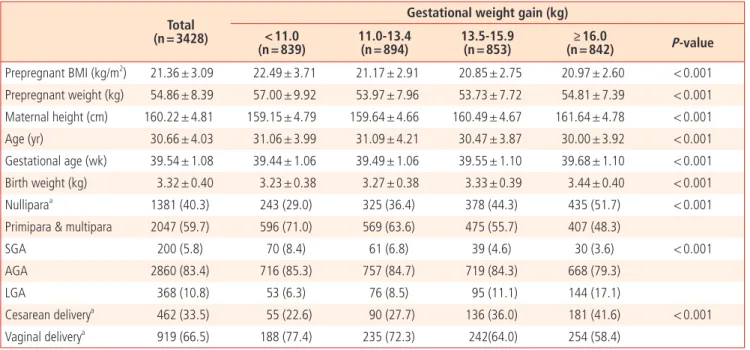
임신전 체중, 신장, 나이, 임신 주수, 출생체중, 출산력, 부당경량아 (SGA)/적정체중아(AGA)/부당과량아(LGA) 및 미산모 제왕절개수술률 등은 임신전 체질량지수 군별 및 임신중 체중증가 군별로 각각 통계적 으로 유의한 차이가 관찰되었다(Tables 2, 3).
임신중 체중증가의 전체 평균은 13.69 kg (
±
4.50 kg)이었으며, 저체 중군, 정상체중군, 과체중군 및 비만군의 평균은 각각 14.04 kg (±
3.96 kg), 14.14 kg (±
4.22 kg), 13.26 kg (±
5.02 kg), 11.42 kg (±
5.18 kg) 이었다. 다른 군과 비교하였을 때, 특히 비만군에서 임신중 체중증가가 적었다(Fig. 1).산모의 나이, 신장, 출산력 및 임신주수 등을 보정한 후 SGA의 빈도 는 임신전 체질량지수가 클수록, 임신중 체중 증가가 클수록 각각 독립 Table 3. Characteristics of the study population according to the gestational weight gain categories
Total (n = 3428)
Gestational weight gain (kg)
< 11.0
(n = 839) 11.0-13.4
(n = 894) 13.5-15.9
(n = 853) ≥ 16.0
(n = 842) P-value Prepregnant BMI (kg/m2) 21.36 ± 3.09 22.49 ± 3.71 21.17 ± 2.91 20.85 ± 2.75 20.97 ± 2.60 < 0.001 Prepregnant weight (kg) 54.86 ± 8.39 57.00 ± 9.92 53.97 ± 7.96 53.73 ± 7.72 54.81 ± 7.39 < 0.001 Maternal height (cm) 160.22 ± 4.81 159.15 ± 4.79 159.64 ± 4.66 160.49 ± 4.67 161.64 ± 4.78 < 0.001
Age (yr) 30.66 ± 4.03 31.06 ± 3.99 31.09 ± 4.21 30.47 ± 3.87 30.00 ± 3.92 < 0.001
Gestational age (wk) 39.54 ± 1.08 39.44 ± 1.06 39.49 ± 1.06 39.55 ± 1.10 39.68 ± 1.10 < 0.001 Birth weight (kg) 3.32 ± 0.40 3.23 ± 0.38 3.27 ± 0.38 3.33 ± 0.39 3.44 ± 0.40 < 0.001
Nulliparaa 1381 (40.3) 243 (29.0) 325 (36.4) 378 (44.3) 435 (51.7) < 0.001
Primipara & multipara 2047 (59.7) 596 (71.0) 569 (63.6) 475 (55.7) 407 (48.3)
SGA 200 (5.8) 70 (8.4) 61 (6.8) 39 (4.6) 30 (3.6) < 0.001
AGA 2860 (83.4) 716 (85.3) 757 (84.7) 719 (84.3) 668 (79.3)
LGA 368 (10.8) 53 (6.3) 76 (8.5) 95 (11.1) 144 (17.1)
Cesarean deliverya 462 (33.5) 55 (22.6) 90 (27.7) 136 (36.0) 181 (41.6) < 0.001
Vaginal deliverya 919 (66.5) 188 (77.4) 235 (72.3) 242(64.0) 254 (58.4)
Values are presented as mean ± standard deviation or number (%).
BMI, body mass index; SGA, small for gestational age; AGA, appropriate for gestational age; LAG, large for gestational age.
aNullipara.
Fig. 1. Box plots of gestational weight gain by prepregnancy body mass index (BMI) categories.
Prepregnancy BMI (kg/m2)
All <18.5 18.5-22.9 23.0-24.9 ≥25.0 19.0
17.0 15.0 13.0 11.0 9.0 Gestational weight gain (kg) 7.0
적으로 통계적으로 유의하게 낮아졌으며, LGA의 빈도는 임신전 체질 량지수가 클수록, 임신중 체중 증가가 클수록 각각 독립적으로 통계적 으로 유의하게 높아졌다(Table 4). 산모의 나이, 신장, 출생체중 및 임신 주수 등을 보정한 미산모 제왕절개수술의 빈도는 임신전 체질량지수 가 클수록, 임신중 체중 증가가 클수록 각각 독립적으로 통계적으로 유 의하게 높아졌다(Table 4). 한편 SGA, LGA 및 미산모 제왕절개수술 빈 도 등에서 임신전 체질량지수군과 임신중 체중증가군 간의 교호작용 (interaction)은 관찰되지 않았다.
고 찰
1990년 IOM [1]에서 임신중 권장체중 증가치를 발표한 이후 1993년 American College of Obstetrics and Gynecologists [29]에서도 동일한 안을 채택한 후, 2009년 개정된 임신중 권장체중 증가치를 IOM [30]에 서 발표하였다. 하지만 서양 산모보다 더 키가 작고, 체격이 날씬한 국내 산모에게 이러한 기준을 적용하기에는 다소 문제점이 있어, 임신전 체질 량지수는 IOTF [27] 기준에 따랐으나, obese class II (BMI 30≥ kg/m2)에 해당되는 산모가 62명에 불과해 obese class I과 obese class II를 통합 하여 obese군으로 분석하였다.
임신중 체중증가와 임신전 체질량지수가 주산기 예후에 미치는 영향 에 관한 최근 국내연구로 전체 산모를 임신전 체질량지수는 IOTF [27]
기준에 따라 저체중(BMI < 18.5 kg/m2), 정상체중(BMI 18.5-22.9 kg/m2), 과체중(BMI 23.0-24.9 kg/m2), 비만(BMI ≥ 25.0 kg/m2) 산모군 등 4개 의 군으로, 임신중 체중증가는 평균
±
2표준편차를 기준으로 3개 군으 로 분류한 Choi [26]의 연구가 있다. Choi의 연구와 본 연구의 차이점은첫째, 본 연구에서는 임신중 체중증가에 영향을 줄 수 있는 중증 자간전 증, 현성 및 임신성 당뇨, 양수과다증/과소증 등을 연구대상에서 제외하 였다. 둘째, 본 연구에서는 전체 산모의 임신중 체중증가의 제1, 제2, 제 3 사분위수를 기준으로 4개의 군으로 분류하였다. 셋째, 영향을 미칠 수 있는 변수들을 보정한 후 주산기 예후의 오즈비를 구하였다.
본 연구를 통해 임신중 체중증가 및 임신전 체질량지수가 특정 주산 기 예후(SGA, LGA 및 미산모 제왕절개수술의 위험도)에 독립적인 연관 성을 확인할 수 있었다. 임신 이후 조절 불가능한 임신전 체질량지수와 달리 임신중 체중증가는 임신 이후 조절 가능한 변수로 향후 한국 산모 의 권장체중 증가치 산정 후, 각 BMI 군별로 산전 진찰 담당의사는 임신 중 체중증가의 단기, 장기 위험성을 산모에게 충분히 설명하여, 더 나은 임신 결과를 얻기 위해 전 임신기간 동안 임신중 체중증가를 주의 깊게 관찰해야 하며, 특히 비만군 산모에게는 보다 세심한 관리가 필요할 것 으로 생각된다.
임신중 체중증가를 억제하여 1990년 IOM에서 정한 권장체중 증가치 에 맞추려는 연구는 최근까지 소수에 불과했지만, 비만군 산모에게 수 중에어로빅 강좌와 동기부여를 통해 임신중 체중증가를 6-7 kg 이내로 억제할 수 있고[31,32], 이러한 임신중 체중증가 조정행위(intervention) 가 출산 후 체중저류 감소에 도움을 준다[33]고 하였다.
본 연구의 제한점으로 첫째, 후향적 연구로서 환자 정보를 얻는데 있 어서 환자 차트에 의존할 수 밖에 없어 차트에서 얻은 정보가 부정확하 여 잘못 분류됨으로써 발생할 수 있는 정보성 편견이 발생 할 수 있다.
둘째, 임신 결과로 SGA, LGA 및 미산모 제왕절개분만을 포함하였으나, 출산 후 체중저류, 조산, 소아 비만 등의 임신 결과는 분석하지 못하였 다. 셋째, 임신중 체중증가에 영향을 미치는 객관적인 인자는 포함하였 지만 흡연여부, 음주 및 불법약물 복용여부, 사회경제적 상태, 직업유무 Table 4. Pregnancy outcomes according to pregestational BMI and gestational weight gain categoriesa
SGA LGA Cesarean delivery
Crude risk (%) Adjusted ORb Crude risk (%) Adjusted ORb Crude risk (%) Adjusted ORc Prepregnancy BMI (kg/m2)
< 18.5 9.1 1.56 (1.10-2.23) 5.3 0.52 (0.35-0.78) 20.2 0.56 (0.40-0.80)
18.5-22.9 5.7 1.0 10.3 1.0 34.1 1.0
23.0-24.9 5.1 0.88 (0.55-1.40) 12.4 0.29 (0.94-1.79) 40.3 1.27 (0.85-1.92)
≥ 25.0 2.8 0.39 (0.20-0.73) 18.5 2.72 (1.99-3.72) 52.6 2.28 (1.46-3.55)
Gestational weight gain (kg)
< 11.0 8.4 1.39 (0.96-2.00) 6.3 0.60 (0.41-0.88) 22.6 0.75 (0.49-1.15)
11.0-13.4 6.8 1.0 8.5 1.0 27.7 1.0
13.5-15.9 4.6 0.63 (0.41-0.95) 11.1 1.41 (1.02-1.94) 36.0 1.74 (1.22-2.49)
≥ 16.0 3.6 0.51 (0.32-0.81) 17.1 2.24 (1.65-3.05) 41.6 2.41 (1.70-3.41)
Values are presented as mean ± standard deviation or number (%).
BMI, body mass index; SGA, small for gestational age; LAG, large for gestational age; OR, odds ratio.
aPrepregnancy BMI and gestational weight gain were mutually adjusted.
bAdjusted for age, parity, weeks’ gestation and maternal height.
cNulliparas adjusted for age, weeks’ gestation, maternal height and birth weight.
및 신체 활동 등 개인적인 건강행위 등의 인자를 고려하지 못하였다. 앞 으로 흡연여부, 음주 및 불법약물 복용여부, 사회경제적 상태, 직업유무 및 신체활동 등 인자를 포함하고, 제왕절개수술, 출산 후 체중저류, 조 산, SGA 또는 LGA, 소아 비만 등 중요한 임신 결과들을 최소화할 수 있 는 임신중 체중증가 범위를 산출하는 연구가 필요하리라고 생각된다.
또한 본 연구는 특정한 종합병원에서 분만한 임신부를 대상으로 한 연 구로 사회경제적 상태 등이 다른 병원과의 단순비교는 다소 무리가 있 을 수 있다고 생각된다.
본 연구를 통해 Nohr 등[25]의 연구와 마찬가지로 임신중 체중증가 및 임신전 체질량지수가 특정 주산기 예후(SGA, LGA 및 미산모 제왕절 개수술의 위험도)에 독립적인 연관성이 있음을 확인할 수 있었다. 과다 하거나 과소한 임신중 체중증가와 연관된 산모나 신생아 합병증을 예방 하기 위해서 한국인 산모를 위한 임신중 체중증가 권장치를 설정하기 위해 향후 본 연구의 제한점을 포함한 다기관 공동연구가 필요할 것으 로 생각된다.
References
1. Institute of Medicine, Committee on Nutritional Status during pregnancy and Lactation, Food and Nutrition Board. Nutrition during pregnancy. Washington (DC): National Academy Press;
1990.
2. Baeten JM, Bukusi EA, Lambe M. Pregnancy complications and outcomes among overweight and obese nulliparous women. Am J Public Health 2001;91:436-40.
3. Cedergren MI. Maternal morbid obesity and the risk of ad- verse pregnancy outcome. Obstet Gynecol 2004;103:219-24.
4. Cnattingius S, Bergstrom R, Lipworth L, Kramer MS. Prepreg- nancy weight and the risk of adverse pregnancy outcomes. N Engl J Med 1998;338:147-52.
5. Sebire NJ, Jolly M, Harris JP, Wadsworth J, Joffe M, Beard RW, et al. Maternal obesity and pregnancy outcome: a study of 287,213 pregnancies in London. Int J Obes Relat Metab Dis- ord 2001;25:1175-82.
6. Kabiru W, Raynor BD. Obstetric outcomes associated with increase in BMI category during pregnancy. Am J Obstet Gy- necol 2004;191:928-32.
7. Johnson JW, Longmate JA, Frentzen B. Excessive mater- nal weight and pregnancy outcome. Am J Obstet Gynecol 1992;167:353-70.
8. Cedergren M. Effects of gestational weight gain and body mass index on obstetric outcome in Sweden. Int J Gynaecol Obstet 2006;93:269-74.
9. Chen G, Uryasev S, Young TK. On prediction of the cesarean
delivery risk in a large private practice. Am J Obstet Gynecol 2004;191:616-24.
10. Young TK, Woodmansee B. Factors that are associated with cesarean delivery in a large private practice: the importance of prepregnancy body mass index and weight gain. Am J Obstet Gynecol 2002;187:312-8.
11. Thorsdottir I, Torfadottir JE, Birgisdottir BE, Geirsson RT.
Weight gain in women of normal weight before pregnancy:
complications in pregnancy or delivery and birth outcome. Ob- stet Gynecol 2002;99:799-806.
12. Dietz PM, Callaghan WM, Cogswell ME, Morrow B, Ferre C, Schieve LA. Combined effects of prepregnancy body mass in- dex and weight gain during pregnancy on the risk of preterm delivery. Epidemiology 2006;17:170-7.
13. Stotland NE, Hopkins LM, Caughey AB. Gestational weight gain, macrosomia, and risk of cesarean birth in nondiabetic nulliparas. Obstet Gynecol 2004;104:671-7.
14. Shepard MJ, Hellenbrand KG, Bracken MB. Proportional weight gain and complications of pregnancy, labor, and delivery in healthy women of normal prepregnant stature. Am J Obstet Gynecol 1986;155:947-54.
15. Stotland NE, Cheng YW, Hopkins LM, Caughey AB. Gestational weight gain and adverse neonatal outcome among term in- fants. Obstet Gynecol 2006;108:635-43.
16. Kac G, Benício MH, Velásquez-Meléndez G, Valente JG, Struchiner CJ. Gestational weight gain and prepregnancy weight infl uence postpartum weight retention in a cohort of brazilian women. J Nutr 2004;134:661-6.
17. Scholl TO, Hediger ML, Schall JI, Ances IG, Smith WK. Ges- tational weight gain, pregnancy outcome, and postpartum weight retention. Obstet Gynecol 1995;86:423-7.
18. Thorsdottir I, Birgisdottir BE. Different weight gain in women of normal weight before pregnancy: postpartum weight and birth weight. Obstet Gynecol 1998;92:377-83.
19. Villamor E, Dreyfuss ML, Baylin A, Msamanga G, Fawzi WW.
Weight loss during pregnancy is associated with adverse pregnancy outcomes among HIV-1 infected women. J Nutr 2004;134:1424-31.
20. Ehrenberg HM, Dierker L, Milluzzi C, Mercer BM. Low maternal weight, failure to thrive in pregnancy, and adverse pregnancy outcomes. Am J Obstet Gynecol 2003;189:1726-30.
21. Schieve LA, Cogswell ME, Scanlon KS, Perry G, Ferre C,
Blackmore-Prince C, et al. Prepregnancy body mass index
and pregnancy weight gain: associations with preterm deliv-
ery. The NMIHS Collaborative Study Group. Obstet Gynecol
2000;96:194-200.
22. Cedergren MI. Optimal gestational weight gain for body mass index categories. Obstet Gynecol 2007;110:759-64.
23. DeVader SR, Neeley HL, Myles TD, Leet TL. Evaluation of gesta- tional weight gain guidelines for women with normal prepreg- nancy body mass index. Obstet Gynecol 2007;110:745-51.
24. Kiel DW, Dodson EA, Artal R, Boehmer TK, Leet TL. Gestational weight gain and pregnancy outcomes in obese women: how much is enough? Obstet Gynecol 2007;110:752-8.
25. Nohr EA, Vaeth M, Baker JL, Sørensen T, Olsen J, Rasmussen KM. Combined associations of prepregnancy body mass index and gestational weight gain with the outcome of pregnancy.
Am J Clin Nutr 2008;87:1750-9.
26. Choi HM. Perinatal outcomes associated with prepregnancy body mass index and weight gain during pregnancy. Korean J Obstet Gynecol 2010;53:981-7.
27. World Health Organization, Regional Office for the Western Pacifi c, International Obesity Task Force. The Asia-Pacifi c per- spective: redefining obesity and its treatment. Melbourne:
Health Communications Australia; 2000.
28. Lee JJ. Birth weight for gestational age patterns by sex, plu- rality, and parity in Korean population. Korean J Perinatol
2007;18:1-11.
29. American College of Obstetricians and Gynecologists. Nutri- tion during pregnancy. Washington (DC): American College of Obstetricians and Gynecologists; 1993. Technical Bulletin no.
179.
30. Institute of Medicine. Weight gain during pregnancy: reex- amining the guidelines. Washington (DC): National Academy Press; 2009.
31. Claesson IM, Sydsjo G, Brynhildsen J, Cedergren M, Jeppsson A, Nystrom F, et al. Weight gain restriction for obese pregnant women: a case-control intervention study. BJOG 2008;115:44- 50.
32. Wolff S, Legarth J, Vangsgaard K, Toubro S, Astrup A. A ran- domized trial of the effects of dietary counseling on gesta- tional weight gain and glucose metabolism in obese pregnant women. Int J Obes (Lond) 2008;32:495-501.
33. Kinnunen TI, Pasanen M, Aittasalo M, Fogelholm M, Hilakivi-
Clarke L, Weiderpass E, et al. Preventing excessive weight gain
during pregnancy: a controlled trial in primary health care. Eur
J Clin Nutr 2007;61:884-91.
임신중 체중증가 및 임신전 체질량지수와 주산기 예후의 연관성
한일병원 산부인과
하정이, 김효진, 강창성, 박성철
목적
임신중 체중증가 및 임신전 체질량지수와 주산기 예후의 연관성을 확인하고자 한다.
연구방법
2001년부터 2009년까지 비합병 만삭분만한 3,428예의 한국인 산모를 대상으로 하였다. 임신전 체질량지수를 기준으로 저체중(< 18.5 kg/m2), 정상체중(18.5-22.9 kg/m2), 과체중(23.0-24.9 kg/m2), 비만군(≥ 25.0 kg/m2) 산모군 등 4개의 군으로 나누었고, 임신중 체중증가 의 제1, 제2, 제3 사분위 수에 따라 4개의 군으로 분류하였다. 임신중 체중증가 및 임신전 체질량지수와 특정 주산기 예후의 독립적 연관 성은 로지스틱 회귀분석을 사용하였다.
결과
임신중 체중이 많이 증가할수록, 임신전 체질량지수가 클수록 부당경량아의 위험도는 낮았고, 미산모 제왕절개수술 및 부당과량아의 위험 도는 높았다.
결론
임신중 체중증가 및 임신전 체질량지수와 주산기 예후의 연관성이 있었다. 과다하거나 과소한 임신중 체중증가와 연관된 산모나 신생아 합병증을 예방하기 위해서 한국인 산모를 위한 임신중 체중증가 권장치를 설정하기 위해 다기관 공동연구가 필요할 것으로 생각된다.
중심단어: 체질량지수, 임신중 체중증가, 주산기 예후