ABSTRACT
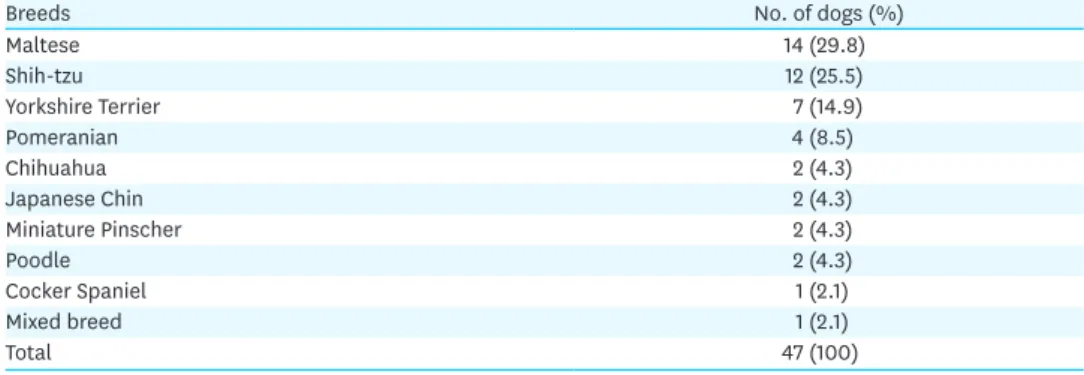
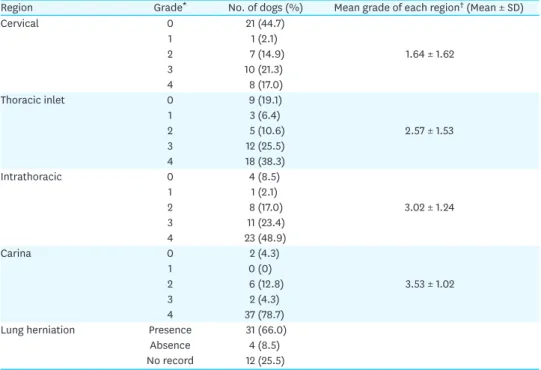
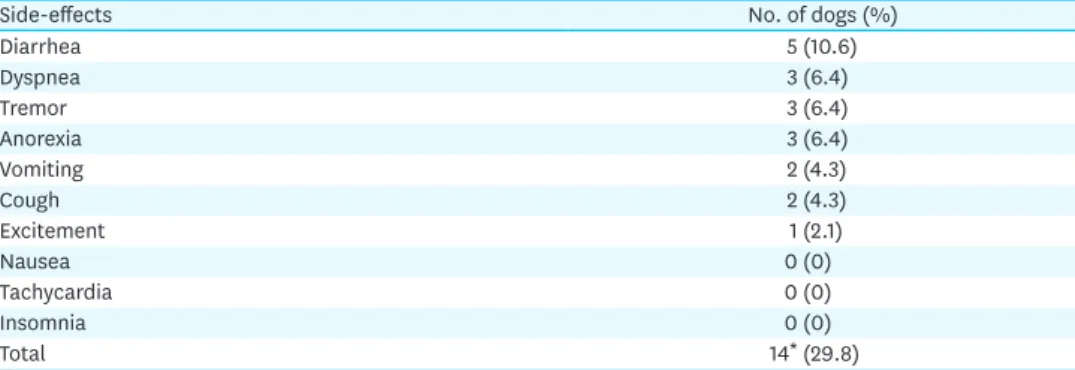
Theophylline acts as a bronchodilator and has an anti-inflammatory effect. In addition, theophylline can be applied in patients where there are concerns regarding the side- effects of corticosteroids. This retrospective case series evaluated theophylline-based therapy in tracheal collapse (TC) canine patients. Forty-seven dogs with TC that received theophylline-based therapy during 2013–2017 were investigated. A fluoroscopic examination was performed to diagnose and grade TC. Theophylline was prescribed (7.5–30 mg/kg PO q12h) and the theophylline serum concentrations were measured. Coughing was assessed using a coughing scoring scale. The mean coughing score decreased after the theophylline- based therapy compared with that observed before treatment. Clinical improvements were observed in 46/47 patients (97.9%). As the intrathoracic TC grading increased, the final theophylline dosage also increased (p value 0.019). The symptom-free period (SFP) with therapy was 189.7 ± 194.45 days (range, 0–720 days) and there was no statistically significant correlation between the SFP and age, sex, or TC grade on fluoroscopy. Although theophylline has generally been used as a third-line treatment, it was used as the main treatment in this study and most patients showed improvements. Dogs have a wider therapeutic index of serum concentrations than humans, and any undesirable effects were easily overcome. With further research, this therapy may prove to be a useful approach, but its safety for long-term use in the treatment of canine TC patients needs to be established.
Keywords: Trachea collapse; small breed dogs; fluoroscopy; theophylline; symptom-free period
INTRODUCTION
Canine tracheal collapse (TC) is a chronic, primary disease of the respiratory tract. The disease is characterized by tracheobronchomalacia with weakened and flattened C-shaped cartilage [1-5], which is accompanied by narrowing of the tracheal lumen and muscle prolapse of the dorsal trachea [2,6,7]. TC occurs mainly in middle-aged to older, overweight, and small-breed dogs [2,4,8]. The most common symptoms in canine TC patients are
Original Article
Received: Mar 4, 2019 Revised: Jul 17, 2019 Accepted: Aug 28, 2019
*Corresponding author:
Hwa-Young Youn
Laboratory of Veterinary Internal Medicine, Department of Veterinary Clinical Science, College of Veterinary Medicine, Seoul National University, 1 Gwanak-ro, Gwankak-gu, Seoul 08826, Korea.
E-mail: [email protected] Woo-Jin Song
Laboratory of Veterinary Internal Medicine, Department of Veterinary Clinical Science, College of Veterinary Medicine, Seoul National University, 1 Gwanak-ro, Gwankak-gu, Seoul 08826, Korea.
E-mail: [email protected]
© 2019 The Korean Society of Veterinary Science
This is an Open Access article distributed under the terms of the Creative Commons Attribution Non-Commercial License (https://
creativecommons.org/licenses/by-nc/4.0) which permits unrestricted non-commercial use, distribution, and reproduction in any medium, provided the original work is properly cited.
ORCID iDs So-Young Jeung
https://orcid.org/0000-0002-5689-3608 Woo-Jin Song
https://orcid.org/0000-0001-9563-6615
So-Young Jeung
1, Sang-June Sohn
1, Ju-Hyun An
1, Hyung-Kyu Chae
1,
Qiang Li
1, Mincheol Choi
2, Junghee Yoon
2, Woo-Jin Song
1,*, Hwa-Young Youn
1,*1
Laboratory of Veterinary Internal Medicine, Department of Veterinary Clinical Science, College of Veterinary Medicine, Seoul National University, Seoul 08826, Korea
2