Korean Circulation Journal
Introduction
Although aspirin remains an integral component of standard th- erapy for acute Kawasaki disease (KD) in the intravenous immuno- globulin (IVIG) era, the optimal dose remains controversial. The Am- erican Heart Association currently recommends high-dose aspirin
Print ISSN 1738-5520 • On-line ISSN 1738-5555
Is High-Dose Aspirin Necessary in the Acute Phase of Kawasaki Disease?
Goni Lee, MD, Seung Eun Lee, MD, Young Mi Hong, MD, and Sejung Sohn, MD
Department of Pediatrics, Ewha Womans University School of Medicine, Mokdong Hospital, Seoul, Korea
Background and Objectives: We sought to determine whether high-dose aspirin is necessary for the acute therapy of Kawasaki disease (KD) in the intravenous immunoglobulin (IVIG) era.
Subjects and Methods: Two groups of KD patients treated during the different periods were included. Study group (n=51, treated with IVIG without concomitant use of aspirin in the acute phase) was compared with control group (n=129, treated with IVIG plus high-dose aspirin) with regard to the response to IVIG, duration of fever after IVIG completion, time to C-reactive protein (CRP) <3 mg/dL, and the incidence of coronary artery lesions (CALs).
Results: There was no difference between the groups in age, sex, and duration of fever before treatment. Pre-IVIG laboratory measures also did not differ from each other. IVIG-resistant cases were 8 (15.7%) in study group and 22 (17.1%) in control group (p=1.000). Mean dur- ation of fever after IVIG completion in IVIG-responsive patients was 13.3±13.5 hours in study group compared to 6.2±8.3 hours in control group (p=0.000). The mean time to decrease in CRP was 4.0±1.7 days in study group and 4.1±2.2 days in control group (p=0.828). There were 2 (3.9%) patients with CALs in study group and 10 (7.8%) in control group (p=0.514).
Conclusion: Although high-dose aspirin shortens the duration of fever, treatment without aspirin in the acute phase has no influence on the response to IVIG, resolution of inflammation, or the development of CALs. In the IVIG era, high-dose aspirin may provide little benefit to the treatment in the acute phase of KD. (Korean Circ J 2013;43:182-186)
KEY WORDS: Kawasaki disease; Aspirin; Therapeutics.
Received: August 22, 2012
Revision Received: October 11, 2012 Accepted: October 16, 2012
Correspondence: Sejung Sohn, MD, Department of Pediatrics, Ewha Wom- ans University School of Medicine, Mokdong Hospital, 1071 Anyangcheon- ro, Yangcheon-gu, Seoul 158-710, Korea
Tel: 82-2-2650-5579, Fax: 82-2-2653-3718 E-mail: [email protected]
• The authors have no financial conflicts of interest.
This is an Open Access article distributed under the terms of the Creative Commons Attribution Non-Commercial License (http://creativecommons.
org/licenses/by-nc/3.0) which permits unrestricted non-commercial use, distribution, and reproduction in any medium, provided the original work is properly cited.
(80 to 100 mg/kg/day) during the acute phase,
1)while moderate- dose aspirin (30 to 50 mg/kg/day) is used in Japan due to concern about hepatic toxicity.
2)Gastritis, upper gastrointestinal bleeding,
3)sensorineural hearing loss,
4)and rarely Reye syndrome
5)are also con- cerns with high-dose aspirin in children with KD. The therapeutic steady state salicylate levels are rarely achieved during the acute phase of KD because of decreased absorption
6)and increased renal clearance of aspirin.
7)Despite this, hypoalbuminemia in the acute phase of the illness promotes less protein binding and higher free drug levels.
8)Meanwhile, the primary goal of treating children with KD is to prevent coronary artery lesions (CALs). Some reports
9)10)have shown that the incidence of CALs is highly dependent on the dose of IVIG, but independent of aspirin dose. This suggests that only antiplatelet doses of aspirin may be adequate during the acu- te phase of the disease.
Thus, considering the risks of drug toxicity and the lack of evid-
ence for prevention of CALs, the role of high-dose aspirin in the acu-
te phase of KD needs to be reassessed. The purpose of this study was
to evaluate the effect of treatment without high-dose aspirin in
the acute phase of KD and thereby determine whether high-dose aspirin is necessary for the acute therapy of KD in the IVIG era.
Subjects and Methods
A total of 51 children who met the diagnostic criteria for KD
1)bet- ween October 2010 and September 2011 were enrolled as the study group. Subjects comprised 30 (58.8%) male and 21 female, aged 2.5 months to 11.5 years. All patients were treated with IVIG (2 g/kg) as a single infusion over 10 to 12 hours without concomitant use of aspirin 2 to 20 days after the onset of the disease. After defervesc- ence, low-dose aspirin (3 to 5 mg/kg) was given as a single daily dose. When the patients remained febrile after the first IVIG therapy, they were retreated with additional therapy without aspirin. As the control group, we included a total of 129 KD patients who were tr- eated with IVIG (2 g/kg) plus high-dose aspirin (80 to 100 mg/kg/
day) 2 to 9 days after the onset of the illness, and then low-dose aspirin after defervescence between November 2008 and Septem- ber 2010. This control group of patients was reported previously.
11)We measured white blood cell (WBC), percentage of neutrophils in WBCs (% neutrophils), hematocrit, platelet counts, serum sodi- um, aspartate aminotransferase (AST), alanine aminotransferase (ALT), protein, albumin, N-terminal pro-brain natriuretic peptide (NT- proBNP), and C-reactive protein (CRP) before and 48 to 72 hours after IVIG treatment. Kobayashi score
12)was utilized as a marker of the severity of the disease. We arbitrarily considered CRP <3 mg/dL as an acceptable criterion for resolution of inflammation. When CRP remained >3 mg/dL following treatment, it was measured again 2 days later. Coronary arteries were assessed by echocardiography performed at the time of diagnosis and discharge, and repeated at weeks 4 and 8 after treatment, and then as needed thereafter. CALs were diagnosed according to the criteria of the Japanese Ministry of Health and Welfare.
13)Patients who presented with CAL before initial treatment were excluded from the study.
Basic patient characteristics and laboratory measures before IVIG therapy were compared between the study and control group.
We compared the response to initial IVIG, duration of fever after completion of initial IVIG treatment, time to CRP <3 mg/dL after IVIG administration, and the incidence of CALs between the groups.
This study was approved by the Institutional Review Board of the hospital (ECT 12-07A-21).
Definition
Duration of fever to IVIG initiation was defined as the time from the onset of the disease to the start of initial IVIG infusion. Duration of fever after IVIG completion was defined as the time from the end of IVIG infusion to defervescence (<37.5°C). IVIG-responsive pa-
tients were defined as patients who became afebrile within 48 to 72 hours after initial IVIG infusion. IVIG-resistant patients were de- fined as those who required additional therapy owing to persistent fever (≥38°C) at least 48 hours after the end of initial IVIG infusion.
Data analyses
Analyses were performed with Statistical Package for the Social Sciences (SPSS) 12.0 statistical analysis software (SPSS Inc., Chicago, IL, USA). Data are presented as mean±SD or absolute numbers and percentages. Continuous variables were compared between the groups using Student t-test. Categorical variables were compared using either χ
2test or Fisher’s exact test. A level of p<0.05 was con- sidered statistically significant.
Results
Comparison in baseline patient demographics between the study and the control group
Patients treated with IVIG without concomitant high-dose aspirin did not differ from those treated with IVIG plus high-dose aspirin with respect to age, sex, duration of fever to IVIG initiation, and Ko- bayashi score (Table 1).
Comparison in baseline laboratory measures between the study and the control group
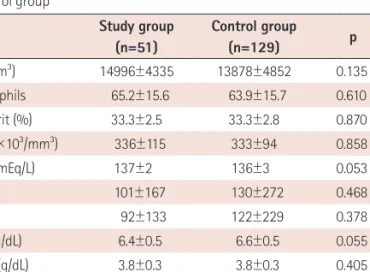
There was no difference between the groups in WBC, % neutro- phils, hematocrit, platelet counts, serum sodium, AST, ALT, protein, albumin, NT-proBNP, and CRP (Table 2).
Comparisons between the study and the control group in total patients
Response to initial intravenous immunoglobulin
Of a total of 51 patients treated with IVIG without aspirin, 43 (84.3%) patients completely responded to a single IVIG therapy, and 8 (15.7%) required retreatment: 7 patients had defervescence after a second Table 1. Comparison in basic characteristics between the study and con- trol group
Study group (n=51)
Control group
(n=129) p
Age (month) 30.7±25.1 30.2±22.3 0.896
Sex (male/female) 30/21 72/57 0.741
Duration of fever
to IVIG (day) 4.5±2.7 4.3±1.7 0.491
Range (day) 2-20 2-9
Kobayashi score 3.1±2.0 3.4±2.2 0.438
IVIG: intravenous immunoglobulin
dose of IVIG; and 1 received a second IVIG followed by infliximab therapy. Of a total of 129 patients treated with IVIG plus aspirin, 107 (82.9%) were IVIG-responsive patients, and 22 (17.1%) were IVIG- resistant patients. There was no difference in the response to IVIG between the study and control group (p=1.000) (Table 3).
Time to decrease in C-reactive protein after initial intravenous immunoglobulin administration
The mean time to CRP <3 mg/dL was 4.0±1.7 days in the study gr- oup and 4.1±2.2 days in the control group, with no difference be- tween the groups (p=0.828) (Table 3).
Incidence of coronary artery lesions
After IVIG therapy, CALs developed in 2 (3.9%) of the 51 patients in the study group and in 10 (7.8%) of the 129 patients in the con- trol group. There was no significant difference in the incidence of CALs between the groups (p=0.514) (Table 3). All CALs were either small aneurysm or dilatation, all of which regressed to normal coro- nary artery at the 2-month follow-up.
Comparisons between the study and the control group in the intravenous immunoglobulin-responsive patients
Between the study and control group, no difference was found with respect to baseline patient demographics and laboratory mea- sures in this group of patients (data not shown).
Duration of fever after completion of intravenous immunoglobulin treatment
The mean duration of fever after IVIG completion was 13.3±13.5 hours in the study group compared to 6.2±8.3 hours in the control group (p=0.000) (Table 4). Of the 43 patients in the study group, 36 (83.7%) became afebrile within 24 hours (Fig. 1), while 98 (91.6%) of the 107 patients in the control group had defervescence within 24 hours after treatment.
Proportion of patients with high C-reactive protein after treatment and time to decrease in C-reactive protein
The number of cases in which CRP remained high (>3 mg/dL) at 48 to 72 hours after IVIG infusion was 4 (9.3%) of the 43 patients in the study group and 10 (9.3%) of the 107 patients in the control group (p=0.242). Regarding the time to CRP <3 mg/dL, no difference was found between the study and control group (3.5±1.1 days vs.
3.6±1.2 days, p=0.839) (Table 4).
Table 2. Comparison in baseline laboratory measures between the study and control group
Study group (n=51)
Control group
(n=129) p
WBC (/mm
3) 14996±4335 13878±4852 0.135
% neutrophils 65.2±15.6 63.9±15.7 0.610
Hematocrit (%) 33.3±2.5 33.3±2.8 0.870
Platelet (×10
3/mm
3) 336±115 333±94 0.858
Sodium (mEq/L) 137±2 136±3 0.053
AST (IU/L) 101±167 130±272 0.468
ALT (IU/L) 92±133 122±229 0.378
Protein (g/dL) 6.4±0.5 6.6±0.5 0.055
Albumin (g/dL) 3.8±0.3 3.8±0.3 0.405
NT-proBNP (pg/mL) 1110±2650 1386±2266 0.479
CRP (mg/dL) 6.7±4.7 8.8±5.9 0.059
WBC: white blood cell, AST: aspartate aminotransferase, ALT: alanine ami- notransferase, NT-proBNP: N-terminal pro-brain natriuretic peptide, CRP:
C-reactive protein
Table 3. Comparison in outcomes between the study and control group Study group
(n=51)
Control group
(n=129) p
Response to IVIG, n (%)
IVIG-responsive 43 (84.3) 107 (82.9) 1.000
IVIG-resistant 8 (15.7) 22 (17.1)
Time to CRP <3 mg/dL (day) 4.0±1.7 4.1±2.2 0.828
CAL, n (%) 2 (3.9) 10 (7.8) 0.514
IVIG: intravenous immunoglobulin, CRP: C-reactive protein, CAL: coronary artery lesion
Table 4. Comparison in outcomes between the study and control group in the intravenous immunoglobulin-responsive patients
Study group (n=43)
Control group
(n=107) p
Duration of fever after
IVIG completion (hour) 13.3±13.5 6.2±8.3 0.000 CRP >3 mg/dL at 48 to 72 hours
after IVIG infusion, n (%) 4 (9.3) 10 (9.3) 0.242 Time to CRP <3 mg/dL (day) 3.5±1.1 3.6±1.2 0.839
CAL, n (%) 2 (4.7) 3 (2.8) 0.625
IVIG: intravenous immunoglobulin, CRP: C-reactive protein, CAL: coronary artery lesion
Fig. 1. The prevalence of fever in the acute phase of Kawasaki disease after intravenous immunoglobulin (IVIG) therapy without aspirin in 43 IVIG-re- sponsive patients.
40 30 20 10
0
Defervescence (hour)
Case No
<24 24-48 48-72 36
5 2