• 검색 결과가 없습니다.

Bilirubin Level is Associated with Left Ventricular Hypertrophy Independent of Blood Pressure in Previously Untreated Hypertensive Patients

N/A
N/A
Protected

Academic year: 2022

Share "Bilirubin Level is Associated with Left Ventricular Hypertrophy Independent of Blood Pressure in Previously Untreated Hypertensive Patients"

Copied!
8
0
0

로드 중.... (전체 텍스트 보기)

전체 글

(1)

Korean Circulation Journal

Introduction

Hypertension (HT) is one of the most common cardiovascular risk factors. Left ventricular hypertrophy (LVH) is frequently encoun- tered in hypertensive patients due to chronic pressure overload.

LVH is an important predictor of mortality and morbidity indepen- dent of other major cardiac risk factors, both in the general popu-

Print ISSN 1738-5520 • On-line ISSN 1738-5555

Bilirubin Level is Associated with Left Ventricular Hypertrophy Independent of Blood Pressure

in Previously Untreated Hypertensive Patients

Teslime Ayaz, MD 1 , Murtaza Emre Durakog ˘ lugil, MD 2 , Sinan Altan Kocaman, MD 2 , Tug ˘ ba Durakog ˘ lugil, MD 3 , Turan Erdog ˘ an, MD 2 , Osman Zikrullah S¸ahin, MD 1 , Serap Baydur S¸ahin, MD 1 , Yüksel C¸ic¸ek, MD 2 , and Ömer S¸atirog ˘ lu, MD 2

1
Departments of Internal Medicine,

2

Cardiology, and

3

Radiology, Recep Tayyip Erdog˘an University, Education and Research Hospital, Rize, Turkey

Background and Objectives: Left ventricular hypertrophy (LVH), a sign of subclinical cardiovascular disease, is an important predictor of cardiovascular morbidity and mortality. The aim of our study was to determine the association of left ventricular mass (LVM) with possible causative anthropometric and biochemical parameters as well as carotid intima-media thickness (CIMT) and brachial flow-mediated dila- tion (FMD) as surrogates of atherosclerosis and endothelial dysfunction, respectively, in previously untreated hypertensive patients.

Subjects and Methods: Our study included 114 consecutive previously untreated hypertensive patients who underwent echocardiogra- phy and ultrasonography to evaluate their vascular status and function via brachial artery CIMT and FMD.

Results: Among all study parameters, age, systolic blood pressure (BP), diastolic BP, pulse pressure, plasma glucose, uric acid, total bilirubin, direct bilirubin, hemoglobin, and CIMT were positively correlated with the LVM index. Multiple logistic regression analysis revealed that of- fice systolic BP, age, male gender, and total bilirubin were independent predictors of LVH.

Conclusion: Bilirubin seems to be related to LVM and LVH. The positive association of bilirubin with these parameters is novel and requires further research. (Korean Circ J 2014;44(5):336-343)

KEY WORDS: Hypertension; Left ventricular hypertrophy; Uric acid; Bilirubin; Waist circumference.

Received: April 20, 2014 Revision Received: July 5, 2014 Accepted: August 19, 2014

Correspondence: Murtaza Emre Durakog˘lugil, MD, Recep Tayyip Erdog˘an University, School of Medicine, Department of Cardiology, Islampasa Mah., Rize 53100, Turkey

Tel: 90 (464) 212 30 09, Fax: 90 (464) 212 30 15 E-mail: [email protected]

• The authors have no financial conflicts of interest.

This is an Open Access article distributed under the terms of the Creative Commons Attribution Non-Commercial License (http://creativecommons.

org/licenses/by-nc/3.0) which permits unrestricted non-commercial use, distribution, and reproduction in any medium, provided the original work is properly cited.

lation and in patients with HT.

1)

Moreover, LVH is generally accepted as a marker of subclinical cardiovascular disease.

2)

Regression of LVH is associated with lower cardiovascular mortality, independent of blood pressure (BP) reduction.

3)

Left ventricular hypertrophy is related to various clinical and an- thropologic parameters. Data from the Framingham Heart Study revealed that subjects with LVH tend to be older, more obese and have higher BP, lower systolic function, and preexistent coronary artery disease (CAD), all of which implicate a high-risk population.

4)

Moreover, age, height, systolic BP, and body mass index (BMI) were the independent predictors of left ventricular mass (LVM) in the Fra- mingham population.

5)

There has been considerable interest regarding the association

of biochemical parameters such as bilirubin and uric acid, with ch-

anged cardiovascular risk in hypertensive patients. Normally, serum

uric acid (SUA) is an important antioxidant and a free radical scav-

enger.

6)

However, under ischemic conditions, xanthine dehydroge-

nase, rather than xanthine oxidase, generates SUA, which facilitates

pro-oxidant and pro-inflammatory effects due to the generation

(2)

of free radicals. Therefore, SUA seems to have a paradoxical effect depending on local ischemia, which may justify its relation to in- creased cardiovascular risk in certain populations.

7)

Accordingly, el- evated SUA markedly increases coronary heart disease and is a predictor of either all-cause or cardiovascular mortality.

8)

Bilirubin, the final product of heme metabolism, has gained attention, owing to its powerful antioxidant activity, especially in physiologic oxygen concentrations.

9)

Several studies have demonstrated that bilirubin is negatively associated with the severity and extent of CAD, and acts as a predictor of cardiovascular morbidity and mortality.

10)

Con- cordantly, higher bilirubin values confer cardioprotection.

11)

Waist circumference, an important measure of abdominal obesity, is close- ly related to metabolic syndrome and cardiovascular disease and is an independent predictor of cardiovascular events.

12)

The prevalence of LVH differs with respect to BP, age, obesity, and gender. Increased LVM ranges from a prevalence of 20% in uncom- plicated HT to almost 100% in severe or complicated HT.

13)

Since LVH is an important marker of cardiovascular disease, we intended to investigate the association of LVM with carotid intima-media th- ickness (CIMT) and brachial flow-mediated dilation (FMD) as surro- gates of atherosclerosis and endothelial dysfunction, respectively.

Moreover, we planned to evaluate the determinants of LVH among several anthropometric and biochemical parameters in previously untreated hypertensive patients.

Subjects and Methods

Patient population and inclusion criteria

Our cross-sectional study included 114 consecutive previously untreated hypertensive patients who underwent echocardiography and ultrasonography to evaluate their vascular status and function by measuring CIMT and FMD of brachial artery.

The study was performed in accordance with the principles stated in the Declaration of Helsinki and approved by the local Ethics Com- mittee. Patients gave informed consent prior to enrollment.

Patients with previous coronary artery, peripheral vascular, and ce- rebrovascular disease, left ventricular systolic dysfunction, renal fail- ure, hepatic or cholestatic disease, hematological disorders, second- ary HT, infectious disease, hyperuricemia, malignancy, and patients previously treated for HT were excluded.

Blood pressure values were obtained by the traditional ausculta- tory method. Resting BP values were obtained at a physician’s office and echocardiography room by the traditional auscultatory method using a sphygmomanometer. Patients were advised to refrain from smoking or consumption of coffee or tea and physical exercise, 30 minutes prior to the measurement. Following a five-minute rest, two separate measurements were averaged to determine office BP.

Baseline characteristics of the patients were recorded. HT was de- fined as the documentation of BP more than 140/90 mm Hg. Diabe- tes mellitus was defined as fasting plasma glucose levels over 126 mg/dL or a glucose level over 200 mg/dL under any measurement, or active use of antidiabetic treatment. Patients who were using to- bacco products on admission to our hospital and those quit smok- ing within the last year were considered to be smokers. BMI was calculated by the following formula: BMI=weight (kg)/height

2

(m).

Metabolic syndrome score was calculated according to current cri- teria.

14)

Since all patients were hypertensive, they all had at least 1 point for the metabolic syndrome score. Additional points were add- ed per patient if they fulfilled the following criteria: waist circumfer- ence >102 cm in males and >88 cm in females, high density lipo- protein-cholesterol (HDL-C) <40 mg/dL in males or <50 mg/dL in females, triglycerides ≥150/mg/dL, and fasting glucose ≥100 mg/dL, or use of antidiabetic therapy. Additionally, we used the Turkish Adult Risk Factor Study (TEKHARF) metabolic syndrome criteria, which differs in waist circumference as >95 cm in men, and >91 cm in women.

15)

Biochemical analyses

Blood samples were drawn by venipuncture to measure routine blood chemistry parameters after fasting for at least 8 hours. Fast- ing blood glucose, serum creatinine, uric acid levels, total cholesterol, HDL-C, low density lipoprotein-cholesterol, and triglyceride levels were recorded. Glucose, creatinine, uric acid, and lipid profile were determined by an autoanalyzer (Architect c16000, Abbott Laborato- ries, IL, USA) using the spectrophotometric method. Serum C-reac- tive protein was analyzed using a nephelometric technique (Beck- man Coulter Immage 800; Fullerton, CA, USA; normal range 0–0.8 mg/L).

Echocardiography and measurement of left ventricular mass

Patients were imaged in the left lateral decubitus position with a

GE-Vingmed Vivid S5 (GE-Vingmed Ultrasound AS, Horten, Norway)

using a 2.5–3.5 MHz transducer by an experienced cardiologist, blind

to clinical status and data of the patients. The echocardiographic

study required recording of ≥10 cycles of 2-dimensional parasternal

long axis views and ≥10 cycles of M-mode with optimal cursor beam

orientation in each view. Interventricular septum (IVS), posterior

wall (PW), left ventricular end-diastolic diameter (LVEDD), and left

ventricular end-systolic diameter were measured and noted. LVM

was calculated according to formula: LVM=1.04 {(LVEDD+PW+IVS)

3

-

(LVEDD)

3

}-13.6 g. In addition, LVM index values were computed by

dividing by the body surface are (BSA) for standardization. BSA was

calculated according to formula: BSA (m

2

)=0.007184×height (cm)

0.725

×

weight (kg)

0.425

. LVH was defined as a LVM index >115 g/m

2

in men

and >95 g/m

2

in women.

(3)

Measurement of carotid intima-media thickness

Ultrasonography was performed on all patients using a high-res- olution ultrasonography scanner (Xario, Toshiba Medical Systems, Tokyo, Japan) with a PLT-805AT linear array transducer. Measure- ments were performed on the right and left carotid arteries. The pa- tient was lying supine with the head directed away from the side of interest and the neck slightly extended. The transducer was manipu- lated so that the near and far walls of the common carotid artery were parallel, and the lumen diameter was maximized in the longi- tudinal plane. The region 1 cm proximal to the carotid bifurcation was identified, and the CIMT of the far wall was evaluated as the distance between the lumen-intima interface and the media-adven- titia interface. The CIMT was measured on the frozen frame of a suitable longitudinal image, with the image magnified to achieve a higher resolution of detail. The CIMT measurement was obtained from four contiguous sites at 1-mm intervals on each carotid artery, and the average of all eight measurements was used for analysis.

The same radiologist, blinded to patient data, performed all the measurements. The intra-observer mean absolute difference in mea- suring the common CIMT was 0.026±0.043 mm (coefficient of vari- ation: 1.6%, intra-class correlation: 0.95). We defined CIMT thick- ness >1.2 mm as indicative of plaque.

16)

Assessment of brachial flow-mediated dilation

A standard protocol was used to assess endothelial function, as previously reported.

17)

Briefly, for the FMD of brachial artery, patients fasted 8 hours before the study. The FMD was evaluated at the same time of the day, at 9.00 a.m, using a high-resolution ultrasonogra- phy scanner (Xario, Toshiba Medical Systems) with a PLT-805AT linear array transducer. The study took place in a quiet, tempera- ture-controlled room. Caffeine intake and cigarette smoking were prohibited for at least 4–6 hours before the study. The right arm was immobilized using two cushions supporting the elbow and the wrist. A sphygmomanometric cuff was placed on the forearm. Af- ter 10–15 minutes of rest, the brachial artery was visualized longi- tudinally with the ultrasonic scanner operating in B mode. After an optimal image of the artery was obtained, the ultrasonic transduc- er was fixed in this position with a custom-built probe holder. The brachial artery diameter was determined manually in the end-dias- tole phase, as indicated by the R wave of the electrocardiogram.

After three baseline measurements were obtained, ischemia was induced by the inflation of the cuff to 30 mm Hg greater than the systolic arterial pressure to occlude arterial flow for 5 minutes. After the deflation of the cuff, diameter measurements were performed at 60 seconds. We used FMD at 1 minute after ischemia to represent the spontaneous endothelial function. The maximal diameter ob- tained during ischemia-induced hyperemia was used to calculate

the percentage of FMD, using the following formula: (maximum di- ameter-baseline diameter)/baseline diameter×100. The same radiol- ogist performed the endothelial function study. The intra-observer reproducibility of resting arterial diameter was 0.01±0.01 mm.

Statistical analysis

Continuous variables are given as mean±SD, if normally distribut- ed; otherwise, as median (min.–max.); categorical variables were de- fined as percentages. Data were tested for normal distribution using the Kolmogorov-Smirnov test. The Student’s t-test was used for the univariate analysis of changes in LVM with respect to categorical variables. Pearson and Spearman correlation coefficients were used for correlation analysis of parametric and nonparametric variables, respectively. Linear regression was used for the multivariate analy- sis of independent variables. Age, waist circumference, systolic and diastolic BP, pulse pressure, glucose, creatinine, uric acid, total bili- rubin, direct and indirect bilirubin, HDL-C, hemoglobin levels, gamma- glutamyl transferase activity, aspartate aminotransferase, CIMT, and FMD were included in the linear regression analysis while the Step- wise method was used for pre-elimination. Thereafter, linear regres- sion analysis with the enter method was used for age, male gender, waist circumference, uric acid, hemoglobin, systolic BP, total biliru- bin, and CIMT.

All tests of significance were two-tailed. Statistical significance was defined as p<0.05. The Statistical Program for the Social Sci- ences (SPSS IBM Statistics, Version 21, NY, USA) was used for all sta- tistical calculations.

Results

Patient characteristics

Demographic characteristics of the patients are detailed in Table 1. The study population consisted of 114 middle-aged (mean age, 48±9) men (39%) and women with untreated HT. The patients, on average, were slightly obese (31.7±5.3 kg/m

2

) with an enlarged waist circumference (96.5±10.2 cm). A low proportion of patients were diabetic (10.5%) and/or hyperlipidemic (18.5%). Approximately one fifth of the group were current smokers. The median systolic and diastolic BP value was 160 (140–200) over 90 (80–140) mm Hg.

Except for the mildly increased serum glucose and cholesterol

concentrations, the biochemical parameters of our study popula-

tion were within normal limits. The mean CIMT was 0.73±0.18 mm

and 14% of the study group had carotid plaques. The brachial FMD

was 14.8±7.2 within the group. The patient group had a median met-

abolic syndrome score of 3 (1–5); therefore, the majority of our pa-

tients also had metabolic syndrome (55%).

(4)

Left ventricular mass and study parameters

Left ventricular mass values did not differ within subgroups form- ed by the presence versus absence of the categorical variables, in-

cluding diabetes mellitus (224±63 g vs. 216±51 g, p=0.627), smok- ing status (237±86 g vs. 213±40 g, p=0.064), hyperlipidemia (198±

49 g vs. 222±53 g, p=0.060), and family history of CAD (213±48 g vs. 234±65 g, p=0.171).

Among all study parameters, age (r=0.281, p=0.004), systolic BP (r=0.374, p<0.001), diastolic BP (r=0.296, p=0.002), pulse pressure (r=

0.290, p=0.003), plasma glucose (r=0.213, p=0.032), uric acid (r=

0.283, p=0.004), total bilirubin (r=0.244, p=0.014), direct bilirubin (r=

0.294, p=0.003), hemoglobin (r=0.295, p=0.003) and CIMT (r=

0.357, p<0.001) were positively correlated with LVM index (Table 2, Figs. 1 and 2). Although insignificant, a trend showing a weak cor- relation between LVM index and FMD (r=-0.176, p=0.078) was ob- served.

Multivariate analyses

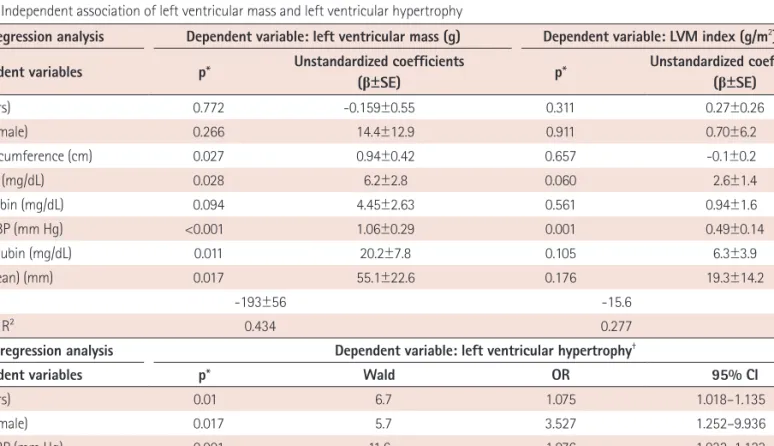
Linear and logistic regression analyses with the enter method were used for independent variables, which were included if they were significantly different in the univariate analyses, after a pre- elimination with the stepwise method. Multiple linear regression analysis revealed that office systolic BP (Beta: 0.296, p<0.001), SUA (Beta: 0.203, p=0.028), total bilirubin (Beta: 0.208, p=0.011), CIMT (Beta: 0.194, p=0.017), and waist circumference (Beta: 0.186, p=

0.027) were independent predictors of LVM (Table 3). Of these pa- rameters, only systolic BP remained a significant predictor of the LVM index following standardization. However, there was a non-sig- nificant trend for uric acid. Multiple logistic regression analysis re- vealed office systolic BP {odds ratio (OR): 1.076, p=0.001}, age (OR:

1.075, p=0.010), male gender (OR: 3.527, p=0.017), and total bilirubin (OR: 3.647, p=0.044) were independent predictors of LVH.

Discussion

We documented that, in addition to systolic BP, age, male gender, and total bilirubin levels are important predictors of LVH hyperten- sive patients who have never been treated.

Left ventricular hypertrophy, a sign of target organ damage, in- creases cardiovascular mortality and morbidity approximately two- fold in HT.

1)

Even though LVH is considered to be a consequence of hemodynamic overload, several other factors, including renin angio- tensin aldosterone system, salt intake, obesity, diabetes, and sym- pathetic neural activity are also blamed in the pathogenesis of this maladaptive state.

18)

Accordingly, BP reduction per se does not cause a regression of LVH, implicating the importance of other etiologic factors.

19)

Serum uric acid is a debated marker of cardiovascular risk. An elevated level of uric acid is frequently encountered in hypertensive patients.

20)

Moreover, uric acid is closely related to metabolic syn- Table 1. Baseline characteristics of the study population

Variables

Mean±SD/Median (25th, 75th percentiles)

(n=114)

Age (years) 48±9

Gender (male, %) 39

BMI (kg/m

2

) 31.7±5.3

Waist circumference (cm) 96.5±10.2

Systolic BP (mm Hg)* 160 (150–170)

Diastolic BP (mm Hg)* 90 (90–100)

Pulse pressure (mm Hg)* 60 (60–70)

Hypertension (%) 100

Diabetes mellitus (%) 10.5

Smoking status (%) 23

Hyperlipidemia (%) 18.5

Family history of CAD (%) 79.6

Glucose (mg/dL)* 101 (90–109)

Creatinine (mg/dL)* 0.7 (0.6–1.9)

Uric acid (mg/dL) 4.9±1.7

Total bilirubin (mg/dL)* 0.7 (0.65–0.80)

Direct bilirubin (mg/dL)* 0.3 (0.2–0.3)

Indirect bilirubin (mg/dL)* 0.5 (0.3–0.7)

Total cholesterol (mg/dL)* 218 (198–246)

LDL-C (mg/dL) 141±32

HDL-C (mg/dL) 48±13

Triglycerides (mg/dL)* 137 (88–184)

CRP (mg/L)* 0.3 (0.19–0.50)

Log10-transformed CRP -0.49±0.33

Leukocytes (/mm

3

) 7237±2175

Hemoglobin (g/dL) 13.8±1.8

Platelets (10

3

/mm

3

) 278±74

GGT activity (U/L)* 21 (14–33)

AST (U/L)* 18 (15–23)

ALT (U/L) * 19 (14–28)

CIMT (mean) (mm) 0.73±0.18

Presence of carotid plaque (%) 14

Flow mediated dilation (%) 14.8±7.2

Metabolic syndrome score (%)* 3 (2–4) (55)

Metabolic syndrome score

(TEKHARF)15)

(%) 3 (2–3) (54)

LVM (g) 218±52

LVM index (g/m

2

) 113±22

*Non-parametric variable. BMI: body mass index, CAD: coronary artery dis-

ease, LDL-C: low density lipoprotein-cholesterol, HDL-C: high density lipo-

protein--cholesterol, CRP: C-reactive protein, GGT: gamma-glutamyl trans-

ferase, AST: aspartate aminotransferase, ALT: alanine aminotransferase,

CIMT: carotid intima-media thickness, LVM: left ventricular mass, SD: stan-

dard deviation

(5)

drome.

21)

Studies investigating the effect of SUA on LVH revealed conflicting results. Iwashima et al.

22)

demonstrated a significant as- sociation between SUA and LVM in 619 patients with essential HT.

Moreover, during follow-up period of 34 months, SUA proved to be an independent predictor of cardiovascular events.

22)

Converse- ly, two studies with large populations failed to demonstrate a sig- nificant relationship between SUA and LVH in patients with essen- tial HT and untreated HT.

23)24)

SUA is usually associated with multiple risk factors, including HT, obesity, dyslipidemia, and insulin resis- tance, all of which are also related to LVH.

25)

Thus, even if SUA may not be related to LVH in the general population, this association may become evident in selected populations, like in our study, that main- ly includes patients with metabolic syndrome.

The documented independent positive association between bili- rubin and LVM in our study is novel and unprecedented. Bilirubin, a bile pigment with potent antioxidant properties, is the end product of heme catabolism by heme oxygenase.

9)

Heme oxygenase-1 is a stress-induced enzyme that catalyzes the degradation of heme into iron, carbon monoxide, and biliverdin.

26)

Biliverdin is rapidly convert- ed to bilirubin by biliverdin reductase. Hu et al.

27)

have revealed that inducing heme-oxygenase-1 inhibits angiotensin II induced LVH in cultured rat neonatal cardiomyocytes. This effect was mediated by bilirubin through the suppression of reactive oxygen species.

27)

The same protective effect of bilirubin on LVH was observed in sponta- neously hypertensive rats.

28)

Liver growth factor, detected in hepato- biliary disorders, is an endogenous factor that is comprised of Table 2. Correlations of the study parameters with LV mass

Parameter (n=114) LV mass (g) LVM index (g/m

2

)

R p

r p

Age (years) 0.218 0.027 0.281 0.004

BMI (kg/m

2

) 0.113 0.259 -0.119 0.233

Waist circumference (cm) 0.400 <0.001 0.165 0.098

Systolic BP (mm Hg)* 0.380 <0.001 0.374 <0.001

Diastolic BP (mm Hg)* 0.275 0.005 0.296 0.002

Pulse pressure (mm Hg)* 0.309 0.002 0.290 0.003

Glucose (mg/dL)* 0.173 0.082 0.213 0.032

Creatinine (mg/dL)* 0.252 0.011 0.177 0.075

Uric acid (mg/dL) 0.388 <0.001 0.283 0.004

Total bilirubin (mg/dL)* 0.352 <0.001 0.244 0.014

Direct bilirubin (mg/dL)* 0.373 <0.001 0.294 0.003

Indirect bilirubin (mg/dL)* 0.306 0.002 0.191 0.054

Total cholesterol (mg/dL) -0.100 0.320 -0.023 0.822

LDL-C (mg/dL) -0.024 0.809 0.045 0.650

HDL-C (mg/dL) -0.224 0.024 -0.084 0.402

Triglycerides (mg/dL)* -0.031 0.758 -0.100 0.317

CRP (mg/L)* 0.099 0.326 0.054 0.589

Leukocytes (/mm

3

) 0.131 0.190 0.076 0.445

Hemoglobin (g/dL) 0.411 <0.001 0.295 0.003

Platelets (10

3

/mm

3

) -0.129 0.197 -0.092 0.357

GGT activity (U/L)* 0.210 0.035 0.104 0.299

AST (U/L)* 0.221 0.026 0.113 0.259

ALT (U/L) * 0.157 0.115 0.162 0.103

CIMT (mean) (mm) 0.347 <0.001 0.357 <0.001

Flow mediated dilation (%) -0.210 0.030 -0.176 0.078

Metabolic syndrome score (0–5)* -0.041 0.683 -0.120 0.231

Metabolic syndrome score

TEKHARF

-0.017 0.862 -0.103 0.302

*Non-parametric variable,

Pearson correlation coefficient was used to analyze the relationship between study variables, if normal distribution; otherwise, Spearman coefficient was used. LV: left ventricular, LVM: left ventricular mass, BMI: body mass index, BP: blood pressure, LDL-C: low density lipoprotein- cholesterol, HDL-C: high density lipoprotein-cholesterol, CRP: C-reactive protein, GGT: gamma-glutamyl transferase, AST: aspartate aminotransferase, ALT:

alanine aminotransferase, CIMT: carotid intima-media thickness

(6)

covalently bound albumin and bilirubin. Liver growth factor is not detected under physiological conditions.

29)

A recent study demon- strated that liver growth factor treatment reduced LVM in hyperten- sive rats.

30)

Although there is some evidence that bilirubin, mediat-

ed by antioxidant properties, may protect against hypertrophy in vitro, to date there is no information regarding the impact of bili- rubin on LVH in humans at physiologic concentrations. We specu- late that either the physiologic effect of bilirubin on LVH may be

Table 3. Independent association of left ventricular mass and left ventricular hypertrophy

Linear regression analysis Dependent variable: left ventricular mass (g) Dependent variable: LVM index (g/m

2

)

Independent variables p* Unstandardized coefficients

(β±SE) p* Unstandardized coefficients

(β±SE)

Age (years) 0.772 -0.159±0.55 0.311 0.27±0.26

Gender (male) 0.266 14.4±12.9 0.911 0.70±6.2

Waist circumference (cm) 0.027 0.94±0.42 0.657 -0.1±0.2

Uric acid (mg/dL) 0.028 6.2±2.8 0.060 2.6±1.4

Hemoglobin (mg/dL) 0.094 4.45±2.63 0.561 0.94±1.6

Systolic BP (mm Hg) <0.001 1.06±0.29 0.001 0.49±0.14

Total bilirubin (mg/dL) 0.011 20.2±7.8 0.105 6.3±3.9

CIMT (mean) (mm) 0.017 55.1±22.6 0.176 19.3±14.2

Constant -193±56 -15.6

Adjusted R

2

0.434 0.277

Logistic regression analysis Dependent variable: left ventricular hypertrophy

Independent variables p* Wald OR 95% CI

Age (years) 0.01 6.7 1.075 1.018–1.135

Gender (male) 0.017 5.7 3.527 1.252–9.936

Systolic BP (mm Hg) 0.001 11.6 1.076 1.032–1.123

Total bilirubin (mg/dL) 0.044 4.1 3.647 1.035–12.846

Constant 0.000 16.5 0.000 -

Nagelkerke R

2

0.348

*Linear and logistic regression analyses with the enter method were used for independent variables, which were included if they were significantly differ- ent in the univariate analyses and after a pre-elimination using a Stepwise method,

Left ventricular hypertrophy (LVM index >115 gm/m

2

in men and >95 gm/m

2

in women). BP: blood pressure, CIMT: carotid intima-media thickness, LVM: left ventricular mass, SE: standard error of the mean

Fig. 1. Relationship of left ventricular mass and serum uric acid.

500.00

400.00

300.00

200.00

100.00

Uric acid (mg/dL)

Left ventricular mass (g)

0.0 2.5 5.0 7.5 10.0 12.5 R

2

linear=0.150

y=1.61E2+11.84*x

Fig. 2. Relationship of left ventricular mass and total bilirubin concentration.

500.00

400.00

300.00

200.00

100.00

Total bilirubin (mg/dL)

Left ventricular mass (g)

0.0 1.0 2.0 3.0 4.0 y=186E2+36.71*x

R

2

linear=0.141

(7)

different than under in vitro conditions or that the bilirubin levels may reflect another process that has not yet been elucidated. This relationship and its clinical significance require further research.

Limitations

Our study has several limitations. The main limitation is our small sample size. Another limitation is that our study included previously untreated patients that were in earlier hypertensive stages. These patients may have less vascular involvement than those with long- standing HT, which would reduce the statistical power of our find- ings. Moreover, our study is cross-sectional in nature; therefore, our results cannot implicate causality. However, in order to decrease the variability in measuring atherosclerotic parameters, we utilized vali- dated end-points, which are a stronger aspect of our study. Lastly, we did not include subjects without HT, so our results may not be generalized to the population as a whole.

Conclusion

Bilirubin seems to be related to LVM and LVH. The positive associ- ation of bilirubin with these parameters is novel and requires further research.

References

1. Levy D, Garrison RJ, Savage DD, Kannel WB, Castelli WP. Prognostic implications of echocardiographically determined left ventricular mass in the Framingham Heart Study. N Engl J Med 1990;322:1561-6.

2. Gardin JM, Lauer MS. Left ventricular hypertrophy: the next treatable, silent killer? JAMA 2004;292:2396-8.

3. Okin PM, Devereux RB, Jern S, et al. Regression of electrocardiographic left ventricular hypertrophy during antihypertensive treatment and the prediction of major cardiovascular events. JAMA 2004;292:2343-9.

4. Levy D, Murabito JM, Anderson KM, Christiansen JC, Castelli WP. Echo- cardiographic left ventricular hypertrophy: clinical characteristics. The Framingham Heart Study. Clin Exp Hypertens A 1992;14:85-97.

5. Savage DD, Levy D, Dannenberg AL, Garrison RJ, Castelli WP. Associa- tion of echocardiographic left ventricular mass with body size, blood pressure and physical activity (the Framingham Study). Am J Cardiol 1990;65:371-6.

6. Strazzullo P, Puig JG. Uric acid and oxidative stress: relative impact on cardiovascular risk? Nutr Metab Cardiovasc Dis 2007;17:409-14.

7. Puddu P, Puddu GM, Cravero E, Vizioli L, Muscari A. Relationships among hyperuricemia, endothelial dysfunction and cardiovascular dis- ease: molecular mechanisms and clinical implications. J Cardiol 2012;

59:235-42.

8. Kuo CF, See LC, Yu KH, Chou IJ, Chiou MJ, Luo SF. Significance of serum uric acid levels on the risk of all-cause and cardiovascular mortality.

Rheumatology (Oxford) 2013;52:127-34.

9. Stocker R, Yamamoto Y, McDonagh AF, Glazer AN, Ames BN. Bilirubin is an antioxidant of possible physiological importance. Science 1987;235:

1043-6.

10. Horsfall LJ, Nazareth I, Petersen I. Cardiovascular events as a function of serum bilirubin levels in a large, statin-treated cohort. Circulation 2012;126:2556-64.

11. Hopkins PN, Wu LL, Hunt SC, James BC, Vincent GM, Williams RR.

Higher serum bilirubin is associated with decreased risk for early famil- ial coronary artery disease. Arterioscler Thromb Vasc Biol 1996;16:

250-5.

12. de Koning L, Merchant AT, Pogue J, Anand SS. Waist circumference and waist-to-hip ratio as predictors of cardiovascular events: meta-regres- sion analysis of prospective studies. Eur Heart J 2007;28:850-6.

13. Mancini GB, Dahlöf B, Díez J. Surrogate markers for cardiovascular dis- ease: structural markers. Circulation 2004;109(25 Suppl 1):IV22-30.

14. Grundy SM, Cleeman JI, Daniels SR, et al. Diagnosis and management of the metabolic syndrome: an American Heart Association/National Heart, Lung, and Blood Institute Scientific Statement. Circulation 2005;

112:2735-52.

15. Onat A, Hergenc¸ G, Can G. [Prospective validation in identical Turkish cohort of two metabolic syndrome definitions for predicting cardio- metabolic risk and selection of most appropriate definition]. Anadolu Kardiyol Derg 2007;7:29-34.

16. Rosvall M, Janzon L, Berglund G, Engström G, Hedblad B. Incident cor- onary events and case fatality in relation to common carotid intima- media thickness. J Intern Med 2005;257:430-7.

17. Corretti MC, Anderson TJ, Benjamin EJ, et al. Guidelines for the ultra- sound assessment of endothelial-dependent flow-mediated vasodi- lation of the brachial artery: a report of the International Brachial Ar- tery Reactivity Task Force. J Am Coll Cardiol 2002;39:257-65.

18. Artham SM, Lavie CJ, Milani RV, Patel DA, Verma A, Ventura HO. Clinical impact of left ventricular hypertrophy and implications for regression.

Prog Cardiovasc Dis 2009;52:153-67.

19. Cacciapuoti F. Molecular mechanisms of left ventricular hypertrophy (LVH) in systemic hypertension (SH)-possible therapeutic perspectives.

J Am Soc Hypertens 2011;5:449-55.

20. Johnson RJ, Feig DI, Herrera-Acosta J, Kang DH. Resurrection of uric acid as a causal risk factor in essential hypertension. Hypertension 2005;

45:18-20.

21. Onat A, Uyarel H, Hergenc¸ G, et al. Serum uric acid is a determinant of metabolic syndrome in a population-based study. Am J Hypertens 2006;

19:1055-62.

22. Iwashima Y, Horio T, Kamide K, Rakugi H, Ogihara T, Kawano Y. Uric acid, left ventricular mass index, and risk of cardiovascular disease in essential hypertension. Hypertension 2006;47:195-202.

23. Tsioufis C, Chatzis D, Vezali E, et al. The controversial role of serum uric acid in essential hypertension: relationships with indices of target or- gan damage. J Hum Hypertens 2005;19:211-7.

24. Cuspidi C, Valerio C, Sala C, et al. Lack of association between serum uric acid and organ damage in a never-treated essential hypertensive population at low prevalence of hyperuricemia. Am J Hypertens 2007;

20:678-85.

25. Osgood K, Krakoff J, Thearle M. Serum uric acid predicts both current

and future components of the metabolic syndrome. Metab Syndr Relat

Disord 2013;11:157-62.

(8)

26. Abraham NG, Kappas A. Pharmacological and clinical aspects of heme oxygenase. Pharmacol Rev 2008;60:79-127.

27. Hu CM, Chen YH, Chiang MT, Chau LY. Heme oxygenase-1 inhibits an- giotensin II-induced cardiac hypertrophy in vitro and in vivo. Circula- tion 2004;110:309-16.

28. Ndisang JF, Jadhav A. Upregulating the heme oxygenase system sup- presses left ventricular hypertrophy in adult spontaneously hyperten- sive rats for 3 months. J Card Fail 2009;15:616-28.

29. Díaz-Gil JJ, Gavilanes JG, García-Cañero R, et al. Liver growth factor purified from human plasma is an albumin-bilirubin complex. Mol Biol Med 1989;6:197-207.

30. Conde MV, Gonzalez MC, Quintana-Villamandos B, et al. Liver growth

factor treatment restores cell-extracellular matrix balance in resistance

arteries and improves left ventricular hypertrophy in SHR. Am J Physiol

Heart Circ Physiol 2011;301:H1153-65.

수치

Fig. 1. Relationship of left ventricular mass and serum uric acid.

참조

관련 문서