385
Open Access
Deoxyribonucleic Acid Copy Number Aberrations in Vasospastic Angina Patients Using an Array Comparative Genomic Hybridization
Suk Min Seo, MD
1, Yoon Seok Koh, MD
1, Hae Ok Jung, MD
1, Jin Soo Choi, MD
2, Pum Joon Kim, MD
1, Sang Hong Baek, MD
1, Ho-Joong Youn, MD
1, Kweon-Haeng Lee, MD
3, and Ki-Bae Seung, MD
11
Cardiovascular Center and Cardiology Division,
2Catholic Neuroscience Center,
3
Department of Pharmacology, College of Medicine, The Catholic University of Korea, Seoul, Korea
ABSTRACT
Background and Objectives: Vasospastic angina (VA) is a specific type of coronary artery disease and develops as a result of coronary artery spasm. Recently, a few studies have revealed that VA caused by coronary artery spasm is related to genetic traits. The objective of this study was to use the recently developed technique of array comparative genomic hybridization (CGH) to screen the genetic aberrations of VA. Subjects and Methods: To identify candidate genes that might be causally involved in the pathogenesis of VA, genomic deoxyribonucleic acids were extracted from whole blood of 28 patients with VA who presented at Department of Cardiology at Seoul St. Mary’s Hospital, Seoul, Korea. The copy number profiles of these patients was then analyzed using array CGH and reverse transcriptase (RT) quantitative polymerase chain reaction (PCR).
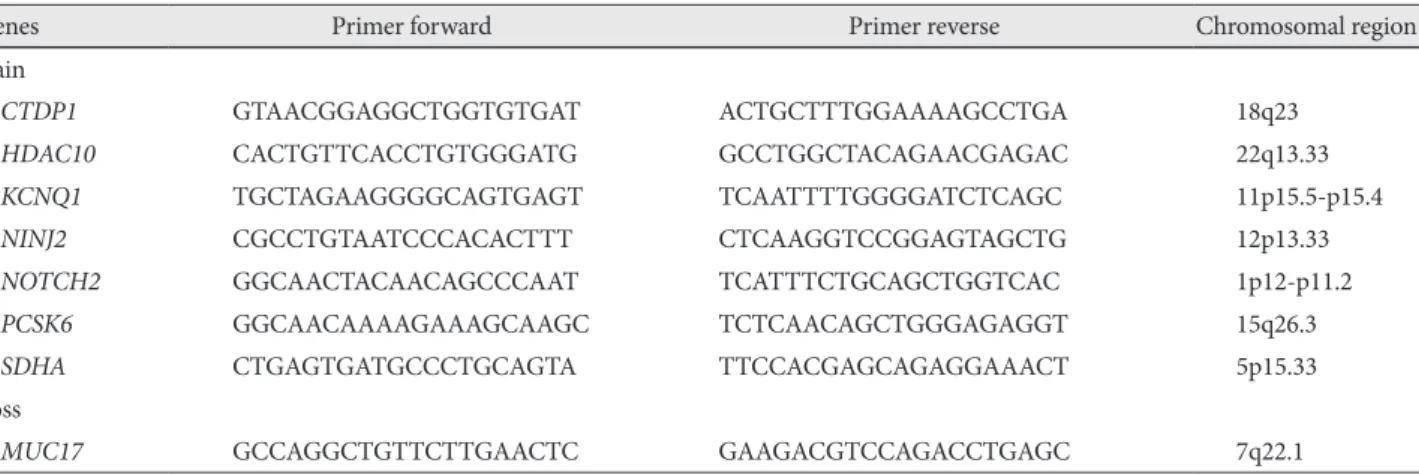
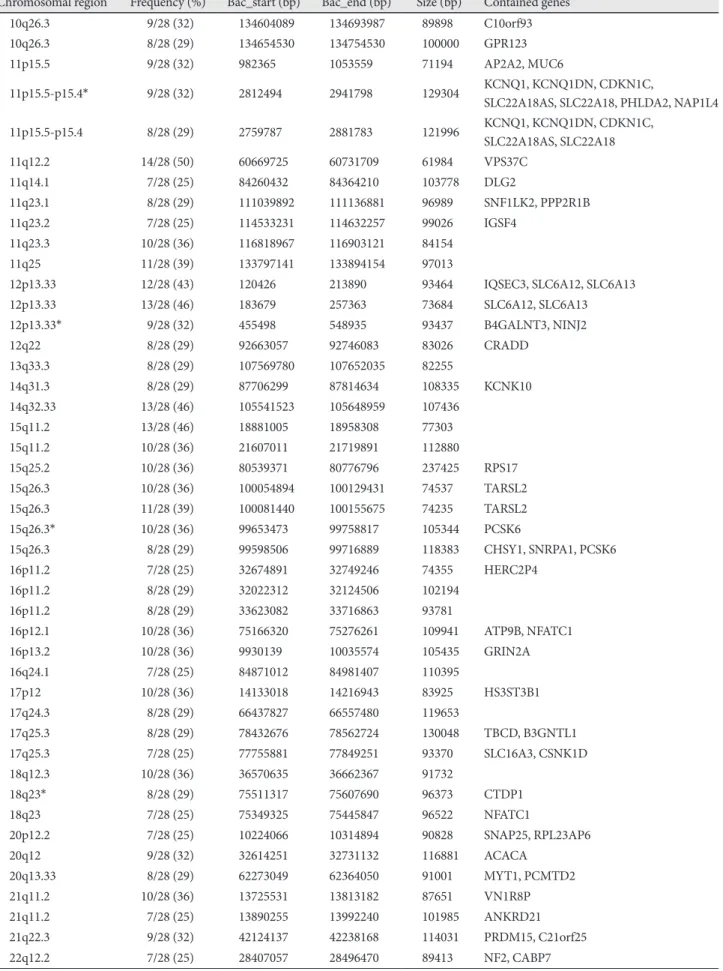
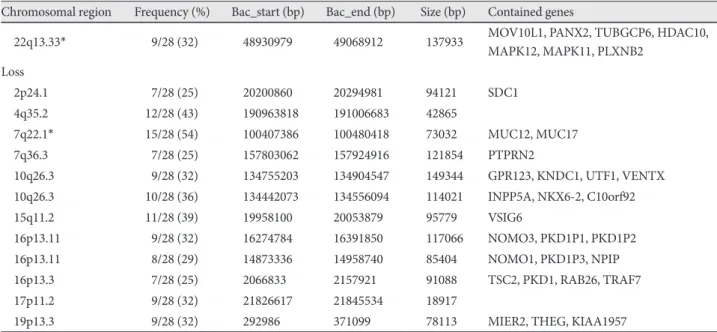
Results: Array CGH revealed gains in 31 different regions, with losses in the 4q35.2, 7q22.1, 10q26.3, 15q11.2, 16p13.11, 17p11.2 and 19q13.3 regions (more than 32% aberration in these regions). Several loci were found to be frequently including gains of 5p and 11q (50% of samples). The most common losses were found in 7q (54% of samples). Copy number aberrations in chromosomal regions were detected and corresponding genes were confirmed by RT quantitative PCR. The fold change levels were highest in the CTDP1 (18q23), HDAC10 (22q13.33), KCNQ1 (11p15.5-p15.4), NINJ2 (12p13.33), NOTCH2 (1p12-p11.2), PCSK6 (15q26.3), SDHA (5p15.33), and MUC17 (7q22.1) genes. Conclusion: Many candidate chromosomal regions that might be related to the pathogenesis of VA were detected by array CGH and should be systematically investi- gated to establish the causative and specific genes for VA. (Korean Circ J 2011;41:385-393)
KEY WORDS: Array comparative genomic hybridization; Vasospastic angina.
Received: September 10, 2010 Revision Received: November 5, 2010 Accepted: December 16, 2010
Correspondence: Hae Ok Jung, MD, Cardiovascular Center and Car- diology Division, College of Medicine, The Catholic University of Korea, 505 Banpo-dong, Seocho-gu, Seoul 137-040, Korea
Tel: 82-2-2258-1302, Fax: 82-2-591-1506 E-mail: [email protected]
• The authors have no financial conflicts of interest.
cc