309
Korean Journal of Ophthalmology 2009;23:309-311 ISSN : 1011-8942 DOI : 10.3341/kjo.2009.23.4.309
Refractive Change Caused Silicone Oil Adhesion to the Intraocular Lens Following Nd:YAG Posterior Capsulotomy
Dong-Hoon Lee, MD, Sang-Hoon Rah, MD, Ie-Na Yoon, MD
Department of Ophthalmology, Wonju Christian Hospital, Yonsei University Wonju College of Medicine, Wonju, Korea
A 32-year-old female who had undergone the silicone oil removal procedure presented with visual disturbance in her left eye. Several months previous, she had cataract surgery in a private clinic, and a month later she had a Nd:YAG laser procedure for posterior capsulotomy. The slit-lamp examination revealed silicone oil droplets that had adhered to the intraocular lens where the posterior capsulotomy was performed. She had experienced high myopia as a manifestation of the resulting refractive changes. We replaced the previous intraocular lens with a new acrylic intraocular lens with resulting improvement to her vision. Here we report the case of a female patient with a history of silicone oil removal surgery where the resulting silicone bubbles had not been removed thoroughly and remained in the vitreous cavity. These bubbles subsequently adhered to the intraocular lens following YAG laser posterior capsulotomy, resulting in refractive changes. We recommend that implanting a silicone intraocular lens in anyone with a history of the silicone oil removal procedure or who has a possible history of silicone oil use should be avoided.
Korean J Ophthalmol 2009;23:309-311 ⓒ 2009 by the Korean Ophthalmological Society.
Key Words: Nd:YAG laser, Refractive change, Silicone oil
Received: January 27, 2009 Accepted: October 29, 2009
Reprint requests to Ie-na Yoon, MD. Department of Ophthalmology, Wonju Christian Hospital, Yonsei University Wonju College of Medicine, #162 Ilsan-dong, Wonju 220-701, Korea. Tel: 82-33-741-0633, Fax: 82-33- 745-2965, E-mail: [email protected]
Silicone oil used in vitreous retinal surgery may cause the deterioration of visual acuity by adhering to silicone intraocular lenses. Further, when this adhesion develops, not only does it render subsequent surgery difficult, it may also necessitate removal or exchange of the intraocular lenses.
Here we report the case of a female patient with a history of silicone oil removal surgery where the resulting silicone bubbles had not been removed thoroughly and remained in the vitreous cavity. These bubbles subsequently adhered to the intraocular lens following YAG laser posterior capsu- lotomy, resulting in refractive changes.
Case Report
A 32-year-old female patient underwent vitrectomy, air- fluid exchange, and silicone oil injection in the left eye for the treatment of proliferative diabetic retinopathy in October 2002. Six months after the ambulatory follow-up, vitrectomy, air-fluid exchange, and silicone oil injection were performed on her right eye for the treatment of proliferative diabetic retinopathy. Silicone oil removal surgery was performed on the left eye. In January 2004, silicone oil removal surgery was performed on the right eye. In February 2004, per the
manifest refractive test, the right eye was -sph1.25 and the left eye was +sph1.00; the best corrected visual acuities were 0.3 and 0.2, respectively. During the ambulatory follow-up, together with deterioration of the left eye visual acuity, the progression of a severe cataract was detected, and thus cataract surgery was recommended. In June 2004, the patient visited our hospital again for acute vision deterioration.
Through an examination of the patient history we found that, in April 2004, in a private clinic, extra-capsular cataract extraction by phacoemulsification and intraocular lens insertion (Silicone, LI61U; Bausch & Lomb, Rochester, NY, USA) were performed on her left eye, and in May 2004, YAG laser posterior capsulotomy was performed. By slit lamp examination, adhesion of silicone oil bubbles to the posterior side of the intraocular lens through the posterior capsulotomy window was observed (Figs. 1 and 2). The result of manifest refraction testing was -sph16.00=-cyl0.50 Ax 90°, and the best-corrected vision was measured as 0.4.
In July 2004, intraocular lens (Acryl, Akreos adapt;
Bausch & Lomb) exchange surgery was performed. Due to the adhesion of the silicone oil, the visual acuity of the intra- ocular lens could not be calculated accurately, and thus an intraocular lens with an A constant and a diopter identical to the previous lens was used to replace the contaminated lens.
In manifest refractive testing performed in May 2005, the left eye was -sph1.25=-cyl0.50 Ax 90°, and the best corrected visual acuity was 0.4.
D iscussion
Korean J Ophthalmol Vol.23, No.4, 2009
310
Fig. 1. Silicone oil adherence to an intraocular lens at the primary position.
Fig. 2. Silicone oil droplets adhere to an intraocular lens in the lateral gaze.
Fig. 3. Normal refraction of the pseudophakic eye.
Fig. 4. Refractive changes of the pseudophakic eye with silicone oil adhesions.
Generally, silicone oil injected into the vitreous cavity induces hyperopic deviation.
1,2This is due to the fact that the refractive index of silicone oil (RI=1.405) is higher than that of the vitreous body or the aqueous fluid (RI=1.336). In 2005, Hotta and Sugitani
3reported a change of refractive power in the pseudophakic eye injected with silicone oil.
They reported that with injected silicone oil into the vitreous cavity, an average +5.69±1.71 diopters of hyperopic deviation of spherical aberration was found. Conversely, after the removal of silicone oil, -5.63±1.33 diopters of spherical aberration change was found. In the current case, in manifest refraction testing performed prior to and after surgery, +14.75 diopters of spherical aberration change was observed.
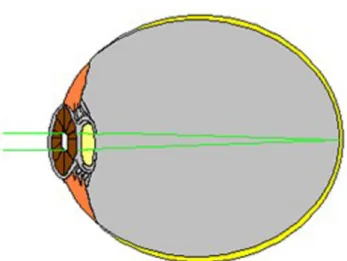
It is believed that the reason for the development of such a large change in refractive power is the accumulation of silicone oil in the narrow posterior sac incision window acting like a convex lens (Figs. 3 and 4).
The adhesion of silicone oil to an intraocular lens occurs frequently when the material of the optic zone is silicone.
4-7In the present case, adhesion of silicone oil to the intraocular lens where the optical area was silicone was observed.
The adhesion of silicone oil to an intraocular lens is ir- reversible in most cases. Apple et al.
8reported three cases that demonstrated irreversible adhesion of silicone oil to
silicone intraocular lenses. They found that in these three cases, the silicone oil could not be removed by mechanical force or through the injection of viscoelastic materials.
As it is difficult to remove silicone oil adhered to in- traocular lenses, the removal or exchange of the lens may be required. Therefore, preventing the adhesion of silicone oil to intraocular lenses is critical. We believe the insertion of a silicone intraocular lens should be avoided in patients who may use silicone oil in the future or who underwent previous silicone oil removal surgery. Also, when performing a posterior capsulotomy in a pseudophakic eye without knowing the particulars of the patient’s past ocular history, one should consider the possibility of the adhesion of silicone oil to an intraocular lens; again demonstrating the critical importance of an accurate history in medicine.
References
1. Stefansson E, Anderson MM Jr, Landers MB 3rd, et al. Refractive changes from use of silicone oil in vitreous surgery. Retina 1988;
8:20-3.
DH Lee, et al. REFRACTIVE CHANGE OWING TO SILICONE OIL ADHESION
311 2. Smith RC, Smith GT, Wong D. Refractive changes in silicone filled
eyes. Eye 1990;4:230-4.
3. Hotta K, Sugitani A. Refractive changes in silicone oil-filled pseu- dophakic eyes. Retina 2005;25:167-70.
4. Eaton AM, Jaffe GJ, McCuen BW 2nd, Mincey GJ. Condensation on the posterior surface of silicone intraocular lenses during fliud- air exchange. Ophthalmology 1995;102:733-6.
5. Glickman GM, Poole TA. Silicone intra ocular lenses during vit- rectomy. Arch Ophthalmol 1987;105:1166.
6. Robertson JE Jr. The formation of moisture droplets on the posterior surface of intraocular lenses during fluid/gas exchange procedures.
Arch Ophthalmol 1992;110:168.
7. Kutner BN. Posterior surface condensation on silicone IOLs.
Ophthalmology 1995;102:1412.
8. Apple DJ, Federman JL, Krolicki TJ, et al. Irreversible silicone oil adhesion to silicone intraocular lenses: a clinicopathologic analysis. Ophthalmology 1996;103:1555-61.