• 검색 결과가 없습니다.

Translation and Validation of the Korean Version of MUDI and MUSIQ with Urinary Incontinent Older Men

N/A
N/A
Protected

Academic year: 2022

Share "Translation and Validation of the Korean Version of MUDI and MUSIQ with Urinary Incontinent Older Men"

Copied!
10
0
0

로드 중.... (전체 텍스트 보기)

전체 글

(1)

Translation and Validation of the Korean Version of MUDI and MUSIQ with Urinary Incontinent Older Men

Young Mi Lim,

1

Jaemann Song,

2

and Heeyoung Oh

3

Departments of

1

Nursing and

2

Urology, Yonsei University Wonju College of Medicine, Wonju;

3

Eulji Univerity College of Nursing, Daejeon, Korea.

Received August, 8, 2008 Accepted September, 16, 2008

Reprint address: requests to Dr. Heeyoung Oh, Eulji Univerity College of Nursing, 143-5 Yongdu-dong, Jung-gu, Daejeon 301- 746, Korea. Tel: 82-42-259-1713, Fax: 82-42-259-1709, E-mail:

[email protected]

Purpose: The purpose of this study was to evaluate the psy- chometric properties of the Korean version of the Male Urinary Distress Inventory (MUDI) and Male Urinary Symptom Impact Questionnaire (MUSIQ). Patients and Methods: A convenient sample of community-dwelling older men with urinary incon- tinence participated. A cross-sectional survey design was used for this study. A panel of experts completed the initial transla- tion into Korean and back-translated the MUDI and MUSIQ.

Upon establishment of the content and translation equivalence between English and Korean versions of the MUDI and MUSIQ, psychometric properties were evaluated for reliability, concurrent, and construct validity with a sample of 143 older men. Results:

The internal consistencies of both instruments were found to be acceptable, and Cronbach's coefficients were 0.88 for the MUDI- K and 0.92 for the MUSIQ-K. A significant moderate correlation between MUDI-K and MUSIQ-K was found in this study, indi- cating modest concurrent validity between these 2 instruments (r = 0.56, p < 0.001). For construct validity, the mean scores of the MUDI-K were significantly different for age, marital status, prostate surgery, erectile dysfunction, and depression (p

< 0.05). The means scores of MUSIQ-K were significantly different for depression (p < 0.05) only. For both the MUDI-K and MUSIQ-K, 7 factors were extracted, accounting for 68.1%

and 72.1% of the variance. Conclusion: Results of this study suggest that the MUDI-K and MUSIQ-K can be used as a reliable and valid measure of health-related quality of life in com- munity-dwelling Korean older men with urinary incontinence.

Key Words: Urinary incontinence, aged, health measurement scale

INTRODUCTION

Urinary incontinence (UI) in older men and

women is an important and complex clinical issue because of its significant impact on the quality of life of the elderly. This problem has been docu- mented in many studies across cultures.

1-4

Depen- ding on the population studies, prevalence esti- mates of urinary incontinence vary widely. Based on US report in 2000, urinary incontinence affects an estimated 17% of men 60 years of age and older.

5

In Japan, it was found that the incidence rate of urinary incontinence, occurring almost daily, in hospitalized men aged 60 and over was 23.3%.

6

In Korea, 11.3% of men over the age of 60 and 25.8% of men over 70 years of age suffer from urinary incontinence.

7

The potential impact of urinary incontinence results in negative health-related quality of life among men.

2,8,9

To promote the quality of life of this population, it would be necessary to assess how they get affected and from what specific problem they get distressed.

The Male Urinary Distress Inventory (MUDI) and Male Urinary Symptom Impact Questionnaire (MUSIQ)

10

are the instruments with which many health professionals assess the health-related quality of life of men with lower urinary tract symptoms (LUTS). These measures were developed, based on the Incontinence Impact Questionnaire (IIQ) and the Urogenital Distress Inventory (UDI) designed for women.

The MUDI with 27 items has a 5-point scale (1

= symptom not present, 2 = symptom present but

not bothersome, 3 = symptom present and slightly

bothersome, 4 = symptom present and moderately

bothersome, and 5 = symptom present and greatly

bothersome). The MUDI ranges from 27 (no

symptom) to 135 (27 symptoms, each with the

(2)

maximum degree of associated distress). It in- cludes 7 interpretable factors; stress symptoms, irritative symptoms, obstructive symptoms, pain, situational urgency, contact urgency, and emotio- nal urgency. The MUSIQ has 32 items and a 4-point scale (0 = not at all, 1 = slightly, 2 = moderately, and 3 = greatly). The MUSIQ ranges from 0 (no impact) to 96 (maximum impact). Six factors including ac- tivity, social contact, emotional health, self-confid- ence, stability of support, and sleep were concep- tually derived through factor analysis.

Although there have been several studies on the quality of life among men with urinary incontin- ence, little attention has been paid to health-related quality of life specific to Korean older men with such health problem. Therefore, systematic studies are needed to examine and quantify distress and impact on urinary symptom to measure health- related quality of life of Korean elders in modern, aging society.

Despite critical clinical implications, no cross- culturally validated Korean language measures are currently available to quantify health-related quality of life of older men with urinary inconti- nence. Hence, the establishment of a quality, cross-culturally validated instrument is in need. In this study, the existing MUDI and MUSIQ were translated into Korean, and the psychometric properties of the Korean version of MUDI-K and MUSIQ-K were tested.

PATIENTS AND METHODS

The psychometric properties of the MUDI-K and MUSIQ-K were established in 3 phases. In phase I, the content validity and equivalence between the Korean and English version of the instruments were examined. In phase II, internal consistency and con- current validity were established. In phase III, hypo- theses were tested to establish construct validity.

Phase I. Establishing content validity and equival- ence

Cross-cultural equivalence

For cross-cultural research, functional and ling- uistic equivalence were evaluated as suggested in previous studies.

11,12

Functional equivalence was as-

sessed by reviewing literature to identify applica- bility to another culture.

11,13,14

Prior to translating the original MUDI and MUSIQ, the content and context of each item were clarified by the resear- chers. All items in the original English version of MUDI and MUSIQ were relevant to Korean cul- ture. Next, linguistic equivalence was evaluated by verifying content and semantic equivalence.

11,12,15

Translating/Back translating

After justification of the context of distress and impact of urinary incontinence, the original MUDI and MUSIQ were translated into Korean by a bilingual nursing professor who is an expert in urinary incontinence research. After the MUDI and MUSIQ were translated, a bilingual researcher with Ph.D translated the Korean version back into English. The both translators had more than 7 years of formal English education, completed their graduate program and earned either Master's or PhD nursing degree in the US.

With the exception of "do you wet the bed?", all items of the MUDI were simple to understand and were appropriate to Korean culture. In contrast to western people who use bed on carpeted bedroom floor, most of Korean use sleeping mat(called 'Yo' in Korean) on the top of 'Ondol' bedroom floor which is traditional Korean style. Therefore, 'bed' in the original version was translated into sleeping mat in the Korean version.

Of 32 items in MUSIQ, with the exception of

"your ability to go on vacation", 31 items were appropriate to understand and be translated in Korean cultural context. In Korea, most retired older men are not currently employed, therefore the word 'vacation' in the original version was judged to be insignificant for the Korean older men. Hence, the 'vacation' was translated into 'taking a trip for rest'.

Establishing content equivalence

To confirm the linguistic equivalence between the original and back translated version of the MUDI and MUSIQ, the content equivalence of each item of instruments was evaluated by Dr.

Robinson who developed the original instruments.

All items in the back translated version were

found to have the same meaning as the original

version.

(3)

Clarifying semantic equivalence

To generate the final Korean version of MUDI and MUSIQ, the semantic meaning was clarified by refining the wording of each item of the Korean version of MUDI and MUSIQ by researchers. The final Korean version of MUDI (MUDI-K) and MUSIQ (MUSIQ-K) was confirmed to have the same meaning, as in the original English version of MUDI and MUSIQ.

Field testing

Prior to the psychometric evaluation with a target population, a field test was conducted with 5 bilingual graduate and post-graduate students and professors who could fluently read and under- stand Korean and English. Five bilingual persons rated all items using 4-point rating scale; 1 = equi- valent, 2 = almost equivalent, 3 = almost not equi- valent, 4 = not equivalent in the instruments for the Content Validity Index (CVI) analysis. The CVI was computed as the proportion of items given ratings of '1' and '2'.

16

All items in MUDI-K and MUSIQ-K were rated as either equivalent, or almost equivalent and yielded a CVI of 1.00.

Phase II. Determining internal consistency and concurrent validity

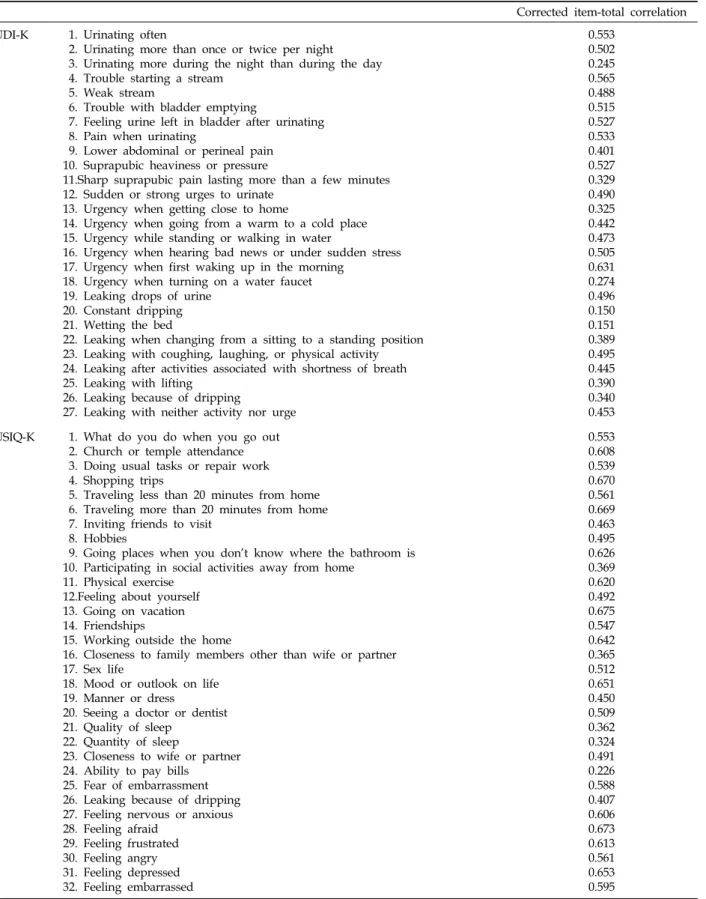
Internal consistency of both MUDI-K and MUSIQ- K was estimated using Cronbach's coefficient. The corrected item-total correlation coefficients were calculated for each item of the both scales. Items whose correlation coefficients were under 0.15 were considered to be poorly correlated with total scale scores.

For concurrent validity, the correlation between MUDI-K scores and MUSIQ-K scores was calcul- ated. Positive correlations between the MUDI-K scores and the MUSIQ-K scores were expected, meaning that the more the distress of urinary symptoms, the more impact on quality of life.

Phase III. Verifying construct validity

In order to establish construct validity of MUDI- K and MUSIQ-K, both known group comparison and principle component analysis were investigated.

Known group comparison was conducted by tes-

ting theoretical hypotheses based on the existing literature.

17

In this study, it was hypothesized that those who are older, have no spouse, and have history of hypertension, diabetes mellitus, prostate surgery, erectile dysfunction, or depression would have higher score on MUDI-K and MUSIQ-K.

18-21

A factor analysis of the MUDI-K with 27 items and MUSIQ-K with 32 items was performed using the principle component analysis with extraction method and varimax rotation method.

Design and sample

A descriptive, cross-sectional survey method was used. Data were collected with a non-pro- bability sampling strategy using structured format face-to-face interviews. A convenience sample of community-dwelling older men with lower uri- nary tract symptoms (LUTS) was recruited over a 5-month period in the waiting room of the urology outpatient clinic at a suburban general hospital in Korea. The sampling criteria were (1) had epi- sodes of urine leakage in the past, (2) able to com- municate, and (3) agree to participate. A total of 143 male subjects participated.

Data collection

After obtaining approval from human subjects committee of the medical center and university, the urology outpatient clinic was contacted and permission was obtained. Research assistants asked potential participants for permission to describe the study to them. Potential participants were given explanation of the study, and informed written consents were obtained. The participants were given the option of completing instruments indepen- dently or with assistance by research assistants.

Data analysis

Data were managed and analyzed using the

Statistical Package for the Social Science (SPSS)

software version 11.0. Descriptive statistics were

obtained; the frequency, mean, standard devia-

tion, distribution of each item, and subscales of

the MUDI-K and MUSIQ-K were analyzed. For

internal consistency, Cronbach's alpha was uti-

lized for subscales and overall score of two instru-

(4)

Table 1. Descriptive Statistics and Reliability Coefficient of MUDI-K and MUSIQ-K

Subscales Items Mean ± SD Alphas

MUDI-K 27 44.2 ± 13.1 0.88

MUDI

10

27 59.3 ± 16.9 0.89

MUSIQ-K 32 10.5 ± 11.6 0.92

MUSIQ

10

32 15.5 ± 17.6 0.95

MUDI-K, Male Urinary Distress Inventory-Korean; MUSIQ-K, Male Urinary Symptom Impact Questionnaire-Korean.


ments. For concurrent validity, Pearson's correlation coefficient between the degree of urinary incon- tinence and MUDI-K and MUSIQ-K was used.

The statistical significant level was set at a p value of less than 0.05. Construct validity was evaluated by two different methods; 1) t-test and Analysis of Variance test to examine differences in mean scores on both instruments with regard to demo- graphic variables and health problems and 2) principle component analysis.

RESULTS

Description of sample

The age of the subjects ranged from 46 to 93 years with a mean of 66.9 years (SD = 8.5), and 53.8% were 70 years or older. The majority of the men were married (90.9%), and over half of the participants (55.2%) were not working. Ninety participants (62.9%) had middle school education or higher. The 3 most prevalent self-reported health problems were erectile dysfunction (53.8%), hyper- tension (37.8%), and diabetes mellitus (21.7%).

Other self-reported problems were cardiovascular disease (10.5%), prostate surgery (9.1%), depression (7.0%), and stroke (4.9%).

Descriptive statistics for the MUDI-K and MUSIQ-K Descriptive statistics for the MUDI-K and MUSIQ- K are shown in Table 1. The MUDI-K scores ranged from 27 to 99, with a mean of 44.15 (SD = 13.14).

The MUSIQ-K scores ranged from 0 to 67, with a mean of 10.50 (SD = 11.56). All mean scores for the MUDI-K and MUSIQ-K were lower than those of the English version of MUDI and MUSIQ.

Reliability

In this study, both instruments demonstrated internal consistency, with Cronbach's coefficients of 0.88 and 0.92 for the MUDI-K and the MUSIQ- K respectively. No items of the MUSID-K and MUSIQ-K showed corrected item-total correlation coefficients smaller than 0.15 (Table 2).

Concurrent validity

As expected, the relationship was statistically significant between distress and impact associated with urinary symptom which represents health related quality of life. In Table 2, significant mode- rate correlation between MUDI-K and MUSIQ-K was found at 0.563 (p < 0.001), indicating modest concurrent validity between distress and impact instruments. This finding showed results similar to the English version of MUDI and MUSIQ (r = 0.59, p < 0.001).

10

Construct validity

Table 3 shows results of t-test and analysis of variance that were used to examine the differences in mean scores on MUDI-K and MUSIQ-K with regard to subjects' socio-demographic characteristics and self-reported health problems.

As expected, the mean scores of the MUDI-K

were significantly different depending on age,

marital status, prostate surgery, erectile dysfunc-

tion, and depression, (p < 0.05): indicating that

MUDI-K scores were higher in older age and the

subjects with no spouse, with a history of prostate

surgery, erectile dysfunction, and depression. The

mean scores of MUDI-K were higher in subjects

with hypertension, and diabetes mellitus, but the

(5)

Table 2. Corrected Item-Total Correlations for Items of the MUDI-K and MUSIQ-K

Corrected item-total correlation MUDI-K 1. Urinating often

2. Urinating more than once or twice per night 3. Urinating more during the night than during the day 4. Trouble starting a stream

5. Weak stream

6. Trouble with bladder emptying

7. Feeling urine left in bladder after urinating 8. Pain when urinating

9. Lower abdominal or perineal pain 10. Suprapubic heaviness or pressure

11.Sharp suprapubic pain lasting more than a few minutes 12. Sudden or strong urges to urinate

13. Urgency when getting close to home

14. Urgency when going from a warm to a cold place 15. Urgency while standing or walking in water

16. Urgency when hearing bad news or under sudden stress 17. Urgency when first waking up in the morning

18. Urgency when turning on a water faucet 19. Leaking drops of urine

20. Constant dripping 21. Wetting the bed

22. Leaking when changing from a sitting to a standing position 23. Leaking with coughing, laughing, or physical activity 24. Leaking after activities associated with shortness of breath 25. Leaking with lifting

26. Leaking because of dripping

27. Leaking with neither activity nor urge

0.553 0.502 0.245 0.565 0.488 0.515 0.527 0.533 0.401 0.527 0.329 0.490 0.325 0.442 0.473 0.505 0.631 0.274 0.496 0.150 0.151 0.389 0.495 0.445 0.390 0.340 0.453 MUSIQ-K 1. What do you do when you go out

2. Church or temple attendance 3. Doing usual tasks or repair work 4. Shopping trips

5. Traveling less than 20 minutes from home 6. Traveling more than 20 minutes from home 7. Inviting friends to visit

8. Hobbies

9. Going places when you don’t know where the bathroom is 10. Participating in social activities away from home

11. Physical exercise 12.Feeling about yourself 13. Going on vacation 14. Friendships

15. Working outside the home

16. Closeness to family members other than wife or partner 17. Sex life

18. Mood or outlook on life 19. Manner or dress

20. Seeing a doctor or dentist 21. Quality of sleep

22. Quantity of sleep

23. Closeness to wife or partner 24. Ability to pay bills

25. Fear of embarrassment 26. Leaking because of dripping 27. Feeling nervous or anxious 28. Feeling afraid

29. Feeling frustrated 30. Feeling angry 31. Feeling depressed 32. Feeling embarrassed

0.553

0.608

0.539

0.670

0.561

0.669

0.463

0.495

0.626

0.369

0.620

0.492

0.675

0.547

0.642

0.365

0.512

0.651

0.450

0.509

0.362

0.324

0.491

0.226

0.588

0.407

0.606

0.673

0.613

0.561

0.653

0.595

MUDI-K, Male Urinary Distress Inventory-Korean; MUSIQ-K, Male Urinary Symptom Impact Questionnaire-Korean.
(6)

Table 3. Analysis of Variance in MUDI-K and MUSIQ-K Scores for Sociodemographic Variables and Health Problem Variables

Variable MUDI-K MUSIQ-K

n Mean SD t/F p value n Mean SD t/F p value

Age (yrs)

< 70 93 42.0 12.1 2.7 0.007 93 9.9 10.6 - 0.9 0.366

≥ 70 50 48.1 14.1 50 11.7 13.2

Spouse

Yes 130 43.3 12.4 2.5 0.013 130 10.2 11.1 1.1 0.265

No 13 52.8 17.5 13 13.9 15.3

Hypertension

Yes 54 44.7 14.6 - 0.3 0.685 54 12.1 13.5 1.3 0.191

No 89 43.8 12.3 89 9.5 10.1

Diabetes mellitus

Yes 31 46.3 15.8 - 1.0 0.308 31 14.2 15.8 - 1.6 0.127

No 112 43.6 12.3 112 9.5 9.9

Prostate surgery

Yes 13 52.8 16.1 - 2.5 0.013 13 14.8 11.8 - 1.4 0.156

No 130 43.3 12.6 130 10.1 11.5

Erectile dysfunction

Yes 66 47.4 15.7 2.7 0.005 66 12.3 12.9 1.7 0.090

No 77 41.3 9.8 77 8.9 8.9

Depression

Yes 10 53.6 19.5 - 2.4 0.018 10 23.3 17.7 2.4 0.037

No 133 43.4 12.3 133 9.5 10.4

MUDI-K, Male Urinary Distress Inventory-Korean; MUSIQ-K, Male Urinary Symptom Impact Questionnaire-Korean.
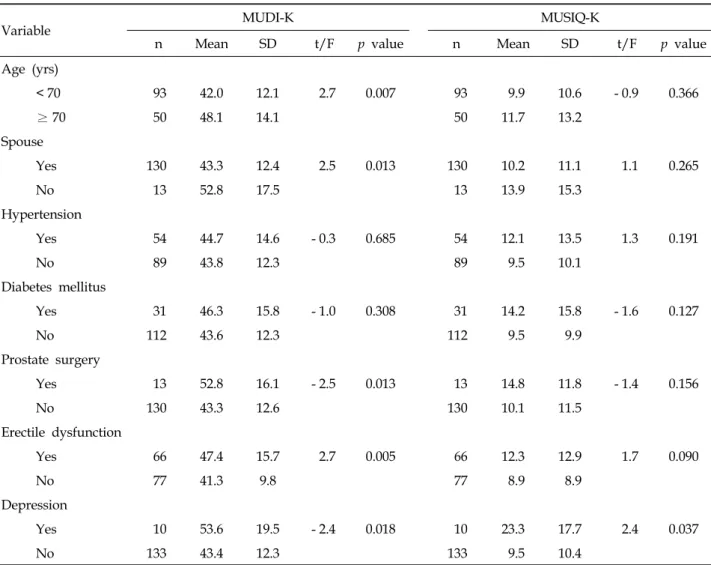
difference did not reach the statistical significance.

The mean scores of MUSIQ-K were significantly different for depression (p = 0.037) only. The MUSIQ- K scores were high in older men and in elders with no spouse, a history of prostate surgery, erectile dysfunction, hypertension, and diabetes mellitus, but did not reach the statistical significance.

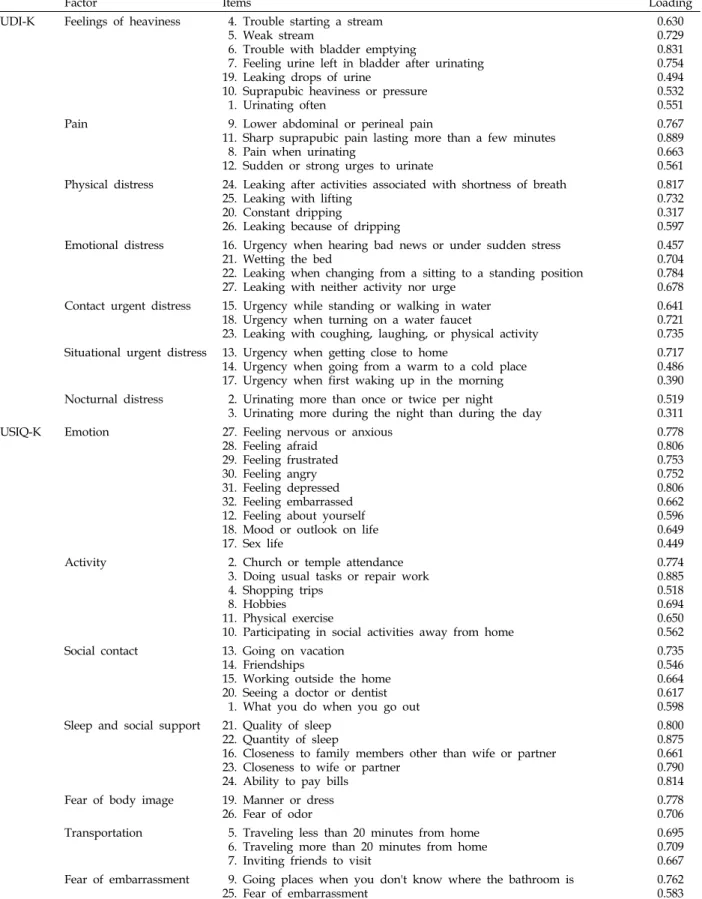
Construct validity was also confirmed by factor analysis (Table 4). For MUDI-K, 7 factors consisted of 27 items were extracted with eigen values greater than 1.00, accounting for 68.1% of the total item variance. MUDI-K with all of the original 27 items was shown to have 7 latent factors. For MUSIQ-K, seven factors with eigen values greater than 1.00

explained 72.1% of the variance. MUSIQ-K with 32 items was shown to have seven latent factors.

DISCUSSION

Urinary incontinence is a common problem in

older men and women and can affect their daily

lives. Especially, incontinence can have a deleteri-

ous impact on their everyday lives. To our best

knowledge this is the first study to investigate the

distress and quality of life among elderly Korean

men with UI, and was conducted to validate the

MUDI and MUSIQ among community dwelling

(7)

Table 4. Factor Loadings Explained from the Principle Component Analysis of the MUDI-K and MUSIQ-K

Factor Items Loading

MUDI-K Feelings of heaviness 4. Trouble starting a stream 5. Weak stream

6. Trouble with bladder emptying

7. Feeling urine left in bladder after urinating 19. Leaking drops of urine

10. Suprapubic heaviness or pressure 1. Urinating often

0.630 0.729 0.831 0.754 0.494 0.532 0.551 Pain 9. Lower abdominal or perineal pain

11. Sharp suprapubic pain lasting more than a few minutes 8. Pain when urinating

12. Sudden or strong urges to urinate

0.767 0.889 0.663 0.561 Physical distress 24. Leaking after activities associated with shortness of breath

25. Leaking with lifting 20. Constant dripping

26. Leaking because of dripping

0.817 0.732 0.317 0.597 Emotional distress 16. Urgency when hearing bad news or under sudden stress

21. Wetting the bed

22. Leaking when changing from a sitting to a standing position 27. Leaking with neither activity nor urge

0.457 0.704 0.784 0.678 Contact urgent distress 15. Urgency while standing or walking in water

18. Urgency when turning on a water faucet

23. Leaking with coughing, laughing, or physical activity

0.641 0.721 0.735 Situational urgent distress 13. Urgency when getting close to home

14. Urgency when going from a warm to a cold place 17. Urgency when first waking up in the morning

0.717 0.486 0.390 Nocturnal distress 2. Urinating more than once or twice per night

3. Urinating more during the night than during the day 0.519 0.311 MUSIQ-K Emotion 27. Feeling nervous or anxious

28. Feeling afraid 29. Feeling frustrated 30. Feeling angry 31. Feeling depressed 32. Feeling embarrassed 12. Feeling about yourself 18. Mood or outlook on life 17. Sex life

0.778 0.806 0.753 0.752 0.806 0.662 0.596 0.649 0.449 Activity 2. Church or temple attendance

3. Doing usual tasks or repair work 4. Shopping trips

8. Hobbies 11. Physical exercise

10. Participating in social activities away from home

0.774 0.885 0.518 0.694 0.650 0.562 Social contact 13. Going on vacation

14. Friendships

15. Working outside the home 20. Seeing a doctor or dentist 1. What you do when you go out

0.735 0.546 0.664 0.617 0.598 Sleep and social support 21. Quality of sleep

22. Quantity of sleep

16. Closeness to family members other than wife or partner 23. Closeness to wife or partner

24. Ability to pay bills

0.800 0.875 0.661 0.790 0.814 Fear of body image 19. Manner or dress

26. Fear of odor 0.778

0.706 Transportation 5. Traveling less than 20 minutes from home

6. Traveling more than 20 minutes from home 7. Inviting friends to visit

0.695 0.709 0.667 Fear of embarrassment 9. Going places when you don't know where the bathroom is

25. Fear of embarrassment 0.762

0.583

MUDI-K, Male Urinary Distress Inventory-Korean; MUSIQ-K, Male Urinary Symptom Impact Questionnaire-Korean.
(8)

male elders with urinary incontinence in Korea.

In this study, the internal consistencies of both instruments, MUDI-K and MUSIQ-K, were found to be acceptable. Consistent with results of the English version of MUDI and MUSIQ in the Robinson and Shea

10

study, a significant moderate correlation between MUDI-K and MUSIQ-K was found in this study, indicating modest concurrent validity between these 2 instruments.

The theoretical structures of the MUDI-K and MUSIQ-K were also confirmed by principle com- ponent analysis. For MUDI-K, the seven factors reflected physical dimensions of urogenital dis- tress experienced by Korean older men with urinary incontinence. Results of this study support similar findings that about 74.3% of men with genitourinary cancer had moderate to severe dis- comfort from lower urinary tract symptoms such as nocturia, weak stream, urgency, and intermit- tency,

22

and men with urinary incontinence had more bothersome limitations in daily activities.

23

For MUSIQ-K, the fifth (fear of body image) and the seventh (fear of embarrassment) among the seven factors reflected more unique dimensions of urinary symptom impact, experienced by Korean older men. One possible explanation of this finding would be cultural differences in viewing the impact on quality life of older men in Korea. It is assumed in Korean culture that elders should especially be respected. Feelings of degradation related to elders' experience with UI, however, impinged on their self-esteem, ultimately resulting in a negative impact on quality of life. The latent dimension captures the fear of not being respected as an older man, hence, and is regarded as one of the most stressful situations which they feel.

The relationships between scores on the distress of urogenital symptoms and urinary symptom impact, and sociodemographic and health pro- blems data support the construct validity of MUDI- K and MUSIQ-K. For age, there was a significant difference on MUDI-K, but no significant differ- ence on MUSIQ-K, indicating that older men felt less impact from urinary symptoms, but more dis- tress from urogenital symptoms compared to younger men, which was similar to the findings of a study by Girman et al.

15

This is, however, inconsistent with findings from the study by Robinson and Shea,

10

in which only MUSIQ scores

were significantly higher in younger men than in older men. In other study by Ku et al.,

24

pain severity had the most predictive factor for distress and quality of life impact in younger Korean men with urinary incontinence. Further studies with a variety of samples to examine the relationship between demographic factors (i.e., age) and troub- lesome and impact of urinary symptoms would be valuable.

As expected, absence of spouse was a signifi- cant factor on distress and impact on urogenital symptoms in Korean men with UI. This finding is not consistent with findings from Robinson and Shea

10

study, and may imply that elders even with spouse in the traditional Korean family system might naturally expect to be cared for by their adult children when they get sick. The spousal support could be a significant factor to influence the quality of life among older men, because urogenital problem could be a threat not only to their expectation for respect of age but also to self-esteem. These results may support cultural differences in distress and quality of life among men with UI between Korea and the USA. Future research is needed to examine the impact on the quality of life in regard with the relationship of spousal support cross-culturally, particularly among older men with urinary incontinence.

Results of this study consistently support findings that higher MUDI-K and MUSIQ-K scores represent effects of depression.

10

Consistent with studies in the US, the present results showed that in Korea there was a statistically significant difference in both MUDI-K and MUSIQ-K between men with UI who were depressed and those who were not.

These findings were similar to those of other studies.

25,26

Thus, it is concluded that psycholo- gical problem (i.e. depression) could be identified, using the MUDI-K and MUSIQ-K, as a measure- ment of the construct Health Related Quality of Life (HRQL).

Participants in this study and the study by

Robinson and Shea

10

did not reflect representative

samples, nevertheless, the results of these studies

support the feasibility of both MUDI and MUSIQ

to measure the construct of HRQL in men with

continence problems. In future studies, these

validated instruments can be used in practice and

research to evaluate the effect of intervention for

(9)

health related quality of life of men with urinary incontinence.

In conclusion, results of this study demonstr- ated that the MUDI-K and MUSIQ-K can be used as a reliable and valid measure of health-related quality of life in community dwelling Korean men with urinary incontinence. The method, including translation, back-translation, and field-testing, was appropriate to examine the psychometric properties of a translated version of the instrument. This is the first research study conducted on distress and impact of urinary symptoms in community dwel- ling older men with urinary incontinence in Korea. Therefore, the results described herein can be an important basis for future research and clinical application. Further studies to evaluate factor structure and test-retest reliability of the MUDI-K and MUSIQ-K would be worthwhile.

REFERENCES

1. Huang AJ, Brown JS, Kanaya AM, Creasman JM, Ragins AI. Van Den Eeden SK, et al. Quality-of-life impact and treatment of urinary incontinence in ethni- cally diverse older women. Arch Intern Med 2006;166:

2000-6.

2. Broome BA. The impact of urinary incontinence on self- efficacy and quality of life. Health Qual Life Outcomes 2003;1:35.

3. Kim KS, Choi ES. Relationship of urinary symptom, urinary discomfort, and quality of life in bladder cancer and benign prostatic hypertrophy of male patients.

Korean J Rehabil Nurs 2004;6:78-87.

4. Teunissen D, Van Den Bosch W, Van Weel C, Largo- Janssen T. "It can always happen": The impact of urinary incontinence on elderly men and women. Scand J Prim Health Care 2006;24:166-73.

5. Stothers L, Thom DH, Calhoun, EA. Urinary incontin- ence in men. In: Litwin MS, Saigal CS, editors. Urologic diseases in America. US Department of Health and Human Services, Public Health Service, National Insti- tutes of Health, National Institute of Diabetes and Digestive and Kidney Diseases. Washington, DC: US Government Printine Office; NIH Publication; No. 07- 5512, 2007. p.195-225.

6. Hoshi T, Nakahara T, Hashimoto S, Hayashi M, Takabayashi K, Miki K, et al. Prevalence of urinary incontinence among institutionalized persons aged 60 and over in Japan. Nippon Koshu Eisei Zasshi 1995;42:

482-90.

7. Yonhap News. Urinary incontinence. 2004 June 26 [retrieved 2007 June 19]. Available from: URL: http://

blog.yonhapnews.co.kr.

8. Hunskaar S, Sandvik H. One hundred and fifty men with urinary incontinence. III. Psychosocial consequ- ences. Scand J Prim Health Care 1993;11:193-6.

9. Gavira Iglesias FJ, Caridad y Ocerín JM, Pérez del Molino Martín J, Valderrama Gama E, López Pérez M, Romero López M, et al. Prevalence and psychosocial impact of urinary incontinence in older people of a Spanish rural population. J Gerontol A Biol Sci Med Sci 2000;55:M207- 14.

10. Robinson JP, Shea JA. Development and testing of a measure of health-related quality of life for men with urinary incontinence. J Am Geriatr Soc 2002;50:935-45.

11. Hsueh KH, Phillips LR, Cheng W, Picot SJ. Assessing cross-cultural equivalence through confirmatory factor analysis. West J Nurs Res 2005;27:755-71.

12. Son GR, Song J, Lim Y. Translation and validation of the revised-Algase Wandering Scale (community ver- sion) among Korean elders with dementia. Aging Ment Health 2006;10:143-50.

13. Phillips LR, Luna I, Russell CK, Baca G, Lim YM, Cromwell SL, et al. Toward a cross-cultural perspective of family caregiving. West J Nurs Res 1996;18:236-51.

14. Butcher JN. Cross-cultural research methods in clinical psychology. In: Kendall PC, Butcher JN, Holmbeck GN, editors. Handbook of research methods in clinical psychology. 2nd ed. New York: Wiley; 1982. p.273-308.

15. Girman CJ, Jacobsen SJ, Tsukamoto T, Richard F, Garraway WM, Sagnier P, et al. Health-related quality of life associated with lower urinary tract symptoms in four countries. Urology 1998;51:428-36.

16. Waltz CF, Strickland OL, Lenz ER. Measurement in nursing research. 2nd ed. Philadelphia: F.A. Davis Co.;

1991.

17. Streiner DL, Norman GR. Health Measurement Scales:

a practical guide to their development and use. Oxford:

Oxford University Press; 1989.

18. Dorey G. Conservative treatment of male urinary in- continence and erectile dysfunction. Philadelphia &

London: Whurr Publishers; 2001.

19. Engstrom G. Lower urinary tract symptoms in Swedish male population prevalence, distress, and quality of life [dissertation]. Uppsala, Sweden: Uppsala University;

2006.

20. Rosen R, Altwein J, Boyle P, Kirby RS, Lukacs B, Meuleman E, et al. Lower urinary tract symptoms and male sexual dysfunction: the multinational survey of the aging male (MSAM-7). Eur Urol 2003;44:637-49.

21. Litwin MS, Nied RJ, Dhanani N. Health-related quality of life in men with erectile dysfunction. J Gen Intern Med 1998;13:159-66.

22. Park JM. A study on lower tract urinary symptoms, discomfort of life and quality of life in male patients with genitourinary cancer [Unpublished doctoral dis- sertation]. Seoul, Korea: Chung-Ang University; 2005.

23. Kim JC. Urinary incontinence and voiding dysfunction

following radical prostatectomy: implications and impact

on health related quality of life. Proceeding of the 8th

Catholic University of Korea Urology Symposium. Seoul,

(10)

Korea: 2006.

24. Ku JH, Kwak C, Oh SJ, Lee E, Lee SE, Paick JS. Influ- ence of pain and urinary symptoms on quality of life in young men with chronic prostatitis-like symptoms.

Int J Urol 2004;11:489-93.

25. Valvanne J, Juva K, Erkinjuntti T, Tilvis R. Major depression in the elderly: a population study in Helsinki.

Inter Psychogeriatr 1996;8:437-43.

26. Tripp DA, Curtis Nickel J, Landis JR, Wang YL, Knauss

JS; CPCRN Study Group. Predictors of quality of life

and pain in chronic prostatitis/chronic pelvic pain syn-

drome: findings from the National Institutes of Health

Chronic Prostatitis Cohort Study. BJU Int 2004;94:1279-

82.

수치

Table 1. Descriptive Statistics and Reliability Coefficient of MUDI-K and MUSIQ-K
Table 2. Corrected Item-Total Correlations for Items of the MUDI-K and MUSIQ-K
Table 3. Analysis of Variance in MUDI-K and MUSIQ-K Scores for Sociodemographic Variables and Health Problem  Variables
Table 4. Factor Loadings Explained from the Principle Component Analysis of the MUDI-K and MUSIQ-K

참조

관련 문서