정서경험과 생체노화
백서채, 김종성
충남대학교병원 가정의학과
The Effect of Emotional Experiences on Biological Aging
Seo Chae Paik, Jong Sung Kim
Department of Family Medicine, Chungnam National University Hospital, Daejeon, Korea
Background: This study was designed to investigate the effects of usual negative emotional experiences on bi- ological aging progression of human.
Methods: A total of 237 subjects who visited the Health Promotion Center at Chungnam National University Hospital from May 2013 through September 2013 was enrolled. Each subject had been drawn up a structured questionnaire about usual experiences of depression, anxiety, anger, and anger expression. The degree of bio- logical aging progression of each subject was computed by a specific formula which consisted of chronological age and biological age reflecting obesity and aging of main organs.
Results: Trait anger and low education level showed the significant correlations with biological aging ( r =0.160, P =0.014, and r =-0.189, P =0.024, respectively). Trait anger and low education level solely displayed the sig- nificant R
2s for biological aging in consequence of multivariate analyses; R
2=0.044, P =0.020, and R
2=0.022, P =0.038, respectively.
Conclusions: This study suggests that the significant relationship between usual anger experience (i.e., trait anger) and biological aging would be present. In addition, lower education level may be related with biological aging.
Korean J Health Promot 2018;18(4):147-158 Keywords: Aging, Anger, Education
■
Received: Aug. 29, 2018
■Revised: Dec. 20, 2018
■Accepted: Dec. 21, 2018
■Corresponding author : Jong Sung Kim, MD, PhD
Department of Family Medicine, Chungnam National University Hospital, 282 Munhwa-ro, Jung-gu, Daejeon 35015, Korea Tel: +82-42-280-7548, Fax: +82-42-280-7879
E-mail: [email protected]
Copyright ⓒ 2018 The Korean Society of Health Promotion and Disease Prevention
This is an Open Access article distributed under the terms of the Creative Commons Attribution Non-Commercial License (http://creativecommons.org/licenses/by-nc/3.0/) which permits unrestricted noncommercial use, distribution, and reproduction in any medium, provided the original work is properly cited.
Introduction
The fight-or-flight response (also called ‘hyperarousal’ or
‘the acute stress response’) is a physiological reaction that occurs in response to a harmful event, attack, or threat to survival.
1)Nowadays, level of individual social stress are gradually increased, thus the fight-or-flight responses are in- creased altogether. It signifies that humans are more likely to experience anger, anxiety, or depression. These negative
emotional experiences considerably affects the physiologic human system. Along with secretion of various hormones including adrenaline, sympathetic nervous system is acti- vated and blood vessels are contracted. Consequently, both blood pressure and blood glucose level rise, thereby increas- ing circulating blood volume to muscles and decreasing to guts.
2)Repeated these experiences could accelerate biological aging.
Previous studies reported adverse effects of anger on the
human organism. Anger increases risks of coronary calcifica-
tion, myocardial infarction, subclinical atherosclerosis, and
coronary artery disease.
3)Anger and hostility are significantly
correlated with metabolic syndrome.
4)Depression also neg-
atively affects the human body. There is a significant associa-
tion between depression and Parkinson’s disease
5)and a high
prevalence of major depression disorder in cancer patients is reported.
6)There are plenty of researches that anxiety has a biologically negative impact. The strong relationship be- tween anxiety and metabolic syndrome
7)and the increased risk of cardiovascular disease by anxiety disorders and panic disorder
8)are reported.
However, above-mentioned studies are almost similar fo- cusing the relationship between negative emotional experi- ences and particular diseases or medical findings only.
Because the physiological impacts of negative emotional ex- periences may be connected with biological aging pro- gression of human, association with the degree of biological aging progression of the human body and negative emo- tional experiences should be investigated.
Moreover, previous studies mostly used the Beck Depression Inventory (BDI),
9)Beck Anxiety Inventory (BAI),
10)Zung Self-Rating Depression Scale,
11)Zung Self-Rating Anxiety Scale,
12)Hamilton Depression Rating Scale,
13)or Hamilton Anxiety Rating Scale
14)for assessing the degree of depression or anxiety. Since these tools are used for screening or diagnosing depression or anxiety, these measures cannot fully reflect usual emotional experiences. Thus, the present study to investigate the relationship between negative emotional experiences and biological aging using structured questionnaire about usual experiences of depression, anxiety, anger, and anger expression.
Methods
1. Study participants and period
This study is a cross-sectional study to investigate the re- lationship between biological aging and emotional experi- ence of anxiety, depression, anger, and anger expression. A total of 300 subjects who visited the Health Promotion Center at the Chungnam National University Hospital in Daejeon from May 2013 through September 2013. The study was approved by the Chungnam National University Hospital Institute Review Board, and written informed con- sent was obtained from all participants or their legal guardians. All clinical investigations were conducted accord- ing to the principles of the Declaration of Helsinki.
All participants had been drawn up respective structured questionnaires: 63 subjects who missed more than one item or question of questionnaires were excluded from analyses and finally 237 subjects were enrolled in this study.
2. Instruments
The questionnaire contains measurements to assess each emotional experiences.
1) Questionnaire for demographics and faith
Socio-biological demographic variables of subjects were sex, age, body mass index (BMI), education level, monthly house- hold gross income, weekly alcohol use, faith level, weekly exercise, smoking, and family function index by adaptability, partnership, growth, affection, and resolve (APGAR) score.
Faith level of each subject was categorized by scoring ‘no or little’ as zero point, ‘a little’ one point, ‘moderate’ two points, and ‘a lot’ three points (Supplementary questionnaire 1). Comprehensive health screening records were also included in the questionnaire.
2) Trait depression inventory
The State-Trait Depression Inventory was developed in 1999 for the purpose of assessing the degree of usual depres- sion by Spielberger and Reheiser.
15)The Trait Depression Inventory was applied in the current survey, separated from the Korean adaptation of State-Trait Depression Inventory (STDI-K) developed by Lee et al.
16)This tool consists of twenty questions which describe emotions and physiological and psychological symptoms. Each question is composed of four-point scale from ‘not at all’ (one point) to ‘very yes’
(four points). The reliability coefficient (Cronbach’s alpha [α]) was 0.822 in this study and it was reported as 0.90 by Lee et al.
16)(Supplementary questionnaire 2).
3) Trait anxiety inventory
The State-Trait Anxiety Inventory was developed in 1970 for estimating the degree of usual anxiety by Spielberger et al.
17)The Trait Anxiety Inventory was used in the present study, exacted from the Korean adjustment of State-Trait Anxiety Inventory application developed by Kim.
18)This tool consists of twenty questions and each question is com- posed of four-point scale from ‘not at all’ (one point) to
‘very yes’ (four points). Lee et al. applied this adjusted in-
ventory to their study and reported that the Cronbach’s α
was 0.884.
18,19)In this research, the reliability coefficient was
0.800 (Supplementary questionnaire 3).
4) Trait anger inventory
The State-Trait Anger Expression Inventory (STAXI) was developed in 1988 for evaluating the degree of usual anger by Spielberger and Sydeman.
20)The Trait Anger Inventory was utilized in this paper, selected from the Korean adaptation of State-Trait Anger Expression Inventory (STAXI-K) adapt- ed by Hahn et al.
21)This tool is made up of two categories which are angry temperament and angry reaction. The former involves a tendency to experience anger in general, while the latter contains when angry is provoked. Five questions make up each category. Each question is composed of four-point scale from ‘not at all’ (one point) to ‘very yes’ (four points).
In the present research, the Cronbach’s α’s were 0.713 in angry temperament and 0.805 in angry reaction (the calculated Cronbach’s α’s were 0.79 and 0.75 respectively, reported by Hahn et al.
21)) (Supplementary questionnaire 4).
5) Anger expression inventory
Anger Expression Inventory in the STAXI, the tool to as- sess the pattern and frequency of anger expression, consists of the three items of anger-in, anger-out, and anger-control.
Each item has eight questions and each question is com- posed of four-point scale from ‘not at all’ (one point) to
‘very yes’ (four points). The sum of responses of these three items, a total of 24 questions, is the frequency of anger expression. The Anger Expression Inventory was used in the current survey, parted from the STAXI-K likewise. In this paper, the Cronbach’s α’s were 0.676 in anger-in, 0.716 in anger-out, and 0.709 in anger-control (the computed Cronbach’s α’s were 0.73, 0.74, and 0.81 respectively, re- ported by Hahn et al.
21)) (Supplementary questionnaire 5).
6) Biological aging
Biological aging was calculated by means of a conversion formula as the below-described.
Biological aging (%)={(biological age-chronological age)/ch- ronological age}×100
The factor ‘biological age’ was developed in Mediage Inc.
(Seongnam, Korea) and listed in an international journal in the Science Citation Index class, which reflects obesity and aging of the main organs-heart, lungs, liver, pancreas, and kidneys.
22,23)The formula to compute biological age consists of the be-
low-mentioned variables: BMI, body fat (%), body muscle (%), waist circumference, waist-hip ratio (WHR), systolic blood pressure (SBP), diastolic blood pressure (DBP), pulse pressure, forced expiratory volume in one second (FEV1), forced vital capacity (FVC), total protein, albumin, albu- min-globulin ratio (AGR), total bilirubin, direct bilirubin, alanine aminotransferase, aspartate aminotransferase, alkaline phosphatase, gamma-glutamyl transpeptidase, total choles- terol, triglyceride, high-density lipoprotein, low-density lip- oprotein, homocysteine, lactate dehydrogenase, serum crea- tine phosphokinase, fasting blood sugar level, glycated hae- moglobin, amylase, blood urea nitrogen, serum creatinine, and creatinine clearance.
3. Statistics
Chi-square or Fisher’s exact tests were used to compare for categorical variables, t-tests for normal distribution, and Kruskal-Wallis tests for non-normal distribution of con- tinuous variables to compare the demographic variables.
One-way analysis of variance (ANOVA) and correlation analyses were used to compute the relationships among gen- eral characteristics (age, sex, BMI, education level, monthly household gross income, faith level, smoking, weekly ex- ercise, weekly alcohol use, and family function index), emo- tional experiences, and biological aging. Stepwise multiple regression analyses were performed to estimate the co- efficients of determination of general characteristics and emotional experiences for biological aging. The SPSS version 18.0 (SPSS Inc., Chicago, IL, USA) was used for all stat- istical analyses. The statistical significance level was less than 0.05.
Results
1. General characteristics and emotional experiences
The mean age of subjects was 52.8±10.8 years old, and the middle-aged were the most common group in this study (Table 1). Men was slightly more than women in number and the ratio of male to female was 53.2:46.8. The mean BMI was 24.0±3.3 kg/m
2. The mean weekly exercise 92.9±138.4 minutes. The mean family function index was 6.4±2.4. In faith level, ‘no or little’ was 37.1%, ‘a little’
30.4%, ‘moderate’ 10.5%, and ‘a lot’ 10.1%. More than a
Characteristic Value Sex
Male 126 (53.2)
Female 111 (46.8)
Age, y 52.8±10.8
BMI 24.0±3.3
Education level
<Elementary school 3 (1.3) Elementary school 26 (11.0)
Middle school 36 (15.2)
High school 58 (24.5)
≥College or university 114 (48.1) Monthly household gross income (106 won)
<1 27 (11.4)
1≤ N <3 63 (26.6)
3≤ N <5 69 (29.1)
≥5 78 (32.9)
Faith level
No or little 88 (37.1)
A little 72 (30.4)
Moderate 25 (10.5)
A lot 24 (10.1)
Smoking
Non-smoker 146 (61.6)
Past smoker 46 (19.4)
Present smoker 45 (19.0)
Weekly exercise, min 92.9±138.4 Weekly alcohol use (standard drinka) 5.3±11.0 Family function index 6.4±2.4
Trait depression 20.7±5.2
Trait anxiety 41.3±9.5
Trait anger 19.9±5.3
Anger expression 48.1±7.1
Abbreviation: BMI, body mass index.
Values are presented as number (%) or mean±standard deviation.
aA standard drink=alcohol 14 g.
Table 1. General characteristics and emotional experiences
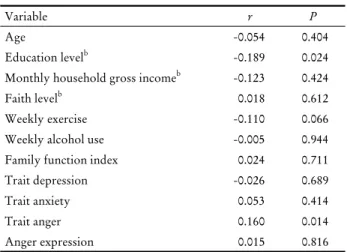
Variable
r P
Age -0.054 0.404
Education levelb -0.189 0.024
Monthly household gross incomeb -0.123 0.424
Faith levelb 0.018 0.612
Weekly exercise -0.110 0.066
Weekly alcohol use -0.005 0.944 Family function index 0.024 0.711
Trait depression -0.026 0.689
Trait anxiety 0.053 0.414
Trait anger 0.160 0.014
Anger expression 0.015 0.816
All variables were calculated by Pearson correlation analyses.
aBiological aging (%)={(biological age-chronological age)/chrono- logical age}×100.
bConverted into dummy variables.
Table 2. The relationships among general characteristics, emotional experiences, and biological aging
ahalf of subjects answered ‘no or little’ or ‘a little’. In educa- tion level, ‘under elementary school graduation’ was 1.3%,
‘elementary school graduation’ 11.0%, ‘middle school grad- uation’ 15.2%, ‘high school graduation’ 24.5%, and ‘college or university graduation’ 48.1%. Most subjects of this study were well-educated.
In monthly household gross income (won), ‘under 1×10
6’ was 11.4%, ‘more than 1×10
6and less than 3×10
6’ 26.6%,
‘more than 3×10
6and less than 5×10
6’ 29.1%, and ‘more than
5×10
6’ 32.9%. Subjects were generally evenly distributed. In smoking, ‘non-smoker’ was 61.6%, ‘past (not present) smok- er’ 19.4%, and ‘present smoker’ 19.0%, implying non-smoker group was majority. The mean weekly alcohol use (standard drink) of subjects was 5.3±11.0 standard drinks (1 standard drink was considered as alcohol 14 g). The means of trait depression, trait anxiety, trait anger, and anger expression were 20.7±5.2, 41.3±9.5, 19.9±5.3, and 48.1±7.1, respectively (Table 1).
2. The relationships among general characteristics, emotional experiences and biological aging
Education level showed significantly negative correlation
with biological aging (r=-0.189, P=0.024), and trait anger
showed significantly positive correlation with biological ag-
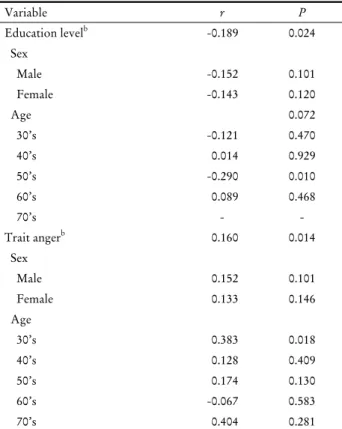
ing (r=0.160, P=0.014) (Table 2). In subgroup analysis of
sex, there were no significant correlations between education
level and biological aging in male (r=-0.152, P=0.101) and
female (r=-0.143, P=0.120) (Table 3). In addition, there were
no significant correlations between trait anger and biological
aging in male (r=0.152, P=0.101) and female (r=0.133,
P=0.146). With age stratification, a significant correlation
between education level and biological aging only in 50’s
was observed (r=-0.290, P=0.010) but the others did not
show. Age group of 30’s showed a significant correlation
between trait anger and biological aging (r=0.383, P=0.018)
Variable
r P
Education levelb -0.189 0.024 SexMale -0.152 0.101
Female -0.143 0.120
Age 0.072
30’s -0.121 0.470
40’s 0.014 0.929
50’s -0.290 0.010
60’s 0.089 0.468
70’s - -
Trait angerb 0.160 0.014
Sex
Male 0.152 0.101
Female 0.133 0.146
Age
30’s 0.383 0.018
40’s 0.128 0.409
50’s 0.174 0.130
60’s -0.067 0.583
70’s 0.404 0.281
aBiological aging (%)={(biological age-chronological age)/chrono- logical age}×100.
bCalculated by Pearson correlation analyses.
Table 3. Subgroup analysis on relationships among general characteristics, emotional experiences and biological aging
aPredictor
R
2 ΔR2 Adjusted R2β
Standard error BetaP
Modelb 0.206c 0.043c 0.034c
Trait anger 0.044d - d 0.017d 0.168e 0.075e 0.198e 0.020e Education level 0.066d 0.022d 0.028d -0.588e 0.277e -0.164e 0.038e
aBiological aging (%)={(biological age-chronological age)/chronological age}×100.
bModel was adjusted for age, sex, body mass index, monthly household gross income, faith level, smoking, weekly exercise, and weekly alcohol use.c
R
2, ΔR2,
andadjusted R2 were calculated using multiple stepwise linear regression analysis.d
R
2, ΔR2, andadjusted R2 were calculated using simple linear regression analysis.eData were calculated using multiple stepwise linear regression analysis.
Table 4. Coefficients of determination of general characteristics and emotional experiences for the biological aging
abut the other groups did not show. However, other varia-
bles of sex, monthly household gross income, faith level, age, smoking, weekly alcohol use, weekly exercise, family function index, trait depression, trait anxiety, and anger ex- pression did not showed significant correlation with bio- logical aging (Table 2).
3. Coefficients of determination of general characteristics and emotional experiences for biological aging
Simple linear regression analysis was performed. Trait anger and education level only showed the significant coefficients of determination (R
2s) for biological aging (Table 4). The R
2s of trait anger and education level were 0.044 and 0.022 respectively. However, sex, monthly household gross income, faith level, smoking, weekly alcohol use, and weekly exercise had no significant R
2for biological aging. Multiple stepwise linear regression analysis was performed adjusting age, sex, body mass index, monthly household gross income, faith level, smoking, weekly exercise, and weekly alcohol use. This model was suitable to show relationship between emotional experi- ences and biological aging (R
2=0.206, P=0.027). In this analysis, education level significantly and negatively affected the bio- logical aging (β=-0.588, P=0.038). However, trait anger showed the positive influence on biological aging (β=0.168, P=0.020).
Discussion
The present study was designed to investigate the associa- tion between usual emotional experiences and biological aging. This study demonstrated that education level showed significantly negative correlation with biological aging and trait anger showed significantly positive correlation with bi- ological aging.
Trait anger means the tendency of anger which a person
experiences continuously regardless of a certain situation or
time period. The finding of significant positive correlation
between trait anger and biological aging in this study is in
line with previous studies that elevated trait anger negatively
affected physical health.
24)The human system aging in the
level of organ-system is generally explained as follows. The
system homeostasis is regulated by the signals of nerves and hormones. When the body’s ability to maintain the homeo- stasis decreases, the system often fails to adapt oneself.
Accordingly, the system aging is progressed and possibly causes some diseases including cancer in this condition.
25)Furthermore, the ‘fight-or-flight response’ theory describes a physiological responses to the stress. When a man/woman feels himself/herself placed in a stressful situation, his/her sympathetic nervous system comes to be activated and cat- echolamines secreted from adrenal medulla in his/her body.
26)Unhealthy reactions are caused consequently that heart rate and respiratory rate are increased, gastrointestinal function is suppressed, most vessels in the system except muscles are contracted, and glycogen and fatty acids are released. Hence, the current study that higher trait anger was correlated with more biological aging consists sub- stantially with the ‘fight-or-flight response’ theory as well as the explanation of aging in the level of organ-system. In addition, our study agrees with the previous study that psy- chological stress weakened humoral and cellular immune reactions.
27)On the other side, trait depression and trait anxiety did not show significant relationships with the biological aging in this study. These results were inconsistent with the pre- vious studies. It was reported that serum tumor necrosis fac- tor alpha (TNF-α) level was more elevated in normal persons than in patients with depression.
28)Emotional stress response of anxiety significantly increased arterial stiffness even after adjusting confounding factors of age, mean arterial pressure, gender, BMI, smoking, education, and income.
29)There are a few reasons why these inconsistencies oc- curred in this study.
Firstly, dependent variables used for aging of human body were different. Although our study reported emotional stress on biologic aging process by biologic age, previous studies used TNF-α and arterial stiffness. TNF-α is a cytokine to regulate immune cells and its dysregulation implicate a variety of human diseases. Arterial stiffness reflects the severity of atherosclerosis. In contrast to these factors, biological aging is a value computed by a specific formula which consists of chronological age and biological age. As stated above, bio- logical age is calculated with BMI, body fat, body muscle, waist circumference, WHR, SBP, DBP, pulse pressure, FEV1, FVC, and other blood test results. Because biological age is a complex parameter reflecting various conditions, relation-
ship between emotional stress and biological age would be more precise in this study than in previous studies.
Secondly, there might be some discordances among in- ventories to estimate the degree of depression and anxiety.
BDI in the previous study was utilized to appraise depression.
On the one hand, the Trait Depression Inventory was em- ployed in this survey, separated from STDI-K.
16)The State-Trait Anxiety Inventory in the old survey was em- ployed to evaluate anxiety, developed by Spielberger et al.
17)On the other hand, the Trait Anxiety Inventory exacted from the Korean adjustment of State-Trait Anxiety Inventory ap- plication done by Kim
18)in the current study. For those rea- sons, adjusted questionnaires for Korean would reflect anxi- ety and depression better than previous tools. These differ- ences could induce inconsistent results.
Finally, there is another possibility that stress hormones are less secreted in circumstances with depression or trait anxiety than with trait anger.
The significant negative correlation between education lev- el and biological aging was found in this study. It did not seem to be significantly affected by sex when performing sub- group analysis. Generally, the higher education level, the less biological aging. People who have a higher formal schooling generally aware the importance of health maintenance and disease prevention. It coincides with the previous result that people who was less educated poorly execute the preventive strategies for cardiovascular diseases.
30)In age stratification, significant relationship was found in the generation of 50’s.
In other generations, there were no significant impacts. The reasons for these differences might be originated from differ- ent numbers of each generations. The most patients were en- rolled in the generation of 50’s (n=77 [32.5%]) in this study.
Meanwhile, the relationship between trait anger and bio- logical aging was not affected by sex. The significant relation- ship between trait anger and biological aging was observed only in the generation of 30’s during age stratification. This could mean that trait anger more powerfully aggravated bio- logical aging in generation of 30’s. Because the other groups did not show significant the relationships, whether the rela- tionship was applied in general population or only in specific group will be needed to investigate.
There are several limitations in this study. Since this study
was a cross-sectional study using questionnaire, detailed
medical history of depression or anxiety could not be fig-
ured out. In addition, calculation formula of biological aging
included the patient’s chronological age, reflecting the possi- bility of influence of patient’s own age. It implied that fac- tors such as educational status could be affected by bio- logical aging itself. However, analysis using Pearson’s corre- lation and subgroup analysis with one-way ANOVA showed that the chronological age did not affect the bio- logical aging. We also adjusted the chronological age when analysis the impact of general characteristics and emotional experiences on biological aging. Nonetheless, causal rela- tionships between usual emotional experiences and bio- logical aging needed further investigations because this study was a cross-sectional study. Furthermore, the number of subjects in this study was small and they lived mostly in the Daejeon-Chungcheong province. Finally, the R
2s of trait anger and education level for biological aging (R
2=0.044 and 0.022, respectively) showed low absolute values in the current study. It implies that many other factors could affect the human body aging.
This study suggests that the significant relationship be- tween usual anger experience (i.e., trait anger) and biological aging would be present. In addition, lower education level may be related with biological aging. Until now, there has been no studies investigating adverse effects of usual neg- ative emotional experiences on the human body system by biological aging progression, in our knowledge. Further studies for causal relationship between emotional stress and biological aging would be needed.
요 약
연구배경: 본 연구는 인간이 평소에 부정적인 정서들을 경 험하는 것과 생물학적 노화 사이의 연관성을 알아보기 위하 여 고안되었다.
방법: 2013년 5월부터 9월까지 충남대학교병원 건강증진 센터를 내원한 237명을 대상으로 연구하였다. 피험자들 개개
인에게 구조화된 설문지를 주어 응답하도록 하였다 . 피험자
들이 ‘평소에 느끼는 우울, 불안, 분노 그리고 분노표현’ (이하
‘정서경험들’)은 특성우울척도([the Korean adaptation of]
State-Trait Depression Inventory에서 분리함), 특성불안척도 (한국형 상태-특성불안척도[State-Trait Anxiety Inventory]에서 분리함 ) 그리고 특성분노척도와 분노표현척도([the Korean adaptation of] State-Trait Anger Expression Inventory에서
분리함 )로 사정하였다. 피험자들 각각이 ‘생물학적으로 노화
가 진행되는 정도’ (이하 ‘생체노화’)는 생체 연령(비만과 주 요 장기들의 노화를 반영)과 실제 나이로 이루어진 특수한
공식으로 계산하였다 . 독립 t-검정, 일원분산분석, 상관분석
을 시행하여 피험자들의 일반적 특성들 (정서경험들을 포함)
과 생체노화들 간의 연관성들을 평가하였다 . 단계적 회귀분
석을 사용하여 피험자들의 일반적 특성들과 생체노화들 간 의 설명력 (R
2)들을 산출하였다.
결과: 일변량분석에서 오직 특성분노와 교육수준만이 생 체노화와 유의한 상관관계를 보였다 ; 전자의 경우는 r=0.160, P=0.014, 후자는 r=-0.189, P=0.024. 다변량분석에서는 특성 분노와 낮은 교육수준만이 생체노화와 유의한 설명력을 나 타냈다 ; 전자의 경우는 R
2=0.044, P=0.020, 후자는 R
2=0.022, P=0.038.
결론: 본 연구는 평소에 경험하는 분노(즉 특성분노)와 낮 은 교육수준이 인체의 생물학적 노화를 촉진시키는 주목할 만한 요인들임을 시사한다.
중심 단어: 노화, 분노, 교육
REFERENCES
1. Cannon WB. The wisdom of the body. New York: W.W.
Norton & Company, Inc.; 1932. p.218-42.
2. Romero ML, Butler LK. Endocrinology of stress. Int J Comp Psychol 2007;20(2):89-95.
3. al’Absi M, Bongard S. Neuroendocrine and behavioral mecha- nisms mediating the relationship between anger expression and cardiovascular risk: assessment considerations and improvements.
J Behav Med 2006;29(6):573-91.
4. Cohen BE, Panguluri P, Na B, Whooley MA. Psychological risk factors and the metabolic syndrome in patients with coronary heart disease: findings from the heart and soul study. Psychiatry Res 2010;175(1-2):133-7.
5. Schrag A, Jahanshahi M, Quinn N. What contributes to quality of life in patients with Parkinson’s disease? J Neurol Neurosurg Psychiatry 2000;69(3):308-12.
6. Kathol RG, Mutgi A, Williams J, Clamon G, Noyes R Jr.
Diagnosis of major depression in cancer patients according to four sets of criteria. Am J Psychiatry 1990;147(8):1021-4.
7. Räikkönen K, Matthews KA, Kuller LH. The relationship be- tween psychological risk attributes and the metabolic syndrome in healthy women: antecedent or consequence? Metabolism 2002;51(12):1573-7.
8. Chignon JM, Lepine JP, Ades J. Panic disorder in cardiac outpatients. Am J Psychiatry 1993;150(5):780-5.
9. Beck AT, Ward CH, Mendelson M, Mock J, Erbaugh J. An in- ventory for measuring depression. Arch Gen Psychiatry 1961;
4(6):561-71.
10. Beck AT, Epstein N, Brown G, Steer RA. An inventory for measuring clinical anxiety: psychometric properties. J Consult Clin Psychol 1988;56(6):893-7.
11. Zung WW. A self-rating depression scale. Arch Gen Psychiatry 1965;12(1):63-70.
12. Zung WW. A rating instrument for anxiety disorders. Psychosomatics
1971;12(6):371-9.
13. Hamilton M. A rating scale for depression. J Neurol Neurosurg Psychiatry 1960;23(1):56-62.
14. Hamilton M. The assessment of anxiety states by rating. Br J Med Psychol 1959;32(1):50-5.
15. Spielberger CD, Reheiser EC. Assessment of emotions: anxiety, anger, depression, and curiosity. Appl Psychol Health Well Being 2009;1(3):271-302.
16. Lee CH, Chon KK, Hahn DW, Kim KH. The Korean adapta- tion of the State-Trait Depression Inventory: STDI-K. Korean J Health Psychol 1999;4(1):1-14.
17. Spielberger CD, Gorsuch RL, Lushene RE. Manual for the state-trait anxiety inventory. Palo Alto: Consulting Psychologist Press; 1970. p.1-2.
18. Kim JT. The relationship of the trait anxiety and sociality [dissertation]. Seoul: Korea University; 1978. Korean.
19. Lee YJ, Bhang SY, Choi S, Lee HK, Kim BW, Kim W, et al.
Korean state-trait anxiety inventory application study in middle and high school students. J Korean Neuropsychiatr Assoc 2008;47(5):471-80.
20. Spielberger CD, Sydeman SJ. State-trait anxiety inventory and state-trait anger expression inventory. In: Maruish ME, ed. The use of psychological testing for treatment planning and outcome assessment: 1st edition. Hillsdale: Lawrence Erlbaum Associates;
1994. p.292-321.
21. Hahn DW, Lee CH, Chon KK. Korean adaptation of the State-Trait Anger Expression Inventory (STAXI-K): the case of college students. Korean J Health Psychol 1998;3(1):18-32.
22. Bae CY, Kang YG, Kim S, Cho C, Kang HC, Yu BY, et al.
Development of models for predicting biological age (BA) with
physical, biochemical, and hormonal parameters. Arch Gerontol Geriatr 2008:47(2):253-65.
23. Park JH, Cho BL, Kwon HT, Lee CM. Developing a biological age assessment equation using principal component analysis and clinical biomarkers of aging in Korean men. Arch Gerontol Geriatr 2009;49(1):7-12.
24. Hahn DW, Park JH, Kim KH. Effects of self-disclosure and ru- mination about stressful life event and emotional experiences on physical health. Korean J Health Psychol 2004;9(1):99-130.
25. Menendez JA, Joven J. Energy metabolism and metabolic sen- sors in stem cells: the metabostem crossroads of aging and cancer. Adv Exp Med Biol 2014;824:117-40.
26. Arun CP. Fight or flight, forbearance and fortitude: the spec- trum of actions of the catecholamines and their cousins. Ann N Y Acad Sci 2004;1018:137-40.
27. Baltrusch HJ, Stangel W, Titze I. Stress, cancer and immunity.
New developments in biopsychosocial and psychoneur- oimmunologic research. Acta Neurol (Napoli) 1991;13(4):315-27.
28. Dannehl K, Rief W, Schwarz MJ, Hennings A, Riemer S, Selberdinger V, et al. The predictive value of somatic and cognitive depressive symptoms for cytokine changes in patients with major depression. Neuropsychiatr Dis Treat 2014;28(10):1191-7.
29. Logan JG, Barksdale DJ, Carlson J, Carlson BW, Rowsey PJ.
Psychological stress and arterial stiffness in Korean Americans.
J Psychosom Res 2012;73(1):53-8.
30. Janković S, Stojisavljević D, Janković J, Erić M, Marinković J.
Association of socioeconomic status measured by education,
and cardiovascular health: a population-based cross-sectional
study. BMJ Open 2014;4(7):e005222.
다음 설문 문항들을 읽고 본인이 해당된다고 생각하는 답가지(①, ②, ③, ④, ⑤) 중 하나에만 O표를 하세요.
1. 어떤 종교를 갖고 계십니까?
① 없다
② 기독교
③ 천주교
④ 불교
⑤ 기타
2. 종교가 있다면, 신앙에 얼마나 의지하십니까? (종교가 있는 분만 답하세요)
① 거의 의지하지 않음
② 조금 의지함
③ 대체로 의지함
④ 많이 의지함
3. 여가활동 또는 취미생활을 하고 계십니까?
① 안 한다.
② 가끔 한다.
③ 정기적으로 하고 있다.
4. 최종학력을 표시해주세요.
① 무학
② 초졸
③ 중졸
④ 고졸
⑤ 대졸 이상
5. 결혼을 하셨습니까?
① 기혼
② 미혼
③ 기타(이혼, 별거, 배우자 사별 등)
6. 평소 가족과 같이 생활하고 계십니까?
① 가족과 같이 지낸다.
② 가족과 떨어져서 지낸다.
7. 본인의 경제적 수입은 어느 정도입니까?
① 월 100만 원 미만
② 월 100~300만 원
③ 월 300~500만 원
④ 월 500만 원 이상
Supplementary questionnaire 1. Questionnaire for demographics and faith
8. 가계의 총 경제적 수입은 어느 정도입니까?
(가정의 경제적 수입원이 본인 혼자인 경우, 7번과 똑같이 답하세요)
① 월 100만 원 미만
② 월 100~300만 원
③ 월 300~500만 원
④ 월 500만 원 이상
9. 나에게 괴롭거나 어려운 일이 생기면 나의 가족에게 도움을 청할 수 있다.
① 항상 그렇다.
② 때때로 그렇다.
③ 아니다.
10. 문제 해결을 위한 대화나 어려움을 서로 나누어 갖기 위해 현재 우리 가족이 취하고 있는 방법들이 좋다고 생각한다.
① 항상 그렇다.
② 때때로 그렇다.
③ 아니다.
11. 내가 새로운 일을 하거나 새로운 제안을 할 때 나의 가족은 이를 따라주고 도와준다.
① 항상 그렇다.
② 때때로 그렇다.
③ 아니다.
12. 분노, 슬픔, 사랑 등 나의 감정에 대응하는 나의 가족의 반응에 만족한다.
① 항상 그렇다.
② 때때로 그렇다.
③ 아니다.
13. 가족과 함께 여가를 보내는 방법 중 현재 우리 가족이 취하는 방법들이 좋다고 생각한다.
① 항상 그렇다.
② 때때로 그렇다.
③ 아니다.
각 문장을 잘 읽으시고 각 문장의 오른편에 있는 답가지들(①, ②, ③, ④) 중에서 ‘평소에 내가 일상생활에서 느끼는 바’를 가장 잘 나타낸다고 생각되는 것 하나에 O표를 하십시오.
평소에 일상생활에서 느끼는 바로는
답가지 전혀
아니다
조금 그렇다
상당히 그렇다
매우 그렇다
나는 행복하다a ① ② ③ ④
나는 침울하다 ① ② ③ ④
나는 완전하다a ① ② ③ ④
나는 슬프다 ① ② ③ ④
나는 평온하다a ① ② ③ ④
나는 기분이 초조하다 ① ② ③ ④
나는 우울하다 ① ② ③ ④
나는 안도감을 느낀다 ① ② ③ ④
나는 희망이 없다 ① ② ③ ④
나는 생활이 즐겁다a ① ② ③ ④
나는 기분이 좋다a ① ② ③ ④
나는 쉽게 피로해진다 ① ② ③ ④
나는 울고 싶은 심정이다 ① ② ③ ④
나는 다른 사람들처럼 행복했으면 좋겠다 ① ② ③ ④
나는 마음을 빨리 정하지 못해서 실패를 한다 ① ② ③ ④
나는 마음이 놓인다a ① ② ③ ④
a: 역산 문항
Supplementary questionnaire 2. Trait depression inventory
나는 마음이 차분하고 침착하다a ① ② ③ ④
나는 너무 많은 어려운 문제가 밀려 닥쳐서 극복할 수 없을 것 같다 ① ② ③ ④
나는 하찮은 일에 너무 걱정을 많이 한다 ① ② ③ ④
나는 행복하다a ① ② ③ ④
나는 무슨 일이건 힘들게 생각한다 ① ② ③ ④
나는 자신감이 부족하다 ① ② ③ ④
나는 마음이 든든하다a ① ② ③ ④
나는 위기나 어려움을 피하려고 애쓴다 ① ② ③ ④
나는 울적하다 ① ② ③ ④
나는 만족스럽다a ① ② ③ ④
사소한 생각이 나를 괴롭힌다 ① ② ③ ④
나는 실망을 지나치게 예민하게 받아들이기 때문에 머릿속에서 지워버릴 수가
없다 ① ② ③ ④
나는 착실한 사람이다a ① ② ③ ④
나는 요즈음의 걱정거리나 관심거리를 생각만 하면 긴장되거나 어찌할 바를 모
른다 ① ② ③ ④
a: 역산 문항
Supplementary questionnaire 3. Trait anxiety inventory
평소에 일상생활에서 느끼는 바로는
답가지 전혀
아니다
때때로 그렇다
자주 그렇다
거의 언제나 그렇다
나는 성미가 급하다 ① ② ③ ④
나는 불같은 성질을 지녔다 ① ② ③ ④
나는 격해지기 쉬운 사람이다 ① ② ③ ④
나는 다른 사람이 잘못해서 내 일이 늦어지게 되면 화가 난다 ① ② ③ ④
나는 일을 잘하고도 다른 사람으로부터 인정받지 못하면 분통이 터진다 ① ② ③ ④
나는 쉽게 화를 낸다 ① ② ③ ④
나는 화가 나면 욕을 한다 ① ② ③ ④
나는 다른 사람 앞에서 비판을 받게 되면 격분한다 ① ② ③ ④
나는 내 일이 막히면, 누군가를 때려주고 싶다 ① ② ③ ④
나는 일을 잘 했는데도 나쁜 평가를 받으면 격분한다 ① ② ③ ④
Supplementary questionnaire 4. Trait anger inventory
화가 나거나 분노를 느낄 때
답가지 전혀
아니다
때때로 그렇다
자주 그렇다
거의 언제나 그렇다
나는 화를 참는다a ① ② ③ ④
나는 화가 난 감정을 표현한다 ① ② ③ ④
나는 말을 하지 않는다 ① ② ③ ④
나는 사람들에게 인내심을 가지고 대한다a ① ② ③ ④
나는 뚱해지거나 토라진다 ① ② ③ ④
나는 사람을 피한다 ① ② ③ ④
나는 소리를 지른다 ① ② ③ ④
나는 냉정을 유지한다a ① ② ③ ④
나는 문을 쾅 닫아버리는 식의 행동을 한다 ① ② ③ ④
나는 상대의 시선을 피한다 ① ② ③ ④
나는 행동을 자제한다a ① ② ③ ④
나는 사람들과 말다툼을 한다 ① ② ③ ④
나는 아무에게도 말하지 않으나, 안으로 앙심을 품는 경향이 있다 ① ② ③ ④
나는 목소리를 높인다 ① ② ③ ④
나는 화가 나더라도 침착하게 자제할 수 있다a ① ② ③ ④
나는 속으로 다른 사람을 비판한다 ① ② ③ ④
나는 나 자신이 인정하고 싶은 것보다 화가 더 나 있다 ① ② ③ ④
나는 대부분의 사람들보다 빨리 진정된다a ① ② ③ ④
나는 욕을 한다 ① ② ③ ④
나는 참고 이해하려고 노력한다a ① ② ③ ④
나는 다른 사람이 알고 있는 것보다 분통이 더 나 있다 ① ② ③ ④
나는 자제심을 잃고 화를 낸다 ① ② ③ ④
나는 화난 표정을 짓는다 ① ② ③ ④
나는 화난 감정을 자제한다a ① ② ③ ④
a: 역산 문항