1. Introduction
With growing concern over humanity’s impact on environmental quality, environmental
education is becoming an increasingly important part of both formal and informal educational curricula around the world. Yet despite the wide academic discussion from practical teaching techniques to more theoretical debates about
Student-Perspective Sources of Environmental Learning in South Korea
Laura A. Bakkensen*
학생관점에서 접근해 본 한국에서의 환경학습 기회
로라 백켄슨*
Abstract:This study aims to uncover sources of environmental learning from a student perspective using the previously unstudied case of South Korea. Literature from other countries credits many sources of learning, including:
media, school, personal sources, and non-governmental organizations. This analysis is based on focus group and questionnaire data collected during in-country field work. Results from South Korea are then compared with other studies carried out in the Asia-Pacific and the Western developed world. The results show that, similar to other countries including Australia, China, and India; South Korean students learn about the environment mainly through the media and schools. Television, schools, and domestic internet web pages were found to be some of the most-used sources of environmental information in South Korea, while more personal sources, such as community, family, and friends, were found to play an overall lesser instructive role. When compared internationally, South Korean students often exhibited less trust in the reliability of various sources, especially business, community, and foreign sources of information.
Key Words : environmental education, learning sources, student-perspective research, focus group, questionnaire.
요약:본 연구의 목적은 한국을 사례로 학생관점 접근을 통해 환경학습의 원천을 밝히는데 있다. 다른 나라에서 이루어진 연구에 의 하면, 환경학습의 원천에는 미디어, 학교, 개인적 기회, 그리고 비정부기구 등이 있다. 본 연구는 한국을 사례로 하여 토의집단과의 면접과 설문조사에 기초하여 이루어졌으며, 그 결과는 다른 나라의 것과 비교하였다. 한국 학생들의 경우 환경에 대한 정보를 호주, 중국, 인도를 포함한 다른 나라와 유사하게 미디어와 학교에서 얻는 것으로 나타났다. 환경정보 습득의 원천으로 가장 중요한 것은 텔레비전과 학교 그리고 인터넷이었으며, 지역사회, 가족 그리고 친구와 같은 개인적 기회는 그다지 중요하지 않은 것으로 나타났다.
외국과 비교해 보면, 한국 학생들은 다양한 출처, 특히 기업, 지역사회, 그리고 외국으로부터의 정보에 대해 비교적 덜 신뢰하는 것으 로 드러났다.
주요어 : 환경교육, 환경학습 원천, 학생관점 접근, 토의집단, 설문
* Instructor, Foreign Language Institute, Cheju National University, [email protected]
conceptions of education and environment, much less is known about how individuals learn factual knowledge, as well as appreciation for, the environment. Literature that does exist in the area often focuses on adult perspectives from developed Western countries. In contrast, this study looks at the case of South Korea (hereafter
‘Korea’) from a youth perspective.
This study also aims to look at environmental education from an opposite paradigm: instead of a teaching viewpoint, it looks at learning from the learner’s viewpoint. In contrast to educator-based assumptions concerning teaching “successes,” a student’s point of view can offer refreshing honesty about what is actually being learned.
Student-level analysis can also be academically rigorous with qualitative and quantitative research methods. Additionally, instead of looking at teachers as a single entity, environmental education is broken down into various sources of learning from which the student can draw. With critical analysis, relative importance can be assigned to various sources, thereby shedding light on the overall question of how students learn about the environment. Once the mechanisms of environmental learning are better known, more effective environmental education plans can be crafted.
2. Sources of Environmental Learning
Significant literature analyzes environmental learning as well as overall theories of environmental education. But despite this impressive scholarship and “a large literature on environmental education practices,... we know very little about how and why children develop a concern for environmental issues”(Hart, 1997, 17).
Even a decade after Hart’s observation, though some progress has been made on the subject,
obscurity remains. It is this complex patchwork of experience and information that this investigation attempts to elucidate.
Intuitively, there are many potential sources from which students can learn about the environment. In the literature, environmental learning can be seen as coming from discrete sources, including the media, schools, non- governmental organizations, government actions, family, friends, community, and personal interactions with nature. Each source draws from different academic traditions such as curriculum theory and youth theory.
1) Media and school
Media significantly influences student views and ideas on many subjects, and environmental education is no exception. The most reported source of student environmental information around the world is television (Rickinson, 2001).
A study by Roper Starch Worldwide (1994) found television as the overwhelming response by young people in the United States. Similar results of the importance of television were found in Australia (Connell et al., 1998), Europe (Filho, 1996), Hong Kong (Chan, 1996), and the United Kingdom (Morris and Schagen, 1996; Palmer, 1995; Bonnett and Williams, 1998; studies summarized by Rickinson, 2001). Additional media sources, such as radio and newspapers, also have a lesser impact in environmental education. Although the Internet has not been heavily studied in an environmental education context, it is the opinion of the author that this is an increasingly important source of learning.
Media can greatly shape the environmental messages that are introduced in a society through television, broadcasting, public service announcements, advertising, and other sources (Blewitt, 2006). Thus, literature demonstrates the importance of media in environmental learning.
Schools are reported as the second most important source of environmental education (Rickinson, 2001). Top-down approaches from government-mandated educational directives as well as government-led educational campaigns are common in most developed countries.
Curriculum theory is often applied to understand environmental learning, as the theory tries to explain the basic relationships between teacher, student, school, and the materials being taught (Carlson, 2005). Environmental applications of curriculum theory detail definitions and concepts on environmental learning (see Payne, 2006;
Palmer, 1998; Fien, 1993). They show that environmental learning is not a simple concept, but rather encompasses many dimensions. For example, the process of learning as defined by the National Curriculum for Schools in England has three essential and interlinked parts for successful learning: knowledge and understanding, skills, and attitudes (Palmer, 1998). In addition, successful environmental curriculum includes four necessary elements: the empirical (relating to quantitative elements), the synoptic (relating to complexities and interconnections in nature), the aesthetic (relating to qualitative issues surrounding the environment) and the ethical (relating to concepts of personal responsibility and stewardship) (Palmer, 1998). The downside of curriculum theory is that it was not developed specifically for environmental learning, and therefore can fail to see the full range of possible “student” and
“teacher” interactions outside the formal school setting where curriculum theory focuses.
Therefore, it can miss a large amount of environmental learning.
Within this traditional top-down type of learning, there is room for creativity and originality. Some governments employ “outdoor schools” where students live in an off-campus setting for a few days to gain first-hand
environmental experience. Studies have shown that these shorter-term outdoor ecology education experiences can have positive impacts on long-term attitudes and environmental knowledge (Bogner, 1998). Additionally, research shows the usefulness of music in classroom environmental learning (Turner and Freedman, 2004). But this top-down educational structure is not without its critics, especially from Marxist traditions that see humanity, especially through capitalism, as destroyers of the environment.
They also claim that public school and university environmental education lacks innovation, and instead perpetuates mores that support social and economic structures at the heart of environmental depletion, ultimately leading to a “culture of denial” of the environmental crisis (Bowers, 1997). But despite the criticism, environmental education in the school setting is still a strong influence on environmental learning.
2) Personal sources
Literature also provides theoretical and empirical evidence for the importance of bottom- up, personal methods of environmental education including family, friends, and community influences, as well as individual experience with nature. Youth theory can help to understand these types of environmental learning. Youth theory explains a child’s social and psychological development, and how this development shapes the child’s behavior, be it law-abiding or delinquent, within society. In terms of environmental education, youth theory details the importance of personal, participatory experience from local sources for children to learn about, and especially gain appreciation for, the environment (Hart, 1997). Community initiatives, family and respected elders, peer groups, and individual experiences can cultivate environmental knowledge and a desire to care.
Importantly, a youth’s environmental views must fit within the formation of their identity and self- esteem during their development process (Hart, 1997; Sauvé and Orellana, 2004). Youth theory does have drawbacks. Although it can theorize necessary ingredients for youth to gain appreciation for the environment, it does not comprehensively explain how some youth develop appreciation, and why some, given similar life conditions, do not.
Lastly, it is important to remember the incredible impact of individual experience with nature in building a desire to learn about and protect the environment. In a study of professionals in the environmental conservation field, forty-four of forty-five respondents described real-life childhood experiences in pristine natural settings as the most important influence in their pursuit of a career in environmental conservation (Tanner, 1980).
Accordingly, a range of literature supports the importance of personal sources of environmental learning.
3) Other learning sources
Non-governmental organizations (NGOs) can also play an important role in environmental education, offering a practical and wide range of environmental education activities led by professionals dedicated to the environment. They can also offer new connections and fresh perspectives, inviting exploration of connections between the environment and everyday life that might not be addressed in more traditional top- down approaches (Haigh, 2006). A drawback to NGOs is their potential for capture by financial interests such as industry contributors, volunteers, and other powerful donors.
Lastly, and perhaps a growing source of environmental knowledge, are international norms and attitudes. International non-
governmental organization campaigns, as well as initiatives through intergovernmental sources, such as the United Nations (UN) offer a wide range of tips and lessons as well as theoretical background for environmental education. Often, the focus is connecting the environment and economic development, with differing views of humanity’s role and responsibilities. The Organisation of Economic Co-operation and Development (OECD) encourages environmental awareness to promote sustainable economic development (OECD, 1995). In contrast, the UN offers resources and teaching tools with multiple aims, including teaching students about environmental care, observing connections between humans and environmental quality, and demonstrating the importance of personal and local actions (UN, 1991). The UN also notes a diversity of approaches to environmental education such as the human approach (focusing on personal connections with local communities), the positive approach (focusing on the UN’s efforts in conjunction with communities for the environment), and student involvement approach (focusing on active participation of the student in many stages of environmental activities) (UN, 1991). In addition to intergovernmental organizations, international NGOs, newspapers, television, and Internet websites are becoming influential in environmental education.
Although all the previous sources ideally have a positive influence on environmental learning, it is also quite possible that some sources may detract from environmental learning. For example, while thoughtful peers might encourage recycling and good citizenship, negative peer pressure can easily discourage environmental stewardship. Because of this, it is important to look at the extent to which the aforementioned factors both encourage and discourage environmental education, so as to properly credit the true sources of education.
4) Factors that affect environmental learning
Other factors, while not necessarily direct sources of learning, can nonetheless impact environmental learning, especially with respect to environmental attitudes. Research shows that demographic factors such as age, socio-economic level, gender, religion, culture, and even geographic location can impact student environmental learning (Rickinson, 2001). Below, the role of religion and culture are further discussed.
One important factor affecting environmental learning is religion. Although religious services may not focus on the factual scientific side of environmental education, religions often encourage the development of environmental appreciation, stewardship, and conservation. Each religion holds differing conceptions of the human/environmental relationship that can potentially change how students internalize the environmental messages that they learn. For example, Buddhist traditions teach respect toward nature and see humans as a part of the greater environment. Christian traditions, in contrast, see humanity as a caretaker of the environment, there to prudently use and manage its existence (Yencken et al., 2000). Religion becomes important in the Korean context due to significant diversity in religious beliefs despite ethnic homogeneity. About 26% of the population identifies with the Christian faith, and a slightly smaller percentage consider themselves to be Buddhist (CIA factbook, 2007), with Korean Shamanism, Jehovah’s Witness, and other faiths also practiced. Unlike countries with more religious homogeneity, the religions practiced in Korea may lead to more diversity in student environmental learning.
Culture also has a role in how environmental information is recognized and understood
(Milton, 1996), as the context for self-identity differs based on cultural surroundings. For example, individualistic Euro-Anglo heritage can differ from those in more communal, collective- oriented traditions such as Korea (Hart, 1997).
But scholars are warned against assuming a priori differences between Eastern and Western environmental thought. The scholar Ronald Inden notes that Eastern connections with nature are often viewed romantically by Western scholars, and can often become pejorative misconceptions presenting the East as more spiritually connected and dependent on nature while on the other hand being less scientific than the West (Guha and Martinez-Alier, 1997). Also, cultures in the North versus South (Guha and Martinez-Alier, 1997) and gender issues (Yencken et al., 2000) are important.
5) Environmental learning: a framework in two parts
Above all, environmental learners need a mental framework to understand ecological knowledge in order to effectively learn. This framework provides context to properly evaluate new information. Those who do not possess such a structure may easily become frustrated or confused when confronted with new sources of environmental learning (Slingsby and Barker, 2005). Accordingly, learning about the environment can be seen as a two-step process.
First, factual knowledge is needed, including concepts such as scientific and social science definitions of the natural environment, environmental health and pollution, and methods to improve the environment. Second, a learned appreciation about the environment is necessary to foster proper knowledge assimilation, as well as a desire to help the environment.
Put together, these can ultimately allow the learner to undertake environmentally conscien-
tious actions and lead a life more aware of his or her impact on the world. Without both factual knowledge and learned appreciation, environmental learning is not effective, as having the first without the second results in a knowledgeable student who does not act on the knowledge. The second without the first results in a student who acts with good intention, but ineffectively because fact-based logic and understanding are missing. Various sources of learning can teach both types of learning, but with different strengths and weaknesses.
3. Sources of Environmental Learning: Korea and the International Setting
Just like its incredible economic success in the second half of the 20th century, Korea’s educational system has performed nothing short of its own “miracle”, going from a 5% rate of elementary school completion in 1945 to an almost 100% literacy rate by the 1990s, with virtually all Koreans completing elementary and middle school, and a 90% high school graduation rate in 1995 (Seth, 2002). In this context, sources of environmental learning will be explored.
Korean education has emphasized for centuries the importance of a “familiar, interdependent, and harmonious existence with nature” (Kim, 2000, 46). More recently, environmental education in Korea has changed dynamically, growing more important in the national curriculum. During the 1970s, as the environmental movement gained momentum in other parts of the world, environmental education in Korea was not emphasized other than basic information about problems facing the environment. The 1980s brought in new concern for the environment, especially as negative side effects of the country’s
fast-paced, heavily industrial-centered development were coming to light and the country’s water, air, as well as city landscapes were becoming more polluted. Demand for more in-depth environmental education soon followed (Nam, 1995).
Creating and executing environmental education in Korean schools has been primarily the task of government-funded institutions including the Korean Educational Development Institute, the Ministry of Environment, and, of course, the Ministry of Education. The 4thNational Curriculum (in 1981) set a foundation for environmental education by noting it as an important subject to learn, and as a result, many schools were persuaded to consider environmental education.
The 5th National Curriculum formally introduced environmental education as a priority for primary and secondary schools in Korea, although it was not introduced as its own subject. Instead, environmental education was taught through various related subjects such as Geography in the social sciences, Biology in the natural sciences, and also during ethics courses. Critics of these advances did not see the revisions going far enough, and wanted environmental education to be taught as a single subject (Nam, 1995).
Accordingly, many were pleased to see environmental education given status as its own subject in the 6th National Curriculum in 1995.
Environmental education was seen as an optional course at all primary and secondary school levels, with implementation optional in elementary, middle and high schools. Although not quite the full mandatory subject status of mathematics or Korean language, it was still a major advancement (Nam, 1995).
In summary, school-based environmental education in Korea continues to develop and increase in importance. Yet despite a highly standardized national curriculum, each student’s environmental education will differ based on
school priorities and individual teachers’
knowledge and goals, as environmental education still remains an optional course (Shin, 2000).
1) Methodology
In designing this study, the methodology was purposely tailored to reflect the methodology of Yencken’s 2000 compilation of environmental education studies across the Asia Pacific. In it, environmental education, including sources of student environmental learning, is studied in countries across the Asia-Pacific region, using both focus groups and questionnaires. As Korea was not one of the countries studied, this author hoped to use a similar methodology to allow the study of Korea to fit more logically in the existing literature, enabling more direct comparisons and contrasts1).
Despite the intentional similarities, there were several important ways in which the current methodology differs and expands upon the Yencken studies. First, this current study adds an additional source of environmental learning: the Internet. As technological advances increase accessibility of this tool to a greater number of students globally, it was the opinion of the author that this is an important source to include in this, and future, environmental research. Second, this study includes an important distinction between domestic and international for several sources of environmental information including the Internet, newspapers, NGOs, and government bodies during focus groups and questionnaires. While Yencken (2000), as well as most other studies, does not look at this distinction, it is useful to gauge the pervasiveness of international norms and views in a nation’s environmental education.
Thirdly, this study looks at how sources can discourage environmental learning, instead of assuming that all will encourage learning. This
has not been heavily studied in previous literature, yet is a vital piece for a more complete understanding of learning. Lastly, the Yencken studies aimed to construct a broader picture of environmental education in each respective country (Yencken, 2000). The current study had a smaller focus, looking specifically at sources of environmental learning. Therefore, the range of focus group and questionnaire topics was much narrower in scope. So, despite the similarities that link the current study with Yencken et al. (2000), the current study is also original.
The research for this study was carried out during three weeks of in-country field research by the author from late March to early April 2007.
During this time, the author visited five public schools (two in Cheonan (천안) and three on Jeju Island (제주도)) and conducted a focus group with six to eight students at each school.
Additionally, a questionnaire was given to fifty students from each school. Although these five schools cannot begin to speak for all the regional uniqueness nor be an absolute authority for the entire country, it was the hope of the author that they can still offer an interesting peek into trends in environmental education in Korea.
The use of focus groups with surveys is a common link in research projects, as the two methods can compliment each other well. Focus groups can be used to evaluate and construct questionnaire topics. Additionally, and most applicable for this study, focus groups can offer insights and depth in analyzing questionnaire data (Morgan, 1997).
The focus group, or small group interviewing, is only one type of method for generating qualitative social science data (Mason, 1996).
Although common in marketing and politics, focus groups are becoming more common as a tool for social science research, including environmental research (Desvousges and Frey, 1989). Focus groups carry unique strengths as
well as weaknesses as a form of qualitative research, mainly stemming from two of the method’s essential features: the dependence on the researcher’s focus, and issues of group dynamics (Morgan, 1997). On the one hand, they allow insights into collective meanings and shared norms that group members use to form opinions and views (Bloor et al., 2001). Such topics often elude quantitative data. But focus groups results can also downplay diversity in responses because intra-group differences often go under-reported due to communal group dynamics and conformity pressure. Therefore, focus groups cannot be seen as an alternative to deeper individual interviews or surveys (Bloor et al., 2001). Lastly, focus groups can nicely balance other sources of information gathering, but cannot be used to validate conclusions from other sources, mainly because focus groups have their own methodological difficulties (Bloor et al., 2001). Care must be taken at many stages, including participant recruitment, question development (Kruger, 1998a), and analyzing and reporting (Kruger, 1998b)
For this study, the author conducted one focus group of six to eight students at each school.
Although typical focus groups last 90-minutes (Bloor et al., 2001), focus groups for this study tended to run shorter, from about 50 to 65 minutes. This was mainly due to school schedule constraints, and also due to the shorter attention span of high school students, especially with the more tedious nature of dual language communication. Ideally, a translator is a third party with no affiliation to the focus group participants. Due to budget limitations, school- affiliated translators were used. The author found that student responses were still quite open, and even expressed critiques of government and school environmental education initiatives.
Nonetheless, it still may have been a source of bias.
After conducting the focus groups, analysis must be systematic, verifiable, and situationally responsive (Kruger, 1998b). The author chose to transcribe, code and analyze the conversations using the analytic induction method (or deviant case analysis) as developed by Znaniecki (1968) and detailed by Bloor et al. (2001). This method, one of the most commonly used for this type of research, starts with the creation of a hypothesis and then analyzing case-by-case to see whether the evidence confirms or contests the original hypothesis. If the latter occurs, the hypothesis is revised and re-applied to the data. Analysis occurs in this systematic yet dynamic fashion (Bloor et al., 2001). For this study, the author created a hypothesis about sources of environmental learning, and amended the hypothesis when new sources were discussed, and also when sources discouraging learning were found.
Data collection also occurred through the administration of a questionnaire, translated into Korean, and given to fifty students at each school. The questions were based closely the questionnaire given in Environment, Education and Society in the Asia-Pacific (Yencken et al., 2000) in order to more closely link this study with the existing literature on environmental education.
2) Results and analysis
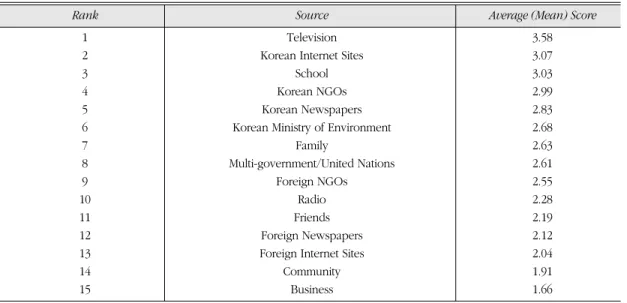
Based on the focus group interviews and questionnaire results, the rich quilt of environmental learning sources in Korea comes to light. Table 1 and 2 below list the mean scores and ranked results from the questionnaire.
As seen from the above tables, television, the Internet and school are all large sources of environmental learning for Korean students. Also, students have a fair amount of trust in these sources, although less trust in the Internet.
Students receive little environmental information from their community, business and friends, and also do not find these sources very reliable.
Media is a large influence as a source of
environmental learning, especially because it encompasses many sources of information.
Korean students found television to be a top source of environmental information. Students Table 1. Amount of information from sources of environmental learning
Rank Source Average (Mean) Score
1 Television 3.58
2 Korean Internet Sites 3.07
3 School 3.03
4 Korean NGOs 2.99
5 Korean Newspapers 2.83
6 Korean Ministry of Environment 2.68
7 Family 2.63
8 Multi-government/United Nations 2.61
9 Foreign NGOs 2.55
10 Radio 2.28
11 Friends 2.19
12 Foreign Newspapers 2.12
13 Foreign Internet Sites 2.04
14 Community 1.91
15 Business 1.66
Note: Students were asked to rate each source by the amount of environmental information they received from it. Rating ranged from 1, representing “no information”, to 4, represented a source of “most” of their information.
Table 2. Reliability of information from sources of environmental learning
Rank Source Average (Mean) Score
1 Multi-government/United Nations 4.01
2 Korean NGOs 3.99
3 Television 3.97
4 Foreign NGOs 3.85
5 Korean Ministry of Environment 3.85
6 School 3.59
7 Korean Newspapers 3.58
8 Korean Internet Sites 3.55
9 Radio 3.51
10 Foreign Newspapers 3.48
11 Family 3.43
12 Foreign Internet 3.39
13 Friends 2.93
14 Community 2.88
15 Business 2.50
Note: Students were asked to rate each source by the reliability of environmental information they received from it. Rating ranged from 1, representing “not reliable” information, to 5, represented “very reliable” information.
often cited television documentaries such as National Geographic and BBC environmental documentaries as sources of information. These sources of international information and norms were some of the most recognizable to students, as many enjoyed watching these programs, subtitled in Korean, in their own homes.
Domestic news programs offered information about current environmental problems (such as the seasonal “Yellow Dust” from China) and controversies (such as environmental group protests over the in-filling of coastal tidelands in the Eastern shore).
In addition to television, the Internet was also one of the top media sources of environmental learning. Korea, per capita, is one of the most internet-wired countries in the world, so students have easy access to this source. But although the Internet was a tool for learning, it was not commonly used for that function as students often chose to surf the web for other purposes in their personal time. When they did search for environmental information, it was primarily through domestic Korean search engines such as Naver and Daum. International websites were rarely visited; the question alone elicited laughter at several schools. Other media sources, such as the radio and newspapers were not high on students’ list of sources of learning, mainly because they were so busy with school that they did not have the time or interest to use them.
School is also a top source of environmental learning. Students reported learning about environmental issues at different frequencies, some during a specific class on the environment in high school, some even during middle and elementary school, while others only learned about the environment as examples in other classes, such as biology (learning the food web), chemistry (learning about acid rain and smog), and social studies (learning about human influences on the environment). The lack of
standardization in environmental education across students and schools is not a reflection of student error in reporting, but rather illustrates the diversity in environmental programs throughout public schools. Overall, a majority of students (68%) responded on the questionnaire that environmental issues are taught only “sometimes”
in school (a few times a year), while 57% of students think environmental issues should be taught often (at least once a month). Interestingly, 65% of all students (regardless of current frequencies of environmental teaching) thought they should be taught more frequently than their current levels, versus 5% who thought they should be taught less often. This implies that students are interested in learning more about environmental issues at school.
Within the context of the government’s standardized national curriculum, environment is currently an optional course, and is also naturally introduced through examples in other science and social science coursework. The result is a range of types and levels of environmental learning given varying priorities at the regional, city, school, and even teacher level. Therefore, although government mandated education seems like a centralized source of environmental learning, its power in dictating the exact type of learning is somewhat diluted.
A second factor that significantly reduces the impact of school environmental learning in Korea is the fact that environment, as a subject, is not directly tested on the university entrance exam.
Intense emphasis is placed on entrance exam subjects, while subjects not on the exam are often put aside, especially during the last years of high school when exam preparation becomes a student’s sole academic focus. Students in one focus group admitted to not really paying attention during their environment course in their first year of high school, and even studying for other subjects during environment class because
it was “not a subject on the university entrance exam.” In recent years, this is changing. The Ministry of the Environment highlighted a small but increasing number of environment-focused questions on the 2006 entrance exam, focusing on both domestic environmental issues such as recycling and personal environmental behaviors, as well as international issues such as global warming and greenhouse gas emissions, and how Korea’s environmental approaches compared with those of other countries (M of E, 2006). If the trend continues and more environmental questions are part of the university entrance exam, it is the opinion of the author that school, as a source of environmental learning, will greatly increase in importance in student’s lives as the pressure to be accepted to a top university will give motivation to learn (at least factual knowledge) about the environment.
In addition to school curriculum, other government sources of environmental learning enter student’s lives. Students cited strict national environmental laws on recycling as another source of motivation to both learn about the environment and also put in practice in their daily lives (or face a steep fine!). Also, students remembered government-sponsored banners in national parks and other areas of natural beauty encouraging good environmental citizenship. But some students said that despite strict environmental laws, many people did not follow the laws. Additionally, there was a dose of skepticism about true motives of the government, as some students alleged that the government really did not always care about the environment and often prioritized development needs over those of the environment. Overall, students seemed to see schools and the government as sources of environmental learning.
Personal, bottom-up sources of environmental learning for students in Korea varied greatly from person to person, and the same source could
both encourage and discourage learning.
Common sources of learning included parents, friends and community members. As for parents and familial sources, the degree to which learning occurred varied significantly. Some students notes their parents as great sources of information and saw them as role models, encouraging (or forcing) students to live in an environmentally- friendly manner by promoting recycling, using less shampoo and conditioner, taking shorter showers, and taking only the amount of food they will eat. Some students saw their parents as being more environmentally knowledgeable than themselves, and caring more about the environment than the students. On the other hand, classmates from the same schools gave completely opposite answers, saying their parents did not care about the environment nor did they encourage environmentally responsible behavior in their homes. Statistically, students were a bit more pessimistic about these sources, as 88%
responded that they talk “several times a year” or
“never” with their friends and family about environmental issues. Therefore, family and parents as sources of environmental learning can be both positive and negative influences, depending on the individual situations.
Students saw friends as more mixed as a source of environmental learning, but on the whole did not encourage environmental learning within peer groups. Although students often learned similar environmental information through classes, they expressed hesitation to put it into practice, especially around their friends for fear of being ridiculed. One student explained that her peers might think she is “just picking up trash to pretend to be good.” Students also admitted that the environment rarely entered their daily conversations, usually only in instances of unusual weather. Instead, conversations mostly center on the daily pressures of studying, appearance, dating, food, and grades.
Students did not see their community as a major source of environmental learning, but this could be due, in part, to ambiguity of the translated term. Students did recall instances where community events encouraged environmental stewardship. For example, on periodic recycling days, community members get together to collect, sort and recycle various types of items. Additionally, students recalled an unusual environmental consciousness during Korea’s co-hosting of the 2002 World Cup. In order to present a positive image to the world during a time of heightened interest in their country for one of the world’s most popular sporting events, picking up trash to keep streets tidy became a national objective. Students remembered community pressure not to litter, as well as pressure to pick up litter no matter who discarded it. Students said that this mentality ended when the World Cup finished, and littering once again became common. Interestingly, when asked to choose between four possible answers, a majority of students (65%) saw the need for community support as necessary to achieve significant improvements in environmental quality and performance. In contrast, 20% selected
“personal lifestyle changes,” 13% responding
“government legislation and regulation,” and scarcely 1% choose “a radical restructuring of society.” So, despite the fact that the community receives very mixed reviews in terms of learning about the environment, students considered the community to be central in helping to solve environmental problems.
Students at all schools noted an individual consciousness necessary for people to learn and care about the environment, saying “we must have a mind for the environment,” and that they need a “heart” and “feelings” about the environment. Students often said they found this through personal experiences in nature such as visiting mountains and forests, as well as other
active learning experiences with their family and sometimes even their community. Eighty-three percent of students responded a “medium” or
“strong” desire to help the environment, but were less confident about their actual environmental knowledge, as 75% of students evaluated their own knowledge as “medium” or “low.” This individual commitment often translated to productive action for the environment, as 64% of students listed that they have taken deliberate action to help the environment. Of the student who responded positively, 66% of the students responded that they felt “positive” or “really good and motivated to do more” as a result of their actions for the environment. In summary, individual experience is important, especially to cultivate environmental appreciation in Korea.
Although the academic literature is rich with hopeful studies about the importance of domestic non-governmental organizations (NGOs) as sources of environmental learning, students did not recognize NGOs as such in focus group interviews. Most often, students were not aware of the vibrant environmental NGO community present in Korea. Those who knew of NGOs did not see education as their objective, but rather saw NGOs through protest stories on the news.
Surprisingly, student rated NGOs quite highly in the questionnaire as a source of environmental information. Perhaps it was a translation issue, but the author did not find complementary results in the focus groups, as student were often silent when asked to name some Korean NGOs.
Therefore, the NGO influence should be further studied.
Information from international NGO and intergovernmental sources was also not high on the students’ radar. Although every school mentioned Greenpeace as a type of international NGO, students were mostly silent when asked what Greenpeace does, although some mentioned “whales” and “nuclear power,” most
likely in reference to some of the large environmental campaigns Greenpeace spearheads. Similarly, students acknowledged knowing about the United Nations (UN), especially with the designation of Korea’s former Foreign Minister Ban Ki-Moon as UN Secretary General in 2007. But when asked if the UN does anything for the environment, most students replied that that they did not know, or said the UN did not address the environment. Only one student mentioned the UN’s work with World Heritage Sites that can help preserve the environment, as Jeju Island was trying to become a World Heritage Site, and so was visited by the UN (UNESCO, 2007). Overall, students had little direct knowledge of actual work of these groups, and therefore did not greatly contribute to students’ direct environmental learning. However, it is quite possible that the work of international organizations still affect environmental learning indirectly, by shaping cultural norms and views of the environment in Korea. Therefore, the importance of their work should not be discounted despite the lack of first hand influence on Korean students.
To different extents, the above sources can also discourage learning. Friends, family, and community can promote priorities counter to environmental learning. Even government can discourage learning: students remember that the Korean government just last year stopped celebrating Arbor Day as an official holiday.
Students said this set a negative message for environmental learning. Students also realized that individual sources could discourage learning, as busy lives forced them to focus on other priorities: studying, games, dating, gossiping, appearance, and food. Many students also acknowledged that they have a certain level of environmental knowledge, but it is not always implemented in their daily lives and actions, for many reasons including laziness, peer pressure,
inconveniences, parents setting an example of not caring, and living in a material-centered society. Lastly, there was an unfortunate pessimistic undertone in some students’
observations, justifying individual environmental damage because “it’s okay to do wrong because you’re just one person” and also believing that “at this [young] age, there is not much we can do to help the environment.” These pessimistic attitudes also inhibit environmental learning.
3) Korea and the international context
Comparing Korea with the greater Asia-Pacific, one finds some similarities and uniqueness in sources of environmental learning. Yencken et al.
(2000) compared locally-conducted studies from nine countries. In the questionnaire, students were asked to rate each source by the amount of environmental information they received from it.
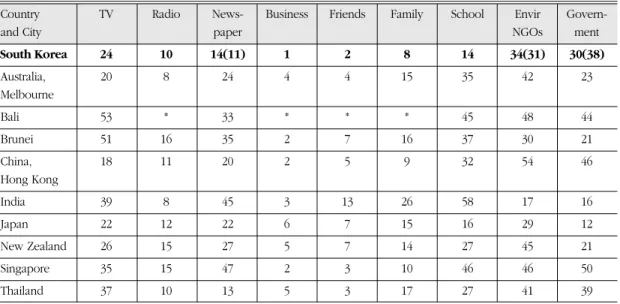
In Table 3 below, the numbers represent the percent of students who rated the source as where they received ‘most’ of their information (a score of 4). Similarly, Table 4 below represents the percent of students who rated a source as
‘very reliable’ (a score of 5). Note that each source was rated separately, so students could rate multiple sources as the highest score. Similar to some countries but more so than others, Korean students listed school and media as a major source of environmental information.
Korean students also, on average, showed more skepticism about the reliability of information sources than other countries.
As seen on table 3 and 4, Korean students have similarities and differences in sources of most of the environmental information as other students in the Asia Pacific. Korean students listed television as a significant source of information, similar only to Bali, and Brunei. Perhaps today, television also plays a larger role in other countries as the diffusion of television technology
Table 3. Sources of most environmental information (%) in Korea and the Asia-Pacific
Country TV Radio News- Business Friends Family School Envir Govern-
and City paper NGOs ment
South Korea 60 5 18(9) 1 9 24 63 75(48) 53(45)
Australia, 44 5 36 2 5 14 46 16 5
Melbourne
Bali 61 * 41 * * * 41 31 24
Brunei 61 12 49 2 11 19 46 18 11
China, 37 10 30 1 4 7 31 31 18
Hong Kong
India 44 14 48 2 16 28 71 12 8
Japan 49 5 26 2 7 9 17 6 3
New Zealand 37 10 32 3 8 13 36 27 8
Singapore 47 7 57 1 5 8 53 10 13
Thailand 72 10 27 1 5 15 30 10 14
Note: * denotes value less than 1%. For Korean data, the value outside the parenthesis represents domestic sources and the value inside the parenthesis represents foreign/international sources. Also, please note that the Internet as a source of environmental information was evaluated for Korea: 34(8). Data from countries other than Korea is from Yencken et al.
(2000, 203). Data for Korea (bold) is based on the author’s study.
Table 4. Environmental information sources considered very reliable (%) in Korea and the Asia-Pacific
Country TV Radio News- Business Friends Family School Envir Govern-
and City paper NGOs ment
South Korea 24 10 14(11) 1 2 8 14 34(31) 30(38)
Australia, 20 8 24 4 4 15 35 42 23
Melbourne
Bali 53 * 33 * * * 45 48 44
Brunei 51 16 35 2 7 16 37 30 21
China, 18 11 20 2 5 9 32 54 46
Hong Kong
India 39 8 45 3 13 26 58 17 16
Japan 22 12 22 6 7 15 16 29 12
New Zealand 26 15 27 5 7 14 27 45 21
Singapore 35 15 47 2 3 10 46 46 50
Thailand 37 10 13 5 3 17 27 41 39
Note: * denotes value less than 1%. For Korean data, the value outside the parenthesis represents domestic sources and the value inside the parenthesis represents foreign/international sources. Also, please note that the Internet as a source of environmental information was evaluated for Korea: 14(10). Data from countries other than Korea is from Yencken et al.
(2000, 203). Data for Korea (bold) is based on the author’s study.
spreads to more remote locations. Interestingly, Korean students listed the newspaper as a more minor role than the rest of the Asia-Pacific countries. In focus group interviews, the students said they were too busy with school to read the newspaper, yet they still had enough time to watch television and surf the Internet. Perhaps this is instead a change toward more technologically advanced sources of information. Business, radio, and friends were all similarly not major sources of environmental information around the Asia- Pacific. Interestingly, school was listed by many Korean students as a source of most of their environmental information (63%), surpassed only by India at 71%. Perhaps this is because of the large emphasis on education in Korea. Although potential bias could arise from the fact that the questionnaires were given during school hours, studies in Yencken (2000) were also conducted in a school setting. Least similar are Korean student views that information from environmental NGOs and the government are major sources of environmental information. Although the percentages are quite high in the questionnaire, these opinions were not confirmed during the focus groups. While students sometimes knew of NGOs, especially the work of Greenpeace, students were largely not aware of actual domestic or international NGO work, and did not see them as a direct source of environmental information. Therefore, it is unclear to the author why students listed it as the largest source of most information. Also, the student focus group discussion did not see the government as a major source of environmental information, other than their role in shaping and directing school curriculum. So, perhaps the high response in the questionnaire was a reflection of this.
In addition to the Asia-Pacific, other research asks similar questions in countries around the world, but (as of 2001), still relatively few studies exist that exclusively explore sources of
environmental learning from the student perspective (Rickinson, 2001). Some studies investigate the potential for a certain source of information to promote learning. Nonetheless, global trends do exist in the literature, although more study is recommended. Rickinson’s (2001) review of the literature from 1993 to 1999 found that most studies listed the following as sources of environmental learning from a student point of view (in order of importance): television, school, family, previous experiences with the environment, and environmental NGOs.
The most reported source of student environmental information around the world is television (Rickinson, 2001). Although television plays a key role in environmental learning in Korea, it is not so unambiguously the number one source. Perhaps this is because students, especially high school students bound for college, can spend more than twelve hours a day at school, and therefore do not have as much free time to watch television. Similar to Connell et al’s 1998 study of Australia, television is not seen as the most reliable source of environmental information in Korea. Korea is perhaps similar to the case of Hong Kong (Yeung, 1998) where students listed school as their major source of environmental information, and also were more correctly familiar with concepts and definitions learned in school rather than those learned through nature programs on television.
In the same studies as above, school is often listed as second most important source of student environmental learning. Students in the UK found that classes, especially science and geography, were great sources of learning (Morris and Schagen, 1996), and also Australian high school students (Connell et al., 1999), although other studies have shown that environmental education is not limited to hard science classes, as environmental issues are also taught in English and social studies classes in the US (Roper Starch
Worldwide, 1994). The importance of school in environmental learning seems very similar with the case of Korea, where students mentioned a variety of classes in which environmental issues were taught, as well as a newer, although often optional class, devoted entirely to environmental issues.
As for other lesser sources of information, although important nonetheless, family, previous personal environmental experiences, and environmental NGOs were important around the world. Students in the US (Roper Starch Worldwide, 1994), the UK (Morris and Schagen, 1996) and within Europe (Filho, 1996) found family to be the third most important source of environmental information. Other studies ranked family as lower in importance, but noted its influence. These studies observed the importance of parents as role models to encourage personal environmental acts such as recycling (Bonnett and Williams, 1998; Palmer, 1995; studies summarized by Rickinson, 2001). For Korea, family is a less important influence in environmental learning, but the author also noted the importance of viewing families as also a source discouraging environmental learning.
During the focus groups, students expressed very mixed reactions about their parents’ levels of environmental awareness and environmentally- friendly practices in their everyday lives. Just as parents can set good examples by encouraging water, electricity conservation, and recycling and reducing waste; parental apathy can negatively affect environmental learning in Korean youth, and very likely in other locations around the world.
4. Conclusion
Although understanding environmental learning
is no simple feat, this study offers some useful insight. First, unlike other academic disciplines, sources of environmental learning are not strictly confined to school. Although school plays an important role in the environmental learning process in Korea and around the world, it is often not the most used source of information. Also, school offers more factual knowledge that can help facilitate a certain type of learning, but other sources including active learning from personal sources such as individual experience with the environment, have more impact on developing a learned appreciation of the environment.
Therefore, when environmental education policy is created for the school setting, it is important to realize the strengths and limitations of the source and policy accordingly. Second, sources of environmental learning are sometimes not so easily distinguished from each other, and certainly are rarely mutually exclusive, as several sources can be linked together to increase impact. This is important as sources can increase effectiveness by building upon each other’s successes in delivering environmental lessons.
Lastly, because sources of information can also discourage environmental learning, sources should strive to engage in critical introspection to acknowledge and reduce these learning inhibiters. With these insights, environmental learning, and eventually environmental education, can become more effective, hopefully leading to a more environmentally aware population.
This study should be seen as only the beginning, opening a door to a wealth of future studies both in Korea and around the world. First and foremost, more countries need to be studied.
Many countries, especially non-Western and developing countries have had little or no past research completed on environmental education, let alone more specific research of source of environmental information. This offers potential
for important future research. Once more research is completed, inter-country comparisons as well as regional analysis can be carried out to find trends and uniqueness in environmental education, attitudes, and ethics.
Another area largely unstudied in environmental literature is sources that discourage environmental learning. The current study addresses the question in a narrow manner, looking at known sources of environmental information and asking how each might also discourage learning. But underlying assumptions and more basic individual and societal characteristics will also no doubt come into play.
Issues such as gender, age, religion and socio- economic status can certainly impact learning;
other larger factors such as educational structure (free versus tuition for basic education;
availability of educational resources; mandatory versus optional basic education), and even more fundamentally political and economic stability are important building blocks for environmental education often un-credited in the literature.
Future research looking at the impact of these individual and societal characteristics could add important light as to the foundations of solid environmental education.
Acknowledgement
The author would like to thank Professors Sangcheol Kwon and Simon Dietz for their guidance in this endeavor.
Notes
1) Accordingly, the author received permission on February 22, 2007 via e-mail from John Fien (also on behalf of co- authors D. Yencken and H. Sykes) to base this study, and especially construct the questionnaire, in a manner mirroring the former study.
References
Blewitt, J., 2006, The Ecology of Learning: Sustainability, Lifelong Learning and Everyday Life, Cromwell Press, London.
Bloor, M., Frankland, J., Thomas, M., and Robson, K., 2001, Focus Groups in Social Research, Sage Publications, London.
Bogner, F. X, 1998, The influence of short-term outdoor ecology education on long-term variables of environmental perspective, Journal of Environ- mental Education, 29(4), 17-29.
Bonnett, M and Williams, J., 1998, Environmental education and primary children’s attitudes towards nature and the environment, Cambridge Journal of Education, 28(2), 159-174.
Bowers, C. A., 1997, The Culture of Denial: Why the Environmental Movement Needs a Strategy for Reforming Universities and Public Schools, State University of New York, Albany.
Carlson, D., 2005, The question concerning curriculum theory, Journal of the American Association for the Advancement of Curriculum Studies, Volume 1, Available online (Accessed July 20, 2007):
http://www.uwstout.edu/soe/jaaacs/vol1/carlson .htm .
Chan, K. K. W., 1996, Environmental attitudes and behaviours of secondary school students in Hong Kong, The Environmentalist, 16(4), 297- 306.
CIA Factbook, 2007, CIA Factbook: Korea, South, Available online (Accessed July 20, 2007):
https://www.cia.gov/library/publications/the- world-factbook/geos/ks.html .
Connell, S., Fien, J., Sikes, H., and Yencken, D., 1998, Young people and the environment in Australia:
beliefs, knowledge, commitment and educational implications, Australian Journal of Environmen- tal Education, 14, 39-48.
Connell, S., Fien, J., Lee, J., Sikes, H., and Yencken, D., 1999, If if doesn’t directly affect you, you don’t think about it: a qualitative study of young people’s environmental attitudes in two Australian cities, Environmental Education Research, 5(1), 95-113.
Desvousges, W. H. and Frey, J. H., 1989, Integrating focus groups and surveys: Examples from environmental risk studies, Journal of Official Statistics, 5(4), 349-363.
Fien, J., 1993, Education for the Environment: Critical Curriculum Theorising and Environmental Education, Deakin University, Geelong, Vic.
Filho, W.L., 1996, Eurosurvey: an analysis of current trends in environmental education in Europe, in Harris, G. and Blackwell, C. (eds.), Environ- mental Education, Vol. 1: Monitoring Change in Education, Arena, Aldershot.
Guha, R. and Martinez-Alier, J., 1997, Varieties of Environmentalism, Earthscan, London.
Haigh, M., 2006, Promoting environmental education for sustainable development: The value of links between higher education and non-governmental organizations (NGOs), Journal of Geography in Higher Education, 30(2), 327-349.
Hart, R. A., 1997, Children’s Participation: The Theory and Practice of Involving Young Citizens in Community Development and Environmental Care, Earthscan, London.
Kim, K.-O., 2000, Developing a [Korean] environmental instruction model for environmental behavior, Journal of Environmental Education, 32(1), 46- 48.
Krueger, R. A., 1998a, Developing Questions for Focus Groups, Focus Group Kit #3, Sage Publications, London.
Krueger, R. A., 1998b, Analyzing & Reporting Focus Group Results, Focus Group Kit #6, Sage Publications, London.
Mason, J., 1996, Qualitative Researching, Sage Publications, London.
Milton, K., 1996, Environmentalism and Cultural Theory, Routledge, London.
Ministry of Environment, South Korea, 2006, Web Q&A post: University entrance exam in Korea was increased to have relevant environmental questions, Available online (Accessed July 20, 2007): http://eng.me.go.kr/docs/news/
press_view.html?seq=316&mcode=&page=4 . Ministry of Education, South Korea, 2007, Ministry of
Education homepage (English language),
Available online (Accessed July 20, 2007):
http://english.moe.go.kr/.
Morgan, D. L., 1997, Focus Groups As Qualitative Research: Second Edition, Sage Publications, London.
Morris, M. and Schagen, I., 1996, Green Attitudes or Learned Responses?, NFER, Slough.
Nam, S.-J., 1995, Environmental education in primary and secondary schools in Korea: Current developments and future agendas, Environmen- tal Education Research, 1(1), 109-122.
OECD Organisation For Economic Co-operation and Development, 1995, Environmental Learning for the 21st Century, OECD, Paris.
Palmer, J. A., 1995, Environmental thinking in the early years: understanding and misunderstanding of concepts related to waste management, Environmental Education Research, 1(1), 35-45.
Palmer, J. A., 1998, Environmental Education in the 21st Century: Theory, Practice, Progress and Promise, Routledge, London.
Payne, P. G., 2006, Environmental education and curriculum theory, Journal of Environmental Education, 37(2), 25-35.
Rickinson, M., 2001, Special issue: learners and learning in environmental education: A critical review of the evidence, Environmental Education Research, 7(3), 208-321.
Roper Starch Worldwide, 1994, Environmental Attitudes and Behaviors of American Youth with an Emphasis on Youth from Disadvantaged Areas, (ED 381 599), National Environmental Education and Training Foundation, Washington DC.
Sauvé, L. and Orellana, I., 2004, Environmental education:
A contribution to the emergence of a culture of peace, in Wenden, A. L. (ed.), Educating for a Culture of Social and Ecological Peace, State University of New York Press, New York, 99-122.
Seth, M. J., 2002, Education Fever: Society, Politics, and the Pursuit of Schooling in South Korea, University of Hawai’i Press, Honolulu.
Shin, D. S., 2000, Environmental education course development for preservice secondary school science teachers in the Republic of Korea, Journal of Environmental Education, 31(4), 11-
18.
Tanner, T., 1980, Significant life experiences: A new research area in environmental education, Journal of Environmental Education, 11(4), 20- 24.
Turner, K. and Freedman, B., 2004, Music and environ- mental studies, Journal of Environmental Education, 36(1), 45-52.
United Nations, 1991, Teaching About Environment and Development, United Nations Publication, New York.
UNESCO, 2007, UNESCO World Heritage Site Homepage, Available online (Accessed July 20, 2007): http://whc.unesco.org/ .
Yencken, D., Fien, J., and Sykes, H., 2000, Environment, Education and Society in the Asia-Pacific,
Routledge, London.
Yeung, S.P-M, 1998, Environmental consciousness among students in senior secondary schools: the case of Hong Kong, Environmental Education Research, 4(3), 251-268.
Correspondence: Laura A. Bakkensen, Foreign Language Institute, Cheju National University (e-mail: lab3883@
gmail.com, phone: 064-754-2291, fax: 064-757-8716) 교신 : 로라 백켄슨, 690-756 제주도 제주시 제주대학교 66 제
주대학교 외국어교육관(이메일: [email protected], 전화: 064-754-2291, 팩스: 064-757-8716)
Received November 16, 2007 Accepted December 8, 2007