http://dx.doi.org/10.3938/NPSM.68.1096
The Past and the Present of Physics Education at a Glance: A Review of International Studies on Physics Education by Using Science Mapping Tool
Hunkoog Jho
∗Department of General Education, Dankook University, Cheonan 31116, Korea (Received 13 September 2018 : revised 27 September 2018 : accepted 27 September 2018)
Since physics was first introduced in school as a means of fostering labor, physics education has contributed much to both society and the scientific community. This study aims at providing an overview of physics education research through science mapping of a large number of references published in international journals up to the present. In this study, 2,089 articles indexed in the Social Sciences Citation Index (SSCI) were extracted from Clarivate Analytics’ online database system Web of Science (WoS), and the obtained referential information was analysed using the R solution. Using the biblometrix and the text mining (tm) R-packages, this study performed semantic and knowledge network analyses, such as bibliographic coupling, co-citation, co-word, n-gram and historiograph. The results show the most productive authors and groups as well as the chronological relations among the references. Analysis of science mapping using open-source software not only provides implications for research on physics education in Korea compared to international trends but also allows qualitative and quantitative research to be done in a more systematic way.
PACS numbers: 01.40.Fk, 01.30.Tt, 07.05.Rm
Keywords: Science mapping, Bibliometrics, R-Studio, Big data, Literature review
I. INTRODUCTION
Physics has been taught in schools to educate machine- men since the 19th century [1,2]. Nowadays, physics is widely taught through K-12 education as well as in post- secondary education. In particular, physics education has contributed enormously to the improvement of the understanding of the nature of science and has cultivated key competencies for informed citizenship [3,4]. For the last 100 years, there have been many attempts to re- form physics education, such as conceptual development, contextualized instruction, heuristic learning, physics in- quiry and teacher-preparation programs [5,6]. Neverthe- less, physics teachers, university instructors and physics educators have struggled to deal with persistent issues.
For example, the physics curriculum is crucial in prepar- ing both pre-professional scientists and students who will go into other careers. Curriculum reforms have still been
∗E-mail: [email protected]
done many times since the beginning of physics educa- tion, such as PSSC (Physical Science Study Committee), HPS (Harvard Project Physics), SISCON (Science in a Social CONtext) and STE(A)M (Science, Technology, Engineering, [Art], and Mathematics) [7,8]. A number of teaching strategies in physics have also been suggested, such as physics by inquiry, peer instruction and mod- elling instruction [9–11].
Such movements in physics education encompass his- torical, philosophical and societal contexts of physics. It is meaningful to review the past endeavours in physic education. In fact, Lee and Kim conducted a review of the literature on physics education published in Korean journals [12]. The results showed that previous studies mostly concentrated on pupils’ conceptual understand- ing at the primary and secondary levels. However, their review does not illustrate detailed information about the directions and tasks of physics education. The commu- nity of research in physics education is relatively small,
This is an Open Access article distributed under the terms of the Creative Commons Attribution Non-Commercial License (http://creativecommons.org/licenses/by-nc/3.0) which permits unrestricted non-commercial use, distribution, and reproduction in any medium, provided the original work is properly cited.
and an overview of international studies on physics edu- cation will be helpful to give some implications for future directions in physics education.
Recently, more attention has been paid to bibliometric and scientometric approaches to various fields of study since these methods are fruitful in helping to visualize the knowledge construction and core publications in emerg- ing issues [13–15]. A few researchers have applied net- work analysis to mapping in studies on physics education [12,16,17]. However, these studies have relied mostly upon semantic network analysis of utterances by pupils or teachers. The bibliometric method with network map- ping offers researchers many interesting results, such as the most productive articles, knowledge networks cen- tring on citations and historical changes in topics of re- search. In addition, emerging software tools enable this to be done in an effective way, and some of these useful tools, such as bibliometrix, RWeka and wordcloud, are in the R environment. This study aims at using the bib- liometric method to conduct a review of the literature on physics education in international journals using the bibliometrix R-package, with some resulting implications given for physics education research.
II. RESEARCH METHOD
The purpose of this study is to share an overview of all research on physics education, particularly centring on language and knowledge networks [18]. Thus, this study utilizes R-Studio mapping software, which has re- cently been used for bibliometric analysis and descrip- tive analysis. The R environment provides many pack- ages related to bibliometrics through its official reposi- tory (https://cran.r-project.org/). The bibliometrix R- package is useful for quantitative research in bibliomet- rics for authors, keywords, citation networks and even historiography [13,14]. The wordcloud and tm packages visualize various relations such as n-gram, word cloud, word-document matrix and topic models.
Data collection was done by extracting many arti- cles from Clarivate Analytics’ WoS (http://www.webof knowledge.com) online database system. This system retrieves the enriched metadata of the literature on di- verse topics indexed in SSCI (Social Science Citation In- dex). Even the aRxiv and bibliometrix packages have
functions on crawling data from WoS and Elsevier’s Sco- pus. To gather the referential information from the system, this study selected ‘physics education’ as the topic, ‘article’ as the document type, ‘English’ as the language and ‘education’ as the subject category, which resulted in 2,089 articles indexed in SSCI being selected.
The output was exported in BibTex format and was converted to a data frame through a function in bib- liometrix. Refining data relied on the stringr and tm packages. The str_replace_all and tm_map functions enabled us not only to remove non-alphanumeric charac- ters and punctuation, but also to remove specific words such as definite and indefinite articles and prepositions and to trim the tenses of verbs and singular and plural types of words [19,20]. A variety of parameters such as removeW ords, stemDocument, stripW hitespace and content_transf ormer allowed us to refine the obtained data automatically.
Data analysis was comprised of three steps. First, this study’s intent was to provide an overview of the liter- ature on physics education as descriptive analysis, in- cluding annual production of articles, total citations per year, most productive authors, most relevant sources and top manuscripts per citations. This descriptive analysis was intended to help readers determine the appropri- ate sources and articles for physics education research.
Next, the refined data were used to show words net- works: frequency of highly referred words, proportion of most frequently occurring words, n-grams (usually bi- grams) and bipartite networks (Document× Author or Document× Citation). The results are helpful in un- derstanding which topics are attractive to physics edu- cators. Finally, this study visualized various types of network mappings pertaining to word, authorship, and citation and produced a historiographic diagram of the most powerful articles from the past to the present. For example, co-word analysis represents the most signifi- cant words as the conceptual structure [21], co-author analysis examines co-occurrence of authors in the author list of a document [22] and co-citation analysis reveals two authors or articles referred in a third document, which indicates that more co-cited articles are apt to deal with the same topic [23]. Historiographic analysis shows a chronological citation network (historiography)
representing the chronological relations of the most rele- vant citations (the histP lot function in the bibliometrix produces a plot according to the given condition) [13].
Aria and Cuccurullo explain how scholars perform bib- liometric analyses using R [14].
III. RESULTS
1. Descriptive Analysis
The literature review on physics education showed that 2,089 articles were published in 150 SSCI-indexed journals, with 4,098 authors participating in these pub- lications (allowing overlap raises the number of appear- ances of authors to 5,461) and the average number of co- authors per document is 2.61, which means that there are many more multiple-authored articles than single- authored articles (344 out of 2,089 articles are single- authored). Since the first article on physics education was published in 1945, publication reached a peak in 2017 with 186 papers, with 127 articles published in the first eight months of 2018. Fig. 1 shows a gradual growth tendency in annual numbers of publications, with pub- lication drastically increasing over the last decade. The source of the most articles is the one of the oldest jour- nals in physics education, American Journal of Physics, which was established in 1933 as American Physics Teacher, changing to American Journal of Physics in 1940. Most of the other top journals, International Jour- nal of Science Education (formerly European Journal of Science Education), European Journal of Physics, Jour- nal of Research in Science Teaching and Science Educa- tion, have a long history in science and physics educa- tion (see Table 1). The fourth and seventh journals in the list are actually the same: Physical Review Special Topics-Physics Education Research was renamed Physi- cal Review Physics Education Research in 2016. Despite its relatively short history, Physical Review Physics Ed- ucation Research has become highly regarded due to its connection with the Physical Review series. Moreover, the articles published in two journals outnumbers the third journal, European Journal of Physics.
The most common nationality for corresponding au- thors was the United States. As shown in Table 2, the
Table 1. The most relevant sources in physics education research.
Rank Source Title Articles
1 Am. J. Phys. 416
2 Int. J. Sci. Educ. 219
3 Eur. J. Phys. 155
4 Phys. Rev. ST PER 99
5 J. Res. Sci. Teach. 88
6 Res. Sci. Educ. 76
7 Phys. Rev. Phys. Educ. Res. 72
8 Sci. & Educ. 67
9 Sci. Educ. 59
10 Eur. J. Math. Sci. Tech. Edu. 56
Fig. 1. (Color online) Annual publication of physics ed- ucation research.
most productive countries are European countries and the United States, with the exception of Taiwan, which ranked 10th. It is interesting to note that the two most productive countries, the United States and Turkey, have low MCP ratios, while some relatively less productive countries, such as Canada, Sweden and Taiwan, have high MCP ratios. It is likely that the United States and the United Kingdom have sufficient communities of physics education that they can concentrate more on do- mestic issues. Taiwan and other countries, however, may be more concerned with international comparative stud- ies or collaboration with scholars in different countries.
It is interesting to note that the average numbers of ar- ticle citations of English-speaking countries are higher than some other countries on the list. Canada’s TC, for example, is 776 even though Italy has more publica- tions. It is assumed that it may be more helpful to col- laborate with British and American scholars to publish
Table 2. The most productive countries of corresponding authors.
Rank Country Articles Ratio SCP MCP MCP Ratio TC
1 The United States 727 0.3527 659 68 0.0935 12,024
2 Turkey 168 0.0815 152 16 0.0952 1,026
3 The United Kingdom 103 0.0500 91 12 0.1165 1,636
4 Germany 86 0.0417 69 17 0.1977 815
5 Spain 74 0.0359 68 6 0.0811 674
6 Australia 62 0.0301 55 7 0.1129 722
7 Italy 61 0.0296 55 6 0.0984 303
8 Canada 59 0.0286 44 15 0.2542 776
9 Sweden 58 0.0281 40 18 0.3103 403
10 Taiwan 52 0.0252 40 12 0.2308 553
(SCP: Single Country Publication, MCP: Multiple Country Publication, TC: Total Citations).
Table 3. The most productive authors in physics education research.
Rank Authors Articles h-index g-index Author fractionalized Articles fractionalized
1 C. Henderson 20 11 22 C. Singh* 9.00
2 C. Singh* 18 7 13 K. S. Taber 8.50
3 C. C. Tsai 15 9 15 C. Henderson 8.05
4 A. Eryilmaz* 13 4 8 T. Gok 8.00
5 C. Fazio 13 6 8 A. Eryilmaz* 6.17
6 L. C. McDermott* 13 8 13 L. C. McDermott* 5.65
7 M. D. Sharma 13 6 12 C. C. Tsai 5.40
8 E. Brewe 12 5 12 E. F. Redish* 5.17
9 J. Haglund* 12 5 8 F. Ogan-Bekiroglu* 5.00
10 E. F. Redish* 11 9 11 J. Haglund* 4.92
articles. Additionally, the sources with the most arti- cles are from the United States: the American Journal of Physics, published by the American Association for Physics Teachers; Physical Review Physics Education Re- search, published by the American Physical Society; and Journal of Research in Science Teaching, published by the National Association of Research in Science Teach- ing.
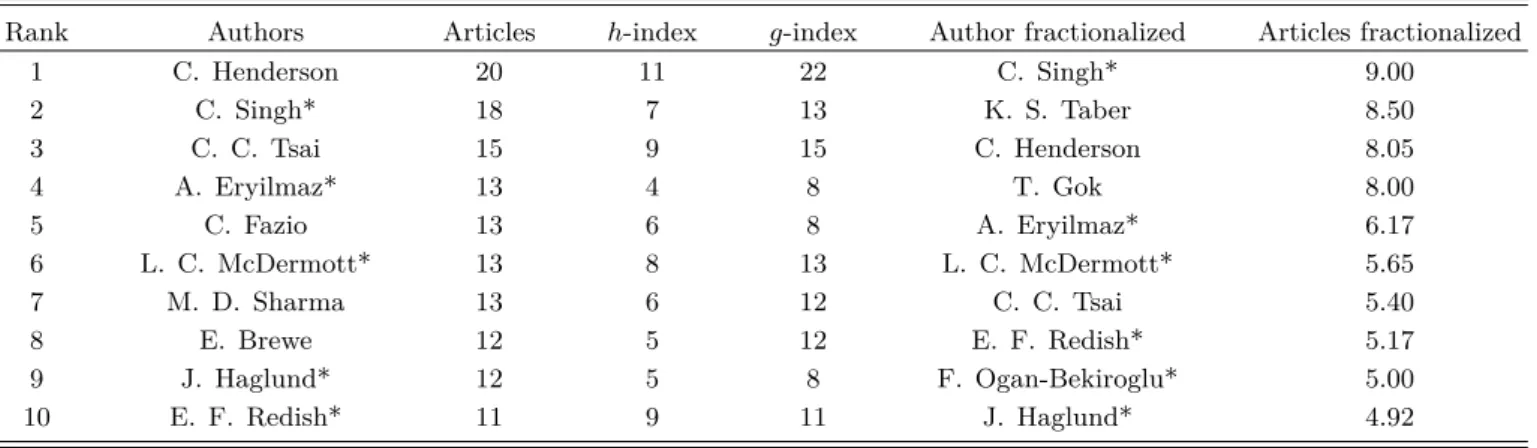
In terms of author performance, Henderson (h-index:
11, g-index: 22) produced the highest number of articles, whereas Singh (h-index: 7, g-index: 13) had the best per- formance in terms of fractional authorship, meaning au- thorship of a document authored by more than one per- son. The results of h-index and g-index also correspond to the name list in Table 3. In general, authorships per article keep rising over time [24]. Singh, a professor of physics at the University of Pittsburgh, wrote 18 articles and had 9.00 articles fractionalized, meaning that 50%
of her articles were written with another author. Aster- isks in Table 3 denote physics educators with doctoral degrees in physics. It is interesting to note that physi- cists take an active part in physics education research, particularly in higher education. Singh, McDermott and Redish are well known for physics tutorials and physics surveys. This indicates that conceptual understanding is regarded as an important topic in physics education, unlike the trends in science education.
The list of most-cited articles does not match the re- sults of the most productive author list. Table 4 reveals that McDermott is the only author from the list of top productive authors in Table 3. The idea of conceptual understanding, taught using methods such as concept maps, meaningful learning, sense making in everyday life, use of representation, science as inquiry and concep- tual change [25–31], has become important in the field, and most articles about this were published before the
Table 4. The top articles about highly cited researches.
Rank Papers TC TCP
1 D. L. Zeidler, K. A. Walker, W. A. Ackett and M. L. Simmons, Sci. Educ. 86, 343 (2002). 347 21.69
2 J. C. Blickenstaff, Gend. Educ. 17, 369 (2005). 294 22.62
3 J. D. Novak, Sci. Educ. 86, 548 (2002). 261 16.31
4 B. Warren, C. Ballenger, M. Ogonowski, A. S. Rosebery and B. J. Hudicourt-Barnes, 234 13.76 J. Res. Sci. Teach. 38, 529 (2001).
5 L. C. McDermott and P. S. Shaffer, Am. J. Phys. 60, 994 (1992). 216 8.31
6 B. A. Crawford, J. Res. Sci. Teach. 44, 613 (2007). 214 19.45
7 M. Limón, Learn. Instr. 11, 357 (2001). 214 12.59
8 I. M. Kinchin, D. B. Hay and A. Adams, Educ. Res. 42, 43 (2000). 211 11.72
9 A. van Heuvelen, Am. J. Phys. 59, 891 (1991). 194 7.19
10 N. Rutten, W. R. van Joolingen and J. T. van der Veen, Comput. Educ. 58, 136 (2012). 185 30.83
(TCP: Total Citations Per Year).
Table 5. The words most frequently presented in the literature as authors’ keywords.
Rank Word Freq. Rank Word Freq.
1 education 1,053 11 research 92
2 physics 811 12 theory 86
3 learning 369 13 knowledge 84
4 science 352 14 educational 83
5 teaching 205 15 school 70
6 student 201 16 engineering 68
7 teacher 197 17 quantum 65
8 model 124 18 chemistry 64
9 conceptual 109 19 analysis 63
10 experiment 104 20 instruction 58
new millennium. Science educators paid a great deal of attention to conceptual understanding until the 1990s, but these results indicate that conceptual understand- ing is still important to physics education research at this time. Articles on the nature of science in socio- scientific contexts, science careers and simulation-based assessment were also highly cited [32–34]. As well, the source journals named on the list are from the United States: J. Res. Sci. Teach, Sci. Educ. and Am. J.
Phys.
2. Semantic Network Analysis
Semantic network analysis is usually defined as a method to analyse the relations between words consist- ing of individual texts and is counted as content analysis
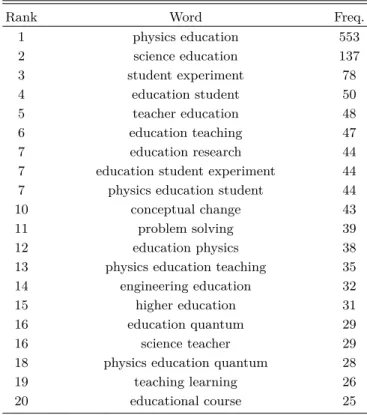
Table 6. Top 20 bigrams through semantic network anal- ysis.
Rank Word Freq.
1 physics education 553
2 science education 137
3 student experiment 78
4 education student 50
5 teacher education 48
6 education teaching 47
7 education research 44
7 education student experiment 44
7 physics education student 44
10 conceptual change 43
11 problem solving 39
12 education physics 38
13 physics education teaching 35
14 engineering education 32
15 higher education 31
16 education quantum 29
16 science teacher 29
18 physics education quantum 28
19 teaching learning 26
20 educational course 25
from the traditional research categories [18]. Semantic network analysis has various names, such as language networks, semantic networks, concept networks, word networks, keyword networks and network texts [35]. In this study, the researcher examined frequency distribu- tions of words, bigrams, co-occurrences of keywords by authors, etc.
Table 5 shows that ‘education’ and ‘physics’ had a
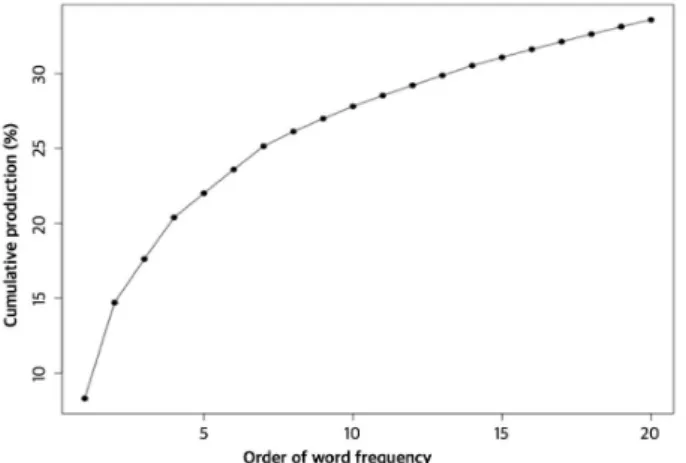
Fig. 2. Cumulative production of the most frequent words.
much higher frequency of occurrence than any other words. The proportion of specific words increases. Fig. 2 presents the cumulative production of the top 20 words, which occupy 33.6% of a total of 12,674 words. Both Tables 5 and 6 show that ‘experiment’, ‘quantum me- chanics’ and ‘engineering education’ are often found in the keywords as content in physics education. In line with the situation in Korea, the revised curriculum in 2015 highlighted science as inquiry and introduced two new subjects: inquiry experiments in science and inter- disciplinary science. The former entails diverse topics in relation to experiments and surveys. In addition, physics textbooks for secondary pupils revisit contents on quantum mechanics according to the revised curricu- lum [4]. There are several assessment tools such as the Quantum Physics Visualization Instrument, the Quan- tum Physics Conceptual Survey, the Quantum Mechan- ics Conceptual Survey and the Quantum Mechanics Di- agnostic Questionnaire [36–39]. Such instruments will be helpful in diagnosing pupils’ understanding in secondary and post-secondary education [40]. Engineering educa- tion as higher education is important to foster the de- velopment of scientists and engineers; however it rarely occurs in Korea. The emphasis on techniques and engi- neering practice in the curriculum will bring about more outcomes in research: the nature of technology or engi- neering, conceptual surveys for engineers and represen- tation in engineering.
This study analysed term frequency-inverse document frequency (TF-IDF). TF refers to how frequently a word emerges in a document, and IDF measures the
frequency of a word occurs in a document in a cor- pus of documents. It is usually defined as idf (term) = ln ( ndocument
ndocuments containg term
) [41]. TF-IDF analysis is use- ful to discern whether a document tackles specific topics with high TF and IDF. For higher IDF values, TF is higher, but the number of documents containing a spe- cific word should be less. Through this, we can construct clusters of documents dealing with specific topics. The correlation analysis using Kendall’s tau coefficient of the function gave a low value (0.0880409), which means that words are seldom contained in specific articles. The anal- ysis of words with high TF (> median value of TF) and low TF (> median value of IDF) extracted only seven words: ‘education’ (113), ‘learning’ (59), ‘physics’ (68),
‘science’ (44), ‘students’ (15), ‘teacher’ (18) and ‘teach- ing’ (18). None of these words can be regarded as unique words found in the articles. The result of the f indAssoc function, which shows the correlation between words in the document-term matrix, also reveals that there is no single word with Pearson’s correlation coefficient r≥ .20 in association with ‘physics’ and ‘education’.
Co-word analysis was used to find the co-occurrences of keywords or terms extracted from the title, abstract or body of a document. This study examined co-occurrence networks of authors’ keywords using the following code (where M refers to the bibliometrix object):
NetMatrix <- biblioNetwork (M, analysis
= “co-occurrences”, network = “au- thor_keywords”, sep = “;”)
networkPlot (NetMatrix, n = 50, size = TRUE, remove.multiple = T, T itle = “Term co-occurrences”, type = “kamada”, labelsize
= 0.5)
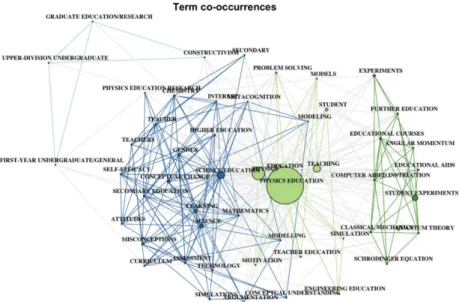
The 50 most frequently occurring words are divided into four clusters as shown in Fig. 3. The radius of the circle in the figure shows the frequency of the words and the colour stands for a specific cluster. The largest clus- ter is in navy and consists of 26 terms. The highest value of betweenness centrality in the navy cluster is ‘science education’ (67.745), and terms pertaining to concep- tual understanding include ‘conceptual change’ (13.464),
Fig. 3. (Color online) Co-occurrence networks based on authors’ keywords.
Fig. 4. (Color online) Bibliographic (author) (a) coupling and (b) collaboration network among authors.
‘curriculum’ (7.996) and ‘misconception’ (5.537). Chem- istry (55.619) and mathematics (33.748) also have strong relations. This indicates that many studies on physics education deal with other sciences and mathematics at the same time. For example, a conceptual survey can be given to students in either physics or chemistry and mathematics. The biggest circle, ‘physics education’, re- lates to other terms: ‘physics’, ‘education teaching’, ‘stu- dent’, ‘simulation’, ‘teacher education’, ‘models’, ‘prob- lem solving’, ‘motivation’ and ‘engineering education’. In terms of betweenness centrality, except for ‘engineering education’, each word is over 4.50. ‘Physical concepts’
and ‘computer-aided instruction’ are placed on the right side of the figure, including the terms ‘computer-aided in-
struction’ (7.0084), ‘quantum theory’ (4.004), ‘classical mechanics’ (2.436), ‘Schrödinger equation’ (2.423) and
‘angular momentum’ (1.885). It is likely that computer- aided or simulation-based instruction has been done in the context of teaching specific content related to me- chanics. The smallest cluster is the left one, which con- sists of ‘constructivism’ (32.741), ‘first-year undergrad- uate/general’ (12.398), ‘upper-division undergraduate’
(1.296) and ‘graduate education/research’ (1.296). Each of these terms has low connection with other studies.
This implies that sufficient research in post-secondary education has not been conducted since the dots in the cluster are very small and far away from the central top- ics.
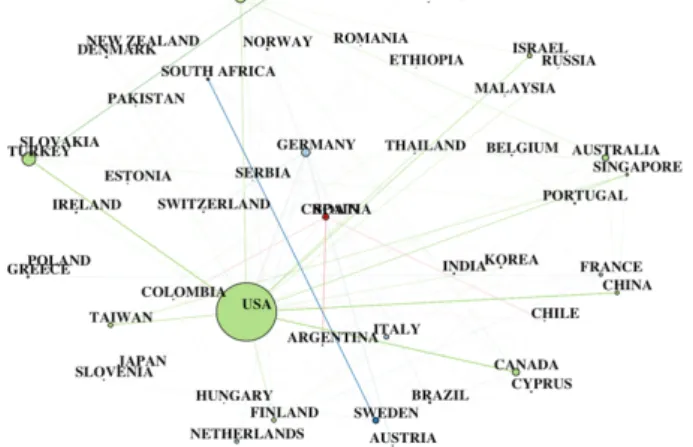
Fig. 5. (Color online) Collaboration networks between countries.
3. Knowledge Network Analysis
A knowledge network, also called science mapping, is defined as a method to visualize the types and patterns of referential information using spatial elements. Bibli- ographic coupling is used to show common references in authors’ oeuvres or documents [42]. The biblioN etwork function allows the construction of many kinds of cou- pling such as authors, countries and keywords. This study examined author coupling after normalization with Salton’s cosine [43]. The parameters for the network plot were set to avoid redundancy when possible: number of authors was set at 100 and the number of labels of au- thors was set at 50. Using clusters with three authors or more gave twelve groups, as depicted in Fig. 4(a). How- ever, the number of vertices with betweenness centrality of greater than 1 was 27 out of 100 vertices. Moreover, there were no links at all while setting the minimum edge at five. Additionally, the collaboration networks de- pict eight clusters consisting of more than three authors.
The collaboration networks represent the co-occurrence of authors in the list of authors, while bibliographic cou- pling focuses on the common results among the whole list of an author. The dim lines connecting different clus- ters in Fig. 4(b) and the low betweenness centrality in Fig. 4(a) show that communications among different re- search groups are not frequent. Collaboration networks among countries also reveal quite a few of connections among countries, but the United States and the United Kingdom are central, as shown in Fig. 5.
Fig. 6. (Color online) Co-citation analysis of references in physics education research.
Co-citation analysis determines the occurrence of au- thors, references or journals in a third document [23].
Co-citation implies that co-cited articles may address the same topic. While co-authorship itself only means the co-work of multiple authors, co-citation in a third article enables us to assume that both cited articles deal with the same topic. However, co-citation analysis among 100 productive authors simply shows three wide clusters.
Conceptual structure mapping does not show a clear-cut division in the references. Each cluster is packed with an enormous number of topics in physics education re- search.
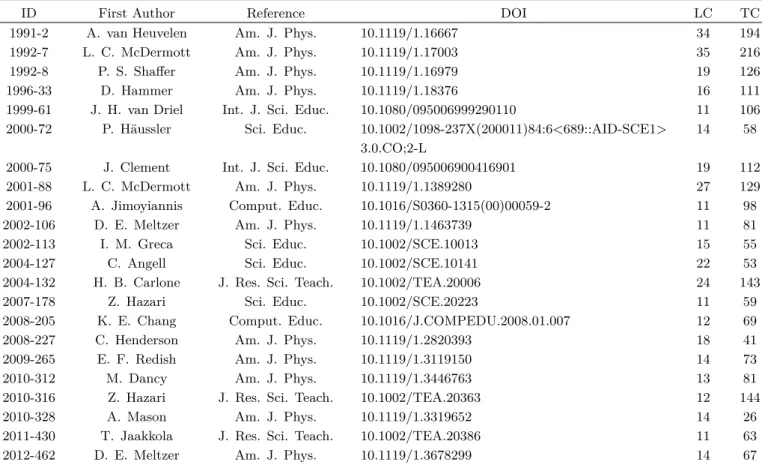
Historiographic analysis, also known as a historiograph or historiographic mapping, represents a chronological mapping of the most relevant citations [13,14]. With the histN etwork function, this study generated a plot with the most productive 20 articles, as shown in Fig. 7.
Table 7. Legend of historiographic mapping (LC: Local Citations, TC: Total Citations).
ID First Author Reference DOI LC TC
1991-2 A. van Heuvelen Am. J. Phys. 10.1119/1.16667 34 194
1992-7 L. C. McDermott Am. J. Phys. 10.1119/1.17003 35 216
1992-8 P. S. Shaffer Am. J. Phys. 10.1119/1.16979 19 126
1996-33 D. Hammer Am. J. Phys. 10.1119/1.18376 16 111
1999-61 J. H. van Driel Int. J. Sci. Educ. 10.1080/095006999290110 11 106
2000-72 P. Häussler Sci. Educ. 10.1002/1098-237X(200011)84:6<689::AID-SCE1> 14 58 3.0.CO;2-L
2000-75 J. Clement Int. J. Sci. Educ. 10.1080/095006900416901 19 112
2001-88 L. C. McDermott Am. J. Phys. 10.1119/1.1389280 27 129
2001-96 A. Jimoyiannis Comput. Educ. 10.1016/S0360-1315(00)00059-2 11 98
2002-106 D. E. Meltzer Am. J. Phys. 10.1119/1.1463739 11 81
2002-113 I. M. Greca Sci. Educ. 10.1002/SCE.10013 15 55
2004-127 C. Angell Sci. Educ. 10.1002/SCE.10141 22 53
2004-132 H. B. Carlone J. Res. Sci. Teach. 10.1002/TEA.20006 24 143
2007-178 Z. Hazari Sci. Educ. 10.1002/SCE.20223 11 59
2008-205 K. E. Chang Comput. Educ. 10.1016/J.COMPEDU.2008.01.007 12 69
2008-227 C. Henderson Am. J. Phys. 10.1119/1.2820393 18 41
2009-265 E. F. Redish Am. J. Phys. 10.1119/1.3119150 14 73
2010-312 M. Dancy Am. J. Phys. 10.1119/1.3446763 13 81
2010-316 Z. Hazari J. Res. Sci. Teach. 10.1002/TEA.20363 12 144
2010-328 A. Mason Am. J. Phys. 10.1119/1.3319652 14 26
2011-430 T. Jaakkola J. Res. Sci. Teach. 10.1002/TEA.20386 11 63
2012-462 D. E. Meltzer Am. J. Phys. 10.1119/1.3678299 14 67
Fig. 7. (Color online) Historical direct citation network from the historical network.
The list of articles is shown in Table 7. The direction of the arrows in Fig. 7 explains the chronical change of re- search trends from the past. For example, van Heuvelen wrote a review of the literature on conventional learn- ing strategies [31], and then McDermott developed a
teaching guide using representation [27,44]. This con- tributed to promoting articles dealing with interactive physics lectures and physics tutorials [45,46] and finally brought about teacher (instructor) education in physics [47,48]. Häussler and Hoffmann developed a survey to examine pupils’ performance and affective domains [49], while Carlone examined girls’ psychological perceptions about physics [50]. Her research topic, gender difference in affective domains [51], contributed to the publication of gender studies about physics identities and careers [52].
IV. CONCLUSIONS AND IMPLICATIONS
The purpose of this study was to provide an overview of the literature on physics education published in in- ternational journals using bibliometric analysis with R software. Two thousand and eighty-nine articles were extracted from WoS, and the collected referential infor- mation followed descriptive and network analysis pro-
vided by official repository in Cran-R project. Descrip- tive analysis showed a gradual growth of publications since the 1940s and an increasing distribution of research publications towards Anglophone countries. Semantic and knowledge networks revealed that the community of physics education was loosely connected but that co- operation was not continuous, even though most studies were based on the collaboration of various authors. Con- ceptual structure mapping and historiographic analysis showed that topics in physics education have fragmented.
Overall, despite its long history, physics education re- search should be deepened through robust communica- tions among physics educators. Even conceptual change, which is often regarded as a conventional strategy, has not been fully conducted. In particular, physics teaching in higher education was set aside because of small num- ber of publications for post-secondary physics education.
The results of this study give us some implications for future studies. Compared to a review of network analysis on domestic papers, less attention was paid to modern physics and engineering education in the Korean community [12]. In terms of instructional environment, computer-aided instruction and simulation need to be more concerned with future learning. STEM education, including engineering education, also needs to be investi- gated to foster the development of pre-professional scien- tists and engineers at the post-secondary level; however, textbook analysis and physics education for the gifted have been more commonly conducted in Korea. While taking into account the adoption of new technology in the educational environment (such as tablets, augmented or virtual reality, and the Internet of things) and the social demand for growing talent with the capabilities to adapt to rapid environmental changes, we need to deal with a wide range of physics teaching for both K-12 and tertiary education and investigate in-depth studies on online and open environments for adaptive learning and distributed cognition [53]. In addition, the effects of psychological and affective factors on physics teach- ing and learning, such as physics identity, self-efficacy in physics, emotional perception about physics and aspira- tion in physics, need more discussion [54–57].
Science mapping is beneficial to both veteran and novice researchers. For beginners, science mapping with
an open-source software tool offers an overview of in- tricate networks in physics education at one view and shows key references and research groups. For experi- enced researchers, this tool is useful to save time and effort in understanding a large number of articles, is ef- fective in extracting necessary information all at once, and makes it easy to visualize the complicated patterns formed by a massive amount of data consisting of many articles. Semantic networks can even be used to do qual- itative research such as an analysis of semantics in the text and a discourse analysis using the Quantitative Dis- course Analysis Package. The R solution is more easily used in analysing English texts, but many packages sup- porting the Korean language are being developed.
ACKNOWLEDGEMENTS
This work was supported by a National Research Foundation of Korea (NRF) grant funded by the Korean Government (MSIT) (No. NRF-2017R1C1B1007561).
REFERENCES
[1] D. E. Meltzer and V. K. Otero, Am. J. Phys. 83, 447 (2015).
[2] G. E. DeBoer, A History of Ideas in Science Edu- cation: Implications for Practice (Teachers College Press, New York, 1991).
[3] Organisations for Economic Co-operation and De- velopment, DeSeCo Project, http://www.oecd.org/
pisa/35070367.pdf (accessed Sep. 10, 2018).
[4] Ministry of Education, National science curriculum, Report No. 2015-74, 2015.
[5] V. K. Otero and D. E. Meltzer, Phys. Teach. 54, 523 (2016).
[6] V. K. Otero and D. E. Meltzer, Phys. Today 70, 50 (2017).
[7] J.-W. Song, J. Kor. Assoc. Sci. Educ. 19, 409 (1999).
[8] H. Jho, O. Hong and J. Song, Eur. J. Math. Sci.
Tech. Educ. 12, 1843 (2016).
[9] L. C. McDermott, Physics by Inquiry: An Intro- duction to Physics and the Physical Sciences (John Wiley & Sons, New York, 1995).
[10] E. Mazur, Peer Instruction: A User’s Manual (Prentice Hall, Upper Saddle River, 1997).
[11] J. Clement, Creative Model Construction in Scien- tists and Students: The Role of Imagery, Analogy, and Mental Stimulation (Springer, Dordrecht, The Netherlands, 2008).
[12] B. Lee and H. Kim, J. Korean Phys. Soc. 72, 1502 (2018).
[13] E. Garfield, J. Inf. Sci. 30, 119 (2004).
[14] M. Aria and C. Cuccurullo, J. Informetr. 11, 959 (2017).
[15] M. J. Cobo, A. G. López-Herrera, E. Herrera- Viedma and F. Herrera, J. Am. Soc. Inf. Sci. Tech.
63, 1609 (2012).
[16] C. N. Yoon, D. Y. Lee and S. K. Han, Sae Mulli 55, 463 (2007).
[17] Y. Song, New Phys.: Sae Mulli 68, 889 (2018).
[18] S. Lee, Network Analysis Methods: Applications and Limitations (Cheongnam, Seoul, 2018).
[19] Y. Baek, Text-Mining Using R (Hanwool Academy, Paju, 2017).
[20] J. Silge and D. Robinson, Text Mining with R: A Tidy Approach (O’Reilly, Boston, 2017).
[21] M. Callon, J.-P. Courtial, W. A. Turner and S.
Bauin, Soc. Sci. Inf. 22, 191 (1983).
[22] H. P. F. Peters and A. F. J. van Raan, Scientomet- rics 20, 235 (1991).
[23] H. D. White and K. W. McCain, J. Assoc. Inf. Sci.
Tech. 49, 327 (1998).
[24] A. Plume and D. van Weijen, Research trends 2014, https://www.researchtrends.com/issue-38-sep tember-2014/publish-or-perish-the-rise-of-the-fract ional-author/ (accessed Sep. 11, 2018).
[25] J. D. Novak, Sci. Educ. 86, 548 (2002).
[26] B. Warren, C. Ballenger, M. Ogonowski, A. S. Rose- bery and J. Hudicourt-Barnes, J. Res. Sci. Teach.
38, 529 (2001).
[27] L. C. McDermott and P. S. Shaffer, Am. J. Phys.
60, 994 (1992).
[28] B. A. Crawford, J. Res. Sci. Teach. 44, 613 (2007).
[29] M. Limón, Learn. Instr. 11, 357 (2001).
[30] I. M. Kinchin, D. B. Hay and A. Adams, Educ. Res.
42, 43 (2000).
[31] A. van Heuvelen, Am. J. Phys. 59, 891 (1991).
[32] D. L. Zeidler, K. A. Walker, W. A. Ackett and M.
L. Simmons, Sci. Educ. 86, 343 (2002).
[33] J. C. Blickenstaff, Gend. Educ. 17, 369 (2005).
[34] N. Rutten, W. R. van Joolingen and J. T. van der Veen, Comput. Educ. 58, 136 (2012).
[35] C. Park and C. Chung, J. Gov. Stud. 19, 73 (2013) [36] S. B. McKagan, K. K. Perkins and C. E. Wieman, Phys. Rev. ST Phys. Educ. Res. 6, 020121 (2010).
[37] S. Wuttiprom, M. D. Sharma, I. D. Johnston, R.
Chitaree and C. Soankwan, Int. J. Sci. Educ. 31, 631 (2009).
[38] E. Cataloglu and R. W. Robinett, Am. J. Phys. 70, 238 (2002).
[39] J. R. Chapman, S. O. Hunt and N. R. Walet, New Directions 9, 66 (2013).
[40] H. Jho, New Phys.: Sae Mulli 68, 869 (2018).
[41] E. D. Kolaczyk and G. Csárdi, Statistical Analysis of Network Data with R (Springer, New York, 2014).
[42] M. M. Kessler, J. Am. Soc. Inf. Sci. Tech. 14, 10 (1963).
[43] L. Leydesdorff, J. Am. Soc. Inf. Sci. Tech. 59, 77 (2008).
[44] P. S. Shaffer and L. C. McDermoot, Am. J. Phys.
60, 1003 (1992).
[45] L. C. McDermott, Am. J. Phys. 69, 1127 (2001).
[46] D. E. Meltzer and K. Manivannan, Am. J. Phys.
70, 639 (2002).
[47] M. Dancy and C. Henderson, Am. J. Phys. 78, 1056 (2010).
[48] C. Henderson, Am. J. Phys. 76, 179 (2008).
[49] P. Häussler and L. Hoffmann, Sci. Educ. 84, 689 (2000).
[50] H. B. Carlone, J. Res. Sci. Teach. 41, 392 (2004).
[51] Z. Hazari, R. H. Tai and P. M. Sadler, Sci. Educ.
91, 847 (2007).
[52] Z. Hazari, G. Sonnert, P. M. Sadler and M. C.
Shanahan, J. Res. Sci. Teach. 47, 978 (2010).
[53] H. Jho, Kor. J. Gen. Educ. 11, 53 (2017).
[54] H. Kim, New Phys.: Sae Mulli 60, 293 (2010).
[55] H.-Y. Jeon, M.-H. Yoo, H.-G. Hong and E.-I. Park, J. Kor. Assoc. Sci. Educ. 29, 68 (2009).
[56] H. Jho, J. Res. Curr. Instr. 21, 132 (2017).
[57] H. Kim, K. Chung and H. Lee, J. Kor. Assoc. Sci.
Educ. 33, 390 (2013).