Journal of Dental Hygiene Science Vol. 7, No. 4 pp. 271~274 (2007)
271
초등학생의 구강건강증진행위와 구강건강상태와의 관련성
김수경†·김윤신
한양대학교 대학원 보건학과
The Relationship between the Oral Health Promotion Behavior and Dental Health Condition of Primary School Children
Soo-Kyung Kim† and Yoon-Sin Kim
Dept. of Health Science, Graduate School Hanyang University, Korea
ABSTRACT The purposes of this study were to understand the oral health promotion behavior and dental health condition of primary school children and to examine the relationships between the two variables. For that purpose, 729 fifth and sixth graders from four primary school located in Seoul were surveyed. In addition to the survey responses, dental examination results were used for analysis. The findings were as follows: 1. The children scored 3.51 out of full 5 points in oral health promotion behavior. they scored the highest at 3.82 in dietary habits, which were followed by going to a dentist for prevention purposes at 3.43, the method and frequency of brushing teeth at 3.40 and the use of fluorine at 3.39. 2. It turned out that 46.9% of the children had decayed permanent teeth. The number of decayed teeth was 1.66 ± 2.32, that of missing teeth was 0.03 ± 0.24. 3. There were reverse correlations(r =
−0.32) between the children's subjective perception of their dental health condition and decayed teeth. The more positive perceptions they had for their own dental health condition, the less decayed teeth they had(p < 0.01). 4. There were also reverse correlations(r =
−0.10) between the children's oral health promotion behavior and decayed teeth. The more they were engaged in Behavior of alimentation, the less decayed teeth they had(p < 0.01). The results indicate that primary school children can keep their dental health by practicing the right oral health promotion behavior, which calls for a need to develop and apply dental health education programs to promote the oral health promotion behavior among primary school children.
Key words Oral health promotion behavior, Dental health condition, Primary school children.
서 론
초등학교시기는유치가영구치로교환되고 당분의섭취가 많아치아우식증이발생하기쉬우므로구강건강관리가매우중 요하며
,
일평생구강건강의기초가되는시기이므로초등학생 들에게구강건강증진행위에 대한필요성을교육하고이를습관 화할 수 있는 실천방안을 체계적으로제공해 주어야한다.
초등학교학생들을대상으로하는학교구강보건은 예방처치 를합리적으로관리하고
,
구강보건지식,
태도및 행동을변화시켜구강건강을적절히관리할수 있는능력을배양시켜주는 계속적인과정이다
.
특히초등학교기간에 습득된구강보건에 관한지식,
태도및 행동능력은일생을 통하여구강건강을유 지하는데초석이되기때문에더욱중요하다.
더구나치아우식 증으로 인한 치아결손은 재생이안 되고 초등학생의 건강한 치아의관리와보존은저작기능과정상교합을유지하는데중요하며
,
혼합치열기의영구치우식은 성인이 된후영구적 치아 손실의 결과를유발시킬 수있다.
이러한 점에서초등학생의 구강질환의 예방관리는 대단히 중요하다.
초등학생의구강건강증진행위를생활화를도모하기위해서는 체계적이고구체적인보건교육이필요하므로학교는건강증진을 위한현장이되어야하며
,
학교에서의보건교육은가정과연계 하여 효율성과생활화 정착에노력을 기울여야한다.
그러나 현재초등학교교육과정중구강보건에관한교육내용이정규 교과과정에포함되지않아 체계적인보건교육이 이루어지고있 지 않는 실정이어서,
적절한 시기에치료로 이행되지못하고 구강병이진행되어발치할수밖에없는경우가많으므로구강 건강증진행위를제고하기위한노력이매우필요하다.
따라서초등학교아동의구강건강을관리하기위해서는학생 의 구강건강에 관한행동수준과구강건강상태와의관련성을 확인함으로써 효율적인 보건교육을계획할 수 있을 것이다
.
이에본연구는초등학교학생들의구강건강증진행위와구강 건강상태를파악하고
,
구강건강증진행위와구강건강상태와의 관 련성을알아봄으로써초등학생의구강건강증진을위한프로그램 개발에 기초자료로 활용되고자 한다.
†
Corresponding author Tel: 016-294-0405 Fax: 031-350-2418
E-mail: [email protected]
272
The Relationships between the Oral Health Promotion Behavior and Dental Health Condition of Primary School Children연구대상 및 방법
1. 연구대상
연구대상자는서울에 위치한
4
개 초등학교에재학중인5, 6
학년학생을임의표출하였으며,
표집의편중으로인한편견을배제하기 위하여강남지역에위치한
2
개 초등학교와강북 지역에위치한2
개 초등학교를 선정하였다.
전체 대상 학생1253
명중1123
명이설문에응하였고,
이 중설문응답이불완전하거나구강검진결과 자료가누락된
394
명의자료를제외한729
명을 연구대상으로 하였다.
2. 연구방법
2.1 구강건강상태 평가
2007
년4
월부터9
월까지학교건강검사일환으로지정된치 과의료기관에서구강검진한자료를이용하였는데이는학교보건 법에의거하여구강건강검진항목으로우식치아(Decayed Teeth),
결손치아
(Missing Teeth)
를 검진한결과자료를 이용하였다.
2.2 구강건강증진행위 평가
구강건강증진행위에관한 평가는자기 기입식설문지를이용 하였으며
,
설문지는선행연구에서신뢰도와 타당도가입증된 도구들을기초로연구자가수정·보완하였다.
구강건강증진행위 에관한 설문문항은 예방목적치과이용2
문항,
잇솔질방법 과횟수2
문항,
불소이용2
문항,
식이습관5
문항총11
문항으 로, 5
점 척도로측정하여점수가 높을수록구강건강증진행위수행정도가높음을의미하며
,
신뢰수준Cronbach`s
α= .686
이 었다.
3. 자료 수집 및 분석방법
본조사는
2007
년9
월3
일부터9
월29
일까지자료를수집 하였으며,
보건교사와담임교사의협조를얻어본연구자가학 생들에게연구의 목적을설명한 후,
설문에자가 기입하도록하였다
.
수집된 자료는SPSS Win 12.0
프로그램을 이용하여대상자의일반적특성을빈도분석하였고
,
구강건강증진행위는평균과표준편차를산출하였으며
,
일반적특성과구강건강상태간의관련성은
t-test,
구강건강증진행위와구강건강상태의상관관계는
Pearson's Correlation
로 분석하였다.
결 과
1. 연구대상자의 일반적 특성
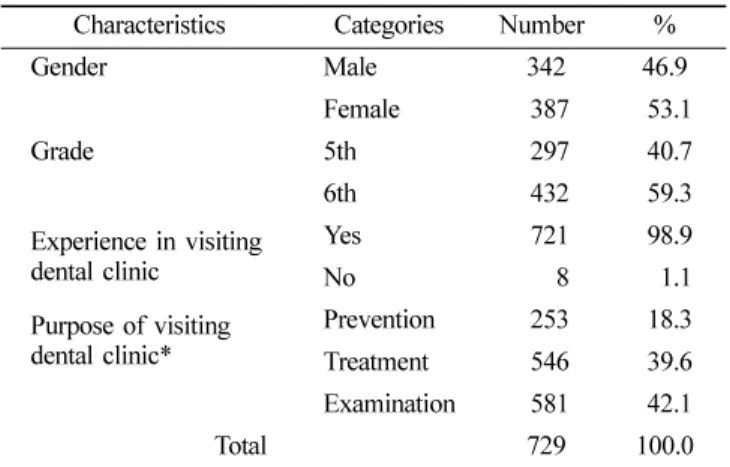
연구대상자의일반적 특성은
Table 1
과같다.
성별은남학 생342
명(46.9%),
여학생387
명(53.1%)
이었으며,
학년은5
학 년297
명(40.7%), 6
학년432
명(59.3%)
이었다.
치과의료기관을 방문한 경험은방문경험이 있는아동은
721
명(98.9%),
방문경험이없는아동은8
명(1.1%)
이었다.
방문 목적으로는다중응답의결과로예방목적이253
명(18.3%),
치료 목적546
명(39.6%),
구강검진581
명(42.1%)
으로 나타났다.
2. 구강건강증진행위
연구대상자의구강건강증진행위는
5
점만점에3.51
점으로중 간이상으로비교적 높은점수를 보였다.
이를 하위 영역별로살펴보면
,
식이습관이3.82
점으로 가장높았고,
예방목적치과 이용이3.43
점,
올바른잇솔질방법 및횟수3.40
점,
불소 이 용3.39
점 순으로 나타났다(Table 2).
3. 구강건강상태
3.1 아동의 우식영구치보유자율
아동의 우식영구치보유자율은
Table 3
과 같다.
전체학생729
명중342
명(46.9%)
이 우식치아를보유하고 있었으며,
성별로는남학생이
43.9%,
여학생이49.6%
이었으며,
학년별로는5
학년이44.4%, 6
학년이48.6%
로 우식치아를보유하고있는것으로 나타났다
.
3.2 주관적 구강건강상태 인식도
아동의주관적구강건강상태에대한인식도는
Table 4
와 같 다.
자신의구강건강상태에대하여 ‘보통이다’라고 인식하는응 답이46.0%
로 가장높았으며,
평균3.30
점으로 나타났다.
다 른친구와비교해서구강건강상태에대한질문에도 ‘보통이다’고인식하는응답이
49.8%
로가장높았으며,
평균3.25
점으로나타났다
.
4. 일반적 특성에 따른 구강건강상태
아동의일반적특성에 따른객관적 구강건강상태는
Table 5
Table 1.
General characteristicsCharacteristics Categories Number %
Gender Male 342 46.9
Female 387 53.1
Grade 5th 297 40.7
6th 432 59.3
Experience in visiting
dental clinic Yes 721 98.9
No 8 1.1
Purpose of visiting
dental clinic* Prevention 253 18.3
Treatment 546 39.6
Examination 581 42.1
Total 729 100.0
*multiple response
Table 2.
Oral health promotion behaviorVariables Mean SD
Oral health promotion behavior 3.51 0.60
Preventive care 3.43 1.06
Used of Fluoride 3.39 1.06
Tooth brushing method 3.40 0.86
Behavior of alimentation 3.82 0.67
Table 3.
Dantal caries of students N(%) Dantalcaries MaleGenderFemale 5th Grade 6th Total
−
192(56.1) 195(50.4) 165(55.6) 222(51.4) 387(53.1) + 150(43.9) 192(49.6) 132(44.4) 210(48.6) 342(46.9) Total 342(100.) 387(100.0) 297(100.0) 432(100.0) 729(100.0)Journal of Dental Hygiene Science Vol. 7
,No. 4
,pp. 271~274 (2007) 273
와 같다
. 729
명 전체 아동의 우식치아는1.66
개,
결손치아는0.03
개로나타났다.
성별에따른객관적구강건강상태와의관계 는남학생의우식치아가1.51
개,
여학생은1.79
개로나타났고,
결손치아는남학생
0.02
개여학생0.04
개로나타났으나유의한 차이는없었다.
학년에따른객관적 구강건강상태는우식치아는
5
학년1.67
개, 6
학년1.65
개이었으며,
결손치아는5
학년0.02
개, 6
학년0.04
개로 나타났으며,
유의한 차이는나타나지 않았다.
5. 주관적 구강건강상태 인식도와 객관적 구강건강상태와의 상관관계
주관적으로느끼는구강건강인식정도와 객관적구강건강상 태 정도의 상관관계는
Table 6
과 같다.
주관적구강건강상태인식과우식치아의관계에서역상관관
계
(r =
−0.32)
가있는것으로나타나주관적구강건강상태인식도가 긍정적일수록 우식치아가 적은 것을 알 수 있었다
(p < 0.01).
6. 구강건강증진행위와 구강건강상태와의 상관관계 구강건강증진행위의하위영역인예방목적치과이용
,
불소이용,
잇솔질방법및횟수
,
식이습관과우식치아간의상관관계를분석 한 결과
Table 7
과같다.
하위영역중 식이습관과우식치아사이에역 상관관계가 있는것으로나타나
(r = − 0.10),
분석 되었다.
식이습관이좋을수록 우식치아가적은것으로나타났다
(p < 0.01).
고 찰
구강병은예방이가능한질병이나이중치아우식증은학령 기에가장빈번히발생하는질병으로치료하지않고방치하게 되면심한통증으로인해학교를 결석하게되기도 하고
,
식사 와 발음에문제가발생하며 그결과로학생의성장과발달에 도 영향을주게된다.
특히12
세는영구치의치열이완성되는 시기이므로구강건강관리가매우중요하다.
학생구강관리의목 적은올바른생활습관형성과구강건강증진행위의능력을길러주 어 구강질환을사전에 예방하는데그목적이 있다.
최근구강 건강증진행위중잇솔질 빈도는일반건강상태를나타내는지 표로적당하다고연구된 바와같이구강건강의중요성이부각 되고 있다.
이에본연구는 초등학생의구강건강증진행위와구강건강상 태와의 관련성을파악하고 두변수간의 관련성을분석하였다
. 2007
년4
월부터10
월까지실시한학생의구강검진결과를 분 석한결과,
우식영구치보유자율은전체학생729
명 중46.9%
가 우식치아를보유하고있었으며
,
성별로는남학생이43.9%,
여학생이
49.6%
이었으며,
학년별로는5
학년이44.4%, 6
학년이48.6%
가우식치아를보유하고있는것으로나타났다.
이결과는 교육인적자원부
(2004)
에서발표한 전국5,6
학년 구강검사결과인 남학생
45.3%,
여학생46.5%
와 비슷한결과이다.
연구대상자의 평균 보유 우식치아는
1.66
개로5
학년은1.65
개,
6
학년은1.67
개로나타났는데이는2003
년국민구강건강실태조사의 결과인각각
11
세1.10
개, 12
세1.50
개보다 다소 높게 나타났다.
우식발생위험치아는평균0.56
개,
결손치아는평균0.03
개로 나타났다.
구강건강상태를평가하는 지표로영구치우식경험도를많이 이용하는데
,
영구치우식경험도란조사 당시에진행되고 있는 우식병소를가지고있는영구치아와우식증으로 인하여발거된 과거의우식영구치아및치료된과거의우식영구치아의수효를 말한다.
영구치우식경험에있어12
세는 많은나라에서아동들Table 4.
Subjective recognition of oral health condition N(%)Item Very
unhealthy Unhealthy Fair Healthy Very
healthy M
±
S.D How to feel my oral health conditions? 14(1.9) 97(13.3) 335(46.0) 222(30.5) 61(8.4) 3.30±
.87 How to feel my oral health conditions comparing against class mate? 14(1.9) 97(13.3) 363(49.8) 200(27.4) 55(7.5) 3.25±
.85Table 5.
Oral health state by general characteristics Characteristics DT(M±SD) t MT
(M
±
SD) t Gender MaleFemale 1.791.51± ±
2.182.44−
1.64 0.020.04± ±
0.160.30−
1.03 Grade 5th6th 1.671.65± ±
2.262.37 0.13 0.020.04± ±
0.170.28−
1.15Total 1.66
±
2.32 0.03±
0.24Table 7.
Correlation between Oral health promotion behavior and the oral health statePreventive care Used of Fluoride Tooth brushing method Behavior of alimentation DT
Preventive care
−
1.00Used of Fluoride
−
0.34**−
1.00Tooth brushing method
−
0.28**−
0.20**−
1.00Behavior of alimentation
−
0.18**−
0.16**−
0.32**−
1.00DT
−
0.07−
0.05−
0.05−
0.10** 1.00**p < 0.01
Table 6.
Correlation between the subjective recognition of oral health condition and the oral health stateVariables OH DT MT
OH 1.00
DT -0.32** 1.00
MT -0.03 0.07 1.00
**p < 0.01, OH: subjective recognition of oral health condition,
DT : Decayed Teeth, MT: Missing Teeth
274
The Relationships between the Oral Health Promotion Behavior and Dental Health Condition of Primary School Children이초등학교를졸업하는연령이고
,
비교적쉽게표본조사대상 으로추출할수있으며,
신뢰도가높아국제적으로영구치우식 경험도를비교하는기준연령이되었다.
이러한이유로세계보 건기구는12
세를국제적으로영구치우식경험 정도를비교하는 기준연령으로공표하였다.
그러나현재우리나라에서는 학교보건법6)에근거한건겅검진 항목및 방법으로 치아상태평가 는우식치아
,
우식발생위험치아,
결손치아를 검사하도록되어있 고처치된과거우식치아에대한 검사가이루어지지않고있 어 영구치우식경험도를 비교할 수있는 통계 지표를 산출할 수 없다.
초등학생은비교적쉽게 표본조사대상으로추출할수 있고
,
학교보건의일환으로신체검사및 구강검사가매년 시행되고있는점을감안한다면,
학교구강보건의귀중한 기초 자료로활용될수 있도록조사내용에대한수정·보완이이루 어져야 할 것으로 사료되었다.
연구대상자의구강건강증진행위는
5
점만점에3.51
점으로중간이상으로비교적 높은점수를 보였다
.
이를 하위 영역별로 살펴보면,
식이습관이3.82
점으로가장 높았다.
이는 단체급 식으로 인한 올바른 식습관이형성되는데 도움이 된 것으로 생각된다.
다음으로예방목적치과이용이3.43
점,
올바른 잇솔 질방법 및 횟수3.40
점,
불소 이용3.39
점순으로 나타났다.
주관적구강건강상태에대한인식정도는
5
점 만점에3.28
점 으로나타났으며,
주관적구강건강상태 인식과우식치아의관계에서역상관관계
(r =
−.322)
가 있는것으로나타나,
주관적구강건강상태인식이긍정적일수록 우식치아가적은 것을알
수있었다
(p < 0.01).
이는김영남의 연구에서 구강건강인식과객관적구강건강상태간에유의한결과를보인것과같은결과 이다
.
주관적인구강건강상태에대한인식도와 구강건강증진행위
간에는순상관관계
(r = .322)
가있는것으로나타나주관적구강건강인식정도가긍정적일수록구강건강증진행위를잘수행하
는것으로나타났다
(p < 0.01).
이는학생이스스로건강하다고생각하는경우에는대체적으로구강건강증진행위를잘수행하는 것으로구강건강에자신있다고 생각하고있음을 알수있다
.
구강건강증진행위영역중식이습관과 우식치아와의관계에는
역상관관계
(r =
−.100)
를 보여식이습관이좋을수록우식치아가적은것으로나타났다
(p < 0.01). Nicholas
는개인적인 건강 상태가건강행위의 선행조건으로보기보다는건강행위의결과 로보는 것이타당할수 있다는상호호혜적인관계의가능성 을제시한것과같이구강건강증진행위실천도가높을수록구 강건강상태가 양호하다고 볼 수 있다.
이상의결과로 볼때
,
초등학생들의 구강건강에구강건강증 진행위의실천도가중요하므로구강건강증진행위를향상시킬수 있는구강건강교육방안이개발되어야하며,
구강건강교육시 이를 반영하여야 할 것이다.
요 약
본 연구는초등학생의 구강건강증진행위와구강건강상태를 파악하고
,
두변수간의 관련성을알아보고자서울시에위치한4
개 초등학교5,6
학년학생729
명을대상으로설문조사와 구강검진자료를 분석한 결과
,
다음과 같은 결과를 얻었다. 1.
아동의구강건강증진행위는5
점만점에3.51
점이었고,
하위영역별로 식이습관
3.82
점으로가장높았고,
예방목적치과이용이
3.43
점,
잇솔질 방법 및 횟수3.40
점,
불소이용
3.39
점 순으로 나타났다.
2.
아동의우식영구치보유자율은46.9%
이었으며,
우식치아는1.66 ± 2.32
개,
결손치아는0.03 ± 0.24
개이었다. 3.
주관적 구강건강상태인식과 우식치아와의관계는역 상관관계
(r =
−0.32)
를보였으며,
자신의 구강건강상태에대 한인식이 긍정적일수록우식치아가 적은것으로 나타났 다(p < 0.01).
4.
구강건강증진행위 하위영역중식이습관이우식치아와 상관관계
(r =
−0.10)
가 있는것으로나타나식이습관이좋을수록 우식치아가 적은 것으로 나타났다
(p < 0.01).
이상의결과를근거로초등학생의구강건강은올바른구강건 강증진행위의실천으로나타나므로초등학생의 구강건강증진행 위를위한구강보건교육의개발과적용이 이루어져야할것으 로 사료된다