• 검색 결과가 없습니다.

Fabrication of Hybrid Composite Plates with an Active Frequency Selective Surface

N/A
N/A
Protected

Academic year: 2021

Share "Fabrication of Hybrid Composite Plates with an Active Frequency Selective Surface"

Copied!
7
0
0

로드 중.... (전체 텍스트 보기)

전체 글

(1)

Paper

Fabrication of Hybrid Composite Plates with an Active Frequency Selective Surface

Yun-Seok Seo*, Heoung-Jae Chun** , Ic-Pyo Hong***, Young-Bae Park****, Yoon-Jae Kim*****

ABSTRACT: This paper describes the fabrication techniques and analysis of hybrid composite plates with an active frequency selective surface (FSS). For fabricating hybrid composite plate with active FSS, an active FSS with a resonance frequency located in the C band can obtained using varactor diodes. The hybrid composite plate was first designed and simulated to determine its electromagnetic properties using the commercial software HFSS. After simulation, active FSSs and hybrid composite plates were fabricated by mounting with varactor diodes. After fabrication, free space measurement was used to determine the electromagnetic properties of active FSS and the hybrid composite plates. The simulation and experimental results were in good agreement.

Key Words: Frequency selective surface, Active FSS, Varactor diode, Hybrid composite plate, Free space measurement, Fabrication

1. INTRODUCTION

Frequency selective surfaces (FSSs), which consist of a dielec- tric substrate and conductive materials, can selectively trans- mit or reflect certain range of frequency of electromagnetic waves. Factors that influence the electromagnetic properties of FSSs include shape, size and spatial period of the conductive material pattern as well as thickness and permittivity of FSS materials. According to the desired reflecting or transmitting frequency range of FSS, loop-type can be divided into high pass filter, low pass filter, bandpass filter and bandstop filter [1]. FSS can be divided into passive FSS and active FSS in accordance the ability to change resonance frequency. In other words, passive FSS or traditional FSS has a fixed resonance fre- quency, while active FSS is a new type of FSS with a modifiable resonance frequency. There are three methods for fabricating active FSSs, namely, altering the electromagnetic properties of the substrate, altering the geometry conductive material, and incorporating circuit components into the conductive mate- rial. With respect to FSS fabrication, the first approach involv-

ing altering of electromagnetic properties requires the use of proper materials. Specifically, it is important to use materials with electromagnetic properties that can be changed by exter- nal factors. Ferroelectric materials are an example of this kind of substrate for active FSS [2]. Indeed, by applying an electric field to a ferroelectric substrate, dielectric constants of sub- strates can be changed in order to shift the resonance fre- quency of the FSS. However, there are a number of serious disadvantages associated with active FSS.

Specifically, ferrites have a high mass and large currents are required to maintain the DC bias across the substrate. More- over, setting up a DC bias over large substrate area is a com- plicated task. In addition to ferroelectric materials, liquid dielectric can be used [3]. Importantly, depending on the kind of liquid dielectric and its quantity in the cavity of the sub- strate, the electromagnetic properties of the substrate of FSS can change in order to shift the resonance frequency. However, this active FSS requires complex designs to handle the liquid properly. Silicon can also be used for this kind of active FSS because the dielectric material properties of silicon change

Received 23 May 2017, received in revised form 28 October 2017, accepted 31 October 2017

** *

**** ***

*****

Blue Planet Co., Ltd

School of Mechanical Engineering, Yonsei University, Corresponding author (E-mail: [email protected]) School of Electric wave Engineering, Kongju University

School of Electrical and Computer Engineering, Ajou University

Agency for Defense Development

(2)

when it is illuminated by plasma [4]. Second, microelectro- mechanical system (MEMS) technology can be used for alter- ing the geometry of conductive materials [5]. By applying a magnetic field to an active FSS, conductive elements can be moved in order to change the resonance frequency and band- width of the active FSS. However, this kind of active FSS requires complex fabrication techniques as well as the ability to produce an external electromagnetic field to mechanically control the element position. The third method for manu- facturing FSSs consists of a PIN diode or varactor diode, which can be used for incorporating circuit components into a conductive screen. By using PIN diodes, capacitance of a metallic screen can be changed by altering the on and off status of the PIN diodes [6]. Varactor diodes can also be used for this purpose [7]. Specifically, varactor diodes are able to change capacitance in accordance with the applied value of reverse voltage. In this way, as reverse voltage increases, capacitance of varactor diode decreases. Thus active FSSs employing varactor diodes can change their resonance frequency continuously.

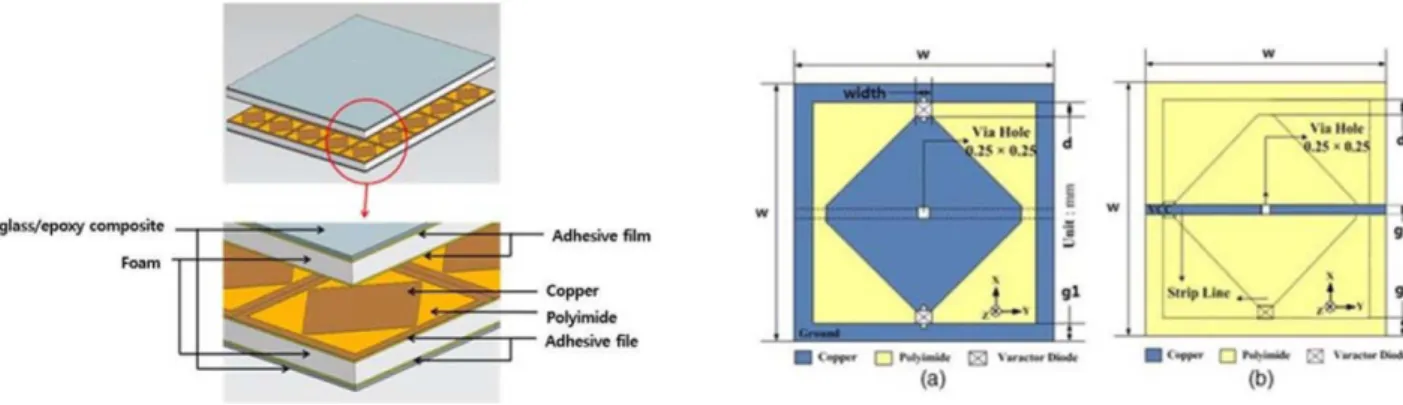
FSSs have been used frequently for hybrid radomes to reduce radar cross section (RCS) [8,9]. A radome is a structure used to protect an antenna from external factors that can cause damage such as collision and harsh environment, while the antenna serves to transmit and sense electromagnetic waves reflected by an object. By combining FSS into radomes, which results in a hybrid radome, the RCS of the radome can be reduced. Specifically, the FSS of a hybrid radome can act as a band pass filter that allows electromagnetic waves from ene- mies whose frequency is in the range of the passband of the hybrid radome to pass through and thus not be reflected back to enemies. Hybrid radomes are made by stacking materials such as FSS, foam, and composites. A flat specimen of a hybrid radome, referred to as a hybrid composite plate in this paper, is shown in Fig. 1. In this material, the FSS is sandwiched between foam and composites in order to protect it from harsh environments. The composite e-glass epoxy is typically used for hybrid radomes because its materials have appropriate properties for hybrid radomes such as low dielectric loss, good mechanical strength, good environmental resistance, and good

dimensional stability during manufacturing. Adhesive films can be used to bond FSS and foam. Until now, passive FSS have been developed and utilized frequently. However, active FSS has recently been developed because of the limitation of pas- sive FSS whereby it cannot change its resonance frequency.

Many fabrication methods for active FSS have been developed as described above [2-7].

Specifically, FSS is frequently used for fabricating hybrid radomes to reduce RCS, and many studies have been per- formed on the use of passive FSS in hybrid radomes [8,9].

However, hybrid radomes using passive FSS carry the same limitations of passive FSS, in that it is difficult to reduce RCS effectively against various frequencies of electromagnetic waves. Therefore there is a growing need to study hybrid radome using active FSS, and only a few studies to date have been published on this area. For this reason, the design, fab- rication and analysis of hybrid composite plate with active FSS were investigated to develop a functional early stage hybrid radome using active FSS. The active FSS used in this study was fabricated using varactor diodes because fabricating a hybrid radome in this way is relatively easy and it allows the reso- nance frequency to be changed simply by applying the proper voltage. Additional reasons why other methods were not cho- sen are as follows. With respect to the first method, use of elec- tromagnetic exchangeable materials as a substrate is not appropriate for hybrid radomes because applying DC bias to the actual hybrid radome properly is difficult when using a fer- rite substrate. Further, hybrid radomes constructed in this way using a liquid dielectric substrate are not structurally stable because of the necessary cavity for the substrate. With respect to the second method, MEMS technology is also not appro- priate for hybrid radomes because moving the conductive ele- ment for FSS is not possible, as it is sandwiched in other materials such as foam and composites to allow for protection from harsh environments. After designing and simulating the active FSS, a simulated hybrid composite plate was also imple- mented and an active FSS with hybrid composite plate was fabricated. After fabrication, free space measurement exper- iments were performed for validation.

Fig. 1. Hybrid composite plate Fig. 2. Designed active FSS (a) upper side, (b) lower side

(3)

2. MATERIALS AND METHODS

2.1 Design of FSS

Contents The conductive pattern of FSS used in this study was designed by referencing the designs of existing research [7]. By modulating these designs, the FSS used in this study was able to achieve a high resonance frequency and proper characteristics for modulating the capacitance of FSS by var- actor diodes. The conductive pattern consisted of a ground grid and octagonal patch on the upper surface as shown in Fig.

2(a) and power gird on the lower surface as shown in Fig. 2(b).

In addition to the grids and patch, a via hole was generated inside the unit cell to connect the power grid and octagonal patch. The design parameters w, d, g1, g2 and width are shown in Fig. 2, where w is the size of the unit cell, d is the distance between the octagonal patch and ground grid, g1 is the width of the ground grid, g2 is the width of the power grid, and width is the width of the face of the octagonal patch parallel to the ground grid. The w, d, g1, g2 and width shown in Fig. 2 were chosen such that the FSS had a resonance frequency in the C band. The value of each design parameter is shown in Table 1.

The design parameter ‘width,’ which had the greatest influ- ence on the capacitance range of FSS and range of resonance frequency, was modulated to determine the range of resonance frequency and required range of capacitance of varactor diodes. Ranges of resonance frequency and capacitance in accordance with different values of ‘width’ are shown in Table 2. Among the different width parameter tested, 1.5 mm was chosen because the range of resonance frequency was large and it allowed for sufficient space to mount the varactor diodes.

2.2 Simulation

Contents To simulate the electromagnetic properties of

active FSS and hybrid composite plates, we used the com- mercial software HFSS 12. HFSS is based on the FEM (finite element method) and is an EM field simulator that solves the EM field using Maxwell’s equations. The unit cell of the active FSS and hybrid composite plate were modeled as shown in Fig. 3.

As shown in Fig. 3(a), the active FSS model, a polyimide film, was modeled using Solid, while the copper pattern of FSS was modeled using perfect E to reduce simulation time.

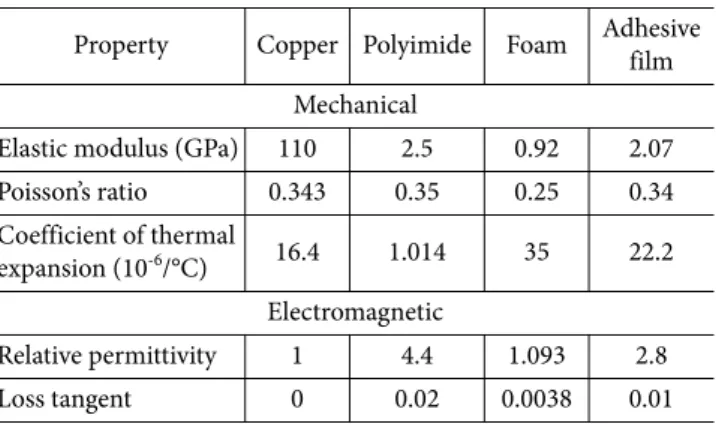
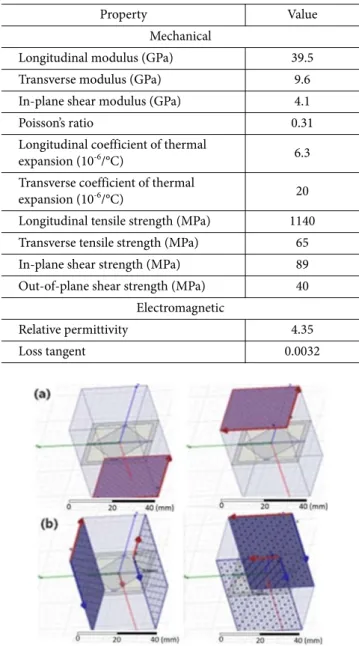
Finally, the varactor diodes were modeled using the LC com- ponent. Fig. 3(b) shows the hybrid composite model, in which the active FSS modeled in Fig. 3(a) was combined with a foam, adhesive film, and e-glass/epoxy composite modeled using Solid. When simulating the active FSS and hybrid composite plate, the capacitance of the LC component should be des- ignated with a proper value in accordance with the reverse voltage applied to varactor diodes. The inductance and capac- itance values used were obtained from the specifications of the varactor diodes. The capacitances of varactor diodes for each reverse voltage are shown in Table 3 and mechanical and elec- tromagnetic properties of materials used in the hybrid com-

Table 1. Values of Design parameters Design

parameter w d g1 g2 width

Value

(mm) 45.0 1.0 2.88 1.5 2.0

Table 2. Range of resonance frequency and dynamic range of capacitance at each value of design parameters (width) Width

(mm)

Reconfigurable Frequency Range (GHz)

Dynamic Range of Capacitance (pF)

3.0 6.62-7.05 0.80-3.00

2.5 6.64-6.94 0.80-3.00

2.0 6.56-6.93 0.80-3.00

1.5 6.44-7.16 0.40-3.00

1.0 6.61-7.19 0.40-3.00

Fig. 3. FE model for analyzing electromagnetic properties (a) active FSS, (b) hybrid composite plate with active FSS

Table 3. Capacitance of varactor diodes at each voltage

Voltage (V) 0 4 8 12 16 20

Capacitance

(pF) 2.22 0.81 0.44 0.35 0.32 0.30

Table 4. Mechanical and electromagnetic properties of copper, polyimide, foam and adhesive film

Property Copper Polyimide Foam Adhesive film Mechanical

Elastic modulus (GPa) 110 2.5 0.92 2.07

Poisson’s ratio 0.343 0.35 0.25 0.34

Coefficient of thermal

expansion (10

-6

/°C) 16.4 1.014 35 22.2 Electromagnetic

Relative permittivity 1 4.4 1.093 2.8

Loss tangent 0 0.02 0.0038 0.01

(4)

posite plate are shown in Table 4 and Table 5, respectively.

Boundary conditions for the analysis are shown in Fig. 4.

As shown in Fig. 4(a), a floquet port was applied to a box covering the entire model of the active FSS and hybrid com- posite plate. For the floquet port, the unit cell was assumed to be infinitely periodically arranged. In addition to the floquet port condition, master and slave boundary conditions were applied as shown in Fig. 4(b). After designing and setting con- ditions, a solution type was selected and analysis setup was performed. Next, the active FSS and hybrid composite plate was simulated in HFSS. Finally, electromagnetic properties such as reflection coefficient dB(S11) and transmission coef-

ficient dB(S21) were obtained using HFSS.

2.3 Fabrication

Contents of FSSs are typically fabricated using a polyimide film with a copper substrate. Polyimide is a typical material for flexible FSS because it has low permittivity and strong resis- tance against heat. Likewise, copper is commonly used for FSSs because it has good conductivity and is relatively cheap.

After fabricating FSS, an active FSS composed of 25 unit cells was fabricated by mounting 2 varactor diodes on each unit cell. One end of the varactor diode was mounted on a ground grid and the other was mounted on an octagonal patch. Com- mercial varactor diodes, SMV 2019-079 LF from SKY- WORKS, were used in this study.

To apply reverse voltage to active FSSs, wires were attached to the power grid and ground grid. In the process of fabri- cating hybrid composite plate with active FSS, composites are first cured by autoclave molding [10]. The autoclave molding process is used for fabrication of advanced high-performance composites for military, aerospace, transportation, and marine applications, among others. The autoclave molding process uses composite materials in prepreg form. Specifically, prepreg sheets are cut to size, oriented as desired, stacked to form a layup, and then cured. In the first step, the entire assembly of the prepreg layup is heated under vacuum in order to melt the resin and remove volatiles. In the second step, the assembly is heated to a higher temperature under high pressure, after which it is cooled gradually to minimize residual stresses and prevent microcracking. In this study, the prepreg composite layup consisted of 4 e-glass/epoxy composite laminas. The final thickness was 0.6 mm, and the material properties of the e-glass/epoxy composite lamina are shown in Table 5. Curing e-glass/epoxy composite for fabricating composite skin pro- ceeded as follows. First, e-glass/epoxy prepreg sheets were cut to the size of the FSS film and composites were stacked. The stacking sequence of composites in this paper was [0/90]s.

Next, a releasing film was attached to both sides of the com- posite, after which they were placed on a tool plate around which a cork dam was built. A pressure plate was then placed on the composite followed by placing the entire assembly into the mold. Finally, appropriate vacuum/temperature/pressure conditions were applied to the mold by using a vacuum pump and air pressure and heating systems. After fabricating the composite skins through autoclave molding, fabricating the hybrid composite plate proceeded as follows. First, the mate- rials were stacked properly as shown in Fig. 1. Next, proper vertical force was applied to ensure the stacked materials joined together properly. Afterwards, the specimen was cov- ered and placed in a vacuum bag under proper conditions to allow adhesives to join completely. Specifically, to allow mate- rials to bond perfectly using an adhesive film, proper air pres- sure and vacuum condition are needed.

Table 5. Mechanical and electromagnetic properties of E-glass/

epoxy lamina

Property Value

Mechanical

Longitudinal modulus (GPa) 39.5

Transverse modulus (GPa) 9.6

In-plane shear modulus (GPa) 4.1

Poisson’s ratio 0.31

Longitudinal coefficient of thermal

expansion (10

-6

/°C) 6.3

Transverse coefficient of thermal

expansion (10

-6

/°C) 20

Longitudinal tensile strength (MPa) 1140 Transverse tensile strength (MPa) 65

In-plane shear strength (MPa) 89

Out-of-plane shear strength (MPa) 40 Electromagnetic

Relative permittivity 4.35

Loss tangent 0.0032

Fig. 4. Boundary conditions for simulation (a) floquet port con-

ditions, (b) master and slave conditions

(5)

2.4 Experiment

There are two primary methods for measuring electromag- netic property, namely, free space measurement and wave- guide measurement. Waveguide measurement uses a waveguide, the purpose of which is to carry electromagnetic waves. Wave- guide measurement systems consist of a network analyzer, coaxial cables, and waveguide section. In this system, the spec- imen is placed in the center of the waveguide section and elec- tromagnetic waves pass through the specimen, where the S- parameter is then gained using a network analyzer. A free space measurement system consists of two horn antennas, one of which serves as a transmitting antenna and the other as a receiving antenna, a sample holder between the two antennas, and a network analyzer. Free space measurement is based on the fact that the phase and attenuation of EM wave passing through or reflecting from a specimen can be measured, and that they vary depending on the specimen properties that are fully defined by the materials permittivity and permeability [11].

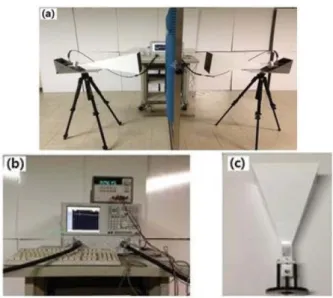
In this paper, free space measurement was used to measure the electromagnetic properties of the active FSS and hybrid composite plate. The entire system for free space measurement is shown in Fig. 5(a).

Briefly, the specimen was placed in the sample holder, through which EM waves from the transmitting antenna were passed. The sample holder consisted of a hole to place the specimen and a separate part covered with an absorber to pre- vent diffraction of electromagnetic waves. The network ana- lyzer shown in Fig. 5(b) was used for calibration and obtaining experimental results through the horn antenna. The power supply shown in Fig. 5(b) was used for applying voltage to the

varactor diodes through wires attached to the active FSS. The horn antennas (MTG) used in our experiments are shown in Fig. 5(c), and had an available frequency range of 3.9 GHz to 8.2 GHz.

3. RESULTS

Using the simulation and experiment methods described above, electromagnetic properties of active FSS and hybrid composite plate were obtained. Among the numerous values that can be used to express electromagnetic properties, we chose S21 in this study because it is the most accurate value that can be obtained from free space measurements. Valida- tion was performed by comparing simulation and experimen- tal results.

Fig. 5. Free space measurement system (a) entire system, (b) power supply(top) for applying voltage to the varactor diodes and network analyzer(bottom) to obtain data, (c) horn antenna to transmit and receive electromagnetic waves

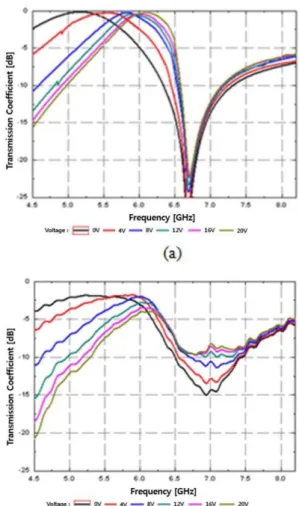
Fig. 6. Results of (a) simulation and (b) experiment of active FSS

Table 6. Resonance frequency of active FSS obtained by simula- tion

Voltage(V) 0 4 8 12 16 20

Resonance

frequency (GHz) 6.36 6.56 6.81 6.94 6.96 7.01

(6)

3.1 Active FSS

The results for the simulated and experimental active FSS are shown in Fig. 6(a) and Fig. 6(b), respectively. Resonance frequencies of the active FSS in the simulation and free space measurement experiment are shown in Table 6 and Table 7.

The resonance frequencies of the active FSS ranged from 6.36 GHz to 7.01 GHz in the simulation and from 6.36 GHz to 7.13 GHz in the free space measurement experiment; the dif- ference in resonance frequency between the simulation and experimental condition was less than 0.2 GHz. Based on Fig.

6(a) and Fig. 6(b), we determined that both results exhibited a tendency towards increased resonance frequency and decreased bandwidth of the passband as the voltage applied to the var- actor diode of the active FSS increased. The bandwidth of the passband under experimental conditions was narrower than for the simulation results, which was attributed to the loss of dB due to experimental circumstances. However, both the sim- ulation and experimental results identified the voltage-inde- pendent frequency associated with the lowest dB value, which were 7.65 GHz and 7.75 GHz, respectively. There are several possible reasons why we observed differences between the sim- ulation and experimental results. First, the experiments were not implemented in an anti-reflection space, and thus reflected electromagnetic waves may have influenced our results. Sec- ond, refraction and diffraction of electromagnetic waves pres- ent in the experimental conditions did not exist in the simulation. Third, the difference in the number of unit cells, which was infinite in the simulation and finite in the exper- iment, likely affected the dB value of S21.

3.2 Hybrid composite plate with active FSS

Contents The results of the simulation of the hybrid com- posite plate are shown in Fig. 7(a), and the experimental results for the hybrid composite plate are shown in Fig. 7(b).

The resonance frequencies of the hybrid composite plate in the simulation and experiments are shown in Table 8 and Table 9. The resonance frequencies of the hybrid composite plate ranged from 5.17 GHz to 6.11 GHz in the simulation and from 5.22 GHz to 6.03 GHz in the free space measurement experiment, the difference of which was less than 0.26 GHz.

As shown in Fig. 7(a) and Fig. 7(b), there was a tendency for the resonance frequency and bandwidth of the passband to change in the hybrid composite plate. The frequency associ- ated with the lowest dB value at all voltages was 6.7 GHz for the simulation and 7.0 GHz for the experiment. The reasons for the differences between simulation result and experiment

result in the case of active FSS were considered to be the same as those responsible for the differences in the case of the hybrid composite plate with active FSS.

Moreover, imperfect bonding conditions in the fabricated hybrid composite plate may have resulted in cavities in the structures filled with air, which in turn may have affected the electromagnetic properties such as relative permittivity. Dif- ferences between the results of the active FSS and hybrid com- Table 7. Resonance frequency of active FSS obtained by free

space measurement

Voltage(V) 0 4 8 12 16 20

Resonance

frequency (GHz) 6.36 6.52 6.68 7.12 7.13 7.13

Fig. 7. Results of (a) simulation and (b) experiment of the hybrid composite plate with active FSS

Table 8. Resonance frequency of hybrid composite plate with active FSS obtained by simulation

Voltage (V) 0 4 8 12 16 20

Resonance

frequency (GHz) 5.17 5.61 5.83 5.91 6.02 6.11

Table 9. Resonance frequency of hybrid composite plate with active FSS obtained by free space measurement

Voltage (V) 0 4 8 12 16 20

Resonance

frequency (GHz) 5.22 5.87 6.01 6.02 6.027 6.3

(7)

posite plate with the active FSS were also noted. For example, the resonance frequencies of the hybrid composite plate were less than that of the active FSS. Specifically, the resonance fre- quency ranged from 0.9 GHz to 1.19 GHz for the simulation and 0.65 GHz to 1.14 GHz in the free space measurement experiment. The reason for the differences was attributed to the dielectric materials of the hybrid composite plate, which included adhesive film and e-glass/epoxy composites covering the active FSS. Indeed, when an FSS is embedded within dielectric materials, there is tendency for the resonance fre- quency of the FSS to decrease in accordance with increasing thickness of the dielectric material [12].

4. CONCLUSIONS

In this study, we present the fabrication and analysis of active FSS and hybrid composite plate with the active FSS for a functional early stage hybrid radome with active FSS. The results of the simulation of active FSS and hybrid composite plate with active FSS revealed the tendency of the resonance frequency to shift. The active FSS was fabricated by mounting two varactor diodes in each unit cell.

Hybrid composite plates were fabricated by sequentially cur- ing composites, stacking materials, and curing adhesive films.

After fabrication, experiments were performed to measure electromagnetic properties of active FSS and hybrid composite plate. The results showed that the simulated and fabricated active FSS functioned similarly, although some minor differ- ences were noted and their potential causes were discussed.

The results of this study demonstrated the feasibility of fab- ricating a real hybrid radome with active FSS using varactor diodes. The FSS used in this study was composed of a copper pattern and polyimide film. The flexibility of this material sup- ports the possibility of fabricating an actual hybrid radome with a curved shape. However, designing an active FSS to a curved shape and properly mounting varactor diodes in curved shape will require significant effort and precision.

ACKNOWLEDGEMENT

This work was supported by the Low Observable Technol- ogy Research Center Program of the Defense Acquisition Pro-

gram Administration and the Agency for Defense Development of Republic of Korea.

REFERENCES

1. Munk, B.A., Frequency Selective Surfaces: Theory and Design, Willey, 1999.

2. Parker, D.A., and Savia, S.B., “Active Frequency Selective Sur- faces with Ferroelectric Substrates”, IEE Proceedings – Micro- waves, Antennas and Propagation, Apr. 2001, pp. 103-108.

3. Lima ACdec., Parker, E.A., and Langley, R.J., “Tunable Fre- quency Selective Surface Using Liquid Substrates”, Electronics Letters, Vol. 30, No. 4, 1994, pp. 281-282.

4. Vardaxoglou, J.C., “Optical Switching of Frequency Selective Surface Bandpass Response” Electronics Letters, Vol. 32, No. 25, 1996, pp. 2345-2346.

5. Zendejas, J.M., Gianvittorio, J.P., Samii, Y.R., and Judy, J.W.,

“Magnetic MEMS Reconfigurable Frequency-selective Sur- faces”, Journal of Microelectromechanical Systems, Vol. 15, No. 3, 2006, pp. 613-623.

6. Taylor, P.S., Parker, E.A., and John, C., “An Active Annular Ring Frequency Selective Surface”, Antennas and Propagation, IEEE Transactions on, Vol. 59, pp. 3265-3271.

7. Mias, C., and Tsakonas, C., “Waveguide Demonstration of Var- actor-Diode-Tunable Bandpass Frequency-Selective Surface”, Microwave and Optical Technology Letters, Vol. 45, pp. 62-65.

8. Chen, H., Hou, X., and Deng, L., “Design of Frequency-selec- tive Surfaces Radome for a Planar Slotted Waveguide Antenna”, IEEE Trans. Antennas and Wireless Propagation Letters, Vol. 8, pp. 1231-1233.

9. Wahid, M., and Morris, S.B., “Bandpass radomes for reduced RCS”, IEE Colloquium on. Antenna Radar Cross Section, May 7, 1991, pp. 4/1-4/4.

10. Daniel, I.M., and Ishai, O., Engineering Mechanics of Composite Materials, Oxford University Press, 2006.

11. Musil, J., and Zacek, F., Microwave Measurement of Complex Permittivity by Free Space Methods and Their Applications, Else- vier, 1986.

12. Callaghan, P., Parker, E.A., and Langley, R.J., “Influence of Sup- porting Dielectric Layers on the Transmission Properties of Frequency Selective Surfaces”, IEE Proceedings-H, Vol. 138, pp.

448-454.

수치

Fig. 1. Hybrid composite plate Fig. 2. Designed active FSS (a) upper side, (b) lower side
Fig. 3. FE model for analyzing electromagnetic properties (a) active FSS, (b) hybrid composite plate with active FSS
Fig. 4. Boundary conditions for simulation (a) floquet port con- con-ditions, (b) master and slave conditions
Fig. 5. Free space measurement system (a) entire system, (b) power supply(top) for applying voltage to the varactor diodes and network analyzer(bottom) to obtain data, (c) horn antenna to transmit and receive electromagnetic waves
+2

참조

관련 문서