서론
산업 혁명 이후 전 세계적으로 매년 평균 온도가 상승하고 있으며, 특히 우리나라의 여름철 평 균 기온은 100여년 만에 2℃ 상승한 24.5℃를 기록 중이다(Korea Meteorological Administration, 2018). 일반적으로 일중 최고 기온이 33.0℃이상일 때를 폭염이라 일컬으며 국내에서는 2일 이상 지속될 때 경보를 발령하고 있다. 기상청에 따르면 2018년은 폭염일수가 31.5일로 관측 이후 1위를 기록하여, 1994년 이후 최대의 폭염이라 평가되고 있다. 폭염은 건강과 직결되는 기상재해로서 많 은 환자와 사망자를 발생하게 한다. 이에 질병 관리 본부나 각 지자체의 재난 안전 대책 본부 등에 서는 각종 폭염 피해 예방 대책과 대응 매뉴얼을 발표 하고 있으며, 이에 따라서 온열질환인 열중증 (heat stroke)에 대한 일반 대중들의 예방의식 등도 점차 높아지고 있는 추세이다.
의복을 활용한 열중증 예방 대책에 관한 연구 동향 조사:
일본의 실용 지향적 연구를 중심으로
손수영
경북대학교 사범대학 가정교육과 조교수
Research trends on prevention of heat stroke using clothing: Focusing on practical research in Japan
Su-Young Son
Department of Home Economics Education, Teachers College, Kyungpook National University, Assistant Professor
Received: September 18, 2018 Revised: October 4, 2018 Accepted: October 6, 2018
Corresponding Author:
Su-Young Son
Department of Home Economics Education Teachers College, Kyungpook National University, 41566, 80 Daehak-ro, Buk-gu, Daegu, 41566 South Korea Tel: +82-53-950-5925 Fax: +82-53-950-5924 E-mail: [email protected]
Abstract
This study identifies Japanese study content on heat stroke prevention measures using clothes, provides basic data for quantitative wearing assessment studies, presents a developmental direction for those, and helps invigorate further research. Studies were collected concerning clothing-based heat stroke measures in order to analyze the following factors: current status of heat stroke by industry and working environment, heat stroke and body cooling method, clothing microclimate and air circulation in a hot environment, hot environments and wearable sensors, and heat stress reduction and skin exposure. The current WBGT standard does not consider the diversity of wearing clothes according to the working environment. Therefore, it is preferable to add a correction value in consideration of design, materials, and ventilation to prevent heat strokes. For the heat stroke and body cooling method, wearing water-perfused clothing is effective to reduce heat stress and maintain exercise ability. Changing the material and design of clothing or wearing air-conditioned clothing can improve ventilation and the clothing microclimate.
However, further evaluation is needed on the effectiveness of air-conditioned clothing as a heat stroke prevention product. The measurement method using a wearable sensor can provide real-time data on the body response due to working in a hot environment. Therefore, it is an effective alarm for heat stroke. Skin exposure area and heat dissipation efficiency should be considered to prevent heat stroke. Reducing the covering area by exposing the head, neck, and limbs, and wearing breathable material can prevent heat stroke from increased body temperature.
Keywords
heat stroke, clothing microclimate, body cooling method, wearable sensor
Family and
Environment
Research
열중증은 고온다습한 환경에서 서열 스트레스가 증가함에 따 라 체온조절, 체액조절, 순환조절 등의 체내의 주요 조절 기능 의 파탄으로 인해 발생하는 장애이며, 고열에 장시간 노출되는 작업 환경 또는 운동 환경에서 자주 발생하게 된다. 이를 유발 하는 원인에는 환경으로부터의 영향뿐만 아니라 신체의 활동 정 도, 착용 의복, 운동 및 작업 지속 시간, 개인적 기질 등의 요인 이 복합적으로 관여하게 되므로 이들 요인을 이용한 열중증의 예방 대책이 요구된다. 열중증 예방을 위하여 서열 환경을 평가 하기 위해 습구 흑구 온도 지수(wet-bulb globe temperature:
WBGT) 지수를 참고하는데, 이는 더위지수로써 열중증을 예방 하기 위해 제안된 지표이며, 국제적인 전문 연구기관인 National Institute of Occupational Safety and Health와 국제표준화기 구 International Organization for Standardization (ISO)에서 사용 중인 신뢰도가 높은 평가 지수이다. WBGT의 서열 허용기준 치는 기온과 기습 및 기류, 복사열을 종합적으로 고려한 지표로서 (ISO7243, 2003), 작업 현장 등에서 널리 적용되고 있다. 그러나 최근에는 적용되는 작업 현장 등에서 착용하는 의복 종류에 따른 보온성(clo)이 고려되지 않은 점이 지적되면서 (Sawada, 2011), 열중증 예방 대책을 위한 의복에 대한 고려의 중요성이 높아지고 있다.
의복의 착용은 체표면을 덮게 되므로 열방산을 방해하여 체 온의 상승을 초래하게 되어 열중증 발생의 요인이 된다. 열중증 의 기초적인 발생 원인인 체온 상승과 탈수를 방지하기 위한 의 복의 요건으로는 체표로부터 나오는 열을 가능한 빠르고 많이 외 부로 방산할 것, 체표에 분비되는 땀을 가능한 빨리 증발시킬 것, 외부로부터의 방사열의 체내 투입을 방지할 것 등을 들 수 있다 (Sawada, 2015). 이러한 요건을 고려하여 의복을 열중증 예방 대 책의 수단으로 활용하는 것이 기대되고 있다.
국내에서는 서열 환경에서의 의복 착용 상태와 착용에 따른 인 체 반응 측정, 서열 스트레스의 경감을 위한 의복의 소재나 디자 인의 변형에 관한 선행 연구들이 발표되어 있으나(Baek et al., 2018; Hwang et al., 2010; Kang et al., 2012; Kim et al., 2005; Kim & Cho 2014; Kim & Kim, 2018), 열중증 예방 대책 의 주요 수단으로 의복을 이용한 제품의 개발이나 착용 시의 성능 을 정량적으로 평가한 선행 연구를 찾아볼 수 없었다.
국내에서 판매되고 있는 열중증 예방을 위한 의류 제품으로는 폭염에 따른 냉감 소재 사용과 우리나라에서 쿨맵시로 표기되고 있는 쿨비즈(Cool Biz)룩 등의 여름철 실용 의류 잡화, 작업 현장 이나 스포츠 현장에서의 사용을 위한 공기순환복과 냉각 조끼 등 을 그 예로 찾아볼 수 있는데, 대부분 국외의 제품을 그대로 판매
하고 있는 경우가 많았다. 이는 국외에서 국내보다 더욱 빠른 시 기에 열중증 예방대책으로 의복이 도입되어 관련한 의류 제품의 개발 및 성능 평가에 관한 연구가 다양하게 이뤄지고 있는 것을 시사한다. 국내에서 판매되고 있는 열중증 예방 대책에 관련한 의 류 제품의 대부분은 일본에서 개발한 경우가 많은데, 이는 고온다 습한 여름철 기상 조건과 도심의 열섬 현상으로 인한 기온의 상승 변화 등이 우리나라와 유사하며, 지리학적으로도 인접해 있기 때 문으로 추측할 수 있다.
이에 본 연구는 열중증 예방 대책에 관한 일본의 연구 사례를 수집하고 그 중 의복을 이용하여 그 성능과 효과를 검증한 실용 지향적 연구 사례를 분석하였다. 국외 연구 사례들을 통해 의복을 활용한 열중증 예방 대책에 관한 연구 동향을 분석하고 추후 연구 를 위한 기초적인 자료를 제공하여 정량적 착용평가 연구의 발전 적 방향 제시와 활성화에 도움이 되고자 한다.
연구방법
의복을 활용한 열중증 예방 대책에 관한 국외의 연구 동향 분 석을 위해서 2000년 1월부터 2018년 6월까지 게재된 저널논문 을 대상으로 분석하였다. 열중증 예방 대책에 관련한 의복 제품 과 관련 연구의 다양성, 유사한 기상 조건 및 지리학적인 특성에 기인하여 일본을 중심으로 자료를 수집하였다. 연구 동향을 분 석하기 위한 저널논문을 수집하기 위하여 일본 내 학술정보 서비 스 중 종합 학술 전자저널 사이트 J-STAGE를 사용하였다.
J-STAGE에서 ‘열중증(熱中症)’을 키워드로 검색하여 1,472건 의 연구 사례를 추출하였으며, 의류 분야로 한정하기 위해 ‘열중 증(熱中症), 의복(衣服)’을 검색어로 사용하여 146건의 연구로 압 축하였다. 146건의 사례 중, 본문의 비공개 사례, 세미나의 초록, 학술대회와 학위 논문 발표의 중복되는 사례 등을 제외한 자료를 검토한 후에 최종적으로 본 연구 주제인 의복을 활용한 열중증 예 방 대책에 부합하는 72건을 선정하였다.
연구 결과의 해석 및 논의
의복을 활용한 열중증 예방 대책에 관련한 연구를 수집하여 분 석한 결과, 크게 열중증 발생 현황과 작업 환경에 대한 조사연구 와 의복 착용 시의 인체반응 측정 및 분석에 관한 연구로 분류할 수 있었고, 수집된 연구는 연구내용과 방법을 고려하여 Table 1
Table 1. Categories for Analytical Review in this Study
Subjects Method n (%)
Survey research or report The current status of heat stroke by industry and working environment
Survey and reports of the current status of heat stroke and those symptoms
for every year 21(29.2)
Measurement and analysis of human body reaction when wearing clothes
Heat stroke and body cooling method Human response measurement, cooling area, water temperature, water- perfused clothing, skin and core temperature, muscle temperature, heart rate, rate of blood flow, sweat rate, subjective evaluation
18(25.0)
Clothing microclimate and air circulation in hot environments
Human response measurement, clothing design, open apertures of clothing, bellow action, difference of clothing material, skin and core temperature, heart rate, rate of blood flow, sweat rate, subjective evaluation
14(19.4)
Hot environments and wearable sensors
Wearable wireless system, real time monitoring, infrared tympanic
temperature, development of devices with micro-sensor 12(16.7) Heat stress reduction and skin
exposure
Human response measurement, the effective body area of skin exposure, comparison of skin exposure parts(limbs vs trunk), skin and core temperature, heart rate, rate of blood flow, subjective evaluation
7(9.7)
72(100)
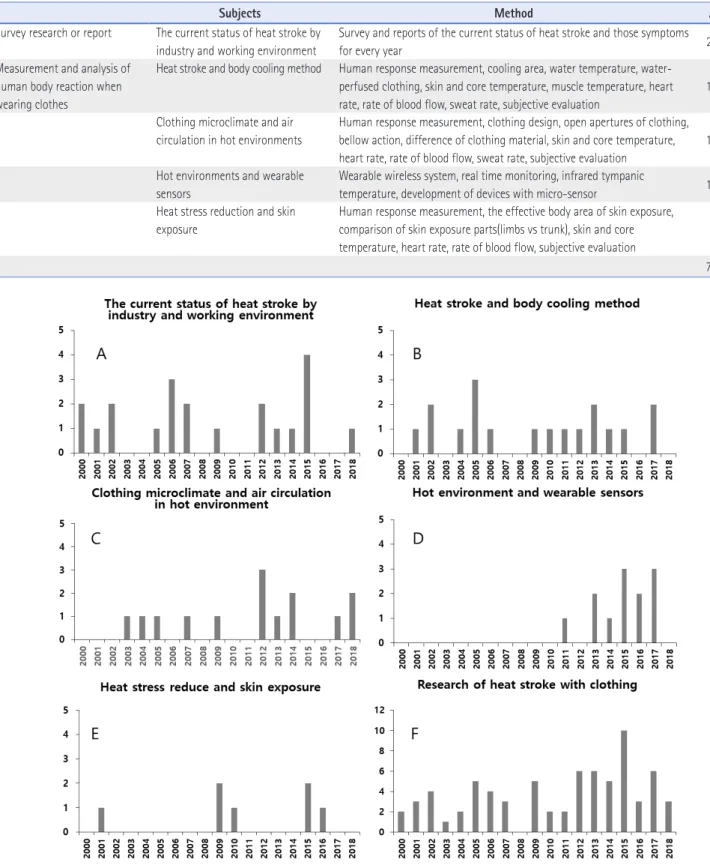
Figure 1. Research trends from 2000 to 2018 (A: The current status of heat stroke by industry and working environment, B: Heat stroke and body cooling method, C:
Clothing microclimate and air circulation in hot environments, D: Hot environments and wearable sensors, E: Heat stress reduction and skin exposure, F: Research of
heat stroke with clothing).
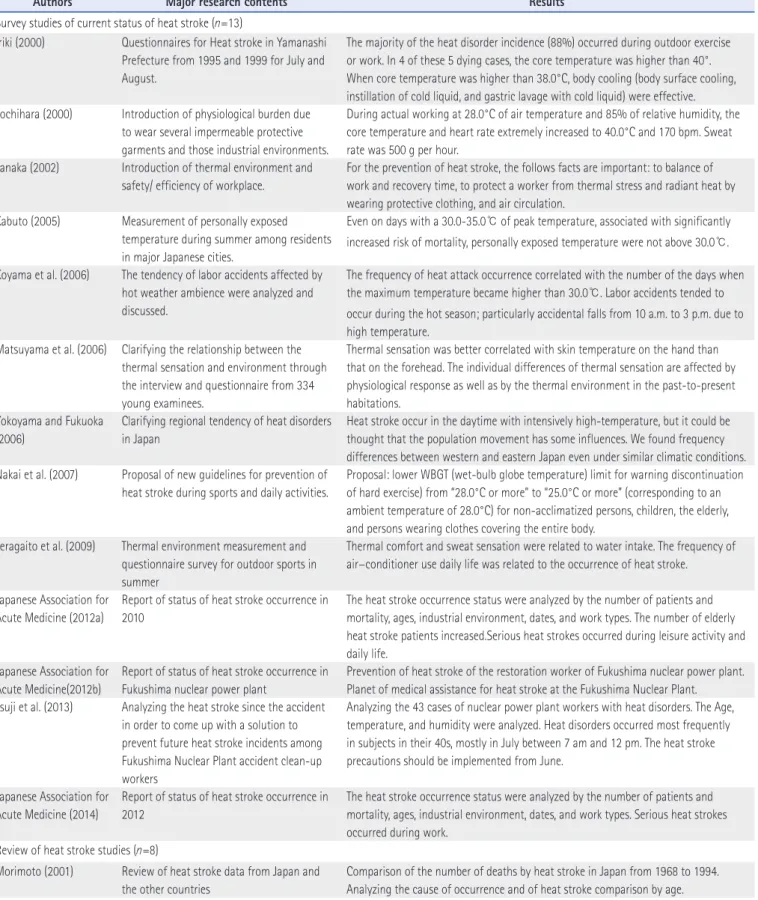
Table 2. Summary of 21 Previous Research Related to the Current Status of Heat Stroke by Industry and Working.
Authors Major research contents Results
Survey studies of current status of heat stroke (n=13)
Iriki (2000) Questionnaires for Heat stroke in Yamanashi Prefecture from 1995 and 1999 for July and August.
The majority of the heat disorder incidence (88%) occurred during outdoor exercise or work. In 4 of these 5 dying cases, the core temperature was higher than 40°.
When core temperature was higher than 38.0°C, body cooling (body surface cooling, instillation of cold liquid, and gastric lavage with cold liquid) were effective.
Tochihara (2000) Introduction of physiological burden due to wear several impermeable protective garments and those industrial environments.
During actual working at 28.0°C of air temperature and 85% of relative humidity, the core temperature and heart rate extremely increased to 40.0°C and 170 bpm. Sweat rate was 500 g per hour.
Tanaka (2002) Introduction of thermal environment and safety/ efficiency of workplace.
For the prevention of heat stroke, the follows facts are important: to balance of work and recovery time, to protect a worker from thermal stress and radiant heat by wearing protective clothing, and air circulation.
Kabuto (2005) Measurement of personally exposed temperature during summer among residents in major Japanese cities.
Even on days with a 30.0-35.0 ℃ of peak temperature, associated with significantly increased risk of mortality, personally exposed temperature were not above 30.0 ℃ .
Koyama et al. (2006) The tendency of labor accidents affected by hot weather ambience were analyzed and discussed.
The frequency of heat attack occurrence correlated with the number of the days when the maximum temperature became higher than 30.0 ℃ . Labor accidents tended to occur during the hot season; particularly accidental falls from 10 a.m. to 3 p.m. due to high temperature.
Matsuyama et al. (2006) Clarifying the relationship between the thermal sensation and environment through the interview and questionnaire from 334 young examinees.
Thermal sensation was better correlated with skin temperature on the hand than that on the forehead. The individual differences of thermal sensation are affected by physiological response as well as by the thermal environment in the past-to-present habitations.
Yokoyama and Fukuoka (2006)
Clarifying regional tendency of heat disorders in Japan
Heat stroke occur in the daytime with intensively high-temperature, but it could be thought that the population movement has some influences. We found frequency differences between western and eastern Japan even under similar climatic conditions.
Nakai et al. (2007) Proposal of new guidelines for prevention of heat stroke during sports and daily activities.
Proposal: lower WBGT (wet-bulb globe temperature) limit for warning discontinuation of hard exercise) from “28.0°C or more” to “25.0°C or more” (corresponding to an ambient temperature of 28.0°C) for non-acclimatized persons, children, the elderly, and persons wearing clothes covering the entire body.
Teragaito et al. (2009) Thermal environment measurement and questionnaire survey for outdoor sports in summer
Thermal comfort and sweat sensation were related to water intake. The frequency of air−conditioner use daily life was related to the occurrence of heat stroke.
Japanese Association for Acute Medicine (2012a)
Report of status of heat stroke occurrence in 2010
The heat stroke occurrence status were analyzed by the number of patients and mortality, ages, industrial environment, dates, and work types. The number of elderly heat stroke patients increased.Serious heat strokes occurred during leisure activity and daily life.
Japanese Association for Acute Medicine(2012b)
Report of status of heat stroke occurrence in Fukushima nuclear power plant
Prevention of heat stroke of the restoration worker of Fukushima nuclear power plant.
Planet of medical assistance for heat stroke at the Fukushima Nuclear Plant.
Tsuji et al. (2013) Analyzing the heat stroke since the accident in order to come up with a solution to prevent future heat stroke incidents among Fukushima Nuclear Plant accident clean-up workers
Analyzing the 43 cases of nuclear power plant workers with heat disorders. The Age, temperature, and humidity were analyzed. Heat disorders occurred most frequently in subjects in their 40s, mostly in July between 7 am and 12 pm. The heat stroke precautions should be implemented from June.
Japanese Association for Acute Medicine (2014)
Report of status of heat stroke occurrence in 2012
The heat stroke occurrence status were analyzed by the number of patients and mortality, ages, industrial environment, dates, and work types. Serious heat strokes occurred during work.
Review of heat stroke studies ( n=8)
Morimoto (2001) Review of heat stroke data from Japan and the other countries
Comparison of the number of deaths by heat stroke in Japan from 1968 to 1994.
Analyzing the cause of occurrence and of heat stroke comparison by age.
과 같이 분류하였다. 의복을 활용한 열중증 예방 대책에 관한 연 구를 주제별로 분류한 결과, 업종별 열중증 발생 현황과 작업 환 경과 관련한 연구 사례가 29.2%로 가장 큰 비중을 차지하였고, 다음으로 열중증과 신체 냉각법 (25.0%), 서열 환경에서의 의복 내 기후와 공기순환 (19.4%), 서열 환경과 Wearable sensor의 사 용(16.7%), 서열 스트레스 경감과 피부 노출 (9.7%)의 순이었다.
의복을 활용한 열중증 예방 대책에 관한 연구는 2000년부터 매해 평균 3.8건이 발표되고 있었으며, 점차적으로 발표 사례가 증가하는 추세이며, 연도별 연구 발표 현황과 각 주제들의 연도 별 연구 발표 현황은 Figure 1에 표시하였다. 흥미로운 점은 서열 환경과 Wearable sensor의 사용에 관련한 연구 발표의 추이인데 (Figure 1의 D), 모든 사례가 2010년 이후 발표되었으며 의복 자 체의 개발보다는 의복에 부착하는 장치의 다양성과 소형화에 집 중하고 있었다.
업종별 열중증 발생 현황과 작업 환경
의복을 활용한 열중증 예방 대책에 관한 연구의 29.2 %가 업 종별 열중증 발생 현황과 작업 환경과 관련한 연구였으며, 총 21 건의 연구 사례를 수집하였다. Table 2에 주요 연구 내용과 결과 를 요약 및 정리하였다. 일본 내의 열중증 발생 현황과 열중증 발 생 시의 작업 환경에 대한 조사 연구와 열중증의 메카니즘과 발생 시의 대응 방법 등에 대한 해설 연구들이 수집되었다.
열중증 발생현황에 대하여 일본 구급학회나 후생노동성에서는 매해 업종별 열중증 사망 또는 질환자 수, 연령별 사망 또는 질환 자 수, 열중증 발생 시의 기상 데이터 등을 조사한 보고서를 각 년 도마다 보고하고 있지만, 발생 당시의 의복 착용 상태나 착용한
의복에 대한 자세한 기록은 찾아볼 수 없었다. 그러나 업종별 열 중증 발생현황을 분석한 결과, 의복 착용이 열중증 발생에 중요 한 요인이 되는 것을 알 수 있었다. 열중증으로 인해 병원으로 긴 급 후송된 1,781명의 환자 중 30% 이상이 노동 및 작업 중에 열 중증이 발생하였고, 그 중 44%가 건설업 종사자 인 것이 보고되 었다(Japanese Association for Acute Medicine, 2012a). 또한, Tokizawa (2017)에 따르면 열중증에 따른 업종 별 사망 및 발생 환자는 건설업에서 가장 많이 발생하였고, 다음이 제조업, 운수 업의 순이었다. 폭염일수가 적었던 2009년과 폭염일수가 많았던 2010년을 비교했을 때, 외부기온의 높고 낮음에 관계없이 열중증
Figure 2. Percentage of fatalities and patients due to heat stroke by industry in 2009 and 2010 (Tokizawa 2017).
Table 2. Continued
Authors Major research contents Results
Osada (2002) Investigation of an effect of relationship between temperature and humidity
Introduction of foreign research about environmental factors such as temperature and humidity and the occurrence of heat stroke.
Hori (2007) Examine the physiological responses of exercise in high temperature
Review of thermal factor: comparison of Asians’ metabolic rate, heat acclimatization, correlation among ambient temperature, exercise intensity, and effective clothing insulation.
Yoshida (2015) Review of studies on the prevention of fever in Japan
The several studies on the prevention and guide line of heat stroke, and evaluation of thermal stress in Japan are introduced.
Nakai (2015a) Introduction of heat stroke status and prevention
Describing of the environmental condition of heat stroke occurrence in Japan, and precaution in daily life
Nakai (2015b) Introduction of heat stroke status in Japan Describing of the environmental condition of heat stroke occurrence in Japan, and heat stroke precautions for the elderly
Matsumoto (2015) Introduction of mechanism of heat stroke. Introduction of 3 stages of heat stroke through diagnosis cases.
Horie (2018) Introduction of mechanism of heat stroke Introduction of classification of heat stroke, thermal mechanism such as body
temperature and sweating for heat stroke prevention.
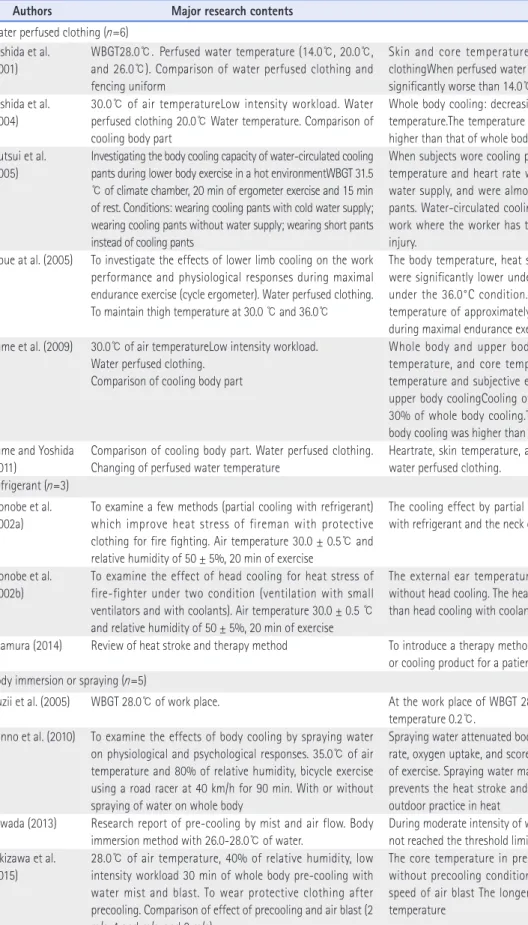
Authors Major research contents Results Water perfused clothing (n=6)
Yoshida et al.
(2001)
WBGT28.0 ℃. Perfused water temperature (14.0 ℃ , 20.0 ℃ , and 26.0 ℃ ). Comparison of water perfused clothing and fencing uniform
Skin and core temperature decreased due to wear water perfused clothingWhen perfused water was 26.0 ℃ , the physiological responses were significantly worse than 14.0 ℃ and 20.0 ℃
Yoshida et al.
(2004)
30.0 ℃ of air temperatureLow intensity workload. Water perfused clothing 20.0 ℃ Water temperature. Comparison of cooling body part
Whole body cooling: decreasing of heart rate, skin temperature and core temperature.The temperature of thigh muscles of upper body cooling was higher than that of whole body cooling
Tsutsui et al.
(2005)
Investigating the body cooling capacity of water-circulated cooling pants during lower body exercise in a hot environmentWBGT 31.5
℃ of climate chamber, 20 min of ergometer exercise and 15 min of rest. Conditions: wearing cooling pants with cold water supply;
wearing cooling pants without water supply; wearing short pants instead of cooling pants
When subjects wore cooling pants were supplied with cold water, the core temperature and heart rate were lower compared to conditions without water supply, and were almost the same as the condition wearing short pants. Water-circulated cooling pants should effectively cool the body at work where the worker has to wear pants that cover his legs to prevent injury.
Inoue at al. (2005) To investigate the effects of lower limb cooling on the work performance and physiological responses during maximal endurance exercise (cycle ergometer). Water perfused clothing.
To maintain thigh temperature at 30.0 ℃ and 36.0 ℃
The body temperature, heat storage, heart rate, and the total sweat loss were significantly lower under the 32.0 °C condition compared to those under the 36.0°C condition. Cooling the lower limbs to reach a thigh temperature of approximately 32.0°C can reduce the physiological strain during maximal endurance exercise.
Kume et al. (2009) 30.0 ℃ of air temperatureLow intensity workload.
Water perfused clothing.
Comparison of cooling body part
Whole body and upper body cooling: decreasing of heart rate, skin temperature, and core temperature,No significant differences of skin temperature and subjective evaluation between whole body cooling and upper body coolingCooling of the head and neck has a cooling effect of 30% of whole body cooling.The temperature of thigh muscles of Upper body cooling was higher than whole body cooling
Kume and Yoshida (2011)
Comparison of cooling body part. Water perfused clothing.
Changing of perfused water temperature
Heartrate, skin temperature, and core temperature decreased due to wear water perfused clothing.
Refrigerant (n =3) Monobe et al.
(2002a)
To examine a few methods (partial cooling with refrigerant) which improve heat stress of fireman with protective clothing for fire fighting. Air temperature 30.0 ± 0.5 ℃ and relative humidity of 50 ± 5%, 20 min of exercise
The cooling effect by partial cooling with refrigerant at armpit and back with refrigerant and the neck opening were not admitted
Monobe et al.
(2002b)
To examine the effect of head cooling for heat stress of fire-fighter under two condition (ventilation with small ventilators and with coolants). Air temperature 30.0 ± 0.5 ℃ and relative humidity of 50 ± 5%, 20 min of exercise
The external ear temperature with head cooling was lower than that without head cooling. The head cooling with small ventilator is more useful than head cooling with coolant.
Osamura (2014) Review of heat stroke and therapy method To introduce a therapy method such as body immersion, and using ice pad or cooling product for a patient of heat stroke
Body immersion or spraying (n=5)
Huzii et al. (2005) WBGT 28.0 ℃ of work place. At the work place of WBGT 28.0 ℃ , using water immersion decreased core temperature 0.2 ℃ .
Konno et al. (2010) To examine the effects of body cooling by spraying water on physiological and psychological responses. 35.0 ℃ of air temperature and 80% of relative humidity, bicycle exercise using a road racer at 40 km/h for 90 min. With or without spraying of water on whole body
Spraying water attenuated body temperature elevation and decreased heart rate, oxygen uptake, and score of thermal sensation during the last 30 min of exercise. Spraying water may be a beneficial way of body cooling, which prevents the heat stroke and maintains the exercise performance during outdoor practice in heat
Sawada (2013) Research report of pre-cooling by mist and air flow. Body immersion method with 26.0-28.0 ℃ of water.
During moderate intensity of work, the core temperature of participants has not reached the threshold limit, through pre-cooling of body immersion.
Tokizawa et al.
(2015)
28.0 ℃ of air temperature, 40% of relative humidity, low intensity workload 30 min of whole body pre-cooling with water mist and blast. To wear protective clothing after precooling. Comparison of effect of precooling and air blast (2 m/s, 4 and m/s, and 8 m/s)
The core temperature in precooling condition was lower than those in without precooling condition (0.4 ℃ ). No significant differences among speed of air blast The longer exposure time of air blast made low core temperature
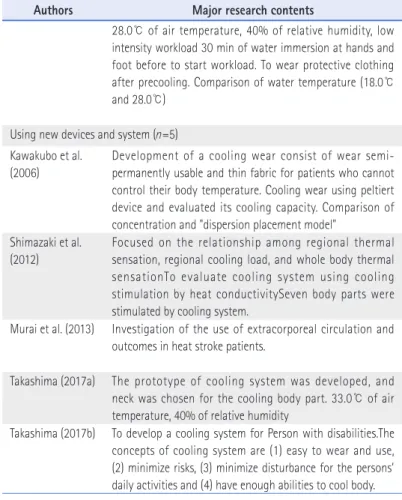
Table 3. Summary of 18 Previous Research Related to Body Cooling Method
의 리스크가 높은 업종은 건설업, 제조업, 운수업으로 정해져 있 는 것을 알 수 있었다(Figure 2). 국내 역시 일본과 유사한 경향을 보였는데(Korea Centers for Disease Control and Prevention, 2018), 2017년의 열중증 발생 환자 1,574명 중 55%가 작업장이 나 논밭을 열중증 발생 장소로 신고하였고, 이는 노동이나 작업 중 열중증이 발생한 것을 시사한다. 업종별 현황에서 가장 많은 열중증 발생자 비율은 기능원 및 관련 기능 종사자였으며, 장치 기계 조작 및 조립종사자 역시 높은 순위였으나, 업종 분류가 일 본과 상이하였으므로 통계 자료의 직접 비교는 불가능하였다. 일 본의 선행 연구에서 상위에 랭크된 건설업, 제조업, 운수업은 서 열 환경에도 불구하고 지정된 의복과 개인 보호구만을 착용한 채 로 작업을 수행하여야 하므로, 작업환경 변동에 따른 열중증을 예 방하기 위한 의복의 개선 및 보호구의 추가적인 고안이 요구된다.
따라서, 작업환경의 변동에 따른 열중증 예방을 위해 사용하는 WBGT지수에 대한 보정도 필요하다. 열중증을 예방하기 위해 제 안된 지표인 WBGT는 자연 습구온도(tnw), 흑구온도(tg), 기온(ta) 을 측정하여 아래와 같이 그 수치를 계산하며, 기류의 유무, 서열
순화의 정도, 작업강도 등에 따라 서열 허용기준치를 나타낸다.
WBGT=0.7tnw+0.2tg+0.1ta(실내) WBGT=0.7tnw+0.2tg(실외)
이 허용기준치는 통기성이 있고 수분 증발을 할 수 있는 0.6clo의 작업복을 입은 상태에서의 심부체온인 직장온 38℃ 도 달을 허용한계로 하는데, 작업 현장에서의 의복 착용의 다양성을 고려하지 않은 수치이므로 의복의 디자인, 소재, 통기성 등을 고 려하여 보정치를 더하는 것이 열중증을 예방할 수 있는 대책이 될 것이다 (Sawada, 2011). 긴팔 상의와 긴 바지의 일반적인 작업복 과 직물로 이루어진 일체형 작업복 착용의 경우에는 WBGT지수 를 그대로 사용할 수 있지만, Spunbond-Meltblown-Spunbond 폴리프로필렌 소재의 일체형 작업복은 0.5℃, 폴리프로필렌 소재 의 일체형 작업복은 1.0℃, 두 겹으로 된 일체형 작업복은 3.0℃, 특정 용도로 사용하는 밀폐성 일체형 작업복은 11.0℃가 보정치 이므로 계산한 WBGT수치에서 더한 뒤 열중증을 판단해야 한다
Authors Major research contents Results
28.0 ℃ of air temperature, 40% of relative humidity, low intensity workload 30 min of water immersion at hands and foot before to start workload. To wear protective clothing after precooling. Comparison of water temperature (18.0 ℃ and 28.0 ℃ )
The core temperature with precooling was significantly lower was not with precooling was lower than no precooling (0.3 ℃ )No significant core temperature difference by different water temperature. Body weight loss and heart rate with low water temperature (18.0 ℃ ) were significantly lower than 28.0 ℃. Thermal comfort with 18.0 ℃ of water temperature evaluated better than 28.0 ℃
Using new devices and system (n=5) Kawakubo et al.
(2006)
Development of a cooling wear consist of wear semi- permanently usable and thin fabric for patients who cannot control their body temperature. Cooling wear using peltiert device and evaluated its cooling capacity. Comparison of concentration and "dispersion placement model"
Concentration placement model of cooling wear was heavier and thicker than Dispersion placement model
Shimazaki et al.
(2012)
Focused on the relationship among regional thermal sensation, regional cooling load, and whole body thermal sensationTo evaluate cooling system using cooling stimulation by heat conductivitySeven body parts were stimulated by cooling system.
To evaluate cooling system using cooling stimulation by heat conductivitySeven body parts were stimulated by the cooling system.
Cooling sensitivity varied at different body region, regional thermal sensation could be predicted by regional cooling load, and high in thermal sensitivity region effected whole body thermal sensation.
Murai et al. (2013) Investigation of the use of extracorporeal circulation and outcomes in heat stroke patients.
The improvement of cooling efficiency was achieved by devising new circuits, devices, and system. The methods of core temperature cooling underwent extracorporeal circulation were clinically useful.
Takashima (2017a) The prototype of cooling system was developed, and neck was chosen for the cooling body part. 33.0 ℃ of air temperature, 40% of relative humidity
Reduction of sweating were observed, and the average skin temperatures and the core temperature of the head with cooling increased more slowly than those without cooling
Takashima (2017b) To develop a cooling system for Person with disabilities.The concepts of cooling system are (1) easy to wear and use, (2) minimize risks, (3) minimize disturbance for the persons’
daily activities and (4) have enough abilities to cool body.
One is “back-support type,” and another is “neck cooling type.” Both of them proved that they have the ability to cool a body and to reduce a mount of sweating of healthy abled-person in a hot environment.
Table 3. Continued
(Sawada, 2011). Sawada (2011)가 제안한 위의 의복 보정치는 일본 후생 노동성의 열중증 예방 매뉴얼에 참고 수치로 기재되어 배포되고 있다. 국내에서는 한국산업안전보건공단의 고열작업환 경 관리지침(Korea Occupational Safety and Health Agency, 2017)에 고온 작업 시의 의복 보정치가 규정되어 있는데, 여름작 업복은 0℃, 상하가 붙은 작업복은 2.0℃, 겨울 작업복은 4.0℃, 방수복은 6.0℃를 WBGT에서 더하도록 기재되어 있어, 일본에서 제안하는 보정치와는 상이한 것을 알 수 있었다.
고열의 작업 현장은 계절별, 업종별로 다양하며, 각 현장에서 착용되고 있는 작업복의 종류는 더욱 다양할 것으로 추정되는데, 이를 일본과 한국에서 언급된 의복별 보정치로 더위지수를 평가 하기에는 부족함이 따를 것이다. 더욱이 이 의복 보정치는 여러 겹의 의복을 겹쳐 입는 경우에는 보정치를 모두 더해서 사용할 수 없으므로, 이와 같은 변수를 고려한 의복 보온성에 관련한 연구와 WBGT 데이터의 보충으로 더욱 정밀한 보정치를 제안할 수 있는 후속 연구가 필요할 것으로 사료된다.
열중증과 신체 냉각법
여름의 스포츠 현장이나 실외 작업장, 건설 현장 등지에서 발 생하는 작업 중의 열중증을 미연에 방지하기 위해서 신체를 침수 하여 고체온이 되는 것을 저지하는 냉각법을 사용할 수 있는데, 운동이나 강도 높은 작업 중에 연속적으로 냉각법을 지속하게 되 면 심부온의 상승이나 운동 능력의 저하 방지에 효과가 있다. 열 중증과 의복에 관련한 연구의 조사 사례 중 18건 (25.0%)가 신 체 냉각법을 이용하였음이 분석되었다(Table 3). 수집된 신체 냉 각법에 관련한 연구들은 작업 전에 냉수욕이나 스프레이를 이용 하여 전신이나 손과 발을 냉각하는 침수법(6건), 직접적인 냉각을 대신하여 유체 순환 튜브를 삽입한 의복의 착용(5건)과 전류나 전
자 시스템 등을 이용한 냉각법(5건), 그 외에 냉각제의 부착(3건) 등으로 분류할 수 있었다. 각 방법을 이용한 연구들은 2000년부 터 2018년에 걸쳐 골고루 분포되어 있지만, 최근에 들어서는 유 체 순환 방식 의복과 냉각제 부착에 관한 연구의 발표는 줄고, 전 류나 전자 시스템 등을 이용한 냉각법이 증가하고 있는 추세이다 (Figure 3).
냉수욕이나 스프레이를 이용하여 전신을 냉각하는 직접 침수 법은 여름의 스포츠 현장이나 실외 작업장, 건설 현장, 농촌 등 지에서 발생하는 작업 중의 열중증을 미연에 방지하기 위해서 신체를 냉각해서 고체온이 되는 것을 저지하는 방법 중 하나이 다. 운동 전에 신체 냉각을 통하여 체온을 떨어뜨린 후에(Pre- cooling), 운동이나 강도 높은 작업을 실시한다면 운동 시작 후 의 체온과 심부온의 상승 시점이 늦어지며, 운동 능력이 향상되기 도 한다. Huzii 등(2005)은 WBGT 28℃의 고온 환경에서 직접 침 수법을 이용하는 것으로 심부온을 0.2℃ 저하시키는 것을 증명하 였다. Tokizawa 등(2015) 역시 전신을 스프레이 방식으로 침수 한 수 30분간 송풍을 가한 후에 방호복을 착용한 상태로 실내온 도37℃, 상대습도 40%의 극서 환경을 실현한 실험실에서 가벼운 보행 운동을 실시한 결과, 신체냉각을 실시하지 않은 조건에 비교 하여 심부온이 0.3℃ 정도 떨어진 상태에서 운동을 시작한 것을 보고하였다.
그러나 직접 침수법은 냉각냉수가 들어있는 욕조에 들어가서 전신을 침수시켜야 하므로 설치 장소와 설비 등이 필요하다는 단 점이 있으며, 신체에 대한 위험성도 큰 것으로 평가된다. 또한 냉 각을 위해서는 착의 및 탈의의 과정을 반복해야 하므로, 작업 중 의 지속적인 냉각에는 어려움이 따를 것으로 사료된다. 작업복의 착의 및 탈의 과정을 통하지 않고도 손쉽게 냉각을 할 수 있는 부 위를 꼽는다면 머리 또는 손과 발 부위 등을 들 수 있는데, 손과 발은 용적당 표면적이 크고 동맥과 정맥의 교차인 동정맥문합이 라 불리는 특수한 혈관구조를 가지고 있어 열방산에도 효과적인 부위이다. 이 부위에 냉각을 가하며 혈류량을 증가시키는 냉각 방 법에서 착안한 손과 발의 부분 냉각법은 실제 작업현장에서 작업 복을 착용한 상태에서도 활용이 가능할 것이다.
실내온도 37.0℃, 상대습도 40%인 극서 환경에서의 방호복 착 용 상태에서의 작업을 실시하기 전 30분간 손과 발 부위를 직접 침수하는 것으로 작업 중의 심부온의 상승이 0.4℃ 저하되어 유 의미하게 억제되는 것이 보고되었는데(Tokizawa et al., 2015), 이 때 사용하는 물의 온도가 서열 스트레스 경감의 중요한 요인이 될 것이다. 28℃와 18℃의 수온을 비교하였을 경우, 심부온 변화 의 유의한 차이는 증명되지 않았지만, 저온인 18℃에서는 작업으
Figure 3. The status of research of body cooling method by year.
로 인한 체중 감소량이 신체냉각을 하지 않은 조건에 비해 유의하 게 적었고 심박수의 상승 역시 억제되었으며, 심리적으로도 더욱 안정감과 쾌적감을 느끼는 것으로 보고되었다. 그러므로 가능한 수온을 낮춘, 저온 상태에서의 침수를 이용한 손과 발의 부분 냉 각은 열중증 예방 효과가 크며 작업 현장에서의 활용이 용이할 것 이다. 그러나 일부 작업 현장에서 물을 준비하고 또 저온을 유지 하는 것의 어려움을 배제할 수 없으므로, 물을 대신할 수 있는 아 이스 팩 또는 Estro-Gel을 사용하는 냉각 글로브나 슬리퍼의 착 용을 고려할 수 있다. 이러한 냉각 글로브나 슬리퍼 착용에 관해 서는 아직 인체 반응 측정이나 착용 평가를 통한 정량적이며 객관 적인 연구 결과가 미흡한 상태이므로 추가적인 연구의 필요성이 제기된다.
최근에는 의복에 튜브를 삽입하여 유체를 순환 시켜 체온 상승 을 방지하고 서열 스트레스를 경감시키는 유체 순환 방식 의복 착 용으로 열중증을 예방하고 있으며, 그 효과를 평가하는 연구 발표 가 활발하다. Kawakubo 등(2006)은 자율적인 체온 조절이 불가 능한 환자들을 위한 냉각복의 개발하고 제작된 제품의 착용평가 를 통해 더욱 가볍고 얇은 모델을 제안하였고, Kume & Yoshida (2011)는 유체 순환 방식 의복 착용에 의한 인체 반응을 측정하여 유체 순환 방식 의복 착용이 체온, 특히 피부온과 심박수의 상승 을 억제하고 주관적인 쾌적감을 유지하는 등의 서열 스트레스 경 감 효과를 가지는 것을 증명하였다. 유체 순환 방식 의복의 착용 유무에 의해 서열 스트레스로 인한 생리적 반응의 유의한 차이를 보였다. VO2max의 약 30% 정도의 가벼운 운동 부하 수준의 작 업에서 유체 순환 방식 의복을 착용한다면 피부온의 상승이 억제 되며 운동으로 인한 체중 감소량이 1/3로 줄어드는 것이 보고되었 다(Kume 등, 2009). 또한 가벼운 운동 부하 수준의 작업에는 전 신의 40%에 해당하는 상반신만을 냉각하는 것으로도 전신 냉각과 같은 생리적 반응의 변화 효과를 가지며, 주관적인 온열감에서도 전신과 상반신 냉각의 유의미한 차이가 보이지 않았다. 또한 머리 와 목 부위의 냉각은 전신 냉각의 30%의 효과를 가지지만 서열 스 트레스와 관련한 인체 반응의 변화에는 유의한 차이를 보이지 않
는 것이 보고되었다(Kume et al., 2009). Yoshida 등(2004)은 대 퇴부를 과도하게 냉각을 할 경우 체온의 상승을 막는 효과는 있으 나, 대퇴부 근육의 온도가 저하되어 운동 능력의 저하로 이어질 수 있음을 언급하였으며, 이는 전신 냉각의 단점으로 볼 수 있다.
유체순환방식의복에 관련하여 서열 스트레스 경감 효과에 좋 은 물의 온도 설정에 대해서도 고려해볼 필요가 있다. Yoshida 등 (2001)은 유체 순환 방식 의복 착용 시 순환하는 물의 온도를 변 화시키며 가벼운 수준의 운동 부하인 VO2max의 약 30% 정도의 운동 환경에서 인체 반응을 측정하였는데, 유체 순환 방식 의복을 착용한 경우, 심부온이 유의하게 저하하였으며 체온의 상승은 순 환하는 물의 온도와 비례하는 것을 알 수 있었다. 그러므로 서열 스트레스 경감 효과를 높이기 위해서는 순환하는 물의 온도를 가 능한 저온으로 유지하는 것이 필요할 것이다.
유체 순환 방식 의복 착용에서는 상반신 냉각만으로도 활동 근인 대퇴부 주위의 온도를 높게 유지하면서 평균 피부온과 심 부온의 상승이나 온랭감각의 악화를 억제할 수 있고, 운동 능력 을 유지하면서 서열 스트레스를 경감할 수 있다 그러므로, 유체 순환 방식 의복 착용의 상반신 냉각법은 열중증을 예방에 유효 하며 효율성이 높은 방법이라 사료된다. 이에 일본 우주 항공 연 구개발 기구는 선행연구들을 참고하여 자체적인 상품개발부서 인 JAXAcosmod를 통해 유체순환방식의복을 개발하여 일본 내 에서 판매를 하고 있는데, 가혹한 환경에서도 인체가 대응할 수 있도록 하는 우주복의 기술을 응용해 땀을 단시간에 흡수, 증발 시켜 잔류하는 땀에 의해서 신체가 끈적해 지지 않도록 개발하였 으며 전신타입이 아닌 조끼 타입의 의복이다 (Japan Aerospace Exploration Agency, 2014).
열중증과 신체 냉각법에 관련하여 유체 순환 방식 의복의 착용 과 냉각제를 사용하는 방법, 신체의 냉수욕이나 스프레이를 이용 한 침수법, 그 외 전류나 전자 시스템 등의 방법을 이용한 연구의 예를 찾아볼 수 있었는데, 각각의 방법은 작업 보조효과나 냉각 효 과에서 다른 장단점을 가진 것으로 사료된다(Table 4). 유체 순환 방식 의복은 의복상태로 착용이 가능한 점이나 전신뿐만 아니라
Table 4. Effects of Body Cooling Methods
Methods of body cooling Ergogenic effect Cooling effect
Facility burden Before work load During work load Core temperature Skin temperature
Water perfused clothing + + + + + + + + +
Refrigerant + + + + + + + +
Body immersion and spraying + + + + + + + + + + + + +
Using peltier devices and system + + + + + + +
+ means degree of ergogenic and cooling effect, + : small. + +: middle, + + +: great
Authors Major research contents Results Using Bellow action (n=1)
Satsumoto &
Nakada (2014)
30.0 ℃ of air temperature, 65% of relative humidity, 20 min of running and recovery. To wear sportswear which aim to accelerate bellows action by inserting the coin in back
Coin inserted sportswear condition showed low skin temperature, low heart rate, but there were no significant differences in core temperature
Changing material (n=8)
Shinya et al. (2003) WBGT 28 ℃ , 20 min of low intensity workload Field investigation and laboratory experiment. Comparison of fencing uniform, short sleeves shirt and pants, and semi nude
In both field investigation and laboratory experiment, increases in chest temperature, skin temperature, core temperature, and sweat rate were significantly greater when wearing a fencing uniform than when wearing the others
Shinya et al. (2004) WBGT 28 ℃ , 20 min of low intensity workload. Comparison of several sports uniform (baseball, soccer, and semi-nude)
Due to wear baseball and soccer uniform, increases skin temperature, core temperature, heart rate, and thermal sensation during exercise were significantly higher, sweat rate was significantly greater than soccer uniform
Shimazaki et al.
(2007)
The heat and the moisture transfer coefficients on clothing material, which is one of the major factors which influence the human thermal comfort were measured in various conditions.
The authors find out the effectiveness of the velocity of wind and the thickness of clothing material on the heat and the moisture transfer properties.
Shimazaki (2009) The heat transfer property, the moisture transfer property and the radiative properties were measured in various conditions using our own making experimental apparatus and principles.
The heat transfer coefficient and the moisture transfer coefficient were determined by the fabric and geometric structure. The established evaluation technique for radiative properties (reflectivity, transmissivity, and absorptivity) were successfully measured for cotton material in different colors. The effects of clothing material were totally found out by tracking the energy flow of clothing material.
Minamisawa et al.
(2012)
To measure color properties, thermal and evaporative resistances of six different clothing materials.
Evaporative resistance decreased with increasing porosity of clothing.
Thermal resistance increased with increasing the product of porosity and thickness of clothing.Mean skin temperature in a hot environment was calculated using physical properties of clothing.
Yachi et al. (2012) To evaluate the effect of different clothing materials on mean skin temperature, weight increase of clothing and comfort sensation.Two types of clothing: 100% of cotton T-shirt and trousers, sweat-absorbent and quick-drying T-shirt and trousers
A significant difference on weight increase of clothing observed in the clothing conditions was found.No difference in the mean skin temperature and comfort sensation of subjects who wore two types of clothing.
Satsumoto et al., (2013)
Hot environment. Comparison of Kendo uniform consist of different material (cotton 100% vs polyester 95% and cotton 5%)
Kendo uniform consist of polyester and cotton had significantly lower value of the clothing microclimate, skin temperature, core temperature, and heart rate than 100% cotton uniform
Tsuji et al. (2014) WBGT 28.7 ℃ by radiant heat and wind, Comparison of workload intensity: 20 min of low intensity and 20 min of moderate intensity. Comparison of white sports-wear consisting of a long-sleeved shirt (45% cotton and 55%
polyester) and short pants (100% polyester), and swimming pants
Skin temperature was greater when subjects wore swimming pants than white sportswear under both the workload. During the moderate workload, the rating of perceived exertion and thermal sensation, and the increases in core temperature, sweat rate, and heart rate were significantly higher in the sports wear than swimming pants at the end of the workload
Using air-conditioned clothing (n=5) Sawada et al.
(2005)
To investigate physiological and psychological relief that is alleviated by wearing air-conditioned clothing when walking outdoor in summer. Outside in summer, WBGT 28.0-30.2 ℃ and 30-43% of relative humidity, moderate intensity of exercise (5 km/h of walking), clothing 0.5-0.6 cloWith and without air-conditioned clothing
Body temperatures and body weight loss were not significantly different between with and without air-conditioned clothing. Skin temperature of waist with air-conditioned clothing was lower than without air- conditioned clothing, however, a significant difference was not shown.
Suzuki et al. (2012) WBGT 27.0 ℃ , 27% of relative humidity, 60 min of farm working To wear air-conditioned clothing consisted of two fan which is located at waist. Comparison of air-conditioned clothing and normal work clothing
When wearing an air-conditioned clothing, the clothing microclimate, skin temperature, core temperature, and heart rate were significantly lower than normal work clothing. The thirsty sensation of normal work clothing was worse than those of air-conditioned clothing
Table 5. Summary of 14 Previous Research Related to Clothing Microclimate and Air Circulation in Hot Environment
부분적으로 사용 가능하므로 작업 전이나 작업 중의 효과가 높다 고 평할 수 있지만 심부온의 상승 억제에는 크게 영향을 미치지 않 는다. 냉각제 사용 역시 작업 전이나 작업 중의 효과는 높지만 냉 각제 사용 정도에 따른 무게의 증가가 문제점으로 지적되며 유체 순환 방식 의복과 마찬가지로 심부온에서는 유의미한 효과가 증명 되지 않았다. 직접 또는 부분 침수법은 심부온과 피부온의 상승 억 제에는 탁월한 효과를 보였지만 설비를 갖추는 것에 부담이 크며 작업 시작 전에 신체 냉각을 마쳐야 하는 단점이 있다. 전류나 전 자 시스템은 경우는 현재 개발의 단계이므로 심부온과 피부온 등 의 인체 반응에 대한 데이터가 부족하며 사용 시의 전력 공급이나 사용 시간 등의 설비적 문제점 역시 고려해야 할 것이다.
서열 환경에서의 의복 내 기후와 공기순환
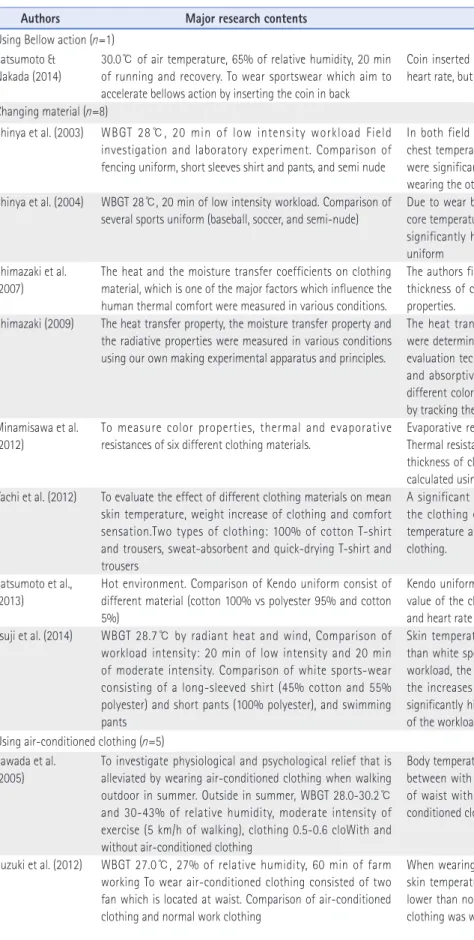
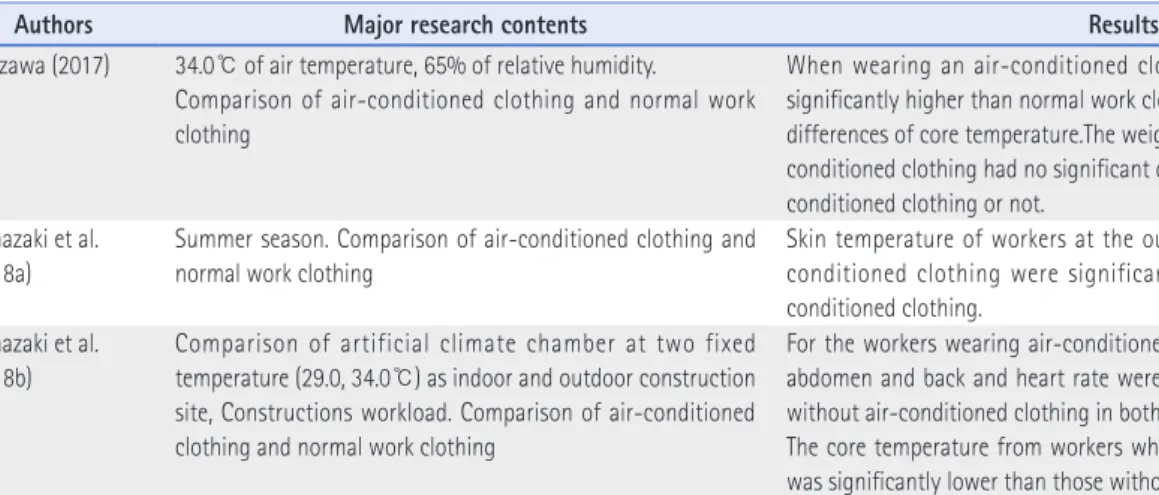
열로 인해 데워진 의복 내 기후는, 상승 기류를 만들어 의복과 인체 사이 공기층을 통해서 옷깃과 소맷부리, 옷단 등의 개구부 에서 밖으로 배출되는데, 의복 면적이 같을 경우에는 의복 내 기 후와 개구부를 통한 공기 순환에 의해 더욱 시원해지는 것이 가 능하다. 의복 내 기후와 공기순환을 주제로 하는 연구는 의복을 활용한 열중증 연구 중 14건(19.4%)을 차지하였고 개구부의 변 형이나 펌핑 효과를 이용한 방열 증가 (Satsumoto & Nakada, 2014), 그리고 통기성이 좋은 소재로의 변형 등의 의복 디자인의 개선에 관한 연구(Minamisawa et al., 2012; Satsumoto et al., 2013; Shimazaki et al., 2009; Shinya et al., 2003; Shinya et al., 2004; Shimazaki et al., 2007; Tsuji et al., 2014; Yachi et al., 2012)와 전동 팬을 부착하여 기류를 생성하는 공기순환복 착용에 관한 연구(Sawada et al., 2005; Suzuki et al., 2012;
Tokizawa et al., 2017; Yamazaki et al., 2018a, b) 등이 이루
어지고 있었다(Table 5). 발표된 사례들은 소재 변형 등을 이용한 디자인 개선에 관한 연구가 반 이상을 차지하였지만 최근에 들어 서 전동 팬을 부착한 공기순환복 착용에 관한 연구 발표가 증가하 고 있는 추세이다(Figure 4).
Satsumoto & Nakada (2014)는 풀무효과(bellow actions)를 증폭시킨 스포츠웨어를 개발하고, 열중증 예방 대책으로서의 효 과를 검증하였다. 운동복 셔츠 뒷부분에 동전을 넣은 주머니를 허 리 높이에 부착하는 것으로 옷의 움직임을 증폭시키고, 이 증폭된 옷의 움직임이 풀무효과를 발생시켜 방열효과를 높일 것이라는 가설로부터 연구가 시작되었다. 서열 환경에서 일반 운동복 셔츠 와 풀무효과를 위해 개선된 운동복 셔츠의 착용 후 운동부하를 가 한 결과, 동전을 넣은 주머니 부착에 의해서 열통과율이 상승했으 며, 의복내 온습도, 심박수, 평균 피부온의 상승이 유의하게 억제
Authors Major research contents Results
Tokizawa (2017) 34.0 ℃ of air temperature, 65% of relative humidity.
Comparison of air-conditioned clothing and normal work clothing
When wearing an air-conditioned clothing, skin temperature were significantly higher than normal work clothing. There were no significant differences of core temperature.The weight loss and sweat rate of an air- conditioned clothing had no significant differences between wearing air- conditioned clothing or not.
Yamazaki et al.
(2018a)
Summer season. Comparison of air-conditioned clothing and normal work clothing
Skin temperature of workers at the outer construction site with air- conditioned clothing were significantly lower those without air- conditioned clothing.
Yamazaki et al.
(2018b)
Comparison of artificial climate chamber at two fixed temperature (29.0, 34.0 ℃ ) as indoor and outdoor construction site, Constructions workload. Comparison of air-conditioned clothing and normal work clothing
For the workers wearing air-conditioned clothing, skin temperature at abdomen and back and heart rate were significantly higher than those without air-conditioned clothing in both air temperature. For the 34.0 ℃ , The core temperature from workers who wear air-conditioned clothing was significantly lower than those without air-conditioned clothing Table 5. Continued
Figure 4. The status of research of clothing microclimate and air circulation in
hot environment by year.
되었다. 그러나 심부온과 주관적 감각에서는 유의한 차이가 보이 지 않았으므로, 열중증 예방대책으로 활용하기 위한 소재나 디자 인 개선의 필요성이 시사되었다.
의복 내 기후의 공기순환은 직물의 통기성과도 관련이 있으며 (Shinya et al., 2003; Shinya et al., 2004), 통기성이 좋은 소재 의 이용은 열중증을 예방할 수 있는 대책이 될 수 있다. 의복 면 적의 감소는 사회적 제약이 있으므로 어느 정도 이상의 피부 노출 이 허용되지 않는 경우에는 통기성이 좋은 소재를 사용하는 것으 로 의복 면적 당 열방산을 증가시킬 수 있다. 열전도와 흡수 면에 서는 면이 좋은 평가를 받지만 땀의 증발이나 통기성 면에서는 폴
리에스테르가 이상적이다 (Yoshida, 2015). 스포츠 종목 중 검도 에서 사용하는 검도복과 방호도구는 수분을 흡수 및 건조시키기 어려운 소재로 되어 있어 착용자의 서열 스트레스를 높이는 것으 로 알려져 있는데, Satsumoto 등(2013)은 이 검도복의 소재를 변 형하여 열중증을 예방하도록 하였다. 폴리에스테르 95%와 면 5%
로 이루어진 통기성을 향상시킨 의 검도복과 면 100%의 일반 검 도복의 서열 환경 착용평가를 한 결과, 폴리에스테르와 면 혼방 의 개선된 검도복은 피부온, 심부온, 의복내 온습도, 발한량 등에 서 낮은 수치를 보였으며, 피부온과 심부온은 0.2℃ 씩 상승하여 면 100%의 검도복 착용에 비하여 유의하게 낮아 열중증 예방 대
Table 6. Summary of 12 Previous Research Related to Hot Environment and Wearable Sensors
Authors Major research contents Results
Development and evaluation of wearable sensor for monitoring of thermal stress (n =8) Takahashi et al.
(2011)
Using a real-time remote biological information monitoring device for workers wearing protective clothingInfrared tympanic temperature
To evaluate real-time remote biological information monitoring device The infrared tympanic temperature measured by developed device has similar result with core temperature
Satsumoto et al., (2013)
Hot environment. Comparison of Kendo uniform Using a wireless body area network system for measuring microclimate, skin temperature, heart rate.
Succeed for collecting physiological When wearing a Kendo uniform consist of polyester and cotton, the clothing microclimate, skin temperature, core temperature, and heart rate were significantly lower than a 100% cotton uniform
Maenaka (2014) To describes a human activity monitoring system including various micro-electro-mechanical sensors
It was described that background of the work, current status, requests to the devices and example devices will be shown as well as the example data for activity monitoring.The future demands for the monitoring system were discussed.
Hamatani et al.
(2015)
Using wearable sensor for measuring heart rate and skin temperature.
To suggest a method to estimate core temperature based on a thermal model
Data from 7 participants revealed that the proposed method can achieve 0.23 ℃ error in core temperature estimation for 60 min.
Estimation of core temperature evaluated by data of 52 hours Takei et al. (2015) Development of flexible humidity sensor which response 10 times
faster than commercial complementary metal–oxide–semiconductor humidity sensor,The sensor was based on Ionic-Gel-coated fabric.
Ionic-Gel-coated fabric has a wide surface area and high gas permeability so that gases can be easily absorbed and detached.
This sensor has many applications such as flu-mask-type human breath sensor, wearable sweat monitoring sensor
Itao et al. (2016) Wearable body temperature control equipmentWater cooling tube for heating and cooling
Developed device control neck temperature from 20 ℃ to 40 ℃
Nakajima and Tsuchiya (2017)
Fabrication of nanosheets based solid state pH sensor for bio- metal–
oxide–semiconductor application
To validate the pH sensor for bio- metal–oxide–semiconductor application with nanosheets under development
Kato et al. (2017) To test a tolerance of capacitive wearable chest-belt electrocardiograph for the electrostatic and movement artifacts. Three types of the electrode having different shielding configurations were tested.
The best tolerance of doubly-shielded five-layered electrode.
The best performed five-layered electrode was used for exercise tolerance test.
Review of wearable sensor (n=4)
Sugimoto (2013) Review of wearable sensor for collecting a biometrics data Using a wireless body area network (WBAN) system:
electrocardiogram, accelerometer, thermometer, pulse-oximeter Itao (2015) Review of wearable sensor for elderly Review of wearable sensor for monitoring of health condition Taniguchi (2016) Review of wearable sensor, earable and boneable Review of wearable computer system. Shape of wearable
sensorThe present condition of earable and boneable sensor Tokizawa (2017) To suggest that using an wearable sensor for monitoring heat stress
of workers
To introduce a new technology of sweat analysis from Gao et al.
(2016)
책으로서의 사용 가능성이 높았다. 이는 서열 환경에서 통기성이 좋은 소재의 의복을 착용하는 경우(Tsuji et al., 2013) 작업이나 운동 부하에 따른 인체 반응의 변화가 적고 이는 서열 스트레스가 경감하는 것을 시사한다.
일본에서 유통되고 있는 열중증 대책 상품은 보냉제를 체간부 나 경부에 덧대는 형식이 많았지만 최근에는 공기순환복의 판매 가 늘고 있다. 공기순환복이란, 피부와 의복 사이의 공간에 의복 에 부착된 팬(fan)를 통해 외부공기를 투입하여 의복 내에 기류 를 생성하고 피부로부터의 기화열과 의복 내 기후의 습도를 저하 시켜 서열 환경으로부터의 영향을 최소화시키는 것을 목적으로 하는 냉각복의 한 종류이며, 건설업이나 제조업 분야에서는 작업
복의 상의만 교체하는 것으로 비교적 도입이 쉬운 제품으로 알려 져 있다. Suzuki 등(2012)은 공기순환복 착용이 서열 환경에서의 농작업 시 인체에 미치는 영향에 관해 연구 사례를 발표하였다.
WBGT 27℃의 서열 환경에서 착용한 결과, 공기순환복을 착용함 으로 인해 의복내 온습도, 심박수, 피부온 등의 상승의 억제 효과 가 증명되었고, 심리적으로 갈증감(thirsty sensation)을 해소하 는 효과가 있었다. 건설현장의 근로자를 대상으로 공기순환복 착 용유무에 따른 인체 반응 변화가 측정되었는데(Yamazaki et al., 2018a), 29.0℃의 고온 환경에서의 공기순환복 착용으로 인해 복 부와 등의 피부온은 유의미하게 낮아졌으나, 전완부의 피부온은 더욱 높은 결과가 보고되었다. 착용한 공기순환복의 쿨링팬이 위