†Corresponding Author: Division of Electrical and Electronics Engineering, Korea Maritime and Ocean University, 727 Taejong-ro, Yeongdo-gu, Busan 606-791, Korea, E-mail: [email protected], Tel: 051-410-4412
1 Department of Electrical & Electronics Engineering, Korea Maritime and Ocean University, E-mail: [email protected], Tel: 051-410-4822
2 Department of Electrical & Electronics Engineering, Korea Maritime and Ocean University, E-mail: [email protected], Tel: 051-410-4822
3 Division of Marine System Engineering, Korea Maritime and Ocean University, E-mail: [email protected], Tel:
051-410-4831
4 Division of Electrical & Electronics Engineering, Korea Maritime and Ocean University, E-mail: [email protected], Tel: 051-410-4821
Relative azimuth estimation algorithm using rotational displacement
Jung-ha Kim1․ Hyun-jun Kim2․ Jong-su Kim3․ Sung-geun Lee4․ Dong-hoan Seo† (Received January 2, 2014; Revised January 21, 2014;Accepted February 10, 2014)
Abstract: Recently, indoor localization systems based on wireless sensor networks have received a great deal of attention because they help achieve high accuracy in position determination by using various algorithms. In order to minimize the error in the estimated azimuth that can occur owing to sensor drift and recursive calcu- lation in these algorithms, we propose a novel relative azimuth estimation algorithm. The advantages of the proposed technique in an indoor environment are that an improved weight average filter is used to effectively reduce impulse noise from the raw data acquired from nodes with inherent errors and a rotational displace- ment algorithm is applied to obtain a precise relative azimuth without using additional sensors, which can be affected by electromagnetic noise. Results from simulations show that the proposed filter reduces the impulse noise, and the acquired estimation error does not accumulate with time by using proposed algorithm.
Keywords: Indoor Localization system, Sensor network, Azimuth, Weight average filter
1. Introduction
Real time location systems(RTLSs) using a wire- less communication technology, which provides useful information to users by recognizing the position of objects, have been widely applied in various areas such as medical, logistical, and industrial areas [1]-[6]. Recently, an indoor navigation system based on a RTLS has been introduced that can guide a user to a desired destination in a complicated indoor envi- ronment when the global positioning system (GPS) is not available [7]-[9]. If this system provides azimuth information as well as location information to users, they can easily be aware of their location and a spe- cific direction to proceed to without any problem.
Basically, these systems are required to provide pre- cise position and azimuth information; thus, they must be robust to radio transmission irregularities and minimize the estimation error that occurs from sensor noise and magnetic disturbances. Therefore, several azimuth acquisition methods have been studied be- cause the azimuth information is essential for indoor navigation systems.
Lee et al. [10] proposed an indoor tracking model that employs a digital magnetic compass(DMC) to de- termine the orientation of a target in real-time and an accuracy refinement algorithm that removes noise in RSSI signals before they are used for distance and location estimation. Another approach involves the
use of a filter, which can efficiently reduce the drift error of inertial sensors, and produces a possible sol- ution without magnetic sensor has been proposed[11].
However, in order to achieve higher tracking accu- racy, a magnetic sensor is necessary. Thus, Zhang et al. [12] presented a method to appropriately solve and handle the magnetic sensor data that adds a func- tion for detecting and minimizing the magnetic field disturbance to the complementary separate-bias Kalman filter. More recently, they proposed a method that utilizes acceleration, angular rate, and magnetic field sensors to provide a long-term stable orientation solution by suggesting the use of a modified Kalman filter [13]. However, the error accumulates with time because the system is calculated recursively. Many of these systems use a wireless sensor network with sev- eral sensors for localization data acquisition plus a specific algorithm with a filter for additional error compensation owing to sensor drift. Because this magnetic sensor is sensitive to electromagnetic noise attributed to a variety of electronic devices, power lines, etc. that can deteriorate its accuracy, it is diffi- cult to obtain satisfactory output azimuth information.
To solve this problem, the acquisition of azimuth in- formation that is robust and stable against electro- magnetic interference is required for the indoor navi- gation system.
This paper presents a novel algorithm for relative azimuth estimation by considering the rotational dis- placement of a mobile node without any magnetic sensors that are affected by electromagnetic noise in an indoor space. The proposed algorithm based on an environment in which a mobile node draws circular arcs with arbitrary radius predicts the central point via the starting and ending points of the arc on the basis of the coordinate data of the mobile node ob- tained by the fixed nodes. In addition, the proposed algorithm estimates the relative azimuth by acquiring the rotation angle from these three points. In addition, we propose an improved weight average filter in or-
der to effectively reduce errors in the rotational dis- placement and then obtain a stable accumulated aver- age error even after several repetitions with time.
2. Proposed relative azimuth algorithm
2.1 Preprocessing using an improved weight average filter
Preprocessing, which effectively remove noise in the raw data acquired from nodes with inherent errors, is very important because it affects the accuracy of the relative azimuth. Generally, raw data acquired from the localization based on wireless communication includes noise due to clock drift and offset and espe- cially propagation loss or distortion caused by ob- stacles in the non line of sight (NLOS) environment.
A large number of methods used to reduce noise dur- ing preprocessing include a standard median filter, weighted median filter, center-weight median (CWM) filter, adaptive center weighted median (ACWM) fil- ter, and modified adaptive center weighted median (MACWM) filter [14]-[16]. Although these filters use a threshold based on variance that provides reason- able noise removal performance to their systems, it is difficult to select the appropriate threshold value in the NLOS environment because the size of the im- pulse is changed in real-time. Therefore, this paper presents an improved weight average filter (IWAF) to improve these problems during preprocessing that can effectively remove impulse noise by applying each different weighting value, depending on
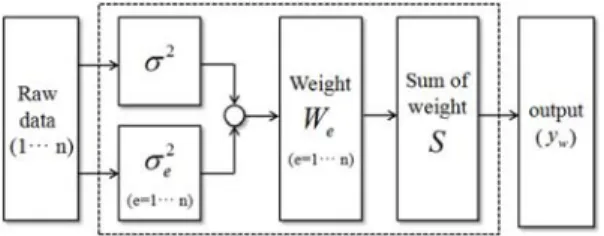
Figure 1: Block diagram of improved weight average filter
the size of each impulse noise without threshold from the position data acquired from a mobile node and then calculating the average value. First, the IWAF is applied to reduce impulse noise in the acquired posi- tion data of mobile nodes following the procedure in Figure 1.
Generally, the population variance() is expressed as
, (1)
where n is the number of raw data points, is the i-th raw data point, and m is the average of the raw data points. The modified variation that represents the variation based on e-th raw data point is given by
, (2)where represents the value of e-th raw data point, and the maximum value of is limitless but a pos- itive real number. As becomes bigger, the stand- ard deviation based on e-th raw data point becomes larger, and the noise characteristics of appear strongly. This noise characteristic has the range of variation 0 to 1 and a weight given by
. (3)
The size of is expressed as a value between 0 and 1. The closer the value of is to 0, the stron- ger its noise characteristic is. The closer the value of
is to 1, the weaker its noise characteristic is. The total sum() of that gives each different weight to each raw data point is
. (4)
Accordingly, to apply the different weights depending on the size of the noise to the raw data, the average () is
∙∙
. (5)
In Equation (5), reduces the impulse noise, which is relatively large compared to the other noise source, because a larger impulse noise implies the use of a smaller weighting value.
2.2 Estimation of relative azimuth
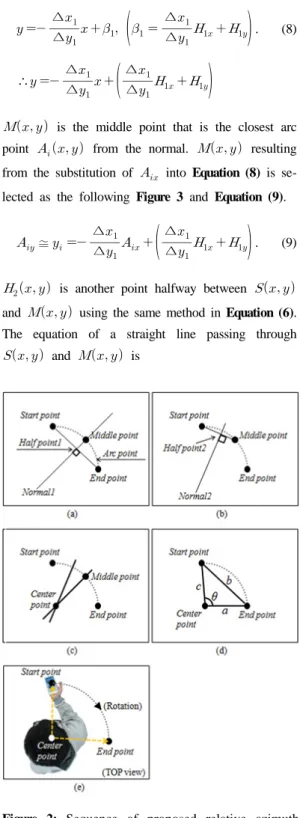
The relative azimuth estimation method of the pro- posed algorithm is described as the stages (a)-(d) in Figure 2. When a user rotates a mobile node, as in Figure 2 (e), the node acquires an arbitrary arc point
, where i is the index number of the ac- quired arc point. is the starting point,
is the ending point, is a point halfway between and , which is ex- pressed as
. (6)
The equation of a straight line passing through
and is
∆
∆
, (7)
where is y-intercept. The normal equation (y) passing through is
∆
∆
∆∆
∴ ∆
∆
∆∆
. (8)
is the middle point that is the closest arc point from the normal. resulting from the substitution of into Equation (8) is se- lected as the following Figure 3 and Equation (9).
≅ ∆
∆
∆∆
. (9) is another point halfway between
and using the same method in Equation (6).
The equation of a straight line passing through
and is
Figure 2: Sequence of proposed relative azimuth estimation
∆
∆
. (10)
The normal equation (y) passing through is
∆
∆
∆∆
. (11) is the center point obtained by Equation (8) and Equation (11), where is the center axis when a user rotates a mobile node. At the stage in Figure 2 (d), each side of the triangle with three points consisting of , , and , are determined as follows
. (12)
Furthermore, the interior angle( ) between a and c is calculated by the second law of cosines.
cos
. (13)
Because is the revolved angle of mobile node by user, the direction of a user can be estimated from the relative azimuth by summing the previous azi- muth with .
Pseudo code to select the for (i←1; i≤n; i←i+1)
if (-) is zero.
← Exit of loop
else if (-) is minimum.
← Exit of loop end for
Figure 3: Acquisition of middle point ( )
3. Simulation result and analysis
3.1 Analysis of proposed IWAF
Simulations were carried out in order to verify the performance of the proposed algorithm. Figure 4 shows the performance of other filters compared to the proposed IWAF with a standard weight filter gen- erally expressed as
∙ ∙ , (14)
Where is the present weight average, is a weight that has a value between 0 and 1, is the previous weight average, and is a present average. When the x-axis value is about 10 in Figure 4, the raw data represents a form of an im- pulse, and as changes, the characteristic of WF is also changes. Here, when is large, a droop phe- nomenon occurs even if impulse is reduced because of the dependence on the previous raw data. This droop phenomenon is not suitable for preprocessing because it affects the impulse for a long time. On the other hand, the advantages of the proposed IWAF are that the droop phenomenon does not exist because the weight is not assigned according to the time, and the impulse noise decreases faster than the general weight filter because the weight is assigned depending on the size of impulse noise. Therefore, the IWAF is suitable for preprocessing to improve the performance of the proposed algorithm and can be applied widely in the field of signal processing using image, control, and sensor processing in which impulse noise exists.
3.2 Analysis of proposed relative azimuth estimation algorithm
Computer simulations are performed to evaluate the performance of the proposed relative azimuth estima- tion algorithm. The components and conditions for the simulation environment are the angular velocity (90 rad/s), the sampling rate (3 ms), the rate of the
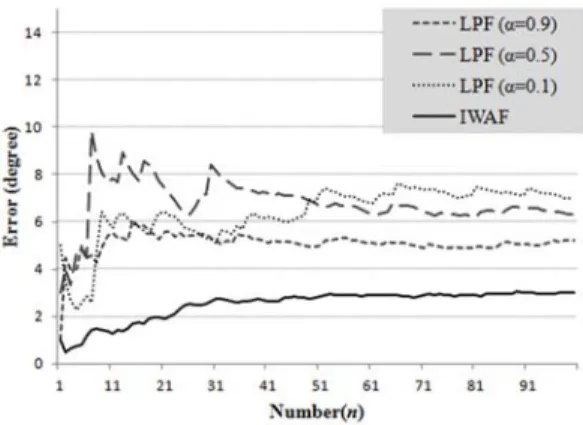
included impulse (1%), and the maximum size of the impulse (100 cm). Also, considering the length of the human arm and the development of the localization estimation, the radius and error of localization are set to 50 cm and 3 cm, respectively. The remaining elements were selected arbitrarily because they can vary depending on the installation environment and the characteristics of the system. Preprocessing is used in order to minimize the errors of localization acquired from a mobile node. In other words, if the error is 0 cm, the azimuth error for the proposed method is 0°. Figure 5 presents the performance of the cumulative average error when the experiments were repeated up to 100 times for the general WFs
Figure 4: Performance of proposed weight average filter.
Figure 5: Cumulative average error when the experiments were repeated n times
and the proposed IWAF. For the general WF used as a preprocessing step, the impulse noise is reduced more for = 0.9 than = 0.1 or = 0.5, and the performance of the general WF ( = 0.9) represents an average error of 5.09°. Meanwhile, for the pro- posed IWAF, the average error is 2.5°. The perform- ance improves by about a factor of two compared to the WF ( = 0.9) because the droop phenomenon does not exist, and the impulse noise is effectively reduced. Furthermore, it is confirmed that the relative azimuth estimation algorithm effectively obtains the azimuth in a localization system that contains an error. In an indoor navigation system, the proposed algorithm provides reliable orientation information to a user without using an azimuth sensor that is vulner- able to magnetic interference.
4. Conclusion
This paper proposed an algorithm that estimates the relative azimuth using rotational displacement in- formation of a mobile node when a user grabs the node and rotates it. The proposed technique may be applied to precise localization systems to guide a user in the right direction by estimating the relative azi- muth without using any sensors that are affected by magnetic fields. Before the rotational displacement al- gorithm is applied, an IWAF is used to effectively re- duce the impulse noise, which can affect the accurate determination of the azimuth, without large computa- tional costs. Then a stable accumulated error, even af- ter several repetitions, is obtained with time. Thus, navigation operates with the proposed algorithm in the indoor environments, where a variety of electro- magnetic interference via electronic devices or power lines exists, with reliable and effective route guidance.
Acknowledgements
This work is the outcome of a Manpower Development Program for Marine Energy by the Ministry of Oceans and Fisheries and the National Research Foundation of Korea (NRF) grant funded by the Korea government (MEST) (No. 20110029766).
References
[1] I. D'Souza, W. Ma, and C. Notobartolo,
“Real-time location systems for hospital emer- gency response,” IEEE IT Professional, vol.
13, no. 2, pp. 37-43, 2011.
[2] H.-T. Cho, T.-W. Kim, Y.-J. Park, and Y.-J.
Baek, “Enhanced trajectory estimation method for RTLS in port logistics environment,” High Performance Computing and Communication &
2012 IEEE 9th International Conference Embedded Software Systems (HPCC-ICESS), pp. 1555-1562, 2012.
[3] H.-J. Cho, K.-I. Hwang, D.-S. Noh, and D.-H.
Seo, “Real time indoor positioning system us- ing IEEE 802.15.4a and sensors”, Journal of the Korean Society of Marine Engineering, vol. 36, no. 6, pp. 850-856, 2012 (in Korean).
[4] J.-H. Seong, T.-W. Lim, J.-S. Kim, S.-G.
Park, and D.-H. Seo, “An improvement algo- rithm for localization using adjacent node and distance variation analysis techniques in a ship”, Journal of the Korean Society of Marine Engineering, vol. 37, no. 2, pp.
213-219, 2013 (in Korean).
[5] H.-J. Cho, J.-S. Kim, S.-G. Lee, J.-W. Kim, and D.-H. Seo, “Fixed node reduction techni- que using relative coordinate estimation algo- rithm,” Journal of The Korean Society of Marine Engineering, vol. 37, no. 2, pp.
220-226, 2013 (in Korean).
[6] J.-H. Seong, J.-S. Park, S.-H. Lee, and D.-H.
Seo, “Indoor localization algorithm based on
WLAN using modified database and se- lective,” Journal of The Korean Society of Marine Engineering, vol. 37, no. 8, pp.
932-938, 2013 (in Korean).
[7] C. Fischer and H. Gellersen, “Location and navigation support for emergency responders:
A survey,” IEEE Pervasive Computing, vol. 9, no. 1, pp. 38-47, 2010.
[8] Y. Chon and H. Cha, “LifeMap: a smart- phone-based context provider for loca- tion-based services,” IEEE Pervasive Computing, vol. 10, no. 2, pp. 58-67, 2011.
[9] J. Fujimoto, S. Hotta, K. Sawada, Y. Hada, K. Hida, and S. Mori, “Hybrid positioning system combining spatially continuous and discrete information for indoor location-based service,” Ubiquitous Positioning, Indoor Navigation, and Location Based Service (UPINLBS), pp. 1-6, 2012.
[10] B.-G. Lee and W.-Y. Chung, “Multitarget three-dimensional indoor navigation on a PDA in a wireless sensor network,” IEEE Sensors Journal, vol. 11, no. 3, pp. 799-807, 2011.
[11] A. R. J. Ruiz, F. S. Granja, J. C. Prieto Honorate, and J. I. G. Rosas, “Accurate pe- destrian indoor navigation by tightly coupling foot-mounted IMU and RFID measurements,”
IEEE Transactions on Instrumentation Measurement, vol. 61, no. 1, pp. 178-189.
2012.
[12] R. Zhang and L. M. Reindl, “Pedestrian mo- tion based inertial sensor fusion by a modi- fied complementary separate bias Kalman fil- ter,” IEEE Sensors Applications Symposium (SAS), pp. 209-213, 2011.
[13] R. Zhang, F. Hoflinger, and L. Reindl,
“Inertial sensor based indoor localization and monitoring system for emergency res- ponders,” IEEE Sensors Journal, vol. 13, no.
2, pp. 838-848, 2013.
[14] S. E. Umbaugh, Computer Vision and Image Processing, Prentice-Hall, Englewood Cliffs, NJ, USA, 1998.
[15] H. S. Yazdi and F. Homayouni, “Impulsive noise suppression of images using adaptive median filter,” International Journal of Signal processing Image Processing and Pattern Recognition, vol. 3, no. 3, pp. 1-12, 2010.
[16] T.-C. Lin, “A new adaptive center weighted median filter for suppressing impulsive noise in images,” Information Sciences, vol. 177, no. 4, pp. 1073-1087, 2007.