Copyright © 2015 The Korean Society for Bone and Mineral Research
This is an Open Access article distributed under the terms of the Creative Commons Attribution Non-Commercial Li- cense (http://creativecommons.org/licenses/by-nc/3.0/) which permits unrestricted non-commercial use, distribu- tion, and reproduction in any medium, provided the original work is properly cited.
pISSN 2287-6375 eISSN 2287-7029
Vitamin D Deficiency Is Highly Concomitant but Not Strong Risk Factor for Mortality in Patients Aged 50 Year and Older with Hip Fracture
Gyeong-Hak Lee1, Jung-Won Lim2, Yong-Gum Park3, Yong-Chan Ha2
1Department of Orthopaedic Surgery, National Medical Center, Seoul;
2Department of Orthopaedic Surgery, Chung-Ang University College of Medicine, Seoul;
3Department of Surgery, Chung-Ang University College of Medicine, Seoul, Korea
Background: The purpose of this study was to ascertain the prevalence of vitamin D de- ficiency and risk factors associated with mortality in patients ≥50-year-of-age with hip fractures. Methods: A total of 489 patients ≥50-year-of-age who sustained a hip frac- ture from January 2010 to October 2014 were followed-up for a minimum of 1 year.
Clinical and radiological outcomes were evaluated including prevalence of vitamin D deficiency. Crude mortality rates were calculated, and the effects of different risk factors on mortality were assessed. Results: Vitamin D deficiency was present in 76.5% of cases (n=237). The prevalence of vitamin D insufficiency was 12.3%, and only 11.2% of pa- tients had normal vitamin D levels. Accumulated mortality was 11% (54 patients) at 1 year. A univariate analysis showed that vitamin D deficiency (P=0.012), age (P<0.001), BMI (P<0.001), type of management (P< 0.001), American Society of Anesthesiologists (ASA) score (P=0.009), pre-fracture ambulatory status (P<0.001), and osteoporosis (P<
0.001) were associated with mortality. A multivariate analysis performed using a Cox proportional hazards model demonstrated that ASA score (P=0.001) and pre-fracture ambulatory status (P=0.011) were independently associated with mortality after hip fracture. Conclusions: We did not find a relationship between serum 25-hydroxy-vitamin D levels and mortality after hip fracture, although we observed a high prevalence of vi- tamin D deficiency and a significant association with mortality in the univariate analysis.
Key Words: Hip fractures, Mortality, Risk factors, Vitamin D
INTRODUCTION
Several studies in developed countries have reported a decreasing trend in hip fracture incidence.[1-4] However, studies in Korea show that a two-fold increase in the total number of hip fractures, and the incidence rate of hip fracture in wom- en increased steeply during a 10-year study period.[5] Hip fractures in elderly pa- tients are the most serious because of high mortality, loss of independence, lower quality of life, and the high socioeconomic burden.[6,7] Although most risk fac- tors, such as ageing, sex, and medical comorbidities, are inevitable, aging is the most important risk factor for hip fractures; thus, identifying modifiable risk fac- tors is extremely important. Among these modifiable risk factors, vitamin D defi- Corresponding author
Yong-Chan Ha
Department of Orthopaedic Surgery, Chung-Ang University College of Medicine, 102 Heukseok-ro, Dongjak-gu, Seoul 06973, Korea
Tel: +82-2-6299-1577 Fax: +82-2-822-1710 E-mail: [email protected] Received: November 18, 2015 Revised: November 25, 2015 Accepted: November 25, 2015
No potential conflict of interest relevant to this article was reported.
Original Article
ciency is a known modifiable risk factor for hip fracture.[8]
A cohort study in Norway reported that patients in the low- est quartile of 25- hydroxy-vitamin D (25-[OH]D) level had a 38% increased risk of hip fracture compared with those in the highest quartile 25-(OH)D level.[9]
According to a multi-national study, Korea has the high- est prevalence (92.1%) of vitamin D insufficiency (25-[OH]
D<30 ng/mL), followed by Japan (90.4%), Lebanon (84.9%), Turkey (76.7%), UK (74.5%), Germany (68.0%), Mexico (67.1%), and Spain (64.7%).[10] Song et al.[11] determined the prev- alence of vitamin D deficiency in an urban Korean popula- tion of 8,976 participants (3,587 men and 5,389 women) aged ≥50-year-of-age. They reported 59.7% and 86.5%
prevalence rates of vitamin D deficiency (25-[OH]D <20 ng/mL) in men and women, respectively. Therefore, vita- min D deficiency is a general phenomenon in Korean el- derly subjects.[11] However, no study has investigated the association between vitamin D deficiency and mortality in patients with hip fractures.
The purpose of this study was to assess the prevalence and relationship between mortality and vitamin D deficien- cy among hospitalized patients aged ≥50-year-of-age 50 with hip fractures.
METHODS
A total of 489 patients (489 hips) aged ≥50-year-of-age who was diagnosed with a femoral neck or intertrochan- teric fracture from January 2010 to December 2014 were include in this study. Of them, 10 patients had a contralat- eral hip fracture and were excluded.
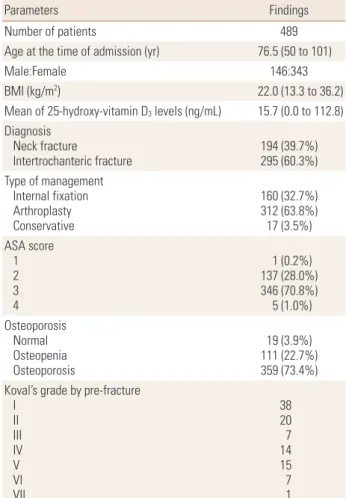
The follow-up period was a minimum of 12 months after discharge. There were 146 men (146 hips) and 343 women (343 hips). Demographic datas including age at the time of admission, diagnosis, body mass index (BMI), American Society of Anesthesiologist (ASA) score,[12] T-score (osteo- porosis, osteopenia, and normal),[13] pre-fracture ambula- tory status using Koval’s categories,[14] serum 25-(OH)D3
level, and type of management were obtained by review- ing the medical records (Table 1).
Blood sampling of all patients at the admission date, af- ter fasting for 8 to 12 hr, was performed by experienced laboratory technicians. Detailed information on the 25- (OH)D assay was provided previously.[15] Briefly, of serum 25-(OH)D levels were assayed with a radioimmunoassay
(RIA) kit (Siemens Healthcare, Erlangen, Germany).
Routine follow-up visits were scheduled at 6 weeks, and 3, 6, 9, 12 months, and every year thereafter. Patients who had not returned for regularly scheduled visits were con- tacted by telephone.
Osteoporosis was defined as a T-score ≤-2.5, osteopenia was defined as a T-score between -1 and -2.5, and normal was defined as a T-score ≥-1.0.[13]
Activity levels were defined as follows: I-independent community ambulator, II-community ambulator with cane, III-community ambulator with walker/crutches, IV-inde- pendent household ambulator, V-household ambulator with cane, VI-household ambulator with walker/crutches, and VII-nonfunctional ambulatory.[14]
According to the Holick [16] classification, vitamin D de- ficiency was considered at a vitamin D level <20 ng/mL, vitamin D insufficiency was 21 to 29 ng/mL, and normal
≥30 ng/mL. In addition, severe vitamin D deficiency was
<10 ng/mL.[17]
Table 1. Demographics of patients
Parameters Findings
Number of patients 489
Age at the time of admission (yr) 76.5 (50 to 101)
Male:Female 146:343
BMI (kg/m2) 22.0 (13.3 to 36.2)
Mean of 25-hydroxy-vitamin D3 levels (ng/mL) 15.7 (0.0 to 112.8) Diagnosis
Neck fracture
Intertrochanteric fracture 194 (39.7%) 295 (60.3%) Type of management
Internal fixation Arthroplasty Conservative
160 (32.7%) 312 (63.8%) 17 (3.5%) ASA score
1 2 3 4
1 (0.2%) 137 (28.0%) 346 (70.8%) 5 (1.0%) Osteoporosis
Normal Osteopenia Osteoporosis
19 (3.9%) 111 (22.7%) 359 (73.4%) Koval’s grade by pre-fracture
I II III IV V VI VII
3820 147 157 1 BMI, body mass index; ASA, American Society of Anesthesiologist.
Table 2. Camparison of parameters regarding mortality in patients with hip fractures
Survival Mortality P-value
Number (%) 375 (76.7) 114 (23.3)
Gender (M/F) 109/266 37/77 0.489
Age (yr) (mean±SD) 74.5±10.1 83.4±7.6 <0.001
BMI (mean±SD) 22.3±3.3 21.0±3.2 <0.001
Diagnosis Neck fracture
Intertrochanteric fracture 151
224 43
71
0.626
Type of management Internal fixation Arthroplasty Conservative
141224 10
1988 7
<0.001
ASA score 1 2 3 4
1171 2552
200 913
0.009
Osteoporosis Normal
Osteoporosis 97
253 17
122
<0.001
Pre-fracture ambulatory status Koval I-III
Koval IV-VII 310
65 68
46
<0.001
Serum Vitamin D level Less than 10 ng/mL
10 ng/mL to less than 20 ng/mL 20 ng/mL to less than 30 ng/mL More than 30 ng/mL
138144 5043
6626 1012
0.001
SD, standard deviation; BMI, body mass index.
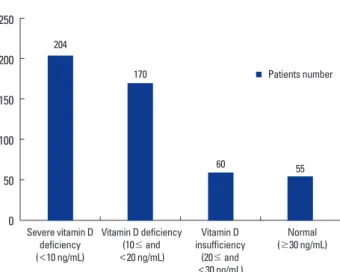
Fig. 1. High prevalence of vitamin D deficiency in patients ≥50-year- of-age with hip fracture.
250 200 150 100 50
0 Severe vitamin D deficiency (<10 ng/mL)
Vitamin D deficiency (10≤ and
<20 ng/mL)
Vitamin D insufficiency
(20≤ and
<30 ng/mL)
Normal (≥30 ng/mL) Patients number 204
170
60 55
Mortality was determined by the hospital records and/
or by interviewing the patient’s family. A systemic search for death certificates at the National Statistical Office was conducted for patients lost to follow-up.
1. Statistical analysis
Sex, age, diagnosis, type of management, BMI, ASA score, T-score (osteoporosis, osteopenia, and normal), pre-frac- ture ambulatory status, and serum 25-(OH)D3 levels were assessed to determine their relationships with mortality.
We used the chi-square or Fisher’s exact tests for categori- cal variables and the t-test for numerical variables. All two- sided P-values<0.05 were considered significant. A multi- variate analysis was performed using age, gender, BMI, type of management, ASA, osteoporosis, pre-fracture ambula- tory status, and serum 25-(OH)D3 levels as these variables had P-values <0.10. The Cox proportional-hazards model was carried out to identify independent factors associated with mortality. The statistical analysis was performed using SPSS version 20 software (SPSS Inc., Chicago, IL, USA).
RESULTS
The mean vitamin D level at admission was 15.7 ng/mL.
The prevalence of vitamin D deficiency was 76.5%, 12.3%
of patients were vitamin D insufficient, with 11.2% had nor- mal vitamin D levels. Of them, severe vitamin D deficiency was present in 41.7% (204/489 patients) (Fig. 1).
During the minimum 1-year follow-up period, 114 of 489 patients (23.3%) died. Of them, 54 died within 1 year,
32 within 2 years, 11 within 3 years, and 17 within 5 years.
The univariate analysis showed that mortality was asso- ciated with vitamin D deficiency (P=0.012), age (P<0.001), BMI (P<0.001), type of management (P<0.001), ASA score (P=0.009), pre-fracture ambulatory status (P<0.001), and osteoporosis (P<0.001). However, no significant associa- tion was found between mortality and sex (P=0.489) or diagnosis (P=0.626) (Table 2). The adjusted multivariate analysis revealed that ASA score (HR 12.220; 95% CI 3.314- 45.063, P=0.001) and pre-fracture ambulatory status (HR 1.681; 95% CI 1.104-2.558, P=0.011) were significant asso- ciated with death after hip fracture.
DISCUSSION
Our results show a high prevalence of hypovitaminosis D and mortality in patients with hip fracture. In total, 89%
of patients were vitamin D deficient or insufficient, and 1-year mortality after hip fracture was 11%. Although vita-
min D deficiency was a possible risk factor for death after hip fracture, we did not find any strong evidence for vita- min D deficiency as risk factor for death after hip fracture.
Medical comorbidities and preoperative ambulatory status were important risk factors for mortality after hip fracture in this study.
Although the mean vitamin D insufficiency (<30 ng/mL) rate was 63.9% in a multinational study of 18 countries that evaluated 2,606 postmenopausal women with osteo- porosis, South Korea had the highest rate (92.1%) of vita- min D insufficiency (<30 ng/mL) among the 18 countries.
[10] Choi [18] evaluated the 2008 Korea National Health and Nutrition Examination Survey IV data that included 6,925 subjects in the general population and reported vi- tamin D deficiency (<20 ng/mL) prevalence rates of 47.3%
in men and 64.5% in women and those for vitamin D insuf- ficiency (<30 ng/mL) were 86.8% in men and 93.3% in wo- men. In this study, vitamin D insufficiency (<30 ng/mL) and deficiency (<20 ng/mL) were present 88.8% and 76.5% of subjects, respectively. The reason for the high vitamin D in- sufficiency rate in Korea may be due to the indoor lifestyle and protection from ultraviolet light.[18]
The relationship between vitamin D deficiency and mor- tality in elderly subjects has been reported in several stud- ies.[19-21] However, serum vitamin D concentrations and mortality rates in elderly patients with hip fractures are rarely reported.[22,23] Although our univariate analysis found that vitamin D deficiency was an independent risk factor for mortality after hip fracture, it was not associated with mortality after adjusting for age (P<0.001), BMI (P=
0.041), type of management (P<0.001), ASA score (P=
0.009), pre-fracture ambulatory status (P<0.001), and os- teoporosis (P<0.001) in the multivariate analysis. This find- ing is similar to a previous study. Gumieiro et al.[22] assess- ed whether serum vitamin D concentration is associated with gait status and mortality among 87 elderly patients with fractures of the proximal femur 6 months after suffer- ing the fracture. They reported that serum vitamin D con- centration was not related to gait status or mortality among patients with fractures proximal femur.[22] Madsen et al.
[23] performed a case control study of 562 patients aged
≥70 years with hip fractures and found that serum para- thyroid hormone serum calcium levels were significantly associated with mortality, whereas serum 25-(OH)D level was not.
Risk factors for mortality after hip fracture have been re- ported in several studies.[24-28] The known risk factors for mortality after hip fracture are race, old age, dementia, male sex, low BMI, low handgrip strength, preoperative activity, preoperative delirium, and medical comorbidities, such as chronic renal failure, congestive heart disease, and chronic obstructive pulmonary disease.[6,25-29] In that study, the patient’s medical condition according to the ASA score and preoperative functional status by the Koval’s classification were important risk factors for mortality after hip fracture.
In a previous Jeju cohort study, Lee et al.[6] performed mid-term follow-up after hip fracture in patients >50 year old. After adjustment for covariates, age, woman sex, and medical comorbidities were significantly associated with the risk for mortality after hip fracture.[6] However, preop- erative functional activity was not associated with the risk for mortality. Karademir et al.[29] reported no significant association between ASA score and mortality after hip frac- ture in patients >75-year-old. The reason for these discrep- ancies might be related to cohort size, sex distribution, and patient age or other demographic characteristics.
This study had several limitations. First, it was a retrospec- tive review of prospectively collected data, and no control group was used. Second, a single blood 25-(OH)D measure- ment is an imperfect surrogate as a long-term indicator of 25-(OH)D. Finally, serum 25-(OH)D levels were measured at baseline by radioimmunoassay. Therefore, further study is necessary to evaluate the real-time effect of vitamin D.
In conclusion, we did not find a relationship between se- rum 25-(OH)D level and mortality after hip fracture, althou- gh we observed high prevalence of vitamin D deficiency and a significant association with mortality in a univariate analysis.
REFERENCES
1. Cassell E, Clapperton A. A decreasing trend in fall-related hip fracture incidence in Victoria, Australia. Osteoporos Int 2013;24:99-109.
2. Leslie WD, O'Donnell S, Jean S, et al. Trends in hip fracture rates in Canada. JAMA 2009;302:883-9.
3. Adams AL, Shi J, Takayanagi M, et al. Ten-year hip fracture incidence rate trends in a large California population, 1997- 2006. Osteoporos Int 2013;24:373-6.
4. Icks A, Haastert B, Wildner M, et al. Trend of hip fracture
incidence in Germany 1995-2004: a population-based study. Osteoporos Int 2008;19:1139-45.
5. Ha YC, Park YG, Nam KW, et al. Trend in hip fracture inci- dence and mortality in Korea: a prospective cohort study from 2002 to 2011. J Korean Med Sci 2015;30:483-8.
6. Lee SR, Ha YC, Kang H, et al. Morbidity and mortality in Jeju residents over 50-years of age with hip fracture with mean 6-year follow-up: a prospective cohort study. J Ko- rean Med Sci 2013;28:1089-94.
7. Yi H, Ha YC, Lee YK, et al. National healthcare budget im- pact analysis of the treatment for osteoporosis and frac- tures in Korea. J Bone Metab 2013;20:17-23.
8. Autier P, Boniol M, Pizot C, et al. Vitamin D status and ill health: a systematic review. Lancet Diabetes Endocrinol 2014;2:76-89.
9. Holvik K, Ahmed LA, Forsmo S, et al. Low serum levels of 25-hydroxyvitamin D predict hip fracture in the elderly: a NOREPOS study. J Clin Endocrinol Metab 2013;98:3341-50.
10. Lips P, Hosking D, Lippuner K, et al. The prevalence of vita- min D inadequacy amongst women with osteoporosis: an international epidemiological investigation. J Intern Med 2006;260:245-54.
11. Song HR, Kweon SS, Choi JS, et al. High prevalence of vita- min D deficiency in adults aged 50 years and older in Gwang- ju, Korea: the Dong-gu Study. J Korean Med Sci 2014;29:
149-52.
12. White BL, Fisher WD, Laurin CA. Rate of mortality for el- derly patients after fracture of the hip in the 1980's. J Bone Joint Surg Am 1987;69:1335-40.
13. WHO Study Group. Assessment of fracture risk and its ap- plication to screening for postmenopausal osteoporosis.
Report of a WHO Study Group. World Health Organ Tech Rep Ser 1994;843:1-129.
14. Koval KJ, Aharonoff GB, Rosenberg AD, et al. Functional outcome after hip fracture. Effect of general versus region- al anesthesia. Clin Orthop Relat Res 1998:37-41.
15. Looker AC, Dawson-Hughes B, Calvo MS, et al. Serum 25- hydroxyvitamin D status of adolescents and adults in two seasonal subpopulations from NHANES III. Bone 2002;30:
771-7.
16. Holick MF. Vitamin D deficiency. N Engl J Med 2007;357:
266-81.
17. Bischoff-Ferrari HA, Can U, Staehelin HB, et al. Severe vita- min D deficiency in Swiss hip fracture patients. Bone 2008;
42:597-602.
18. Choi HS. Vitamin d status in Korea. Endocrinol Metab (Seoul) 2013;28:12-6.
19. Ginde AA, Scragg R, Schwartz RS, et al. Prospective study of serum 25-hydroxyvitamin D level, cardiovascular dis- ease mortality, and all-cause mortality in older U.S. adults.
J Am Geriatr Soc 2009;57:1595-603.
20. Fiscella K, Franks P. Vitamin D, race, and cardiovascular mortality: findings from a national US sample. Ann Fam Med 2010;8:11-8.
21. Wang JB, Abnet CC, Chen W, et al. Association between serum 25(OH) vitamin D, incident liver cancer and chronic liver disease mortality in the Linxian Nutrition Interven- tion Trials: a nested case-control study. Br J Cancer 2013;
109:1997-2004.
22. Gumieiro DN, Pereira GJ, Minicucci MF, et al. Associations of vitamin D deficiency with postoperative gait and mor- tality among patients with fractures of the proximal fe- mur. Rev Bras Ortop 2015;50:153-8.
23. Madsen CM, Jørgensen HL, Lind B, et al. Secondary hyper- parathyroidism and mortality in hip fracture patients com- pared to a control group from general practice. Injury 2012;
43:1052-7.
24. Colais P, Di Martino M, Fusco D, et al. The effect of early surgery after hip fracture on 1-year mortality. BMC Geriatr 2015;15:141.
25. Paksima N, Koval KJ, Aharanoff G, et al. Predictors of mor- tality after hip fracture: a 10-year prospective study. Bull NYU Hosp Jt Dis 2008;66:111-7.
26. Chatterton BD, Moores TS, Ahmad S, et al. Cause of death and factors associated with early in-hospital mortality af- ter hip fracture. Bone Joint J 2015;97B:246-51.
27. Alegre-López J, Cordero-Guevara J, Alonso-Valdivielso JL, et al. Factors associated with mortality and functional dis- ability after hip fracture: an inception cohort study. Osteo- poros Int 2005;16:729-36.
28. Meyer HE, Tverdal A, Falch JA, et al. Factors associated with mortality after hip fracture. Osteoporos Int 2000;11:228- 32.
29. Karademir G, Bilgin Y, Erşen A, et al. Hip fractures in pati- ents older than 75 years old: Retrospective analysis for prog- nostic factors. Int J Surg 2015. http://dx.doi.org/10.1016/
j.ijsu.2015.11.009.