Copyright © 2013 The Korean Society for Bone and Mineral Research
This is an Open Access article distributed under the terms of the Creative Commons Attribution Non-Commercial Li- cense (http://creativecommons.org/licenses/by-nc/3.0/) which permits unrestricted non-commercial use, distribu- tion, and reproduction in any medium, provided the original work is properly cited.
National Utilization of Calcium Supplements in Patients with Osteoporotic Hip Fracture in Korea
Sang-Hwan Kim1, Young-Bong Ko2, Young-Kyun Lee1, Seok-Woo Hong1, Hyung-Jin Choi3, Yong-Chan Ha2, Chan-Soo Shin4
1Department of Orthopaedic Surgery, Seoul National University Bundang Hospital, Seongnam;
2Department of Orthopaedic Surgery, Chung-Ang University College of Medicine, Seoul;
3Division of Endocrinology, Department of Internal Medicine, Chungbuk National University College of Medicine, Cheongju;
4Division of Endocrinology and Metabolism, Department of Internal Medicine, Seoul National University College of Medicine, Seoul, Korea
Background: Calcium is prescribed worldwide for patients diagnosed with osteoporosis.
However, the national utilization of calcium and compliance with calcium is unclear in Korea. Our purpose is to evaluate Korea's national utilization of calcium and compliance with calcium in patients with osteoporotic hip fracture from 2007 to 2010 using data from the Health Insurance Review and Assessment (HIRA) Service. Methods: From 2007 to 2011, osteoporotic hip fractures were identified using the International Classification of Diseases, 10th revision (ICD-10) and procedure code form from the nationwide data- base of the Health Insurance Review and Assessment Service. Compliant users of calci- um were defined as the patients’ medication possession ratio of 80 or more. We analyzed the compliance of calcium according to age and gender. Results: Among 85,228 pa- tients with hip fracture, 20,800 patients (24.4%) received a prescription of a calcium sup- plement. Among them, only 1,692 patients (8.1%) were identified as compliant users of calcium. The proportion of compliant users was higher in women than men in all age groups. The proportion of compliant users decreased with age in women. Conclusions:
In Korea, the national utilization of calcium was low and compliance with calcium was unsatisfactory even in patients with osteoporotic hip fracture.
Key Words: Calcium, Compliance, Hip fractures, Osteoporosis, Osteoporotic fractures
INTRODUCTION
Osteoporotic hip fractures have become an increasing health concern among the elderly,[1,2] and are associated with excess mortality, decreased mobility, and impaired activity of daily living.[3-5] Patients with osteoporotic hip fracture can be at risk of a subsequent osteoporotic fracture.[6,7] Therefore, several guidelines have been recommended for the treatment of osteoporosis in patients with os- teoporotic hip fracture.[8-10] Strategies for treatment of osteoporosis have been recommended to include comprehensive education for life-style modification, sup- plementation of calcium and vitamin D, and anti-osteoporosis drugs.[8-10]
However, recent practice and research have focused on anti-osteoporosis drugs, such as anti-resorptive and bone-formation agents.[11,12] In particular, bisphos- phonate has been the most commonly administered anti-osteoporosis drug in Corresponding author
Young-Kyun Lee
Department of Orthopaedic Surgery, Seoul National University Bundang Hospital, 166 Gumi-ro, Bundang-gu, Seongnam 463-707, Korea
Tel : +82-31-787-7204 Fax : +82-31-787-4056 E-mail : [email protected] Received: October 13, 2013 Revised: October 13, 2013 Accepted: October 14, 2013
Sang-Hwan Kim and Young-Bong Ko equally contributed to this work, and should be considered co-first authors.
No potential conflict of interest relevant to this article was reported.
The authors wish to thank Hwa-Young Kim for data collection and analysis. This study was a part of the Korean Nationwide-databased Osteoporosis Study (KNOS) that was performed by the policy and information analysis department of the Health Insurance Review and Assessment Service and the Korean Society for Bone and Mineral Research.
real practice.[13,14] This phenomenon can also be found in Korea. In fact, the full effect of bisphosphonate for treat- ment of osteoporosis depends on the sufficient use of cal- cium.[15-18] Moreover, compliant use of calcium was as- sociated with a reduced risk of osteoporotic fracture.[19, 20]
Although compliance with bisphosphonate has been well reported in literature,[6,7,21] there has been a lack of study on compliance with calcium supplementation. More- over, no study has yet reported Korea's national utilization of calcium after diagnosis of osteoporotic hip fracture.
The purpose of this study is to investigate Korea's nation- al utilization of calcium and compliance with calcium in patients with osteoporotic hip fracture from 2007 to 2010 using data from the Health Insurance Review and Assess- ment (HIRA) Service.
METHODS
This study was a retrospective review of the nationwide claims database of HIRA, which was established by the Ko- rean government. The HIRA database has covered over 99% of the Korean population since 2007. The database, which includes data on diagnoses (as determined by the International Classification of Diseases, 10th revision [ICD- 10]), procedures, prescription records and demographic information, has been used on several occasions for epide- miological studies.[1,5,7,22-24]
Our inclusion criteria comprised of osteoporotic hip frac- tures (femoral neck fractures or intertrochanteric fractures) from 2007 to 2011. Hip fractures require hospitalization and surgical intervention, and are recorded prospectively nationwide using ICD-10 codes. To identify osteoporotic hip fractures, the selected ICD-10 codes and a minimum cut-off value of 50 years were used.[1,5] Hip fracture was defined in femoral neck fractures (ICD-10 S720) or intertro- chanteric fractures (ICD-10 S721) requiring hospitalization.
In addition, we limited the cohort to those patients who performed one of the following seven procedures: open reduction of fractured extremity-femur, closed pinning-fe- mur, external fixation-pelvis/femur, closed reduction of fractured extremity-pelvis/femur, bone traction, skin trac- tion or hemiarthroplasty-hip.[1,5]
Patients could not be censored for loss to follow-up or death, because information regarding death was not avail-
able in the database. To avoid any bias, only patients who had one or more medical records after 1 year from their in- dex date were included, thereby ensuring no loss to fol- low-up and survival of patients up to that time.
Data on the duration and number of prescription of cal- cium supplements was analyzed. In this study, the type of calcium supplements was not distinguished. In addition, compliance with calcium was evaluated during the 12 mon- ths after hip fracture by using the medication possession ratio (MPR). MPR was defined as the sum of days supplied with calcium supplements divided by the length of follow- up (365 days in each period). Patients with an MPR of more than 80% were defined as compliant users of calcium.[25- 27] Among the remaining patients with calcium prescrip- tions, those with an MPR of less than 80% were defined as non-compliant users.
To determine the compliance with calcium, patients were divided into 5-year age groups and dichotomized by gender. We used descriptive statistics for presenting the national utilization of calcium supplement and compliance with calcium. De-identified information was used in this study. Statistics analysis was performed using SPSS for win- dows, version 16 (SPSS Inc., Chicago, IL, USA). This study was approved by the HIRA institutional review boards.
RESULTS
In total, 85,228 patients (24,113 men and 61,115 wom- en) were identified as patients with osteoporotic hip frac- ture from 2007 to 2010. Among those aged 50 years or older, the crude overall incidence of hip fracture was 160.3 per 100,000 persons during the study periods, and the gender-specific incidence was 98.2 per 100,000 person years for men and 213.5 per 100,000 person years for wom- en. Of the 85,228 patients with hip fracture, calcium sup- plement was administered in 20,800 patients (24.4%).
Women were more prescribed with calcium than men;
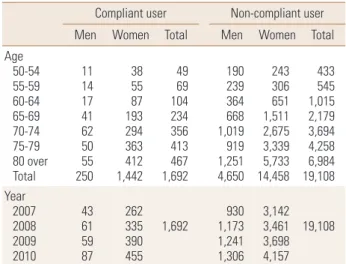
also, the proportion of patients with calcium prescription increased in women from 2007 to 2010 (Fig. 1). Of the 20,800 patients prescribed with calcium supplementation, only 1,692 patients (8.1%) were identified as compliant us- ers of calcium (Table 1). The proportion of compliant users was higher in women than men in all age groups. Further, in women, the proportion of compliant users decreased with age (Fig. 2).
DISCUSSION
In this nationwide study, we evaluated the proportion of prescription for calcium supplements after osteoporotic hip fracture. We also analyzed compliance with calcium in patients with hip fractures from 2007 to 2010 in Korea.
During the study period, calcium supplement was admin- istered in 24.4% of the patients after being diagnosed with osteoporotic hip fracture; however, only about 8% of the patients with the prescription were compliant users of cal- cium. Although women demonstrated a higher proportion of compliant users than men in all age groups, the propor- tion of compliant users decreased with age in women.
A previous epidemiologic study using the HIRA database reported that bisphosphonate was administered in 58% of
patients with osteoporotic hip fracture during the similar study periods (from 2007 to 2011).[7] However, in this study, in terms of calcium supplement, only 24.4% of the patients received a calcium prescription after being diagnosed with hip fracture.
Among several strategies for treatment of osteoporosis, anti-resorptive agents, such as bisphosphonate and selec- tive estrogen receptor modulator, have been widely used in elderly patients.[11-14] This dominant use of anti-re- sorptive agents may have led both physicians and patients to overlook the role of calcium supplement as an essential component of osteoporosis treatment.[11,28] However, in order to treat osteoporosis as well as to prevent osteopo- rotic fracture, calcium supplement should be recommend- ed with anti-osteoporotic drugs.[8-10,28,29]
Fig. 1. Proportion of patients with calcium prescription after hip frac- ture from 2007 to 2010.
25
20
15
Proportion (%)
2007 2008 2009 2010 Year
Proportion of calcium prescription
Men
Total Women
Table 1. Compliance with Calcium Supplements according to Age and Gender
Compliant user Non-compliant user Men Women Total Men Women Total Age50-54
55-59 60-64 65-69 70-74 75-79 80 over Total
1114 1741 6250 25055
3855 19387 294363 1,442412
4969 104234 356413 1,692 467
190239 364668 1,019 1,251919 4,650
243306 1,511651 2,675 3,339 5,733 14,458
433545 1,015 2,179 3,694 4,258 6,984 19,108 Year2007
20082009 2010
4361 5987
262335 390455
1,692 930
1,173 1,241 1,306
3,142 3,461 3,698 4,157
19,108
Fig. 2. Proportion of compliant user (medication possession ratio [MPR] ≥ 80) of calcium according to age.
15
10
5
0
Proportion (%)
50-54 55-59 60-64 65-69 70-74 75-79 80- Age
Compliant user in women
Total 2007 2008 2009 2010
15
10
5
0
Proportion (%)
50-54 55-59 60-64 65-69 70-74 75-79 80- Age
Compliant user in men
Total 2007 2008 2009 2010
Particularly in Korea, the contemporary reimbursement guideline for anti-osteoporosis drugs requires that patients had a T-score of less than -2.5 after the annual examination of bone mineral density.[7] Consequently, in Korea, calci- um supplementation should be considered as the primary strategy after osteoporotic hip fracture.[16] However, our study revealed that in Korea, only a quarter of patients with hip fractures received calcium prescription.
The proportion of compliant users of bisphosphonate was about 7% in the previous study,[7] and the proportion of compliant users of calcium was approximately 8% in this study.
There are several possible reasons for such low compli- ance with calcium, such as bisphosphonate. Patient fac- tors, including poor awareness on calcium for osteoporo- sis, have been presented to be important.[30-32] General- ly, women have been known to have higher awareness and more treatment for osteoporosis compared to men.
[32] In this study, the proportion of compliant users were higher in women. This might be due to physicians' indiffer- ence and ignorance about the necessity of calcium in os- teoporosis management. However, the proportion of pa- tients with calcium prescription increased in women from 2007 to 2010. Drug-related factors, including gastrointesti- nal discomfort and constipation, should also be consid- ered.[33]
This present study has an advantage of a large sample size from a nationwide database; however, there are sever- al limitations. First, we could not exclude fractures due to high-energy trauma, because the study design is based on an ICD-10 coding system. However, we used additional cri- terion of “aged 50 years or more,” as elsewhere.[1,5,7,24]
Second, we did not distinguish the type and dose of calci- um. The compliance with calcium supplement could be in- fluenced by the type of calcium.[34] Third, we could not compare the clinical results between compliant and non- compliant users, because only de-identified data were avail- able from HIRA.
In spite of these limitations, our study demonstrated that in Korea, the national utilization of calcium was low from 2007 to 2010 and further, compliance with calcium was unsatisfactory even in patients with osteoporotic hip fractures. Considering that calcium supplementation is es- sential to the treatment of osteoporosis, further efforts should be taken in order to increase the compliance of cal-
cium, particularly in patients with osteoporotic hip fracture.
CONFLICT OF INTEREST
This study was supported by the 2011-Grant from Korea Academy of Medical Sciences, and by the Health Insurance Review and Assessment Service funded by the Korean government. No benefits in any form have been received or will be received from any commercial party related di- rectly or indirectly to the subject of this article.
Young-Kyun Lee and Yong-Chan Ha designed the study.
Hyung-Jin Choi, Seok-Woo Hong, and Chan-Soo Shin gath- ered the data. Young-Bong Ko and Sang-Hwan Kim ana- lyzed it, and wrote the initial draft. All authors ensured the accuracy of data and manuscript.
REFERENCES
1. Park C, Ha YC, Jang S, et al. The incidence and residual life- time risk of osteoporosis-related fractures in Korea. J Bone Miner Metab 2011;29:744-51.
2. Cummings SR, Melton LJ. Epidemiology and outcomes of osteoporotic fractures. Lancet 2002;359:1761-7.
3. Haentjens P, Autier P, Collins J, et al. Colles fracture, spine fracture, and subsequent risk of hip fracture in men and women. A meta-analysis. J Bone Joint Surg Am 2003;85:
1936-43.
4. Salaffi F, Cimmino MA, Malavolta N, et al. The burden of prevalent fractures on health-related quality of life in post- menopausal women with osteoporosis: the IMOF study. J Rheumatol 2007;34:1551-60.
5. Yoon HK, Park C, Jang S, et al. Incidence and mortality fol- lowing hip fracture in Korea. J Korean Med Sci 2011;26:
1087-92.
6. Lee YK, Ha YC, Yoon BH, et al. Incidence of second hip frac- ture and compliant use of bisphosphonate. Osteoporos Int 2013;24:2099-104.
7. Lee YK, Ha YC, Choi HJ, et al. Bisphosphonate use and sub- sequent hip fracture in South Korea. Osteoporos Int 2013.
doi: 10.1007/s00198-013-2395-5.
8. National Osteoporosis Foundation. Physician’s guide to prevention and treatment of osteoporosis. 2003 [cited by 2006 Feb 15]. Available from: http://www.nof.org/phys- guide/
9. Javid KS, Thien A, Hill R. Implementation of and compli-
ance with NICE guidelines in the secondary prevention of osteoporotic fractures in postmenopausal women. Ann R Coll Surg Engl 2008;90:213-5.
10. American Association of Clinical Endocrinologists. AACE clinical practice guidelines for the prevention and treat- ment of postmenopausal osteoporosis. J Fla Med Assoc 1996;83:552-66.
11. Jang S, Park C, Jang S, et al. Medical service utilization with osteoporosis. Endocrinol Metab 2010;25:326-39.
12. Lee YK, Kim S, Kim KC, et al. Domestic characteristics and trends of publications on bone metabolism in South Ko- rea between 1998 and 2012. J Bone Metab 2013;20:43-5.
13. Russell RG, Watts NB, Ebetino FH, et al. Mechanisms of ac- tion of bisphosphonates: similarities and differences and their potential influence on clinical efficacy. Osteoporos Int 2008;19:733-59.
14. Bilezikian JP. Efficacy of bisphosphonates in reducing frac- ture risk in postmenopausal osteoporosis. Am J Med 2009;
122:S14-21.
15. Watts NB. Risedronate for the prevention and treatment of postmenopausal osteoporosis: results from recent clini- cal trials. Osteoporos Int 2001;12 Suppl 3:S17-22.
16. Boonen S, Vanderschueren D, Haentjens P, et al. Calcium and vitamin D in the prevention and treatment of osteo- porosis - a clinical update. J Intern Med 2006;259:539-52.
17. Ensrud KE, Black DM, Palermo L, et al. Treatment with alen- dronate prevents fractures in women at highest risk: re- sults from the Fracture Intervention Trial. Arch Intern Med 1997;157:2617-24.
18. Harris ST, Watts NB, Genant HK, et al. Effects of risedronate treatment on vertebral and nonvertebral fractures in wom- en with postmenopausal osteoporosis: a randomized con- trolled trial. Vertebral Efficacy With Risedronate Therapy (VERT) Study Group. JAMA 1999;282:1344-52.
19. Nowson CA. Prevention of fractures in older people with calcium and vitamin D. Nutrients 2010;2:975-84.
20. Chapuy MC, Meunier PJ. Prevention of secondary hyper- parathyroidism and hip fracture in elderly women with calcium and vitamin D3 supplements. Osteoporos Int 1996;
6 Suppl 3:60-3.
21. Lee YK, Nho JH, Ha YC, et al. Persistence with intravenous zoledronate in elderly patients with osteoporosis. Osteo- poros Int 2012;23:2329-33.
22. Choi HJ, Shin CS, Ha YC, et al. Burden of osteoporosis in
adults in Korea: a national health insurance database study.
J Bone Miner Metab 2012;30:54-8.
23. Lee YK, Ha YC, Park C, et al. Bisphosphonate use and in- creased incidence of subtrochanteric fracture in South Ko- rea: results from the National Claim Registry. Osteoporos Int 2013;24:707-11.
24. Lee YK, Jang S, Jang S, et al. Mortality after vertebral frac- ture in Korea: analysis of the National Claim Registry. Os- teoporos Int 2012;23:1859-65.
25. Gold DT, Martin BC, Frytak JR, et al. A claims database anal- ysis of persistence with alendronate therapy and fracture risk in post-menopausal women with osteoporosis. Curr Med Res Opin 2007;23:585-94.
26. Siris ES, Harris ST, Rosen CJ, et al. Adherence to bisphos- phonate therapy and fracture rates in osteoporotic wom- en: relationship to vertebral and nonvertebral fractures from 2 US claims databases. Mayo Clin Proc 2006;81:1013- 22.
27. Soong YK, Tsai KS, Huang HY, et al. Risk of refracture asso- ciated with compliance and persistence with bisphospho- nate therapy in Taiwan. Osteoporos Int 2013;24:511-21.
28. Stafford RS, Drieling RL, Johns R, et al. National patterns of calcium use in osteoporosis in the United States. J Reprod Med 2005;50:885-90.
29. Norman M, Parker MJ. Compliance with a pharmacologi- cal secondary fracture prevention policy. Injury 2006;37:
718-20.
30. Baek JH, Lee YK, Hong SW, et al. Knowledge on osteopo- rosis in guardians of hip fracture patients. J Bone Miner Metab 2013;31:481-4.
31. Wilson RK, Tomlinson G, Stas V, et al. Male and non-Eng- lish-speaking patients with fracture have poorer knowl- edge of osteoporosis. J Bone Joint Surg Am 2011;93:766- 74.
32. Nguyen NV, Dinh TA, Ngo QV, et al. Awareness and knowl- edge of osteoporosis in Vietnamese women. Asia Pac J Public Health 2011. doi: 10.1177/1010539511423569.
33. Whiting SJ, Wood RJ. Adverse effects of high-calcium diets in humans. Nutr Rev 1997;55:1-9.
34. Albertazzi P, Steel SA, Howarth EM, et al. Comparison of the effects of two different types of calcium supplementa- tion on markers of bone metabolism in a postmenopausal osteopenic population with low calcium intake: a double- blind placebo-controlled trial. Climacteric 2004;7:33-40.