Letter to the Editor
370 Ann Dermatol
Received February 14, 2012, Revised September 12, 2012, Accepted for publication October 6, 2012
Corresponding author: Weon Ju Lee, Department of Dermatology, Kyungpook National University School of Medicine, 130 Dongdeok-ro, Jung-gu, Daegu 700-721, Korea. Tel: 82-53-420-5837, Fax: 82-53-426-0770, E-mail: [email protected]
This is an Open Access article distributed under the terms of the Creative Commons Attribution Non-Commercial License (http://creativecommons.
org/licenses/by-nc/3.0) which permits unrestricted non-commercial use, distribution, and reproduction in any medium, provided the original work is properly cited.
ustekinumab.
Although controlled clinical trials will be required to esta- blish the effectiveness of ustekinumab in AD, we suggest that ustekinumab might be a useful and safe treatment of refractory AD in young patients.
REFERENCES
1. Hu Y, Shen F, Crellin NK, Ouyang W. The IL-17 pathway as a major therapeutic target in autoimmune diseases. Ann N Y Acad Sci 2011;1217:60-76.
2. Di Cesare A, Di Meglio P, Nestle FO. The IL-23/Th17 axis in
the immunopathogenesis of psoriasis. J Invest Dermatol 2009;129:1339-1350.
3. Koga C, Kabashima K, Shiraishi N, Kobayashi M, Tokura Y.
Possible pathogenic role of Th17 cells for atopic dermatitis. J Invest Dermatol 2008;128:2625-2630.
4. Hayashida S, Uchi H, Moroi Y, Furue M. Decrease in circulating Th17 cells correlates with increased levels of CCL17, IgE and eosinophils in atopic dermatitis. J Dermatol Sci 2011;61:180-186.
5. Puya R, Alvarez-López M, Velez A, Casas Asuncion E, Moreno JC. Treatment of severe refractory adult atopic der- matitis with ustekinumab. Int J Dermatol 2012;51:115-116.
http://dx.doi.org/10.5021/ad.2013.25.3.370
The Efficacy of Complete Surgical Excision of Keloid and Piercing Sinus Tract on Earlobe Keloid
Hyun Wuk Cha, Han Jin Jung, Hyun Jung Lim, Seok-Jong Lee, Do Won Kim, Weon Ju Lee
Department of Dermatology, Kyungpook National University School of Medicine, Daegu, Korea
Dear Editor:
The external ear is one of the most common sites for keloid formation. Many different treatment modalities such as surgical excision, intralesional corticosteroids, radiothe- rapy and pressure earrings have been used for earlobe keloids1. Among them, surgical excision is used either as a monotherapy or as a part of a combination therapy. It is thought that the recurrence rate of earlobe keloids after monotherapy with surgical excision is higher than that after combination therapy. This study evaluated the effi- cacy of complete surgical excision for earlobe keloids.
This study was approved by institutional review boards of Kyungpook National University Hospital.
We retrospectively reviewed 20 patients with earlobe
keloids treated with complete surgical excision (Fig. 1) regardless of clinical subtypes1 (anterior button, posterior button, dumbbell, wraparound, lobular) from January 2000 to May 2012 in our clinic. In this study, complete surgical excision of earlobe keloids was designed for the total removal of the keloidal mass and piercing sinus tract.
Earlobe keloids were diagnosed by clinical and histo- pathological examination. We also retrospectively evalu- ated 15 patients with earlobe keloids who were treated with a combination of surgery and post-surgical adjunctive therapy. The recurrence rate of complete surgical excision was compared with that of surgery and adjunctive thera- py. In addition, clinical subtypes, age, accompanying keloid and size were assessed for their effect on the
Letter to the Editor
Vol. 25 No. 3, 2013 371 Fig. 1. Complete surgical excision of earlobe keloid. The sinus tract, which is indicated by yellow arrows, should be totally removed.
If not, the remaining sinus tract may become a cause of keloid relapse.
recurrence rate after complete surgical excision. Statistical analysis was performed using chi-square and Fisher’s exact tests. A p<0.05 was considered to be statistically significant.
The age of the 20 patients in the study (the ratio of male to female was 0 : 20) was variable (ages 16 to 52 years;
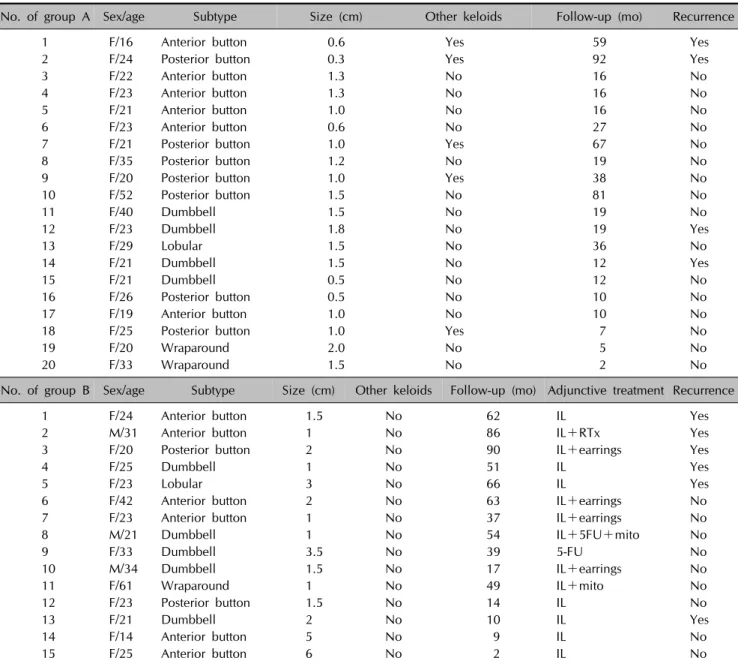
mean age 25.3 years) (Table 1). All patients were treated with complete surgical excision and histopathology con- firmed the characteristics of keloids as well as the sinus tract in the keloidal mass were present. Fifteen patients treated with a combination of surgery and postsurgical adjunctive therapy consisted of 12 females and 3 males (ages 20 to 61 years; mean age: 28.2 years) (Table 1).
Adjunctive therapy included intralesional injection of corticosteroid, radiotherapy, pressure earrings, intralesion- al application of 5-fluorouracil and mitomycin C. The recurrence rate of earlobe keloids in patients treated with complete surgical excision was 20% (4 out of 20). The 1-year follow-up recurrence rate of earlobe keloids in patients treated with complete surgical excision was 27%
(4 out of 15). The recurrence rate of earlobe keloid after a combination of surgery and postsurgical adjunctive therapy was 40% (6 out 15). The 1-year follow-up re- currence rate of earlobe keloid after a combination of surgery and postsurgical adjunctive therapy was 42% (5 out 12). There was no statistically significant difference in the recurrence rate of earlobe keloids between the two groups (p>0.05). Differences in the recurrence rate of earlobe keloids in patients treated with complete surgical excision according to clinical subtype, age, accompanying keloid and size were not statistically significant (p>0.05).
Keloids of the chest and shoulder are relatively resistant to treatment, with high recurrence rates after treatment with a single therapeutic modality. Earlobe keloids need to be considered differently from other keloids. Earlobe keloids show lower tension and have a piercing sinus tract co-
vered with keratinocytes. Many authors have noted a lower rate of keloid recurrence in the earlobe2,3. In the current study, the recurrence rate after complete surgical excision was 20% (27% at the 1-year follow-up). The superior outcome of complete surgical excision of earlobe keloids likely results from the lower skin tension in this region and the removal of the intrakeloidal sinus tract.
There have been clinical observations that wounds sub- jected to increased skin tension are more likely to form keloids. The fleshy tissue of the earlobe makes closure without tension easier to accomplish1. Moreover, disconti- nuation of the wearing of earrings after complete surgical excision of earlobe keloids reduces the tension from the weight of earrings. Mechanical tension is capable of inducing several cell functions, including stimulation of gene expression, protein synthesis and proliferation4-7. A recent study revealed that there was increased formation of focal adhesion complexes of keloid fibroblasts which had increased expression of transformation growth factor (TGF)-β1, TGF-β2, and collagen I compared with nor- mal fibroblasts8. The sinus tract is thought to be the leading edge and cause of skin irritation in earlobe kelo- ids. The role of keratinocytes is of interest because not only do they secrete autocrine proteins, but they also secrete cytokines in paracrine-like fashion into the extra- cellular domain to induce local proliferative, metabolic and immunologic activities. One recent study compared the influence of keloid-derived keratinocytes and normal keratinocytes on the growth and proliferation of fibroblasts in an in vitro serum-free coculture system. It revealed that there was a considerable increase in the proliferation of the fibroblasts cocultured with keloid-derived keratino- cytes, as compared with the normal keratinocyte controls9. This strongly suggests that keloid-derived keratinocytes might have an important role in keloid pathogenesis by producing signals that stimulate fibroblasts in the under-
Letter to the Editor
372 Ann Dermatol
Table 1. Patient demographics
No. of group A Sex/age Subtype Size (cm) Other keloids Follow-up (mo) Recurrence
1 F/16 Anterior button 0.6 Yes 59 Yes
2 F/24 Posterior button 0.3 Yes 92 Yes
3 F/22 Anterior button 1.3 No 16 No
4 F/23 Anterior button 1.3 No 16 No
5 F/21 Anterior button 1.0 No 16 No
6 F/23 Anterior button 0.6 No 27 No
7 F/21 Posterior button 1.0 Yes 67 No
8 F/35 Posterior button 1.2 No 19 No
9 F/20 Posterior button 1.0 Yes 38 No
10 F/52 Posterior button 1.5 No 81 No
11 F/40 Dumbbell 1.5 No 19 No
12 F/23 Dumbbell 1.8 No 19 Yes
13 F/29 Lobular 1.5 No 36 No
14 F/21 Dumbbell 1.5 No 12 Yes
15 F/21 Dumbbell 0.5 No 12 No
16 F/26 Posterior button 0.5 No 10 No
17 F/19 Anterior button 1.0 No 10 No
18 F/25 Posterior button 1.0 Yes 7 No
19 F/20 Wraparound 2.0 No 5 No
20 F/33 Wraparound 1.5 No 2 No
No. of group B Sex/age Subtype Size (cm) Other keloids Follow-up (mo) Adjunctive treatment Recurrence
1 F/24 Anterior button 1.5 No 62 IL Yes
2 M/31 Anterior button 1 No 86 IL+RTx Yes
3 F/20 Posterior button 2 No 90 IL+earrings Yes
4 F/25 Dumbbell 1 No 51 IL Yes
5 F/23 Lobular 3 No 66 IL Yes
6 F/42 Anterior button 2 No 63 IL+earrings No
7 F/23 Anterior button 1 No 37 IL+earrings No
8 M/21 Dumbbell 1 No 54 IL+5FU+mito No
9 F/33 Dumbbell 3.5 No 39 5-FU No
10 M/34 Dumbbell 1.5 No 17 IL+earrings No
11 F/61 Wraparound 1 No 49 IL+mito No
12 F/23 Posterior button 1.5 No 14 IL No
13 F/21 Dumbbell 2 No 10 IL Yes
14 F/14 Anterior button 5 No 9 IL No
15 F/25 Anterior button 6 No 2 IL No
Group A treated with complete surgical excision designed for the total removal of keloid mass and piercing sinus tract; group B treated with surgery and postsurgical adjunctive therapy.
No.: number, F: female, M: male, IL: intralesional corticosteroids, RTx: radiotherapy, earrings: pressure earrings, 5-FU: 5-fluorouracil, mito: topical mitomycin C.
lying dermis to proliferate or produce more extracellular matrix9. Moreover, other data have suggested that the leading edge of the keloid, which is thought to be the sinus tract, is different from the center where the process has already burned out10. This would suggest that removal of the sinus tract may help prevent recurrence of the keloid.
In this study, all earlobe keloids were removed by complete surgical excision. There was no statistical significance acco- rding to clinical subtype. We could not find statistical signi-
ficance in the recurrence rate of earlobe keloids in patients with complete surgical excision according to age (2 were teenagers, 14 in their 20s, 2 in their 30s, 1 in her 40s and 1 in her 50s), accompanying keloids (5 had an accompanying keloid) and size (8 had a keloid less than 1.0 cm in size and 12 had a keloid over 1.0 cm in size).
This study showed the recurrence rate of complete sur- gical excision was as low as that in combination therapy using surgery and postsurgical adjunctive therapy. We believe these results come from the removal or decrease
Letter to the Editor
Vol. 25 No. 3, 2013 373
Received May 11, 2012, Revised August 28, 2012, Accepted for publication October 8, 2012
Corresponding author: Si Yong Kim, Department of Dermatology, St. Vincent’s Hospital, College of Medicine, The Catholic University of Korea, 93 Jungbu-daero, Paldal-gu, Suwon 442-723, Korea. Tel: 82-31-249-7465, Fax: 82-31-253-8927, E-mail: [email protected]
This is an Open Access article distributed under the terms of the Creative Commons Attribution Non-Commercial License (http://
creativecommons.org/licenses/by-nc/3.0) which permits unrestricted non-commercial use, distribution, and reproduction in any medium, provided the original work is properly cited.
of keloid-promoting factors, such as removal of the sinus tract and reduction of tension in the tissues. Additional factors including age, clinical subtype, accompanying keloid and size should be further evaluated for their effect on the recurrence rate of earlobe keloids.
REFERENCES
1. Baldwin H. Keloid management. In: Robinson JK, Hanke CW, Sengelmann RD, Siegel DM, editors. Surgery of the skin: procedural dermatology. Philadelphia: Elsevier Mosby, 2005:705-718.
2. Ogawa R, Miyashita T, Hyakusoku H, Akaishi S, Kuribayashi S, Tateno A. Postoperative radiation protocol for keloids and hypertrophic scars: statistical analysis of 370 sites followed for over 18 months. Ann Plast Surg 2007;59:688-691.
3. Narkwong L, Thirakhupt P. Postoperative radiotherapy with high dose rate iridium 192 mould for prevention of earlobe keloids. J Med Assoc Thai 2006;89:428-433.
4. Chen BP, Li YS, Zhao Y, Chen KD, Li S, Lao J, et al. DNA microarray analysis of gene expression in endothelial cells in response to 24-h shear stress. Physiol Genomics 2001;7:
55-63.
5. Chiquet M. Regulation of extracellular matrix gene expres- sion by mechanical stress. Matrix Biol 1999;18:417-426.
6. Lin K, Hsu PP, Chen BP, Yuan S, Usami S, Shyy JY, et al.
Molecular mechanism of endothelial growth arrest by lami- nar shear stress. Proc Natl Acad Sci U S A 2000;97:9385- 9389.
7. Meyer CJ, Alenghat FJ, Rim P, Fong JH, Fabry B, Ingber DE.
Mechanical control of cyclic AMP signalling and gene trans- cription through integrins. Nat Cell Biol 2000;2:666-668.
8. Wang Z, Fong KD, Phan TT, Lim IJ, Longaker MT, Yang GP.
Increased transcriptional response to mechanical strain in keloid fibroblasts due to increased focal adhesion complex formation. J Cell Physiol 2006;206:510-517.
9. Lim IJ, Phan TT, Song C, Tan WT, Longaker MT. Investi- gation of the influence of keloid-derived keratinocytes on fibroblast growth and proliferation in vitro. Plast Reconstr Surg 2001;107:797-808.
10. Butler PD, Longaker MT, Yang GP. Current progress in kelo- id research and treatment. J Am Coll Surg 2008;206:731- 741.
http://dx.doi.org/10.5021/ad.2013.25.3.373
Carcinoma Erysipeloides from Adenocarcinoma of the Lung
Ji Hyun Lee, Chae Young Won, Eun Kyung Kim, Ji Han Jung
1, Gyong Moon Kim, Si Yong Kim
Departments of Dermatology and 1Pathology, College of Medicine, The Catholic University of Korea, Seoul, Korea
Dear Editor:
Lung cancer usually metastasizes the brain, bone, liver, adrenal gland, kidneys, and gastrointestitnal tract1. Lung cancer is the first cancer of cutaneous metastasis found in men and is second to breast cancer for women2. Adenocarcinomas have been estimated to account from
3.1% to 45.0% for cutaneous lung metastases1,3. Some adenocarcinomas to the skin from the lung show well-formed, glandular structures, which are similar to gas- trointestinal metastatic adenocarcinomas2.
A 67-year-old woman was referred for a pruritic, erythe- matous plaque on the neck for two months. The lesion