ABSTRACT
Purpose: The theory of planned behavior (TPB) was used to investigate how the psychological constructs of attitude, subjective norms, and perceived behavioral control (PBC) affect the individual intention of behaviors in adults. Social support is also important in enabling the stability of healthy eating. This study examined the relationship between three major constructs of TPB as well as social support and the intention of healthy dietary behaviors in adults residing in Beijing, China using the extended TPB.
Methods: The study questionnaire was based on previously validated items and an online survey was conducted from October to November 2020. Using a total of 244 Chinese adults in Beijing, multiple linear regression analysis was used to test the relationships between three major constructs of TPB as well as the social support and intention of healthy eating.
Results: Among the three major constructs of TPB, subjective norms (p = 0.044) and PBC (p = 0.000) were significantly related to the behavioral intention of healthy eating (p = 0.000), and the model explained 76.6% of the variance of the behavioral intention from the three constructs of TPB included in the multiple linear regression model. The additional inclusion of social support to the model did not increase the explanatory power of the model to describe the behavioral intention of healthy eating. The subjective norms (p = 0.040) and PBC (p = 0.000) were still significant where social support did not explain the variance of the behavioral intention adequately.
Conclusion: The subjective norms and PBC may be potential determinants of the behavioral intention of healthy eating in adults residing in Beijing, China. These study results can be used to promote healthy eating in Chinese adults living in urban areas. Large-scale intervention studies will be needed to determine if social norms and PBC predict the actual behaviors of healthy eating in Chinese adults.
Keywords: behavior, intention, healthy eating, social norms, behavior control
INTRODUCTION
With rapid industrialization and economic growth, dietary life relies heavily on eating out due to social needs such as changes in family units and women's participation in society [1].
Research Article
Received: Jan 13, 2021 Revised: Feb 9, 2021 Accepted: Feb 9, 2021 Correspondence to Ji-Yun Hwang
Major of Foodservice Management and Nutrition, Sangmyung University, 20 Hongjimun 2-gil, Jongno-gu, Sangmyung University, Seoul 03016, Korea.
Tel: +82-2-781-7521 E-mail: [email protected]
© 2021 The Korean Nutrition Society This is an Open Access article distributed under the terms of the Creative Commons Attribution Non-Commercial License (http://
creativecommons.org/licenses/by-nc/3.0/) which permits unrestricted non-commercial use, distribution, and reproduction in any medium, provided the original work is properly cited.
ORCID iDs Dan Liu
https://orcid.org/0000-0003-2688-3908 Seungwoo Lee
https://orcid.org/0000-0001-9883-4510 Ji-Yun Hwang
https://orcid.org/0000-0003-4003-1293 Funding
This research was funded by a 2019 research Grant from Sangmyung University.
Conflict of Interest
There are no financial or other issues that might lead to conflict of interest.
Dan Liu 1, Seungwoo Lee 2, and Ji-Yun Hwang 2
1 Department of Foodservice Management and Nutrition, Graduate School, Sangmyung University, Seoul 03016, Korea
2Major of Foodservice Management and Nutrition, Sangmyung University, Seoul 03016, Korea
Factors related to the intention of
healthy eating behaviors based on the
theory of planned behavior: focused
on adults residing in Beijing, China
proportion of Chinese aged 6 years and over who eat out was greater in the urban (51.7%) than in the rural (39.1%) [2]. According to data from the National Bureau of Statistics, in 2017, the national catering revenue reached 4.0 trillion Yuan, a year-on-year increase of 10.7% [3]. Meals outside the home are more likely to provide high content of energy, total fat, saturated fatty acids, trans fatty acids, added sugars, and sodium [4-8] and thus those who eat out frequently or for a long time may have an increased risk of chronic diseases such as obesity and hyperlipidemia. In this era, healthy eating or intention of healthy eating is important to maintain health and prevent chronic disease risks.
The theory of planned behavior (TPB) is commonly used to investigate how the psychological constructs of attitude, subjective norms, and perceived behavioral control (PBC) affect individual intention of behaviors [9-11] and especially health related decision-making behaviors in adults [12-14]. The stronger the intention, the greater the likelihood that individuals will practice their actions [15]. Attitude is known as the degree to which an individual has a favorable or unfavorable evaluation of the behavior, subjective norms measure the importance others hold about performing or not performing a behavior and one's willingness to comply to those referents, and PBC describes the perceived ease or difficulty an individual has for practicing a behavior. PBC also directly affects behavior by accounting for factors outside an individual's control and especially for behaviors not under volitional control [9]. Practicing healthy eating habits are not easy and are not under complete control. In this regard, behavioral control may be an important determinant of behavior. The degree of intention of practicing healthy eating is significantly related to the likelihood of certain behavior [10]. Social support is also important in ensuring and enabling stability of healthy eating, as bridging social networks increases informal forms of support to obtain healthy food choices [16]. Therefore, as an environmental factor, degree of social support may affect individual intention to healthy eating differently. As the political, economic, and cultural center of China, people in Beijing have experienced rapid modern development. According to data of the China Statistical Yearbook, the expenditure on eating out per capita of urban households in Beijing increased 121% from 2003 to 2011 [17] with the acceleration of urbanization as well as increased income. Although these changes in dietary life style may be related to practicing healthy eating habits in people in Beijing, limited studies have existed to explore relationships between factors related to healthy eating.
Therefore, this study examines relationships between three constructs of TPB as well as social support and intention of healthy eating in adults living in Beijing.
METHODS
Conceptual framework
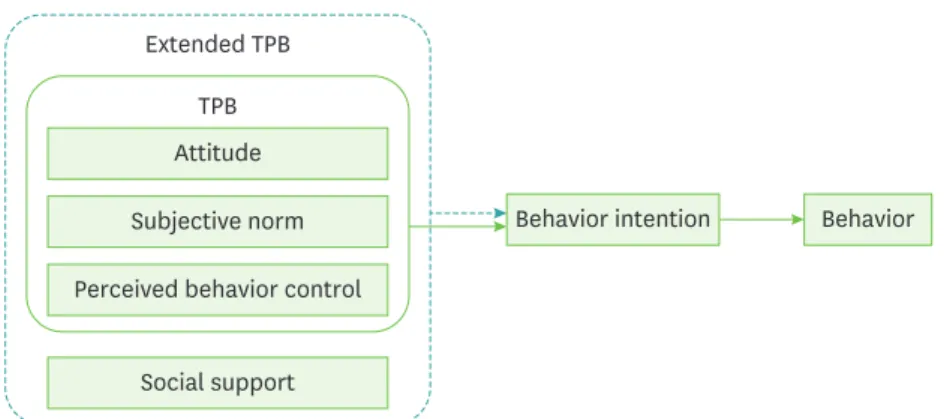
In order to explain relationships between three major constructs as well as social support and the behavioral intention, the study used a conceptual framework based on the TPB suggested by Ajzen's [9,10] (Fig. 1). The study hypotheses according to the conceptual framework are as follows: first, three constructs of TPB, i.e., attitude, subjective norms, and PBC, may be related to intention of healthy eating behavior, and second, in addition to three major constructs of TPB, social support may be additionally related to intention of healthy eating behaviors, based on the extended TPB.
Sampling population
The study population was Chinese adults residing in Beijing, China. From October to November 2020 an online survey was conducted using principles of snowballing and a survey link was circulated using social media such as the WeChat. A total of 250 adults living in Beijing voluntarily participated in an online self-filled questionnaire survey, 6 subjects with insufficient data were excluded, and a total of 244 subjects were finally eligible for the analysis. This study was approved by the Institutional Review Board (IRB) of Sangmyung University in October 2020 (SMUIRBC-2020-009).
Study questionnaire
Data on age and sex were collected. Self-reported height (cm) and weight (kg) were calculated into body mass index (BMI) and categorized as < 18.5 kg/m2, 18.5–22.9 kg/m2, 23.0–24.9 kg/
m2, 25.0–29.9 kg/m2, ≥ 30 kg/m2. Questions regarding healthy eating were obtained from previously validated items [18,19] and modification was made suitable for study population if needed. Attitudes toward healthy eating were measured by asking respondents to rate on a 5-point Likert scale for six evaluative adjectives that describe healthy eating including harmful-beneficial, useful-useless, good-bad, enjoyable-unenjoyable, boring-interesting, and desirable-undesirable [18]. The scores were reversed so that a large number represented positive attitude toward the behavior. The Cronbach alpha coefficient was 0.93.
Subjective norms were measured by asking respondents to rate on a 5-pointLikert scale (1 = strongly agree to 5 = strongly disagree) for seven statements [20]: “My family think I should engage in healthy eating”, “My friends think I should engage in healthy eating”, “My classmates and/or co-workers think I should engage in healthy eating”, “Experts (doctor, nutritionists, etc.) think I should engage in healthy eating”, “The government authorities think I should engage in healthy eating”, “TV programs I watch think I should engage in healthy eating”, “Newspapers I read think I should engage in healthy eating”. We added one items regarding internet sources: “Internet information (blogs, YouTube, etc.) I read thinks I should engage in healthy eating.” The scores were converted so that a large number would represent positive subjective norms toward the behavior. The Cronbach alpha coefficient for eight items was 0.95.
PBC was assessed by asking respondents to rate on a 5-point Likert scale four questions about whether they perceived that they have control over healthy eating (1 = definitely yes to 5 =
Behavior intention Behavior
Social support Extended TPB
Attitude Subjective norm Perceived behavior control
TPB
Fig. 1. A conceptual framework of the study.
TPB, theory of planned behavior.
enough discipline to eat healthily?” and “Do you have enough time to eat healthily?”. These questions were adapted from a previous study [18]. We added one more questions: “Do you want to eat healthy no matter what the difficulties you have?”. The scores were converted so that high score would represent high PBC. The Cronbach alpha coefficient for four items was 0.88.
Social support was assessed by asking subjects to rate on a 5-point Likert scale four statements about whether they get social support for healthy eating (1 = definitely yes to 5 = definitely no): “There are fruits and vegetables fresh and ready to eat at home”, “There are healthy snacks at home (e.g., fruits, dairy products, nuts, etc.)”, “I or my family (spouse, parents, etc.) made a healthy meal for dinner”, “My family (spouse, parents, etc.) helped me eat fruits and vegetables (when I was with my family)”, “I prepared healthy snacks (such as fruits, dairy products, nuts, etc.) or meals (when I am with my family) with my family (spouse, parents, children, etc.)”. These questions were adapted from a previous study [21].
The scores were converted so that high score would represent high social support. The Cronbach alpha coefficient for four items was 0.94.
Behavioral intention was measured by asking subjects to rate on a 5-pointLikert scale four statements including one from a previous study [19] about whether they are willing to engage in healthy eating (1 = definitely yes to 5 = definitely no): “I am willing to have a healthy meal within the next 2 weeks”, “I want to have a healthy meal in the next 2 weeks”, “I have a plan to have a healthy meal in the next 2 weeks”, “I would like to recommend healthy meals to my friends, family, and co-workers”. The scores were reversed so that a large number represented higher behavioral intention. The Cronbach alpha coefficient for four items was 0.91.
Statistical analysis
Data were expressed as means with SD (continuous) or number and percentage (categorical).
Multiple linear regression analysis was conducted to examine the relationships between three major constructs of TPB as well as social support and intention of healthy eating. Statistical analyses were performed with the SPSS software (Statistical Package for the Social Science, version 21.0; IBM, Armonk, NY, USA). Statistical significance was defined as p < 0.05.
RESULTS
General characteristics of the subject
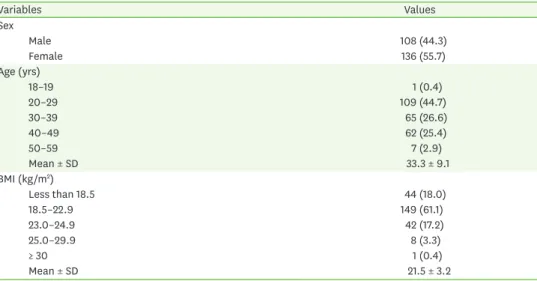
Of the 244 Chinese adults living in Beijing, 136 (55.7%) were females and mean age were 33.3
± 9.1 years (Table 1). According to BMI, 61.1% were normal weight, whereas underweight, overweight, and obesity were 18.0%, 17.2%, and 3.7%, respectively.
Constructs of TPB and social support
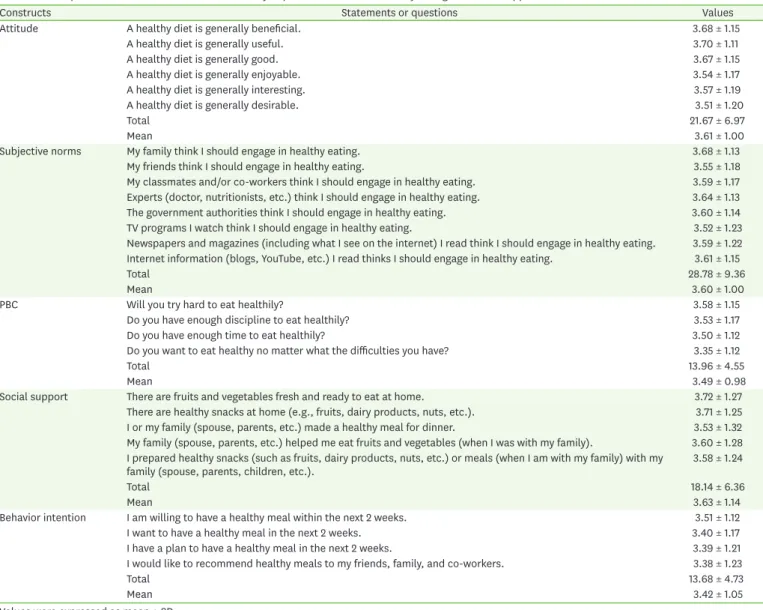
The mean values of statements of attitudes toward healthy eating ranged 3.51 (desirable- undesirable) to 3.70 (useful-useless) and the total average value was 3.61 (Table 2). The mean average scores of subjective norms regarding healthy eating were lowest at “TV programs I watch think I should engage in healthy eating” (3.52) and highest at “My family think I should engage in healthy eating” (3.68) and the total mean value of subjective norms was 3.60. The mean values of PBC questions ranged from 3.35 (“Do you want to eat healthy no matter what the difficulties you have?”) to 3.58 (“Will you try hard to eat healthily?”) and the total average score was 3.49. The average of statements of social support was from 3.53
(“I or my family (spouse, parents, etc.) made a healthy meal for dinner”) to 3.72 (“There are fruits and vegetables fresh and ready to eat at home”) and the total mean value was 3.63.
The mean value of statements of behavioral intention was ranged from 3.38 (“I would like to recommend healthy meals to my friends, family, and co-workers”) to 3.51 (“I am willing to have a healthy meal within the next 2 weeks”) and the total average was 3.42.
Relationship between three constructs of TPB and behavioral intention
The overall results relating 3 constructs of TPB and intention of healthy eating are shown in Table 3.
As subjective norms (p = 0.044) and PBC (p = 0.000) increase, behavioral intention of healthy eating increases and the model explains 76.6% of the variance of the behavioral intention.
Relationship between three constructs of TPB as well as social support, and behavioral intention
Additional inclusion of social support to the model did not increase the explanatory power of the model to explain behavioral intention of healthy eating (Table 4). Subjective norms (p
= 0.040) and PBC (p = 0.000) were still significant where social support did not significantly explain variance of the behavioral intention.
DISCUSSION
This study investigated the relationships between the constructs of TPB as well as social support and intention of healthy eating behavior in adults residing in Beijing, China through an online survey. We found a strong relationship between major constructs of TPB and intention of healthy eating. Subjective norms (p = 0.044) and PBC (p = 0.000) were significantly related to behavioral intention of healthy eating (p = 0.000) and the model explains 76.6% of the variance of the behavioral intention from the three constructs of TPB included in the multiple linear regression model. Social support was not significant and did not explain additionally of the variance of the behavioral intention. Our results suggest that subjective norm and PBC may be independent predictors for likelihood of actual healthy eating behaviors.
Table 1. General characteristics of the subjects (n = 244)
Variables Values
Sex
Male 108 (44.3)
Female 136 (55.7)
Age (yrs)
18–19 1 (0.4)
20–29 109 (44.7)
30–39 65 (26.6)
40–49 62 (25.4)
50–59 7 (2.9)
Mean ± SD 33.3 ± 9.1
BMI (kg/m2)
Less than 18.5 44 (18.0)
18.5–22.9 149 (61.1)
23.0–24.9 42 (17.2)
25.0–29.9 8 (3.3)
≥ 30 1 (0.4)
Mean ± SD 21.5 ± 3.2
Values are presented as number (%).
BMI, body mass index.
Our finding is consistent with previously reported results [12-15,18,19]. As shown in Danish adolescents [19] as well as young adults in Hong Kong [12], PBC is the strongest factor related to behavioral intention of healthy eating than any other constructs [19]. There have been limited studies investigating relationships between constructs of TPB and intention of healthy eating in adults. However, in other similar studies, PBC was the most significant factor for predicting intention to travel [22], to promote physical activity [12], and to purchase healthy food [23,24] in adults. PBC describes the perceived ease or difficulty an Table 2. Descriptive statistics of constructs of the theory of planned behavior of healthy eating and social support
Constructs Statements or questions Values
Attitude A healthy diet is generally beneficial. 3.68 ± 1.15
A healthy diet is generally useful. 3.70 ± 1.11
A healthy diet is generally good. 3.67 ± 1.15
A healthy diet is generally enjoyable. 3.54 ± 1.17
A healthy diet is generally interesting. 3.57 ± 1.19
A healthy diet is generally desirable. 3.51 ± 1.20
Total 21.67 ± 6.97
Mean 3.61 ± 1.00
Subjective norms My family think I should engage in healthy eating. 3.68 ± 1.13
My friends think I should engage in healthy eating. 3.55 ± 1.18
My classmates and/or co-workers think I should engage in healthy eating. 3.59 ± 1.17 Experts (doctor, nutritionists, etc.) think I should engage in healthy eating. 3.64 ± 1.13
The government authorities think I should engage in healthy eating. 3.60 ± 1.14
TV programs I watch think I should engage in healthy eating. 3.52 ± 1.23
Newspapers and magazines (including what I see on the internet) I read think I should engage in healthy eating. 3.59 ± 1.22 Internet information (blogs, YouTube, etc.) I read thinks I should engage in healthy eating. 3.61 ± 1.15
Total 28.78 ± 9.36
Mean 3.60 ± 1.00
PBC Will you try hard to eat healthily? 3.58 ± 1.15
Do you have enough discipline to eat healthily? 3.53 ± 1.17
Do you have enough time to eat healthily? 3.50 ± 1.12
Do you want to eat healthy no matter what the difficulties you have? 3.35 ± 1.12
Total 13.96 ± 4.55
Mean 3.49 ± 0.98
Social support There are fruits and vegetables fresh and ready to eat at home. 3.72 ± 1.27
There are healthy snacks at home (e.g., fruits, dairy products, nuts, etc.). 3.71 ± 1.25
I or my family (spouse, parents, etc.) made a healthy meal for dinner. 3.53 ± 1.32
My family (spouse, parents, etc.) helped me eat fruits and vegetables (when I was with my family). 3.60 ± 1.28 I prepared healthy snacks (such as fruits, dairy products, nuts, etc.) or meals (when I am with my family) with my
family (spouse, parents, children, etc.). 3.58 ± 1.24
Total 18.14 ± 6.36
Mean 3.63 ± 1.14
Behavior intention I am willing to have a healthy meal within the next 2 weeks. 3.51 ± 1.12
I want to have a healthy meal in the next 2 weeks. 3.40 ± 1.17
I have a plan to have a healthy meal in the next 2 weeks. 3.39 ± 1.21
I would like to recommend healthy meals to my friends, family, and co-workers. 3.38 ± 1.23
Total 13.68 ± 4.73
Mean 3.42 ± 1.05
Values were expressed as mean ± SD.
PBC, perceived behavioral control.
Table 3. Relationship between 3 major constructs of theory of planned behavior and intention of healthy eating based on a multiple regression model
Factors β1) SE p-value Adj. R2 F-value (p-value)
Intercept 0.02 0.13 0.904 0.766 266.33 (0.000)
Attitude 0.12 0.09 0.171
Subjective norm 0.19 0.09 0.044
Perceived behavioral control 0.66 0.07 0.000
R-squared means coefficient of determination for a final model.
1)Regression coefficient for intention of healthy eating for each factor.
individual has for practicing a behavior. Therefore, strategies to promote healthy eating need to enhance PBC of individuals.
Nonetheless, some studies have also shown incompatible results. In our study, subjective norms were also significantly related to intention to eat healthy, as shown in a previous study [12]. Subjective norms measure the importance others hold about practicing or not performing a behavior and one's willingness to comply to those referents. The social norm was not a significant predictor of healthy eating in Danish adolescents [19] but was a significant one in young adults in Hong Kong [12]. However, attitude, which is known as the degree to which an individual has a favorable or unfavorable evaluation of the behavior, was a significant predictor of intention to eat healthy in Danish adolescents [19] not in young adults in Hong Kong [12] and in our study population. Attitude is the degree to which an individual has a favorable or unfavorable evaluation of the behavior and subjective norms refer to the belief that a significant person or group of people will support a certain behavior [9]. Subjective norms are decided by the perceived social pressure from others for an individual to act in a certain manner and their motivation to meet with those people's views [25]. In countries like China due to its own culture, intention to behavior and/or behavior may be affected by what others expect he or she would like to do rather than by what he or she would like to do. In this regard, cultural or/and ethnic characteristics need to be considered for interpreting results, although a direct comparison is not possible due to differences in the study condition as well as in the nature of study design and sampling frame. In our study, social support was added in the Extended TPB model to investigate whether degree of social support may affect individual intention of healthy eating differently, as shown previously [16]. However, social support was not significantly related to intention of healthy eating. The use of different measurements for social support and/or degree of social support for healthy eating across study populations could lead to variable results for intention of healthy eating.
Our study had several limitations that should be addressed in further studies. Due to the epidemic of coronavirus disease 2019, we obtained data from self-reports of subjects, these data may not be as accurate as those obtained from face-to-face interviews. However, detailed description of survey items may reduce some errors of the study. Furthermore, we observed a relationship between constructs of TPB as well as social support only in a cross-sectional setting. Therefore, we were not able to determine whether subjective norms and PBC are causes or consequences of intention of healthy eating, although our study was based on the evidence- and theory-based framework. The causality needs to be evaluated in a further study in the Chinese population. Moreover, our findings need to be interpreted with caution because of the poor generalizability due to the nature of convenience sampling method.
Although Beijing is currently the political, economic, and cultural center of China, collecting samples from limited areas of China lacks generalizability as well. Several factors related to Table 4. Relationship between 3 major constructs of theory of planned behavior as well as social support and intention of healthy eating based on a multiple regression model
Factors β1) SE p-value Adj. R2 F-value (p-value)
Intercept 0.12 0.15 0.424 0.767 200.95 (0.000)
Attitude 0.12 0.09 0.155
Subjective norm 0.19 0.09 0.040
Perceived behavioral control 0.67 0.07 0.000
Social support −0.04 0.03 0.172
R-squared means coefficient of determination for a final model.
1)Regression coefficient for intention of healthy eating for each factor.
the TPB were validated previously in adolescents [18,19,21] not in adults and questions regarding social support were based on social cognitive measures [21] although reliability of survey questions ranged from 0.88 to 0.95 suitable for capturing factors related to healthy eating. Nonetheless, our study had several advantages. To the best of our knowledge, this study is the first study to investigate constructs of TPB as well as social support for healthy eating in China.
SUMMARY
In summary, subjective norms and PBC may be potential determinants of behavioral intention of healthy eating in adults residing in Beijing, China. Our study results could be used for promoting healthy eating to Chinese adults living in the urban areas. Nutrition intervention or education needs to enhance social norms and PBC for healthy eating in the study population. Large-scale intervention studies are warranted to evaluate whether social norms and PBC predict actual behaviors of healthy eating in Chinese adults.
REFERENCES
1. Rappoport L, Downey RG, Huff-Corzine L. Conceptual differences between meals. Food Qual Prefer 2001; 12(1): 9-17.
CROSSREF
2. National Health and Family Planning Commission. Report on the status of Chinese residents' nutrition and chronic diseases. Beijing; 2015.
3. National Bureau of Statistics. China statistics abstract-2017. Beijing; 2017.
4. Paeratakul S, Ferdinand DP, Champagne CM, Ryan DH, Bray GA. Fast-food consumption among US adults and children: dietary and nutrient intake profile. J Am Diet Assoc 2003; 103(10): 1332-1338.
PUBMED | CROSSREF
5. Bowman SA, Vinyard BT. Fast food consumption of U.S. adults: impact on energy and nutrient intakes and overweight status. J Am Coll Nutr 2004; 23(2): 163-168.
PUBMED | CROSSREF
6. Krishnan S, Coogan PF, Boggs DA, Rosenberg L, Palmer JR. Consumption of restaurant foods and incidence of type 2 diabetes in African American women. Am J Clin Nutr 2010; 91(2): 465-471.
PUBMED | CROSSREF
7. Prentice AM, Jebb SA. Fast foods, energy density and obesity: a possible mechanistic link. Obes Rev 2003;
4(4): 187-194.
PUBMED | CROSSREF
8. Kris-Etherton PM, Lefevre M, Mensink RP, Petersen B, Fleming J, Flickinger BD. Trans fatty acid intakes and food sources in the U.S. population: NHANES 1999–2002. Lipids 2012; 47(10): 931-940.
PUBMED | CROSSREF
9. Ajzen I, Madden TJ. Prediction of goal-directed behavior: attitudes, intentions, and perceived behavioral control. J Exp Soc Psychol 1986; 22(5): 453-474.
CROSSREF
10. Ajzen I. Theory of planned behavior. Organ Behav Hum Decis Process 1991; 50(2): 179-211.
CROSSREF
11. Jun J, Arendt SW. Understanding healthy eating behaviors at casual dining restaurants using the extended theory of planned behavior. Int J Hospit Manag 2016; 53(2): 106-115.
CROSSREF
12. Cheng OY, Yam CLY, Cheung NS, Lee PLP, Ngai MC, Lin CY. Extended theory of planned behavior on eating and physical activity. Am J Health Behav 2019; 43(3): 569-581.
PUBMED | CROSSREF
13. Watanabe T, Berry TR, Willows ND, Bell RC. Assessing intentions to eat low-glycemic index foods by adults with diabetes using a new questionnaire based on the theory of planned behaviour. Can J Diabetes 2015; 39(2): 94-100.
PUBMED | CROSSREF
14. Blue CL. Does the theory of planned behavior identify diabetes-related cognitions for intention to be physically active and eat a healthy diet? Public Health Nurs 2007; 24(2): 141-150.
PUBMED | CROSSREF
15. Fila SA, Smith C. Applying the theory of planned behavior to healthy eating behaviors in urban Native American youth. Int J Behav Nutr Phys Act 2006; 3(1): 11.
PUBMED | CROSSREF
16. Paul CJ, Paul JE, Anderson RS. The local food environment and food security: the health behavior role of social capital. Int J Environ Res Public Health 2019; 16(24): 5045.
PUBMED | CROSSREF
17. State Statistics Bureau. China statistical yearbook 2012. Beijing; 2012.
18. Wu T, Snider JB, Floyd MR, Florence JE, Stoots JM, Makamey MI. Intention for healthy eating among Southern Appalachian teens. Am J Health Behav 2009; 33(2): 115-124.
PUBMED | CROSSREF
19. Grønhøj A, Bech‐Larsen T, Chan K, Tsang L. Using theory of planned behavior to predicthealthy eating among Danish adolescents. Health Educ 2012; 113(1): 4-17.
CROSSREF
20. Chan K. Mass communication and pro-environmental behavior: wasterecycling in Hong Kong. J Environ Manage 1998; 52(4): 317-325.
CROSSREF
21. Dewar DL, Lubans DR, Plotnikoff RC, Morgan PJ. Development and evaluation of social cognitive measures related to adolescent dietary behaviors. Int J Behav Nutr Phys Act 2012; 9(1): 36.
PUBMED | CROSSREF
22. Lam T, Hsu CHC. Predicting behavioral intention of choosing a travel destination. Tour Manage 2006;
27(4): 589-599.
CROSSREF
23. Cook AJ, Kerr GN, Moore K. Attitudes and intentions towards purchasing GM food. J Econ Psychol 2002;
23(5): 557-572.
CROSSREF
24. Lim HR, An S. Intention to purchase wellbeing food among Korean consumers: an application of the theory of planned behavior. Food Qual Prefer 2021; 88(3): 104101.
PUBMED | CROSSREF
25. Krueger NF Jr, Reilly MD Jr, Carsrud AL. Competing models of entrepreneurial intentions. J Bus Venturing 2000; 15(5-6): 411-432.
CROSSREF