Printed in the Republic of Korea
단 신
π-다리로 연결된 디-페로센의 전기화학적 특성
손경인 ․ 강선영 ․ 오율의 ․ 노동윤*
서울여자대학교 화학과 (2008. 11. 20 접수)
Electrochemical Properties of Di-ferrocenes Linked by π-Bridge
Kyung-In Son, Sun-Young Kang, Youl Eui Oh and Dong-Youn Noh*
Department of Chemistry, Seoul Women's University, Seoul 139-774, Korea (Received November 20, 2008)
주제어: 페로세닐 칼콘, 탈용매 반응, 전기화학
Keywords: Ferrocenyl chalcone, Solvent-free reaction, Electrochemistry
Ferrocene (C10H10Fe: bis(η5-cyclopentadienyl)iron:
Fc) is known as a good electron donor molecule
showing one reversible redox cycle.1 This is one of the reasons why ferrocene is widely used as the main component of electronic, optical and biolo- gically-active materials. Especially, multi-ferrocenyl compounds are frequently studied in the research field of intra-molecular electron-transfer processes.Di-ferrocene compounds linked by a polyethylene moiety (Fc(CH = CH)mFc: dFcEm) are the typical system studied by many researchers.2 The number and the geometry of ethylene linkage are the critical factors which control the efficiency of electron- transfer in this system. In this study, we prepared and spectroscopically characterized a di-ferrocenyl compound in which two ferrocenyl groups are linked by an enone moiety (Fc-C(O)CH = CH-Fc:
Fc-Fc). The electron-transfer behavior of this
compound was investigated electrochemically and compared with that of 1,2-diferrocenylethylene (dFcE). This is a part of series of studies of ferrocenyl chalcones.3EXPERIMENTAL General Methods
Acetylferrocene (ActFc), ferrocenecarboxaldehyde
(FcAld) and HPLC-grade organic solvents were commercially purchased (Aldrich) and used as received.
The FT-IR spectra were recorded on a MIDAC FT-IR spectrometer within the range of 4000 ~ 400 cm-1. The UV-Vis spectra were measured on an HP 8452A diode array spectrophotometer. The
1H NMR spectra were obtained on a Bruker Avance 500 using CDCl3 as a solvent. The mass spectra were obtained on a JMS-700 Mstation by fast atom bombardment (FAB). The electrochemical studies were carried out at room temperature with a CHI 620A Electrochemical Analyzer (CHI Instrument Inc.) under the following conditions: 1.0 mM sam- ples in MeCN containing 0.1 M n-Bu4N․BF4 using a Pt-button (r = 1 mm) working electrode, Ag/AgCl reference electrode and Pt-wire (ϕ = 1 mm) coun- ter electrode at a scan rate of 50 mV s-1. The poten- tials were referenced to that of Fc/Fc+ (E1/2 = +0.464 V vs. Ag/AgCl).
Preparation of Fc-Fc
A mixture of ActFc (1 mmol, 228 mg), FcAld (1 mmol, 214 mg) and NaOH (5 mmol, 200 mg) was ground with an agate mortar and a pestle. This mixture was allowed to stand in a water bath (85
°C) for 30 min. The final product was extracted
Fe O
Fe O
+ Fe
OHC
Fe
ActFc FcAld Fc-Fc
Fe Fe
CHO Fe
T i C l4/ Z n
FcAld dFcE N a O H
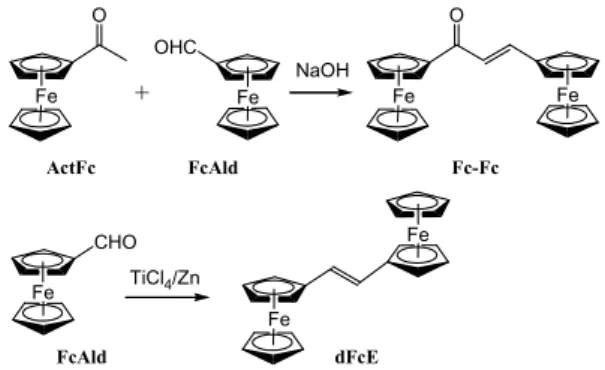
Scheme 1. Syntheses of Fc-Fc and dFcE.
Fig. 1. Energy-minimized structures of Fc-Fc with s-cis conformation calculated by using DMol3 method.
with CH2Cl2 and the solution was dried with MgSO4. After filtration, the solvent was removed at reduced pressure and the final product was sepa- rated from the residue by column chromatography (SiO2, CH2Cl2). Yield: 63% (267 mg). Wine-red colored powder. Mp: 208~209oC. Elemental anal- ysis: Cal. (Obs.) for C23H20Fe2O: C, 65.14 (65.28);
H, 4.75 (4.75). FAB-MS(m/z, %): 424.1 (M+, 100), 359.1 ([M-C5H5]+, 17), 307.3 ([M-Fe(C5H5)+4H]+, 10). FT-IR (KBr, cm-1): 3089 (Cp C-H), 1664, 1641 (C=O), 1574, 1448, 1290, 1248 (C=C), 826 (Cp C-H), 674 (C-H), 512, 481 (Cp-Fe). 1H NMR (500 MHz, CDCl3, ppm): 7.71 (1H, CH, d, J = 15.4 Hz), 6.75 (1H, CH, d, J = 15.4 Hz), 4.88 (2H, C5H4, t, J = 1.9 Hz), 4.60 (2H, C5H4, t, J = 1.8 Hz), 4.56 (2H, C5H4, t, J = 1.9 Hz), 4.47 (2H, C5H4, t, J
= 1.8 Hz), 4.20 (5H, C5H5, s), 4.19 (5H, C5H5, s).
UV-vis (nm): 314, 382, 492 (MeCN); 250, 316, 386, 500 (CHCl3); 320, 386, 510 (EtOH); 322, 394, 488, 512 (MeOH).
Preparation of dFcE
1,2-Diferrocenylethylene (dFcE) was synthe- sized by the McMurry coupling method4 using
FcAld and a low-valence titanium compound pre-
pared in a TiCl4 and Zn powder mixture, as de- scribed in a previous report.5 This compound was characterized spectroscopically and confirmed to be identical with that prepared before.5RESULTS AND DISCUSSION Synthesis and Characterization
Fc-Fc was synthesized by solvent-free aldol
condensation using ActFc and FcAld with NaOH as a base catalyst. The purification of Fc-Fc was easily achieved by column chromatography using CH2Cl2 as the eluent, giving rise to a moderate yield (63%). In this reaction, using stoichiometric amounts of the reactants is important to reduce the amount of side products. For example, the product (Fc-Fc) can react further with an excess of the ace- tyl reactant to produce 1,5-pentadione derivatives via Michael addition reaction.6 The purified prod- uct was characterized by elemental analysis to-gether with the FAB-mass, FT-IR, 1H-NMR and UV-Vis spectroscopic methods. The FAB-MS da- ta show the mother peak (M+) at 424.1 for Fc-Fc with 100% intensity and the successive loss of the Cp and FeCp moieties at m/z = 359.1 and 307.3, respectively. The ν(C=O) of ActFc was observed at 1663 cm-1, which shifts to a lower frequency (1641 cm-1) for Fc-Fc. This is due to the delocali- zation of the π-electrons on the carbonyl and ethyl- ene moieties in the enon linkage. The NMR spec- tra measured at room temperature show two dou- blets at 7.71 ppm (J = 15.4 Hz) and 6.75 ppm (J = 15.4 Hz) together with other peaks from the ferro- cenyl moieties, indicating that the ethylene moiety in the enon linkage is in the trans-conformation.7
Statistically, four isomers (two s-cis and two s-trans conformational isomers) are possible as the reaction product, among which the minimized energy structures of Fc-Fc with the s-cis con- formation8 are shown in Fig. 1. This may be one of the reasons why the Fc-Fc compound was pre- cipitated as a reddish-brown powder, rather than being grown as single crystals, when it was re- crystallized in many appropriate solvent pairs such as CH2Cl2/n-Hx, CH2Cl2/ether, CH2Cl2/EtOH, etc.
Furthermore, the techniques of electrochemical
Table 1. The cyclic voltammetry parameters for Fc-Fc, dFcE and their reactants.a
Compound Anodic Cathodic
E1/2 b ∆Eo c
Epa1 Epa2 Epc1 Epc2
ActFc 0.745 0.679 0.712
FcAld 0.787 0.717 0.752
Fc-Fc 0.611 0.551 0.581 0.165
0.781 0.711 0.746
dFcE 0.456 0.351 0.404 0.173
0.621 0.532 0.577
aThe samples are dissolved in MeCN containing 0.1 M n-Bu4N·BF4 electrolyte, and the potentials (in volt) are referenced to Fc/Fc+ (E1/2 = +0. 464 V vs. Ag/AgCl). bE1/2 = (Epa + Epc)/2. c∆Eo = E1/22 - E1/21.
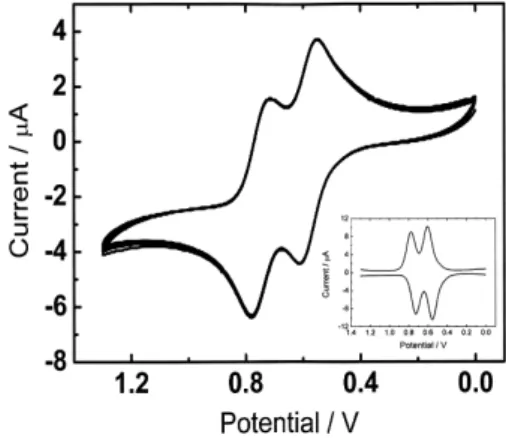
Fig. 2. The cyclic voltammogram (CV) scanned 10 times repeatedly between 0 V and +1.3 V and corresponding differential pulse voltammograms (DPV; inset) of the Fc-Fc compound (vs. Ag/AgCl).
Fig. 3. The cyclic voltammogram (CV) scanned 5 times repeatedly between 0 V and +1.0 V and corre- sponding differential pulse voltammograms (DPV; in- set) of the dFcE compound (vs. Ag/AgCl).
oxidation using an n-Bu4N․PF6 electrolyte and chemical oxidation with I2, TCNQ or F4TCNQ were not effective to obtain a single crystal of the Fc-Fc charge-transfer salt, for the same reason.
Electrochemical Study
The cyclic voltammetry (CV) and differential pulse voltammetry (DPV) results for Fc-Fc and
dFcE are shown in Fig. 2 and 3, respectively. The
electrochemical parameters are listed and com- pared with those of the reactants in Table 1. Both complexes show two reversible and reproducible cycles on a repeated scan between 0~1.3 V, irre- spective of the working electrodes (Pt, Au or glassy carbon), corresponding to the two redox processes of the ferrocenyl moieties (Fc+ ↔ Fc). The firsthalf-wave potential of dFcE (E1/21 = 0.404 V) is smaller than that of Fc-Fc (E1/21 = 0.581 V) and even smaller than those of ActFc (E1/21 = 0.712 V) and FcAld (E1/21 = 0.752 V). Based on the results of the MO calculation9 on the simplified com- pounds (Fig. 4), in which the ferrocenyl moieties were replaced with cyclopentadienyl rings, the electrons in the HOMO are mainly located on the Cp-C(O)CH=CH- part of Cp-C(O)CH=CH-Cp, while they are on the Cp part of Cp-CH=CH-Cp.
It can be inferred from this result that the E1/21 val- ue of dFcE is smaller than that of Fc-Fc. On the contrary, the difference between E1/21 and E1/22 for
dFcE (∆E
o = 173 mV) is slightly larger than that for Fc-Fc (165 mV). As the ∆Eo value is closely re- lated to the measure of repulsive energy between(A) (B)
Fig. 4. HOMO of (A) Cp-C(O)CH=CH-Cp (N = 34, -11.920 eV) and (B) Cp-CH=CH-Cp (N = 29, -12.408 eV).
These are the model compounds in which the ferrocenyl moieties in Fc-Fc and dFcE are replaced with cyclo- pentadienyl rings for the simplification of the calculation.
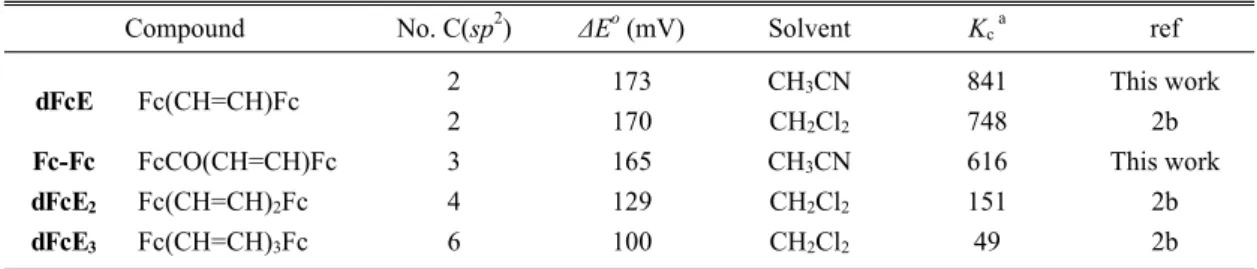
Table 2. The comparison of ∆Eo (mV) and Kc values of the diferrocenyl compounds.
Compound No. C(sp2) ∆Eo (mV) Solvent Kc a ref
dFcE Fc(CH=CH)Fc 2 173 CH3CN 841 This work
2 170 CH2Cl2 748 2b
Fc-Fc FcCO(CH=CH)Fc 3 165 CH3CN 616 This work
dFcE2 Fc(CH=CH)2Fc 4 129 CH2Cl2 151 2b
dFcE3 Fc(CH=CH)3Fc 6 100 CH2Cl2 49 2b
a∆Eo = (RT/F) ln Kc = (25.69) ln Kcat 298K.
[Fe(II)-Fe(II)] n1e-
E1o [Fe(II)-Fe(III)]
n2e-
E2o [Fe(III)-Fe(III)]
At equilibrium,
[Fe(II)-Fe(II)] + [Fe(III)-Fe(III)]
Kc 2[Fe(II)-Fe(III)]
Kc = exp[∆Eo n1 n2 F / RT]
the two charged centers (that is, the Coulomb re- pulsion energy), it can be expressed by the com- proportionation constant (Kc) of the successive re- dox processes of the di-ferrocenyl system, as de- scribed below:10
where n1 = n2 = 1, ∆Eo = E2o-E1o and Kc = exp[∆Eo/ 25.69] at 298K. This gives Kc = exp(165/25.69) ≈ 616 for Fc-Fc and Kc = exp(173/25.69) ≈ 841 for
dFcE. These K
c values are compared with those ofdFcE
m (m = 1, 2 and 3)2b in Table 2. The results clearly show that the number of sp2 carbon atomsbetween the redox active ferrocenyl centers of the
dFcE
m system is inversely proportional to the Kcvalue. It is noteworthy that the Kc value for Fc-Fc (No. C(sp2) = 3) is closer to that of dFcE (No. C(sp2) = 2), than that of dFcE2 (No. C(sp2) = 4), even though the enone bridge contains an additional ketone moiety. In other words, we can surmise that the additional antibonding π-orbital on the ketone moi- ety does not significantly inhibit the intramolecular electron-transfer process. Moreover, it should also be pointed out that the solvents used in the CV measurement (CH3CN and CH2Cl2) do not af- fect the results seriously enough to cause a devia- tion from this trend.
In conclusion, it is demonstrated herein that the enone is as effective a bridging group as the ethyl- ene moiety, in terms of its accommodation of elec- tronic communication between the two redox ac- tive ferrocenyl groups.
Acknowledgments. This work was supported by
a Research Grant from Seoul Women's University (2007).REFERENCES
1. Hayashi, T.; Togni, A. (eds.), Ferrocenes, VCH, Weinheim, 1995.
2. (a) Tolbert, L. M.; Zhao, X.; Ding, Y.; Bottomley, L.
A. J. Am. Chem. Soc., 1995, 117, 12891. (b) Ribou, A. C.; Launay, J. P.; Sachtleben, M. L.; Li, H.;
Spangler, C. W. Inorg. Chem., 1996, 35, 3735-3740.
(c) Dong, T. Y.; Lin, P. J.; Lin, K. J. Inorg. Chem., 1996, 35, 6037. (d) Dong, T. Y.; Chang, C. K.; Lee, S. H.; Lai, L. L.; Chiang, M. Y.; Lin, K. J. Organomet., 1997, 16, 5816. (e) Heigl, O. M.; Herker, M. A.;
Hiller, W.; Kohler, F. H.; Schell, A. J. Organomet.
Chem., 1999, 574, 94.
3. (a) Jung, Y. J.; Son, K.-I.; Oh, Y. E.; Noh, D.-Y.
Polyhedron, 2008, 27, 861. (b) Son, K.-I.; Noh, D.-Y.
J. Korean Chem. Soc. 2007, 51, 591.
4. (a) McMurry, J. E. Acc. Chem. Res., 1974, 7, 281.
(b) McMurry, J. E.; Fleming, M. P.; Kees, K. L.;
Krepski, L. R. J. Org. Chem., 1978, 43, 3255. (c) Takimiya, K.; Shibata, Y.; Ohnishi, A.; Aso, Y.;
Otsubo, T.; Ogura, F. J. Mater. Chem., 1995, 5, 1539.
5. Lee, H. J.; Noh, D. Y. J. Mater. Chem. 2000, 10, 2167.
6. Yang, J.-X.; Tao, X.-T.; Yuan, C. X.; Yan, Y. X.;
Wang, L.; Liu, Z.; Ren, Y.; Jiang, M. H. J. Am. Chem.
Soc., 2005, 127, 3278.
7. Silverstein, R. M.; Bassler, G. C.; Morrill, T. C.
Spectroscopic Identification of Organic Compounds, 5th ed., John Wiley, Singapore, 1991.
8. MS Visualizer 4.3, Accelrys.
9. Chem3D Ultra, ver. 10.0, ChemOffice, CambridgeSoft.
10. Richardson, D. E.; Taube, H. Inorg. Chem., 1981, 20, 1278.