Journal of the Korean Chemical Society
2005, Vol. 49, No. 6
Printed in the Republic of Korea
-613-
단 신
Cp2TiCl2를 촉매로 한 LiBH4에 의한 gem-Dibromocyclopropanes의 Cyclopropanes으로의 탈브롬화반응
이갑용*·이형수
대구가톨릭대학교화학과
(2005. 9. 27 접수)
Cp2TiCl2 Catalyzed Debromination of gem-Dibromocyclopropanes to Cyclopropanes by LiBH4
Gab Yong Lee*and Hyung Soo Lee
Department of Chemistry, Catholic University of Daegu, Gyeongsan, Gyeongbuk 712-702, Korea (Received September 27, 2005)
주제어: 탈브롬화반응, 선택성, Cp2TiCl2,LiBH4,촉매 Keywords: Debromination, Selectivity, Cp2TiCl2,LiBH4,Catalyst
INTRODUCTION
The reduction of halogen derivatives of hydrocar- bons is very efficient and reliable procedure in organic synthesis, and a number of reducing agents for this have been reported.1 For dehalogenations, gem-dihalocyclopropanes have been shown to be extremely valuable starting materials for the prepa- ration of cyclopropane and cyclopropene deriva- tives.2 The reduction of gem-dihalocyclopropanes to monohalocyclopropanes has been effected by various reducing reagents such as organotin hydride,3a Grignard reagent,3b chromium sulfate,3c lithium alu- minum hydride,3d,e sodium borohydride,3f potassium diphenyl phosphide,3g sodium hydrogen telluride,3h and silver perchlorate.3i Titanium complexes serve as a catalyst for the dehalogenation such as the reduction of aromatic halides with NaBH4,4a,b the dehalogenation of organic halides by RMgX,4c the defluorination of perfluorodecalin by using Al/HgCl2,4d and the dehalogenation of monohalopyridines with Red-Al.4e The reductive debromination of vic- dibromides to alkenes by using Cp2TiCl2/Zn combi- nation reagent5a or Cp2TiCl2/In system5b was also
reported. Cp2ZrCl2 has been used for the catalytic dehalogenation of aromatic halides by alkylmagne- sium reagents6a and the stoichiometric hydrolysis of aromatic perfluorocarbons using Mg/HgCl2.6b How- ever, these methods have not been achieved for the direct conversion of gem-dibromocyclopropanes to cyclopropane as a practical method. During the course of our studies on reactionsof unsaturated hydrocarbons catalyzed by titanium or zirconium complexes,7 we found the debromination of gem- dibromocyclopropanes with LiBH4 to cyclopro- panes catalyzed by Cp2TiCl2 in THF (eq. 1).
(1)
EXPERIMENTAL SECTION
All glassware used was predried in an oven, assembled hot and cooled with a stream of argon in glove box. All reactions were carried out under
Journal of the Korean Chemical Society
614 이갑용·이형수
argon atmosphere. All solvents were distilled and stored over an appropriate drying agent. Cp2TiCl2,
LiBH4,NaBH4,and LiAlH4 were purchased from Strem Co., and used without further purification.
Other reagents were purified before use. 1H NMR spectra were recorded in CCl4 on Varian Gemini- 200 spectrometer with tetramethylsilane as an inter- nal standard. Infrared spectra were measured in a KBr pellet with a Matterson Genesis FT-IR II spec- trophotometer. GC analyses were carried out with a Younglin GC-600D gas chromatograph equipped with HP-5 (Hewlett Packard, 0.32 mm, 30 m) cap- illary columns. Mass spectra were obtained using a Shimadzu GC/MS QP-5050.
Preparation of 1,1-dibromo-2,2-diphenylcyclo- propane.A mixture of 1,1-diphenylethene (10.48 g, 58.0 mmol), bromoform (30.33 g, 120.0 mmol), and N,N-dimethyl-n-dodecylamine (0.239 g, 1.12 mmol) was stirred in benzene (15 mL). 50%
Sodium hydroxide (80 mL) was added dropwise to the solution, the reaction mixture was stirred vigor- ously at 50oC for 4 h. The mixture was treated with dilute hydrochloric acid (100 mL) and extracted with diethyl ether/benzene(1/1) (3×30 mL). The organic layer was dried over magnesium sulfate, and the solvent was removed under reduced pres- sure. Recrystallization of the product from benzene gave 1,1-dibromo-2,2-diphenylcyclopropane (11.3 g, 55%). mp. 154~156oC, 1H NMR (CCl4): δ7.14 ~7.46 (m, 10H, Ar), 2.39 (s. 2H, CH2), IR (cm-1): 3029, 1595, 1446, 1162, 669. Mass m/e 350 (M+), 352 (M++2), 354 (M++4).
gem-Dibromocyclopropanes were prepared from
appropriate alkenes and dibromocarbene by the reported procedure.9
Typical procedure for debromination of 1,1- dibromo-2-phenylcyclopropane to phenylcyclo- propane. The mixture of Cp2TiCl2 (1.01 g, 4.04 mmol), LiBH4 (0.894 g, 41.1 mmol), and THF (25 mL) was placed in a vessel under argon. After stirring for 1 h, and 1,1-dibromo-2-phenylcyclopropane (4.40 g, 15.9 mmol) in THF (15 mL) was slowly introduced to the mixture at 40oC. The complete reaction was confirmed by GC, and the mixture was treated with dilute hydrochloric acid (20 mL) and extracted with diethyl ether. The organic layer was dried over sodium sulfate, and the solvent was evaporated under reduced pressure. The residue was purified by column chro- matography on silica-gel with n-hexane (1.13 g, 60 %).
The distillation of the residue gave phenylcyclopro- pane under reduced pressure (bp. 62~63oC/13 mm).
1H NMR (CCl4): δ7.08~7.23 (m, 5H, Ar), 1.70~2.51 (m, 1H, CH), 0.62~1.10 (m, 4H, CH2), IR (cm-1):
3028, 1595, 1446, 1162, 729, 699.
The products are already reported (in the litera- ture) and were characterized by comparison with authentic samples using GC and spectral data.
RESULTS AND DISCUSSION
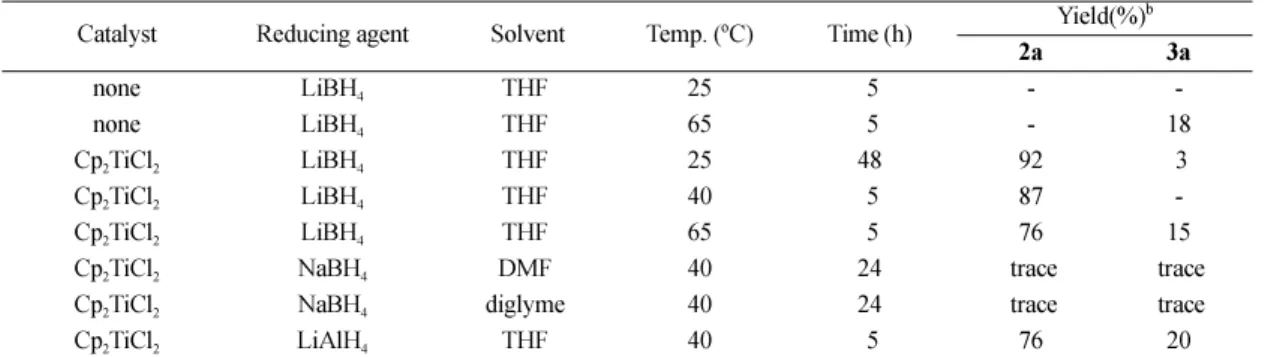
The debromination of 1,1-dibromo-2-phenylcy- clopropane (1a) in the presence of catalytic amounts of Cp2TiCl2 was examined in THF under various reaction conditions (Table 1). In the reaction of 1a (4.1 mmol) with LiBH4 (10.1 mmol) in THF (15 mL) in the absence of Cp2TiCl2 at 25oC for 5 h, phenyl-
Table 1. Debromination of 1a catalyzed by Cp2TiCl2 under various conditionsa
Catalyst Reducing agent Solvent Temp. (oC) Time (h) Yield(%)b
2a 3a
none LiBH4 THF 25 5 - -
none LiBH4 THF 65 5 - 18
Cp2TiCl2 LiBH4 THF 25 48 92 3
Cp2TiCl2 LiBH4 THF 40 5 87 -
Cp2TiCl2 LiBH4 THF 65 5 76 15
Cp2TiCl2 NaBH4 DMF 40 24 trace trace
Cp2TiCl2 NaBH4 diglyme 40 24 trace trace
Cp2TiCl2 LiAlH4 THF 40 5 76 20
aCatalyst: reducing agent : 1a = 1 : 10 : 4. bGC yields.
Cp2TiCl2를촉매로한 LiBH4에의한gem-Dibromocyclopropanes의 Cyclopropanes으로의탈브롬화반응 615
2005, Vol. 49, No. 6
cyclopropane (2a) was not obtained and 1a was mostly recovered, but 1-bromo-2-phenylcyclopro- pane (3a) was obtained in 18% yield at 65oC for 5 h. Addition of catalytic amounts of Cp2TiCl2 (1.1 mmol)to themixture of 1a and LiBH4 in THF pro- moted the debromination of 1a to 2a at 25oC, but the reaction proceeded very slowly (48 h). The reaction of 1a occurred smoothly at 40oC for 5 h to give 2a as a major product in an excellent yield, but 2a and 3a were obtained at 65oC for 5 h in 76%
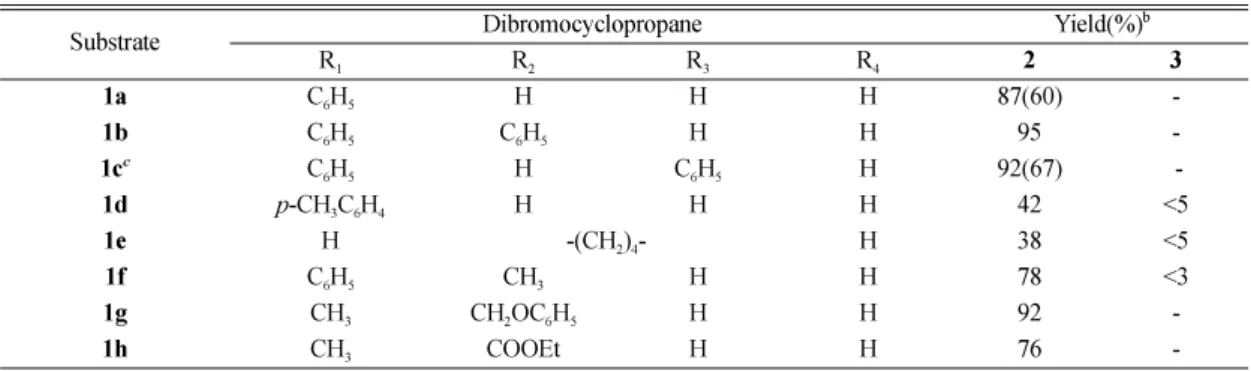
and 15% yields, respectively. The reaction of 1a with equimolar amounts of Cp2TiCl2 afforded 2a in 98 % yield without formation of the expected cou- pling products.4c The reduction of aryl halides with NaBH4 catalyzed by Cp2TiCl2 was reported to be solvent dependent.4b Therefore, we examined the debromination of 1a to 2a with NaBH4 at 40oC in DMF and diglyme, respectively, but these reactions were not achieved under the same reaction condi- tions. The reactions required long reaction times or elevated temperatures.4a,b The similar reduction of 1a with LiAlH4 instead of LiBH4 was tested, 2a and 3awere obtained in 76% and 20% yields, respec- tively.The selectivity of Cp2TiCl2-LiAlH4 system shows poorer than that of Cp2TiCl2-LiBH4 system for the reduction of gem-dibromocyclopropanes to cyclo- propanes. The debromination of gem-dibromocy- clopropanes with LiBH4 catalyzed by Cp2TiCl2 in THF at 40oC was found to be superior and selec- tively proceeded to give cyclopropanes. The results are listed in Table 2. As shown in Table 2, the debromination of gem-dibromocyclopropanes with phenyl groups (1a~1c) occurred to give the corre-
sponding cyclopropanes in an excellent yields, but the yields of cyclopropanes with p-tolyl and alkyl groups (1d, 1e) were low and monobromocyclopro- panes (3d, 3e) were little obtained with recovery of the substrates in high yields. The product yields are considerably affected by the electronic nature of substit- uents on the gem-dibromocyclopropanes. The reduction of trans-1c was achieved to give trans-2c. The debromination of 1g and 1h smoothly pro- ceeded without a cleavage of C-O bond. The debro- minations are chemoselective as ether and ester groups remained unaffected under the reaction con- ditions.5b,6a Also, the dechlorination of 1,1-dichloro- 2,2-diphenylcyclopropanewas appliedto thisreagent system. This reaction hardly occurred under the same conditions, and required a elevated tempera- ture (65oC) and a longer time to complete the reac- tion (>48 h).4a Deuterolysis after the reaction of 1b with LiBH4 did not give any trace of deuterated 1,1- diphenylcyclopropanes, but the reaction of 1b with LiBD4 gave dideuterated 1,1-diphenylcyclopropane.
The source of hydrogen in this reaction should be derived from LiBH4. The reaction mechanism is not clear yet. However, we would like to consider pos- sible paths on Cp2TiCl2 catalyzed debromination of gem-dibromocyclopropanes by LiBH4. One involves a oxidative addittion/reductive elimination to the low valence titanium complex species.6 Another possi- ble path is a radical reaction involving reduced titanium complex catalysts.4b Although the role of Cp2TiCl2 is still not clarified, it is likely that reduc- tion of Cp2TiCl2(IV) with LiBH4 provides low valent titanium, which reacts with gem-dibromocyclopro-
Table2.Debromination of gem-dibromocyclopropanesa
Substrate Dibromocyclopropane Yield(%)b
R1 R2 R3 R4 2 3
1a C6H5 H H H 87(60) -
1b C6H5 C6H5 H H 95 -
1cc C6H5 H C6H5 H 92(67) -
1d p-CH3C6H4 H H H 42 <5
1e H -(CH2)4- H 38 <5
1f C6H5 CH3 H H 78 <3
1g CH3 CH2OC6H5 H H 92 -
1h CH3 COOEt H H 76 -
aCp2TiCl2 : LiBH4 : substrate = 1 : 10 : 4, 40oC, 5 h. bGC yields, isolated yields in parenthesis. cTrans type.
Journal of the Korean Chemical Society
616 이갑용·이형수
panes to give cyclopropanes.9 The actual reaction might be further complicated with multiple paths.
Although the scope and limitations were not fully established, the present method could be a practical alternative to conventional method.
REFERENCES
1. Hudlický, M. Reductions in Organic Chemistry; Ellis Horwood: Chichester, England, 1984; pp. 62-69.
2. (a) Masakzu, Y.; Rikisaku, S. Terahedron Lett. 1991, 32, 3349.(b) Shim, S. C.; Lee, S. Y.; Lee, D. Y.; Choi, H. J. Bull. Korean. Chem. Soc.1994, 15, 845 and ref- erences cited therein.
3. (a) Sayferth. D.; Yamazaki, H.; Alleston, D. L. J. Org.
Chem. 1963, 28. 703. (b) Seyferth, D.; Prokai, B. J.
Org. Chem.1966, 31, 1702. (c) Kobrich, G.; Goyert, W.
Tetrahedron, 1963, 24, 4327. (d) Yamanaka, H.; Yagi, T.; Teramura, K.; Ando, T. J. Chem. Soc. D. 1971, 380.
(e) Jefford, C.; Kirkpatrick, D.; Delay, F. J. Am. Chem.
Soc. 1972, 94, 8905. (f) Groves, J.; Ma, K. W. J. Am.
Chem. Soc.1974, 96, 6527. (g) Meijs, G. F. J. Org.
Chem. 1987, 52, 3923. (h) Osuka, A.; Takechi, K.;
Suzuki, H. Bull. Chem. Soc. Jpn. 1984, 57, 303. (i) Shimizu, N.; Watanabe, K.; Tsuno, Y. Chem. Lett, 1983, 1877.
4. (a) Meunier, B. J. Organomet. Chem. 1981, 204, 345.
(b) Liu, Y.; Schwartz, J. Tetrahedron, 1995, 51, 4471.
(c) Yanlong, Q.; Guisheng, L.; Huang, Y-Z. J. Orga- nomet. Chem. 1990, 381, 29. (d) Kiplinger, J. L.; Rich- mond, T. G. J. Am. Chem. Soc. 1996, 118, 1805. (e) Woo, H-G.; Kim, B-H.; Song, S-J. Bull. Korean Chem.
Soc.1999, 20, 865.
5. (a) Davies, S. G.; Thomas, S. E. Synthesis, 1984, 1027.
(b) Yoo, B. W.; Choi, K. H.; Ko, J. J.; Nam, G. S.;
Chang, K. Y.; Choi, K. I.; Kim, J. H. Bull. Korean Chem. Soc.2001, 22, 541.
6. (a) Hara. R.; Sun, W-H.; Nishihara, Y.; Takahashi, T.
Chem. Lett. 1997, 1251. (b) Kiplinger, J. L.; Richmond, T. G. J.Chem. Soc. Chem. Commun. 1996, 1115.
7. (a) Isagawa, K.; Sano, H.; Hattori, M. Otsuji, Y. Chem.
Lett. 1979, 1069. (b) Lee, H. S.; Isagawa, K.; Otsuji, Y.
Chem. Lett.1984, 363. (c) Lee, H. S.; Isagawa, K.; Toy- oda, H.; Otsuji, Y. Chem. Lett.1984, 673. (d) Lee, H.
S.; Bull. Korean Chem. Soc.1987, 8, 484. (e) Lee, H, S.; J. KoreanChem. Soc. 1988, 32, 79. (f) Lee, H. S.;
Lee, H. Y. Bull. Korean Chem. Soc.2000, 21, 451. (g) Lee, H, S.; Kim, C. E. J. KoreanChem. Soc. 2003, 47, 297. (h) Lee, H. S.; Lee, G. Y. Bull. Korean Chem. Soc.
2005, 26, 461. (i) Lee, H. S.; Lee, G. Y. J. Korean Chem. Soc.2005, 49, 321.
8. Kadlec, V.; Kadlecová, H.; trouf, O. J. Organomet.
Chem. 1974, 82, 113.
9. (a) Dohmlow, E. V.; Schönefeld, J. Liebigs Ann. Chem.
1971, 744, 42. (b) Isagawa, K.; Kimura, Y.; Kwon, S.
J. Org. Chem.1974, 39, 3176.
S
ˇ.