The Effect of Curcumin Supplementation and Aerobic Training on Anthropometric Indices, Serum Lipid
Profiles, C-Reactive Protein and Insulin Resistance in Overweight Women: A Randomized, Double-Blind, Placebo-Controlled Trial
Sepideh Dolati
1, Khoosheh Namiranian
2, Reyhaneh Amerian
3, Samane Mansouri
4, Sajad Arshadi
5, Mohammad Ali Azarbayjani
5,*
1
Department of Nutrition, Ministry of Health, Tehran;
2Department of Health Tehran University of Medical Sciences, Tehran;
3Department of Exercise Physiology, Faculty of Physical Education, Islamic Azad University of Tehran, Tehran;
4Nutrition Group, Abadan School of Medical Sciences, Abadan;
5Department of Exercise Physiology, Faculty of Physical Education and Sports Science, Islamic Azad University, Central Tehran Branch, Tehran, Iran
Background: This study aimed to investigate the effects of curcumin supplementation alone and in combina- tion with aerobic training on body composition, glycemic variables, serum levels of C-reactive protein (CRP) and lipid profiles in overweight women.
Methods: In this randomized, double-blind, placebo-controlled trial, 40 healthy sedentary overweight females (aged 30–45 years with body mass index [BMI] of 25–30 kg/m
2) were randomly assigned to four groups of 10 subjects each: curcumin supplementation (Cur), placebo (Pla), placebo+aerobic training (Pla+Tra), curcumin supplementation+aerobic training (Cur+Tra). Curcumin or placebo capsules (500 mg/day) were administered for 8 weeks.
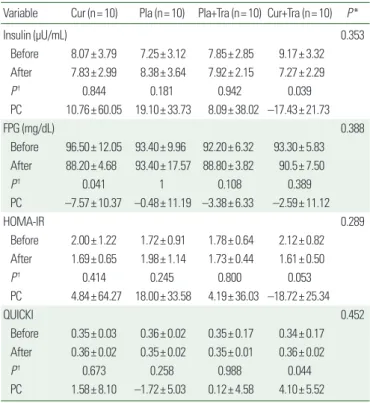
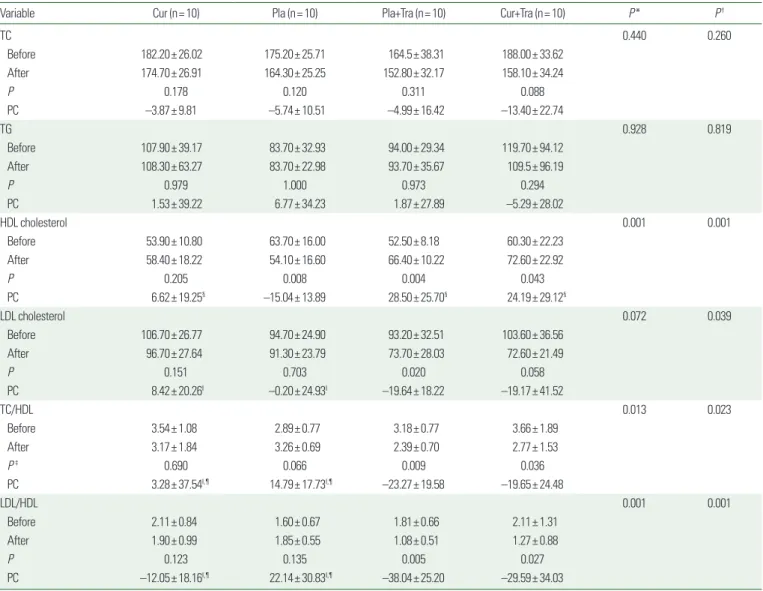
Results: During the intervention, Cur group showed significant reductions in weight, BMI and fasting blood glucose level; Cur+Tra group decreased waist circumference, waist-to-hip ratio, homeostatic model assessment for insulin resistance, serum insulin level, low-density lipoprotein to high-density lipoprotein ratio, and total cholesterol to high-density lipoprotein ratio and increased serum high-density lipoprotein cholesterol. The be- tween-groups analysis indicated increased high-density lipoprotein cholesterol in the Cur and Cur+Tra groups compared to the Pla group. The estimated marginal means of serum CRP were significantly higher in Pla+Tra group than in the Cur and Cur+Tra groups.
Conclusion: These findings suggest that the combination of curcumin supplementation with aerobic training more effectively improves glycemic and lipidemic statuses than curcumin supplementation or aerobic training alone.
Key words: Curcumin, Exercise, Overweight, C-reactive protein, Lipids, Insulin resistance
Received October 8, 2019 Reviewed November 7, 2019 Accepted January 27, 2020
* Corresponding author Mohammad Ali Azarbayjani
https://orcid.org/0000-0002-3502-7487 Department of Exercise Physiology, Faculty of Physical Education and Sports Science, Islamic Azad University, Central Tehran Branch, Army Boulevard, Shahid Sohani St., Sohank Square, Tehran 1986755881, Iran
Tel: +98-9106759828 Fax: +98-81454357
E-mail: [email protected] The first two authors contributed equally to this study.
INTRODUCTION
Currently, overweight and obesity are problems around the world, especially for women.
1,2In developing countries, it seems that the
prevalence of obesity among women is more than that among men.
3This condition has an important effect on health impairment, fe- male reproduction
4and reduced quality of life.
5Overweight and obesity are associated with diseases such as cardiovascular disease,
Copyright © 2020 Korean Society for the Study of Obesity
This is an Open Access article distributed under the terms of the Creative Commons Attribution Non-Commercial License (https://creativecommons.org/licenses/by-nc/4.0/) which permits unrestricted non-commercial use, distribution, and reproduction in any medium, provided the original work is properly cited.
2017-03-16 https://crossmark-cdn.crossref.org/widget/v2.0/logos/CROSSMARK_Color_square.svg