ISSN: 2233-601X (Print) ISSN: 2093-6516 (Online)
Received: September 1, 2015, Revised: November 2, 2015, Accepted: November 3, 2015, Published online: October 5, 2016
Corresponding author: Hyun Min Cho, Department of Trauma Surgery, Pusan National University Hospital Trauma Center, 179 Gudeok-ro, Seo-gu, Busan 49241, Korea
(Tel) 82-51-240-7369 (Fax) 82-51-240-7719 (E-mail) [email protected]
© The Korean Society for Thoracic and Cardiovascular Surgery. 2016. All right reserved.
This is an open access article distributed under the terms of the Creative Commons Attribution Non-Commercial License (http://creativecommons.org/
licenses/by-nc/4.0) which permits unrestricted non-commercial use, distribution, and reproduction in any medium, provided the original work is properly cited.
Analysis of Sternal Fixation Results According to Plate Type in Sternal Fracture
Chun Sung Byun, M.D. 1 , Il Hwan Park, M.D., Ph.D. 1 , Wan Jin Hwang, M.D. 2 , Yeiwon Lee, M.D. 2 , Hyun Min Cho, M.D. 3
1
Department of Thoracic and Cardiovascular Surgery, Wonju Severance Christian Hospital, Yonsei University Wonju College of Medicine,
2Department of Thoracic and Cardiovascular Surgery, Konyang University Hospital, Konyang University
College of Medicine,
3Department of Trauma Surgery, Pusan National University Hospital Trauma Center
Background: Sternal fractures are relatively rare, and caused mainly by blunt anterior chest wall trauma. In most cases, sternal fractures are treated conservatively. However, if the patient exhibits problematic symptoms such as intractable chest wall pain or bony crepitus due to sternal instability, surgical correction is indicated.
But no consensus exists regarding the most appropriate surgical method. We analyzed the results of surgical fixation in cases of sternal fracture in order to identify which surgical method led to the best outcomes.
Methods: We retrospectively reviewed the medical records of patients with sternal fractures from December 2008 to December 2011, and found 19 patients who underwent open reduction and internal fixation of the sternum with a longitudinal plate (L-group) or a T-shaped plate (T-group). We investigated patients’ charac- teristics, clinical details regarding each case of chest trauma, the presence of other associated injuries, the type of open reduction and fixation, whether a combined operation was performed, and postoperative complications. Results: Of the 19 patients, 10 patients (52.6%) were male, and their average age was 56.8 years (range, 32 to 82 years). Seven patients (36.8%) had isolated sternal fractures, while 12 (63.2%) had other associated injuries. Seven patients (36.8%) were in the L-group and 12 patients (63.2%) were in the T-group. Three patients in the L-group (42.9%) showed a loosening of the fixation. In all patients in the T-group, the fracture exhibited stable alignment. Conclusion: Open reduction and internal fixation with a T-shaped plate in sternal fractures is a safer and more efficient treatment method than treatment with a longitudinal plate, especially in patients with a severely displaced sternum or anterior flail chest, than a lon- gitudinal plate.
Key words: 1. Sternum
2. Thoracic injuries 3. Fracture fixation 4. Bone plates
Introduction
Sternal fractures are relatively rare, accounting for
<0.5% of total bone fractures and 8% to 10% of cases of blunt thoracic trauma [1-4]. Blunt anterior
chest wall contusions, in which the chest collides
with the steering wheel in traffic accidents, are the
main cause of sternal fractures. Morbidity and mor-
tality from sternal fractures are both directly related
to the degree of co-injury, and have no clear relation
http://dx.doi.org/10.5090/kjtcs.2016.49.5.361
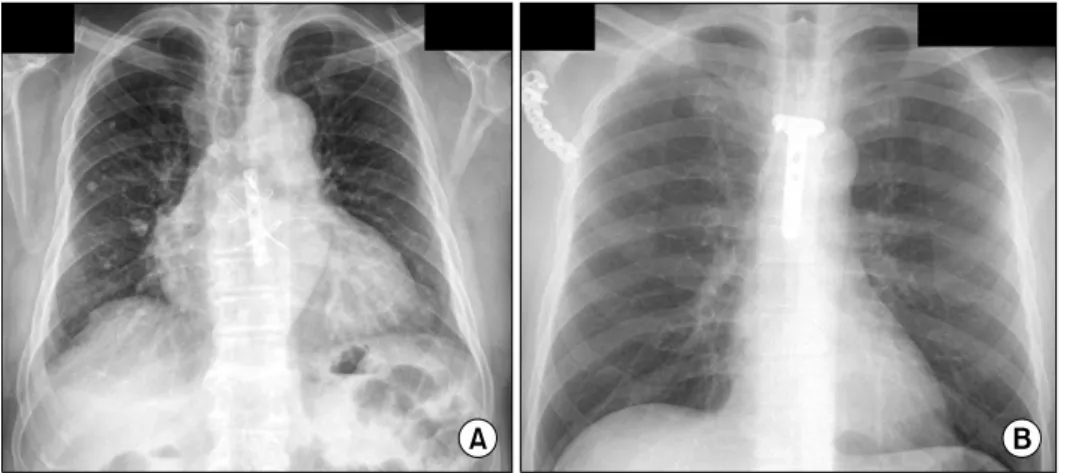
Fig. 1. Open reduction and internal fixation of sternum with (A) longi- tudinal plate with stainless steel wiring and (B) T-shaped plate.
to the sternal fracture itself [5,6]. Sternal fractures are treated conservatively in most cases. However, no reports have assessed the incidence of long-term complications after conservative treatment of sternal fractures. According to reports published over the last 50 years, if the internal organs sustain no dam- age in a severe sternal fracture, the mortality rate is low. No consensus exists regarding the most appro- priate methods of surgical correction if a patient ex- hibits problematic symptoms such as intractable chest wall pain or bony crepitus due to sternal instability or a chest wall deformity [7,8]. Therefore, we ana- lyzed the results of surgical fixation in patients with severe sternal fractures to determine the most ap- propriate surgical methods for sternal fractures.
Methods
We retrospectively reviewed the medical records of 117 patients with sternal fractures who were treated at Konyang University Hospital from December 2008 to December 2011. Of these patients, 19 pa- tients underwent open reduction and internal fixation of the sternum. Patient characteristics such as age and gender, as well as information regarding the du- ration of admission, chest X-ray findings, chest com- puted tomography (CT) findings, and operative re- cords, were collected. Clinical information including the mechanism of injury, time of injury, type of ster- nal fixation, co-injury site, surgical information for the co-injury site, and postoperative complications was also included. For patients with a sternal frac- ture, the surgical indications were complaints of se- vere pain and functional limitations with severe dis-
location of the sternum in a chest X-ray or chest CT, or a flail motion that caused difficulty in weaning them from a mechanical ventilator.
Surgery was performed with a 10-cm mid-sternal incision between the sternal notch and the xyphoid process under general anesthesia. After dissection of the fractured sternum, the fractured site was cor- rected manually and fixed with a titanium plate (Hankil Tech Medical Co. Ltd, Hwaseong, Korea) with cortical screws (Hankil Tech Medical Co. Ltd). 7 patients were treated with a longitudinal plate that was occa- sionally reinforced by a stainless steelwire (the L-gr- oup) (Fig. 1A). 12 patients, a T-shaped plate without wiring was used (the T-group) (Fig. 1B). Following surgery, we checked for hemothorax or pneumotho- rax on an immediate postoperative chest X-ray. When patients became ambulatory, we confirmed sternal their fixation status via a lateral sternum X-ray.
Incomplete fixation was defined as screw loosening in a radiologic examination after sternal fixation dur- ing the follow-up period.
Statistical analysis was performed using PASW SPSS statistics ver. 17.0.2 (SPSS Inc., Chicago, IL, USA). The Fisher exact test was used to evaluate dif- ferences between the groups, with p-values <0.05 considered statistically significant.
Results
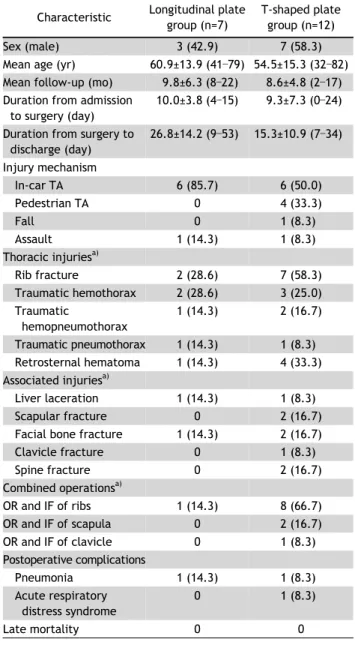
Of the 19 patients who underwent surgical fixation
of the sternum using a titanium plate and screws, 10
patients were male (52.6%), and their average age
was 56.8 years (range, 32 to 82 years). The mean
follow-up time was 9.2 months (range, 2 to 22
Table 1. General characteristics of patients (n=19) Characteristic Longitudinal plate
group (n=7)
T-shaped plate group (n=12)
Sex (male) 3 (42.9) 7 (58.3)
Mean age (yr) 60.9±13.9 (41 –79) 54.5±15.3 (32–82) Mean follow-up (mo) 9.8±6.3 (8 –22) 8.6±4.8 (2 –17) Duration from admission
to surgery (day)
10.0±3.8 (4 –15) 9.3±7.3 (0 –24)
Duration from surgery to discharge (day)
26.8±14.2 (9 –53) 15.3±10.9 (7–34)
Injury mechanism
In-car TA 6 (85.7) 6 (50.0)
Pedestrian TA 0 4 (33.3)
Fall 0 1 (8.3)
Assault 1 (14.3) 1 (8.3)
Thoracic injuries
a)Rib fracture 2 (28.6) 7 (58.3)
Traumatic hemothorax 2 (28.6) 3 (25.0) Traumatic
hemopneumothorax
1 (14.3) 2 (16.7)
Traumatic pneumothorax 1 (14.3) 1 (8.3) Retrosternal hematoma 1 (14.3) 4 (33.3) Associated injuries
a)Liver laceration 1 (14.3) 1 (8.3)
Scapular fracture 0 2 (16.7)
Facial bone fracture 1 (14.3) 2 (16.7)
Clavicle fracture 0 1 (8.3)
Spine fracture 0 2 (16.7)
Combined operations
a)OR and IF of ribs 1 (14.3) 8 (66.7)
OR and IF of scapula 0 2 (16.7)
OR and IF of clavicle 0 1 (8.3)
Postoperative complications
Pneumonia 1 (14.3) 1 (8.3)
Acute respiratory distress syndrome
0 1 (8.3)
Late mortality 0 0
Values are presented as numbers (%) or mean±standard deviation (range).
TA, traffic accident; OR, open reduction; IF, internal fixation.
a)