• 검색 결과가 없습니다.

Change of Specialty Preference of the 2 Private Premedical School Students in Daegu City: 1998-2001

N/A
N/A
Protected

Academic year: 2021

Share "Change of Specialty Preference of the 2 Private Premedical School Students in Daegu City: 1998-2001"

Copied!
14
0
0

로드 중.... (전체 텍스트 보기)

전체 글

(1)

Abstract :

Jung Jeung Lee, M.D., Choong Won Lee, M.D., Kyung Tak Yoo, M.D.

Department of Preventive Medicine

Keimyung University School of Medicine, Daegu, Korea

(2)

Key Words :

(3)
(4)

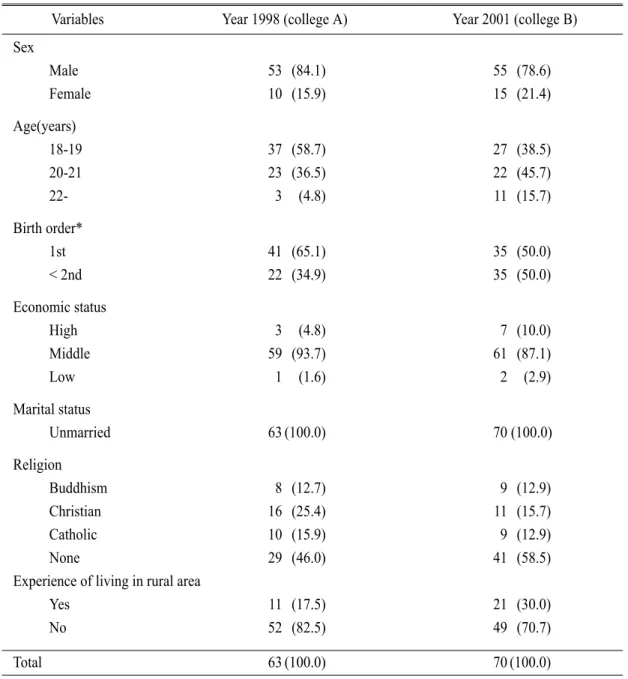
Table 1. General characteristics of study population (I) 

Sex

Male     53 (84.1) 55 (78.6)

Female       10 (15.9) 15 (21.4)

Age(years)

18-19 37 (58.7) 27 (38.5)

20-21 23 (36.5) 22 (45.7)

22- 3 (4.8) 11 (15.7)

Birth order*

1st  41 (65.1) 35 (50.0)

< 2nd 22 (34.9) 35 (50.0)

Economic status

High 3 (4.8) 7 (10.0)

Middle 59 (93.7) 61 (87.1)

Low 1 (1.6) 2 (2.9)

Marital status

Unmarried 63 (100.0) 70 (100.0)

Religion

Buddhism 8 (12.7) 9 (12.9)

Christian 16 (25.4) 11 (15.7)

Catholic 10 (15.9) 9 (12.9)

None 29 (46.0) 41 (58.5)

Experience of living in rural area

Yes 11 (17.5) 21 (30.0)

No 52 (82.5) 49 (70.7)

Total 63 (100.0) 70 (100.0)

Variables   Year 1998 (college A)

Unit: person (%)  Year 2001 (college B) 

* p<0.05 measured by chi-square test.

(5)

Table 2. General characteristics of study population ( )

Admission to medical college*

Entered a medical college after 34 (54.0) 22 (31.4)

finishing the high school

Cram to repeat a medical college 20 (31.7) 23 (32.9)

entrance exam

Have a experience of studied other 9 (14.3) 25 (35.7)

field of study Career choice*

Practitioner 8 (12.7) 28 (40.0)

Work in general hospital 31 (49.2) 19 (27.0)

Professor in teaching hospital 21 (33.3) 21 (30.3)

Others 3 (4.8) 2 (2.9)

People who influenced to go to medical college

None (him- or herself) 40 (63.5) 38 (54.3)

Parents 21 (33.3) 23 (32.9)

Brothers/Sisters 2 (3.2) 4 (5.7)

Friends - -

Teachers - 3 (4.3)

Others - 2 (2.8)

Total 63(100.0) 70 (100.0)

Variables Year 1998 (college A)

Unit: person (%) Year 2001 (college B)

* p 0.05 measured by chi-square test.  

(6)

Table 3. Reasons for choosing the medical school (results of multiple answers)

To serve the public by giving medical care 22 (34.9) 32 (45.7)

To live a life with secure income 43 (68.3) 42 (60.0)

To have a lifelong job 41 (65.1) 33 (47.1)

To follow the demand of family members

9 (14.3) 16 (22.9)

or teachers

School achievements and the results of the college

18 (28.6) 9 (12.9)

entrance exam were sufficient to select the medical course

Aptitude for medical science 20 (31.7) 15 (21.4)

Prestige of speciality 10 (15.9) 12 (17.1)

Others - 1 (1.4)

Variables Year 1998

(College A)

Unit: person (%) Year 2001 (College B)

Table 4. Reasons for choosing this medical school (results of multiple answers)

The high school achievements were sufficient to select 

56 (88.9) 56 (80.0)

this school

The reputation of this school in the community 8 (12.7) 11 (15.7)

Recommendation of the parents or teachers 15 (23.8) 19 (27.1)

Economic reasons including the difficulty in paying 5 (7.9) 11 (15.7) educational expenses and the scholarship from the school

The history of the school 2 (3.2) 4 (5.7)

Others 4 (6.3) 5 (7.1)

Variables Year 1998

(College A)

Unit: person (%)

Year 2001

(College B)

(7)

Male Female 1998 2001 Yes No

Total 106(100.0) 27 (100.0)

Table 5. Comparison between each factor based on whether the respondent has a specialty preferred  

Do you participate in intracurricular activities?

Tend to participate in 90 (84.9) 23 (85.1)

Average (or have no idea) 10 (9.4) 4 (12.9)

Do not participate in 6 (5.6) -

What is your degree of satisfaction on studying medical science?

Satisfactory 77 (72.6) 15 (55.5)

Average 26 (24.5) 10 (37.0)

Unsatisfactory 3 (2.8) 2 (7.4)

Is there a doctor within your family members (including cousins)?

Yes 33 (31.1) 7 (25.9)

No 73 (68.9) 20 (74.1)

Preferred speciality Have preferred speciality Have no idea

Unit: person (%)

Table 6. Preferred speciality by each characteristics

Experience of living in  rural area Speciality

Psychiatry 7 (8.0) 4 (16.0) 6 (9.5) 5 (7.1) 1 (3.1) 10 (9.9)

Pediatrics 7 (5.4) 1 (4.0) 4 (6.3) 4 (5.7) 3 (9.4) 5 (5.0)

Internal medicine 5 (7.1) 4 (16.0) 3 (4.8) 6 (8.6) 1 (3.1) 8 (7.9) General & Thoracic surgery 7 (13.4) 1 (4.0) 5 (7.9) 3 (4.3) 2 (6.3) 6 (5.9) Neurosurgery,

orthopedics, 22 (18.8) 1 (4.0) 9 (14.3) 14 (20.2) 5 (15.6) 18 (17.8) plastic surgery

Ophthalmology 11 (10.2) 1 (4.0) 4 (6.3) 8 (11.4) 4 (12.5) 8 (7.9)

Dermatology 6 (5.6) 5 (20.0) 2 (3.2) 9 (12.9) 3 (9.4) 8 (7.9)

Have no idea 23 (21.4) 4 (16.0) 15 (23.8) 12 (17.1) 6 (18.8) 21 (20.8)

Others 20 (18.6) 4 (16.0) 15 (23.8) 9 (12.9) 7 (21.9) 17 (16.8)

Total 108 (100.0) 25(100.0) 63 (100.0) 70(100.0) 32 (100.0) 101 (100.0)

Sex Year

Unit: person (%)

(8)

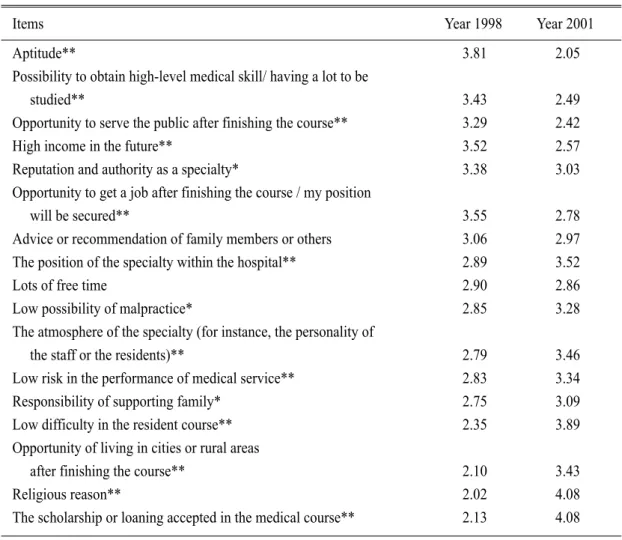
Table 7. Factors affecting specialty selection

Aptitude** 3.81 2.05

Possibility to obtain high-level medical skill/ having a lot to be 

studied** 3.43 2.49

Opportunity to serve the public after finishing the course** 3.29 2.42

High income in the future** 3.52 2.57

Reputation and authority as a specialty* 3.38 3.03

Opportunity to get a job after finishing the course / my position 

will be secured** 3.55 2.78

Advice or recommendation of family members or others  3.06 2.97

The position of the specialty within the hospital** 2.89 3.52

Lots of free time 2.90 2.86

Low possibility of malpractice* 2.85 3.28

The atmosphere of the specialty (for instance, the personality of 

the staff or the residents)** 2.79 3.46

Low risk in the performance of medical service** 2.83 3.34

Responsibility of supporting family* 2.75 3.09

Low difficulty in the resident course** 2.35 3.89

Opportunity of living in cities or rural areas

after finishing the course** 2.10 3.43

Religious reason** 2.02 4.08

The scholarship or loaning accepted in the medical course** 2.13 4.08

* : p 0.05, ** : p 0.01  measured by t-test.

Items Year 1998

Unit: point (5 is the full marks)

Year 2001

(9)

* p 0.05 measured by Fisher s exact test.

Table 8. People who influenced to go to medical college or to choose the speciality according to the doctor within family members (including cousins).

People who influenced

None (him- or herself) 17 (42.5) 61 (65.6) 26 (81.3) 63 (85.1)

Parents 20 (50.0) 24 (25.8) 3 (9.4) 5 (6.8)

Brothers/sisters 3 (7.5) 3 (3.2) 2 (6.3)

Friends 1 (1.4)

Teacher 3 (3.2)

Others 2 (2.2) 1 (3.1) 5 (6.8)

Total 40(100.0) 93(100.0) 32(100.0) 74(100.0)

-

- - -

- - -

-

Yes No Yes No

People who influenced to  go to medical college*

Doctor within family members (including cousins)

Unit: person (%) People who influenced 

to select speciality

Table 9. Preferred speciality influenced by each factor in choosing speciality

Speciality %

Aptitude Dermatology 11.9 

Ophthalmology 10.7

Orthopedics 8.3

High-level medical skill /having a lot to be studied Dermatology 12.0

Ophthalmology 10.9

Orthopedics 8.7

Opportunity to serve the community Ophthalmology 12.1

Dermatology  11.1

Psychiatry 10.1

High income Dermatology 12.0

Ophthalmology 10.8

Orthopedics, pediatrics, psychiatry 8.4 Opportunity to get a job /position will be secured Ophthalmology 12.5

Dermatology 8.8

Pediatrics, otolaryngology, neurosurgery 7.5

Items 

(10)

Classified  the  speciality  as  followed;  1:  internal  medicine,  pediatrics,  family  medicine.  2:  surgery,  chest surgery. 3: neurosurgery, orthopedics, plastic surgery. * p 0.05  measured by Fisher s exact test.

Table 10. Preference of speciality by characters of subjects

Psychiatry 10.0 16.3 9.5 16.7 11.4 20.0 9.1 25.0

Internal medicine

1

20.0 24.5 19.0 19.4 25.0 - 27.3 15.0

Surgery I

2

- 12.2 9.5 13.9 6.8  - 14.5 -

Surgery II

3

20.0 24.5 42.9 19.4 36.4 40.0 18.2 55.0

Ophthalmology?   50.0 22.4 19.0 30.6 20.5 40.0 30.9 5.0

otorhinolaryngology

Total (person) 10  49 21 36 4 5 55 20

Type of characters Intro-

spective  Normal Extro

spective Normal Pretty

well None Normal Pretty well Speciality

Unit: (%)

Understanding of the others Leadership*

(11)
(12)
(13)

1. Grum CM, Woolliscroft JO. Choosing a specialty: a guide for students. JAMA 1993;269:1183-6. 

2.  ,  ,  . 

2000;12:216-26. 

3. Elam  CL,  Johnson  MM,  Wiggs  JS,  Messmer  JM Brown  PI,  Hinkley  R.  Diversity  in  medical  school.

Acad Med 2001;76:60-5.  

4. Ellsbury  KE,  Carline  JD,  Irby  DM,  Stritter  FT.

Influence of third-year clerkships on medical student specialty  preferences. Adv  Health  Sci  Edu  Theory Pract 1998;3:177-86. 

5. Lieu  TA,  Schroeder  SA,  Altman  DF.  Specialty choices  at  one  medical  school:  recent  trends  and analysis  of  predictive  factors.  Acad  Med 1989;64:622-9. 

6. Babbott D, Baldwin DC Jr, Killian CD, Weaver SO.

Trends  in  evolution  of  specialty  choice:  comparison of  US  medical  school  graduates  in  1983  and  1987.

JAMA 1989;261:2367-73.

7. Martini  CJ,  Veloski  JJ,  Barzansky  B,  Xu  G,  Fields SK.  Medical  school  and  student  characteristics  that influence  choosing  a  generalist  career.  JAMA 1994;272:661-8.

8. Tardiff K, Cella D, Seiferth C, Perry S. Selection and change of specialties by medical school graduates. J Med Educ 1986;61:790-6. 

9. Anita P, Phyllis LC, Robert HF, Arlene SA, Mark A.

Moskowitz  specialty  choices,  compensation,  and career  satisfaction  of  underrepresented  minority faculty  in  Academic  Medicine.  Acad  Med 2000;75:157-60. 

10. Babbott D, Baldwin DC Jr, Killian CD, Weaver SO.

Racial-ethnic  background  and  specialty  choice:  a study of US medical school graduates in 1987. Acad Med 1989;64:595-9. 

11. Bergquist SR, Duchac BW, Schalin VA, Zastrow JF, Barr  VL,  Borowiecki  T.  Perceptions  of  freshman medical  students  of  gender  differences  in  medical specialty choice. J Med Educ 1985;60:379-83. 

12. Weissman SH, Haynes RA, Killian CD, Robinowitz C.  A  model  to  determine  the  influence  of  medical school  on  students career  choices:  psychiatry,  a case study. Acad Med 1994;69:58-9.

13. Jarecky RK, Schwartz RW, Haley JV, Donnelly MB.

Stability  of  medical  specialty  selection  at  the University of Kentucky. Acad Med 1991;66:756-61.

14. Burack  JH,  Irby  DM,  Carline  JD,  Ambrozy  DM, Ellsbury  KE,  Stritter  FT.  A  study  of  medical students specialty-choice  pathways:  trying  on possible selves. Acad Med 1997;72:534-41.

15. Carline  JD,  Greer  T.  Comparing  physicians specialty  interests  upon  entering  medical  school with  their  eventual  practice  specialties. Acad  Med 1991;66:44-6.

16. Golden WE. related articles initial career choices of medical school honors graduates in the early 1970s and 1980s. Acad Med 1989;64:616-21.

17. Kassebaum DG, Szenas PL. Factors influencing the

specialty choices of 1993 medical school graduates.

(14)

Acad Med 1994;69:163-70.

18. Solomon  DJ,  DiPette  DJ.  Specialty  choice  among students entering the fourth year of medical school.

Am J Med Sci 1994;308:284-8.

19. Emilie HSO. Factors influencing students choices of  primary  care  or  other  specialties.  Acad  Med 1993;68:572-4.  

20. Kassebaum DG, Szenas PL. Specialty intentions of 1995  US  medical  school  graduates  and  patterns  of

generalist career choice and decision making. Acad Med 1995;70:1152-7.

21. Kassebaum  DG,  Szenas  PL.  Specialty  preferences of  1993  medical  school  graduates.  Acad  Med.

1993;68:866-9.

22. Fincher RE, Lewis LA, Jackson TW. Why students choose  a  primary  care  or  nonprimary  care  career.

Am J Med. 1994;97:410-7.

수치

Table 1. General characteristics of study population (I)  Sex Male     53 (84.1) 55 (78.6) Female           10 (15.9) 15 (21.4) Age(years) 18-19 37 (58.7) 27 (38.5) 20-21 23 (36.5) 22 (45.7) 22- 3 (4.8) 11 (15.7) Birth order* 1st  41 (65.1) 35 (50.0) &lt; 
Table 2. General characteristics of study population ( ) Admission to medical college* Entered a medical college after 34 (54.0) 22 (31.4) finishing the high school Cram to repeat a medical college 20 (31.7) 23 (32.9) entrance exam Have a experience of stu
Table 3. Reasons for choosing the medical school (results of multiple answers) To serve the public by giving medical care 22 (34.9) 32 (45.7) To live a life with secure income 43 (68.3) 42 (60.0) To have a lifelong job 41 (65.1) 33 (47.1) To follow the dem
Table 7. Factors affecting specialty selection Aptitude** 3.81 2.05 Possibility to obtain high-level medical skill/ having a lot to be  studied** 3.43 2.49 Opportunity to serve the public after finishing the course** 3.29 2.42 High income in the future** 3
+2

참조

관련 문서