ABSTRACT
Background and Purpose: Four published quantitative systematic reviews showed conflicting results involving coffee consumption and the risk of Alzheimer's disease (AD). The aim of this meta-epidemiological meta-analysis (MEMA) was to evaluate the factors underlying the conflicting results and estimate the effect size and direction of the AD risk associated with coffee consumption in population-based cohort studies.
Methods: The primary subjects of MEMA were derived from 3 cohort studies selected by the related systematic reviews. Additional studies involving the primary subjects were searched using citation discovery tools. Prospective cohort studies evaluating the association between coffee consumption and AD risk were selected. A fixed effects model was applied to estimate the summary relative risk (sRR) and its 95% confidence intervals (CIs). Subgroup analysis was conducted according to the level of coffee consumption. Egger's test was used to evaluate publication bias.
Results: Four cohort studies were finally selected. A total of 36,300 participants from Finland, Sweden, Germany, and the United States of America were selected. The sRR (and its 95% CI) (I-squared value) by highest-versus-lowest method was 0.98 (0.92–1.05) (0.0%). In addition, none of the results of subgroup analyses by the level of coffee consumption showed any statistical significance.
Conclusions: This MEMA found that there was no association between coffee consumption and AD risk. Based on recent evidence suggesting that gene-environment interactions contribute to AD pathogenesis, it is necessary to conduct population-based cohort studies involving non-Caucasians.
Keywords: Coffee; Alzheimer Disease; Cohort Studies; Meta-analysis
INTRODUCTION
The disease burden associated with age-related neurodegenerative disorders is increasing along with the increase in human lifespan.1 Dementia is the leading cause of disability in the elderly, and Alzheimer's disease (AD) accounts for the most substantial portion of dementia.2
Original Article
Received: Jun 4, 2020 Revised: Jul 29, 2020 Accepted: Aug 17, 2020 Correspondence to Jong-Myon Bae
Department of Preventive Medicine, Jeju National University College of Medicine, 102 Jejudaehak-ro, Jeju 63243, Korea.
E-mail: [email protected]
© 2020 Korean Dementia Association This is an Open Access article distributed under the terms of the Creative Commons Attribution Non-Commercial License (https://
creativecommons.org/licenses/by-nc/4.0/) which permits unrestricted non-commercial use, distribution, and reproduction in any medium, provided the original work is properly cited.
ORCID iDs Jong-Myon Bae
https://orcid.org/0000-0003-3080-7852 Funding
This work was supported by the 2020 education, research and student guidance grant funded by Jeju National University.
Conflict of Interest
The author has no financial conflicts of interest.
Jong-Myon Bae
Department of Preventive Medicine, Jeju National University College of Medicine, Jeju, Korea
History of Coffee Consumption and Risk of Alzheimer's Disease:
a Meta-epidemiological Study of
Population-based Cohort Studies
differed with the application of the highest versus lowest method (HLM), which utilized the results of the highest consumption group based on the lowest group, and the dose-response meta-analysis based on cups of coffee consumption per day (cup/d).
Thus, it is necessary to select only population-based cohort studies with AD occurrence as the outcome, followed by a new meta-analysis according to the amount of coffee consumption.
A meta-epidemiological study for previous systematic reviews was conducted to evaluate the association between coffee consumption and AD.12,13
METHODS
The meta-epidemiological study involved articles selected by the reported systematic reviews.12,13Among the articles selected from the 4 systematic reviews presented in Table 1, a total of 3 cohort studies analyzed the incidence of AD according to coffee consumption.14-16 Of the 3 cohort studies selected from the previous systematic reviews, the most recent presentation year was 2018.16 Therfore, any study reported untill April 20, 2020 should be searched. To this end, the citation discovery tool of ‘cited by’ provided by PubMed was used to create a list of articles citing the cohort studies selected by the systematic reviews shown in Table 1.17 Next, the articles were selected if the population-based prospective cohort study showed the magnitude of AD risk according to coffee consumption.
The relative risks (RRs) and 95% confidence intervals (CIs) adjusted for confounding factors were extracted from the articles finally selected. Finally, the logarithmic RR and standard error of logarithm RR were calculated. To determine the effect size by the level of coffee intake, the coffee intake was categorized into low (0–2 cup/d), moderate (3–5 cup/d), and high (more than 6 cups/d) groups.18 The level of heterogeneity was assessed as I-squared Table 1. sRR and 95% CIs of the published systematic reviews involving population-based cohort studies
Authors Year of
publication Searching Intake Selected studies sRR (95% CI) I-squared (%)
Barranco Quintana et al.6 2007 Jan 2004 - 2NC 0.73 (0.54–0.99) -
Liu et al.7 2016 Dec 2014 HLM 2CO+2NC 0.73 (0.55–0.97) 0.0
1 cup/d 2CO 1.02 (0.95–1.08) 0.0
Wu et al.8 2017 Feb 2016 1–2 vs. 0 cup/d 2CO+1NC 0.71 (0.54–0.94) 0.0
3< vs. 0 cup/d 2CO 1.07 (0.63–1.82) 0.0
Larsson and Orsini9 2018 Oct 2018 1 cup/d 5CO (2 mortality) 1.01 (0.95–1.07) 41.8
sRR: summary relative risk, CI: confidence interval, NC: nested case-control study, HLM: highest versus lowest method, CO: cohort study, cup/d: cup per day.
value (%) and, if less than 50%, a fixed-effect model was used to calculate the summary RR (sRR) and its 95% CI.19 Egger's test was performed to identify publication bias,20 and the p value for statistical significance was 0.05.
RESULTS
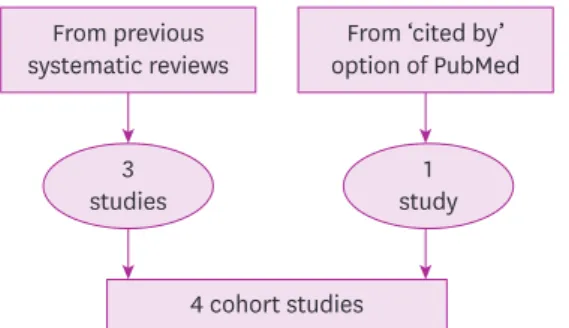
A total of 388 articles cited 5 studies selected from 4 systematic reviews in Table 1 as of April 30, 2020.14-16,21,22 A new study was selected using the selection criteria.23 Therefore, 4 cohort studies were finally selected for meta-analysis (Fig. 1).14-16,23 The studies reported from Northern Europe (Finland, Sweden, Germany) and North America (USA) involved a total of 36,300 participants.
Three studies14,15,23 reported the RRs adjusted for apolipoprotein Eε4 carrier status.
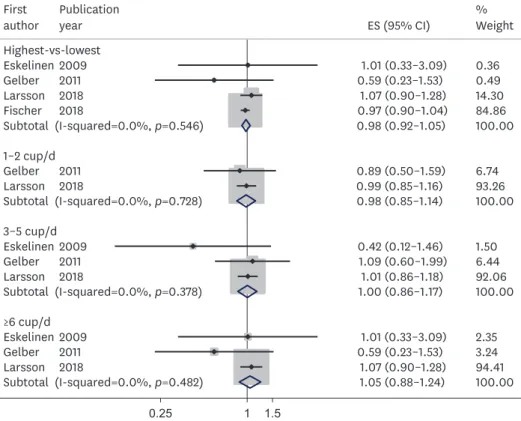
The effect size based on HLM from the 4 cohort studies showed no statistical significance (sRR=0.98; 95% CI, 0.92–1.05) with no heterogeneity between the papers (I-squared=0.0%) (Fig. 2). Subgroup analysis of low, moderate, and high groups according to the amount of coffee consumption revealed no statistical significance (Fig. 2). The P-value of Egger's test for evaluating publication bias was 0.83.
DISCUSSION
Results showed that coffee consumption was not related to AD occurrence. Subgroup analysis also showed similar results. The potential reasons for the conflicting results presented in Table 1 are as follows.
First, the author evaluated a potential effect based on the difference in research design of the selection criteria among the 4 systematic reviews shown in Table 1. To this end, the meta- analysis based only on the ‘prospective’ cohort studies showed no statistical significance.
No statistical significance was detected even after the addition of 2 nested case-control studies21,22 selected by Barranco Quintana et al.6 and Liu et al.7 in Table 1 (sRR=0.97; 95% CI, 0.12–1.03; I-squared=22.6%).
Second, the author determined a potential effect based on the difference in search strategy in the 4 systematic reviews. The most recently published Larsson and Orsini9 selected the cohort studies only, so it is reasonable to exclude the 2 nested case-control studies.21,22 However, given that the search deadline was October 2018, Fischer et al.23 was included because the
4 cohort studies 3
studies From previous systematic reviews
From ‘cited by’
option of PubMed
1 study
Fig. 1. Flow-chart of the final selection of prospective cohort studies.
publication date was June 2018. Meanwhile, Panza et al.24 indicated that 1 in 4 participants of Lindsay et al.22 was included in Tyas et al. cohort.21 Thus, the conclusion of 2 systematic reviews6,7 selecting 2 nested case-control studies21,22 may be over-estimated.
Finally, the author determined a potential effect based on the difference in meta-analysis of the extracted information. Wu et al.8 demonstrated the differences in results with 1–2 cup/d and 3+ cup/d of coffee consumption. Therefore, a subgroup analysis based on the amount of coffee consumption was conducted. No statistical significance was observed between coffee consumption and AD risk.
While considering the 3 potential studies that showed inconsistent results in previous systematic reviews, it is apparent that there was no association between coffee consumption and AD risk. However, it is necessary to consider measurement errors because the level of coffee consumption was measured by a self-reported questionnaire in prospective cohort studies.
Further, reverse causality may be involved due to the slow progression of AD during the follow- up.9 Finally, given recent evidence that AD is triggered by gene-environment interactions,25 it is necessary to conduct population-based cohort studies involving non-Caucasians.
REFERENCES
1. Prince MJ, Wu F, Guo Y, Gutierrez Robledo LM, O'Donnell M, Sullivan R, et al. The burden of disease in older people and implications for health policy and practice. Lancet 2015;385:549-562.
PUBMED | CROSSREF
3–5 cup/d Eskelinen Gelber Larsson
Subtotal (I-squared=0.0%, p=0.378)
≥6 cup/d Eskelinen Gelber Larsson
Subtotal (I-squared=0.0%, p=0.482) 20092011
2018
20092011 2018
0.42 (0.12–1.46) 1.09 (0.60–1.99)
1.01 (0.86–1.18) 1.00 (0.86–1.17)
1.01 (0.33–3.09) 0.59 (0.23–1.53)
1.07 (0.90–1.28) 1.05 (0.88–1.24)
1.506.44 92.06 100.00
2.353.24 94.41 100.00 1
0.25 1.5
Fig. 2. Forest plot for estimating the summary ES by coffee consumption level.
ES: effect size, CI: confidence interval, cup/d: cup per day.
2. Bhatti GK, Reddy AP, Reddy PH, Bhatti JS. Lifestyle modifications and nutritional Interventions in aging- associated cognitive decline and Alzheimer's disease. Front Aging Neurosci 2020;11:369.
PUBMED | CROSSREF
3. Xu W, Tan L, Wang HF, Jiang T, Tan MS, Tan L, et al. Meta-analysis of modifiable risk factors for Alzheimer's disease. J Neurol Neurosurg Psychiatry 2015;86:1299-1306.
PUBMED | CROSSREF
4. Wierzejska R. Can coffee consumption lower the risk of Alzheimer's disease and Parkinson's disease? A literature review. Arch Med Sci 2017;13:507-514.
PUBMED | CROSSREF
5. Flaten V, Laurent C, Coelho JE, Sandau U, Batalha VL, Burnouf S, et al. From epidemiology to pathophysiology: what about caffeine in Alzheimer's disease? Biochem Soc Trans 2014;42:587-592.
PUBMED | CROSSREF
6. Barranco Quintana JL, Allam MF, Serrano Del Castillo A, Fernández-Crehuet Navajas R. Alzheimer's disease and coffee: a quantitative review. Neurol Res 2007;29:91-95.
PUBMED | CROSSREF
7. Liu QP, Wu YF, Cheng HY, Xia T, Ding H, Wang H, et al. Habitual coffee consumption and risk of cognitive decline/dementia: a systematic review and meta-analysis of prospective cohort studies.
Nutrition 2016;32:628-636.
PUBMED | CROSSREF
8. Wu L, Sun D, He Y. Coffee intake and the incident risk of cognitive disorders: a dose-response meta- analysis of nine prospective cohort studies. Clin Nutr 2017;36:730-736.
PUBMED | CROSSREF
9. Larsson SC, Orsini N. Coffee consumption and risk of dementia and Alzheimer's disease: adose-response meta-analysis of prospective studies. Nutrients 2018;10:E1501.
PUBMED | CROSSREF
10. Loftfield E, Freedman ND, Graubard BI, Guertin KA, Black A, Huang WY, et al. Association of coffee consumption with overall and cause-specific mortality in a large US prospective cohort study. Am J Epidemiol 2015;182:1010-1022.
PUBMED | CROSSREF
11. Park SY, Freedman ND, Haiman CA, Le Marchand L, Wilkens LR, Setiawan VW. Association of coffee consumption with total and cause-specific mortality among nonwhite populations. Ann Intern Med 2017;167:228-235.
PUBMED | CROSSREF
12. Bae JM. Meta-epidemiology. Epidemiol Health 2014;36:e2014019.
PUBMED | CROSSREF
13. Murad MH, Wang Z. Guidelines for reporting meta-epidemiological methodology research. Evid Based Med 2017;22:139-142.
PUBMED | CROSSREF
14. Eskelinen MH, Ngandu T, Tuomilehto J, Soininen H, Kivipelto M. Midlife coffee and tea drinking and the risk of late-life dementia: a population-based CAIDE study. J Alzheimers Dis 2009;16:85-91.
PUBMED | CROSSREF
15. Gelber RP, Petrovitch H, Masaki KH, Ross GW, White LR. Coffee intake in midlife and risk of dementia and its neuropathologic correlates. J Alzheimers Dis 2011;23:607-615.
PUBMED | CROSSREF
16. Larsson SC, Wolk A. The role of lifestyle factors and sleep duration for late-onset dementia: acohort study. J Alzheimers Dis 2018;66:579-586.
PUBMED | CROSSREF
17. Bae JM, Kim EH. Citation discovery tools for conducting adaptive meta-analyses to update systematic reviews. J Prev Med Public Health 2016;49:129-133.
PUBMED | CROSSREF
18. You DC, Kim YS, Ha AW, Lee YN, Kim SM, Kim CH, et al. Possible health effects of caffeinated coffee consumption on Alzheimer's disease and cardiovascular disease. Toxicol Res 2011;27:7-10.
PUBMED | CROSSREF
19. Harris RJ, Bradburn MJ, Deeks JJ, Harbord RM, Altman DG, Sterne JA. Metan: Fixed- and random-effects meta-analysis. Stata J 2008;8:3-28.
CROSSREF
20. Sedgwick P. Meta-analysis: testing for reporting bias. BMJ 2015;350:g7857.
PUBMED | CROSSREF
25. Larsson SC, Traylor M, Malik R, Dichgans M, Burgess S, Markus HS, et al. Modifiable pathways in Alzheimer's disease: Mendelian randomisation analysis. BMJ 2017;359:j5375.
PUBMED | CROSSREF