Determination of the MYB Motif Interacting with WD40 and Basic Helix Loop Helix Proteins
Ji Hye Kim · Bong-Gyu Kim · Joong-Hoon Ahn
Received: 10 February 2012 / Accepted: 25 February 2012 / Published Online: 31 March 2012
© The Korean Society for Applied Biological Chemistry 2012
Abstract Plant MYB transcription factors regulate secondary metabolism, cellular morphogenesis, and plant hormone signaling pathway. MYB proteins in plants consist of two repeats of 50 amino acid residues, which are referred to as R2R3 and they interact with WD40 or basic helix loop helix (bHLH) proteins.
Yeast two hybrid assay was determined whether rice MYB protein interacts with either OsTTG1, which contains a WD40 domain, or with OsGL3, which contains a bHLH domain. Among 30 OsMYB proteins, three interacted with OsTTG1 and five interacted with OsGL3. A series of MYB mutants were created to determine the MYB domain important for the interaction with OsTTG1 or OsGL3. By using the yeast two hybrid assay, we found that the R3 motif of OsMYB10 and the R2 motif of OsMYB16 were required for interaction with OsTTG1 and OsGL3 proteins, respectively.
Keywords basic helix loop helix · MYB · transcription factor
Gene expression is regulated at several levels. Transcription factors control many biological processes involved in the metabolism and development of a cell or organism. Although the processes that are controlled by transcription factors may vary, some transcription factors are conserved and form a family. The members of such family, the MYB protein family, were first identified as the product of c-MYB proto-oncogene in animal (Thompson and Ramsay, 1995; Lipsick, 1996). The DNA-binding domain of the MYB proteins is conserved and consists of one to four helix-turn- helix motifs, referred to as R0R1R2R3. Each motif consists of about 50 amino acids, which form three α-helices and regularly spaced tryptophan residues (Rabinowicz, 1999). The structural analysis of the MYB protein-DNA complex showed that the third
α-helix recognizes the DNA and specifically five amino acids in the third α-helix recognize the major groove of the binding DNA (Ogata et al., 1994).
In animals, MYB proteins contain three repeat motifs (R1R2R3), whereas in plants, the MYB proteins mostly contain two repeat motifs (R2R3) (Lipsick, 1996; Jiang et al., 2004). Approximately 125 R2R3 MYB genes are present in Arabidopsis thaliana (Romero et al., 1998) and more than 80 may be present in rice (Jiang et al., 2004).
R2R3 MYB proteins have diverse functions in plants. The biological functions of MYB in plants are yet to be clearly elucidated. However, recent advances in molecular genetics have shown that these genes are involved in the control of cell shape as in trichome formation (Serna and Martin, 2006), regulation of secondary metabolism (Koes et al., 2005), disease resistance (Liu et al., 2004), and hormone response (Abe et al., 1997). MYB proteins may also play crucial roles in morphological and physiological variations by controlling the developmental processes (Serna, 2004).
Most transcription factors including R2R3 MYB proteins, interact with other proteins. For example, R2R3 MYB protein interacts with basic helix-loop-helix (bHLH) proteins to regulate anthocyanin biosynthesis in maize (Goff et al., 1992), and A.
thaliana (Zimmermann et al., 2004). R2R3 MYB also interacts with WD40 (tryptophan-aspartate) protein (Ramsay and Glover, 2005). In A. thaliana, three classes of transcription factors, WD40, bHLH, and MYB, are cooperatively involved in regulating flavonoid biosynthesis, root-hair initiation and seed coat mucilage (Broun, 2005; Ramsay and Glover, 2005).
Rice is one of the model crop plants, and its genome has been characterized (Goff et al., 2002; Yu et al., 2002). More than 1300 transcription factors have been identified in the rice genome, and studies of individual transcription factors are in progress.
However, it is not clear whether protein-protein interactions between bHLH and MYB or between WD and MYB observed in A. thaliana and maize is present in rice. Therefore, we performed yeast two hybrid assay to analyze the interactions between a J. H. Kim · B.-G. Kim · J.-H. Ahn ( )
Department of Bioscience and Biotechnology, Bio/Molecular Informatics Center, Konkuk University, Seoul 143-701, Republic of Korea
E-mail: [email protected]
SHORT COMMUNICATION J Appl Biol Chem (2012) 55(1), 67−70 http://dx.doi.org/10.3839/jabc.2011.061
68 J Appl Biol Chem (2012) 55(1), 67−70
typical WD protein and MYB as well as those between bHLH protein and MYB protein. In addition, we also determined the critical motif of MYB, which interacts with the WD and bHLH proteins.
Eighty-four R2R3 MYB genes from Oryza sativa were previously cloned (Kim et al., 2005). Among them, 30 were cloned into pGADT7 vector, which had GAL4 activation domain (AD) (Clontech Laboratories, Inc Palo Alto, CA). The presence of TTG1 (OsTTG1) and GL (OsGL3) homologs of rice was analyzed with TTG1 (Walker et al., 1999) and GL3 (Bernhart et al., 2003) of A. thaliana. TTG1 gene from A. thaliana controls several developmental and biochemical pathways including the formation of trichome on leaves, the production of seed mucilage and anthocyanin pigments and GL3 is also involved in the formation of hair in root. OsTTG1 and OsGL3 were cloned by using reverse transcriptase-polymerase chain reaction (RT-PCR) using their respective published sequences (GenBank accession number:
NM_001054286.1 for OsTTG1 and NM_001060067.1 for OsGL3). Then, both genes were subcloned into pGABKT7 vector (Clontech Laboratories, Inc.), which contained GAL4 DNA binding domain (BD). Yeast two hybrid assay was performed using Matchmaker GAL4 two-hybrid system (Clontech, Laboratories, Inc.). MYB gene constructs fused with GAL4 activation domain (AD) and OsTTG1 or OsGL3 construct fused with GAL4 DNA binding domain were cotransformed in Saccharomyces cerevisiae AH109 by using a lithium acetate method according to the manufacturer’s (Clontech Laboratories, Inc.) instructions. The transformants were selected using a synthetic dropout medium lacking leucine, tryptophan, histidine, and adenine (Clontech Laboratories, Inc.) supplemented with 30 mM 3-aminotriazole (3-AT, Sigma-Aldrich, St Louis, MO).
OsTTG1 interacted with three MYB proteins (MYB 10, MYB11, and MYB 35) and OsGL3 interacted with five MYB proteins (MYB 16, MYB43, MYB149, MYM150, and MYB151) (Table 1). It has been reported that bHLH proteins interact with several MYB proteins in plants including A. thaliana, Petunia hybrida, and Zea mays (Esch et al., 2004; Feller et al., 2011).
OsTTG1 is a typical protein containing a WD domain and OsGL3 is a bHLH protein. The MYB proteins that we used were R2R3 type, which contains two repeat motifs. We analyze the same motif (R2 or R3) in R2R3 motifs mediates interaction with both WD protein and bHLH protein or different motif interacts with two proteins (i.e. R2 motif interacts with OsTTG1 and R3 motif interacts with OsGL3 or vice versa). To identify the MYB motif required for the interaction with the bHLH and WD40 proteins, we created R2R3 domain deletion mutants of MYB10 and MYB 16 (Fig. 1); Mutant 1 did not contain the region from the N-terminal up to the beginning of the R3 motif, mutant 2 contained the R2R3 motif region up to the first α-helix of the R3 motif, mutant 3 contained the region up to the second α-helix of the R3 motif, and mutant 4 contained the region up to the end of the R3 motif. Each mutant was fused to the GAL4 activation domain. The domain-deletion mutants derived from MYB10 were cotransformed to AH109 with OsTTG1 and those mutants derived
from MYB16 were cotransformed with OsGL3. The transformants were screened using a dropout media lacking adenosine, histidine, leucine, and tryptophan (Clontech Laboratories, Inc.) and supplemented with 30 mM 3-AT. Mutant 1 and mutant 4 derived from MYB10, both of which contained the entire R3 motif, showed interactions with OsTTG1; however, mutants 2 and 3, both of which contained the R2 motif but lacked the entire R3 motif, did not show any interactions (Fig. 2A). It indicated that the R3 motif but not the R2 motif of OsMYB10 is required for protein-protein interactions between OsMYB10 and OsTTG1;
further, the C-terminal region after the R3 motif was not important for interactions between OsMYB10 and OsTTG1. On the other hand, mutant 2-4 derived from OsMYB16, all of which contained the entire R2 motif, showed interaction with OsGL3. But, mutant 1, which contains the entire R3 motif but not the entire R2 motif, did not interact with OsGL3 (Fig. 2B). It indicated that the R2 motif of OsMYB16 is required for the interaction with OsGL3.
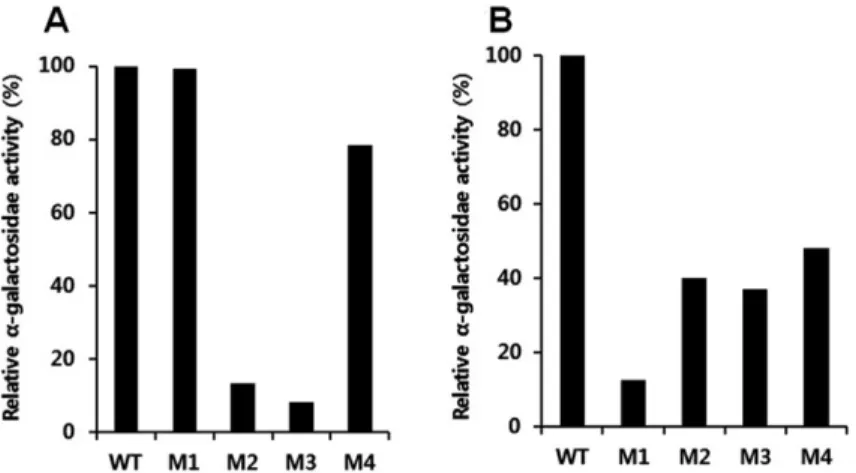
We also performed and α-galactosidase assay using p-nitrophenyl α-D-galactopyranoside (PNPG; Sigma-Aldrich) according to a protocol provided with the Matchmaker system (Clontech Laboratories, Inc.). The results of this assay showed that OsTTG1 Table 1 Interactions between MYB and OsTTG1 or OsGL3
AD/BD Accession number OsTTG1 OsGL3
MYB3 BAB39972 X X
MYB8 BAC07040 X X
MYB10 CAA75509 O X
MYB11 BAA23339 O X
MYB12 BAA23340 X X
MYB14 CAA72218 X X
MYB15 CAA72217 X X
MYB16 BAA23337 X O
MYB17 CAD44619 X X
MYB18 CAA72187 X X
MYB21 CAA72186 X X
MYB23 AY026332.1 X X
MYB30 BAC22341 X X
MYB31 BAB67851 X X
MYB33 BAB39921 X X
MYB35 AC079874.21 O X
MYB36 BAD08950 X X
MYB43 AY151043.1 X O
MYB53 AP002836.1 X X
MYB74 AP002069.2 X X
MYB89 BAC64999 X X
MYB106 CAE04569 X X
MYB111 CAE05473 X X
MYB134 BAD04026 X X
MYB136 NM_191052.1 X X
MYB139 CAE04731 X X
MYB137 BAD05679 X X
MYB149 AC113433.8 X O
MYB150 AAM47303 X O
MYB151 NP_914401 X O
J Appl Biol Chem (2012) 55(1), 67−70 69
interacted with mutant 1 of MYB10 and OsGL3 interacted with mutants 2, 3, and 4 of MYB16 (Fig. 3). These results also suggested that OsTTG1 interacts with OsMYB10 through the R3 motif, whereas OsGL3 interacted with OsMYB16 through the R2 motif. It seems that the interaction between bHLH and MYB proteins is not always mediated through the R2 motif. EGL3, which is one of bHLH protein from A. thaliana, interacted with
Pap1, a MYB protein from A. thaliana through R3 motif (Zimmermann et al., 2004). WD proteins may interact with MYB proteins through the R2 motif; however, extensive research is required to conform the motif important for interactions among these proteins.
Acknowledgment This work was supported by Konkuk University (2011).
References
Abe H, Yamaguchi-Schinozaki K, Urao T, Iwasaki T, Hosokawa D, and Shinozaki K (1997) Role of Arabidopsis MYC and MYB homologs in drought and abscisic acid-regulated gene expression, Plant Cell 9, 1859–
1868.
Bernhardt C, Lee MM, Gonzalez A, Zhang F, Lloyd A, and Schiefelbein J (2003) The bHLH genes GLABRA3 (GL3) and ENHANCER OF GLABRA3 (EGL3) specify epidermal cell fate in the Arabidopsis root.
Development 130, 6431–6439.
Broun P (2005) Transcriptional control of flavonoid biosynthesis: A complex network of conserved regulators involved in multiple aspects of differentiation in Arabidopsis, Current Opin Plant Biol 8, 272–279.
Esch JJ, Chen MA, Hillestad M, and Marks MD (2004) Comparison of TRY and the closely related At1g01380 gene in controlling Arabidopsis trichome patterning. Plant J 40, 860–869.
Feller A, Machemer K, Braun EL, and Grotewold E (2011) Evolutionary and comparative analysis of MYB and bHLH plant transcription factors.
Plant J 66, 94–116.
Goff SA, Cone KC, and Chandler VL (1992) Functional analysis of the transcriptional activator encoded by the maize B gene, evidence for a direct functional interaction between two classes of regulatory proteins.
Genes Dev 6, 864–875.
Goff S, Ricke D, Lan TH, Presting G, Wang R, Dunn M et al. (2002) A draft sequence of the rice genome (Oryza sativa ssp. japonica). Science 296, 92–100.
Jiang C, Gu J, Chopra S, Gu X, and Peterson T (2004) Ordered origin of the typical two- and three-repeat Myb genes, Gene 326, 13–22.
Kim BG, Ko JH, Min SY, and Ahn J-H (2005) Classification and expression profiling of putative R2R3 MYB genes in rice. Agric Chem Biotechnol 48, 127–132.
Koes R, Verweij W, and Quattrocchio F (2005) Flavonoids; a colorful model for the regulation and evolution of biochemical pathways. Trends Plant Sci 10, 236–242.
Lipsick JS (1996) One billion years of Myb. Oncogene 13, 223–235.
Fig. 1 Schematic representation of OsMYB mutants. Mutant 1 with deletion of the R2 domain. Mutant 2 with deletion of the second and third α-helices of the R3 domain. Mutant 3 with deletion of the third α-helix of the R3 domain. Mutant 4 with the deletion of the C-terminal region after the R3 domain.
Fig. 2 Yeast two-hybrid assay between OsTTG1 and OsMYB10 domain-deletion mutants (A) and between OsGL3 and OsMYB16 domain-deletion mutants (B).
Fig. 3 Comparison of α-galactosidase activity between OsTTG1 and OsMYB10 domain-deletion mutants (A) and between OsGL3 and OsMYB16 domain-deletion mutants (B).
70 J Appl Biol Chem (2012) 55(1), 67−70
Liu Y, Schiff M, and Dinesh-Kumar SP (2004) Involvement of MEK1 MAPKK, NTF6 MAPK, WRKY/MYB transcription factors, COI1 and CTR1 in N-mediated resistance to tobacco mosaic virus. Plant J 38, 800–
809.
Ogata K, Morikawa S, Nakamura H, Sekikawa A, Inoue T, Kanai H, Sarai A, Ishii S, and Nishimura Y (1944) Solution structure of a specific DNA complex of the Myb DNA-binding domain with cooperative recognition helices. Cell 79, 639–648.
Rabinowicz PD, Braun EL, Wolfe AD, Bowen B, and Grotewold E (1999) Maize R2R3 Myb genes:sequence analysis reveals amplification in the higher plants. Genetics 153, 427–444.
Ramsay NA and Glover BJ (2005) MYB-bHLH-WD40 protein complex and the evolution of cellular diversity. Trends in Plant Sci 10, 63–70.
Romero I, Fuertes A, Benito MJ, Malpica JM, Leyva A, and Paz-Ares J (1998) More than 80 R2R3-MYB regulatory genes in the genome of Arabidopsis thaliana. Plant J 14, 273–284.
Serna L (2004) A newtwork of interacting factors triggering different cell fates. Plant Cell 16, 2258–2263.
Serna L and Martin C (2006) Trichomes: Different regulatory networks lead to convergent structures. Trend in Plant Sci 11, 274–280.
Thompson MA and Ramsay RG (1995) Myb: An old oncoprotein with new roles. Bioessays 17, 341–350.
Walker AR, Davison PA, Bolognesi-Winfield AC, James CM, Srinivasan N, Blundell TL et al. (1999) The TRANSPARENT TESTA GLABRA1 locus, which regulates trichome differentiation and anthocyanin biosynthesis in Arabidopsis, encodes a WD40 repeat protein. Plant Cell 11, 1337–1350.
Yu J, Hu S, Wang J, Wong GK, Li S, Liu B et al. (2002) A draft sequence of the rice genome (Oryza sativa L. ssp. indica). Science 296, 79–91.
Zimmermann I M, Heim MA, Weisshaar B, and Uhrig JF (2004) Comprehensive identification of Arabidopsis thaliana MYB transcription factors interacting with R/B-like BHLH proteins. Plant J 40, 22–34.