• 검색 결과가 없습니다.

The study on a ship energy management system applied rechargeable battery

N/A
N/A
Protected

Academic year: 2021

Share "The study on a ship energy management system applied rechargeable battery"

Copied!
6
0
0

로드 중.... (전체 텍스트 보기)

전체 글

(1)

This paper is extended and updated from the short version that appeared in the Proceedings of the International

†Corresponding Author: Department of Marine Engineering, Korea Maritime and Ocean University, 727 Taejong-ro, Yeongdo-gu, Busan 606-791, Korea, E-mail: [email protected], Tel: 051-410-4283

1 Department of Marine Engineering, Korea Maritime and Ocean Engineering University, E-mail: [email protected], Tel:

051-410-4866

The study on a ship energy management system applied rechargeable battery

Jae-hee Jang

1

․ Jin-seok Oh

(Received November 4, 2013; Revised November 21, 2013;Accepted December 20, 2013)

Abstract: Recently, the study of energy saving technology of ships begins in earnest, as energy saving poli- cies are performed all around the world. SEMS (Ship Energy Management System) is one of the techniques to increase energy efficiency by applying to a independent system like a ship and offshore. SEMS is com- posed of Cooling Pump Control System (CPCS), Renewable Energy Emergency Power Control System (REEPCS), Load Control System (LCS), and Heating, Ventilation, and Air Conditioning System (HVACS).

SEMS is enable to increase energy efficiency and achieve integrated management through the interlocking of each system. Especially, it is possible to improve the flexibility of the selection of the generator capacity in conjunction with a rechargeable battery and renewable energy. In this paper, SEMS applied rechargeable bat- tery is proposed and simulated. By applying the rechargeable battery, it was confirmed that SEMS applied re- chargeable battery can be operated at optimum efficiency of the generator.

Keywords: Ship energy management system, Rechargeable battery, Efficiency of generators

1. Introduction

For systems that make up the independent power system as ship, efficient use of energy is important.

In recent years, due to environmental regulations to be strengthened and oil prices soaring, various tech- nological developments have been made with the aim to improve the efficiency of ship operations and re- duce operating costs. In particular, the International Maritime Organization (IMO) mandates the Ship Energy Efficiency Management Plan (SEEMP) in 2013. In future, it is considered that these environ- mental regulations will be further strengthened.

As a method for improving the energy efficiency of the ship, you can operate the generator at optimum load factor and manage the energy used by the auxil- iary system. In the case of a ship, propulsion system is accounted for the highest load factor. In addition,

load of auxiliary system such as lighting, heating and cooling system accounted for the next. In the case of vessels, such as cruise ships, because the proportion of the auxiliary system load is higher than the other ship, it is necessary to improve the efficiency through the monitoring and control. Generator of the ship ex- poses the best efficiency in the load factor of 85% of its capacity, but the potential for problems of safety hazards is high any more. For this reason, it is ad- vantageous to operate the generator at 85% load fac- tor as far as possible in order to increase the energy efficiency of the ship [1].

In this paper, the Ship Energy Management System

(SEMS) including Load Control System (LCS),

Renewable Energy Emergency Power Control System

(REEPCS), Heating, Ventilating, Air Conditioning

System (HVACS) and Cooling Pump Control System

(CPCS) is proposed, and researched.

(2)

2. Structure of Ship Energy Management System

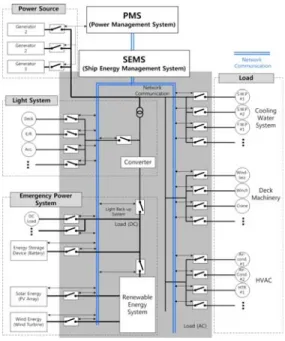
Ship Energy Management System (SEMS) linked with the Power Control Management System (PCMS) refers to technology that can reduce the energy, and assure the flexibility of power utilization and gen- eration system. SEMS comprising Cooling Pump Control System (CPCS), Renewable Energy Emergency Power Control System (REEPCS), Load Control System (Load Control System) and Heating, Ventilation, and Air Conditioning System (HVACS) is intended to increase the operational flexibility of the power system rather than efficiency of the gen- erator itself and the propulsion system of the ship.

Figure 1 shows the components of the SEMS.

With integrated management of SEMS, linkage be- tween individual systems like air conditioning system, seawater pump system, and generator system is possible. Further, by applying the renewable energy and the rechargeable battery, it would improve effi- ciency and reduce energy and carbon dioxide emis- sions of ships.

Figure 1: Components of SEMS

2.1 Cooling Pump Control System

CPCS is a system to reduce power consumption by taking into account water temperature, and pressure, and controlling the flow of sea water and fresh water.

CPCS is controlling RPM of the seawater pump and fresh water pump and a valve, on the basis of in- ternal algorithms. Figure 2 shows schematic diagram of the CPCS.

CPCS is that system using an inverter and motor control technology to control pumps in response to en- vironmental conditions, and it allows to save energy.

Figure 2: Schematic diagram of the CPCS

2.2 Renewable Energy Emergency Power Control System

REEPCS is a system for managing the development of renewable energy. This is used in charging to emer- gency power supply or safety services [2]. And then the emergency battery is full, it can be reduced load of ship by using HVACS and light system. Figure 3shows the schematic diagram of REEPCS [3].

Figure 3: Schematic diagram of the REEPCS

(3)

2.3 Load Control System

Heavy consumer such as Ballast pump, Crane, etc increases the number and capacity of the generator.

LCS is a system to improve the efficiency of power operation linked with the PCMS to manage and oper- ate the load that heavy consumer needs [4].

Through the control algorithm, LCS can manage the power system more efficiently and maximize en- ergy savings. By measuring the various quantity of electricity and the change in the load, it is possible to improving safety and peak value control.

Figure 4: Schematic diagram of the LCS

2.4 Heating, Ventilation, and Air Conditioning System

Figure 5 : Schematic diagram of the HVACS

HVACS is a system that can be adjusted to the minimum power of Fan, Damper, and Unload system,

by measuring the temperature and humidity inside and outside. And here, the algorithm working with the power system of the ship and changing the set temperature if necessary, are included.

3. Rechargeable battery linked SEMS

SEMS including CPCS, REEPCS, LCS and HVACS reduces unnecessary load on the ship operations and increases the efficiency of energy. Additionally, when building the SEMS of the rechargeable battery based, it is possible to prevent the rapid changed in generator load and improve the flexibility in the sizing of the generator. Figure 6 shows an overview of the SEMS applied the rechargeable battery.

Figure 6: Overview of the SEMS and rechargeable battery

Productivity of renewable energy since not con-

stant, it is possible to improve the efficiency by con-

necting a rechargeable battery. Further, it is possible

to manage the rapid changing heavy consumer by

linking with LCS to control load of ship. For this to

be possible, the control algorithm of the rechargeable

battery must be included.

(4)

Because of the heavy consumer(like the bow thruster, ballast pump, etc), the capacity of the gen- erator is chosen significantly. In the case of SEMS applied the rechargeable battery, it is possible to ei- ther reduce the number of the generator, and reduce the capacity of the generator. Figure 7 is a control al- gorithm of SEMS applied the rechargeable battery.

Figure 7: Flow chart of LCS applied rechargeable battery

4. Simulation

SEMS applied rechargeable battery has advantages that improve the efficiency of the generator by main- taining the optimum load, enhance the reliability by storing renewable energy has not uniform energy pro- duction, and prepare a sudden load change. The simu- lation is composed of the produced electricity from generator, renewable energy, propulsion load and aux- iliary load that can be ON/OFF. And charging and discharging of the rechargeable battery takes place in accordance with the efficiency of the generator. The conditions of the simulation are shown in Table 1.

LabVIEW has been used as simulation program.

Figure 8 shows a flowchart of the simulation.

Parameter Value

Capacity of D/G 2500kW

Capacity of Rechargeable

battery 1000kWh

Production of electricity

of Renewable energy 500kW

Operating time 30000sec

Table 1: Simulation condition

Figure 8: Flow chart of simulation

Figure 8 is an algorithm to calculate the surplus power and determine the parallel operation of the gen- erator or use of the rechargeable battery. If the surplus power is sufficient, It can be determine the "stop gen- erator" or "charging of rechargeable battery" according to the number of units in operation of the generator.

If it is determined that single generator can afford all loss, parallel operation of generator will switch to in- dependent operation of the generator[4]. Otherwise it will move to the charging algorithm of the recharge- able battery. In addition, when the single generator operating surplus power is generated, it will move to the charging algorithm of the rechargeable battery.

Conversely, if surplus power is insufficient when the

single generator is operating, it would be moved to

(5)

discharge algorithm of the rechargeable battery. As a result, charge or discharge of rechargeable battery will be determined by SOC. If it is determined that SOC of the rechargeable battery is sufficient, the using re- chargeable battery commands is transmitted, otherwise parallel operation command is transmitted. If both fail, free power shortage alarm is sent.

Figure 9 shows the change in the overall power consumption as a result of having been simulated on the basis of the conditions in Table 1.

In order to apply the rechargeable battery, and ad- justed the load via the ON / OFF of the auxiliary loads. It is possible to confirm that the load changes between 1400kW to 3000kW.

Figure 10 is a graph showing the power to be charged and discharged the rechargeable battery.

Based on the load factor, charging and discharging are performed. In Figure 11, it is able to confirm that the charge amount of the rechargeable battery is in- creased or decreased depending on the charge and discharge amounts that shown in Figure 10.

Figure 9: Total power consumption

Figure 10: Power that is charged and discharged in rechargeable battery

Figure 11: Battery remains

Figure 12 : Comparison load factor

Figure 12 is a graph comparing the load factor to bear 1 generator if it does not apply to the case of applying the rechargeable battery. When applying the rechargeable battery, it can be confirmed that the load factor of the generator is kept constant at 85% or less. If the load on the generator did not reach 85%, by charging power to the rechargeable battery, so as to maintain a 85% load factor. When the load that 1 generator should bear is more than 85%, the re- chargeable battery operates with generator, so it is sufficient to run only 1 generator. It is possible to prevent the low-load operation of the generator by such a mechanism, maintain the optimum load factor, and improve the efficiency of energy and the flexi- bility in the selection of the generator capacity.

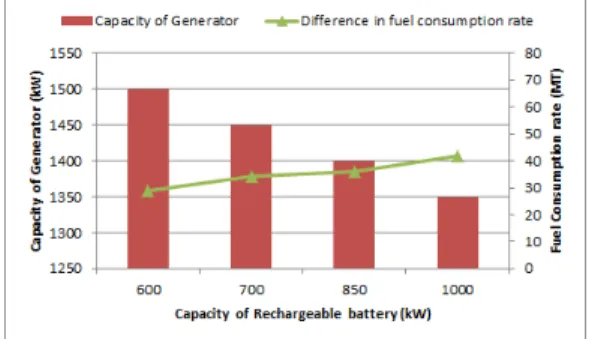
Figure 13 is a graph showing the difference in fuel

consumption and capacity of the generator due to

change in capacity of rechargeable battery witch is

derived based on simulation and Specific fuel con-

sumption curve[5]. The difference in fuel con-

sumption rate means the difference between a fuel

consumption rate of SEMS applied the rechargeable

(6)

Figure 13 : Change in fuel consumption rate and capacity of the generator due to the change in capacity of the rechargeable battery

battery and a fuel consumption rate of conventional generator that does not use a rechargeable battery.

Referring to the graph, when the capacity of the re- chargeable battery increases, the difference in the fuel consumption rate increases and the capacity of the generator decreases. However, analysis for the econo- my is required for practical application, because of the high price of the rechargeable battery.

5. Conclusion

In this paper, SEMS applied the rechargeable bat- tery is proposed and the simulation for this is done.

Through SEMS applied the rechargeable battery, it is enable to reduce unnecessary load to the ship during operation, increase flexibility in the selection of the generator capacity, and improve the efficiency of re- newable energy. In addition, it prevents rapid change of the load.

For the application of substantial SEMS applied the rechargeable battery, it is necessary to consider, such as the following. Basically, the capacity of the gen- erator decreases the capacity of the rechargeable bat- tery increases. However, because there is a problem of the price of the rechargeable battery, the studies to searching the optimal point between capacity of the generator and the capacity of the rechargeable battery should be proceeded.

Acknowledgement

This work is the outcome of a Manpower Development Program for Marine Energy by the Ministry of Oceans and Fisheries.

References

[1] M. Lappi, J. P. Jalkanen, and L. Johansson,

“Effect of speed reduction on particle emissions of ships”, Journal of Clean Shipping Currents, vol. 2 no. 3, pp. 1-6, 2013.

[2] Joo-Seok Park, Seung-Ho Hang, Chul Hee Cho, Bo Yun Jang, Hong-Soo Kim, and Young-Soo Ahn, “A study on renewable energy and the secondary battery-electricity storage tech- nologies”, The Korean Solar Energy Society Conference Proceedings, pp. 121-127, 2006.

[3] Battery Back-Up system, http://www.dcacpower.co.kr/other/AUTO.htm,

Accessed Nobember 4, 2013

[4] Standard Application Documentation Multi-Function System for Control and Protection of Generator Plants, TR-MARINE TECHNOLOGY, 2010.

[5] So-Yeon Kim, Byung-Geul Cho, and Seung-Ki

Sul, “Feasibility study of intergrated power sys-

tem with battery energy storage system for na-

val ship”, IEEE, pp. 532-537, 2012.

수치

Figure 1: Components of SEMS
Figure 5 : Schematic diagram of the HVACS
Figure 8 shows a flowchart of the simulation.
Figure 13 : Change in fuel consumption rate and  capacity of the generator due to the change in  capacity of the rechargeable  battery

참조

관련 문서