Vol. 17, No. 4 pp. 361-372, 2016
과학 중심 융합인재교육(S-STEAM) 프로그램이 유아의 창의성 및 다중지능에 미치는 영향
송민서1*, 김형재2
1동명대학교 유아교육과, 2영동대학교 유아교육과
The effects of S-STEAM program on creativity and multiple intelligences of young children
Min-Seo Song
1*, Hyoung-Jai Kim
21Department of Early Childhood Education, Tong-Myoung University
2Department of Early Childhood Education, Yong-Dong University
요 약 본 연구는 S-STEAM 프로그램을 개발하고, 본 프로그램이 유아의 창의성 및 다중지능에 미치는 영향을 검증하는데 그 목적이 있다. 이를 위해 유아과학교육과 융합인재교육에 대한 문헌과 선행연구 분석을 토대로 S-STEAM 프로그램을 개발 하였다. 효과 검증을 위해 S시에 소재한 어린이집 만 4세 유아 29명(실험집단 14명, 비교집단 15명)을 대상으로 실험집단에게 S-STEAM 프로그램을 비교집단에게 누리과정에 기초한 과학활동을 실시하였다. 연구도구는 창의성 측정도구 TTCT(도형A, B형)를 실시하였고, 교사에게 교사평가 유아 다중지능 검사도구를 실시하였다. 자료 분석은 본 프로그램이 창의성 및 다중지 능에 미치는 영향을 분석하기 위해 공분산분석을 실시하였다. 연구결과, 첫째, 본 S-STEAM 프로그램은 전체 창의성과 창의 성 하위요인 유창성, 독창성, 추상성, 정교성 및 개방성 모두에 긍정적인 영향을 미치는 것으로 나타났다. 둘째, 본 S-STEAM 프로그램은 전체 다중지능과 다중지능 하위영역 중 개인이해지능을 제외한 언어, 음악, 공간, 논리․수학, 신체‧운동, 대인관 계, 자연친화 지능에 긍정적인 영향을 미치는 것으로 나타났다.
Abstract The purpose of this study was to develop a STEAM-based science education program for children and to verify its effectiveness. An S-STEAM-based science education program for young children was developed through careful analysis of prior research on science education for young children and S-STEAM. The participants were 29 four-year-old children from daycare centers located in Seoul (an experimental group of 14 and comparative group of 15). The S-STEAM program was applied to the experimental group, while the control group went through a general science education course provided by the government. TTCT of Creative Thinking (TTCT: Figures A and B) was used as a research tool, and a multiple intelligence test tool was applied to teachers of the groups. Afterwards, analysis of covariance was implemented to find the S-STEAM program's effects. First, the results showed positive effects on overall creativity, as well as in fluency, originality, abstractness, elaboration, and openness components of creativity.
Second, the results showed positive effects on overall multiple intelligences and its components of linguistic, musical, spatial, logical/mathematical, physical exercise, interpersonal, and naturalist intelligence.
Keywords : creativity, convergent program, multiple intelligences, science education, S-STEAM education
*Corresponding Author : Hyoug-Jai Kim(Young-Dong Univ.) Tel: +82-10-8783-3856 email: [email protected] Received January 27, 2016
Accepted April 7, 2016
Revised (1st March 7, 2016, 2nd March 14, 2016) Published April 30, 2016
1. 연구의 필요성 및 목적
21세기는 지식 기반 사회, 세계화·정보화 시대, 다양
성을 존중하는 시대이면서 동시에 융합 과학 기술을 요 구하는 시대로, 이러한 사회적 요구는 분절된 교과 학문 의 유능성 보다는 종합적인 사고력과 통합적 문제해결력
을 갖춘 창의성 교육에 대한 강조로 이어지고 있다[1].
이처럼 변화를 추구하는 사회에서는 창의적인 과학기술 의 지식과 정보를 창출하는 인적 자원을 필요로 한다.
즉, 지식, 기술, 학문 간의 통합과 융합을 통해 창의적이 고 문제해결력을 갖춘 인재를 필요로 하는 시대가 되었 다[2].
2001년부터 미국에서 STEM이라는 용어를 교육 분 야에서 사용되기 시작하였으며, NSF의 교육인적자원 국 장인 Ramaley이 STEM 교육의 주창자로서, STEM 교 육을 “메타 학문적인 접근으로 정규교육과정에 기술과 공학을 통합함으로써 수학, 과학과 같은 교과목의 수업 을 혁신시키는 교육이다.”라고 정의하였다[3]. 2002년 No Child Left Behind 정책이 세워지면서 STEM은 주 목 받는 교육으로 급부상하였고, 미국의 미래는 STEM 분야에서 학습자들을 교육하는 것에 달려있다고 인식하 고 있다. 영국은 2004~2014년 동안 학과 혁신에 대한 기틀을 수립하고, 세계의 선도자적인 역할을 위해서는 STEM 교육정책이 필요하다고 하였다. 영국 DfES(교육 부)의 STEM의 목적은 우수한 인재들을 STEM영역으로 유입하는 것과 대중의 STEM 소양을 증진하는 것으로 삼았다.
PISA 2006에 따르면, 우리나라 학생들의 과학교과에 대한 가치 인식 및 흥미도 하락이 결과적으로 교과의 인 지 영역의 하락을 초래할 것이며[4], 이러한 원인은 현실 과 동떨어진 교과구성에도 책임이 있다는 지적이 있으며 [5], 국제비교연구 OECD에서도 우리나라가 과학에 대 한 흥미, 자신감 등 정의적 영역에서 최하위의 기록을 보 이며, 이는 이공계 진학률을 낮춤으로써 과학기술 인력 양성의 문제에 직면하고 있음을 밝혔다[6].
최근 우리나라에서도 융합인재를 양성하기 위한 노력 으로 과학을 중심으로 관련 학문과 예술과의 융합교육을 적용하고 있다. 즉, 과학교과와 다른 영역 간 통합적 접 근이 과학교육에 영향을 미친다는 선행연구, 과학과 수 학[7], 과학과 문학[8], 과학과 사회[9], 과학과 예술[10]
의 통합 관련 연구들이 진행되었으며, 교육과학기술부는 2011년 6대 핵심과제 중 ‘세계적 과학기술인재 육성’ 추 진을 위해 초·중·등 교육과정에 미국의 STEM에 예술(A) 을 더해 융합인재교육을 주요 정책으로 발표하였다[11].
융합인재교육이란 과학, 기술, 공학, 예술, 수학이 서 로 관계를 맺고, 연결된 새로운 방식의 교육 시스템으로 분리된 교과목 교육과 전혀 다른 교수․학습방법이다
[12]. 융합인재교육의 목적은 학습자가 자신과 학습을 연결하여 주도적 학습을 유도하며, 과학교과와 다른 교 과를 연결하는데 있다[13]. 융합인재교육 측면의 과학교 육은 과학기술에 대한 흥미와 이해, 융합적 사고, 문제해 결력을 통한 융합인재교육에서 ‘실생활에서의 문제해결 력을 배양한다.’는 점이 기존의 과학교육과 차별화된다 [11].
이처럼 과학과 다양한 학문의 통합 활동의 중요성이 부각됨에 따라 유아교육분야에서도 과학과 문학[14], 음 악[15], 미술[16-23], 그리고 예술의 영역[24]을 통합한 다양한 프로그램 개발에 관련된 연구들이 진행되고 있음 에도 불구하고, 선행연구들은 융합인재교육 활동이 아니 라 단일 영역과 과학을 통합한 프로그램이거나 과학의 사전활동이나 확장활동으로 다른 영역을 연계한 활동들 로 포괄적인 융합적 차원과는 다르다는 한계점을 가진다 [25]. 따라서 이러한 시대적 흐름과 사회적 요구에 맞춰
‘창의성’, ‘다중지능’ 등을 지향하는 과학 중심 융합인재 교육 프로그램의 개발이 절실히 요구된다.
과학은 유아의 호기심을 일어나게 하는 근원이 되며 그들로부터 새로운 것을 발견한다는 점에서 본질적으로 창의성을 촉진시킨다[26]. 과학활동은 유아의 창의성 증 진에 효과적이며[27-28] 특히, 융합인재교육을 통해 창 의성이 계발된다는 주장이 몇몇 선행연구를 통해서도 밝 혀지고 있다. 구체적으로, 미술‧과학 융합교육 프로그램 이 유아의 창의성발달에 효과적이라고 하였고[29], [12]
융합인재교육 기반 조형 활동 수업이 유아의 창의성을 향상시켰다고 하였다. 또한 [30]은 융합인재교육 기반 환경미술교육이 유아의 창의성(유창성, 융통성, 독창성, 상상력)에 긍정적인 영향을 미친다고 하였다.
한편, 교과 중심 교육과는 달리 융합인재교육은 좌뇌 형 학습자에게 우뇌형 사고를 경험하게 하고, 우뇌형 학 습자에게는 좌뇌형 사고의 경험을 제공하여 폭넓은 시각 을 가능하게 하는 교육의 기회를 제공한다[31]. 모든 유 아는 최소한 한 가지의 우수한 지능을 가지고 있으며, 8 개 지능영역 내에서 강점, 약점을 지니고 있으며, 강점 영역의 지능을 통합적으로 이용하여 가르치면 성공적으 로 학습할 수 있다[32]. 따라서 융합인재교육을 통한 다 중지능의 개발은 Leonardo da Vinci, Mihchelangelo, Albert Einstein, Steve Jobs와 같은 융합형 다중지능이 계발된 미래지향적인 두뇌를 보유한 인재 양성을 가능하 게 할 것이다. 그럼에도 불구하고, 다중지능이론 관련 과
학교육 연구들은 그 대상이 대부분 초등학생이며, 유아 대상으로는 [33]에서 [물] 주제 탐구․표현 교육 프로그 램이 신체운동지능, 논리수학지능, 공간지능, 언어지능 을 향상시킨다고 하였다. 더구나 융합인재교육을 통해 다중지능을 분석한 연구는 전문하였다.
최근 유아를 대상으로 하는 융합인재교육의 필요성을 제기하거나 교육의 기틀을 마련하기 위한 선행연구들 [34-38]이 이루어졌나, 융합인재교육 프로그램 개발과 관련된 연구들은 창의성 및 과학적 탐구능력을 위한 예 술, 과학 융합프로그램의 효과를 알아본 연구[15], 미술·
과학 융합인재교육 프로그램이 유아의 창의성 발달에 미 치는 효과를 분석한 연구들[2], [13]로 그 수가 제한적이 며, 대부분 예술과 과학 융합 프로그램을 개발하였다. 또 한, 이들 선행연구들은 유아 수준에서 과학, 기술, 공학, 수학의 개념 및 원리가 어느 정도 적용가능한지에 대한 판단과 기준이 미비하여 융합인재교육이 갖는 교육 목적 및 목표에 도달하지 못하고 있다.
융합교육은 유아의 흥미를 유발할 뿐만 아니라 발달 수준에 적합하며 학습 효과를 극대화 시킬 수 있기 때문 에 통합교육의 중요성이 강조되고 있는 유아교육현장에 서도 융합 형태의 활동이 필요하다. 또한 대부분 융합인 재교육 프로그램은 만 5세 유아 대상이며, 만 4세 유아 는 발달에 대한 충분한 정보 및 발달수준에 적합한 교육 과정의 연구가 미흡하다는 견해[37]에 따라 과학 중심 융합인재교육 프로그램은 유아교육현장에서 과학활동이 시작되는 연령인 만 4세부터 개발‧적용되어야 한다.
따라서 본 연구에서는 만 4세 유아들의 흥미와 발달 에 적합하며 융합적 사고력뿐만 아니라 창의성과 다중지 능 계발에 도움이 되는 과학 중심 융합인재교육 프로그 램(S-STEAM)을 개발한 후 본 프로그램이 유아의 창의 성 및 다중지능에 미치는 영향을 검증하고자 한다. 이는 유아를 위한 다양한 융합인재교육 프로그램 개발을 위한 기초자료가 될 것이며, 유아교육현장에 의미 있게 적용 될 수 있는 S-STEAM 프로그램 활동에 대한 교육목표, 교육내용, 교수·학습방법 및 평가방법 등의 자료로 활용 될 것이다. 본 연구의 목적을 수행하기 위해 다음과 같은 연구문제를 설정하였다.
연구문제 1. S-STEAM 프로그램이 유아의 창의성에 미치는 영향은 어떠한가?
연구문제 2. S-STEAM 프로그램이 유아의 다중지능 에 미치는 영향은 어떠한가?
2. 프로그램 개발
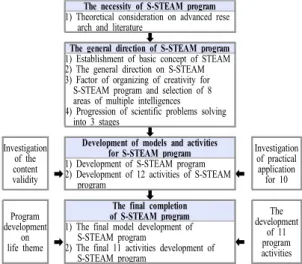
2.1 S-STEAM 프로그램 개발 절차 S-STEAM 프로그램 개발절차는 Fig. 1과 같다.
The necessity of S-STEAM program 1) Theoretical consideration on advanced rese
arch and literature
The general direction of S-STEAM program 1) Establishment of basic concept of STEAM 2) The general direction on S-STEAM 3) Factor of organizing of creativity for S-STEAM program and selection of 8 areas of multiple intelligences
4) Progression of scientific problems solving into 3 stages
Investigation
of the content validity
Development of models and activities
for S-STEAM program Investigation of practical application
for 10
➡1) Development of S-STEAM program 2) Development of 12 activities of S-STEAM
program
Program
development life themeon
The final completion
of S-STEAM program The
development of 11 program activities
➡
1) The final model development of S-STEAM program
2) The final 11 activities development of S-STEAM program
Fig. 1. The procedure of S-STEAM program development
첫째, S-STEAM 프로그램 개발의 필요성을 유아의 과학 프로그램, 과학 활동, 융합인재교육, S-STEAM과 관련된 선행연구 및 문헌들을 고찰하여 명시하였다. 둘 째, S-STEAM, 창의성과 다중지능 관련된 선행연구들을 고찰하여 본 S-STEA M 프로그램이 지향하는 방향을 설정하였다. 이를 위해 선행연구를 바탕으로 융합인재교 육의 기본 개념과 S-STEAM에 대한 기본 방향 및 과학 프로그램 구성을 위한 창의성 하위요인을 구성요인을 설 정하였으며, 다중지능 하위요인 언어지능, 음악지능, 공 간지능, 논리·수학지능, 신체·운동지능, 대인관계지능, 개 인이해지능, 자연탐구지능 하위요인을 구성요인으로 설 정하고 진행하고자 하였다. 셋째, S-STEAM 프로그램 모형 및 13개 활동을 개발하였다. 넷째, 개발된 프로그 램에 대해 유아교육과 교수 3인이 내용타당도를 검토하 였고, 만 4세 유아 10명을 대상으로 현장적용 검증을 거 친 후 유아의 S-STEAM 프로그램 최종 모형과 생활주 제별 11개의 활동이 최종적으로 개발되었다.
2.2 S-STEAM 프로그램 개발 2.2.1 프로그램 기본 방향
첫째, [13]이 제시한 목적 및 목표를 기초로 하여 본 S-STEAM 프로그램은 만 4세 유아의 창의성과 다중지
능 및 융합적 사고력을 향상시키고자 하는 목적 아래
‘S-STEAM 프로그램을 통해 창의적 사고를 기른다.’
‘S-STEAM 프로그램을 통해 다중지능을 계발한다’.
S-STEAM 프로그램을 통해 융합적 사고력을 기른다.’의 3가지 목표를 선정하였다. 본 프로그램의 교육내용 선정 을 위해 융합인재교육과 유아 과학과 미술, 음악, 수학
간의 통합교육과 관련된 선행연구들
[13],[16-17],[23],[33], [39]의 고찰을 통해 시사점을 도 출하였다. 또한 대부분의 융합형 선행연구들은 예술이 과학에 보충적으로 기여하는 매개체의 역할만을 하여 완 전한 융합 프로그램이 아니라는 제한점을 보완하여 유아 의 창의성과 다중지능을 계발하는데 초점을 두어 본 프 로그램은 생활주제 11개로 유아의 흥미와 사전지식에 기반을 둔 활동내용을 선정하였다.
둘째, 본 프로그램의 교수·학습방법은 [40]이 제안한 융합인재교육 활동 교수‧학습과정을 기초로 하여 ‘상황 제시단계’, ‘창의적 설계 감성적 체험 내용융합’, ‘문제 해결에 대한 결론짓기’의 3단계로 설정하였다. 또한 유 아 창의성 관련 선행연구 고찰을 통해 창의성 하위요인 은 유창성, 독창성, 추상성, 정교성, 개방성을 구성하였 으며, 다중지능 영역은 언어지능, 음악지능, 공간지능, 논리·수학지능, 신체·운동지능, 대인관계지능, 개인이해 지능, 자연탐구지능 영역으로 구성하였다.
셋째, 평가는 유아교육현장에서 실시하고 있는 활동 마무리 단계에서의 유아평가를 실시하였다. 이는 [13]에 서 제시한 융합인재교육의 적절성 평가 체크리스트 하위 영역 중 교육의 목적, 교육 개념(흥미증진, 실생활 연계, 융합적 사고력 배양), 융합인재교육 활동 준거(상황 제시 하위요소 자연스러운 융합, 창의적 설계 하위요소인 학 생중심, 아이디어 발현, 자기 문제화, 학습방법, 과정, 활 동 중심, 다양한 산출물, 협력학습), 감성적 체험 (Hands-on, 성공의 경험, 새로운 도전 요소, 자기평가)을 기초하여 평가항목을 선정하였다.
2.2.2 프로그램 구성요인
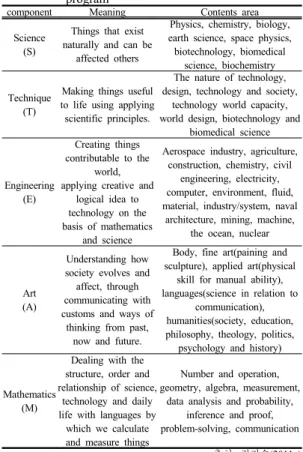
본 S-STEAM 프로그램에서의 구성요인은 Table 1과 같다.
Table 1. The component of STEAM for S-STEAM program
component Meaning Contents area
Science (S)
Things that exist naturally and can be
affected others
Physics, chemistry, biology, earth science, space physics, biotechnology, biomedical
science, biochemistry
Technique (T)
Making things useful to life using applying scientific principles.
The nature of technology, design, technology and society,
technology world capacity, world design, biotechnology and
biomedical science
Engineering (E)
Creating things contributable to the
world, applying creative and
logical idea to technology on the basis of mathematics
and science
Aerospace industry, agriculture, construction, chemistry, civil
engineering, electricity, computer, environment, fluid, material, industry/system, naval
architecture, mining, machine, the ocean, nuclear
Art (A)
Understanding how society evolves and affect, through communicating with customs and ways of
thinking from past, now and future.
Body, fine art(paining and sculpture), applied art(physical
skill for manual ability), languages(science in relation to
communication), humanities(society, education, philosophy, theology, politics,
psychology and history)
Mathematics (M)
Dealing with the structure, order and relationship of science,
technology and daily life with languages by which we calculate and measure things
Number and operation, geometry, algebra, measurement,
data analysis and probability, inference and proof, problem-solving, communication
출처: 김진수(2011a)
2.2.3 S-STEAM 프로그램의 교수·학습 모형 본 S-STEAM 프로그램의 교수·학습 모형으로 과학적 문제해결과정은 Fig. 2와 같다.
The 1st
stage ― The stage of presentation of situation
The 2nd
stage ― Creative design Sensible experience
Contents fusion Applying of STEAM
The 3rd
stage ― Bring a conclusion of problem solving
Fig. 2. The scientific problem solving 3 stages of S-STEAM program
Fig. 2와 같이, 본 S-STEAM 프로그램 모형의 교수·
학습과정은 상황제시단계’, ‘창의적 설계 감성적 체험 내 용융합’, ‘문제해결에 대한 결론짓기’의 3단계를 거치며, 문제해결에 아이디어 제안 및 적용단계에서 과학(S), 기 술(T), 공학(E), 예술(A), 수학(M)의 융합적 사고를 적용 하였다.
Table 3. The activity contents and factors of S-STEAM programs
Life
theme Activity contents Factors of STEAM
Nursery school
and friends
1. Boxes in our memory made with noodles
Making a frame mixing many colour
in boiled noodles rather than using
glue.
S: Investigation of the objects of boiled noodles
T: Making a frame design which noodles do not fall
E: The diversity of materials A: Expression using various materials M: Figure and pattern, space
I and family
2. My heart telling to family with salt To write a letter on
the various textures of black colour (cloth, coloured paper
and non-woven fabric) and heat it, after colouring salty water with edible dyes.
S: Material change, the principle of vaporization
T: To know electricity and electrical goods
E: The diversity of materials A: Expressing with various materials M: Measuring vaporizing
Our village
3. Let's make writing papers in our village To grind it in a
blender and sieving it after soak milk papers in water, and
then, heat it after mixing it with various shapes and colours,
and filtering it.
S: Material change, the principle of power T: Knowing electricity and electrical
goods, and characteristic desgisn E: Writing papers using recycled product A: Design using various materials M: Position, arrangement, figure and
patterns
Animals and plants,
and nature
4. The parti-coloured popcorn zoo To express it using
paints sprays in various ways, after making animals with
popcorns without adhesives.
S: Investigation of the characteristics of objects
T: Design of making a tower E: Movement using water A: Mixture of various colours M: The number of objects
Health and safety
5. Laver and sea mustards changed.
After soaking laver and sea mustards in water and expressing
in a painting, restoring them to the
original state and then, express with new laver and sea mustards again.
S: The and change of objects and tempera ture
T: Electricity and electric goods E: The diversity of materials A: The expression of new colour and
for m with various colour M: Change as time goes.
Living tools
6. A water purifier changing to clean water To change impure
water to clean water with a water purifier made with pebbles, charcoal and sand.
S: The procedure of change of water T: To design a water purifier E: The diversity of materials A: The expression of the design of a
water purifier
M: The percentage of impur water, position
transpor tation facilities
7. Smilingly roller coaster Making a roller
coaster after putting paintings of various colours in a small
ball, and seeing movement of a marble and paints rolling the marble.
S: spinning, speed T: Roller coaster design
E: The structure of a ball inserting paints.
A: Mixture of colour and desgin according to movement
M: Time and the position of a small ball
2.2.4 프로그램 활동내용 및 융합요소
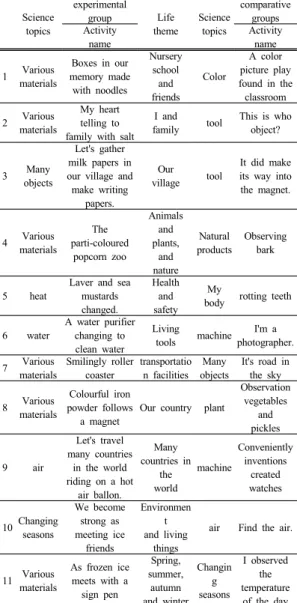
실험집단은 S-STEAM 프로그램을 비교집단은 누리 과정 기반 과학활동을 실시하였고, 생활주제에 따른 구 체적인 활동명은 Table 2와 같다.
Table 2. The camparison between the experimental and comparative group in scientific activity Science
topics
experimental
group Life
theme
Science topics
comparative groups Activity
name
Activity name
1 Various materials
Boxes in our memory made with noodles
Nursery school
and friends
Color
A color picture play found in the classroom 2 Various
materials
My heart telling to family with salt
I and
family tool This is who object?
3 Many
objects
Let's gather milk papers in our village and make writing
papers.
Our village tool
It did make its way into the magnet.
4 Various materials
The parti-coloured
popcorn zoo
Animals and plants,
and nature
Natural products
Observing bark
5 heat
Laver and sea mustards changed.
Health and safety
My
body rotting teeth
6 water
A water purifier changing to clean water
Living
tools machine I'm a photographer.
7 Various materials
Smilingly roller coaster
transportatio n facilities
Many objects
It's road in the sky
8 Various materials
Colourful iron powder follows a magnet
Our country plant
Observation vegetables
and pickles
9 air
Let's travel many countries
in the world riding on a hot
air ballon.
Many countries in
the world
machine
Conveniently inventions
created watches
10 Changing seasons
We become strong as meeting ice
friends
Environmen t and living
things
air Find the air.
11 Various materials
As frozen ice meets with a
sign pen
Spring, summer,
autumn and winter
Changin g seasons
I observed the temperature of the day
본 프로그램의 활동내용 및 융합적 요소의 구체적인 내용은 Table 3과 같다.
Our country
8. Colourful iron powder follows a magnet Adding colours using
colourful iron powder and a magnet for a famous
painting without colour, and expressing new a famous painting with
colour using colourful iron
powder and background colour.
S: Investigation on the characteristics of a magnet
T: the frame structure of magnet famous painting
E: Making a famious painting with recycled products
A: The formation of colour and famous paintings with colourful iron powder M: Varieties of figures
Many countrie s in the
world
9. Lets' travel many countries in the riding on air ballon.
Making a hot air ballon using various
materials and observing which materials make a ballon fly in the sky
for a long time.
S: The character of gas T: Design of a hot air balloon E: Understanding the way of movement
using wind
A: Designing a hot air balloon M: Position, arrangement, number of
objects
Environ ment
and living things
10. We become strong as meeting ice friends After grinding ice,
let's hold it together and make it solid,
and let's see the way on how new ice cubic remains unmelted for a long
time.
S: The nature of substance and the change of objects
T: ice design and machines
E: Weighting and balancing, and finding out not to be melted
A: Using various colour and shapes M: Figure and time
Spring, summer,
autumn and winter
11. As frozen ice meets with a sign pen Expressing what
happens when ice is melted on the writing written with
an aqueous pen
S: The change of temperature, the nature being dissolved in water T: characteristic desgisn
E: Unspreadable materials variety A: Mixture of various colour M: time
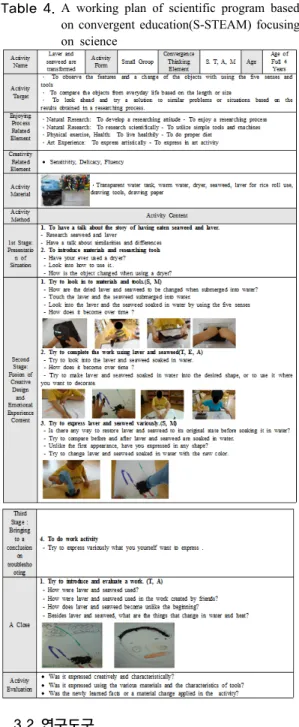
본 프로그램 활동계획안은 Table 4와 같다.
3. 연구방법
3.1 연구대상
연구대상은 서울에 소재하고 있는 어린이집에 다니고 있는 유아들로, 만 4세 2학급 유아 총 29명(남아 18명, 여아 11명) 대상으로 하였다. 두 학급 중 실험집단(남 9 명, 여 5명)은 총 14명, 비교집단(남 9명, 여 6명)은 총 15명이었으며, 두 집단 모두 유사한 연령분포로 이루어 졌다.
Table 4. A working plan of scientific program based on convergent education(S-STEAM) focusing on science
3.2 연구도구
3.2.1 도형 창의성 측정도구
창의성 측정은 Torrance의 창의적 사고력 도형검사 (Torrance Test of Creative Thinking: Figural A and B, 2002년 개정판)를 사용하였다. 검사는 그림 구성하기, 완성하기, 선 더하기의 총 3가지 활동과제로 유창성, 독 창성, 제목의 추상성, 정교성, 개방성의 5개 요인점수가 산출된다. TTCT 검사 전문가 라이선스를 소지하고 있는
연구자와 연구자를 포함하여 검사훈련을 받은 유아교육 과 석사생 1명이 시행하였고, 채점은 TTCT 검사 전문가 라이선스를 소지하고 있는 연구자에 의하여 이루어졌다.
채점점수는 채점요강에 제시된 기준을 중심으로 5 하위 요인의 표준점수를 산출하였고, 창의성 표준점수를 산출 하였다. 본 검사에서의 채점자간 신뢰도는 유창성 .99, 독창성 .95, 정교성 .92, 제목의 추상성 .98, 개방성 .97 로 나타났다.
3.2.2 다중지능 검사
다중지능 검사는 본 연구에서는 [41]의 MIDAS (Multiple Intelligences Developmental Assessment Scales) 를 사용하였다. MIDAS는 8개 지능 영역으로 구성되어 있으며, 음악지능은 음악 능력, 악기, 목소리, 감상의 4개 척도로 총 11개, 신체·운동지능은 신체적 기능, 무용(활 동), 손을 이용한 활동의 3개 척도로 총 10개, 논리·수학 지능은 문제해결과 계산의 2개 척도로 총 9개, 공간은 상상, 예술적 구성, 구조의 3개 척도로 총 10개, 언어지 능은 언어 민감성, 읽기, 쓰기, 말하기의 4개 척도로 총 13개, 대인관계지능은 사람이해, 다른 사람들과 함께 하 기, 리더십의 3개 척도로 총 13개, 개인이해지능은 자아 알기, 목표 인식, 정서 조절, 행동 조절의 4개 척도로 총 14개, 자연친화지능은 동물 돌보기, 식물 돌보기, 과학의 3개 척도로 총 13개로 구성되어있다. 유아의 다중지능 질문지는 5점 평정척도로 교사가 지각한 점수로 평정하 였으며, 41, 58, 59, 64번은 부정 문항으로 역으로 점수 를 부여하였다. 다중지능은 각 영역별 프로파일로 구성 되기 때문에 전체 다중지능 점수를 산출하는 것은 의미 가 없어 본 연구에서는 다중지능 영역별 점수만 산출하 였고, 영역별 Cronbach's 계수는 음악지능 .90, 신체지 능 .89, 논리·수학지능 .91, 공간지능 .94, 언어지능 .91, 대인관계지능 .86, 개인이해지능 .84, 자연친화지능 .87 로 나타났다.
3.3 연구절차
예비검증은 만 4세 유아 중 연구 동의를 얻은 10명을 대상으로 현장적용을 통해 2015년 4~5월까지 6주 동안 총 10회에 걸쳐 이루어졌다. 개발된 프로그램에 대해 유 아교육과 교수 3인이 내용타당도를 검토하였고, 각 활동 에 대한 목표, 내용, 교수·학습방법, 평가가 적절한지 5점 리커트 척도로 평정한 후 평균 3.5점 이하를 받은 ‘탑이 무너진다.’, ‘알록달록 달걀’ 2개 활동은 적절하지 않다
고 판단하여 제외하였다. 또한, 만 4세 유아 중 부모로부 터 연구 동의를 얻은 10명을 대상으로 현장적용을 거친 후 2015년 4월 13일~5월 21일까지 주 2회 총 12회에 걸쳐 예비실험이 이루어졌다. 융합인재교육의 교육내용 을 추출하기 위해 1차로 국내·외 융합인재교육 관련 서 적, 논문을 참고하며 각 요소별 교육내용을 구성하였다.
2차로 만 4세 유아에게 적절한 내용인지 판단하기 위해 누리과정 영역별 내용과 비교‧분석을 하였다. 3차로 S-STEAM에 적절한 내용을 선정하였다.
창의성과 다중지능의 효과를 알아보기 위해 2015년 6 월 2, 3일에 S시에 위치한 K어린이집의 만 4세 총 28명 유아(실험집단과 비교집단)들을 대상으로 오전 자유선택 활동 시간 시 창의성 검사(TTCT 도형 A형), 다중지능에 대한 사전검사를 40분간 담임교사에 의해 실시하였고, 본 프로그램의 효과검증은 2015년 6월 초부터 8월 초까 지 사전검사를 실시한 다음 11회기(주 1회, 30분씩) 동 안 실시하였다. 실험집단의 교사 경력은 4년, 비교집단 의 교사 경력은 5년이었다. 2015년 8월 18일, 19일에 실 험집단과 비교집단을 대상으로 사전검사와 동일한 방법 으로 두 검사에 대한 사후 검사(TTCT 도형 B형, 다중지 능 검사)를 40분간 담임교사에 의해 실시하였다.
3.2.4 자료처리
수집된 자료는 pearson 상관분석, 독립표본 t-검증, 공변량분석(ANCOVA)을 통해 분석하였다.
4. 연구 결과
4.1 프로그램이 창의성에 미치는 영향
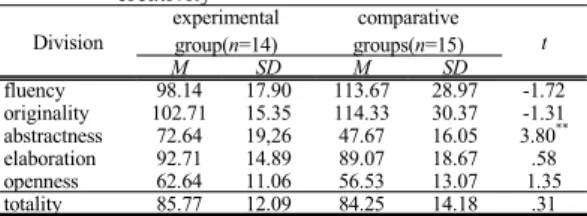
두 집단 간의 사전 창의성의 동질성 검증 결과는 Table 5와 같다.
Table 5.homogeneity validation for Pre-creativity between experimental and comparison groups in creativity
Division experimental group(n=14)
comparative groups(n=15) t
M SD M SD
fluency 98.14 17.90 113.67 28.97 -1.72
originality 102.71 15.35 114.33 30.37 -1.31 abstractness 72.64 19,26 47.67 16.05 3.80**
elaboration 92.71 14.89 89.07 18.67 .58
openness 62.64 11.06 56.53 13.07 1.35
totality 85.77 12.09 84.25 14.18 .31
**p < .01
Table 5와 같이, 사전 창의성에서 추상성은 유의한 차 이로 실험집단이 비교집단보다 높게 나타났지만(t=3.80, p<.01) 전체 창의성을 포함하여 나머지 하위요인은 모두 두 집단 간에 유의한 차이가 없는 것으로 동질하다고 볼 수 있다.
실험 후 두 집단의 창의성 점수에 대한 평균 및 표준 편차를 알아본 결과는 Table 6과 같다.
Table 6. The average and standard deviation of creativity between experimental and comparative group Division post-test adjustment post-test
N M SD M SD
fluency Ex. Group 14 136.43 7.96 139.67 4.12 Com. Group 15 126.20 23.30 123.18 3.97 originality Ex. Group 14 134.21 13.00 137.27 4.30 Com. Group 15 122.67 24.59 119.81 4.15 abstract-
ness
Ex. Group 14 92.64 12.67 84.13 3.86 Com. Group 15 58.13 20.37 66.08 3.70 elaboration Ex. Group 14 113.14 11.97 112.95 5.38 Com. Group 15 89.67 24.89 89.85 5.19 openness Ex. Group 14 77.00 8.81 74.93 2.03 Com. Group 15 62.27 12.41 64.20 1.96 totality Ex. Group 14 110.69 6.70 110.31 2.03 Com. Group 15 91.79 12.03 92.14 1.97
Table 6과 같이, 실험 후 전체 창의성과 창의성 하위 요인 모두 실험집단 점수가 비교집단보다 높았다. 이에 실험 후 창의성 점수에 대해 공분산 분석을 실시한 결과 는 Table 7과 같다.
Table 7. Covariance analysis on the score of groups creativity
Division sum of
squares
degree of freedom
mean
square F
fluency
Covariance
(Before) 2588.76 1 2588.76 11.53**
group 1774.34 1 11774.34 7.90**
error 5837.07 26 224.50
originality
Covariance
(Before) 4132.64 1 4132.64 16.46***
group 2079.41 1 2079.41 8.28**
error 6529.05 26 251.12
abstract- ness
Covariance
(Before) 3658.34 1 3658.34 22.45***
group 1536.84 1 1536.84 9.43**
error 4236.61 26 162.95
elaboration
Covariance
(Before) 83.26 1 83.26 0.21
group 3816.17 1 3816.17 9.50**
error 10449.79 26 401.92
openness
Covariance
(Before) 1715.39 1 1715.39 30.77***
group 799.85 1 799.85 14.00**
error 1449.55 26 55.75
totality
Covariance
(Before) 1104.20 1 1104.20 19.09***
group 2380.84 1 2380.84 41.17***
error 1503.66 26 57.83
**p < .01, ***p < .001
Table 7과 같이, 실험 후 실험집단이 비교집단보다 창 의성 점수가 유의한 차이로 높게 나타났다(F = 41.17, p
< .001). 하위영역은 실험 후 유창성(F =7.90, p < .01), 독창성(F = 8.28, p < .01), 추상성(F =9.43, p < .01), 정 교성(F =9.50, p < .01), 개방성(F =14.00, p < .01) 모두 유의한 차이로 실험집단이 비교집단보다 높게 나타났다.
4.2 프로그램이 다중지능에 미치는 영향 두 집단 간의 사전 다중지능 영역의 동질성 검증 결과 는 Table 8과 같다.
Table 8.homogeneity validation for Pre-creativity between experimental and comparison groups in multiple intelligence
Division experimental group(n=14)
comparative groups(n=15) t
M SD M SD
linguistic intelligence 36.07 5.41 38.67 7.69 -1.04 musical intelligence 32.07 4.07 37.27 8.21 -2.14* spatial intelligence 28.36 5.67 27.47 7.25 .37 logic·mathematical
intelligence 33.57 6.94 37.87 8.56 -1.48
physical·exercising
intelligence 41.21 7.39 47.27 9.87 -1.86
interpersonal intelligence 43.14 5.87 43.67 9.91 -.17 intra-personal intelligence 44.71 7.03 46.27 8.74 -.52 naturalist intelligence 46.50 3.03 44.67 9.17 .71
*p < .05
Table 8과 같이, 사전 다중지능 영역 중 신체·운동지 능만 유의한 차이를 보였지만(t=-2.14, p<.05) 나머지 다 중지능 영역은 모두 두 집단 간에 유의한 차이가 없는 것으로 동질한 집단임을 알 수 있다.
실험 후 두 집단의 다중지능 영역의 평균 및 표준편차 를 알아본 결과는 Table 9와 같다.
Table 9. The average and standard deviation of multiple intelligences between experimental and comparative group
Division post-test adjustment
post-test
N M SD M SD
linguistic intelligence
Ex. Group 14 43.29 5.46 44.16 .81 Com. Group 15 41.67 5.08 40.85 .79 musical
intelligence
Ex. Group 14 36.00 3.99 38.06 .79 Com. Group 15 35.87 7.04 33.94 .76 spatial
intelligence
Ex. Group 14 33.43 5.52 33.03 .50 Com. Group 15 30.33 6.25 30.70 .48 logic·mathematical
intelligence
Ex. Group 14 39.36 6.95 40.96 1.07 Com. Group 15 38.20 6.74 36.70 1.03 physical·exercising
intelligence
Ex. Group 14 48.86 5.75 50.54 1.35 Com. Group 15 44.87 7.52 43.30 1.30 interpersonal
intelligence
Ex. Group 14 52.14 5.87 52.29 1.37 Com. Group 15 45.27 7.24 45.13 1.32 intra-personal
intelligence
Ex. Group 14 51.50 5.60 51.99 .88 Com. Group 15 50.20 6.01 49.75 .85 naturalist
intelligence
Ex. Group 14 52.57 3.84 51.84 .92 Com. Group 15 48.27 7.96 48.95 .89
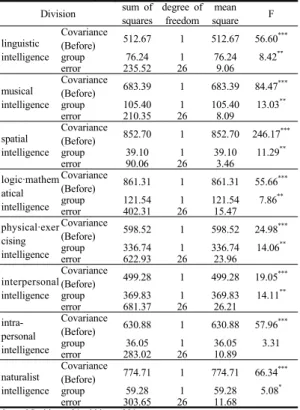
Table 9와 같이, 실험 후 다중지능 영역 모두 실험집 단점수가 비교집단보다 높게 나타났다. 이에 실험 후 다 중지능 영역에 대해 공분산 분석을 실시한 결과는 Table 10과 같다.
Table 10. Covariance analysis on the score of groups multiple intelligences
Division sum of
squares
degree of freedom
mean
square F
linguistic intelligence
Covariance
(Before) 512.67 1 512.67 56.60***
group 76.24 1 76.24 8.42**
error 235.52 26 9.06
musical intelligence
Covariance
(Before) 683.39 1 683.39 84.47***
group 105.40 1 105.40 13.03**
error 210.35 26 8.09
spatial intelligence
Covariance
(Before) 852.70 1 852.70 246.17***
group 39.10 1 39.10 11.29**
error 90.06 26 3.46
logic·mathem atical intelligence
Covariance
(Before) 861.31 1 861.31 55.66***
group 121.54 1 121.54 7.86**
error 402.31 26 15.47
physical·exer cising intelligence
Covariance
(Before) 598.52 1 598.52 24.98***
group 336.74 1 336.74 14.06**
error 622.93 26 23.96
interpersonal intelligence
Covariance
(Before) 499.28 1 499.28 19.05***
group 369.83 1 369.83 14.11**
error 681.37 26 26.21
intra- personal intelligence
Covariance
(Before) 630.88 1 630.88 57.96***
group 36.05 1 36.05 3.31
error 283.02 26 10.89
naturalist intelligence
Covariance
(Before) 774.71 1 774.71 66.34***
group 59.28 1 59.28 5.08*
error 303.65 26 11.68
*p < .05, **p < .01, ***p < .001
Table 10과 같이, 실험 후 다중지능 영역은 개인이해 지능을 제외하고(F =3.31, p > .05), 음악지능(F =8.42, p
< .01), 신체·운동지능(F =13.03, p < .001), 논리·수학지 능(F =11.29, p < .01), 공간지능(F =7.86, p < .01), 언어 지능(F =14.06, p < .01), 대인관계지능(F =14.11, p <
.01) 및 지연친화지능(F =5.08, p < .05)에서 실험집단 점 수가 비교집단보다 유의한 차이로 높게 나타났다.
4. 논의 및 결론
본 연구는 창의적 융합인재 양성 위해 만 4세 유아를 위한 S-STEAM 프로그램을 개발하고, 본 프로그램이 유 아의 창의성과 다중지능에 미치는 영향의 검증을 통해
S-STEAM 프로그램의 유아교육현장 활용 가능성을 모 색하는데 그 목적이 있다. 본 연구의 주요 결과를 논의하 면 다음과 같다.
첫째, S-STEAM 프로그램이 만 4세 유아의 창의성에 미치는 효과를 알아본 결과, 본 프로그램에 참여한 유아 들은 참여하지 않은 유아들에 비해 전체 창의성과 창의 성 하위요인, 유창성, 독창성, 추상성, 정교성 및 개방성 에 긍정적인 효과를 보였다. 이는 본 연구에서 개발한 S-STEAM 프로그램 유아의 창의성 향상에 효과적이라 는 것을 의미하며, 유아 과학과 다른 영역 간의 융합인 재교육 프로그램이 유아의 창의성 증진에 효과적이라는 선행연구들[2], [33],[42-43]의 결과들을 지지한다. 또한, 융합인재교육 접근에 의한 발명활동이 유아의 창의성에 긍정적인 영향을 미친다는 연구결과[44]와 CPS 모형 기 반 과학통합 프로그램이 유아의 창의성에 효과가 있다는 [45]의 결과와 같은 맥락이다.
이는 유아 과학교육을 유아가 일상생활에서 호기심을 가지고, 흥미롭게 여기는 다양한 예술 활동과 연결시키 는 것이 유아의 창의성에 효과적이라는 견해[46]를 지지 한다. 따라서 유아가 융합인재교육의 다양한 활동을 하 면서 주변 생활 속 문제상황을 인식하고 문제를 해결하 기 위한 아이디어를 생각해 보고 다양한 융합적 사고와 문제해결 경험을 통해 창의성이 증진되었다는 것을 의미 한다.
둘째, S-STEAM 프로그램이 유아의 다중지능에 미치 는 효과를 알아본 결과, 본 프로그램에 참여한 유아들은 참여하지 않은 유아들에 비해 다중지능 향상에 긍정적인 효과를 보였다. 이는 유아 과학교육과 관련된 선행연구 [47-54]에서 제시하고 시행되어 왔던 내용 영역을 추출 하였다. 따라서 다중지능이론에 기초한 유아과학교육 내 용은 국내의 과학교육과 국가수준에서 제시하는 내용을 반영하고 있다고 볼 수 있다. 다중지능 이론은 교육과정 간의 연계를 쉽게 하고, 학문간 내용과 개념의 통합에도 유용[55-56]하다는 탐구중심 교수·학습방법과 통합적 교 수·학습방법으로 선정하였고, 다중지능이론에 기초한 유 아과학교육은 과학적 기초소양을 증진시킨다는 목적 설 정을 지지한다고 볼 수 있다. 다중지능의 영역과 과학과 상관지어 제공되는 통합교육으로 유아들에게 하나의 지 능영역으로만 받아들이지 않고 전체적 맥락 속에서 자연 스럽게 통합된 여러 가지 지능을 복합적으로 받아들임으 로써 더 잘 이해할 수 있고, 기억보다 개념화에 초점을
둔다는 점에서 유용한 방법[57]이며, 유아들은 한 가지 목표뿐만 아니라 다른 영역이 가지고 있는 목표도 함께 달성할 수 있게 되고, 한 분야에서 습득한 지식이 다른 분야와 어떻게 연결이 되는지를 이해하게 되어 문제를 만났을 때 해결할 수 있는 능력을 기르게 된다는 견해 [58]를 반영한 것이다.
S-STEAM 프로그램은 주제 중심의 다양한 문제를 해 결하는 활동이며, 누리과정 기반 과학활동 보다 기술, 공 학 분야까지 아우르는 수학, 미술, 음악 등 활동 간의 긴 밀한 관계를 더 잘 구축하게 하는 활동으로 이루어져있 어, 창의적 설계 과정 속에서 창의성이 향상되었고 친구 들과 피드백을 통해 감성적 체험을 하면서 다중지능이 많이 계발됨을 확인 할 수 있었다.
이러한 본 S-STEAM 프로그램은 기존의 생활주제 중 심의 과학, 미술, 음악, 수학 등의 활동과 연계하여 확장 활동으로 활용한다면 수업의 시너지 효과를 가져 올 수 있고 유아들의 흥미를 이끌어내어 교육적 효과를 초래하 는 등 창의적, 감성적 체험을 가능하게 하는 유아과학교 육의 새로운 패러다임을 제공할 것이다. 특히 유아교육 과정의 특징이 통합교육과 유‧초연계임을 고려할 때, 본 융합인재교육 프로그램은 현재 융합형 교육과정을 운영 하고 있는 초등학교 교육과정과의 연계 및 통합에서도 일조할 것으로 보인다. 또한, 이는 교육현장에서 효과성 측면 뿐만 아니라 우리나라 창조경제에 이바지 할 수 있 는 미래 융합인재양성에도 크게 기여할 수 있을 것으로 기대된다.
본 연구를 통해 몇 가지 제언을 하면 다음과 같다. 첫 째, 연구대상이 특정 유치원에 속한 한 반의 소수의 만 4세 유아들이라는 점에서 본 연구결과를 일반화시키는 데 한계가 있으므로 연구대상의 수를 확장하고 만 3세, 5세로 연령을 확장하여 적용하는 연구가 이루어져야 할 것이다. 둘째, S-STEAM 프로그램은 약 3개월 동안 11 회기에 걸쳐 단기간에 그 효과를 검증하였으므로 본 프 로그램을 심화·확장하여 1년 이상의 체계적, 단계적인 S-STEAM 프로그램을 개발하여 효과를 검증해야 할 것 이다. 셋째, 본 연구에서는 개발한 S-STEAM 프로그램 을 기초로 유아교육현장에 다양하고 활용도가 높은 수학 (M형), 미술, 음악 등의 예술(A형) 중심의 융합인재교육 프로그램을 개발할 필요가 있다. 넷째, 융합인재교육을 유아교육현장에 보급하기 위한 교사교육 연수 프로그램 의 개발과 더불어 교원양성기관에 융합인재교육 관련 교
과목의 적용을 위한 융합형 교육과정 개발이 요구된다.
기술이나 공학을 포함하여 전문적인 과학전공 지식이 부 족한 유아교사들이 대부분인 유아교육현장 실정에서 좀 더 체계적인 융합인재교육이 이루어지기 위해서는 ‘융합 인재교육 교사연구회’를 구축하여 현장 중심의 프로그램 개발이나 활발한 현장연구가 이루어져야 할 것이다. 이 를 위해 유아교육학계에서도 유아교육과정 구성 시 교사 주도적인 수업시간 설계 및 연계수업의 자율성을 보장하 고[59], 최신 기술에 대한 정보 및 교육이 제공된다면 창 의적 설계와 감성적 체험이 가능한 융합인재교육을 실천 하게 될 것이다.
References
[1] Y, A Lee, "Discussion on the Current Situation and enjoy the process of improvement projects", The Korean Society For Early Childhood Education, 15, pp. 103-106, 2015.
[2] E, S Park. "Effects of Infant creativity in the development of Art-Science STEAM educational programs". Myongji University Master's Thesis. 2013.
[3] National Science Foundation. “Preparing the Next Generation of STEM Innovators: Identifying and Developing Our Nation's Human Capital”. National Science Board. 2010.
[4] M, K Lee, E, Y Jeong. "A study factors in school science Influencing student's attitudes toward science", Korea Science Education, 24(5). 946-958. 2004.
[5] Y, J Shin, S, K Han. "A study of the elementary school teachers' perception in STEAM eucation", The Korean Society of Elementary Science Education. 30(4).
514-523. 2011.
[6] Y, S Kwak, C, J Kim, Y, R Lee, D, S Jeong.
"Investigation on elementary and secondary student's interest in science". Journal Korean earth science society. 27(3). 260-268. 2006.
[7] Y, K Hong. "Designing the integrated mathematics and science program and its effectiveness". Journal of curriculum integration. 3(2). 42-67. 2009.
[8] Y, W Han, W, K Lee. "An effect of integrated science inquiry learning method through literature materials on the elementary science learning". The Korean Society of Elementary Science Education . 24(1). 9-20. 2005.
[9] M, J Jung, K, S Yoon, D, K Kwon. "A meta-analysis on the application effects of STS teaching and learning model. Journal science education. 32(2). 55-70. 2008.
[10] S, S Kim, H, R Yang, B, Y Lim. "A study on the development of in-service teacher education program for improvement of early childhood teacher's lesson builiding capacity. Early Childhood Education Journal, 15(6). 311-335. 2011
[11] Ministry of Education and Science Technology,. “Open to creative talent and advanced science and technology, the future Republic of Korea”. 2011 business report.
Ministry of Education and Science Technology,. 2010.
[12] Y, Y Jeoung.. “The study of the effect to the child's creativity through the formative activity based on convergence human resource education : Formative activity focused on moving”, Myongji University Master's Thesis, 2013.
[13] Ministry of Education and Science Technology, "Ceative culture of creative economy and the future human resource development strategy", Ministry of Education and Science Technology, 2013.
[14] M, S Kim “The effects of the science integrated activities using picture books on young children's scientific process skill and problem-solving ability”.
Chonnam National University Master's Thesis, 2005.
[15] L, J Hwa, B, S Jeong. "The effects of literature-based science activities on childresn's science inquiry ablilty and attitude". Journal of Future Early Childhood. 10, pp.
61-83, 2003.
[16] N, Y Kim, “Development of an integrated art with science education program for young children and its effectiveness”, Chung-ang University Doctoral thesis, 2012.
[17] N, Y Kim, H, S Cho. “Development of an integrated art with science education program for young children and its effectiveness”, The korean society for early childhood teacter education, 16, pp. 73-101, 2012.
[18] J, H Kim, “The effects of integrated science and art activities based on the constructivist approach on young children's scientific attitudes and scientific process skills”, Myongji University Master's Thesis. 2010.
[19] E, K Son. "A study on the development of arts-based science program for young childen". Pusan national university Master's Thesis. 2009.
[20] G, H Ahn, “The Effects of Integrated Art and Science Activities on Young Children's Scientific Problem-Solving Ability”, Chonnam national university Master's Thesis, 2008.
[21] I, W Jun, “The effect of the inergrated science and art activities of on young children's naturalist and emotional intelligence”, Korea Open Association for Early Childhood Education, 20(1), 2015.
[22] S, A Chi, N, H Kim, H, J Shim, S, M Lee, J, Y Shim,
“The effect of th integrated activity wit art and science on young children's scientific inquiry competence, scientific attitude, spatial ability and representation ability”, The korean society for early childhood teacter education, 13(5), 2009.
[23] Y, R chae, S, K Shin, “Relationship between Early childhood teachers' safety recognition and class environment condition of safety”, The korean society for early childhood teacter education, 13(3), 2008.
[24] J, Y ahn, M, S Choi, The development and effects of early childhood science education program with artistic experiences. The korean society for early childhood teacter education, 18(4), pp. 431-455, 2014
[25] J, W Choi, S, J Seo "The effects of a convergent arts
and science program on young children's creativity and scientific inquiry", Family and Environment Research.
53, pp. 67-80, 2015.
DOI: http://dx.doi.org/10.6115/fer.2015.005
[26] Lynch, M. D., Harris, C, R.. “Fostering creativity in children. K-8, Needham Heights”, MA: Allyn and Bacon. 2001.
[27] Y, O Kim. "The Effect of Constructivism Preschooler's science program on Creativity and Problem solving".
Chonbuk national university Master's Thesis. 2004.
[28] H, W Park. "Effects of Constructivist Science Program on Creativity and Problem Solving Abilities among Young Children", Journal of gifted/talented education, 18(3), 401-424. 2008.
[29] Y, S Park. "Effects of Infant creativity in the development of Art-Science STEAM educational programs". Muongji national university Master's Thesis.
2013
[30] J, S, Yoon. "Effect of an environmental education program based on the STEAM approach, on a preschooler's creativity and attitude towards the environment", Dong-Guk national university Master's Thesis. 2015.
[31] B, Y Lee (2014). A Study on The importance of Brain Development through Convergence of Art with STEAM Education. Korea Institute of Science and Art Forum, 17, 293-293.
DOI: http://dx.doi.org/10.17548/ksaf.2014.09.17.293 [32] Kornhaber, "Enhancing Equity in Gifted Education: a
framework for examining assessments drawing on the theory of multiple intelligences", HIGH ABILITY STUDIES, 10(2), 1999.
[32] J, H Jeong, Y, M Suh. "Theme representation program water as subject matter: It's impack on young children's multiple intelligence, scientific research capability and scientific attitudes", The journal of korea open association for early childhood education. 2014.
[33] M, J Kim, H, S Cho, D, W Kim, “An analysis of the status of the unifying science, Technology, Engineerung, Arts and math education method known as STEAM in domestic primary schools with a view to the direction of early childhood education”, Early Childhood Education Research, 34(4), 2014.
[34] E, H Baik, “Analysinng science and arts unified activity patterns in the 'three to five-year-old nuri course teaches's manual' based on STEAM, Korea Association for Early Childhood Education, pp. 371-386. 2014.
[35] Y, S Lee, "The direction of STEAM Education in Nuri-Curriculm“, Korea Association for Early Childhood Education, 34(1), 2014.
[36] H, J Yoo, “STEAM educational activities for the four children”, Korea Association for Early Childhood Education, 13(1), pp. 67-72, 2013.
[37] E, W Lee, S, G Lee, C, W Lee, K, W Lee, K, S Lee.
"A study of the developmental patterns of the four year old korean children". Journal for Early Childhood Education. 12. 53-69. 1992.
[38] J, S Jung, "Keynote Speech: Infant science education, Science and Education for the Future“, Korea
Association for Early Childhood Education, 13, pp.
32-42. 2013.
[39] H, S Kim, S, H Chung, “Arts and sciences convergence STEAM program development using the work of art:
aprimary center”, Arts Education, 13(1), 2015.
[40] H, S, Cho. "Early childhood STEAM education orientation for fusion talent". Early Childhood Education Korea Society Conference. 2013.
[41] Shearer, C. B. "The multiple intelligences and MIDAS subscale. http:..
www.angelfire.com/oh/themidas/eachmihtml. 1995.
[42] J, S Yu, “Effect Of an Environmental Education Program, Based on The STEAM Approach, on a Preschooler's Creativity and Attitude Towards the Environment”. Dong Guk University Master's Thesis.
2015.
[43] Y, J Yu, “The study of the effect to the child's creativity through the formative activity based on convergence human resoure eduation”. Myongji University Master's Thesis. 2013.
[44] Y, S Hwang, S, H Kang. “This book integrates scientific activities impact on children's creativity development”, Korea Open Association for Early Childhood Education, 11(1), 314-315. 2011.
[45] N, H Kim, "The effect of STEAM education approach-based inventive activity on young children's creativity and scientific problem-solving ability.
choung-ang national university Master's Thesis. 2015.
[46] M, H Shon. “Effects of the CPS model based integrated science program on creativity and scientific problem-solving skill's of infants”. Sookmyung Women's University Master's Thesis. 2015.
[47] B, Y Lim, Y, K Son, J, H Oh "Effect of early childhood science education program based on the creativity of the art integrated early childhood", the korean society for early childhood teacter education, 65, pp. 37-57, 2010.
[48] I, S Choi, "Focused Multiple Intelligence integrated science education" Seoul; Hakjisa, 2009.
[49] Y, S Shin, K, S An, Y, J Kim, B, K An, "Life and environmental science education center for young children" Paju- Yangseowon 2007.
[50] B, K Jo, Y, M Go, O, J Nam. "Infant science education for teachers and pre-service teachers", Paju- Yangseowon, 2007.
[51] Worth, K., & Grollman, S. “Worms, shadows, and whirlpools: Science in the Eearly childhood Classroom.
Education Development Center”, Inc., Newton, MA, 2003.
[52] NRC, “Should international nurse recruitment be restricted”, NURSING AND RESIDENTIAL CARE, 1996.
[53] Barufadi, J. P., Ladd, G. T., & Moses, A. J., “Heath science: Level K”. Lexington, MA: Heath and Heach Company, 1981.
[54] SCIS. “Beginning: Teacher’s guide. Chicago”, IL: Rand McNally & Company, 1974.
[55] ESS. “A working guide to the elementary science study”, Newton, MA: Elementary Science Study of
Education Development Center, 1971.
[56] Hanley, Hermiz, Logioia & Levine-Albuck, "Improving student interest and Achievement in social studies using a multiple intelligence approach", 2002.
[57] M, S Su. "Effects of integrated curriculum based on multiple intelligence theory on elementary school children's multiple intelligence development". Korea National University Master's Thesis. 2001.
[58] J, Y Kim, “Teaching method of the secondary school musical education applied by multiple intelligence theory of H, Gadner”, Chung-Ang University Master's Thesis.
2013.
[59] J, A Lee. "A study on the impact of creative scientific thinking from art and scence STEAM education program", Hanyang University Doctoral Thesis. 2015.
송 민 서(Min-Seo Song) [정회원]
•2010년 9월 : 성균관대학교 아동학 전공 (문학석사)
•2015년 9월 ~ 현재 : 경성대학교 유아교육과 박사과정
•2015년 11월 ~ 현재 : 무덕유치원 교사
•2016년 3월 ~ 현재 : 동명대학교 유아교육과 겸임교수
<관심분야>
창의성교육, 유아과학교육, 유아 융합인재교육
김 형 재(Hyoungl-Jai Kim) [정회원]
•2011년 8월 : 경성대학교 대학원 아동보육전공 (이학박사)
•2013년 8월 : 경성대학교 대학원 유아교육전공(교육학박사)
•2014년 3월 ~ 2016년 2월 : 동명 대학교 창의․인성연구소 공동연구원
•2016년 4월 ~ 현재 : 영동대학교 유아교육과 조교수
<관심분야>
창의성교육, 유아과학교육, 유아 융합인재교육