Letter to the Editor
Vol. 26 No. 2, 2014 275
Received January 3, 2013, Revised April 6, 2013, Accepted for publication May 14, 2013
*Recep Kesli is now with Department of Microbiology, Afyon Uni- versity Faculty of Medicine, Afyonkarahisar, Turkey.
Corresponding author: Arzu Ataseven, Department of Dermatology, Konya Training and Research Hospital, Meram, Konya 42090, Turkey. Tel: 90-0 505 691 58 59, Fax: 90-0 332 323 67 23, E-mail: arzuataseven@hotmail.
com
This is an Open Access article distributed under the terms of the Creative Commons Attribution Non-Commercial License (http://
creativecommons.org/licenses/by-nc/3.0) which permits unrestricted non-commercial use, distribution, and reproduction in any medium, provided the original work is properly cited.
5. Pasqualotto AC, Bittencourt Severo C, de Mattos Oliveira F, Severo LC. Cryptococcemia. An analysis of 28 cases with
emphasis on the clinical outcome and its etiologic agent.
Rev Iberoam Micol 2004;21:143-146.
http://dx.doi.org/10.5021/ad.2014.26.2.275
Levels of Serum Soluble P-Selectin and E-Selectin in Psoriatıc Patients
Arzu Ataseven, Huseyin Ataseven1, Perihan Ozturk2, Mehmet Ozdemir3, Recep Kesli4,*
Department of Dermatology, Konya Training and Research Hospital, Konya,
1Department of Gastroenterology, Necmettin Erbakan University Faculty of Medicine, Konya,
2Department of Dermatology, Sutcu Imam University Faculty of Medicine, Kahramanmaras,
3Department of Microbiology, Necmettin Erbakan University Faculty of Medicine, Konya,
4Department of Microbiology, Konya Training and Research Hospital, Konya, Turkey
Dear Editor:
Psoriasis is an immune-mediated, chronic inflammatory disease1. Selectins generate the first adhesive stage con- tributing to the tethering and rolling of leukocytes into the vascular endothelium for the distribution of immune cells to the inflamed tissue. This essential role is a potential target for the development of novel treatments2. The main aim of our study was to determine the levels of serum soluble P-selectin (sP-selectin) and soluble E-selectin (sE- selectin), which contribute to the inflammatory process in the pathogenesis of the disease, in patients and controls;
and to assess the association between sP-selectin and sE- selectin levels and the severity of the disease. We also intended to evaluate whether these molecules contribute to the pathogenesis of psoriasis, which is known to have
multifactorial etiologies. Between July 2012 and Septem- ber 2012, twenty-four patients (9 males, 15 females) who were diagnosed with psoriasis clinically and/or histopa- thologically in our clinic were included in this study. The control group consisted of 24 healthy age-matched indivi- duals with comparable demographical features (10 males, 14 females) and without any infectious, systemic or der- matological diseases, and who were not smokers. All participants signed the consent form prior to the study.
Consent was also obtain from the local ethical committee (IRB approval: Necmettin Erbakan University Faculty of Medicine Ethics Committee, 2012-40). Patients who recei- ved systemic medication and/or phototherapy and topical antipsoriatic treatment were excluded from the study.
Other factors for being excluded from the study were as follows: pregnancy, age less than 18 years, smoking, hypertension, diabetes mellitus, chronic renal failure, liver and cardiac failure, acute and chronic infections, auto- immune diseases and cancer. Peripheral blood samples were obtained from both the study and control groups.
The samples were centrifuged at 3,500 rpm for 4 minutes, and the serum was stored at −80°C. Psoriasis area and severity index (PASI) scores of the patients with psoriasis were recorded. The data were statistically assessed.
Statistical analysis was done with Mann-Whitney U using SPSS 15.0 (SPSS Inc., Chicago, IL, USA). A p-value less than 0.05 was considered significant. The mean age was
Letter to the Editor
276 Ann Dermatol
Fig. 1. Serum soluble P-selectin levels in the patient and control
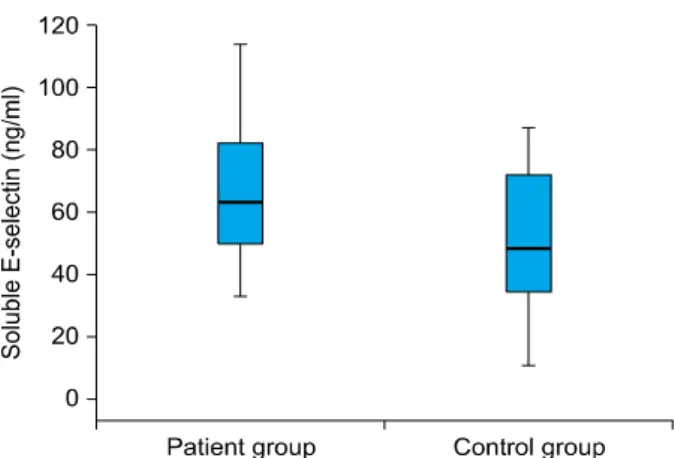
groups. Fig. 2. Serum soluble E-selectin levels in the patient and control
groups.
43.12±15.74 years (minimum 18 years, maximum 70 years) in the study group and 42.04±11.63 years (minimum 22 years, maximum 64 years) in the control group. The mean PASI scores were calculated as 11.058±
9.21 (minimum 3, maximum 36.6) in the patient group.
The mean sP-selectin level was 212.45±68.15 (minimum 104.34, maximum 331.01) in the patient group and 168.20±47.61 (minimum 86.64, maximum 324.34) in the control group. On the other hand, the mean sE- selectin was found as 65.84±20.19 (minimum 33.41, maximum 114.12) in the patients and 51.35±22.10 (mini- mum 11.50, maximum 87.15) in the controls. A com- parison of both serum sE-selectin and sP-selectin levels between the patient and control groups revealed a statistically significant difference (p<0.05) (Fig. 1, 2).
However, there was no significant correlation between sE-selectin, sP-selectin levels and the PASI scores among the patients (r=0.014, p>0.05; r=0.017, p>0.05 res- pectively). Various studies have been performed regarding the role of selectins in the etiopathogenesis of psoriasis;
however, no clear result has been obtained so far. Our aim of this study was to assess the role of serum sP-selectin and sE-selectin levels in the pathogenesis and their effect on disease severity. P-selectin is released to the systemic circulation from platelets and is activated by thrombin or histamine during coagulation and subsequ- enty facilitates leukocyte-platelet adhesion. Endothelial P- selectin directs platelets to postcapillary venules during the inflammatory response, and P-selectin in platelets causes thrombus formation by platelet and leukocyte congregation. P-selectin, secreted from activated platelets, facilitates leukocytes rolling, the first step in leukocyte extravasation3. Tamagawa-Mineoka et al.4 noted that sP- selectin levels were significantly higher in psoriatic pa- tients and then regressed to prior levels following treat-
ment. Furthermore, Garbaraviciene et al.3 reported a signi- ficant correlation between P-selectin and PASI and con- cluded that platelet P-selectin expression could be used as a successful biomarker to monitor the treatment of pso- riasis. In another study, no correlation was found between sP-selectin levels and the severity of the disease in the patient group compared to the control group5. On the other hand, in our study, serum sP-selectin levels were significantly higher in the patient group compared to that in the control group, and there was no correlation bet- ween serum sP-selectin levels and disease severity. E- selectin is a 115-kDa single-chain glycoprotein, previously known as endothelial leukocyte adhesion molecule. E-se- lectin plays an important role in the adhesion of neu- trophils, eosinophils, memory T-cells and tumor cells to the vascular endothelium via carbohydrate ligands such as sialyl Lewis X6. Factors that determine the processe of conversion to the soluble form are tumor necrosis factor-α, interleukin-1 and lipopolysaccharides. Psoriatic plaques are characterized by strong E-selectin expression on the luminal surfaces of the capillary and the postcapillary endothelial cells. Interestingly, E-selectin is not expressed in the synovial joints affected by psoriatic arthritis.
Furthermore, despite continuous E-selectin upregulation and constant cytokine stimulation in the psoriatic skin, E-selectin expression is temporary7. Consistent with our study, some studies have reported that sE-selectin levels were increased in the serum of psoriatic patients com- pared to that of controls8-10. However, other studies have found that the levels of sE-selectin were not significantly increased in patients with psoriasis5. We did not find any significant correlation between the levels of serum sE-selectin and sP-selectin and PASI scores of psoriatic patients. Czech et al.8 also did not discover any cor- relation between these parameters. This may be due to the
Letter to the Editor
Vol. 26 No. 2, 2014 277 small number of patients enrolled in our study. However,
there are studies that have reported a correlation between serum sE-selectin levels and disease severity in these pa- tients9,10. In conclusion, this study demonstrates that se- rum sE-selectin and sP-selectin levels of the patient group were significantly higher that those of the control group.
However, there was no significant correlation between the levels of sE- selectin and sP-selectin and PASI score in the psoriatic patients. This study emphasizes the potential role of P-selectin and E-selectin adhesion molecules in the complex etiopathogenesis of psoriasis.
REFERENCES
1. Diamantino F, Ferreira A. Future perspectives in the treat- ment of psoriasis: news in biological therapies. Acta Med Port 2011;24:997-1004.
2. Schön MP. Inhibitors of selectin functions in the treatment of inflammatory skin disorders. Ther Clin Risk Manag 2005;1:
201-208.
3. Garbaraviciene J, Diehl S, Varwig D, Bylaite M, Ackermann H, Ludwig RJ, et al. Platelet P-selectin reflects a state of cutaneous inflammation: possible application to monitor treatment efficacy in psoriasis. Exp Dermatol 2010;19:736- 741.
4. Tamagawa-Mineoka R, Katoh N, Kishimoto S. Platelet acti-
vation in patients with psoriasis: increased plasma levels of platelet-derived microparticles and soluble P-selectin. J Am Acad Dermatol 2010;62:621-626.
5. Ghalamkarpour F, Saeedi M, Hedayati M, Maarefat A. So- luble E-selectin and P-selectin serum levels in patients with psoriasis compared to healthy controls. Iran J Dermatol 2010;13:9-11.
6. Wakita H, Takigawa M. E-selectin and vascular cell adhe- sion molecule-1 are critical for initial trafficking of helper- inducer/memory T cells in psoriatic plaques. Arch Dermatol 1994;130:457-463.
7. Bhushan M, Bleiker TO, Ballsdon AE, Allen MH, Sopwith M, Robinson MK, et al. Anti-E-selectin is ineffective in the treat- ment of psoriasis: a randomized trial. Br J Dermatol 2002;
146:824-831.
8. Czech W, Schöpf E, Kapp A. Soluble E-selectin in sera of patients with atopic dermatitis and psoriasis--correlation with disease activity. Br J Dermatol 1996;134:17-21.
9. Groves RW, Kapahi P, Barker JN, Haskard DO, MacDonald DM. Detection of circulating adhesion molecules in erythro- dermic skin disease. J Am Acad Dermatol 1995;32:32-36.
10. Bonifati C, Trento E, Carducci M, Sacerdoti G, Mussi A, Fazio M, et al. Soluble E-selectin and soluble tumour necro- sis factor receptor (60 kD) serum levels in patients with psoriasis. Dermatology 1995;190:128-131.