Received March 27, 2014, Revised June 24, 2014, Accepted for publication June 24, 2014
Corresponding author: Dusan Popadic, Institute of Microbiology and Immunology, School of Medicine, University of Belgrade, 1, Dr Subotica St., 11000 Belgrade, Serbia. Tel: 381-11-3643-235, Fax:
381-11-3643-235, E-mail: [email protected]
This is an Open Access article distributed under the terms of the Creative Commons Attribution Non-Commercial License (http://
creativecommons.org/licenses/by-nc/3.0) which permits unrestricted non-commercial use, distribution, and reproduction in any medium, provided the original work is properly cited.
ORIGINAL ARTICLE
TNF, IL12B, and IFNG Gene Polymorphisms in Serbian Patients with Psoriasis
Svetlana Popadic1,2, Emina Savic3, Milos Markovic3, Zorica Ramic3, Ljiljana Medenica1,2, Vera Pravica3, Zorica Spuran4, Vladimir Trajkovic3, Dusan Popadic3
1Department of Dermatovenereology, School of Medicine, University of Belgrade, 2Clinic of Dermatovenereology, Clinical Center of Serbia,
3Institute of Microbiology and Immunology, School of Medicine, University of Belgrade, 4Blood and Blood Component Collection Department, National Blood Transfusion Institute of Serbia, Belgrade, Serbia
Background: Psoriasis is a common chronic inflammatory skin disease with a strong genetic basis. Cytokines such as tu- mor necrosis factor alpha (TNF-α), interleukins (ILs) such are IL-12 and IL-23, and interferon gamma (IFN-γ) are released from various inflammatory and resident cells, and have been implicated in the initiation/maintenance of inflammation.
Certain alleles of the aforementioned cytokines may be asso- ciated with disease susceptibility/severity. Objective: To in- vestigate the association of three common functional gene polymorphisms, namely TNF −308 G/A (rs1800629), IL12B (encoding the p40 subunit of IL-12/23) +1188 A/C (rs3212227), and IFNG +874 T/A (rs2430561) with psoriasis develop- ment and severity in Serbian patients. Methods: We geno- typed 130 patients with psoriasis (26 of whom also had psori- atic arthritis) and 259 controls; rs1800629 and rs3212227, and rs2430561, by real-time PCR assay. Results: The TNF GG genotype was detected at a higher frequency in patients with psoriasis compared to control subjects (OR, 1.420; 95%
CI, 0.870∼2.403) without statistical significance (p=
0.191). Lack of the TNF G allele was associated with lower psoriasis severity (p=0.007). The IL12B AC genotype was underrepresented in the patients with psoriatic arthritis com- pared to healthy subjects (OR, 0.308; 95% CI, 0.090∼
1.057; p=0.049). The distribution of the rs2430561 allele and genotype frequencies was similar between patients with psoriasis and controls. Conclusion: Our study demonstrates an effect of the rs1800629 on psoriasis severity, and a mar- ginal impact of the rs3212227 on susceptibility to psoriatic arthritis. Collectively, our results obtained in a Serbian cohort expand current knowledge regarding individual predis- position to psoriatic disease. (Ann Dermatol 27(2) 128∼132, 2015)
-Keywords-
Allele frequencies, Interferon gamma, p40 IL-12/23, Psoriasis, Real-time PCR, Tumor necrosis factor-alpha
INTRODUCTION
Psoriasis vulgaris (PsV) is a common chronic inflammatory skin disease that is characterized by cutaneous inflammation and keratinocyte hyperproliferation, and it is often accom- panied by severe complications such as psoriatic arthritis (PsA)1. It is believed to result from pathological immune activation in genetically prone individuals. Substantial evi- dence supports a central role for T helper (TH) cells, such are TH1 and TH17 cells, in the pathogenesis of PsV1. A va- riety of cytokines have also been implicated, including the proinflammatory cytokine tumor necrosis factor alpha (TNF-α), the TH1-axis cytokines, interleukin (IL)-12 and in- terferon gamma (IFN-γ), and the TH17-axis cytokines IL-23 and IL-171.
The importance of single nucleotide polymorphisms (SNPs) that affect cytokine production is well established and has been extensively studied, since SNPs may contribute to the susceptibility, severity, and clinical outcome of various
Table 1. Characteristics of the 130 patients with PsV
Characteristic n (%)
Gender
Male 93 (71.5)
Female 37 (28.5)
Type of PsV
Type 1 (age at onset <30 y) 62 (47.7) Type 2 (age at onset >30 y) 68 (52.3) PASI score
Low (<10) 12 (9.2)
Intermediate (10>PASI>20) 63 (48.5)
High (>20) 55 (42.3)
Psoriatic arthritis 26 (20.0)
PsV: psoriasis vulgaris, PASI: psoriasis activity and severity index.
immune-mediated chronic inflammatory diseases. One of the most studied SNPs is the polymorphism at position −308 in the promoter region of the TNF gene (rs1800629), which represents a G to A substitution2. It has been shown that transcriptional activators preferentially bind to the A al- lele, making AA homozygous individuals high TNF-α producers3. A recent meta-analysis identified variant geno- types and alleles of this SNP as protective in PsV4. Another functional SNP is the +1188 A/C polymorphism of the IL12B gene (rs3212227). The IL12B gene encodes the p40 IL-12B subunit that heterodimerizes with the p35 subunit (IL-12A) to form IL-12, or with the p19 subunit (IL-23A) to form IL-23. The rs3212227 SNP is believed to be func- tional, since the CC genotype confers increased p40 IL-12B expression and mRNA stability5. Recent genome wide association studies (GWASs) identified a significant association between this IL12B SNP and PsV6,7. A third well-defined functional SNP is the polymorphism at +874 T/A in the IFNG gene (rs2430561). For this SNP, a T to A change results in disruption of a nuclear factor kappa-B binding site, which leads to lower IFN-γ production8. Although all three functional SNPs in the genes encoding TNF-α, the p40 subunit of IL-12/23, and IFN-γ were as- sociated with PsV and/or PsA in several studies4,9,10, there have also been a considerable number of studies that failed to replicate these results11-14. Obviously, the influ- ence of various genetic variants on PsV risk may be very complex due to the existence of stratification factors, such as ethnic variance and subtype of the disease. As there is a lack of comprehensive studies in the Serbian population, our aim was to analyze the association between these three functional SNPs and PsV in Serbian patients.
MATERIALS AND METHODS
Patients
This study included 130 patients with PsV who were treat- ed at the Clinic of Dermatovenereology, the Clinical Centre of Serbia. Demographic and clinical data for all patients are shown in Table 1. Patients with PsV were stratified ac- cording to their psoriasis activity and severity index (PASI) score, as described previously15; a diagnosis of PsA was confirmed in patients with PsV by an experienced rheu- matologist. Ethnically matched blood samples from 259 healthy blood donors were obtained from the National Blood Transfusion Institute of Serbia. Informed written consent was obtained from all individuals participating in this study prior to blood sampling, and this study was ap- proved by the ethics committees of the University of Belgrade School of Medicine, the Clinical Centre of Serbia, and the National Blood Transfusion Institute (IRB
No. 29/5-15), in accordance with the Declaration of Helsinki.
DNA extraction
Genomic DNA was isolated from peripheral blood that had been sampled in tubes containing ethylenediamine- tetraacetic acid, using the GeneJET Whole Blood Genomic DNA Purification Mini Kit (Fermentas Thermo Fisher Scientific Inc., Vilnius, Lithuania).
SNP detection
Detection and analysis of the TNF −308 G/A (rs1800629) and IL12B +1188 A/C (rs3212227) polymorphisms were performed using real-time PCR with commercial TaqMan probes (Applied Biosystems Inc., Foster City, CA, USA) and Maxima Probe qPCR Master Mix (Fermentas Thermo Fisher Scientific Inc.), and the cycling conditions recom- mended by the manufacturer of the oligonucleotide mix.
The IFNG +874 T/A (rs2430561) polymorphism was de- termined as previously described16.
Statistical analysis
Comparisons between genotype and allele frequencies in different populations were performed using Pearson’s chi-square test, Fisher’s exact test, or the Kruskal-Wallis test, followed by the Mann-Whitney U test, as appropriate.
All genotype frequencies were in Hardy-Weinberg equili- brium.
RESULTS
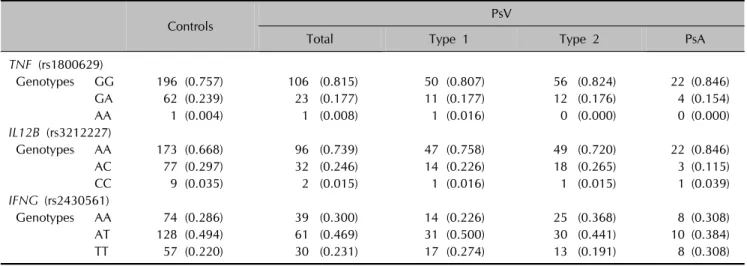
The results of genotyping analysis for patients with PsV and healthy controls are presented in Table 2. The geno- type distribution of each of the three cytokine genes exam- ined was similar in patients with PsV and the control pop- ulation (Table 3). In addition, there were no significant dif-
Table 2. Allele frequencies and genotype distribution of TNF, IL12B, and IFNG SNPs in patients and controls
Controls PsV
Total Type 1 Type 2 PsA
TNF (rs1800629)
Genotypes GG 196 (0.757) 106 (0.815) 50 (0.807) 56 (0.824) 22 (0.846)
GA 62 (0.239) 23 (0.177) 11 (0.177) 12 (0.176) 4 (0.154)
AA 1 (0.004) 1 (0.008) 1 (0.016) 0 (0.000) 0 (0.000)
IL12B (rs3212227)
Genotypes AA 173 (0.668) 96 (0.739) 47 (0.758) 49 (0.720) 22 (0.846)
AC 77 (0.297) 32 (0.246) 14 (0.226) 18 (0.265) 3 (0.115)
CC 9 (0.035) 2 (0.015) 1 (0.016) 1 (0.015) 1 (0.039)
IFNG (rs2430561)
Genotypes AA 74 (0.286) 39 (0.300) 14 (0.226) 25 (0.368) 8 (0.308)
AT 128 (0.494) 61 (0.469) 31 (0.500) 30 (0.441) 10 (0.384)
TT 57 (0.220) 30 (0.231) 17 (0.274) 13 (0.191) 8 (0.308)
Values are presented as number (frequency).
PsV: psoriasis vulgaris, PsA: psoriatic arthritis.
Table 3. OR, with 95% CI, and p-value for susceptibility to the indicated condition vs. controls associated with TNF, IL12B, and IFNG alleles and genotypes
PsV total PsV Type 1 PsV Type 2 PsA
p-value OR (95% CI) p-value OR (95% CI) p-value OR (95% CI) p-value OR (95% CI) TNF (rs1800629)
Genotypes GG 0.191 1.42 (0.87∼2.40) 0.406 1.34 (0.67∼2.67) 0.244 1.50 (0.76∼2.98) 0.306 1.77 (0.59∼5.32) GA 0.159 0.68 (0.40∼1.16) 0.296 0.69 (0.34∼1.40) 0.269 0.68 (0.34∼1.35) 0.306 0.57 (0.19∼1.70) AA 1.000 2.00 (0.12∼32.2) 0.349 4.23 (0.26∼68.5) 1.000 NA 1.000 NA IL12B (rs3212227)
Genotypes AA 0.155 1.40 (0.88∼2.24) 0.170 1.56 (0.82∼2.94) 0.410 1.28 (0.71∼2.31) 0.062 2.73 (0.91∼8.18) AC 0.290 0.77 (0.48∼1.25) 0.261 0.69 (0.36∼1.32) 0.597 0.85 (0.47∼1.55) 0.049 0.31 (0.09∼1.06) CC 0.349 0.43 (0.09∼2.04) 0.694 0.46 (0.06∼3.66) 0.480 0.42 (0.05∼3.33) 1.000 1.11 (0.14∼9.13) IFNG (rs2430561)
Genotypes AA 0.764 1.07 (0.68∼1.70) 0.342 0.73 (0.38∼1.40) 0.191 1.45 (0.83∼2.55) 0.806 1.11 (0.46∼2.67) AT 0.639 0.91 (0.59∼1.38) 0.920 1.02 (0.59∼1.78) 0.435 0.81 (0.47∼1.38) 0.286 0.64 (0.28∼1.46) TT 0.806 1.06 (0.64∼1.76) 0.362 1.34 (0.71∼2.52) 0.603 0.84 (0.43∼1.64) 0.310 1.58 (0.65∼3.81) OR: odds ratio, 95% CI: 95% confidence interval, PsV: psoriasis vulgaris, PsA: psoriatic arthritis, NA: not applicable.
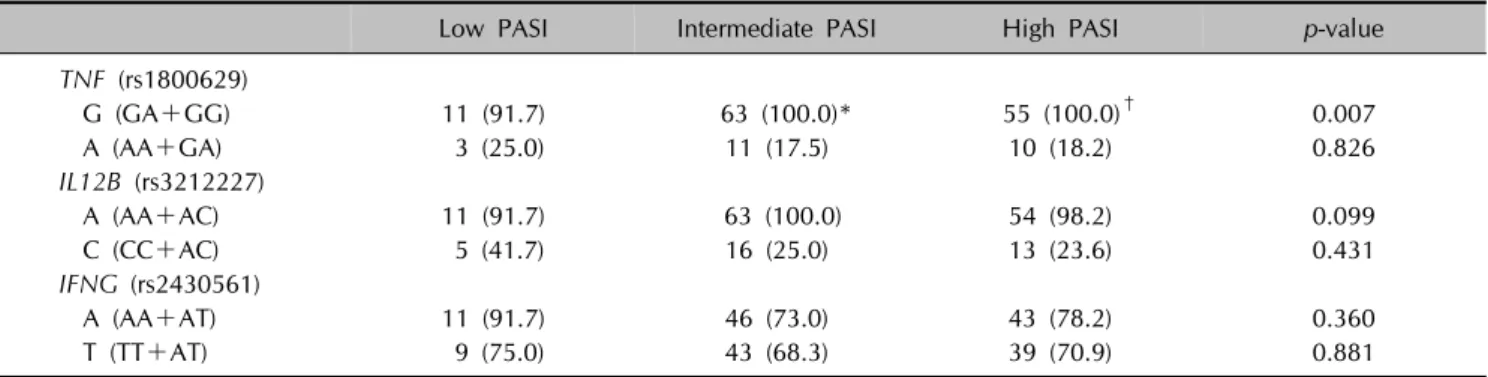
ferences between patients with either early onset (type 1) or late onset (type 2) PsV and the control subjects (Table 3). When controls were compared with only those pa- tients with PsV who also had PsA, a borderline sig- nificance was observed for the rs3212227 AC genotype (conferring protection) and AA genotype (conferring risk) of the IL12B gene SNP (p=0.049 and p=0.062, re- spectively), while genotypes for other gene SNPs did not differ between the groups (Table 3). Furthermore, TNF, IL12B, and IFNG allele carriage analysis did not reveal any significant differences between controls and patients with PsV or PsA, or between the two types of PsV (data not shown). However, a decreased frequency of TNF G al- lele carriers among patients with a low PASI score re-
inforces the possible risk effect associated with this allele or, alternatively, indicates a protective role of the other al- lele (A) in PsV (Table 4). None of the TNF, IL12B, or IFNG allele combinations was significantly different in patients compared to control subjects (data not shown).
DISCUSSION
In this study, we investigated the association of PsV in Serbian patients with polymorphisms in the genes encod- ing TNF-α, the p40 subunit of IL-12/23, and IFN-γ, which had previously been reported to affect gene expression and to have possible roles in the disease’s development and severity. The results of our investigation did not identify any
Table 4. TNF, IL12B, and IFNG allele carriage in patients with PsV stratified by psoriasis activity and severity index score
Low PASI Intermediate PASI High PASI p-value
TNF (rs1800629)
G (GA+GG) 11 (91.7) 63 (100.0)* 55 (100.0)† 0.007
A (AA+GA) 3 (25.0) 11 (17.5) 10 (18.2) 0.826
IL12B (rs3212227)
A (AA+AC) 11 (91.7) 63 (100.0) 54 (98.2) 0.099
C (CC+AC) 5 (41.7) 16 (25.0) 13 (23.6) 0.431
IFNG (rs2430561)
A (AA+AT) 11 (91.7) 46 (73.0) 43 (78.2) 0.360
T (TT+AT) 9 (75.0) 43 (68.3) 39 (70.9) 0.881
Values are presented as number (%). Percentages refer to the portion of patients within a stratum, according to PASI score. PsV:
psoriasis vulgaris, PASI: psoriasis activity and severity index. *p=0.022, †p=0.032, compared to low PASI group.
significant difference in allele frequencies or genotype dis- tribution between our patients and healthy individuals.
The important role of TNF-α in the pathogenesis of PsV is well established. However, the influences of SNPs located in the TNF promoter region, such as rs1800629, on al- tered PsV and PsA risk are less clear. Published studies show conflicting results, with some authors reporting asso- ciation of this SNP with disease susceptibility4 and others failing to find any association11,14, suggesting that this TNF polymorphism may have diverse effects in a population made up of various ethnicities4. Thus, our result could re- flect ethnic specificity in the Serbian population, although another study with more patients is needed in order to confirm this. In addition, the most recent meta-analysis re- vealed a significant protective effect of the TNF −308 A allele (genotypes AA and AG) in PsV4. This is in line with our finding of an association of the G allele with more se- vere disease, although the number of patients with low PASI score was small in our study.
Data obtained for IL12B genotypes and alleles did not dif- fer in our cohort of patients in comparison with disease-free individuals. This is in contrast with several studies from Europe, Asia, and America that demonstrated the pro- tective effect of the rs3212227 C allele in PsV/PsA10. Such a discrepancy was probably due to a limited sample size in our study. Indeed, the frequency of the risk-conferring AA genotype in our study was clearly higher among PsV patients than the controls (0.74 vs. 0.67), but the differ- ence did not reach statistical significance. Likewise, asso- ciations with the AC and AA genotypes were at the limits of significance when patients with PsA were compared with healthy individuals. Assuming the observed genotype frequencies, a total of more than 570 patients with PsV should have been included in our study in order to reach a power of 80% at a probability of p=0.05, which is be- yond the number we could gather in our hospital.
Interestingly, similar genotype distributions and a lack of significant difference were observed in a recently pub- lished study of Spanish patients with PsV12.
In contrast to TNF and IL12B SNPs, studies analyzing the effects of the rs2430561 IFNG polymorphism on PsV de- velopment and severity are scarce, yet our results support previous evidence that this SNP does not directly influ- ence susceptibility to PsV11. Lack of association of this IFNG polymorphism was also found in a comprehensive GWAS that looked for correlation between 438,670 SNPs in 1,539 PsV cases and 1,400 controls13. The only ex- ception among these reports was a study by Baran et al.9 that demonstrated, albeit in a limited number of individuals, the predominance of the TA heterozygote in a healthy group of individuals compared to patients with PsV.
The main caveat of our study is the relatively small sample size. Therefore, some associations could have been missed due to an insufficient number of patients and controls, as was probably the case for the IL12B +1188 A/C SNP.
Consequently, our results are in apparent contrast to those from several previously published studies that demon- strated association between some of the SNPs and PsV.
We believe that the observed differences are primarily due to the low number of patients in our study, since the odds ratios and confidence intervals obtained in our cohort are comparable to those from most other studies4,10,12. On the other hand, ethnic specificity of the Serbian population with regard to some of analyzed SNPs cannot be excluded.
Despite these limitations, our study is relevant because it is the first to analyze the association of gene polymorphisms with PsV development and severity in the Serbian po- pulation. It is also one of the rare studies that evaluate the relevance of the IFNG +874 T/A polymorphism in pa- tients with PsV. Therefore, the results of this study will ex- pand genetic knowledge regarding the role of three im- portant functional polymorphisms in PsV, which may
prove valuable for future meta-analyses and, ultimately, therapy.
ACKNOWLEDGMENT
This study was supported by the Fund of The Serbian Ministry of Education and Science (Grant No. 175038).
REFERENCES
1. Perera GK, Di Meglio P, Nestle FO. Psoriasis. Annu Rev Pathol 2012;7:385-422.
2. Qidwai T, Khan F. Tumour necrosis factor gene polymor- phism and disease prevalence. Scand J Immunol 2011;74:
522-547.
3. Smith AJ, Humphries SE. Cytokine and cytokine receptor gene polymorphisms and their functionality. Cytokine Growth Factor Rev 2009;20:43-59.
4. Li C, Wang G, Gao Y, Liu L, Gao T. TNF-alpha gene promoter −238G>A and −308G>A polymorphisms alter risk of psoriasis vulgaris: a meta-analysis. J Invest Dermatol 2007;127:1886-1892.
5. Basu M, Das T, Ghosh A, Majumder S, Maji AK, Kanjilal SD, et al. Gene-gene interaction and functional impact of polymorphisms on innate immune genes in controlling Plasmodium falciparum blood infection level. PLoS One 2012;7:e46441.
6. Cargill M, Schrodi SJ, Chang M, Garcia VE, Brandon R, Callis KP, et al. A large-scale genetic association study confirms IL12B and leads to the identification of IL23R as psoriasis-risk genes. Am J Hum Genet 2007;80:273-290.
7. Nair RP, Duffin KC, Helms C, Ding J, Stuart PE, Goldgar D, et al; Collaborative Association Study of Psoriasis. Genome- wide scan reveals association of psoriasis with IL-23 and NF-kappaB pathways. Nat Genet 2009;41:199-204.
8. Pravica V, Perrey C, Stevens A, Lee JH, Hutchinson IV. A single nucleotide polymorphism in the first intron of the human IFN-gamma gene: absolute correlation with a poly- morphic CA microsatellite marker of high IFN-gamma production. Hum Immunol 2000;61:863-866.
9. Baran W, Szepietowski JC, Mazur G, Baran E. IFN-gamma promoter gene polymorphism in psoriasis vulgaris. Biomarkers 2008;13:52-58.
10. Zhu KJ, Zhu CY, Shi G, Fan YM. Meta-analysis of IL12B polymorphisms (rs3212227, rs6887695) with psoriasis and psoriatic arthritis. Rheumatol Int 2013;33:1785-1790.
11. Craven NM, Jackson CW, Kirby B, Perrey C, Pravica V, Hutchinson IV, et al. Cytokine gene polymorphisms in psoriasis. Br J Dermatol 2001;144:849-853.
12. Eiris N, Santos-Juanes J, Coto-Segura P, Gómez J, Alvarez V, Morales B, et al. Resequencing of the IL12B gene in psoriasis patients with the rs6887695/rs3212227 risk geno- types. Cytokine 2012;60:27-29.
13. Elder JT. Genome-wide association scan yields new insights into the immunopathogenesis of psoriasis. Genes Immun 2009;10:201-209.
14. Magalhães RF, Biral AC, Pancoto JA, Donadi EA, Mendes CT Jr, Magna LA, et al. Human leukocyte antigen (HLA) and single nucleotide polymorphisms (SNPs) tumor necrosis factor (TNF)-alpha −238 and −308 as genetic markers of susceptibility to psoriasis and severity of the disease in a long-term follow-up Brazilian study. Int J Dermatol 2010;
49:1133-1140.
15. Naldi L. Scoring and monitoring the severity of psoriasis.
What is the preferred method? What is the ideal method? Is PASI passé? facts and controversies. Clin Dermatol 2010;
28:67-72.
16. Popadic D, Savic E, Spuran Z, Markovic M, Mostarica Stojkovic M, Ramic Z, et al. Distinctive frequencies of
+874T/A IFN-γ gene polymorphism in a healthy Serbian population. Clin Transl Sci 2012;5:461-463.