Treatment Gap in the National Health-screening Program in Korea: Claim-based Follow-up of Statin Use for Sustained Hypercholesterolemia
Participation in a screening program by itself may not improve clinical outcomes.
Treatment gaps in the program may limit its full benefit. We evaluated statin prescription rates for subjects with sustained hypercholesterolemia to assess the treatment gaps in the National Health Screening Program (NHSP) in Korea. A retrospective, random cohort was established among National Health Insurance Corporation (NHIC) members. Finally, we examined 465,499 individuals who attended the NHSP from 2003 to 2010 without any history of dyslipidemia, statin prescription, or hospitalization for cardiovascular events until the end of 2002. The subsequent statin prescription rates were identified from the NHIC medical service claim database from 2003 to 2011. Descriptive data and odds ratio from multivariate logistic analyses on statin prescription rates and the corresponding correlations were evaluated. The NHSP detected 114,085 (24.5%) cases of newly diagnosed hypercholesterolemia. However, only 8.6% of these received statin prescription within 6 months of diagnosis. For cases of sustained hypercholesterolemia determined in the next screening visit by the NHSP, the statin prescription rate increased, but only to 12.2%.
Statin prescriptions were more common among females, older individuals, and
hypertension or diabetes patients. Furthermore, the statin prescription rates had increased over the study period. The NHSP exhibited low statin prescription rate which has been improving. For the NHSP to be effective, it would be worthwhile to decrease the gap between the diagnosis of hypercholesterolemia and the following treatment.
Keywords: Hypercholesterolemia; Cholesterol; Cardiovascular Diseases; Prevention;
Statins Eunmi Ahn,1 Dong Wook Shin,2,3,4
Hyung-kook Yang,1 Jae Moon Yun,2 So Hyun Chun,5 Beomseok Suh,2 Hyejin Lee,2,3 Ki Young Son,2,3 and BeLong Cho2,3
1Cancer Policy Branch, National Cancer Control Research Institute, National Cancer Center, Goyang;
2Department of Family Medicine, Seoul National University Hospital, Seoul; 3Department of Family Medicine, College of Medicine, Seoul National University, Seoul; 4JW Lee Center for Global Medicine, and College of Medicine, Seoul National University, Seoul; 5Department of Family Medicine, Gachon University Gil Medical Center, Incheon, Korea
Received: 30 December 2014 Accepted: 7 July 2015 Address for Correspondence:
Dong Wook Shin, MD
Department of Family Medicine, Cancer Survivorship Clinic, Seoul National University Hospital, 101 Daehak-ro, Jongno-gu, Seoul 110-744, Korea
Tel: +82.2-2072-0847, Fax: +82.2-766-3276 E-mail: [email protected]
Funding: This research was supported by a fund from the Research of Korea Centers for Disease Control and Prevention (No. 2012E3302800).
http://dx.doi.org/10.3346/jkms.2015.30.9.1266 • J Korean Med Sci 2015; 30: 1266-1272
INTRODUCTION
Hypercholesterolemia is a well-established risk factor for car- diovascular disease (CVD), and accounts for 4.5% of all-cause mortality worldwide (1). Furthermore, it is a risk factor that can be modified by therapeutic lifestyle changes (TLC) and lipid- lowering agents (2, 3). Among the available lipid-lowering ther- apies, statins represent a cost-effective tool for the primary pre- vention of coronary heart disease (4, 5), and can reduce the rel- ative risk of major vascular events by 20% for each 1 mM/L re- duction in low density lipoprotein (LDL) (6).
The National Cholesterol Expert Panel (NCEP) recommends screening for dyslipidemia in individuals from the age of 20 yr and initiating lipid-lowering medication in cases where the ther- apeutic goal is not reached within 12 weeks of TLC. The United States Preventive Services Task Force (USPSTF) and European Society of Cardiology (ESC) similarly support screening and therapeutic intervention for dyslipidemia. Based on these rec-
ommendations, many countries are conducting national screen- ing programs for dyslipidemia, including Japan, Korea, United Kingdom, and the United States. In Korea, the National Health Insurance Corporation (NHIC) introduced an examination for hypercholesterolemia in the biennial National Health Screen- ing Program (NHSP) in 1995.
However, previous studies have shown that the invitation of patients for health checks failed to improve total mortality or cardiovascular mortality (7), and that for a screening program to be effective in clinical settings, appropriate therapeutic inter- ventions should be employed (8). In usual medical practice, compliance of patients following the prescription of lipid-low- ering therapy is known to be poor (9). However, only few em- pirical studies have investigated the follow-up practices after population screening regarding appropriate prescription of lip- id lowering agents when patients are detected with hypercho- lesterolemia.
The number of statin prescriptions written can be a strong Cardiovascular Disorders
surrogate marker of effective clinical intervention for hypercho- lesterolemia, because statins are the most frequently prescribed (87%) lipid-lowering agents (10). Therefore, we analyzed the statin prescription rate for newly diagnosed hypercholesterol- emia and sustained hypercholesterolemia patients identified by the national screening program as the primary outcome. We also analyzed factors associated with statin prescription rates, to examine the patients at risk of not receiving effective treatment in spite of having sustained hypercholesterolemia.
MATERIALS AND METHODS NHSP in Korea
Screening for hypercholesterolemia is a part of the NHSP. The NHSP is a population-based health-screening program provid- ed biennially by the Korean NHIC, a universal healthcare payer covering nearly the whole Korean population (96.9%). The par- ticipation rate in the NHSP was 48% in 2003 and increased to 73% in 2011. The NHIC directly invites the subjects to participate in the program and afterwards informs them about the test re- sults. During the process, subjects are to choose for themselves which medical center or clinic they wish to get their screening tests done and receive the necessitated management from.
Data sources
This study is based on the insurance registry database of NHIC members, their NHSP data, and the Korean National Heal th In- surance (NHI) medical service claims data. The NHSP data pro- vided information about serum cholesterol levels and health behaviors. The NHI medical service claims data provided infor- mation on medical history, including comorbid diseases and statin prescriptions.
Study subjects
The potentially eligible subjects included 3% of the adults (> 20 yr) who were selected randomly from the NHIC registry, as of December 31, 2002. They included 3% random sample of house- holders stratified by age and gender using the social security number and their household members. The follow-up period was up to 8 yr, through December 31, 2010. Among 1,162,354 eligible subjects, we excluded 412,397 subjects who did not par- ticipate in the screening program during the study period. We also excluded 284,458 subjects who were diagnosed with hy- percholesterolemia, prescribed statins, or hospitalized for myo- cardial infarction (ICD-10 codes I21, I22) or stroke (I61, I62, I63, I64) before they first attended the NHSP. The number of subjects in the study population was 465,499 (Fig. 1).
Definitions and study outcome
Newly diagnosed hypercholesterolemia was considered when cases of hypercholesterolemia were diagnosed for the first time
during the study period. Sustained hypercholesterolemia was defined as those with hypercholesterolemia in > 2 consecutive screenings, each in 2 yr interval. To evaluate the clinical inter- vention rate in the NHSP strictly, we operationally defined the target population for statin treatment as cases with sustained hypercholesterolemia on the consecutive screening after the first diagnosis (newly diagnosed hypercholesterolemia) (Table 1). Hypercholesterolemia was defined as a total serum choles- terol concentration of ≥ 6.2 mM/L (≥ 240 mg/dL) (4). Serum cholesterol was tested in fasting conditions, and the level was measured using an enzymatic method. Quality control in each hospital was assured by the Korean Association of Laboratory Quality Control (11).
Statin prescription was defined as the prescription of statins within 6 months after detection through the NHSP. The time lim- it of 6 months was set to measure the direct effect of NHSP, while considering the 12 weeks of TLS in the NCEP recommendation (4) as well as a cushion period. The prescription code included any form of statin listed in the claims data: atorvastatin, fluvas- tatin, pitavastatin, pravastatin, rosuvastatin, and simvastatin.
Based on these definitions, we analyzed the statin prescription rate for newly diagnosed hypercholesterolemia and sustain ed hypercholesterolemia patients as the primary outcome measure.
Statistical analyses
Descriptive statistics were used to present data on the attendan- ce for health-screening check-ups as well as statin prescription information. Among clinical characteristics of study subjects, Charlson comorbidity index (12) was calculated using the diag- nosis for inpatient care from the KNHI medical service claims data. To evaluate the correlation between subject characteris- tics and statin prescription, a multivariate logistic model was constructed based on the univariate analyses of risk factors of coronary heart disease (CHD) (4) using the stepwise selection technique. In the final model, we calculated the odds ratio and 95% confidence intervals, adjusted for gender, age, comorbidi- ties (hypertension and diabetes), smoking, and year of exami- nation. We used STATA version 12.0 (StatCorp. Houston, TX, USA) to analyze the data, and the statistical significance was defined as P < 0.05.
Ethics statement
This study was approved by the institutional review board of Seoul National University Hospital (IRB No. C-1206-055-414).
Informed consent was exempted by the board.
RESULTS
Diagnosis of hypercholesterolemia and statin prescriptions
Among 465,499 subjects who attended the first screening visit
Fig. 1. Flow chart of subjects. *Diagnosed with dyslipidemia (ICD-10 code E78) or were prescribed statins; †Inpatient care for myocardial infarction (ICD-10 codes I21, I22) or stroke (I61, I62, I63, I64); ‡Fasting serum cholesterol level ≥ 240 mg/dL.
1,162,354 potential subjects
465,499 attended screening more than once
114,085 cases of hypercholesterolemia detected for the first time‡
51,853 attended the next screening
20,785 still had hypercholesterolemia‡
Newly-diagnosed hypercholesterolemia during the follow up period
Sustained hypercholesterolemia in the next screening 9,842 (8.6%) prescribed stains within 6 months
31,068 with normal cholesterol levels
2,529 (12.2%) were prescribed statins within 6 months 48,289 did not attend the next screening
4,101 (3.6%) prescribed statins from 6 months onward until the next screening 412,397 did not attend the screening 284,458 excluded
· Already diagnosed as having dyslipidemia*
· Hospitalized for cardiovascular events†
351,414 always had normal cholesterol levels
Table 1. Examples of cases of newly diagnosed hypercholesterolemia and sustained hypercholesterolemia
Cases Year of examination
Interpretation 2003-2004 2005-2006 2007-2008 2009-2010
Case 1 X O X X Newly diagnosed hypercholesterolemia in 2005-2006 but it was not sustained
Case 2 X X X O Newly diagnosed hypercholesterolemia in 2009-2010 but it was not sustained
Case 3 X O O X Newly diagnosed hypercholesterolemia in 2005-2006 and it was sustained in2007-2008
Case 4 X O X O Newly diagnosed hypercholesterolemia in 2005-2006 but it was not sustained
Case 5 O X O O Newly diagnosed hypercholesterolemia in 2003-2004 but it was not sustained
O: Serum cholesterol level ≥ 240 mg/dL. X: Serum cholesterol level < 240 mg/dL or did not attend the National Health Screening Program.
of the NHSP and were not previously diagnosed with hypercho- lesterolemia, 114,085 subjects (24.5%) were newly diagnosed with hypercholesterolemia. Of these, 8.6% (n = 9,842) were pre- scribed with statin within 6 months of the NHSP, and an addi- tional 3.6% (n = 4,101) were prescribed statins in the subsequent 6 months until the next NHSP screening.
Among the 100,142 subjects who had not been prescribed for a statin after their initial diagnosis of hypercholesterolemia, 51,853 (51.8%) attended the next NHSP screening and 20,785 of
these subjects (40.1%) had sustained hypercholesterolemia. How- ever, only 12.2% (n = 2,529) of them were prescribed statin treat- ment within 6 months following the examination (Fig. 1).
Statin prescription after hypercholesterolemia by age, sex, and comorbidities
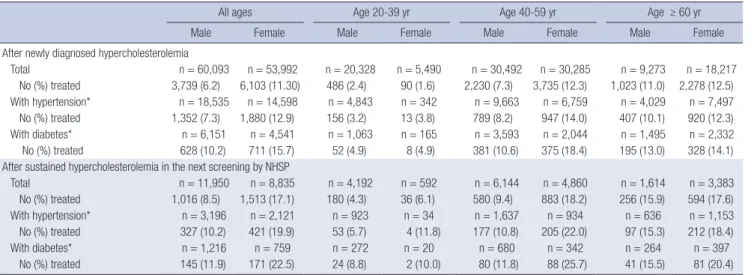
The statin prescription rate was higher among women than men for those aged ≥ 40 yr; this trend was not observed for those aged < 40 yr. Considering CVD risk factors, people were pre-
scribed statins more frequently if they were diagnosed as hy- pertension and aged from 20 to 59 yr old. Notably, male patients of all ages and female patients aged > 40 yr, who had been di- agnosed with diabetes, were most frequently prescribed with statins. The prescription rate was high in subjects with sustained hypercholesterolemia compared to subjects with newly diagnos- ed hypercholesterolemia regardless of gender or age (Table 2).
Factors associated with statin prescriptions in subjects with sustained hypercholesterolemia
Among 20,785 cases of sustained hypercholesterolemia, statin prescriptions correlated with female gender (adjusted odds ra- tio [aOR], 1.73; 95% CI, 1.40-2.15) and older age (aOR for age 40-59 yr, 2.13; 95% CI, 1.73-2.63; aOR for ages 60-79 yr, 2.55; 95%
CI, 1.94-3.34). Past diagnoses of comorbidities were also impor- tant correlates, including hypertension (aOR, 1.41; 95% CI, 1.19- 1.67) and diabetes (aOR, 1.26; 95% CI, 1.00-1.34). Above all, statin prescription rates were found to have increased in recent years (aOR for 2007-2008, 1.27; 95% CI, 1.13-1.43; aOR for 2009-2010, 1.70; 95% CI, 1.53-1.89) (Table 3).
DISCUSSION
To our knowledge, this is the first longitudinal report about the treatment gap observed in a population-based dyslipidemia screening program. It is an important issue because it could limit the full benefit of a prevention program for cardiovascular dis- eases (13). The strengths of our study include the use of a large database from a nationally representative sample, and the near- ly complete follow-up for the primary outcome variable. The use of claim data for comorbidities and statin prescription de- tails, rather than self-reported information, is another strength compared to other previous studies reporting prescription rates
for dyslipidemia (14-16).
Although we designed a conservative study, only 12.2% of patients with sustained hypercholesterolemia were prescribed with statins within 6 months of the screening. This suggests that many patients with hypercholesterolemia do not receive ap- propriate clinical intervention despite their active participation in a consecutive health-screening program, indicating that the test results may not be suitably utilized for preventing CVD. Par- ticipants were more likely to be prescribed statins if they had es- tablished risk factors (4). This was the case if they were older, hy- pertensive, diabetic or middle-aged and older women. Howev- er, the prescription rates were < 20% even for higher risk groups, such as older people, smokers, and those with diabetes or hy- pertension, although recent guidelines have recommended in- tensive statin treatment in such high risk groups (4).
Although the data may not be directly comparable, our re- sults are in marked contrast to the statin prescription rates seen in the National Health Service (NHS) Health Check in the UK.
In the first 2 yr of the NHS Health Check, statin prescription rates increased from 14.0% to 60.6% between the pre- and post-screen- ing periods in groups at high risk of CVD (17). The discrepancy in the efficacy of NHS Health Check and NHSP could be due to the different degree of integration and the continuity of health- care services. In the NHS Health Checks, the test is ordered and followed up by medical professionals who care for each patient at high risk (18). The cardiovascular disease screening by Medi- care in the US adopts a similar process where the test is initiated by doctors or healthcare providers for their own patients (19).
However, the NHSP is operated independently from the prima- ry care physicians of individual patients. Physicians cannot bro- wse nor follow up on the NHSP reports for their patients. In the NHSP, patients have to apply for the screening, receive the test report, and then seek medical advice by themselves.
Table 2. Statin prescriptions in hypercholesterolemic subjects within the first 6 months after the NHSP
All ages Age 20-39 yr Age 40-59 yr Age ≥ 60 yr
Male Female Male Female Male Female Male Female
After newly diagnosed hypercholesterolemia
Total n = 60,093 n = 53,992 n = 20,328 n = 5,490 n = 30,492 n = 30,285 n = 9,273 n = 18,217
No (%) treated 3,739 (6.2) 6,103 (11.30) 486 (2.4) 90 (1.6) 2,230 (7.3) 3,735 (12.3) 1,023 (11.0) 2,278 (12.5)
With hypertension* n = 18,535 n = 14,598 n = 4,843 n = 342 n = 9,663 n = 6,759 n = 4,029 n = 7,497
No (%) treated 1,352 (7.3) 1,880 (12.9) 156 (3.2) 13 (3.8) 789 (8.2) 947 (14.0) 407 (10.1) 920 (12.3)
With diabetes* n = 6,151 n = 4,541 n = 1,063 n = 165 n = 3,593 n = 2,044 n = 1,495 n = 2,332
No (%) treated 628 (10.2) 711 (15.7) 52 (4.9) 8 (4.9) 381 (10.6) 375 (18.4) 195 (13.0) 328 (14.1) After sustained hypercholesterolemia in the next screening by NHSP
Total n = 11,950 n = 8,835 n = 4,192 n = 592 n = 6,144 n = 4,860 n = 1,614 n = 3,383
No (%) treated 1,016 (8.5) 1,513 (17.1) 180 (4.3) 36 (6.1) 580 (9.4) 883 (18.2) 256 (15.9) 594 (17.6)
With hypertension* n = 3,196 n = 2,121 n = 923 n = 34 n = 1,637 n = 934 n = 636 n = 1,153
No (%) treated 327 (10.2) 421 (19.9) 53 (5.7) 4 (11.8) 177 (10.8) 205 (22.0) 97 (15.3) 212 (18.4)
With diabetes* n = 1,216 n = 759 n = 272 n = 20 n = 680 n = 342 n = 264 n = 397
No (%) treated 145 (11.9) 171 (22.5) 24 (8.8) 2 (10.0) 80 (11.8) 88 (25.7) 41 (15.5) 81 (20.4)
*Diagnosed with hypertension (ICD-10 codes I10-I15) or diabetes (ICD-10 codes E10-E14) in the National Health Insurance medical service claims data. NHSP, National Health Screening Program.
Compliance with lipid-lowering therapy is usually poor (9). It has been reported that many patients were not concerned re- garding their cholesterol level reports (20), were not aware of the desirable cholesterol levels (21, 22), or did not understand its importance as a risk factor for CVD (22, 23). In addition, pa- tients often believe that TLC would be equally as effective at lowering cholesterol as statins (20) and often have concerns about the adverse effects of statins (20, 24, 25). Therefore, it is difficult to achieve appropriate treatment if the clinical follow
up is left entirely to the patient. A promising finding was that the prescription rate increased from 10.0% to 15.5% during the study period of 8 yr. This finding agrees with the increasing trend of lipid-lowering drug use worldwide (5, 14, 15, 26), although the prescription rate is still low in Korea, as reported in 2011 (27).
This study has several limitations. First, our study evaluated only the treatment gap in the NHSP. During the study period (median follow-up, 3.86 yr), we could not assess for a significant decrease in myocardial infarction and all-cause mortality using Table 3. Factors associated with statin prescriptions for sustained hypercholesterolemia in the National Health Screening Program
Characteristics
Prescription for statins within 6 months (n = 20,785)
OR (95% CI) aOR* (95% CI)
No (n = 18,256)
No (%) Yes (n = 2,529)
No (%) Sex
Male 10,934 (91.5) 1,016 (8.5) 1 (reference) 1 (reference)
Female 7,322 (82.9) 1,513 (17.1) 2.22 (2.04-2.42) 1.58 (1.40-1.79)
Age (yr)†
(mean ± SD) 49.76 ± 12.62 54.96 ± 10.40
20-39 4,568 (95.5) 216 (4.5) 1 (reference) 1 (reference)
40-59 9,541 (86.7) 1,463 (13.3) 3.24 (2.80-3.76) 2.35 (2.00-2.75)
60-79 4,147 (83.0) 850 (17.0) 4.33 (3.71-5.06) 2.39 (2.00-2.85)
BMI (kg/m2)
(mean ± SD) 24.87 ± 3.09 24.82 ± 2.96
< 17 40 (90.9) 4 (9.1) 0.70 (0.25-1.97) N/A
17-24 9,841 (87.6) 1,397 (12.4) 1 (reference) N/A
≥ 25 8,372 (88.1) 1,126 (11.9) 0.95 (0.87-1.03) N/A
Missing data 3 (60.0) 2 (40.0) N/A N/A
CCI‡
(mean ± SD) 0.34 ± 0.72 0.65 ± 0.91
0 13,731 (90.5) 1,436 (9.5) 1 (reference) 1 (reference)
1 3,298 (82.3) 709 (17.7) 2.06 (1.86-2.27) 1.70 (1.52-1.89)
2 881 (76.5) 271 (23.5) 2.94 (2.54-3.41) 2.34 (1.99-2.76)
≥ 3 346 (75.4) 113 (24.6) 3.12 (2.51-3.89) 2.20 (1.72-2.81)
Hypertension§
No 13,687 (88.5) 1,781 (11.5) 1 (reference) 1 (reference)
Yes 4,569 (85.9) 748 (14.1) 1.26 (1.15-1.38) 1.28 (1.26-1.42)
Diabetes§
No 6,209 (89.3) 744 (10.7) 1 (reference) 1 (reference)
Yes 12,047 (87.1) 1,785 (12.9) 1.43 (1.26-1.62) 1.26 (1.00-1.34)
Smoking
None 9,935 (86.0) 1,622 (14.0) 1 (reference) 1 (reference)
Ex-smokerll 1,983 (90.1) 217 (9.9) 0.67 (0.58-0.78) 1.02 (0.86-1.21)
Smoker 4,751 (92.5) 387 (7.5) 0.50 (0.44-0.56) 0.89 (0.77-1.03)
Missing 1,587 (84.0) 303 (16.5) N/A N/A
Drinking problems¶
No 5,789 (89.8) 656 (10.2) 1 (reference) N/A
Yes 3,233 (91.0) 321 (9.0) 0.88 (0.76-1.01) N/A
Missing data 9,234 (85.6) 1,552 (14.4) N/A N/A
Year of examination
2003-2004 N/A N/A N/A N/A
2005-2006 8,600 (90.0) 953 (10.0) 1 (reference) 1 (reference)
2007-2008 5,091 (87.4) 736 (12.6) 1.30 (1.18-1.45) 1.27 (1.13-1.43)
2009-2010 4,565 (84.5) 840 (15.5) 1.66 (1.50-1.83) 1.70 (1.53-1.89)
*Adjusted for gender, age, number of comorbidity, hypertension, diabetes, smoking, year of examination; †Age at the second hypercholesterolemia; ‡ICD-10 version of Charlson comorbidity index (12); §Diagnosed with hypertension (ICD-10 codes I10-I15) or diabetes (ICD-10 codes E10-E14) in the National Health Insurance medical service claims data;
llPerson who have quitted smoking at the time of screening test but ever smoked more than 100 tobacco cigarette; ¶Drinking problem: more than 14 units of alcohol per week for men; 10 units of alcohol per week for women. TC, serum total cholesterol; OR, odds ratio; aOR, adjusted odds ratio; CI, confidence interval; SD, standard deviation; BMI, body mass index; N/A, not available; CCI, Charlson comorbidity index.
information on statin prescription within the first 6 months (data not shown). The effect of pharmacologic intervention rates on long-term clinical outcomes in every stage, such as the treat- ment rate, control rate, cardiovascular event, and cardiovascu- lar mortality remains to be investigated. Second, in the present study, the criteria for statin prescriptions were based on serum total cholesterol level only, and not on the LDL or High Density Lipoprotein (HDL) levels that are used in clinical practice. In Korea, serum total cholesterol levels have been used as the con- ventional standard for prescribing statins for a long time (27), and during the study period, the National Health Insurance al- lowed insurance coverage for statin prescription based on the serum total cholesterol level. In a similar vein, the National Heal- th-Screening Program tested only for serum total cholesterol levels until 2008. Although recent guidelines are focusing more on the LDL or HDL levels, we adopted the conventional stan- dard during the study period for the fair evaluation of the fol- low-up practice during the same period. Meanwhile, the total cholesterol levels are good for predicting the risk of cardiovas- cular disease, compared to the new biomarkers (2, 28). More- over, statin prescription rates were still very low in high risk groups, suggesting that the conclusion of our study would be robust even with different criteria for statin treatment. Third, a comprehen- sive evaluation of interventions for dyslipidemia was not con- sidered, as we had no information on the TLC. However, we overcame this limitation by using the criterion of statin prescrip- tion only in patients with sustained hypercholesterolemia. Four- th, the statin prescription rate may have been overestimated due to a selection bias, as participants in a health-screening program are more likely to be interested in their health and ad- here to clinical follow-up.
In spite of these limitations, this study showed that a wide treatment gap is present in the NHSP in Korea, although it is improving. There has been remarkable development in lipid- lowering therapies, which can help in cases of sustained dyslip- idemia (6). Considering the contrasting findings between NHSP and NHS Health Check, the real-world benefit and efficacy of screening programs can vary widely. Therefore, to reduce the cardiovascular disease burden, it would be worthwhile to de- crease the treatment gap and to re-evaluate the clinical benefits of a health-screening program.
DISCLOSURE
The authors declare no conflict of interest.
AUTHOR CONTRIBUTION
Conception of the study: Shin DW, Cho BL, Son KY. Acquisition of data: Cho BL, Yang HK. Statistical analysis: Ahn E, Yang HK.
Manuscript preparation: Ahn E, Shin DW, Chun SH, Suh B. Man-
uscript approval: all authors.
ORCID
Eunmi Ahn http://orcid.org/0000-0002-9826-0788 Dong Wook Shin http://orcid.org/0000-0001-8128-8920 Hyung-kook Yang http://orcid.org/0000-0003-0727-0874 So Hyun Chun http://orcid.org/0000-0002-2183-2119 Hyejin Lee http://orcid.org/0000-0001-5279-340X Beomseok Suh http://orcid.org/0000-0003-0644-5855 Ki Young Son http://orcid.org/0000-0003-1262-100X BeLong Cho http://orcid.org/0000-0001-9558-689X REFERENCES
1. World Health Organization. Global status report on noncommunicable diseases 2010. Geneva: World Health Organization, 2011.
2. Lloyd-Jones DM, Larson MG, Beiser A, Levy D. Lifetime risk of develop- ing coronary heart disease. Lancet 1999; 353: 89-92.
3. Lee KH, Jeong MH, Ahn Y, Cho MC, Kim CJ, Kim YJ. New horizons of acute myocardial infarction: from the Korea Acute Myocardial Infarc- tion Registry. J Korean Med Sci 2013; 28: 173-80.
4. Expert Panel on Detection E, and Treatment of High Blood Cholesterol in Adults. Executive summary of the third report of The National Choles- terol Education Program (NCEP) expert panel on detection, evaluation, and treatment of high blood cholesterol in adults (adult treatment panel III). JAMA 2001; 285: 2486-97.
5. Ebrahim S, Casas JP. Statins for all by the age of 50 years? Lancet 2012;
380: 545-7.
6. Mihaylova B, Emberson J, Blackwell L, Keech A, Simes J, Barnes EH, Voysey M, Gray A, Collins R, Baigent C. The effects of lowering LDL cho- lesterol with statin therapy in people at low risk of vascular disease: me- ta-analysis of individual data from 27 randomised trials. Lancet 2012;
380: 581-90.
7. Krogsbøll LT, Jørgensen KJ, Gøtzsche PC. General health checks in adults for reducing morbidity and mortality from disease. JAMA 2013; 309: 2489- 90.
8. Donabedian A. The quality of medical care. Science 1978; 200: 856-64.
9. Liberopoulos EN, Florentin M, Mikhailidis DP, Elisaf MS. Compliance with lipid-lowering therapy and its impact on cardiovascular morbidity and mortality. Expert Opin Drug Saf 2008; 7: 717-25.
10. Böhler S, Scharnagl H, Freisinger F, Stojakovic T, Glaesmer H, Klotsche J, Pieper L, Pittrow D, Kirch W, Schneider H, et al.; DETECT-Study Group.
Unmet needs in the diagnosis and treatment of dyslipidemia in the pri- mary care setting in Germany. Atherosclerosis 2007; 190: 397-407.
11. Cho HI. Twenty-years of experiences in external quality assurance in Korea. Southeast Asian J Trop Med Public Health 1999; 30: 32-8.
12. Sundararajan V, Henderson T, Perry C, Muggivan A, Quan H, Ghali WA.
New ICD-10 version of the Charlson comorbidity index predicted in-hos- pital mortality. J Clin Epidemiol 2004; 57: 1288-94.
13. Pearson T, Kopin L. Bridging the treatment gap: improving compliance with lipid-modifying agents and therapeutic lifestyle changes. Prev Car- diol 2003; 6: 204-11.
14. Primatesta P, Poulter NR. Lipid concentrations and the use of lipid low- ering drugs: evidence from a national cross sectional survey. BMJ 2000;
321: 1322-5.
15. Ford ES, Mokdad AH, Giles WH, Mensah GA. Serum total cholesterol concentrations and awareness, treatment, and control of hypercholester- olemia among US adults: findings from the National Health and Nutri- tion Examination Survey, 1999 to 2000. Circulation 2003; 107: 2185-9.
16. Goff DC Jr, Bertoni AG, Kramer H, Bonds D, Blumenthal RS, Tsai MY, Psaty BM. Dyslipidemia prevalence, treatment, and control in the Multi- Ethnic Study of Atherosclerosis (MESA): gender, ethnicity, and coronary artery calcium. Circulation 2006; 113: 647-56.
17. Artac M, Dalton AR, Majeed A, Car J, Millett C. Effectiveness of a nation- al cardiovascular disease risk assessment program (NHS Health Check):
results after one year. Prev Med 2013; 57: 129-34.
18. National Health Service (UK). What is NHS Health Check. Available at http://www.nhs.uk/Planners/NHSHealthCheck/Pages/NHSHealthCheck- what.aspx [accessed on 30 January 2015].
19. Centers for Medicare and Medicaid Services (US). Your guide to Medi- care’s preventive services. 4th ed. Baltimore, MD: Centers for Medicare &
Medicaid Services, US Department of Health and Human Services 2011.
20. Aung TH, Go YY, Low LP, Chua T. Public perceptions, knowledge and awareness of cholesterol management in Singapore: a prospective pilot study. Singapore Med J 2013; 54: 32-5.
21. Choi EJ, Jekal Y, Kim S, Yoo JS, Kim HS, Oh EG, Jeon JY, Jang Y, Chu SH, Kim MJ. Middle-aged women’s awareness of cholesterol as a risk factor:
results from a national survey of Korean Middle-aged Women’s Health
Awareness (KomWHA) study. Int J Nurs Stud 2010; 47: 452-60.
22. Nash IS, Mosca L, Blumenthal RS, Davidson MH, Smith SC Jr, Paster- nak RC. Contemporary awareness and understanding of cholesterol as a risk factor: results of an American Heart Association national survey.
Arch Intern Med 2003; 163: 1597-600.
23. Kandula NR, Tirodkar MA, Lauderdale DS, Khurana NR, Makoul G, Bak- er DW. Knowledge gaps and misconceptions about coronary heart dis- ease among U.S. South Asians. Am J Prev Med 2010; 38: 439-42.
24. Kon RH, Russo MW, Ory B, Mendys P, Simpson RJ Jr. Misperception among physicians and patients regarding the risks and benefits of statin treatment: the potential role of direct-to-consumer advertising. J Clin Li- pidol 2008; 2: 51-7.
25. Tolmie EP, Lindsay GM, Kerr SM, Brown MR, Ford I, Gaw A. Patients’
perspectives on statin therapy for treatment of hypercholesterolaemia: a qualitative study. Eur J Cardiovasc Nurs 2003; 2: 141-9.
26. Ford ES, Li C, Pearson WS, Zhao G, Mokdad AH. Trends in hypercholes- terolemia, treatment and control among United States adults. Int J Car- diol 2010; 140: 226-35.
27. Ministry of Health and Welfare (KR), Korea Centers for Disease Control and Prevention. 2011 National Health Statistics: the fifth Korea Nation- al Health and Nutrition Examination Survey, 2010-2012. Seoul: Minis- try of Health and Welfare, 2012, p432.
28. Ingelsson E, Schaefer EJ, Contois JH, McNamara JR, Sullivan L, Keyes MJ, Pencina MJ, Schoonmaker C, Wilson PW, D’Agostino RB, et al. Clin- ical utility of different lipid measures for prediction of coronary heart dis- ease in men and women. JAMA 2007; 298: 776-85.