Vol. 2, No. 1, pp 27~33, 2008
Corresponding author:Hak Sun Kim, MD
Department of Orthopaedic Surgery, Yongdong Severance Hospital, 612 Eonjuro, Gangnam-gu, Seoul, 135-720, Republic of Korea
Tel: +82-2-2019-3411, Fax: +82-2-573-5393, E-mail: [email protected]
Incidence & Risk Factors Associated with Superior Mesenteric Artery Syndrome following Surgical Correction of Scoliosis
Ju Young Kim, Hak Sun Kim, Eun Su Moon, Jin Oh Park, Dong Eun Shin#, Gene Kyu Lee$, Jung Won Ha�, and Yeun Su Jung�
Department of Spinal Orthopaedic Surgery, Yong-Dong Severance Hospital, Yonsei University, College of Medicine, Seoul, Korea, Department of Spinal Orthopaedic Surgery, Bundang Cha Hospital, Seoul, Korea#,
Washington University in St. Louis, St. Louis, MO 63105$, Department of Orthopaedic Surgery, National Health Insurance Corporation Ilsan Hospital�
S
Sttuuddyy DDeessiiggnn:: Retrospective.
P
Puurrppoossee:: To more accurately determine the incidence and clarify risk factors.
O
Ovveerrvviieeww ooff LLiitteerraattuurree:: Superior mesenteric artery syndrome is one of the possible complications following correctional operation for scoliosis. However, when preliminary symptoms are vague, the diagnosis of superior mesenteric artery syn- drome may be easily missed.
M
Meetthhooddss:: We conducted a retrospective study using clinical data from 118 patients (43 men and 75 women) who underwent correctional operations for scoliosis between September 2001 and August 2007. The mean patient age was 15.9 years (range 9�24 years). The risk factors under scrutiny were the patient BMI, change in Cobb’s angle, and trunk length.
R
Reessuullttss:: The incidence of subjects confirmed to have obstruction was 2.5%. However, the rate increased to 7.6% with the inclusion of the 6 subjects who only showed clinical symptoms of obstruction without confirmative study. The BMI for the asymptomatic and symptomatic groups were 18.4±3.4 and 14.6±3, respectively. The change in Cobb’s angle for the asymp- tomatic and symptomatic groups were 24.8±13.6�and 23.4±9.1�, respectively. The change in trunk length for the asymp- tomatic and symptomatic groups were 2.3±2.1 cm and 4.5±4.8 cm, respectively. Differences in Cobb’s angle and the change in trunk length between the two groups did not reach statistical significance, although there was a greater increase in trunk length for the symptomatic group than for the asymptomatic group.
C
Coonncclluussiioonnss:: Our study shows that the incidence of superior mesenteric artery syndrome may be greater than the previously accepted rate of 4.7%. Therefore, in the face of any early signs or symptoms of superior mesenteric artery syndrome, prompt recognition and treatment are necessary.
K
Keeyywwoorrddss:: Scoliosis, Superior mesenteric artery syndrome, BMI, Trunk length
Introduction
Abdominal pain is one of the most common complaints in patients who have undergone correctional operations for scoliosis. However, little attention has been directed to this matter, because it is easily treatable through conservative treatment methods. One of the causes of abdominal pain
following a scoliosis correctional operation is superior mesenteric artery (SMA) syndrome, which was first dis- cussed by Rokitansky in 18421. SMA syndrome manifests in patients approximately 1 week after operation2,3,4,5,6,7. The SMA passes in front of the third portion of the duodenum at the level of the third lumbar vertebra. Consequently, SMA syndrome can cause duodenal obstruction, which leads to nausea, bilious vomiting, and abdominal distention. Conser-
vative treatment measures usually resolve this disorder.
However, severe complications such as electrolyte imbal- ance or gastric perforation, may rarely occur, potentially leading to patient death1,4,8,9. Therefore, a comprehensive understanding of risk factors and incidence is important for pre- and post-operative patient care, especially considering that the potential complications are life-threatening.
The association between correctional operations for scol- iosis and SMA syndrome is particularly compelling, because scoliosis patients carry a greater risk for SMA syn- drome.
One prominent characteristic of scoliosis patients is their low weight relative to their height. Patients who are markedly underweight, who undergo a correctional opera- tion, and who consequently experience an increase in height or a decrease in body weight are at an even greater risk.
Various research efforts have been directed at analyzing the effects of post-operative weight and height changes on the risk of SMA syndrome3,6,11,12. It is already known that an increase in height, especially the trunk length, is one factor that increases the risk of SMA syndrome.
The accepted incidence of SMA syndrome is between 1%
and 4.7%. However, this rate has been determined based on studies of patients who have been confirmed to have intesti- nal obstruction2,5,7,13. The inclusion of patients without con- firmed intestinal obstruction would undoubtedly increase this figures.
The purpose of this study was to more accurately deter- mine the incidence by analyzing patients confirmed to have intestinal obstruction and those with less explicit symptoms, and to closely analyze the effects of post-operative height and weight changes on the risk of SMA syndrome.
Materials and Methods
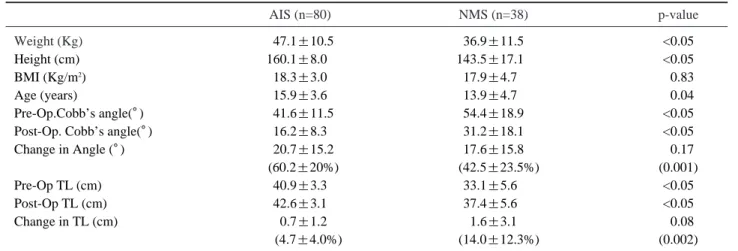
Between September 2001 and August 2007, a retrospec- tive clinical study was conducted on patients who under- went correctional operations for scoliosis at the Young- dong Severance and Bundang Cha Hospitals. The subject pool consisted of those patients who underwent posterior spinal fusion with or without anterior spinal fusion. The lower part of the fusion had to be below the second lumbar vertebrate. The study group consisted of 118 patients (43 men and 75 women) covering an age range from 9 to 24 years, with the mean age being 15.9 years. Furthermore, 80 patients had adolescent idiopathic scoliosis (AIS), and 38 had neuromuscular scoliosis (NMS) (Table 1). From this pool of patients, we selected those subjects suffering from excessive nausea, bilious vomiting, or abdominal distension after approximately one week (range five to ten weeks).
Patients who showed only moderate nausea or severe nau- sea with no accompanying vomiting were excluded.
Patients with abdominal distention underwent a simple abdominal x-ray to exclude postoperative ileus. Confirma- tion was restricted to those patients who showed positive results on upper gastrointestinal (GI) barium contrast study.
The risk factors analyzed in this study included body mass index (BMI), and changes in both Cobb’s angle and trunk length. BMIs were calculated by dividing each patient’s weight (kilograms) by the square of his or her height (meter). All values were obtained at the time of hos- pitalization. The BMIs of patients under 20 years of age were calculated and analyzed as a percentile, as recom- mended by the Korean Society of Pediatrics. These values
Table 1. Demographics of the entire subject pool according to the etiology
AIS (n=80) NMS (n=38) p-value
Weight (Kg) 147.1±10.5 36.9±11.5 <0.05
Height (cm) 160.1±8.01 143.5±17.11 <0.05
BMI (Kg/m2) 118.3±3.01 17.9±4.71 <0.83
Age (years) 115.9±3.61 13.9±4.71 <0.04
Pre-Op.Cobb’s angle(�) 141.6±11.5 54.4±18.9 <0.05
Post-Op. Cobb’s angle(�) 16.2±8.3 31.2±18.1 <0.05
Change in Angle (�) 120.7±15.2 17.6±15.8 <0.17
1(60.2±20%) 1(42.5±23.5%) (0.001)
Pre-Op TL (cm) 140.9±3.31 33.1±5.61 <0.05
Post-Op TL (cm) 42.6±3.1 37.4±5.61 <0.05
Change in TL (cm) 10.7±1.2 1.6±3.1 <0.08
11 (4.7±4.0%) 1(14.0±12.3%) (0.002)
AIS: adolescent idiopathic scoliosis; NMS: neuromuscular scoliosis; Op.: operation; TL: Trunk Length
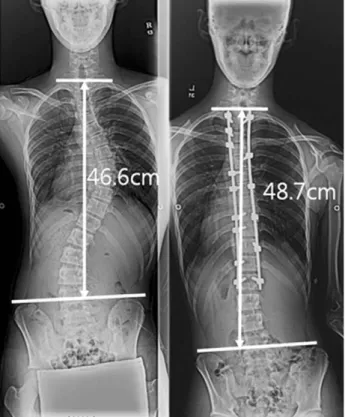
were both age- and sex-specific. The change in Cobb’s angle and trunk length were analyzed using a whole spine x-ray. The trunk length was obtained by measuring the ver- tical length from the point where the line connecting the apex of the first rib crosses the mid-point of the T1 verte- brae, down to the point where it meets the line connecting the two iliac crests (Fig. 1). A two-tailed student t test was used to calculate the p-value. A p-value less than 0.05 was considered statistically significant.
Results
Three patients (1 AIS and 2 NMS) were confirmed to have SMA syndrome, and 6 patients (3 AIS and 3 NMS) were thought to suffer from SMA syndrome based on clini- cal symptoms without barium radiography confirmation (Fig. 2). The incidence of confirmed patients was 2.5%
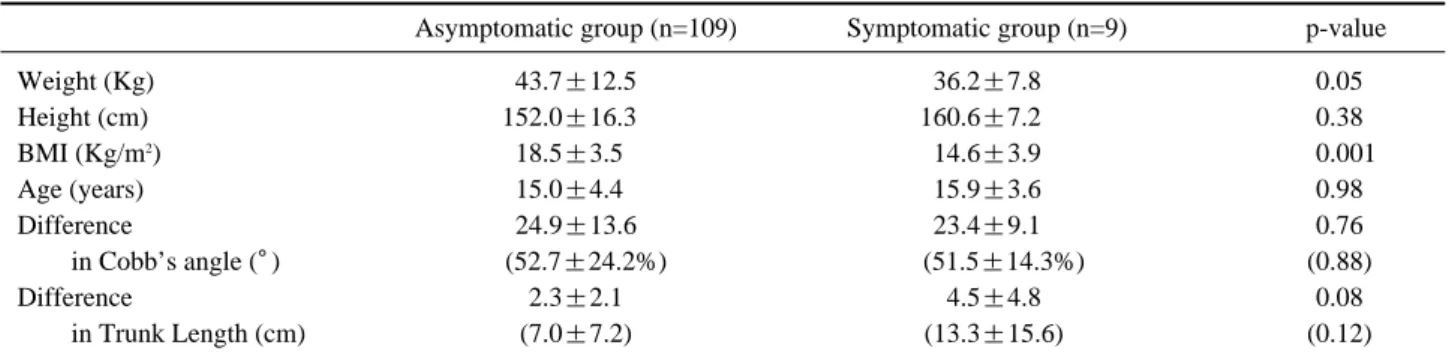
(AIS 1.3% and NMS 5.3%). However, with the inclusion of the 6 patients thought to have the disorder based on clinical symptoms, the incidence increased to 7.6% (AIS 5% and NMS 13.2%). The BMI for the asymptomatic and sympto- matic group were 18.5±3.5 (AIS 18.4±2.9, NMS 18.7±
4.3) and 14.6±3.9 (AIS 17.2±3.6, NMS 12.5±2.8), respectively, with a statistically significant difference
between the groups (Tables 2~4). NMS patients showed a more significant difference in their BMI values. Analysis of age-sensitive BMI percentile data showed that 32 patients (29.4%) were under the 5th percentile in the asymptomatic group and 6 patients (66.7%) were under the 5th percentile in the symptomatic group. The change in Cobb’s angle for the asymptomatic and symptomatic groups were 24.9±
13.6�(AIS 27.0±12.6�, NMS 21.8±14.6�) and 23.4±
9.1�(AIS 20.5±6.3�, NMS 25.8±11.0�), respectively, whereas the change in trunk length was 2.3±2.1 cm (AIS 1.9±1.5, NMS 2.9±2.7) for the asymptomatic group and 4.5±4.8 cm (AIS 0.8±0.3, NMS 7.0±5.1) for the sympto- matic group. There was no statistically significant differ- ence between the groups, although the change in trunk length for the symptomatic group was greater than that for the asymptomatic group. Of the confirmed SMA syndrome subjects, 2 showed improvement through conservative mea- sures, while 1 subject showed a resolution in symptoms fol- lowing a duodenojejunostomy (Fig. 3).
Discussion
Abdominal pain is a common complaint following cor- rectional operation for scoliosis. However, the majority of physicians do not pay proper attention to this symptom. The satisfaction that patients and guardians have regarding oper- ational success is based not only on the final surgical out- come, but also on the post-operative care they receive. Con- sequently, managing and treating abdominal pain following surgery is very important. The first task is to research and discover the cause of pain. Consequently, a comprehensive understanding of the incidence of the disorder is crucial, especially when the potential complications are life-threat- ening. The reported mortality rate in patients suffering from SMA syndrome is 33%14. The incidence of SMA syndrome is thought to be between 1% and 4.7%2,5,7,13.However, these numbers are based on patients confirmed to suffer from the disease. In this study, we considered both the confirmed patients and those with only clinical symptoms of SMA syndrome. The incidence turned out to be approximately 7.6%, with the rate of SMA syndrome in patients suffering from NMS being a striking 13.2%. It is also important to take into consideration the time when the disorder mani- fests. In this retrospective study, the subject pool was com- prised of subjects suffering from symptoms potentially caused by SMA syndrome, at 5 to 10 days post-operative.
Fig. 1. Trunk length measurement.
This mode of selection was based on previous studies show- ing that the symptoms from SMA syndrome manifest approximately 1 week post-operatively3,5,7. However, there have been dissenting views stating that symptoms can arise anywhere from 3 to 40 days post-operatively2,4,6. Though our subject selection was based on clinical symptoms and on a restrictive time period for the manifestation of the disorder, we showed that the incidence of SMA syndrome is more common than previously thought.
More attention is now being directed to SMA syndrome in patients undergoing correctional operations for scoliosis, because of the heightened susceptibility of these patients to the disorder3,6,11,12,15. The majority of scoliosis patients have a lighter body weight relative to their height4,6,7,16. This imbal-
ance of height to weight is exacerbated when these patients undergo a correctional operation that abruptly increases their trunk length and thus their height, or when they fail to receive adequate post-operative care, thereby resulting in weight loss.
The primary factor we analyzed was the BMI, which pro- vides us with a height-to-weight ratio that can be compared across individuals. Earlier studies have shown that when the age- and sex-matched weight of an individual is below the 25th percentile, the risk of SMA syndrome is greater4,6,7,13,16. Our study showed a significant difference in the BMI between asymptomatic and symptomatic persons. Even greater differences in BMI values were seen in NMS sub- jects. It is worth noting that the number of severely under- Fig. 2. A 14-year-old girl with adolescent idiopathic scoliosis. (A) Whole spine radiographs demonstrated a pre-operative Cobb angle of 30�and a trunk length of 45.4 cm. Post-operatively, the Cobb angle was 15�, and the trunk length was 43.6 cm. (B) The barium contrast study confirmed the presence of SMA syndrome. (C) An abdominal CT scan showed compression of the duodenum by the SMA.
B A
C
weight subjects whose BMI fell below the 5th percentile was 32 (29.4%) in the asymptomatic group and 6 (66.7%) in the symptomatic group. The age- and sex-matched BMI percentile seems to be more predictive of SMA syndrome risk than is the absolute BMI.
The correctional change in curvature angles in the sagittal and coronal planes also plays a role in SMA syndrome risk.
A greater angle of correction is accompanied by a greater increase in patient height. A previous study showed that the preoperative flexibility of the kyphosis angle, scoliosis angle, and the translation distance from the vertical center of the sacral line were important in predicting the occur- rence of SMA syndrome13. However, one drawback of the study was the limitation of the subject pool to patients with adolescent idiopathic scoliosis.
Postoperative ileus shows many of the same clinical symptoms as SMA syndrome, thus making the clinical dis-
tinction difficult. General anesthesia, analgesics, electrolytic imbalance, and greater splanchnic nerve injury are all potential causes of post-operative ileus, which manifests in patients approximately 1 day post-operatively, and resolves anywhere from 3 to 5 days thereafter. Recent studies have noted the incidence of ileus to be between 3.5% and
6.1%17,18. One of the greatest challenges in this study was to
distinguish between SMA syndrome and ileus. The three subjects confirmed to have SMA syndrome showed symp- toms at approximately one week post-operatively. However, a great number of patients showed similar symptoms around this period or immediately post-operatively. Of the total patient pool, 9 patients (6.3%) were confirmed to have post- operative ileus, but that number increased to 13 patients (9%) when those assumed to have the disorder were includ- ed. Constipation could also possibly be mistaken for SMA syndrome. We were unable to find previous elaboration on Fig. 3. A 14-year-old boy with NMS. (A) Whole spine
radiographs demonstrated a preoperative Cobb angle of 69.4�and a trunk length of 34.8 cm. Post-operative- ly, the Cobb angle was 54�, and the trunk length was 42.5 cm. (B) A duodenojejunostomy was performed due to the manifestation of SMA syndrome, as shown by this barium contrast study.
B A
this disorder. However, patients undergoing correctional operations for scoliosis are prone to develop both pre-opera- tive and post-operative constipation due to changes in envi- ronment and difficulty in movement. Teenage female patients and those with adolescent idiopathic scoliosis are particularly susceptible to constipation. Constipation- induced abdominal pain and distention were found in 12 patients (8.3%) in this study. The time period during which patients began to suffer from symptoms was broad, running anywhere from 3 days to 10 days. But, patients with consti- pation exhibited abdominal pain without nausea or vomit- ing. Abdominal complaints in these patients resolved after defecation.
Conclusions
The incidence of SMA syndrome may be greater than previously thought, especially in patients with NMS. Close attention and careful scrutiny and testing should be exer- cised in patients with abdominal pain following correctional operations for scoliosis. In patients with a BMI under the 5th percentile, rigorous pre- and post-operative nutritional care and attention are important.
REFERENCES
01. Rokitansky C: Handbuch der Pathologischen Anotomie.
Table 2. Statistical analysis of the entire subject pool according to the existence of symptom
Asymptomatic group (n=109) Symptomatic group (n=9) p-value
Weight (Kg) 43.7±12.5 36.2±7.8 0.051
Height (cm) 152.0±16.31 160.6±7.21 0.381
BMI (Kg/m2) 18.5±3.51 14.6±3.9 0.001
Age (years) 15.0±4.41 15.9±3.6 0.981
Difference 24.9±13.6 23.4±9.1 0.761
in Cobb’s angle (�) 1 (52.7±24.2%) 11 (51.5±14.3%) (0.88)1
Difference 2.3±2.1 14.5±4.8 0.081
in Trunk Length (cm) (7.0±7.2) 1(13.3±15.6) (0.12)1
Table 3. Analysis of adolescent idiopathic scoliosis patients according to symptom existence
Asymptomatic group (n=76) Symptomatic group (n=4) p-value
Weight (Kg) 47.8±10.5 40.1±8.8 0.261
Height (cm) 160.5±8.111 155.4±4.91 0.371
BMI (Kg/m2) 18.4±2.91 17.2±3.6 0.591
Age (years) 15.8±3.41 16.4±5.2 0.741
Difference 27.0±12.6 20.5±6.3 0.481
in Cobb’s angle (�) (60.5±20.7%) 11 (57.7±15.1%) (0.79)1
Difference 1.9±1.5 10.8±0.3 0.201
in Trunk Length (cm) 1(5.0±4.2%) 11 (2.9±2.2%) (0.43)1
Table 4. Analysis of neuromuscular scoliosis patients according to symptom existence
Asymptomatic group (n=33) Symptomatic group (n=5) p-value
Weight (Kg) 40.2±11.6 33.1±6.0 0.100
Height (cm)* 144.3±13.11 164.8±6.01 0.002
BMI (Kg/m2)* 18.6±3.81 12.5±2.8 0.002
Age (years) 14.4±5.31 15.4±1.2 0.730
Difference 19.9±11.8 125.8±11.0 0.340
in Cobb’s angle (�) 1 (40.7±24.2%) 11(51.2±19.5%) (0.37)0
Difference 2.9±2.7 17.0±5.1 0.130
in Trunk Length (cm) (11.2±9.5%) 11 (21.0±17.3%) (0.19)0
Vienna: Branmiller and Siedel, 1842.
02. Athanasios I, Tsirikos FRCS, Lindsay A Jeans: Superior mesenteric artery syndrome in children and adolescents with spine deformities undergoing corrective surgery. J Spinal Disord Tech 12005; 8: 263-271.
03. Crowther MA, Webb PJ, Eyre-Brook IA: Superior mesenteric artery syndrome following surgery for scoliosis.
Spine 2002; 27: E528-E533.
04. Kennedy RH, Cooper MJ: An unusually severe case of the cast syndrome. Postgrad Med 1983; 59: 539-540.
05. Roei Hod-Feins, Leonel Copeliovitch, Ibrahim Abu- Kishk, et al: Superior mesenteric artery syndrome after scoliosis repair surgery:a case study and reassessment of the syndrome’s pathogenesis.Journal of pediatric orthopaedics 2007; 16: 345-349.
06. Shah, Munir A, Albright, et al: Superior Mesenteric Artery Syndrome in Scoliosis Surgery: Weight Percentile for Height as an Indicator of Risk. Spine 2003; 23: 665- 668.
07. Zhu ZZ, Qiu Y: Superior mesenteric artery syndrome fol- lowing scoliosis surgery: its risk indications and treatment strategy. World J Gastroenterol 2005; 11: 3307-3310.
08. Bunch W, Delaney J: Scoliosis and acute vascular com- pression of the duodenum. Surgery 1970; 67: 901-906.
09. Stheneur C, Rey C, Pariente D, et al: Acute gastric dilatation with superior mesenteric artery syndrome in a young girl with anorexia nervosa. Arch Pediatr 1995; 2:
973-976.
10. Willet A: Fatal vomiting following application of plaster- of-Paris bandage in case of spinal curvature. St. Bartholomew’s
Hosp Rep 1878; 14: 333-335.
11. Hutchinson DT, Bassett GS: Superior mesenteric artery syndrome in pediatric orthopedic patients. Clin Ortho- pRelat Res 1990; 250: 250-257.
12. Vitale MG, Higgs GB, Liebling MS, Roth N, Roye DP Jr: Superior mesenteric artery syndrome after segmental instrumentation: a biomechanical analysis. Am J Orthop 1999; 8: 461-467.
13. Stuart V Braun, Douglas M, Hedden, Andrew W, Howard: Superior Mesenteric Artery Syndrome Following Spinal Deformity Correction. J Bone Joint Surg Am 2006;
88: 2252-2257.
14. Boseker EH, Moe JH, Winter RB, Koop SE: Determina- tion of “normal”thoracic kyphosis: a roentgenographic study of 121 “normal”children. J Pediatr Orthop 2000; 20:
796-798.
15. Willner S: A study of growth in girls with adolescent idio- pathic structural scoliosis. Clin Orthop 1974; 101: 129-135.
16. Munns SW, Morrissy RT, Golladay ES, Mckenzie CN:
Hyperalimentation for superior mesenteric artery (cast) syndrome following correction of spinal deformity. J Bone Joint Surg Am 984; 66: 1175-1177.
17. Grossfeld S, Winter RB, Lonstein JE, et al: Complica- tions of anterior spinal surgery in children. J Pediatr Orthop 1997; 17: 89-95.
18. Weis JC, Randal RR, Clements DH, et al: Prevalence of perioperative complications after anterior spinal fusion for patients with idiopathic scoliosis. J Spinal Disord 1997; 10:
371-375.