Chapter 14 and 15 Polymer viscoelasticity
(Ref. John.D.Ferry, Viscoelastic Properties of polymers, John Wiley(1980))
• Hooke’s Law :
τ = Y є
the strain є is proportional to the stress τ, Y is Young’s modulus(tensile strength)
(a) tensile deformation
• tensile strain є =
0 0
l l l−
• tensile stress τ = A
f
• tensile modulus Y = ε τ
• tensile compliance D = τε
(b)
• shear deformation • shear strain γ = tanα =
dy dx
• shear stress σ = f/A • shear modulus G = σ / γ • shear compliance J = γ / σ
• a fluid surface at y : velocity : u =
dt dx
• a fluid surface at y + dy : velocity : u + du
• shear strain : γ = dy
dx(dimensionless)
• shear rate : γ• = dt
d ( γ) = dtd (
dydx ) = dyd (
dx ) = dt
dydu (time-1) - an alternate definition of the shear rate is the velocity gradient du/dy.
• shear stress : τ =
) (
) (
direction y
in A
direction x
in
F
length2
force
• viscosity : ≡ • γ η τ
◦ Relations between τ and γ• - Flow curves.
- Newton’s law : shear stress is linearly proportional to the shear rate, the proportionality constant being the viscosity η.
τ = ηγ• (η = dyne sec/cm2) Taking logarithm :
log τ = log η + log γ•
• τ = η
•n
γ
taking logarithm : log τ = log η + nlog γ•
(a) n = 1 (가장 간단한 경우) : Newtonian flow (η = constant) - for small molecules (ex : silicone polymer)
- the structure, the resistance to flow does not change with the intensity of shearing
(b) n < 1 : pseudoplastic flow (shear – thinning) η decreases with increase of γ• : η = f(γ•) (e.g.) polymer melts and solutions
- resistance to flow decreases with the intensity of shearing.
(c ) n > 1 : dilatant flow (shear – thickening) η increases with the increase of γ•
(e.g.) slurries, suspension(벌꿀)
- resistance to flow increases with the intensity of shearing
• Bingham plastic
((ex)emulsion (치약)
- three types of fluid (a) Newtonian fluid
(b) Non-newtonian fluid
flow t dila
ticflow pseudoplas
tan
-these two fluids, though shear dependent, are time independent ; 즉 일정한 (constant) shear rate나 stress가 maintain 하는 한, the same viscosity will be observed at equilibrium.
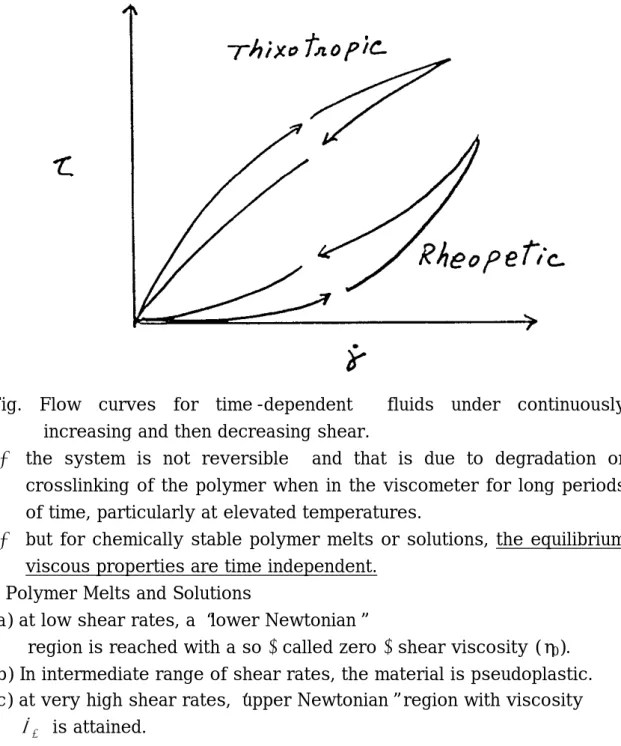
- Time dependent behavior : (a) Rheopetic
(b) Thixotropic
(a) Rheopetic fluid – when sheared at a constant rate or stress, the viscosity will increase over a period of time.
(e.g.) muds
(b) Thixotropic fluid – when sheared at a constant rate or stress, the viscosity will decrease over a period of time.
(e.g.) ketchup, paint
Fig. Flow curves for time-dependent fluids under continuously increasing and then decreasing shear.
- the system is not reversible and that is due to degradation or crosslinking of the polymer when in the viscometer for long periods of time, particularly at elevated temperatures.
- but for chemically stable polymer melts or solutions, the equilibrium viscous properties are time independent.
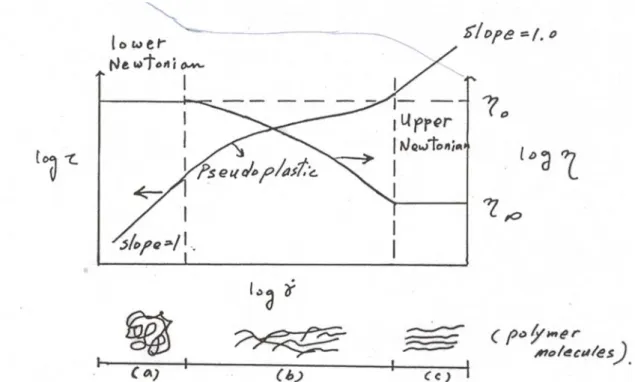
◦ Polymer Melts and Solutions
(a) at low shear rates, a “lower Newtonian”
region is reached with a so – called zero – shear viscosity (η0).
(b) In intermediate range of shear rates, the material is pseudoplastic.
(c) at very high shear rates, ‘upper Newtonian” region with viscosity η is attained. ∞
Fig. Generalized flow properties for polymer melts and solutions
(a) The molecules are in their most random and highly entangled state, and have their greatest resistance to slippage(flow).
(b) The molecules begin to unentangle and align in the shear field, reducing their resistance to flow.
(c) Pretty much completely untangled and aligned, and reach a state of minimum resistance to flow.Sometimes mechanical degradation.
ο Quantitative representation of flow behavior - for purely viscos non-Newtonian flow
τ =K(γ•)n (power law)
where K=consistency (depend on n) n=flow index
K(•)n
= γ
τ 에서 (γ•)n은 dimension으로 맞지 않으므로 보정:
•
• −
= γ
τ
γ
1 n
K
(K has the usual viscosity units)
when n=1: Newton’s law n<1: Pseudoplastic fluid n>1: Dilatant fluid
▪ Melt flow in screw extruder channel
10<γ•<102
▪ Melt flow in injection molding
102<γ•<103
▪ n값: PE 0.3~0.6 PP 0.3~0.4 PVC 0.2~0.5 Nylon 0.6~0.9
(ex) Determine the equation relating viscosity to shear rate for a power-law fluid.
(sol)
( ) ( )
1γ γ
γ γ
η τ = •
•
=
≡
−
•
•
n n
K K
ο Temperature dependence of flow properties
) , ( T f τ
η= or η =
f
/(γ,•T)▪ zero-shear viscisity, AeE/RT
0=
η
E=flow activation energy
▪ BeE/RT
0=
η
(τ :constant)▪ BeE/RT
0=
η
((γ•): constant)ο A more general expression for the variation of
η
0with temperature:log 51.6 ( )
) (
44 . 17 )
( ) (
0 0
g g
g T T
T T T
T
− +
− −
η η
=William-Landell-Ferry(WLF)equation
-good for a wide variety of polymers in the temperature range of Tg to Tg+100 CO
ο Influence of molecular weight on Flow Properties.
- by empirical equation
1 0∝(M− w)
η
for M− w< M− wc4 . 3 0∝(M− w)
η
for M− w> M− wcwhere M− wc is a critical molecular weight.
M− wc depends on the temp and polymer type, but most commercial polymers are well above M− wc.
M− wc ≈ 4000~50000(g/mole)
-entanglement가 시작되는 M.W.(500~600개의 carbon atom)
p.s = M− wc(40000)
Fig. The effect of molecular weight on viscosity.
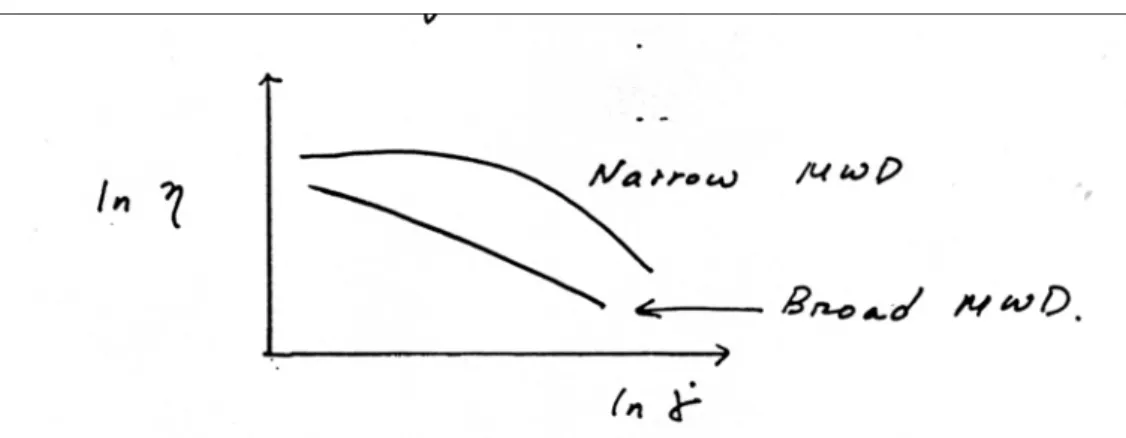
ο MWD(Molecular weight distribution)effects on η
Broad MWD 물성이 떨어진다.
ο chain braching effects on η.
Short branch - η. decrease
Longbranch - η. Increase(entanglement가 많아짐)