Vol. 20, No. 9 pp. 279-289, 2019
A Study on the Relationship among Attachment to Pet, Purchasing
Attributes of Pet Products, Satisfaction, and Behavioral Intention
Eun-Ok Park1, Jae-Ik Shin1*, Min-Yeong Park2
1Dep. of Distribution, Gyeongnam National University of Science and Technology
2Dep. of Industrial Management, Gyeongsang National University
반려동물에 대한 애착도와 반려동물용품의 구매속성, 만족 및
행동의도와의 관계에 관한 연구
박은옥1, 신재익1*, 박민영2
1경남과학기술대학교 유통학과, 2경상대학교 산업경영학과
Abstract This study is conducted to provide marketing implications for the growing pet-related market by identifying the impact of attachment to pets on the purchasing attributes of pet goods and the relationship between the purchasing attributes, satisfaction, and behavioral intention.The survey was conducted on 173 respondents among the pet owners who had purchased pet products (beauty/bathing goods). The confirmatory factor analysis and path analysis were conducted using SPSS 22.0 and AMOS 21.0. This analysis results showed that attachment to a pet significantly influences the purchasing attributes of pet products: price appropriateness, quality, design, reputation and the sales environment.
The relationship between the product purchasing attributes, satisfaction, and behavioral intention showed that price appropriateness, quality, and the sales environment of the product purchasing attributes had a significant impact on satisfaction, but the product's design and reputation do not.
Satisfaction has a significant effect on behavioral intention. This study demonstrates that the pet product market should consider product quality, price appropriateness, use and an accessible sales environment based on the characteristics of pets rather than considering the design or reputation of the owner's preference of product.
요 약 2018년 연간 애완용품의 온라인쇼핑 거래액은 8,223억 원으로 4% 증가년 전과 비교하여 4배 이상 급증하였고, 반려동물과 관련된 지출액 중 반려동물 관련 패션잡화, 내구재 등에 대한 지출규모가 증가하고 있어 반려동물 용품시장 은 성장세를 이어갈 것으로 보고 있다. 이러한 추세에 따라서 본 연구는 반려동물에 대한 애착도가 반려동물 용품 구매속 성에 미치는 영향과 구매속성과 만족, 행동의도간의 영향관계를 확인함으로써 성장하는 반려동물 관련 시장에 마케팅적 시사점을 제공하고자 실시하였다. 반려동물을 키우고 있는 사람들 중 반려동물 용품(미용/목욕 용품)을 구매해 본 적이 있는 173명의 응답자를 대상으로 설문조사를 실시하여 SPSS 22.0과 AMOS 21.0을 이용하여 확인요인분석과 경로분석 을 실시하였다. 분석 결과, 반려동물에 대한 애착도는 반려동물 용품 구매속성인 가격적절성, 품질, 디자인, 평판, 판매환 경에 유의한 영향을 미치는 것으로 나타났다. 구매속성과 만족, 행동의도간의 관계에서는 구매속성 중 가격적절성, 품질, 판매환경은 만족에 유의한 영향을 미치나 디자인과 평판은 영향을 미치지 않는 것으로 나타났다. 만족은 행동의도에 유 의한 영향을 미치고 있다. 이러한 연구결과를 통해 반려동물 용품 시장에서는 주인의 선호도에 따른 디자인이나 평판보 다는 반려동물의 특성에 따른 제품품질과 가격적절성, 이용 및 접근이 용이한 판매환경을 고려해야 함을 알 수 있다.
Keywords : Pet, Attachment, Purchasing Attributes of Pet Products, Satisfaction, Behavioral Intention
*Corresponding Author : Jae-Ik Shin(Gyeongnam National Univ. of Science and Technology) email: [email protected]
Received June 26, 2019 Revised July 26, 2019 Accepted September 6, 2019 Published September 30, 2019
1. Introduction
In 2017, 29.4 percent of the nation's 15.92 million households are estimated to have 6.32 million dogs and 4.73 million cats. The number of pets is increasing from 17.4 percent in 2010 to 21.8 percent in 2015 and 29.2 percent in 2017[1].
In 2014 the size of the pet-related industry was 1,568.4 billion won. The feed industry was 484.1 billion won, pet and related goods industry was 384.9 billion won, veterinary service industry was 655.1 billion won, burial and protection service was 33.8 billion won, and insurance was 600 million won[1]. In addition, online pet shopping volume of 828.3 billion won in 2018 increased by 18.5 percent from the previous year and surged more than four times compared with four years ago[2].
The spending on pet products related to fashion accessories and durable goods is more than monthly average of 120,000 won per household, and the goods market is expected to continue growing due to the increase in the prices of goods and the purchase of premium products[3].
With the increase of pet pampers, which regard pets as family members, the pet related market is getting bigger and more segmentation.
Domestic large discount marts operate various pet items corner including cage, dog scrub supplies and snacks, dog joint nutrition, and dog beauty products. Not only are products with various functions such as automatic feeding machines with IT technology for pets, and location tracking devices for pets, but the service sector including pet cafes, pet taxis, and puppy funeral services are gradually becoming more advanced[4-5]. Along with the aging of pets, related products and services have also been diversified and have evolved from financial products to hotel accommodations and herbal services. In recent years, there have been steadily increasing sales of unique dog products such as
dog beer, samgyetang, duck meat soup, bath salts, moisturizers, and masks[6].
In this study, we investigate the purchasing characteristics of pet goods, which are necessities but luxuries for the family who owns the animals. The difference in the degree of attachment can depend on the purpose of raising pets. Thus, the purpose of this study is to propose the marketing implications of the pet goods market in the future by identifying the relationship between attachment to pet, product selection attributes, satisfaction, and behavioral intentions.
2. Previous Study and Hypothesis
2.1 AttachmentThe term "companion animal" can be regarded as a concept that identifies a pet as a companion, a family, a friend, or a lover who has given meaning to "spend the rest together"[7]. In other words, many animals in the family today are not a means of providing humans with pleasure only as toys, but rather being a part of the family and living together with[8].
Humans can get many beneficial responses from animals[9]. Pets have positive effects on human body, psychology, and emotion. They promotes human sociality through the relationship between people and their pets. In addition, many studies showed that by caring for pets, the ability to look at others' emotions and to control one’s emotions are also beneficial[10].
In Bae's(2016) study of the effect of attachment to pets on adolescent emotions, the higher the degree of attachment with the companion animals, the higher the psychological well-being of adolescents and the less loneliness[10].
Attachment theory of Sable(1995) showed that loneliness and stress are reduced by attachment to companion animals[11]. Kwon et al.(2015) suggested that attachment to pets positively
affects children's emotions[12].
Attachment is related to consumers' emotions, unlike satisfaction and involvement, etc.
Consumers are willing to pay a premium price for a particular product or lose it, which is an important concept for content and digital device manufacturers[13-14]. The following hypotheses are set to identify the effect of attachment to pets on the purchase attribute of their goods.
H1: Attachment to pets will have a significant impact on the purchase attribute of their goods.
H1-1: Attachment to pets will have a significant impact on price appropriateness.
H1-2: Attachment to pets will have a significant impact on quality.
H1-3: Attachment to pets will have a significant impact on design.
H1-4: Attachment to pets will have a significant impact on reputation.
H1-5: Attachment to pets will have a significant impact on sales environment.
2.2 Purchase Attribute
The study of Choo et al.(2016) on flower shop showed that store attributes such as price, freshness, diversity, professionalism, kindness, location, and store atmosphere have a significant effect on store satisfaction[15]. Seong(2008) suggested that a price is an external attribute of products and plays a very important role in consumer's purchase decision[16].
The price perceived by consumers acts as an important clue to the purchase of products. The high price plays a role in delaying or abandoning the purchase decision of consumers and also negatively affects the store satisfaction[17].
Levy and Weitz(1998) argued that salespeople are engaged in face-to-face interaction with consumers in stores, so that the service provided by salespeople(expertise and kindness of information provided) plays an important role in
store satisfaction, profit, and shopping satisfaction[18]. Yoo et al.(1998) examined the effect of store location, traffic location, and parking space, etc. on store brand and suggested that these constructs positively/negatively affect store satisfaction and attitude[19].
A store atmosphere is created by its design or physical environment and causes a psychological utility or feeling and affects the overall value provided by the retailer. The store atmosphere is stronger in terms of image appeal to consumers 'emotional response, which can enhance consumers' purchasing and loyalty[20].
In this study, the following hypotheses are presented to confirm the relationship between purchase attributes and satisfaction of pet products.
H2: Purchase attribute of pet products will have a significant impact on satisfaction.
H2-1: Price appropriateness will have a significant impact on satisfaction.
H2-2: Quality will have a significant impact on satisfaction.
H2-3: Design will have a significant impact on satisfaction.
H2-4: Reputation will have a significant impact on satisfaction.
H2-5: Sales environment will have a significant impact on satisfaction.
2.3 Satisfaction
Hoffman et al.(2006) regarded satisfaction as a very important factor from the perspective of marketing and suggested that as a result of determining whether the performance of expectations is consistent with or inconsistent, it is said to have a customer retention and word of mouth effect if satisfied[21]. Lee and Cunningham(2001) argued that satisfaction reduces customer acquisition costs and the maintenance costs for repurchase, and increases the costs of a rival company and the profitability
Attachment
Price appropriateness
Quality Design
Reputation
Sales environment
Satisfaction Behavior
intention H1-1
H1-2 H1-3
H1-4 H1-5
H2-1
H2-2
H2-3 H2-4 H2-5
H3
Fig. 1. Research Model of one’s own company[22].
The following hypothesis is presented to identify the relationship between satisfaction with pet products and their behaviour.
H3: Satisfaction with pet products will have a significant effect on behavioral intention.
2.4 Behavioral Intention
The degree of satisfaction and dissatisfaction that consumers feel after purchasing affects their future purchase behavior. If consumers feel satisfied, they are more likely to buy the same product again in the future, and try to tell others only the advantages of the product they have purchased[23-24]. A study of Kim and Choi(2014) on basic cosmetics showed that customer satisfaction has a positive effect on repurchase intention[25], and a study by Kim(2014) confirmed that customer satisfaction has a significant effect on customer behavior intention[26]. Son's(2015) study of fast-food restaurants also showed that customer satisfaction has a significant impact on purchasing behavior, while Hwang's(2013) study of agricultural online shopping showed that satisfaction has a significant effect on revisit intention and positive word of mouth[24,27].
3. Research Model and Analysis
Method
3.1 Research Model
This study presents a research model as shown in Fig. 1. in order to identify purchasing attributes(price appropriateness, quality, design, reputation, and sales environment) according to attachment to pets, and to examine the relationship between purchasing attributes, satisfaction, and behavioral intention of pet goods.
3.2 Analysis Method 3.2.1 Research Method
To test the hypothesis of this study, a survey was conducted for 40 days from 18 February to 29 March 2019 on customers who had experience in raising pets and purchasing their goods(limited to beauty/bathing goods). A total of 180 questionnaires were collected and 173 were analyzed, excluding the insincere 7 questionnaires. Confirmatory factor, correlation, reliability, and path analyses were performed using SPSS 22.0 and AMOS 21.0.
Item Classification Frequency Percent Item Classification Frequency Percent
Pet Type
Dog 108 62.4
Gender Male 62 35.8
Cat 18 10.4 Female 111 64.2
Both 32 18.5
Number of Use
More than three
times a week 8 4.6
Etc. 15 8.7
A Store for Purchase
Online Specialty store 35 20.2 1 to 2 times a
week 19 11
Offline Specialty store 73 42.2
More than once
a fortnight 48 27.7
Offline general stores such as large discount stores, convenience
stores, etc.
34 19.7
More than once a
month 72 41.6
Various online
markets 26 15 More than once
every six months 26 15
Etc. 5 2.9
Table 2. Characteristics of Sample
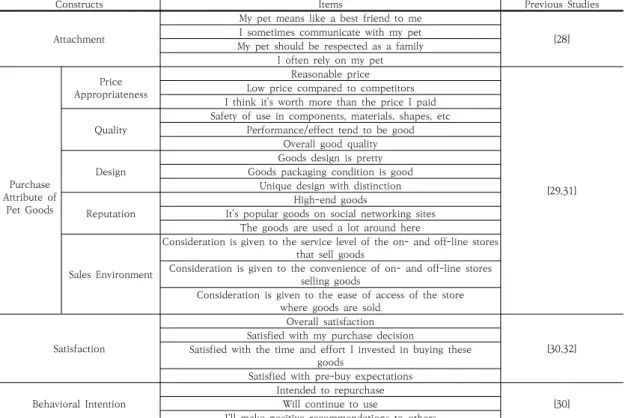
Constructs Items Previous Studies
Attachment
My pet means like a best friend to me
[28]
I sometimes communicate with my pet My pet should be respected as a family
I often rely on my pet
Purchase Attribute of
Pet Goods
Price Appropriateness
Reasonable price
[29,31]
Low price compared to competitors I think it's worth more than the price I paid Quality Safety of use in components, materials, shapes, etc
Performance/effect tend to be good Overall good quality
Design Goods design is pretty
Goods packaging condition is good Unique design with distinction
Reputation High-end goods
It's popular goods on social networking sites The goods are used a lot around here
Sales Environment
Consideration is given to the service level of the on- and off-line stores that sell goods
Consideration is given to the convenience of on- and off-line stores selling goods
Consideration is given to the ease of access of the store where goods are sold
Satisfaction
Overall satisfaction
[30,32]
Satisfied with my purchase decision
Satisfied with the time and effort I invested in buying these goods
Satisfied with pre-buy expectations
Behavioral Intention Intended to repurchase
[30]
Will continue to use
I'll make positive recommendations to others Table 1. Measurement Items of the Constructs
3.2.2 Operational Definition of Variable The variable’s measurement items used for empirical analysis of the research model and hypotheses are presented in Table 1.
4. Empirical Analysis
4.1 Characteristics of SampleFactor Item Standardized
Coefficient S.E. CR Cronbach’s α CompositeReliability AVE Attachment
att1 0.648
0.755 0.769 0.457
att2 0.758 0.238 7.401
att3 0.712 0.158 7.161
att4 0.571 0.190 6.171
Price Appropriateness
pri1 0.706
0.697 0.803 0.577
pri2 0.764 0.117 8.386
pri3 0.805 0.132 8.576
Quality qua1 0.691
0.824 0.841 0.641
qua2 0.866 0.125 10.567
qua3 0.834 0.120 10.293
Design des1 0.745
0.610 0.784 0.552
des2 0.859 0.101 7.447
des3 0.603 0.087 9.058
Reputation rep1 0.729
0.821 0.824 0.610
rep2 0.761 0.116 9.240
rep3 0.848 0.108 9.792
Sales Environment env1 0.781
0.812 0.822 0.608
env2 0.870 0.105 10.739
env3 0.677 0.095 9.075
Satisfaction
sat1 0.724
0.868 0.847 0.580
sat2 0.795 0.110 10.604
sat3 0.736 0.120 9.544
sat4 0.789 0.113 10.338
Behavioral Intention
heh1 0.891
0.855 0.858 0.670
beh2 0.855 0.075 14.290
beh3 0.696 0.070 10.957
x2(df)=444.016(260), p=0.000, CMIN/DF=1.708 GFI=0.849, IFI=0.925, TLI=0.904, CFI=0.923, RMSEA=0.064 Table 3. Confirmatory Factor Analysis
1 2 3 4 5 6 7 8
Attachment 1
Price Appropriateness 0.379** 1
Quality 0.335** 0.355** 1
Design 0.121 0.253** 0.336** 1
Reputation 0.119 0.080 0.323** 0.476** 1
Sales Environment 0.187* 0.205** 0.430** 0.413** 0.453** 1
Satisfaction 0.368** 0.423** 0.565** 0.402** 0.246** 0.416** 1
Behavioral Intention 0.251** 0.433** 0.505** 0.285** 0.101 0.268** 0.733** 1
Table 4. Correlation Analysis
4.2 Validity and Reliability Testing
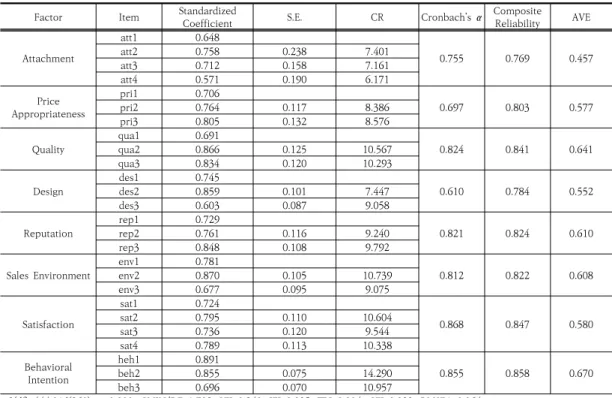
Reliability and validity tests were conducted to ensure that the concepts of each variable are being measured correctly. The reliability analysis using Cronbach's α value was conducted to confirm the internal consistency of each variable, and the reliability of the scale was confirmed as the alpha value was higher than 0.6. The results of confirmatory factor analysis to review the convergent and discriminant validity of scales for
the constructs used in this study showed that the composite reliability and AVE(average variance estimate) values of most factors are 0.7 and 0.5 and lower than some of the criteria, but the scales used in this study have representative.
4.3 Hypothesis Testing
In this study, a path analysis was conducted using a structural equation model to examine the relationship between attachment to pets,
Attachment
Price appropriateness
Quality Design
Reputation Sales environment
Satisfaction Behavior
intention 0.502**
0.487**
0.152 0.197*
0.349**
0.345**
0.511**
0.189*
-0.038 0.097
0.830**
Fig. 2. Path Model
Hypothesis Path Standardized
Coefficient S.E. t value p value Result
H1-1 Attachment→Price
Appropriateness 0.502 0.134 4.660** 0.000 Supported
H1-2 Attachment→Quality 0.487 0.151 4.911** 0.000 Supported
H1-3 Attachment→Design 0.152 0.143 1.589 0.112 Rejected
H1-4 Attachment→Reputation 0.197 0.199 2.123* 0.034 Supported
H1-5 Attachment→
Sales Environment 0.349 0.187 3.621** 0.000 Supported
H2-1 Price Appropriateness→
Satisfaction 0.345 0.091 4.196** 0.000 Supported
H2-2 Quality→Satisfaction 0.511 0.078 5.933* 0.000 Supported
H2-3 Design→Satisfaction 0.189 0.076 2.306* 0.021 Supported
H2-4 Reputation→Satisfaction -0.038 0.051 -0.471 0.637 Rejected
H2-5 Sales Environment→
Satisfaction 0.097 0.051 1.363 0.173 Rejected
H3 Satisfaction→
Behavioral Intention 0.830 0.119 9.618** 0.000 Supported
x2(df)=472.441(270), p=0.000, CMIN/DF=1.750, GFI=0.838, IFI=0.917, TLI=0.898, CFI=0.917, RMSEA=0.066; *:p<0.05, **:p<0.01 Table 5. Hypothesis Testing
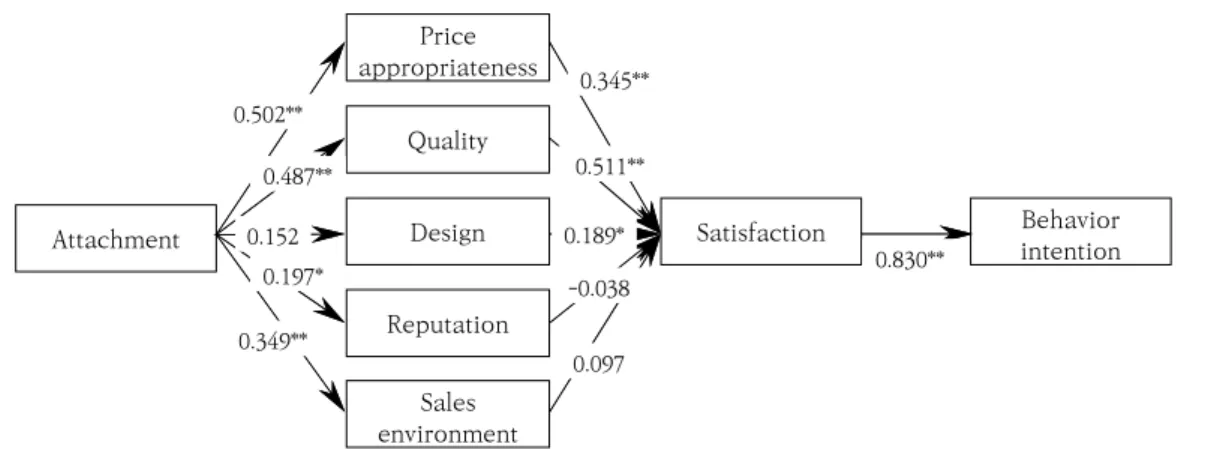
purchase attributes, satisfaction, and behavioral intention of pet goods. The results of the path analysis are presented in Fig. 2. and Table 5.
The effect of attachment to pet on price appropriateness of pet goods(H1-1) was supported at a significant level of 0.01(β=0.502 and t value=4.660). The effect of attachment to pet on quality of pet goods(H1-2) was supported at a significant level of 0.01(β=0.487 and t value=4.911). The effect of attachment to pet on design of pet goods(H1-3) was not supported at a significant level of 0.05(β=0.152 and t value=1.589). The effect of attachment to pet on
reputation of pet goods(H1-4) was supported at a significant level of 0.05(β=0.197 and t value=2.123). The effect of attachment to pet on sales environment of pet goods(H1-5) was supported at a significant level of 0.01(β=0.349 and t value=3.621). The greater attachment to pets, it was confirmed that price, quality, reputation, and sales environment were considered in the purchase of pet goods.
The effect of price appropriateness of pet goods on satisfaction(H2-1) was supported at a significant of 0.01(β=0.345 and t value=4.196).
The effect of quality of pet goods on
satisfaction(H2-2) was supported at a significant of 0.01(β=0.511 and t value=5.933). The effect of design of pet goods on satisfaction(H2-3) was supported at a significant of 0.05(β=0.189 and t value=2.306). The effect of reputation of pet goods on satisfaction(H2-4) was not supported at a significant of 0.05(β=-0.038 and t value=-0.471). The effect of sales environment of pet goods on satisfaction(H2-5) was not supported at a significant of 0.05(β=0.097 and t value=1.363). This shows that quality is the most important factor in the purchase of pet goods, and price appropriateness and design follow.
The effect of satisfaction with purchase attributes on behavioral intention was supported at a significant of 0.01(β=0.830 and t value=9.618). The more satisfied you are with various attributes of pet goods, the more likely they are to be purchased.
5. Conclusions
5.1 DiscussionThe results of this study are as follows, confirming the relationship between attachment to pets, purchasing attributes, satisfaction, and behavioral intention of companion animal goods.
First, attachment to pets has a significant effect on the purchasing attributes of companion animal products: price appropriateness, quality, reputation, and sales environment. The greater attachment to pets, the more cautious they become in purchasing companion animal goods and take into account various factors, especially quality and price appropriateness of the products. When a companion animal is considered to be like a member of a family or a friend, it can be purchased after considering quality of pet goods, such as safety, raw materials, and ingredients, due to health concerns. Consumers also prefer pet goods that are used a lot around them and have a good
reputation for other users, such as SNS.
Attachment to pets does not significantly affect the animal product design. Officials at the Abandoned Animal Protection Center, which values animals as a living organism and put on pretty clothes or dye them, being thought that such acts as wearing incense could be more animal abuse. If the product is not intended to eliminate inconveniences for the health of pets, but for the personal tastes and aesthetic desires of owners, it can be harmful to companion animals and is viewed negatively. For respondents who protect and adopt abandoned pets, the attachment has no further effect on design.
Second, among the purchasing attributes of pet goods, price appropriateness, quality, and design have a significant impact on satisfaction, but reputation and the sales environment do not significantly affect. The factor most considered in the purchase of beauty/bath goods of pets is the overall excellent quality including the product's composition, safety, performance, or effectiveness.
Also, price appropriateness, such as whether or not purchase benefits, value over price paid, and rationality, affects purchase satisfaction, and the products of unique design, which is fashionable or differentiated, also impacts satisfaction.
The reputation of social networking sites and people around them has no impact on satisfaction. According to consumers' personal tastes, they will use other products if they are reluctant or uncomfortable with their use.
Therefore, with the exception of new purchases, the reputation of neighborhood may not be taken into account much because the product is constantly used by individuals' pets.
The sales environment has also no significant impact on satisfaction. Most pet stores are located in large, convenient locations such as parking, or in the form of shop-in-shop in large retail stores, and thus may not be considered for
use or access. In addition, the service and ease of use and access to online purchases are basically satisfied, so they do not appear to be important.
Third, satisfaction with pet products has a significant effect on behavioral intention. This is consistent with the results of previous studies such as Hoffman et al.(2013), Kim and Choi(2014), and Kim et al.(2009), suggested that customers will buy and continue to use products they are satisfied with or positively recommend to others[24-25,31].
5.2 Management Implications
Through this study, we intend to present management implications as follows.
First, the greater attachment to pets, the more interested the purchase attributes of companion animal goods. Since pets and owners are generally attached, all customers will consider different purchase attributes when purchasing the products. Therefore, pet product marketers will have to consider a variety of purchasing attributes, including quality, price appropriateness, reputation, and sales environment of the product.
In this study, the impact relationship was identified by presenting quality, design, reputation, price appropriateness, and sales environment of companion animal goods as purchasing attributes, but the other attributes may also affect attachment to pets, so further study will be required.
Second, in the initial purchase of pet products, the product design will be selected according to the taste and preference of the owner or affected by the evaluation and promotion marketing of the people around consumers and social network sites. While these products may not be a problem if they are not uncomfortable or reluctant to use them, consumers will find and use other products suitable for them if bath products have side effects due to their scent, touch, sensitivity to ingredients, etc, or if pets have negative reactions to beauty products such as brushes or barbers. In other words, customers who have
already used a variety of pet products will continue to purchase the products that meet their pets' preferences, not their design or reputation. Therefore, marketers will have to prioritize pet goods that take into account the performance and effectiveness of them and reasonable price policies rather than various designs.
This study was conducted to provide implications for realistic qualitative improvements rather than simple market expansion at a time when pet-related markets are growing and diversifying.
Researches have only been conducted on some of the pet-related markets, but further studies of other related goods and services are also considered necessary.
References
[1] I. Ji, H. Kim, W. Kim, G. Seo, “Development Strategies for the Companion Animal Industry,” Korea Rural Economic Institute Report, pp. 1-231, 2017.
DOI:
http://www.dbpia.co.kr/journal/articleDetail?nodeId=
NODE07368359
[2] Statistics Korea, Household survey, Online Shopping Mall Operation Type/Trade Amount by Product Group, http://kosis.kr, 2019.
[3] W. Hwang, G. Jeong, D. Kim, “2018 Pet Report - The Status And Child Care Status of the Pets-Related Industry,” KB Financial holding Management Research Institute, 2018.
DOI:
http://www.dbpia.co.kr/journal/articleDetail?nodeId=
NODE07368359
[4] Newsfreezon, DYU Company, Which Specializes in ICU, Has Released a New Concept of Next-Generation Pet Care Service for Pets And Received Attention, 2019. 4.
19.,
http://www.newsfreezone.co.kr/news/articleView.html
?idxno=108387, 2019. 4. 23.
[5] K. Jin, B. Chung, “Development of Unit Furniture Design for Dogs,” The Journal of Art & Design, Vol.
18, No. 3, pp. 29-46, 2015.
[6] Yeonhapnews, Beer, Samgyetang, Moisturizer.
Popularity of Pet Exotic Products, 2019. 4. 16., https://www.yna.co.kr/view/AKR20190415120100030?
input=1195m, 2019. 4. 23.
[7] H. Lee, B. Park, “Pet,” Seoul, KNOU Press, 2004.
[8] S. Lee, “The Meanings of Pets from the Prospect of Social Science in the Modern Korean Society,”
Department of Sociology, Graduated School, Pusan National University, 2009.
[9] O. Kim, “Petology,” Seoul, Dongil Press, 2012.
[10] S. Bae, “The Effect of Attachment and Pet Loss on Emotion of Adolescents by Caring Experience with Companion Animals,” Educational Counseling Department of Education, Graduate School of Kang-Nam University, 2016.
[11] P. Sable, “Pets, Attachment, And Well-Being across the Life Cycle,” Social work, Vol. 40, No. 3, pp. 334-341, 1995.
DOI: https://doi.org/10.1093/sw/40.3.334
[12] H. Kwon, “A Study on the Effect of the Education of Companion Animals on Children's Emotion in the Society of U-City : Targeting on the Elementary School,” Journal of Industrial Convergence, Vol. 13, No. 1, pp. 49-62, 2015.
DOI: http://php36.g2inet.kr/paper_file/13_1_5.pdf [13] Y.-K. Son, K.-G. Yoon, “The Effects of User
Satisfaction By Types of Brand Experience on Brand Attachment and Repurchase Intention,” Korean Business Review, Vol. 43, No. 5, pp. 1595-1626, 2014.
DOI:
http://www.dbpia.co.kr/journal/articleDetail?nodeId=
NODE06156158
[14] Y.-B. Kim, J. B. Kim, S.-H. Lee, “Digital Pen Effects on the Product Attachment and Retention Intent for Smartphone Consumer,” Journal of Consumer Studies, Vol. 26, No. 6, pp. 77-99, 2015.
DOI:
http://www.papersearch.net/thesis/article.asp?key=33 95358
[15] Y.-H. Choo, J.-H. Hong, H.-J. Lee, “A Study on the Effect of Flower Shops’ Store Attributes on the Store Loyalty : Focused on the Moderating Effect of Shopping Motivation and Purchasing Situation,” Journal of Product Research, Vol. 34, pp. 111-126, 2016.
DOI:
http://scholar.dkyobobook.co.kr/searchDetail.laf?barc ode=4010024861402#
[16] H.-W. Seong, “Effects of Price Perception and Store Attributes on Fashion-Related Store Choice Behavior-Focused on Department Store, Discount Store, and Internet Shopping Mall,” Journal of the Korean Society of Clothing and Textiles, Vol. 32, No.
8, pp. 1274-1285, 2008.
DOI: http://210.101.116.28/W_files/ksi3/02803108_pv.pdf [17] D. R. Lichtenstein, N. M. Ridgway, R. G. Netemeyer,
“Price Perceptions And Consumer Shopping Behavior:
A Field Study,” Journal of Marketing Research, pp.
234-245, 1993.
DOI: https://journals.sagepub.com/doi/abs/10.1177/
002224379303000208
[18] M. Levy, B. Weitz, “Retailing Management. 3rd Ed.,”
New York: Mcgraw-Hill, 1998.
[19] C. Yoo, J. Park,, D. J. Macinnis., “Effects of Store Characteristics And In-Store Emotional Experiences On Store Attitude,” Journal of Business Research, Vol.
42, No. 3, pp. 253-263, 1998.
DOI:
https://www.sciencedirect.com/science/article/abs/pii /S0148296397001227
[20] R. J. Donovan, J. R. Rossiter, “Store Atmosphere: An Environmental Psychology Approach,” Journal of Retailing, Vol. 58, No. 1, pp. 34-57, 1982.
DOI:
https://www.researchgate.net/profile/Robert_Donova n/publication/248766608_Store_Atmosphere_An_Envi ronmental_Psychology_Approach/links/5a38c3ef0f7e9 b7c48700249/Store-Atmosphere-An-Environmental-P sychology-Approach.pdf
[21] K. D. Hoffman, J. Bateson, “Service Marketing:
Concepts, Strategies and Cases,” Ohio, Thomson/South-Western, 2006.
[22] M. Lee, L. F. Cunningham, “A Cost/Benefit Approach to Understanding Service Loyalty,” Journal of Services Marketing, Vol. 15, No. 2, pp. 113-130, 2001.
DOI:
https://www.emerald.com/insight/content/doi/10.110 8/08876040110387917/full/html
[23] T. L. Chillder, A. R. Rao, “The Influences of Familial And Peer-Based Reference Groups on Consumer Decisions,” Journal of Consumer Research, Vol. 19, No. 9, pp. 198-211, 1992.
DOI:
https://academic.oup.com/jcr/article-abstract/19/2/1 98/1929871
[24] Y.-C. Hwang, “A Study on Influencing Factors of Consumer Satisfaction, and Behavior after Purchase in Online Shopping for Agricultural Products,” Journal of Marketing Studies, Vol. 21, No. 2, pp. 59-71, 2013.
DOI: https://www.earticle.net/Article/A201051 [25] S.-O. Kim, K-I. Choi, “Influence of the Service Quality
Determining Factors upon the Satisfactions and Repurchase Intention in the Skin Care Cosmetics,”
Journal of the Korean Society of cosmetology, Vol. 20, No. 6, pp. 1122-1129, 2014.
DOI: http://210.101.116.28/W_files/kiss6/45801815_pv.pdf [26] S.-J. Kim, “A Study on the Chinese Tourist's Customer
Satisfaction and Behavior Intention for Korea Cosmetics Market,” Korean Management Consulting Review, Vol. 14, No. 4, pp. 109-122, 2014.
DOI: https://www.earticle.net/Article/A236718 [27] B.-M. Son, “A Study on the Influence of Fast Food
Restaurant Brand Image on Customer Satisfaction and Purchase Behavior,” Journal of MICE & Tourism Research, Vol. 42, pp. 93-110, 2015.
DOI:
http://www.papersearch.net/thesis/article.asp?key=34 06756
[28] H.-S. Kim, “The Relationship Between Parental Child-rearing Attitude, Attachment Stability and Their Emotional Intelligence,” Korean Journal of Child Education and Care, Vol. 4, No. 2, pp. 113-127, 2004.
DOI:
http://www.dbpia.co.kr/journal/articleDetail?nodeId=
NODE07450762
[29] H.-D. Choi, “The Effects of Selection Attributes on Repurchase And Viral Intentions in Korean Rice Cake Franchise,” Journal of the Table & Food Coordinate, Vol. 11, pp. 73-89, 2016.
DOI:
http://scholar.dkyobobook.co.kr/searchDetail.laf?barc ode=4010025041537#
[30] G.-J. Kim, L. Feng, D.-J. Kim, “An Analysis on Korean-style Restaurant Selection Attributes in China,” Journal of Foodservice Management, Vol. 12, pp. 245-265, 2009.
DOI:
http://scholar.dkyobobook.co.kr/searchDetail.laf?barc ode=4010024030484
[31] J.-H. Yoon, “The Influence of Shopping Orientation on Duty-Free Attributes and Purchasing Intention in Chinese Tourists,” Northeast Asia Tourism Research, Vol. 12, No. 4, pp. 43-62, 2016.
DOI: https://www.earticle.net/Article/A288749 [32] D.-W. Koo, S.-M. Lee, I-H. Kim, “The Impact of Brand
Identification of a Coffee Shop Customer on Involvement, Customer Satisfaction, And Brand loyalty,”
Korea Customer Satisfaction Management Review, Vol. 17, No. 1, pp. 67-87, 2015.
DOI:
http://www.papersearch.net/thesis/article.asp?key=33 19598
Eun-Ok Park [Regular member]
• Feb. 2010 : Gyeongsang national Uni. graduate school Department of Business Administration(master)
• Feb. 2014: Gyeongsang national Uni. graduate school Department of Business Administration(doctor)
• Sep. 2010,~June. 2019: Gyeongsang national Uni., Gyeongnam National Uni. of Science and Technology instructor
<Research Interests>
Marketing, Distribution
Jae-Ik Shin [Regular member]
• Feb. 2000: Busan University.
graduate school Department of Business Administration(master)
• Aug. 2005: Gyeongsang national Uni. graduate school Department of Business Administration (doctor)
• Sep. 2015~present: Gyeongnam National Uni. of Science and Technology professor
<Research Interests>
Distribution channel, Marketing, Internet Marketing, Service Marketing, CSR
Min-Yeong Park [Regular member]
• Feb. 2008 : Gyeongsang national Uni. graduate school Department of Business Administration(master)
• Feb. 2012: Gyeongsang national Uni. graduate school Department of Business Administration(doctor)
• Sep. 2008.~present: Gyeongsang national Uni., Jinju Health college, Korea International University
<Research Interests>
Marketing, Distribution
![Fig. 1. Research Model of one’s own company[22].](https://thumb-ap.123doks.com/thumbv2/123dokinfo/5334277.175792/4.799.83.688.722.988/fig-research-model-s-company.webp)