
Yeon-Taek Ryu* 국제수로기구(IHO)에서의 한국과 일본 간 동해/일본해 표기 분쟁 및 S-23 개정을 위한 대안에 관한 고찰
13
0
0
전체 글
(2) 류연택. ernments, and mapmakers refer to S-23 not only in. Singapore in 2010 and was attended by 42 delegates. naming oceans and seas but also in delineating the. from thirteen IHO member states (International Hydro-. rd. limits of oceans and seas. The 3 edition of S-23 dated. graphic Organization, 2009; 2012). However, eventually,. 1953 remains the current edition but is out of date. The. the mission of the S-23 WG was not achieved.. 11th International Hydrographic Conference (IHC) in. Taking into account the unresolved naming differences. 1977 by decision No. 17 tasked the International Hydro-. of IHO member states for the same sea area, this paper. graphic Bureau (IHB) to undertake a revision of this. seeks to propose alternatives to enable the publication. publication (International Hydrographic Organization,. of the 4th edition of IHO publication S-23 and focuses. 2002). However, after 43 years, this work has yet to be. on IHO, East Sea/Sea of Japan issue, and dual naming. completed.. principle of the IHO Technical Resolution A 4.2.6. Re-. It may be noted that the different positions taken by. flections on not only the IHO and the East Sea/Sea of. Korea and Japan in naming the sea area between the. Japan issue but also the dual naming principle of the. Korean peninsula and the Japanese archipelago, are a. IHO Technical Resolution A 4.2.6 are structured as follows.. significant reason for the lengthy deliberations and. In section 2, this paper examines the naming of the. delay in the progress of the revision of S-23 over the. sea area between the Korean peninsula and the Japanese. last forty-three years. Bilateral discussions have taken. archipelago from the 1st edition of S-23 (1929) to the. place between Korea and Japan without any agreement.. final draft of the 4th edition of S-23 (2002). This paper,. Various options proposed in naming the sea area be-. in section 3, illustrates the proposal by Australia and. tween the Korean peninsula and the Japanese archipelago. France to the S-23 WG. In section 4, this paper explores. have been rejected by either one or both of the inter-. ongoing naming dispute about the sea area between the. ested states or did not receive the support of the. Korean peninsula and the Japanese archipelago. Finally,. appropriate majority of IHO member states.. in section 5, this paper proposes four alternatives as a conclusion to enable the publication of the 4th edition. IHO member states, in 2009, overwhelmingly supported the proposal of the directing committee of the IHB for. of IHO publication S-23.. the establishment of the S-23 Working Group (S-23 WG) with, in accordance with the approved Terms of Reference (ToR), the following task to ‘produce a revised edition. II. Naming of the Sea Area between the Korean Peninsula and the Japanese Archipelago from the 1st Edition of S-23 (1929) to the Final Draft of the 4th Edition of S-23 (2002). of special publication S-23, Limits of Oceans and Seas, and submit a report of its work together with a draft 4th edition of the publication to the IHB, for the subsequent approval of IHO member states.’ The Rules of Procedures (RoP) of the S-23 WG indicate that ‘decisions of the S-23 WG should generally be made by consensus’. In the 1st edition of S-23 (1929), the 2nd edition of S-23. (International Hydrographic Organization, 2009; 2012).. (1937), the 3rd edition of S-23 (1953), and the draft of. The S-23 WG, in accordance with its RoP, worked. the 4th edition of S-23 (1986), the name of the sea area. mainly by correspondence and had two face-to-face. between the Korean peninsula and the Japanese archi-. meetings. The first meeting took place in Monaco on. pelago was ‘Japan Sea.’ However, in the final draft of. th. June 1, 2009, organized by the IHB, prior to the 4. the 4th edition of S-23 (2002), the pages for the sea area. Extraordinary International Hydrographic Conference. between the Korean peninsula and the Japanese archi-. (EIHC) and was attended by 39 delegates from fourteen. pelago, the sea area 7.6 in the chartlet-index, was left blank,. IHO member states. The second meeting took place in. due to the naming dispute between Korea and Japan.. - 224 -.
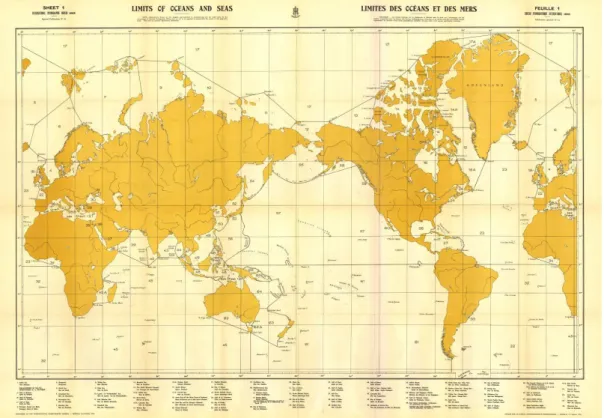
(3) 국제수로기구(IHO)에서의 한국과 일본 간 동해/일본해 표기 분쟁 및 S-23 개정을 위한 대안에 관한 고찰. Fig. 1. Sheet 1, Limits of Oceans and Seas, 3rd Edition of S-23 (1953) Source : International Hydrographic Organization, 1953.. In August 2002, the final draft of the 4th edition was submitted to member states for approval. In this draft 4th edition, the two pages referring to the sea area between the Korean peninsula and the Japanese archipelago were not included, with an explanation given in the circular letter that an addendum could be issued to address the matter at a later stage. However, in September 2002, for some reason, the new directing committee of IHB decided to interrupt the voting procedure (International Hydrographic Organization, 2005). At the 17th IHC in 2007, the president of the conference proposed the publication of a 4th edition of S-23 in two volumes. One volume could incorporate all the agreed issues and could be published immediately, while a second volume would cover unresolved matters being withheld until any outstanding issues could be. Fig. 2. The Front Cover of the Final Draft of the 4th Edition of S-23 (2002). resolved. However, this proposal was not accepted. Source : International Hydrographic Organization, 2002.. (International Hydrographic Organization, 2007).. - 225 -.
(4) 류연택. Fig. 3. The Chartlet-index of North Pacific Ocean and its Sub-divisions in the Final Draft of the 4th Edition of S-23 (2002) Source : International Hydrographic Organization, 2002: 7-1.. Several options have been proposed on how the sea. purpose of the publication to provide information to. area between the Korean peninsula and the Japanese. support navigation safety (Choi et al., 2005; International. archipelago could be named in S-23, but these have. Hydrographic Organization, 2012; Ryu, 2012; 2015; 2018;. been rejected by either one or both of the interested. Sung and Kang, 2013). Australian proposal provides a method of including. states or else did not receive the support of the appro-. alternate positions relating to the name or limit of sea. priate majority of member states.. and ocean areas and will thus enable a new edition of S-23 to be published. The proposal by Australia to the. III. Proposal by Australia and France to the S-23 Working Group. S-23 WG is as follows. 1. The following text should be added to the front. At the second meeting of S-23 WG in Singapore in. cover of the draft of the 4th edition of S-23:. 2010, Australian delegate stated that it is clear that there. ‘The publication S-23 should be considered an inter-. are some sea and ocean areas where national interests. national reference document that shows the generally. are so strong that it will be impossible to reach con-. agreed names and limits of the sea and ocean areas in. sensus on a single name. The publication S-23 should. common use. Where there are significant national re-. be an international reference document that shows the. servations and another name is in use then the alternate. generally agreed names and limits of the sea and ocean. name and/or limits are also shown.’. areas. Where there are significant national reservations. 2. When and only when consensus cannot be reached. and another name is in use then the alternate name. on the name or limits of a sea or ocean area then the. and/or limits are also shown. This will serve the specific. alternative positions are to be included in S-23 by one. - 226 -.
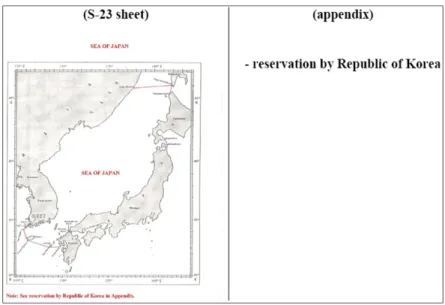
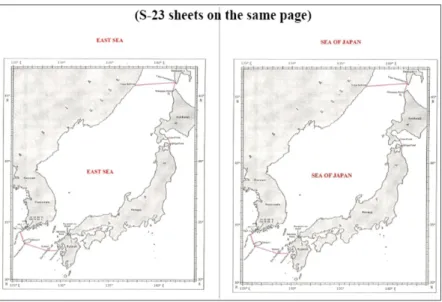
(5) 국제수로기구(IHO)에서의 한국과 일본 간 동해/일본해 표기 분쟁 및 S-23 개정을 위한 대안에 관한 고찰. Table 1. S-23, section 52 Endonym KR/KP 동해. Donghae. Endonym RU Япóнское мópе. Yаpónskoye móre. Endonym JP 日本海. Exonym** en -. Exonym* fr. Exonym es. East Sea. Mer de 1’Est. TBD. Sea of Japan***. Mer du Japon. TBD. *,** Exonym in English or French may vary from one nation to another. Each nation can make its own choice in accordance with national toponymy policies. *** Variant: Japan Sea.. Regarding the sea area between the Korean peninsula. of the following methods: a. the fact that there is a reservation by (an)other. and the Japanese archipelago, the proposal by France. member state(s) be included on the main page referring. is as follows (International Hydrographic Organization,. to the sea or ocean area, and details of the reservation,. 2012; Ryu, 2012; 2015; 2018).. such as a alternative name/limits be clearly detailed in an annex, or. - S-23 sheets covering the sea area between the. b. the fact that there is a reservation by (an)other. Korean peninsula and the Japanese archipelago. member state(s) be included on the first page referring. - No name at all, but single reference to the ad hoc. to the sea or ocean area and a second page for the same. sections of S-23 (e.g. ‘See § 52’, Table 1). sea or ocean area be inserted in S-23 immediately following the first. The second page will show the. France’s proposal can be used in conjunction with the. alternative name(s) or limits of the sea or ocean area. Australian proposal. However, unfortunately, France’s. where consensus was not reached.. proposal was withdrawn by France’s delegate for some reason.. In short, the Australian proposal provided two options for detailing reservations; either use of an ‘annex’ or ‘a. IV. Ongoing Naming Dispute about the Sea Area between the Korean Peninsula and the Japanese Archipelago. second page immediately following the first.’ The Australian proposal could form a possible basis for naming of the sea area between the Korean peninsula and the Japanese archipelago.. A list of three areas of concern was identified and. Australia presented a proposal with two options at the nd. 2 S-23 WG meeting in Singapore. The first, ‘to provide. circulated by IHB. The three areas of concern are (1). reservations in an annex’ was presented to S-23 WG. sea area between the Korean peninsula and the Japanese. members, and was rejected by the Republic of Korea. archipelago, (2) Malacca Strait, and (3) South China Sea. and others thus did not gain consensus. According to. – East China Sea. According to the IHB, the majority of. the Australian delegate, Australia later agreed that the. the responses received from IHO member states about. second option, ‘to include a separate page with alternative. the areas of concern refer to the issue of naming the. naming immediately following the first’ need not be. sea area between the Korean peninsula and Japanese. formally presented to all working group members as it. archipelago. Three groups of positions can be recognized. became clear that this option would not lead to consensus. from the responses. Those, which is the majority, indi-. when Japan advised the Australian delegate that it was. cating that the countries concerned must come to an. not acceptable.. agreement before moving to an update with some additional comments and views, those which support the. - 227 -.
(6) 류연택. Fig. 4. A Proposal by Australia to the S-23 Working Group Source : Ryu, 2018: 124.. Fig. 5. Alternative Proposal by Australia to the S-23 Working Group Source : Ryu, 2018: 125.. different names to appear on the relevant page and not. ization, 2012).. in the annex, and those which support one name with. It is clear that consensus has not been reached among. reservations to be inserted in an annex. The position. S-23 WG members on all of the ‘areas of concern.’ The. of both the Republic of Korea and the Democratic. Australian delegate points out that it is apparent that the. People’s Republic of Korea is that both names ‘East Sea’. root cause of not reaching consensus on S-23 is due to. and ‘Japan Sea’ should be used simultaneously on the. political pressures related to strong national positions. same page in S-23 (International Hydrographic Organ-. rather than differences over technical depiction of names. - 228 -.
(7) 국제수로기구(IHO)에서의 한국과 일본 간 동해/일본해 표기 분쟁 및 S-23 개정을 위한 대안에 관한 고찰. Fig. 6. Proposal by the Republic of Korea in Response to the Proposals by Australia to the S-23 Working Group Source : Ryu, 2018: 125.. Fig. 7. Proposal by France to the S-23 Working Group Source : Ryu, 2018: 126.. and limits. France’s withdrawal from the S-23 WG high-. accept that political imperatives have the over-riding. lighted this fact and subsequent statements by France’s. importance, accept that these cannot be solved by the. S-23 WG members have confirmed it (International Hydro-. IHO and recommend the withdrawal of the S-23 pub-. graphic Organization, 2012; Ryu, 2012; 2015; 2018). The. lication from the IHO catalogue. In fact, the naming of. IHO must decide whether S-23 is to be a technical. geographical features is inherently intertwined with. hydrographic publication and thus proceed to resolve. political matter (Alderman, 2002; 2006; Chi, 2012; Short,. national disagreements using the technical methods, or. 2012; Alderman and Inwood, 2013; Radil, 2016; Kim,. - 229 -.
(8) 류연택. orating dual naming principle according to IHO Technical. 2017; Yi et al., 2017; Rose-Redwood et al., 2019). Furthermore, the Australian delegate argues that there. Resolution A 4.2.6 (Ryu, 2012; 2015; 2018). By the same. are already internationally recognized means for displaying. token, United Nations Resolution on the Standardization. differing names for the same geographical feature in use. of Geographical Names III/20 also clearly recommends. by United Nations Group of Experts on Geographical. that when countries sharing a given geographical feature. Names (UNGEGN) and adopted by the IHO. For example,. do not succeed in agreeing on a common name, it should. the final draft of the 4th edition of S-23 in 2002 clearly. be a general rule of international cartography that the. states that both names of ‘English Channel (La Manche)’. name used by each of the countries concerned will be. can be used on charts according to IHO Technical Reso-. accepted (Lee, 2004; Raper, 2010; Park, 2012; Woodman,. lution A 4.2, paragraph 6 (International Hydrographic. 2017). Basically based on the important recommendation. Organization, 2012; Ryu, 2012; 2015; 2018). In a similar. of the IHO Technical Resolution A 4.2.6, the Republic. vein, ‘East Sea’ should be used concurrently with ‘Japan. of Korea proposes that the body of water separating the. Sea.’ It is very important to note that this dual naming. Korean peninsula and the Japanese archipelago should. is in line with IHO Technical Resolution A 4.2.6.. have dual names, namely, ‘East Sea/Sea of Japan.’. th. IHC in 2012, USA proposed chapter-. The names ‘East Sea’ and ‘Sea of Japan’ should be. by-chapter approach. However, for some reason, USA. used simultaneously to designate the sea area between. withdrew their proposal. Meanwhile, China proposed. the Korean peninsula and the Japanese archipelago, on. the abolishment of the S-23. Japan proposed an approach. the following grounds:. At the 18. that was similar with the USA proposal. However, Japan’s. Until the 19th century, various names had been used. proposal was supported by Japan only. Most member. to designate the sea area concerned such as ‘Sea of. states of the IHO abstained. Four countries including. Joseon (ancient Korean Dynasty),’ ‘East Sea,’ and ‘Oriental. the Republic of Korea, China, Cuba, and the Democratic. Sea,’ while ‘Sea of Japan’ had not been widely used. People’s Republic of Korea opposed the Japan’s proposal. even in Japan. Moreover, many maps at that time did. (International Hydrographic Organization, 2012).. not show any names for this sea area. With the rise of. st. At the 1 Session of the IHO Assembly in 2017, the. Japan as a regional power in Asia in the late 19th and. Assembly tasked the secretary-general to facilitate an. early 20th centuries, the sea area had become widely. informal consultation process regarding the future of. known as ‘Sea of Japan.’ Korea, on the other hand, was. S-23 among interested member states, including deter-. unable to present its views on naming the sea area. mining mutually agreed modalities of work and to. when the first and second editions of the ‘Limits of. report the result of the consultations to the assembly at. Oceans and Seas’ were published in 1929 and 1937. the next ordinary session (International Hydrographic. respectively, since it was under Japanese colonial rule.. Organization, 2017).. When the third edition was published in 1953, Korea. The naming of the body of water separating the. was in the midst of the Korean War.. Korean peninsula and the Japanese archipelago is a. Historically, the name ‘East Sea’ has been used for the. matter for negotiation between neighboring states. How-. past 2,000 years in Korea. Currently, 75 million people. ever, taking into account the unresolved naming differences. living on the Korean peninsula use the name ‘East Sea.’. between the Republic of Korea and Japan for the same. The use of ‘East Sea’ in world maps and media outlets. sea area, the Republic of Korea proposes a plausible. has steadily increased (Stoltman, 2018). In addition, the. th. alternative to enable the publication of the 4 edition. simultaneous use of the names ‘East Sea’ and ‘Sea of. of IHO publication S-23. The option is to publish names. Japan’ is consistent with the fundamental principles of. and spatial details of the sea area in question incorp-. the IHO.. - 230 -.
(9) 국제수로기구(IHO)에서의 한국과 일본 간 동해/일본해 표기 분쟁 및 S-23 개정을 위한 대안에 관한 고찰. Fig. 8. Dual Naming of ‘English Channel (La Manche)’ according to IHO Technical Resolution A 4.2. Paragraph 6 in the Final Draft of the 4th Edition of S-23 in 2002 Source : International Hydrographic Organization, 2002: 1-10-1-11.. The IHO adopted Technical Resolution A 4.2.6 in. constructive proposals that have been made to publish. 1974, which essentially provides that if two or more. the 4th edition of S-23. For example, the IHO should. countries sharing a given geographic feature under a. investigate the final draft of the 4th edition in 2002, the. different name cannot agree on a common name, each. two-volume approach that was proposed by the former. of the names should be accepted (Ryu, 2012; 2015;. IHC chairman, Williams, and specially the IHO Technical. 2018). This general rule of international cartography is. Resolutions, and the United Nations Resolutions on the. also confirmed by the United Nations Conference on the. Standardization of Geographical Names. In order to efficiently expedite the publication of the. Standardization of Geographical Names in its resolution. 4th edition of S-23, all of discussions and procedures. III/20 adopted in 1977. Lying between Korea and Japan and extending north. should be considered. The IHO should examine the. towards Russia, the sea area includes the territorial. responses and all other relevant documents in order to. waters and exclusive economic zones of the countries. develop possible solutions for areas of concern. How-. encircling the area, and several countries have jurisdiction. ever, in the preparation of the 4th edition of S-23, the. and sovereign rights over it. It would therefore be. IHO Technical Resolutions should be the most important. inappropriate to name the sea area after one particular. elements for solutions for the areas of concern. A lot of efforts and endeavors were already put to. country without the consent of other surrounding. prepare the final draft of the 4th edition of S-23 in 2002,. countries (Oh, 2017). The current edition of S-23 does not reflect the names. it would be logical to use the final draft as a starting. of oceans and seas in an appropriate manner. It is highly. point for discussion in order to produce the 4th edition. desirable to publish a revised version of the current. of S-23. The purpose of the S-23 WG was to produce. edition. A major responsibility of the IHO is to consider. a revised draft of the 4th edition of S-23 based on the. all possible means and ways to produce the 4th edition. work that has been done in the past. Since the prep-. of S-23. The IHO should comprehensibly examine various. aration of the draft of the 4th edition of S-23 in 1986,. - 231 -.
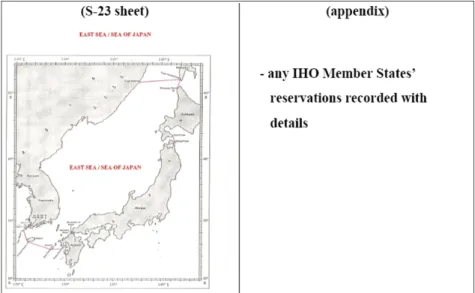
(10) 류연택. 4. The fourth option is to publish the 4th edition of. a lot of efforts had been made by the IHB to prepare th. the final draft of the 4 edition of S-23 in 2002. In this. S-23 without pages of the sea names and spatial. regard, it is important to acknowledge the efforts to. details of the sea area, and issue a page addendum. prepare the final draft in 2002. For the progress of S-23,. when the naming disputes are resolved.. it is very reasonable to use the 2002 final draft as a cornerstone in producing a revised draft of the 4th. For the sea area between the Korean peninsula and. edition of S-23. To ignore the last final draft in 2002. the Japanese archipelago, the first option could be the. that involved a lot of efforts of the IHB might hamper. most plausible. Naming ‘East Sea’ for the Korean-side. the credibility of the IHO that pursues the progress of. sea area and naming ‘Sea of Japan’ for the Japanese-side. S-23.. sea area without the delineation of the limits of each. In addition to the technical and scientific issues. sea would be the most neutral solution, which is also. associated with the S-23, the IHO should consider the. consistent with IHO Technical Resolution A 4.2.6. De-. political aspects of the S-23 because delineating limits. lineating the limits of each sea can have the possibility. of seas and naming of seas are inherently intertwined. to bring another dispute between Korea and Japan.. with political issues among neighboring states.. Another possible solution could be to use ‘East Sea’ for the Korean EEZ (or Korean territorial waters) and to use ‘Sea of Japan’ for the Japanese EEZ (or Japanese territorial. V. Conclusion. waters) with the delineation of limits of each sea. The limitation of this paper is that this paper does not. Taking into account the unresolved naming differences. include a detailed questionnaire survey on to what extent. between Korea and Japan for the sea area between the. each of the four alternatives to enable the publication. Korean peninsula and the Japanese archipelago, this paper proposes four alternatives to enable the publication of the 4th edition of S-23. These four options are as follows. 1. The first option is to use dual names, using each name within territorial waters or EEZs without (or with) the delineation of the limits of each sea (Choo, 2009; 2012). 2. The second option is to publish names and spatial details of the sea area incorporating dual naming principles according to IHO Technical Resolution A 4.2.6 and also have any IHO member states’ reservations recorded with details in appendix. 3. The third option is to publish names and spatial details of the sea area as submitted by Korea and Japan, and then issue a page addendum when the member states’ reservations can be depicted in. Fig. 9. The First Option for the Naming of the Sea Area between the Korean Peninsula and the Japanese Archipelago. appendix.. Source : Ryu, 2018: 129.. naming disputes are resolved. Again any IHO. - 232 -.
(11) 국제수로기구(IHO)에서의 한국과 일본 간 동해/일본해 표기 분쟁 및 S-23 개정을 위한 대안에 관한 고찰. Fig. 10. The Second Option for the Naming of the Sea Area between the Korean Peninsula and the Japanese Archipelago Source : Ryu, 2018: 130.. Fig. 11. The Third Option for the Naming of the Sea Area between the Korean Peninsula and the Japanese Archipelago Source : Ryu, 2018: 130.. of the 4th edition of S-23 is plausible. Although naming. Technical Resolution A 4.2.6 but also United Nations. ‘East Sea’ for the Korean-side sea area and naming ‘Sea. Resolution on the Standardization of Geographical Names. of Japan’ for the Japanese-side sea area without the. III/20, an in-depth research from the viewpoint of inter-. delineation of the limits of each sea would be the most. national law is needed. In addition, an in-depth research. neutral solution, which is consistent with not only IHO. on how using dual names, namely, East Sea/Sea of. - 233 -.
(12) 류연택. Table 2. The Fourth Option for the Naming of the Sea Area between the Korean Peninsula and the Japanese Archipelago S-23 Sheet and Main Pages. Page Addendum. - without pages of the sea. - issue a page addendum. names and spatial details of. when the naming disputes. the sea area or. are resolved. sea between Korea and Japan and topics of the geographical toponymy, Journal of the Korean Geographical Society, 47(6), 870-883 (in Korean). International Hydrographic Organization, 1953, Limits of Oceans and Seas (Special Publication N° 23), 3rd edition, Monaco: IHO. International Hydrographic Organization, 2002, Names. - blank pages. and Limits of Oceans and Seas, Special Publication. Source : Ryu, 2018: 130.. No. 23 (English Version, Final Draft), 4th edition, Japan, for the sea area between Korean peninsula and. Monaco: IHO.. Japanese archipelago can be legitimized simultaneously. International Hydrographic Organization, 2005, Report of. by Koreans, Japanese, and international society is needed.. Proceedings, 3rd Extraordinary International Hydrographic Conference, April 11-14, Monaco. International Hydrographic Organization, 2007, Report of. References. Proceedings, XVIIth International Hydrographic Conference, May 7-11, Monaco.. Alderman, D.H., 2002, School names as cultural arenas:. International Hydrographic Organization, 2009, Report of. The naming of U.S. public schools after Martin. Proceedings, 4th Extraordinary International Hydro-. Luther King, Jr., Urban Geography, 23(7), 601-626.. graphic Conference, June 2-4, Monaco.. Alderman, D.H., 2006, Naming streets for Martin Luther. International Hydrographic Organization, 2012, Report of. King, Jr.: No easy road, in Schein, R.H., ed., Landscape. Proceedings, XVIIIth International Hydrographic Con-. and Race in the United States, New York: Routledge,. ference, April 23-27, Monaco.. 213-236.. International Hydrographic Organization, 2017, Report of. Alderman, D.H. and Inwood, J., 2013, Street naming and. Proceedings, 1st Session of the IHO Assembly, April. the politics of belonging: Spatial injustices in the. 24-28, Monaco.. toponymic commemoration of Martin Luther King. Kim, S.B., 2017, The critical reading on the traditional. Jr., Social & Cultural Geography, 14(2), 211-233.. toponymy: A case study of the Ganggyego’s preface,. Chi, S.H., 2012, The political geography of place names:. Journal of the Cultural and Historical Geography,. The decisions of city names in the process of. 29(1), 93-110 (in Korean).. administrative district reorganization, Journal of the. Lee, K.S., 2004, Geographical studies and international. Korean Association of Regional Geographers, 18(3),. organizations: Concerning international standardization. 310-325 (in Korean).. of the geographical name of East Sea, Journal of the. Choi, Y., Oh, S.B., and Kim, Y.B., 2005, International. Korean Geographical Society, 39(1), 1-12 (in Korean).. Hydrographic Organization and the name “East. Oh, S.J., 2017, An identity aspect to the “wars” of maps. Sea”, Journal of the Korean Society of Civil Engineers,. in East Asia: Focusing on the East Sea/Sea of Japan. 53(9), 143-149 (in Korean).. name debate, Korea Observer, 48(1), 57-83.. Choo, S., 2009, Endonym, geographical feature and. Park, C., 2012, A study on the naming of the East Sea. perception: The case of the name East Sea/Sea of. viewed from an international law – UNCSGN reso-. Japan, Journal of the Korean Geographical Society,. lutions and IHO resolution, Law Review, 53(3),. 44(5), 661-674.. 115-141 (in Korean).. Choo, S., 2012, Recent discussions on the naming of the. Radil, S.M., 2016, The multi-scalar geopolitics of place. - 234 -.
(13) 국제수로기구(IHO)에서의 한국과 일본 간 동해/일본해 표기 분쟁 및 S-23 개정을 위한 대안에 관한 고찰. naming: The case of post-civil war Cyprus, Pro-. Sung, H.H. and Kang, J., 2013, The generic terms and. ceedings, The 22nd International Seminar on Sea. the standards of a delimitation for oceans and seas. Names: Seas and Islands: Connecting People, Culture,. based on S-23 (Names and Limits of Oceans and. History and the Future, October 23-26, Jeju, South. Seas), Journal of the Korean Geographical Society,. Korea, 185-196.. 48(6), 914-928 (in Korean).. Raper, P.E., 2010, United Nations resolutions on maritime. Woodman, P., 2017, Dual naming in cartographic and. feature names, in Raper, P.E., Kim, J.H., Lee, K.S.,. non-cartographic environments, Proceedings, The. and Choo, S., eds., Geographical Issues on Maritime. 23rd International Seminar on Sea Names: Achieving. Names: Special Reference to the East Sea, Seoul:. Peace and Justice through Geographical Naming,. Northeast Asian History Foundation, 141-155.. October 22-25, Berlin, Germany, 183-189.. Rose-Redwood, R., Vuolteenaho, J., Young, C., and Light,. Yi, S., Choi, H., and Lim, E., 2017, The analysis of the. D., 2019, Naming rights, place branding, and the. context related to Dokdo in new geography text-. tumultuous cultural landscapes of neoliberal urbanism,. book of North Korea revised in 2013, Journal of the. Urban Geography, 40(6), 747-761.. Association of Korean Geographers, 6(2), 113-125. Ryu, Y.-T., 2012, Reflections on the IHO S-23 and the. (in Korean).. naming of East Sea, Proceedings, The 18th Inter-. Yi, S., Choi, H., Phuong, D.T.T., and Kim, J., 2017, The. national Seminar on Sea Names: Asian and European. issues on sovereignty of the South China Sea, and. Perspectives, March 7-9, Brussels, Belgium, 177-187.. Vietnam’s territorial education, Journal of the Asso-. Ryu, Y.-T., 2015, International Hydrographic Organization. ciation of Korean Geographers, 6(1), 1-13 (in Korean).. and the East Sea/Sea of Japan issue, Proceedings,. International Hydrographic Organization, https://iho.int/en. The 21st International Seminar on Sea Names: Heritage,. International Hydrographic Organization, “Past Conference. Perception and International Relations, August 23-26,. Assembly Proceedings”, https://legacy.iho.int/srv1/. Helsinki, Finland, 189-207.. index.php?option=com_content&view=article&id=. Ryu, Y.-T., 2018, Dual naming in the International Hydro-. 388&Itemid=306&lang=en. graphic Organization’s S-23, Proceedings, The 24th International Seminar on Sea Names: Dual Naming: Correspondence : Yeon-Taek Ryu, 28644, 1 Chung-. Feasibility and Benefits, August 26-29, Gangneung,. dae-ro, Seowon-gu, Cheongju-si, Chungcheong-. South Korea, 119-131. Seo, T.-Y., 2012, Education on Dokdo and East Sea in. buk-do, Korea, Department of Geography Education,. secondary geography textbook from 1945 liberation. College of Education, Chungbuk National University. to 1950s, Journal of the Association of Korean Geo-. (Email: [email protected]). graphers, 1(1), 1-9 (in Korean). 교신 : 류연택, 28644, 충청북도 청주시 서원구 충대로 1,. Short, J.R., 2012, Korea: A Cartographic History, Chicago:. 충북대학교 사범대학 지리교육과(이메일: ytryu@. University of Chicago Press.. chungbuk.ac.kr). Stoltman, J.P., 2018, Dual naming of geographic features: The search for mutual benefits, Proceedings, The 24th International Seminar on Sea Names: Dual Naming: Feasibility and Benefits, August 26-29,. 투고접수일: 2020년 3월 30일. Gangneung, South Korea, 15-24.. 심사완료일: 2020년 4월 18일 게재확정일: 2020년 4월 22일. - 235 -.
(14)
수치

+2
관련 문서