J F E S
Journal of Forest and Environmental Science
Journal of Forest and Environmental Science Vol. 31, No. 2, pp. 73-77, May, 2015
http://dx.doi.org/10.7747/JFES.2015.31.2.73
Easy and Quick Survey Method to Estimate Quantitative Characteristics in the Thin Forests
Mehrdad Mirzaei*, Amir Eslam Bonyad, Mahboobeh Mohebi Bijarpas and Fatemeh Golmohamadi Faculty of Natural Resources, University of Guilan, Someh Sara 1144, Iran
Abstract
Acquiring accurate quantitative and qualitative information is necessary for the technical and scientific management of forest stands. In this study, stratification and systematic random sampling methods were used to estimation of quantitative characteristics in study area. The estimator (((E%)2xT)) was used to compare the systematic random and stratified sampling methods. 100 percent inventory was carried out in an area of 400 hectares; characteristics as: tree density, crown cover (canopy), and basal area were measured. Tree density of stands was compared through systemic random and stratified sampling methods. Findings of the study reveal that stratified sampling method gives a better representation of estimates than systematic random sampling.
Key Words: inventory, systematic random, stratification, zagros forests
Received: October 18, 2014. Revised: December 13, 2014. Accepted: December 16, 2014.
Corresponding author: Mehrdad Mirzaei
Faculty of Natural Resources, University of Guilan, Someh Sara 1144, Iran
Tel: (98)9187429259, 1344323600, Fax: (98)9187429259, 1344323600, E-mail: [email protected]
Introduction
Among forest sciences, forest inventory and measure- ment are important, and the correct operation of forest in- ventory in each forestry plan regarding the goal of forestry plans is of great importance. Accurate and updated in- formation is needed for various purposes, including forest management, health monitoring, biodiversity, climate change, and the effects of various environmental factors (Holopainen 1998). This information is obtained by in- ventory or sampling in the forest area. The main objective of a forest inventory is to describe the structure and species composition of a given stand with maximum possible accu- racy and at a reasonable cost (Husch et al. 1982; Avery and Burkhart 2002). Inventory technique is very effective in obtaining current and accurate information for forest planning. It can remedy the defects of periodic inventory and provide data for scientific forest management and man-
agement planning (Mingcan 1999). Sampling methods and plot design have to be adapted to the characteristics of the stands present in the country or region studied. It is necessary to decide which variables to measure and through which type of inventory method to measure them. It is also necessary to decide on a sampling intensity in order to meet the maximum acceptable error for the analyzed variables. In most cases, if a sampling method that is in harmony with the type of forest and forest management goals is chosen and performed correctly, the analysis proves to be more use- ful and acceptable than full calipering inventory. One meth- od that has proved its efficiency and practicability often in the last decades is double sampling for stratification (2st) (Cochran 1977; De Vries 1986; Schreuder et al. 1993;
Sarndal et al. 2003; Gregoire and Valentine 2008;
Mandallaz 2008). The theory of double sampling (or two phase sampling) was first formulated by Neyman (1938) in connection with collecting information on the strata weights
in stratified sampling. Rao (1973) applied it to stratification for non-response problems and analytic comparisons.
Cochran (1977) provided some basic results for two-phase sampling in his book. Ige and Tripathi (1987) suggested some alternative sampling strategies based on DSS that uti- lize first-phase sample auxiliary information at both design and estimation stages of a survey. This led Singh and Vishwakarma (2010) to propose a general procedure for es- timating the population mean based on double sampling for stratification and auxiliary information. Saborowski et al.
(2010) studied this method for periodic inventories under the infinite population approach.
In samples from the Zagros forests, sampling methods are needed that have low-cost implementation and accept- able accuracy. According to Beasom and Haucke (1974), the density obtained by four distance sampling methods (closet individual, nearest neighbors, random pairs, and point centered quarter) in the oak forests of southern Texas were compared with 100% inventory. The authors con- cluded that density estimates by random pairs and point centered quarter methods were closest to actual density. In order to study the use of the stratification inventory method for volume estimation, the cost and precision of systematic random sampling and the stratification method were com- pared in the Kheyroodkenar forest by Akhavan et al.
(2001). Results showed that in this forest, the stratification method was better and provided a higher accuracy than the systematic random sampling method. Spark and Masters (2002) compared six sampling methods in fixed plots with 3.64 and 5.64 m radii, square plots with a central point, var- iable plots, transect, and 10x10 m square plots in three for- est stands in the southeast regions of Oklahoma. Results in- dicated that fixed and variable plot methods are more ap- propriate for use in regions with diverse density and differ- ent sizes of tree stems. To estimate density and basal area characteristics in the Arasbaran forests, Alijanpour et al.
(2004) analyzed and compared the three sampling methods of rectangular plots, circle plots, and transect method.
Ultimately, the transect method was selected as the optimal sampling method in the Arasbaran forests. Pique et al.
(2011) compared the accuracy of the estimated means of three main stand variables (basal area, stand density, and di- ameter class distribution) in forest stand inventories per- formed with relascope plots and with conventional fixed ra-
dius circular plots, both measuring a similar number of trees (15-20). The results showed that for stands with mul- tiple strata and open structures, the Bitterlich relascope provided a more accurate estimate for basal area than for density, while the reverse occurred for fixed radius plots. To investigate and determine an appropriate inventory method for the Yasuj oak forests considering inventory precision and accuracy for canopy parameter per hectare, Fallah et al.
(2012) selected the systematic random (rectangular plots), transect, strip, and stratification methods and evaluated their efficiency in the forest. This study introduced the transect method as the most appropriate inventory method for these forests. The aim of the current study was to com- pare stratification and systematic random sampling meth- ods in order to determination the best sampling method for estimating quantitative characteristics of the Zagros forests.
Materials and Methods
Study area
The study area was 400 ha located at 46°22'30" E and 46°23'40"E longitude and 33°41'5"N and 33°41'50"N latitude. Dalab woodland includes the Quercus brantii, mixed (Quercus brantii-Pistacia atlantica-Acer cine- rascens), and Daphne mucronata-Amygdalus orientalis types. This area has a semi-humid cold climate based on the DeMartonne climate classification; the Emberger climate classification rates the climate of the area as semi-arid (Rostami and Heidari 2009). The characteristics measured in this study were trees per ha, crown cover, and basal area.
Full-calipering inventory (100% inventory) method In this inventory method, all trees in a forest area or stand that are above DBH>12.5 cm were measured. To simplify the 100% inventory, the forest area was divided in- to plots of 0.5 ha. Each plots was measured separately and the characteristics of the trees in each plot, including spe- cies, diameter, and canopy trees (large and small diame- ters), were measured and recorded.
Systematic random sampling method
Sampling with rectangular plots is a method that uses a fixed area. This study was based on the systematic random sampling inventory network (100x50 m) and was im-
Table 2. Results of full calipering inventory
Characteristic μ SD CV (%)
Density (trees/ha) 68.04 ±32.87 48.3 Basal area (m2/ha) 15.16 ±8.97 59.17
Canopy (%) 35.71 ±14.48 40.54
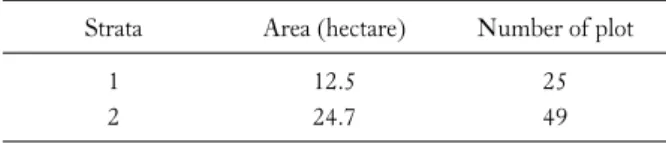
Table 1. Characteristics of strata in stratification sampling method Strata Area (hectare) Number of plot
1 12.5 25
2 24.7 49
Table 4. Results of stratification sampling method
Characteristic SD E %
density (tree/ha) 65.61 ±20.00 ±2.32 7.03 Basal area (m2/ha) 15.7 ±6.16 ±0.71 8.99
Canopy (%) 31.33 ±21.24 ±2.47 15.68
Table 3. Results of systematic-random with rectangular plots sam- pling method
Characteristic SD E %
density (trees/ha) 56.25 ±26.25 ±3.05 10.79 Basal area (m2/ha) 14.26 ±7.1 ±0.82 11.43
Canopy (%) 28.5 ±23.47 ±2.72 19.05
plemented in the study area. The sides of the crossing in- ventory network were the beginning points for sampling and 74 rectangular plots 40x25 m in size were measured.
All tree characteristics were measured for each plot. The cal- culation mean of characteristic is as follow (Zobeiri 2005):
(1)Where, is the mean of characteristic, xi is character- istic measured, and n is the number of plot.
Stratification sampling method
The stratification sampling method is used in places where parts of a forest stand are different from each other (Zobeiri 2007). In this investigation, after taking inventory, it was determined that the study area differed in aspect density. Therefore, using the proportional allocation meth- od, the study area was divided into two strata. In this meth- od, after estimating the total number of plots, the plots were divided into extensions of the strata. Characteristics of these strata are given in the following table:
In this method, the calculations for each strata and for to- tal study area were performed separately. The calculation mean of characteristic is as follow (Zobeiri, 2007):
(2)Where, is the mean of characteristic for total area,
is the mean of characteristic in strata, N is total number
of sample plots, and Nj is number of plots to be measured in strata.
Time studies
Cost is one of the most important factors in choosing a sampling method. The sampling method selected should achieve an acceptable accuracy at the lowest cost. To com- pare the two methods, inventory costs as well as accuracy is the more efficient factor. In addition the sampling methods were compared with a 100% inventory as a criteria of accu- racy and cost ((E%)2xT) (Loetsch et al. 1973; Husch et al.
1982).
Results
Statistical parameters including mean (μ), standard de- viation (SD), and coefficient of variation (CV) for variables measured at full calipering inventory were calculated.
Mean of density, basal area, and canopy were 68.04 trees/ha, 15.16 m2/ha, and 35.71%, respectively. Other stat- istical parameters are shown in the following table.
For variables measured with the systematic-random sam- pling method, statistical parameters including mean (), standard deviation (SD), standard error (), and in- ventory error (E %) were calculated. Results are shown in Table 3.
Statistical parameters were also calculated with the strat- ification method, and the results are shown in Table 4.
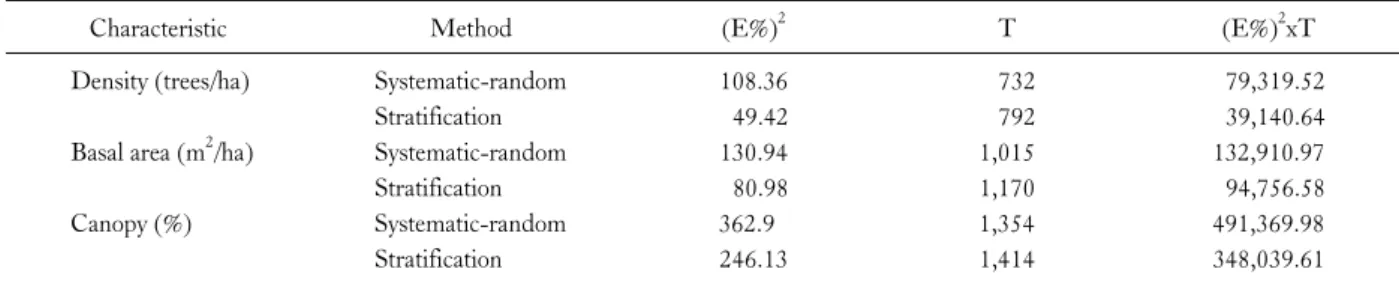
Table 5. Comparison of different sampling methods based on (E%)2xT
Characteristic Method (E%)2 T (E%)2xT
Density (trees/ha) Systematic-random 108.36 732 79,319.52
Stratification 49.42 792 39,140.64
Basal area (m2/ha) Systematic-random 130.94 1,015 132,910.97
Stratification 80.98 1,170 94,756.58
Canopy (%) Systematic-random 362.9 1,354 491,369.98
Stratification 246.13 1,414 348,039.61
E%, accuracy of sampling methods; T, total time of sampling methods (minute).
Comparison of different sampling methods based on (E%)2xT
In this investigation, in addition to a comparison of dif- ferent sampling methods with 100% inventory, the criteria of accuracy and cost ((E%)2xT) were used to compare the results, which are presented in the following table.
Discussion
In the 100% inventory method, the actual mean of meas- ured characteristics was obtained and used as the criteria of comparison. The results obtained using this method showed that the actual means of density, basal area, and crown canopy characteristics were 68.04 trees, 15.16 m2/ha, and 35.71%, respectively (Table 2). Mean number of trees per hectare obtained with the systematic random method was 56.25 (Table 3), while the mean number per hectare obtained using the stratification method was calculated at 65.61 trees (Table 4). Furthermore, confidence limits calcu- lated for the stratification method involved the actual mean of the study area (65.61±4.6). Mean basal area and crown canopy characteristic measurements also calculated with the systematic random method with rectangular plots were 13.26 m2 and 28.5% and with the stratification method were 15.7 m2 and 31.33%, respectively (Tables 3 and 4).
The confidence limits calculated for basal area and crown canopy characteristics in the stratification method involved actual means of the study area (15.7±1.41 and 31.33±
4.9), while confidence limits for characteristics measured in the systematic random method did not involve actual means. Based on Tables 3 and 4, it can be concluded that the use of stratified sampling for estimating the number of
trees per hectare, basal area, and canopy characteristics has been effective, because the accuracy of sampling is increased.
Forests are a major consideration in global discussions regarding sustainable development. Without the help of statistics science and forest measuring, any research in the field of forestry is incomplete and often impossible. Thus, statistics and forest measurements play basic roles among the various forest sciences. The need for accurate in- formation and the high costs associated with collecting this information require discussion to find a middle-ground solution. The chosen method must be appropriately priced, and the obtained results must have sufficient accuracy. Such information is needed to shape forest management policies and to focus research on areas where resource policy-makers need to improve current technology and knowledge. In or- der to better evaluate two sampling methods of precision and cost, ((E%)2xT) was used in this research, and the re- sults are shown in Table 5. The results showed that the sys- tematic random sampling method with a stratified amount of (E%)2xT for measured characteristics is less than the systematic random sampling method with rectangular plots. The study results also showed that the implemen- tation of the systematic random sampling method with strat- ification makes the mean estimate for quantitative character- istics to 100% inventory or actual mean closer. Akhavan et al. (2001) showed that using the systematic random method with stratification is better than the systematic sampling method; their results are in accord with the results of the present study. Therefore, considering the results obtained in this study, implementing the systematic random sam- pling method with stratification to estimate density, basal area, and canopy characteristics in the Daalaab region’s for- ests produces more suitable results with higher accuracy.
References
Akhavan R, Zobeiri M, Namiranian M. 2001. A study of strat- ification method using for volume estimation in Kheyroodkenar forest. Iranian J Nat Res 54: 235-245. (in Persian with English abstract)
Alijanpour A, Zobeiri M, Marvi Mohajer MR, Zargham N. 2004.
An investigation of the best statistical sampling method in forest of Aras - baran. Iranian J Nat Res 56: 397-405. (in Persian with English abstract)
Avery TE, Burkhart HE. 2002. Forest measurements. 5th ed.
McGraw-Hill, New York, pp 456.
Beasom SL, Haucke HH. 1975. A comparison of four distance sampling techniques in south Texas live oak Motes. J Range Manage 28: 142-144.
Cochran WG. 1977. Sampling Techniques. 3rd ed. John Wiley, New York.
De Vries PG. 1986. Sampling Theory for Forest Inventory. A Teach-Yourself Course. Springer, Berlin.
Fallah A, Zobeiri M, Rahimipour Sisakht A, Naghavi H. 2012.
Investigation on four sampling methods for canopy cover esti- mation in Zagros oak forests (case study: Mehrian forests of Yasuj city). Iranian J For Pop Res 20: 194-203. (in Persian with English abstract)
Gregoire T, Valentine H. 2008. Sampling Strategies for Natural Resources and the Environment. Chapman & Hall.
Heidari RH, Zobeiri M, Namiranian M, Sobhani H. 2009.
Comparison of circular plot and transect sampling methods in the Zagros oak forests (case study: educational and research for- est of Razi university, Kermanshah province). Iranian J For Pop Res 17: 359-368. (in Persian with English abstract)
Holopainen M. 1998. Forest habitat mapping by means of digi- tized aerial photographs and multispectral airborne measure- ments. Publication of the Department of Forest Resource Management, University of Helsinki, pp 48.
Husch B, Miller CI, Beers TW. 1982. Forest mensuration. Roland press company, New York, pp 402.
Ige AF, Tripathi TP. 1987. On double sampling for stratification
and use of auxiliary information. J Indian Soc Agri Statis 39:
191-201.
Loetsch F, Haller KE, Zohrer F. 1973. Forest inventory. 2nd ed.
Munchen, BLV Verlagsgesellschaft, pp 905.
Mandallaz D. 2008. Sampling Techniques for Forest Inventories.
Chapman & Hall/CRC, Boca Raton.
Mingcan L, Lu W, Gadow KV. 1999. Thinning inventory techni- que and its application in forest resource inventory. J For Res 10:
79-82.
Neyman J. 1938. Contribution to the theory of sampling human populations. J American Statis Assoc 33: 101-116.
Pique M, Obon B, Condes S, Saura S. 2011. Comparison of rela- scope and fixed-radius plots for the estimation of forest stand variables in northeast Spain: an inventory simulation approach.
Eur J For Res 130: 851-859.
Rao JNK. 1973. On double sampling for stratification and ana- lytical surveys. Biometrika 60: 125-133.
Rostami A, Heidari H. 2009. Typology of forest stands and evalua- tion of their overall status in natural forest of Daalaab region, Ilam province. J Agri Nat Res 15: 274-277. (in Persian with English abstract)
Saborowski J, Marx A, Nagel J, Bockmann T. 2010. Double sam- pling for stratification in periodic inventories—Infinite pop- ulation approach. For Eco Manage 260: 1886-1895.
Särndal CE, Swensson B, Wretman J. 2003. Model assisted survey sampling. Springer, Berlin.
Schreuder HT, Gregoire TG, Wood GB. 1993. Sampling methods for multiresource forest inventory. Wiley, New York.
Sparks J, Masters R. 2002. Comparative evaluation of accuracy and efficiency of six forest sampling methods. Pro Okla Aca Sci 82: 49-56.
Vishwakarma GK, Singh HP, Singh S. 2010. A family of estimators of population mean using multi-auxiliary variate and post- stratification. Lithuanian Assoc Nonlin Analys 15: 233-253.
Zobeiri M. 2005. Forest inventory. 2nd ed. University of Tehran, pp 401.
Zobeiri M. 2007. Forest biometry. 2nd ed. University of Tehran, pp 411.