• 검색 결과가 없습니다.

BIM based Construction Project Case Analysis for Facility Life Cycle Management from the Perspective of the Client

N/A
N/A
Protected

Academic year: 2021

Share "BIM based Construction Project Case Analysis for Facility Life Cycle Management from the Perspective of the Client"

Copied!
10
0
0

로드 중.... (전체 텍스트 보기)

전체 글

(1)

발주처 관점의 시설물 생애주기 관리를 위한 BIM 기반 건설 프로젝트 사례 분석

BIM based Construction Project Case Analysis for Facility Life Cycle Management from the Perspective of the Client

DOI: https://doi.org/10.13161/kibim.2020.10.3.012

함남혁

1)

, 김웅기

2)

, 김재준

3)

Ham, Nam-Hyuk

1)

· Kim, Woong-Gi

2)

· Kim, Jae-Jun

3)

Received April 28, 2020; Received September 22, 2020 / Accepted September 23, 2020

ABSTRACT: From the perspective of the client, the value of information for use in facility management is very low at the point of use.

This is because the facility owner, who is a non-professional, cannot accurately request necessary information from the perspective of long-term facility life cycle management. The purpose of this study is to define the information necessary for facility management and to analyze the project operation method to procur this information to the client using BIM. To this end, this study analyzed the role of client and contractor, project delivery process, standards, and submissions in the BIM-based procurement area through USACE Air Force Hospital project case analysis. As a result of the analysis, if the client, who is the subject of facility operation, defines in advance the type and input method of necessary information in the operation stage, the client can receive the BIM optimized for operation from the contractor. The results of this study can be used to establish standards for receiving information necessary for establishment of procurement process and facility management of public institutions considering BIM introduction.

KEYWORDS: BIM, FLCM, COBie-MHS, Client

키 워 드: 건설정보모델링, 시설물 생애주기 관리, COBie-MHS, 발주자

1. Introduction

Information used for facility lifecycle management is prepared by contractor selected by facility owner. However, information created based on 2D drawing causes sudden loss of information as the project progresses. On the other hand, it is known that the quality of information written based on BIM does not conceptually cause loss of information, and can secure a high level of information quality in the operation stage (Sacks et al., 2018). From the facility owner's point of view, BIM offers the benefit of minimizing document errors and emissions, rework, construction cost, project duration, and claims and litigation (Computer Integrated

Construction Research Program, 2013). However, the majority of facility owners do not clearly set the purpose of using BIM to contractors in the project planning stage (Volk et al., 2014). This is because the facility owner only restricts the implementation of BIM to simply receiving the BIM model from the contractor. If the purpose of using the BIM of the facility owner is clear, documents and information necessary for operations can be defined in advance, and BIM services can be provided by defining contract requirements in detail (Giel and Issa, 2016).

In order to provide the necessary BIM services to facility owners, project documents that should include BIM related contents include team selection documents, contract

1)

정회원, 한양사이버대학교 건축도시건설공학부 조교수 ([email protected]) (교신저자)

2)

정회원, 한양대학교 건축환경공학과 박사과정 ([email protected])

3)

정회원, 한양대학교 건축공학부 교수 ([email protected])

(2)

requirements, and BIM project execution plan. Choosing the right team based on contract requirements is the basis for a successful BIM project. In this regard, the BIM project execution plan (BEP) serves as a tool for the project team to manage BIM performance according to the requirements of facility owners defined in the contract (Lin et al., 2016).

BIM contract requirements can be added to existing design and construction contracts, or included as an appendix. For facility owners who perform BIM once, it is advantageous to include BIM requirements in existing contracts to simplify documentation. On the other hand, for facility owners who need to perform BIM repeatedly and long- term, it is advantageous to add BIM contract requirements as an appendix. Because BIM is constantly evolving, it is possible to simplify the task of updating and modifying BIM contract requirements (Cavka et al., 2017). In addition, the same appendix can be used repeatedly for key contracts in design and construction. Finally, risks arising from information inconsistencies can be minimized.

However, it is difficult to find a case where the BIM project was operated for the purpose of managing the facility lifecycle in advance from the perspective of the facility owner. This study intends to conduct an empirical study on the BIM based project delivery process from the perspective of facility owners. To this end, USACE's Air Force Hospital construction project data that was conducted in Korea was analyzed.

2. Literature Review

2.1 Role of BIM in FLCM

B u i l d i n g I n f o r m a t i o n M o d e l i n g ( B I M ) i s a d i g i t a l representation of physical and functional characteristics of a facility (Sacks et al., 2018). A BIM is a shared knowledge resource for information about a facility forming a reliable basis for decisions during its life-cycle, defined as existing from earliest conception to demolition (Lam et al., 2012). A lot of studies to analyze the effects of sharing and utilizing information accumulated in BIM have been performed (Singh et al, 2011; Oraee et al., 2017; Liu et al., 2017).

However, most of the researchers are focusing on process improvement and quality improvement in the architecture,

engineering and construction (AEC) field, not the facility management (FM) field. Ham et al. (2018) and Lee et al.

(2012) analyzed the economic impact of design errors accumulated in the design stage on the construction stage through BIM-based design validation. Lee et al. (2019) quantitatively analyzed the processes and effects of BIM- based digital fabrication using a queue model. Ham et al.

(2020) proposed an optimal decision-making methodology for the allocation of BIM staff to be used in the construction phase. Ham and Lee (2018) conducted an empirical study on the safety diagnosis process for aging facilities utilizing BIM and laser scanning.

Project stakeholders (e.g. architect, structural engineer, contractor, facility owner, etc.) have different responsibilities, expertise and requirements for the creation and use of BIM (Travaglini et al., 2014). Therefore, the value of information may vary depending on who uses the BIM that has accumulated abundant information (Fadeyi, 2017).

In particular, the facility owner is the end user of the BIM information and receives the accumulated information from the previous workflow (Liu and Issa, 2013). The information supplied from the contractor should perfectly reflect the requirements of the facility owner, but it is difficult in reality.

Because not only do project stakeholders ultimately use BIM to perform other tasks, but when the information generated by each task accumulates in BIM, it becomes a huge chunk of information. It is very challenging to extract only the information necessary for facility lifecycle management from the BIM that has become such a chunk of information.

On the other hand, as a concept related to information

exchange using BIM, Model View Definition (MVD) is a very

broad and diverse subset of the entire IFC schema for

explaining information exchange for a specific work process

(Hietanen and Final, 2006). MVD can be narrowed to a

wide range depending on the end user's requirements for a

specific workflow. In MVD, architects can provide structural

engineers with a model for reference to the placement and

design of structural elements (Nawari and Sgambelluri,

2010), or a contractor to provide a model for calculating the

bill of quantity (Gokce and Gokce, 2013). Also included is

a case where the contractor provides facility owners with

data such as construction operations building information

exchange (COBie) for operations (William et al., 2013). As

(3)

seen in the examples of MVD, the requirements for the information of the end user are very important because the subject generating the information and the subject using the information are different (Lee et al., 2016). If these requirements are not clear, it becomes a BIM full of useless information. In addition, since all information included in the BIM is not necessary for facility owners, information necessary for operations must be regenerated. This is a risk that additional costs and resources need to be put in from the perspective of the facility owner.

2.2 Loss of Information Value for Facility Lifecycle Management

The main information that can be used to manage the facility lifecycle of buildings is as-built documents delivered from the contractor after construction is completed (Klein et al., 2012). As BIM became mandatory, BIM was added to as-built documents (Glema, 2013). However, despite these positive change, the value of information available to facility owners is very low. The main causes of the decrease in the value of information available to facility owners can be analyzed in two aspects: project delivery process (Cavka et al., 2017) and interoperability (Lavy and Jawadekar, 2014).

First, in the project delivery process, a lot of information is accumulated in the BIM. In an ideal situation, BIM, which has accumulated a lot of information, can be considered to have high utilization value. However, contractors participating in the actual construction project try to fulfill their respective responsibilities specified in the contract. As a result of this, only the BIM as a lump of accumulated work information of all participants remains, not the BIM that can share information from the perspective of various participants. In most cases, as-built BIMs that are finally delivered to facility owners contain a lot of information that is unlikely to be used in facility lifecycle management.

Second, interoperability problems of submittals may occur at the time of facility lifecycle management. In other words, as-built documents, including BIM, were delivered, but interoperability issues could lead to problems where information could not be viewed, modified, or changed. If the necessary information cannot be extracted from the BIM in a desired format, or if the effort put into this process is excessive, the usability of the information will inevitably

decrease. Even if an IFC file is delivered to solve this interoperability problem, the same problem situation as BIM occurs again to utilize the information contained in the IFC.

2.3 Construction Operations Building information exchange (COBie)

As discussed above, if the requirements of the end user are unclear, useless information accumulates in the project delivery process. As a result, a problem arises in that the facility owner must regenerate information for managing the facility lifecycle. In addition, the interoperability problem of BIM-related data is a problem to be solved from a long-term facility lifecycle management perspective. In this regard, many studies have been conducted on the exchange of various construction information led by the National Institute of Building Sciences (NIBS) (Eastman et al., 2010). These studies include the construction operations building information exchange (COBie), specifier`s properties information exchange (SPie), and the BIM service interface exchange (BIMSie), and building automation modeling information exchange (BAMie) (Baldwin, 2019). In particular, COBie is an information exchange format developed by USACE and is a standard for information exchange based on IFC (Sarel and Nishaant, 2015; East, 2012). COBie consists of a total of 20 worksheets, etc. instruction, contact, facility, floor, space, zone, type, component, system, assembly, connection, spare, resource, job, impact, document, attribute, coordinate, issue, picklist.

There are two ways to enter the data required for facility

lifecycle manage in the COBie spreadsheet (Yalcinkaya

and Singh, 2015). One is a method in which the operator

manually inputs information into an MS Excel sheet

according to the guidelines, and the other is a method

of extracting COBie through BIM software. The method of

extracting COBie through BIM software is divided into two

types. The first is a method of extracting IFC or IFCXML

files from the BIM model, and converting the extracted files

into XML files to convert them back to Excel. The second

method is to create a COBie spreadsheet file directly from

BIM software. In particular, in the case of USACE, Autodesk's

Revit is specified as a BIM authoring tool, and COBie is

extracted through the Autodesk COBie Toolkit installed in

Revit.

(4)

Facility owners can overcome interoperability problems through COBie extracted in spreadsheet format. However, since the process of extracting COBie is complicated, it is difficult for the contractor to provide all the information necessary for facility lifecycle management. Therefore, when COBie is delivered through a traditional project delivery process, the facility owner must regenerate information necessary for facility lifecycle management. Even assuming that an information format such as COBie solves the interoperability problem, the type and level of information included in the COBie must be clearly defined in advance from the perspective of the facility owner. In addition, a BIM-based project delivery process must be established to continuously manage the quality of as-built documents (e.g.

BIM, COBie, etc.). Therefore, this study intends to analyze the BIM procurement area, BIM project delivery process, BIM standard, and BIM submittals of the USACE case project to which the BIM-based project delivery process is applied. In addition, from the perspective of facility owners, the implications of ordering BIM projects for facility lifecycle management and future research directions will be presented.

3. Integration of BIM into Project Delivery Process for FLCM

3.1 BIM procurement areas for FLCM

In order to build a BIM-based project delivery process from the perspective of the facility owner, the responsibilities of the facility owner and the contractor must be clearly separated. Figure 1 shows the BIM procurement areas of the facility owner and the contractor. The role of the facility owner in BIM procurement areas is to clarify the objectives to be achieved through the BIM project. When the purpose of facility lifecycle management is established, the documents to be delivered from the contractor must be selected and defined in order to achieve the purpose. In addition, detailed requirements for performing BIM should be presented to the contractor.

The contractor's role is as follows when the facility owner presents BIM requirements in detail. First, a team must be formed that has the capability to meet the requirements of

facility owners. In addition, the BIM project execution plan (BEP) must be prepared so that the BIM requirements of the facility owner are clearly reflected and approved by the facility owner. Next, as the project proceeds based on the approved BEP, a BIM including information necessary for facility lifecycle management must be prepared. Preparation and quality control of as-built documents delivered to facility owners should not be performed at the time of completion like the traditional project delivery process, but must be carried out continuously from the start of the project.

Otherwise, the information requested by the facility owner may be omitted or an error may occur. In terms of quality management of information, facility owners should be able to present standards for clarifying roles and responsibilities between facility owners and contractors, such as templates for BIM authoring, level of detail (LOD), and information exchange (IE) sheets.

Based on these BIM procurement areas, the contractor must generate the necessary information to manage the facility lifecycle through an iterative and continuous process during the project. In addition, facility owners must perform quality control and quality assurance on this information.

4. A Case Study of USACE – Military Health System

4.1 Project Description

USACE has been conducting several BIM projects related to healthcare facilities. The BIM project for the Military Health System was introduced by the facility manager to manage the operation of healthcare facilities before the requirements

Figure 1. BIM procurement areas [2]

(5)

of USACE, the facility owner. The BIM minimum requirements (BMR) of the Military Health System (MHS) defined by the purpose of operation and maintenance of healthcare facilities specify in detail the requirements for information to manage the facility lifecycle and the requirements for submitting BIM and COBie-MHS. A construction specification containing these documents as an appendix is provided to the contractor.

This study aims to analyze the case of the USACE Osan Air Force hospital project that has been in progress since 2013. Prior to the project, in Gunsan Air Force Base, a small-scale construction (1,076 SF) was carried out to remove the existing facilities and build a new two-story medical facility including dentistry. However, the size of the project was too small to be selected for the case analysis.

Therefore, the hospital project case of Osan Air Force Base, which is much larger than the Gunsan Air Force Base Project, was selected. The construction period is about 4 years, and it is a project to construct a healthcare facility with a total floor area of 121,396 SF, including the expansion of existing facilities (26,000 SF) and new construction (26,198 SF). An overview of the example project is summarized in Table 1. The scope of work specified in the contract of the case project includes: new 2-story hospital addition adjacent to the existing hospital facility, 2nd floor addition (upper level) located over the existing single story portion of the existing facility, various areas of alteration work within both the upper and lower levels of the existing hospital building 777, some modification of the parking lot, sidewalks, and separated drive-up / drop-off lanes. Also, it is required to perform BIM for facility lifecycle management.

4.2 BIM project delivery process for FLCM

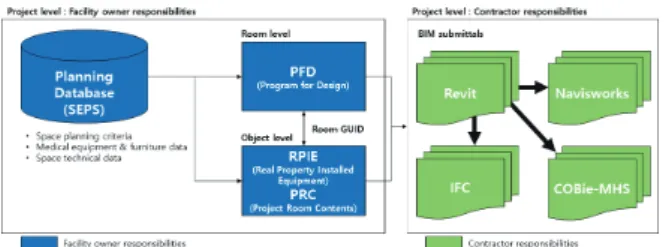
The final submittals of the project should include a COBie- MHS format that allows information to be linked through USACE's facility operations and maintenance systems, DMLSS-FM and DMLSS-E & TM. USACE, the owner of the facility, has a basic planning database called space and equipment planning system (SEPS), which includes detailed specifications for criteria, medical equipment & furniture data, and space technical data for space planning. The contractor is provided with the information necessary for facility lifecycle management before the project starts.

In the construction phase, the contractor must create a BIM by linking room level information (e.g. program for design, PFD) and object level information (e.g. real property installed equipment, RPIE, project room contents, PRC) to the room GUID (Figure 2). These project parameters are the basis of the information generated at the construction stage, and can actually be used for facility lifecycle management.

Requirements for these parameters are defined in the BIM minimum requirements (BMR). This definition contains the required input information for the parameter name, parameter type (e.g. project, room, object), description, and information type.

4.3 BIM standard for FLCM

In some cases, it is difficult to understand the purpose of the facility owner's BIM from the perspective of the contractor carrying out the BIM project. But, USACE sets the project goals and BIM objectives for medical facilities through the MHS BIM objectives document. The objectives of BIM included in the MHS BIM objective document include: LOD, PFD validation, equipment validation, DMLSS- facility management (FM) integration, DMLSS-equipment

& technology management (E & TM) integration, energy,

Contract data Contents

Contractor S Construction Co., Ltd.

Date of award 26 Sep 2013

Total contract amount 24,489,367,549 KRW (22,361,380 USD) Full notice to proceed (NTP) issued 26 Sep 2013

Performance period 1,412 calendar days after NTP

New addition only 824 days

Construction complete date (CCD) 08 Aug 2017 Table 1. General contract data

Figure 2. The schema of BIM based project delivery process

(6)

planning & programming analysis, initial outfitting & transition (IO & T) support, interoperability of required elements across the FLCM. USACE has designated BIM software (e.g. Revit 2013 or later) that should be used in the project.

In addition, it is required that the submittals should be operable, compatible, and editable through BIM software.

In the long term, regardless of the type of BIM software, standardization is pursued, but the project provided a BIM project environment file (e.g. revit template) for BIM software designated as an effort to standardize submittals.

The contractual aspect requires the contractor to submit a BIM project execution plan (BEP) on how to fulfill the facility owner's BIM requirements. BEP includes project information, key project contacts, project goals, BIM objectives, organizational roles & staffing, BIM process design, BIM information exchange worksheet, minimum modeling and data requirements, collaboration procedure, quality control, technological infrastructure needs, model organization, project deliverables, etc. If the BEP is not approved by USACE, no payment will be made to the contractor, or if the BIM is not implemented as planned by the contractor to the BEP, payment may be withheld. Other advantages of facility owners receiving standardized BEP are as follows. Providing standard forms can add efficiency to BEP creation and speed up the review and approval process.

In particular, in the construction phase among various BIM uses, Interference management (3D coordination), record modeling, and COBie-MHS are designated as mandatory items. These are BIM uses that are directly related to managing the quality of final as-built BIM and CAD data submittal, which is necessary for facility lifecycle management.

In addition, it is a rule to document any contracted items that the contractor has decided to perform in the BEP. Even if it is an optional item, the item decided to be carried out in the project is included in the contract and must be fulfilled.

These contents are required to submit BIM process design, BIM information exchange worksheet, minimum modeling matrix (M3) for BIM use suggested by contractor through the appendix of BEP. In particular, M3 defines the minimum data requirements for the project's BIM model. The M3 document consists of introduction, modeling requirements, and scope- LOD-grade. The contractor must fill in the M3 form with

reference to one or more of the standard classification systems (e.g. omniclass, uniformat, masterformat). In this case, considering the characteristics of the project, the work scope, LOD, and grade should be filled with reference to the guidelines provided by USACE. USACE's project is characterized by providing detailed criteria for managing the quality of the BIM model. Through this standard, USACE has established a procurement process to ensure the quality of the as-built documents that are finally submitted by properly managing the quality of intermediate submissions.

4.4 BIM submittals for FLCM

The BIM model built by the contractor based on BEP and BIM standards for facility lifecycle management is shown in figure 3. USACE required the contractor to input detailed specification information on equipment used by facility users in operating the hospital facility into the BIM model. In addition, a dataset that is a working environment for authoring BIM model was developed in advance. In this project, templates for modeling using Revit were provided for disciplines. In the template, the library DB required for modeling, as well as the view system and the final calculated schedule are basically included.

Building the BIM model and checking the information contained in it must be done repeatedly and continuously in the project delivery process. USACE requires the BEP to include a recurring quality control (QC) and a quality assurance (QA) plan for step-by-step submittals.

Additionally, a review plan for CAD standards, model standards, and parameters should be reflected in the BEP.

In relation to the quality management of the BIM model,

Figure 3. As-built BIM for FLCM

(7)

the BEP should include a plan to perform visual check, interference check, model integrity check, version updating check, revision authority check, etc. The purpose of this documentation is to build a procurement system to receive information that can be directly used for facility lifecycle management from contractors.

The format of the data supplied by the contractor includes a BIM model (e.g. *.rvt) written in Revit, a BIM authoring tool, a viewer BIM model (e.g. *.nwc) extracted from the original BIM model, and a neutral BIM model (e.g. *.ifc).

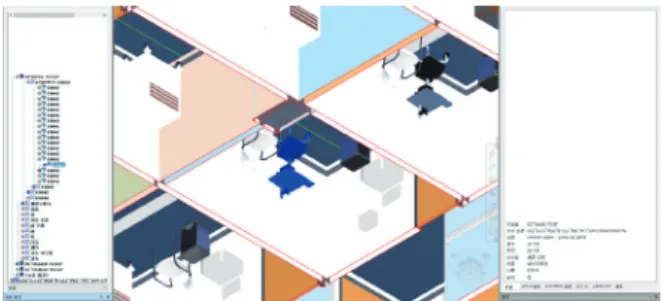
Many people have the illusion that the BIM model will only be good for facility lifecycle management due to the advantages of the visualization aspect of 3D-expressing buildings and the database aspect of the BIM model created based on objects. However, as shown in Figure 4, checking the information of a specific object in the BIM model has a limitation in that it is necessary to check the information by searching for the location of the object in the 3D model and selecting the searched object.

In the case of a viewer file, it is possible to automatically search based on information of an object through BIM viewer software such as Navisworks. However, in order to check the information and hierarchy of an object, the information contained in the object, as shown in Figure 5, must be indirectly checked through the selection tree or the property window. From the point of view of the facility owner who needs to manage the facility lifecycle, this is considered to be a very inconvenient and inefficient information search process. The strong advantage of BIM is that it contains a lot of information, as reviewed through literature reviews earlier. However, even if information is input to the BIM model at the LOD 500 level, if it is inconvenient to search for and extract the necessary information, the facility owner has no choice but to perform a task for generating separate information.

On the other hand, COBie sheets cannot be extracted directly from the BIM model, but can be extracted through Autodesk COBie toolkit, an add-in installed in Revit. The COBie sheet is constructed so that quite a lot of information can be entered directly or indirectly in facility lifecycle management. For such information, the contractor must construct the BIM model according to the requirements of the facility owner, and manually enter the parameter values according to the object type (e.g. room, equipment, furniture, etc.). In the case project, the contractor established and approved the BIM project delivery process in compliance with the BIM standard suggested by the facility owner.

From the contractor's point of view, authoring a BIM model through a detailed design drawing and inputting additional information necessary for facility lifecycle management into the BIM model are separate tasks. Because there is a large amount of information that needs to be built for facility lifecycle management, integrating the two tasks is the best way to reduce the workload.

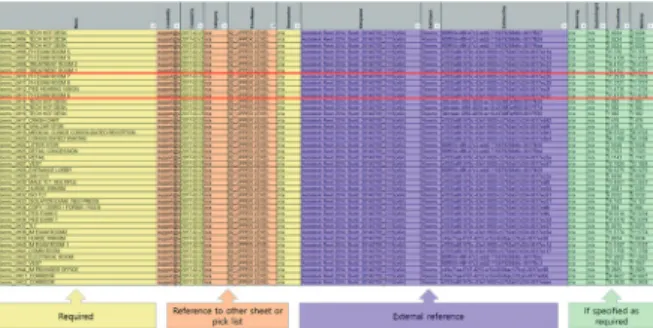
COBie-MHS is a worksheet containing information on hospital facilities, and the tab that contains the space information included in the project as shown in figure 6 and the tab that contains component information included in the project as shown in figure 7 are typical. In the COBie- MHS sheet, information contained in different tabs is linked through the room GUID. The colors displayed in a single tab are classified as 'required (yellow)', 'reference to other sheet or pick list (orange)', 'external reference (violet)', and 'if specified as required (green)'. Since the BIM model was constructed by linking room level information and object level information through a room GUID, desired information can be easily extracted by filtering categories from the extracted spreadsheet. In particular, information on a space including specific components can be extracted, and on the Figure 4. Example of checking information of a specific object

from the BIM model

Figure 5. Example of checking information of a specific object

from a viewer file

(8)

contrary, information on components included in a specific space can be extracted.

Figure 8 shows the components included in the room called UH10. From the perspective of the facility owner who manages the facility lifecycle, room information indicating the assets and location of the assets included in the facility is essential. Thus, if the facility owner specifies the requirements for BIM procurement areas, BIM project delivery process, BIM standard, and BIM submittals to the contractor, the end user (e.g. facility owner, facility manager, etc.) of the information can acquire information necessary for facility lifecycle management without any restriction on reproducing information or interoperability.

5. Discussion

This study performed case analysis on the BIM based project delivery process required for facility lifecycle management. The roles required for facility owners

to receive information necessary for facility lifecycle management from contractors are summarized as follows.

The first is to clarify the roles and responsibilities of facility owners and contractors by defining BIM procurement areas. Second, the BIM project delivery process should be presented to potential contractors who will participate in various projects of facility owners from a long-term perspective. Otherwise, the facility owner faces a plethora of useless information and the reproduction of information. It is also included in the efforts of the facility owner to specify the BIM use that should be included in the BEP. Third, a detailed BIM standard for constructing a BIM model including information and inputting information should be established.

The BIM standard should consider data compatibility issues with the facility owner's FM system. If necessary, as in the case of USACE, in the short term, the facility owner should designate the BIM SW or provide a modeling template for disciplines. In addition, it is necessary for facility owners to provide standards and methods for submitting COBie- MHS to overcome compatibility. Fourth, quality management of BIM submittals is essential. Because the amount of information required for facility lifecycle management is very large, it is impossible to input information at once and check the quality normally. Therefore, it is necessary to perform repetitive and continuous quality control in the BIM project delivery process and quality assurance for interim submittals. Otherwise, rework should be repeated to filter information required for facility lifecycle management from unrefined chunks of information. This is very unproductive for facility owner.

6. Conclusions

This study suggested implications for the role and responsibilities of the facility owner rather than the contractor through a very specific case study of the BIM-based project delivery process for facility lifecycle management. Despite these contributions, the limitations of this study are as follows.

This study analyzed cases of a single USACE project conducted in Korea. Due to the small number of cases, there is a limit to verifying the effectiveness of the procurement Figure 6. COBie-MHS : information of space

Figure 7. COBie-MHS : information of components

Figure 8. COBie-MHS : Components of specific space(UH10)

(9)

process. In addition, this study was conducted for facility owner requesting information on facility spaces and assets included in spaces. Depending on the characteristics of the facility owner, research on building information to manage the lifecycle of aging facilities (e.g. structural safety, aging MEP, etc.) is also necessary. Finally, it is difficult to conclude that the COBie format is a fundamental alternative for facility lifecycle management. The process of extracting COBie- MHS in compliance with the requirements of USACE is very complex and has a lot of work. Crucially, inputting the data required for facility lifecycle management to the BIM model is not only done manually, but also has the inconvenience of using an add-in to extract COBie-MHS from the BIM model.

Even if the facility owner has established a systematic BIM- based project delivery process, such repetitive manual work is a barrier to the integration of BIM for facility lifecycle management.

Therefore, there is a need to develop a technology that automatically inputs information required for facility lifecycle management into a COBie sheet rather than a BIM model, and links it back with the BIM model. In addition, it is necessary to study the economic benefits that facility owners will have when using BIM for facility lifecycle management.

This can be a catalyst for improving the level of design and construction procurement systems. Finally, in order to fill in the blanks of existing studies for integrating BIM into facility lifecycle management, a case study should be conducted for facility owners who request information about the structural BIM model and MEP BIM model in terms of the scope of the study.

Acknowledgements

This work was supported by the research fund of Hanyang Cyber University.

References

Baldwin, M. (2019). The BIM-Manager: A Practical Guide for BIM Project Management, Mensch und Maschine Schweiz AG, Beuth Verlag, ISBN 3410268227.

Cavka, H. B., Staub-French, S., Poirier, E. A. (2017).

Developing owner information requirements for BIM- enabled project delivery and asset management.

Automation in construction, 83, pp. 169-183.

Computer Integrated Construction Research Program. (2013).

BIM Planning Guide for Facility Owners, Version 2.0, June, The Pennsylvania State University, University Park, PA, USA., Available at http://bim.psu.edu. (Sep. 23. 2020).

East, E. W. (2012). Construction-Operations Building information exchange (COBie) buildingSMART alliance, National Institute of building Sciences, Washington, DC., NIBS Official Website. http://www.nibs. org/?

page=bsa_cobie (Mar. 30. 2020).

Eastman, C. M., Jeong, Y. S., Sacks, R., Kaner, I. (2010).

Exchange model and exchange object concepts for implementation of national BIM standards. Journal of Computing in Civil Engineering, 24(1), pp. 25-34.

Fadeyi, M. O. (2017). The role of building information modeling (BIM) in delivering the sustainable building value.

International Journal of Sustainable Built Environment, 6(2), pp. 711-722.

Giel, B., Issa, R. R. (2016). Framework for evaluating the BIM competencies of facility owners. Journal of management in engineering, 32(1), 04015024.

Glema, A. (2013). Public Buildings Service BIM Standards as Mandatory Procedures for Architects and Engineers.

In 20th International Conference on Computer Methods in Mechanics CMM-2013, Pozna , pp. 27-31.

Gokce, K. U., Gokce, H. U. (2013). IFC View for Bill of Quantities for Software Interoperability. In Proceedings of the 30th CIB W78 International Conference, pp. 827-836.

Ham, N., Lee, S. H. (2018). Empirical Study on Structural Safety Diagnosis of Large-Scale Civil Infrastructure Using Laser Scanning and BIM. Sustainability, 10(11), 4024.

Ham, N., Moon, S., Kim, J. H., Kim, J. J. (2018). Economic

analysis of design errors in BIM-based high-rise construction

projects: Case study of Haeundae L Project. Journal of

Construction Engineering and Management, 144(6), 05018006.

(10)

Ham, N., Moon, S., Kim, J. H., Kim, J. J. (2020). Optimal BIM staffing in construction projects using a queueing model.

Automation in Construction, 113, 103123.

Hietanen, J., Final, S. (2006). IFC model view definition format. International Alliance for Interoperability, pp. 1-29.

Klein, L., Li, N., Becerik-Gerber, B. (2012). Imaged-based verification of as-built documentation of operational buildings. Automation in Construction, 21, pp. 161-171.

Lam, K. P., Karaguzel, O. T., Zhang, R., Zhao, J. (2012).

Identification and analysis of interoperability gaps between Nbims/Open standards and building performance simulation tools. Center for Building Performance and Diagnostics, Carnegie Mellon University: Pittsburgh, PA, USA.

Lavy, S., Jawadekar, S. (2014). A case study of using BIM and COBie for facility management. International Journal of Facility Management, 5(2).

Lee, G., Park, H. K., Won, J. (2012). D3 City project—

Economic impact of BIM-assisted design validation.

Automation in Construction, 22, pp. 577-586.

Lee, J. S., Kwon, N., Ham, N. H., Kim, J. J., Ahn, Y. H.

(2019). BIM-Based Digital Fabrication Process for a Free- Form Building Project in South Korea. Advances in Civil Engineering, 2019, https://doi.org/10.1155/2019/4163625 Lee, Y. C., Eastman, C. M., Solihin, W. (2016). An ontology-

based approach for developing data exchange requirements and model views of building information modeling. Advanced Engineering Informatics, 30(3), pp. 354-367.

Lin, Y. C., Chen, Y. P., Huang, W. T., Hong, C. C. (2016).

Development of BIM execution plan for BIM model management during the pre-operation phase: a case study. Buildings, 6(1), pp. 1-14.

Liu, R., Issa, R. R. A. (2013). Issues in BIM for facility management from industry practitioners' perspectives. In Computing in Civil Engineering, pp. 411-418. https://doi.

org/10.1061/9780784413029.052

L i u , Y . , V a n N e d e r v e e n , S . , H e r t o g h , M . ( 2 0 1 7 ) . Understanding effects of BIM on collaborative design and construction: An empirical study in China. International Journal of Project Management, 35(4), pp. 686-698.

Nawari, N. O., Sgambelluri, M. (2010). The role of n a t i o n a l B I M s t a n d a r d i n s t r u c t u r a l d e s i g n . I n Structures Congress 2010, pp. 1660-1671. https://doi.

org/10.1061/41130(369)151.

Oraee, M., Hosseini, M. R., Papadonikolaki, E., Palliyaguru, R., Arashpour, M. (2017). Collaboration in BIM-based construction networks: A bibliometric-qualitative literature review. International Journal of Project Management, 35(7), pp. 1288-1301.

Sacks, R., Eastman, C., Lee, G., Teicholz, P., (2018). BIM handbook: A guide to building information modeling for owners, designers, engineers, contractors, and facility managers, 3rd ed., John Wiley & Sons, Inc., DOI:10.1002/9781119287568.

Sarel, L., Nishaant, S. (2015). Quantifying the effect of using BIM and COBie for facility management on work order processing times: a case study.

Singh, V., Gu, N., Wang, X. (2011). A theoretical framework of a BIM-based multi-disciplinary collaboration platform.

Automation in construction, 20(2), pp. 134-144.

Travaglini, A., Radujkovi , M., Mancini, M. (2014). Building information Modelling (BIM) and project management: A Stakeholders perspective. Organization, technology &

management in construction: an international journal, 6(2), pp. 1001-1008.

Volk, R., Stengel, J., Schultmann, F. (2014). Building Information Modeling (BIM) for existing buildings—Literature review and future needs. Automation in construction, 38, pp. 109-127.

William East, E., Nisbet, N., Liebich, T. (2013). Facility management handover model view. Journal of computing in civil engineering, 27(1), pp. 61-67.

Yalcinkaya, M., Singh, V. (2015). Examining the evolution

of COBie standards in building information modelling

for facilities management. In 32nd CIB W78 Information

Technology for Construction Conference (CIB W78 2015),

Eindhoven, The Netherlands.

수치

Figure 1. BIM procurement areas [2]
Figure 2. The schema of BIM based project delivery process
Figure 5. Example of checking information of a specific object  from a viewer file
Figure  8  shows  the  components  included  in  the  room  called  UH10.  From  the  perspective  of  the  facility  owner  who  manages  the  facility  lifecycle,  room  information  indicating the assets and location of the assets included in  the  faci

참조

관련 문서