Ⅰ. 서 론
아동기에 나타나는 섭식장애(feeding disorder)는 성
장・발달에 필요한 영양수준을 유지하지 못할 정도로 음 식 섭취가 어렵거나 음식을 거부하는 경우를 말한다 (Babbitt, Hoch, & Coe, 1994; Piazza, Patel, Gulotta,
대한감각통합치료학회지 제19권 1호
The Journal of Korean Academy of Sensory Integration 2021 Vol. 19. No. 1
http://dx.doi.org/10.18064/JKASI.2021.19.1.39
섭식장애가 있는 아동의 연하재활치료 : 체계적 고찰
전주영
*, 박혜연
***연세로이재활의학과 의원 소아작업치료실 작업치료사
**연세대학교 보건과학대학 작업치료학과 조교수
국문초록
목적 : 체계적 문헌고찰을 통해 섭식장애가 있는 아동의 질환에 따른 연하장애를 증상별로 세분화하고 증상 에 따른 치료방법을 알아보고자 한다.
연구방법 : 데이터베이스는 PubMed, Medline, CINAHL을 통해 검색하였다. PRISMA, PICOS를 이용하여 연구를 선정하고 체계적 고찰을 시행하였다. 최종적으로 연구에 사용한 문헌은 총 13개로 연구의 질적수 준, 질환군, 평가도구, 중재방법, 중재 후 효과에 대해서 분석하였다.
결과 : 총 13편의 연구를 분석한 결과 섭식장애가 있는 아동의 질환군은 자폐스펙트럼장애(Autism Spectrum Disorder; ASD)는 6편(46.15%), 뇌성마비(Cerebral Palsy; CP)는 7편(53.85%)으로 나타났다. 섭식 장애 중재를 받은 아동의 연령대는 ASD는 2-8세, CP는 12개월-18세까지로 확인하였다. 평가영역에서 ASD는 행동평가, CP는 구강과 삼킴기능 평가영역이 가장 많았다. 중재방법에서 ASD는 행동수정이 가 장 많았고, CP는 구강감각운동, 음식질감조절, 전기자극치료가 각각 동일한 빈도로 적용된 것으로 나타 났다. 중재 후 치료효과에서는 모두 효과가 있었다.
결론 : 본 연구에서 섭식장애가 있는 아동의 질환군, 적용되는 평가도구, 중재방법을 고찰을 통해 알아보았 다. 본 연구가 질환에 따른 평가와 중재 선택 시 임상가들이 시행착오를 거치지 않고 효율적인 섭식장애 중재를 적용할 수 있는 프로토콜 개발을 하는데 기초자료로 활용될 수 있을 것으로 기대한다.
주제어 : 발달장애, 섭식장애, 신경발달장애, 연하재활치료
교신저자: 박혜연([email protected])
접수일: 2020.12.10. ∥심사일: (1차: 2021.01.06. / 2차: 2021.01.28.) ∥게재확정일: 2021.06.14.
Sevin, & Layer, 2003; Yang & Chung, 2007). 섭식장 애는 정상아동에게서는 약 20~45%, 발달장애와 신경학 적 장애가 있는 아동에게서는 약 80%이상 나타난다고 보 고되고 있다(Linscheid, Budd, & Rasnake, 2003;
Manikam & Perman, 2000; Rogers, Arvedson, Buck, Smart, & Msall, 1994; Seo & Kim, 2018). 특히, 발달장 애와 신경학적 장애가 있는 아동은 정상아동과는 다르게 운동 및 감각 기능조절의 문제, 지각 및 인지 문제, 음식의 질감이나 종류, 식사도구, 식사 시 주변 환경 변화에 민감 하게 반응하여 충분한 영양 공급이 어려우며(Fung et al., 2002), 섭식장애가 지속이 된다면 아동에게는 영양부족 으로 인한 성장 장애(failure to thrive)를 초래하고 가족 들에게는 양육스트레스를 야기할 수 있다고 보고하고 있 다(An, Joung, Jang, & Kwon, 2014; Kuperminc et al., 2013). 따라서 섭식장애로 인하여 아동의 성장과 발달에 부정적인 영향을 미칠 뿐만 아니라 아동과 가족들의 삶의 질을 저하시키게 된다.
각 질환마다 질환 특성에 따른 다른 중재 방법들을 적 용하는 것을 확인할 수 있었는데, 신경학적 장애를 동반 한 섭식장애 아동은 운동기능 손상으로 인해서 삼킴근 육의 기능저하로 인해 흡인(aspiration)위험이 높으며 (Arvedson, 2013), 이로 인해 흡인성 폐렴이 나타난다 고 보고하였다(Arslan, Demir, & Karaduman, 2017).
또한 씹기 능력 저하로 식괴형성(bolus formation)부족 하여 구강단계(oral phase)에서 인두단계(pharyngeal phase)로 음식물의 이동이 어려워 음식물 섭취에 제한을 받게 된다(Arslan, Demir, & Karaduman, 2017). 신경 학적 장애를 동반한 섭식장애 아동을 위해 치료실에서 제 공하고 있는 연하재활치료는 보상적 접근과 치료적 접근 으로 나눌 수 있다. 보상적 접근으로는 섭식 자세조절, 음 식의 점도 조절, 다양한 맛을 제공하는 전략 등이 있으며 (Song & Jung, 2018), 이를 위한 치료기술로는 섭식 자세 조절(positioning), 음식질감조절(texture modification) 이 있다. 치료적 접근인 구강운동과 감각자극 중재는 구 강구조물의 기능적인 변화를 촉진시켜 안전하게 삼키는 것을 목적으로 진행하며(Song & Jung, 2018), 이에 대한 치료기술로는 구강감각운동(oral sensorimotor therapy), 전기자극(Neuro Muscular Electrical Stimulation;
NMES)이 있다. 하지만, 섭식장애 아동들마다 문제요소 들이 제각각이고, 발달수준이 달라 효과적인 개별 맞춤
치료 프로그램을 계획하는 것은 어렵다고 보고하고 있다 (Arvedson, 2013).
발달장애를 가진 아동에서는 먹는 것을 거부(음식을 뱉기, 토하기, 물고있기 등)하거나 한정된 질감, 맛의 음 식을 과도하게 섭취하는 행동적인 문제가 나타난다 (Chatoor & Ganiban, 2003; Yang & Chung, 2007). 이 를 위한 치료로는 행동수정치료(behavior modification) 가 가장 효과적이나(Kerwin, 1999; Linscheid, 2006;
Yang & Chung, 2007), 치료실에서는 효과를 보이지만 다른 장소(집, 식당 등)나 다른 급식자(feeder)에 따른 일반화가 어렵고, 효과를 보기까지 시간, 비용에 대한 효 율성에 대한 문제, 증상에 따른 효과적인 치료법 제시를 하지 못하는 등 단점들이 노출되고 있다(Van der burg, Didden, Jongerius, & Rotteveel, 2007; Yang &
Chung, 2007). 이렇듯 섭식장애 아동을 대상으로 한 다 양한 연구들이 진행되고 있으나, 연구대상의 섭식장애에 미치는 문제 요소와 증상이 다양하고 그로 인한 중재의 일반화가 어렵기 때문에 질환에 따른 효과적이고 객관적 인 치료방법을 제시하지 못하고 있다.
따라서 본 연구에서는 섭식장애를 보이는 아동을 위한 연하재활치료의 효과적인 치료적 접근을 위해서 체계적 문헌고찰을 통해 섭식장애가 있는 아동의 질환에 따른 연하장애를 증상별로 세분화하고 증상에 따른 중재방법 을 알아보고자 한다. 이를 통해 작업치료사들이 섭식장 애 증상에 따른 효과적인 연하재활치료를 선택할 수 있 는 기초자료를 마련하고자 한다.
Ⅱ. 연구 방법 1. 문헌 검색 및 자료 수집
본 연구를 위해서 문헌검색용 데이터베이스는 PubMed, Medline Complete(EBSCOhost), 학술연구정 보서비스(RISS)를 이용하였으며, 1 저자가 대학원생으 로 재학 중인 ‘연세대학교 학술정보원’을 통해 위에서 제 시된 데이터베이스에 접근할 수 있었으며, 여기서 검색 된 논문의 전문(full text)을 볼 수 있었다.
검색용어는‘(dysphagia OR "deglutition disorder" OR
"swallowing disorder" OR "feeding disorder") AND
("cerebral palsy" OR "Autism spectrum disorder" OR
"developmental disorder") AND (management OR treatment OR therapy OR rehabilitation)’로 사용하였 다. 각 데이터베이스에서 얻은 자료들을 확인하여 중복검색 된 자료들과 다음 포함 기준과 배제 기준을 토대로 분석대상 논문을 선별하였다.
2. 포함 기준 및 배제 기준
섭식장애 아동을 대상으로 한 연하재활치료를 고찰하 기 위해서, 다음과 같은 포함 기준 및 배제 기준을 설정 하였다. 분석논문에 대한 선정 기준은 연구편향(bias) 를 줄이고 연구의 질을 독립적으로 평가하기 위해서 PICOS(Population, Intervention, Comparison, Outcomes, Study design) Framework를 사용하였다. 본 연구에서 는 고찰한 연구 선정은 PICOS를 통해 5개 영역인 연구 대상자, 연구 중재, 연구 평가 방법, 연구 결과, 연구 설계 를 기반으로 선정하였다(Table 1)(Richardson, Wilson, Nishikawa, & Hayward, 1995).
첫째, 연구 대상자는 18세 미만으로 신경발달장애(뇌 성마비, 외상성 뇌손상 등) 또는 발달장애(지적장애, 자 폐스펙트럼장애, 각종 증후군) 진단을 받은 아동으로 선 정하였다. 둘째, 연구 중재는 섭식장애 아동의 음식물 섭 취 증진을 위해 시도한 모든 치료방법이 적용된 연구들 을 선정하였다. 셋째, 연구 평가 방법은 중재 전과 중재 후를 비교하여 중재효과를 확인한 연구들을 선정하였다.
넷째, 연구 결과는 각 연구마다 제시된 연구 목표를 달성 한 연구로 중재적용 후 입으로 먹는 횟수나 먹는 양이 늘 었거나, 식이단계 수준 또는 구강운동기술이 향상한 연
구를 선정하였다. 다섯째, 연구 설계는 사례연구, 단일 실험연구, 무작위 대조군 연구로 선정하였다.
3. 문헌 선별 과정 및 선정
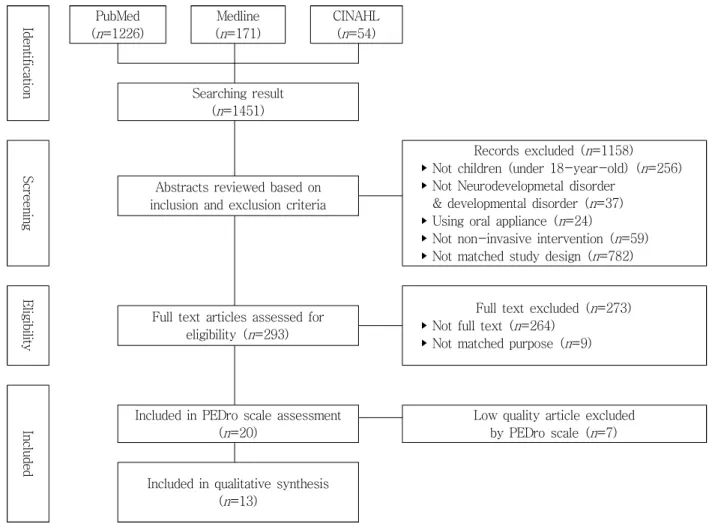
문헌의 수집과 선별은 저자 2인이 각각 검토하고 진행 하였다. 연구 선정에 대한 의견이 일치하지 않는 경우에 자료의 선정기준과 연구를 재검토하여 합의하는 과정을 거쳤다. 연구 자료는 PRISMA(Preferred Reporting Items for Systematic Reviews and Meta-Analyses) 흐름도 를 이용하여 수집하고 분석하였다(Moher, Liberati, Tetzlaff, & Altman, 2009). PubMed에서 1226편, Medline에서 171편, CINAHL에서 54편으로 총 1451편 의 문헌들이 검색되었으며, 1차에는 PICOS 포함기준과 배제기준에 따라 문헌 확인을 통해 293편이 선정되었고, 2차에서는 연구 전문을 볼 수 없고, 연구목적이 적합하 지 않는 경우에는 제외하여 총 20편의 문헌이 선정되었 다. 연구의 질을 평가하는 PEDro scale이 3점 미만인 연 구를 제외시켜 최종적으로 13편의 연구가 선정되었다 (Figure 1).
4. 문헌의 질 평가
본 연구에서 선정된 13개 연구의 질적수준 분석을 위 해 저자 2인이 Physiotherapy Evidence Database (PEDro) Scale을 수행하였다. 우선 저자 2인이 각각 13 개의 연구에 대해서 PEDro scale을 수행 후 점수가 다를 경우 합의를 통해 11항목에 대해서 최종 채점을 완료하 였다(Table 2). PEDro scale은 문헌에 대한 일정 수준의
Components Detail
Participants
Under 18-year-old
Diagnosed with neuro-developmental disorder (cerebral palsy, traumatic brain injury etc), Developmental disorder(intelligence disorder, autism spectrum disorder, other syndrome)
Intervention
Therapy for oral intake with non-invasive intervention
(ex> oral sensorimotor, positioning, texture modification, neuromuscular electrical stimulation, behavior modification, family intervention etc)
Comparison Pre and post intervention
Outcome Increase oral intake, food texture, oral motor skill Decrease behavior problem
Study design Case report, single case design, randomized controlled trial Table 1. Inclusion and exclusion criteria according to PICOS
외적 및 내적타당도를 제공하여 치료적 중재의 질적 수 준을 평가할 수 있으므로 재활의학 분야에서 사용되는 도구이다. 총 11항목으로 각 항목에 해당하는 경우는 1 점, 해당하지 않거나 불확실한 경우는 0점이다. 총점은 10점으로 1번 항목을 제외하고 2번에서 11번까지 항목의 합이다. 총점 3점 이하는 낮은 질적 수준, 4-5점은 중증 도의 질적 수준, 6-8점은 높은 수준의 질적 수준, 9-11 점은 아주 높은 질적 수준을 의미한다.
Ⅲ. 연구 결과 1. 연구대상
본 연구에서 분석한 13편의 PEDro scale은 모두 3 점 이상으로 나타났다(Table 2). 섭식장애가 있는 아 동들의 진단군은 자폐스펙트럼장애(Autism Spectrum
Disorder; ASD) 아동을 적용한 연구가 6편(46.15%), 뇌 성마비 (Cerebral Palsy; CP) 아동을 적용한 연구가 7편 (53.85%)으로 확인할 수 있었다(Table 3). 진단별 섭식 장애를 보여 중재에 의뢰된 연령은 ASD 진단을 받은 아 동들은 최소 2세부터 최대 8세, CP 진단을 받은 아동들 은 최소 12개월부터 최대 18세까지로 나타났다(Table 4).
단, Christiaanse 등(2011)의 연구에서는 연구대상을 아 동이라고 명시를 하였으나, 구체적인 연령은 제시하지 않았다.
2. 질환별 평가도구
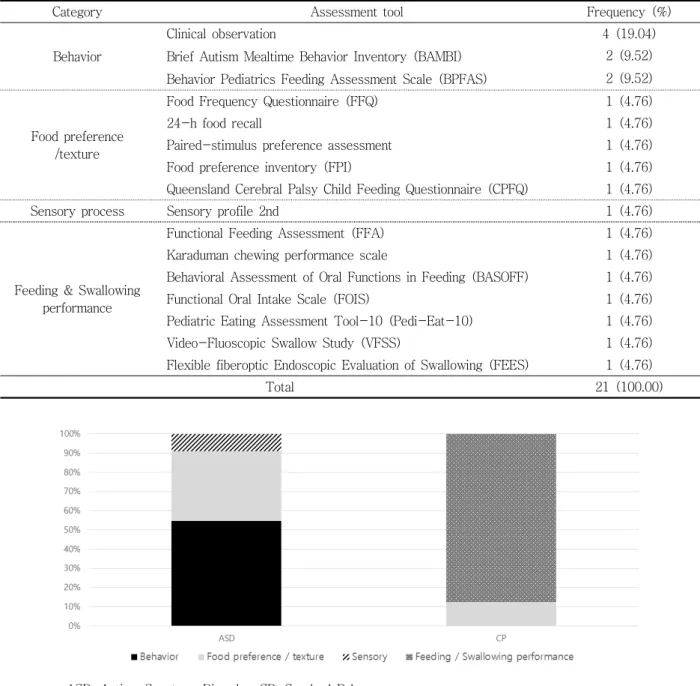
섭식장애가 있는 아동에게 중재를 적용하기 전・후 효 과를 비교하기 위해 적용한 평가도구는 총 21가지로 같 은 영역끼리 묶어서 정리해 놓았다(Table 5). 평가도구 에서 임상관찰(clinical observation)을 적용한 연구가 4개(19.04%)로 가장 많았고, Brief Autism Mealtime
Id en tif ic at io n
PubMed (
n
=1226)Medline (
n
=171)CINAHL (
n
=54)Searching result (
n
=1451)S cr een in g
Records excluded (
n
=1158) ‣ Not children (under 18-year-old) (n
=256) ‣ Not Neurodevelopmetal disorder& developmental disorder (
n
=37) ‣ Using oral appliance (n
=24)‣ Not non-invasive intervention (
n
=59) ‣ Not matched study design (n
=782) Abstracts reviewed based oninclusion and exclusion criteria
E lig ib ilit y
Full text excluded (
n
=273) ‣ Not full text (n
=264)‣ Not matched purpose (
n
=9) Full text articles assessed foreligibility (
n
=293)In cl ude d
Included in PEDro scale assessment (
n
=20)Low quality article excluded by PEDro scale (
n
=7)Included in qualitative synthesis (
n
=13)Figure 1. PRISMA flow diagram for literature search and study inclusion
Behavior Inventory(BAMBI), Behavior Pediatrics Feeding Assessment Scale(BPFAS)를 적용한 연구가
각각 2개(9.52%)로 나타났다.
또한 진단별로 적용된 평가도구에서 차이가 있는 것으
No Author Item PEDro
Scale Quality
1 2 3 4 5 6 7 8 9 10 11
1 Croft (1992) ⋁ ⋁ ⋁ ⋁ ⋁ ⋁ 5 Fair
2 Larnert & Ekberg (1995) ⋁ ⋁ ⋁ ⋁ 4 Fair
3 Dematteo, Law & Goldsmith (2002) ⋁ ⋁ ⋁ ⋁ ⋁ 5 Fair
4 Christiaanse et al. (2011) ⋁ ⋁ ⋁ ⋁ ⋁ 5 Fair
5 Sığan et al. (2013) ⋁ ⋁ ⋁ ⋁ ⋁ 5 Fair
6 Sharp et al. (2014) ⋁ ⋁ ⋁ ⋁ ⋁ ⋁ ⋁ ⋁ 8 Good
7 Peterson et al. (2016) ⋁ ⋁ ⋁ ⋁ ⋁ ⋁ ⋁ 7 Good
8 Arslan & Karaduman (2017) ⋁ ⋁ ⋁ ⋁ ⋁ ⋁ ⋁ 7 Good
9 Cosbey & Muldoon (2017) ⋁ ⋁ ⋁ ⋁ ⋁ 5 Fair
10 Seiverling et al. (2018) ⋁ ⋁ ⋁ ⋁ ⋁ 5 Fair
11 Hillman (2019) ⋁ ⋁ ⋁ ⋁ ⋁ 5 Fair
12 Crowley et al. (2020) ⋁ ⋁ ⋁ ⋁ 4 Fair
13 Umay, Gurcay, Ozturk &
Akyuz (2020) ⋁ ⋁ ⋁ ⋁ ⋁ ⋁ ⋁ ⋁ 8 Good
Table 2. PEDro Scale for researches
Diagnosis Frequency (%)
Autism Spectrum Disorder (ASD) 6 (46.15)
Cerebral Palsy (CP) 7 (53.85)
Total 13 (100.00)
Table 3. Diagnosis of participants
Diagnosis Study Ages (years)
1 2 3 4 5 6 7 8 9 10 11 12 13 14 15 16 17 18
ASD
Cosbey & Muldoon (2017) Crowley et al. (2020)
Hillman (2019) Peterson et al. (2016) Seiverling et al. (2018) Sharp et al. (2014)
CP
Croft (1992) Larnert & Ekberg (1995)
Dematteo, Law &
Goldsmith (2002)
Christiaanse et al. (2011) Nor recorded
Sığan et al. (2013) Arslan & Karaduman (2017) Umay, Gurcay, Ozturk & Akyuz
(2020)
* ASD: Autism Spectrum Disorder, CP: Cerebral Palsy Table 4. Distribution of age by diagnosis
로 나타났다(Figure 2). ASD 아동에게는 행동을 측정하 는 평가도구가 55%로 가장 많았고, 다음으로 선호하는 음식과 질감을 측정하는 평가도구(36%), 감각처리를 측 정하는 평가도구(9%) 순이었다. CP 아동에게는 구강과 삼킴기능 평가도구가 88%로 가장 많았으며, 다음으로는 선호하는 음식과 질감을 측정하는 평가도구가 12%를 차 지하였다.
3. 질환별 중재방법
섭식장애 향상을 위해 적용된 중재방법은 범주별로 나 누어 요약정리 하였다(Table 6). 이 중 가장 많이 적용된 중재방법은 행동수정(behavior modification)으로 9번 으로 42.85%를 차지하였으며, 그 뒤로 구강감각운동 (oral sensorimotor) 4번(19.04%), 음식질감조절(texture modification) 3번(9.52%), 전기자극(electrical stimulation)
Category Assessment tool Frequency (%)
Behavior
Clinical observation 4 (19.04)
Brief Autism Mealtime Behavior Inventory (BAMBI) 2 (9.52) 2 (9.52) Behavior Pediatrics Feeding Assessment Scale (BPFAS)
Food preference /texture
Food Frequency Questionnaire (FFQ) 1 (4.76)
24-h food recall 1 (4.76)
Paired-stimulus preference assessment 1 (4.76)
Food preference inventory (FPI) 1 (4.76)
Queensland Cerebral Palsy Child Feeding Questionnaire (CPFQ) 1 (4.76)
Sensory process Sensory profile 2nd 1 (4.76)
Feeding & Swallowing performance
Functional Feeding Assessment (FFA) 1 (4.76)
Karaduman chewing performance scale 1 (4.76)
Behavioral Assessment of Oral Functions in Feeding (BASOFF) 1 (4.76)
Functional Oral Intake Scale (FOIS) 1 (4.76)
Pediatric Eating Assessment Tool-10 (Pedi-Eat-10) 1 (4.76)
Video-Fluoscopic Swallow Study (VFSS) 1 (4.76)
Flexible fiberoptic Endoscopic Evaluation of Swallowing (FEES) 1 (4.76)
Total 21 (100.00)
* ASD: Autism Spectrum Disorder, CP: Cerebral Palsy
Figure 2. Rates of evaluation by diagnosis Table 5. Categorized and frequency of assessment tool
2번(9.52%), 부모교육(parent education) 2번(9.52%), 섭식 자세조절(positioning)과 환경수정(environmental modification)이 각 1번(4.76%) 순으로 나타났다. 특히, 행동수정에서 강화(reinforcement)가 5번(23.80%)으로 가장 빈도가 높은 것을 확인할 수 있었다.
각 진단별 적용된 치료 분류에서 차이가 나타나는 것 이 나타났다(Figure 3). ASD 아동에게 적용된 치료는 행동수정이 64.28%으로 가장 많이 차지하는 것을 확인 할 수 있었으며, 뒤를 이어 구강감각운동과 부모교육이 각각 14.28%, 환경수정이 7.14%로 나타났다.
Category Intervention Frequency (%)
Behavior modification
Individualized food acceptance hierarchial sequence 1 (4.76)
9 (42.85)
Reinforcement 5 (23.80)
Extinction 2 (9.52)
Video modeling 1 (4.76)
Oral sensorimotor
Sequential Oral Sensory approach 1 (4.76)
4 (19.04)
Pre-meal sensory integration therapy 1 (4.76)
Oral motor therapy 1 (4.76)
Functional Chewing Training 1 (4.76)
Positioning Flexed neck position with a 30° reclined sitting position 1 (4.76) 1 (4.76) Texture modification Compared mashed potato with non-mashed (soft boiled) potato 1 (4.76) 2
(9.52) Differential food texture on intake by mouth (Puree, Minced, Soft) 1 (4.76)
Electrical stimulation At digastrics muscles & infrahyoid muscles 1 (4.76) 2 (9.52)
At bilateral masseter muscles 1 (4.76)
Parent education Coached by researcher 1 (4.76) 2
(9.52)
Parent-training curriculum 1 (4.76)
Environment Environmental modification 1 (4.76) 1
(4.76)
Total 21 (100.00)
Figure 3. Rates of intervention by diagnosis Table 6. Categorized and frequency of intervention
CP 아동에게 적용된 치료는 구강감각운동, 음식질감 조절, 전기자극치료가 28.57%로 동일한 빈도로 적용되 었으며, 그 뒤를 이어 자세조절이 14.29%로 나타났다.
4. 중재별 치료효과
섭식장애를 위한 다양한 중재방법을 적용한 후 치료효
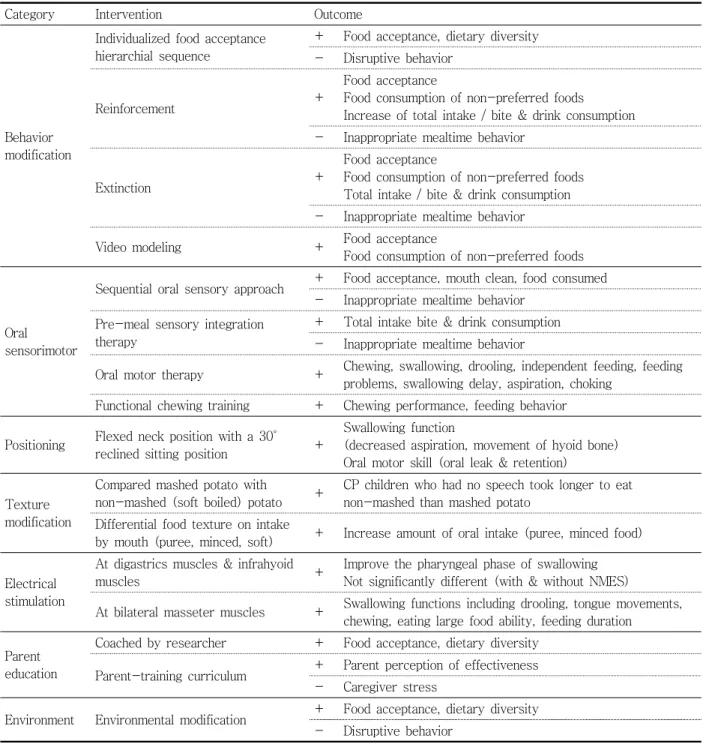
과는 다음과 같다(Table 7). 본 연구에서 분석한 중재방 법 15개 모두에서 치료효과가 나타났다.
행동수정을 적용한 연구에서의 공통된 치료효과는 음식섭취(food acceptance), 먹는 음식이 다양해지고 (dietary diversity), 선호하지 않은 음식을 먹기 시작하 며(food consumption of non-preferred foods), 먹는 양 이 늘어났다고(total intake) 나타났다. 또한 식사 시 나
Category Intervention Outcome
Behavior modification
Individualized food acceptance hierarchial sequence
+ Food acceptance, dietary diversity - Disruptive behavior
Reinforcement +
Food acceptance
Food consumption of non-preferred foods
Increase of total intake / bite & drink consumption - Inappropriate mealtime behavior
Extinction +
Food acceptance
Food consumption of non-preferred foods Total intake / bite & drink consumption - Inappropriate mealtime behavior
Video modeling + Food acceptance
Food consumption of non-preferred foods
Oral sensorimotor
Sequential oral sensory approach + Food acceptance, mouth clean, food consumed - Inappropriate mealtime behavior
Pre-meal sensory integration therapy
+ Total intake bite & drink consumption - Inappropriate mealtime behavior
Oral motor therapy + Chewing, swallowing, drooling, independent feeding, feeding problems, swallowing delay, aspiration, choking
Functional chewing training + Chewing performance, feeding behavior
Positioning Flexed neck position with a 30°
reclined sitting position +
Swallowing function
(decreased aspiration, movement of hyoid bone) Oral motor skill (oral leak & retention)
Texture modification
Compared mashed potato with
non-mashed (soft boiled) potato + CP children who had no speech took longer to eat non-mashed than mashed potato
Differential food texture on intake
by mouth (puree, minced, soft) + Increase amount of oral intake (puree, minced food)
Electrical stimulation
At digastrics muscles & infrahyoid
muscles + Improve the pharyngeal phase of swallowing
Not significantly different (with & without NMES)
At bilateral masseter muscles + Swallowing functions including drooling, tongue movements, chewing, eating large food ability, feeding duration
Parent education
Coached by researcher + Food acceptance, dietary diversity Parent-training curriculum + Parent perception of effectiveness
- Caregiver stress
Environment Environmental modification + Food acceptance, dietary diversity - Disruptive behavior
* + : Increase; - : Decrease
Table 7. Summary of intervention outcome
타나는 문제행동(disruptive behavior, inappropriate mealtime behavior)이 공통적으로 감소한 것을 확인할 수 있었다.
구강감각운동을 적용한 연구에서도 행동수정에서 나 타났던 치료효과와 동일하게 음식섭취와 먹는 양이 늘어 났으며, 추가적으로 씹기(chewing), 삼킴(swallowing), 침흘림(drooling), 흡인(aspiration)과 같이 구강 및 삼 킴기능이 좋아진 것을 확인할 수 있었다. 섭식 시 자세조 절로 인해서 구강운동기능 향상으로 인해 입안에 음식이 입 밖으로 흐르거나(oral leak), 잔여물(retention)이 남 아있지 않게 되었고, 삼킴기능 향상으로 흡인이 감소되 었고, 설골(hyoid bone)의 움직임이 향상된 것을 알 수 있었다. 음식질감조절에서는 대상 아동들이 먹고 삼키기 쉽게 같은 재료여도 다른 질감으로 바꿔 섭취량을 늘린 것으로 나타났다. 특히, 구강기능이 떨어지는 아동에게 삶거나(soft boiled), 퓨레(puree), 다진(minced) 음식 을 제공하였을 때 먹는 양이 늘어나고 그로 인해 식사시 간도 증가한 것을 확인할 수 있었다.
전기자극(electrical stimulation)에서는 자극 위치가 삼킴근육(digastrics & infrahyoid muscles)과 씹기근 육(masseter muscle)으로 차이가 있음을 확인하였다.
삼킴근육을 자극한 연구에서는 인두기 기능향상으로 삼 킴기능이 향상된 것으로 나타났으며, 씹기근육을 자극한 연구에서는 구강기 기능향상으로 침흘림, 혀의 움직임, 큰 덩어리의 음식을 먹을 수 있게 되고, 음식을 바로 삼 키지 않고 씹게 되면서 먹는 시간이 늘어났으며, 이로 인 해 삼킴기능에서도 향상된 것을 알 수 있었다.부모교육 (parent education)을 통해 음식섭취와 음식의 다양성 이 향상됨과 동시에 부모가 직접 치료에 참여하면서 아이가 좋아지는 것을 부모가 인지하게 되고 만족도가 향상하는 것으로 나타났다. 환경수정(environmental modification)은 기존 중재와 마찬가지로 음식섭취와 음 식의 다양성이 증가하였으며, 식사 시 나타나는 문제행 동이 감소하는 것으로 나타났다.
Ⅳ. 고 찰
본 연구에서 분석대상으로 선정된 연구는 총 13편이었 으며, 이 중 ASD 아동을 대상으로 한 연구 6편, CP 아동
을 대상으로 한 연구는 7편으로 고찰을 통해 섭식장애가 있는 아동의 진단군과 연령대, 섭식장애 평가도구, 섭식 장애를 치료하기 위한 다양한 중재방법과 효과에 대해서 알아보았다. 본 연구에서 ASD와 CP 진단을 받은 아동을 대상으로 한 13편 연구 중에서 나이가 정확하게 기술되 지 않은 1개 연구(Croft, 1992)를 제외하고, 나머지 12개 의 연구에서 ASD, CP 아동 모두에서 2-9세 사이의 연 령대를 대상으로 적용한 것으로 나타났다. 이는 섭식장 애가 장기간 지속이 될 경우 아동의 영양 상태가 불균형 이 발생할 수 있으며(Stallings, Charney, Davies, &
Cronk, 1993), 8세 이후까지도 섭식장애로 인한 영양문 제가 지속이 된다면 성장률이 평균이하로 떨어지기 (Schwarz, 2003) 때문에 조기치료가 중요하며 9세 이전 에 시행되는 것으로 판단된다. 본 연구 결과에 따르면 섭 식장애를 평가하기 위해 사용한 평가도구는 진단별로 차 이가 있으며, 단일 평가도구보다는 여러 평가도구를 적 용한 것으로 나타났다.
결과에 따르면 ASD 아동에게는 식사 시 나타나는 행 동양상과 선호하는 음식의 질감에 대한 평가가 많이 이 루어지는 것으로 나타났다. 이는 ASD 아동들이 행동의 유연성이 저하되어 있고 감각이 예민하며(Cermak, Curtin, & Bandini, 2010; Chistol et al., 2018;
Johnson et al., 2014), 특히 편식이 심하고 까다로운 식성과 새로운 음식에 대한 민감한 반응으로 음식을 거 부하는 등의 식사 시 나타나는 행동에 문제가(Collins et al., 2003; Cornish, 1998) 일어나기 때문에 이런 양상 을 적절하게 판별할 수 있는 평가도구를 적용한 것으로 판단된다. 또한 CP 아동에게는 음식을 섭취하고 삼키는 기능에 대한 평가도구가 압도적으로 많았다. 이는 행동 에 초점을 맞춘 ASD 아동을 위한 평가도구와 달리 CP 아동은 구강 운동기능에 초점을 두고 있다는 것을 알 수 있었다. CP는 뇌손상으로 인한 신경학적인 장애로 신체 운동 조절의 손상으로 인해서 구강감각과 운동기능 저하 가 동반되어 CP 아동의 섭식장애를 유발하는 중요한 요 인으로 CP 아동의 섭식장애는 구강운동기능 저하가 가 장 주된 원인이라고 볼 수 있다(Benfer et al., 2013;
Santoro et al., 2012). ASD, CP 아동에서 나타나는 섭 식장애는 진단별로 다른 양상을 보이지만 결과적으로 영 양에 불균형이 생기게 되어 성장에 부정적인 영향을 끼 칠 수 있기 때문에 진단에 따른 적절한 평가도구를 사용
하여 조기에 문제를 파악하여 치료하는 것이 중요하다.
섭식장애가 있는 아동을 중재하기 위해 적용한 치료영 역은 진단별로 차이가 있는 것으로 나타났다. 본 연구 결 과에 따르면 첫째, ASD 아동에게는 행동수정이 가장 많 았으며, 행동수정 기법 중에서 강화와 소거전략이 사용 빈도가 높았다. 이는 ASD 아동에게 보이는 문제행동들 로 인해 행동 중재가 필요하다는 것을 알 수 있었다.
강화는 목표행동(target behavior)의 빈도를 늘리는 데 가장 효과적인 전략이다. 그러나 강화는 중재가 들어 가기 전에 강화물에 대한 격리가 일정 기간 이루어져야 하며, 강화물에 대한 빈도에 따른 효과에 차이가 상이하 며 강화물을 제공해주지 않으면 그 효과가 유지되지 않 는 등의 문제가 발생한다. 이런 부작용을 보완하기 위하여 다른 행동수정 전략과 같이 사용되기도 한다(Crowley et al, 2020; Hillman, 2019; Seiverling et al., 2018).
소거는 목표행동의 빈도를 늘리면서 동시에 문제행동 을 줄여주는데 가장 효과적인 전략이다(Freeman &
Piazza, 1998; Kim & Chung, 2016). 가장 많이 사용되 는 소거전략으로는 숟가락을 입 앞에서 치우지 않는 방 법(Non-Removal Spoon; NRS)이다. NRS는 여러 연구 들을 통해 효과성이 입증되었지만, 음식을 억지로 먹이게 하는데 이로 인해 신체적, 감정적 저항이 거세지고 음식 거부 행동이 일시적으로 늘어나는 소거폭발(extinction burst)이 나타나는 부작용을 가지고 있기 때문에(Lerman, Iwata, & Wallace, 1999), 이러한 부작용을 보완하기 위해 다른 행동수정 전략과 같이 사용된다(Hillman, 2019; Seiverling et al., 2018).
둘째, 구강감각운동 중재 시 진단별로 세부적인 치료 내용에 차이가 있음을 알 수 있었다. ASD 아동에게 적용 된 구강감각운동치료는 감각을 기반으로 한 치료로 식사 전에 15분 정도 감각통합활동을 적용하거나 음식의 질감 을 세분화하여 아이에게 부드럽고 건더기가 없는 음식부 터 일반 음식까지 점차적으로 제공하는 방법을 사용하였 지만 CP 아동에게는 구강운동을 기반으로 한 치료로 씹 기와 삼킴을 촉진기법, 자세조절 등 안전하게 음식을 섭 취하는 치료를 적용한 것을 확인할 수 있었다. 이렇게 중 재방법에서 차이가 나타나는 이유는 식사 시 나타나는 문제점의 차이로 알 수 있다. 식사시간에 ASD 아동의 주 된 문제는 착석, 음식거부, 편식 등의 문제를 가지고 있 으며, CP 아동의 주된 문제는 음식 섭취 시 흡인 등의 차
이를 보이므로 서로 다른 중재접근이 필요하다는 것을 알 수 있다.
셋째, ASD 아동을 위한 중재로 행동수정이 치료의 대 부분을 차지하였지만, 그와 반대로 CP 아동을 위한 중재 는 일부 영역으로 치우치지 않고 여러 분야에 걸쳐 고루 시행된 것을 확인할 수 있었다. 이는 CP 아동들은 뇌 손 상으로 인해 운동영역 손상뿐만 아니라 감각, 인지, 의사 소통, 지각, 행동 등 다양한 영역의 손상과 동반하기 때 문에(Bax et al., 2005) 어느 하나의 치료에 치우치기보 다는 대상 아이들 상태에 따라서 다양하게 시도되는 것 으로 판단된다. CP 아동을 대상으로 한 구강감각운동 중 재는 씹기, 삼킴, 입 주변 근육, 액체류 마시기와 같이 구강운동치료를 한 연구 또는 단계적인 접근을 통한 기 능적인 씹기 훈련을 진행하였으며(Arslan & Karaduman, 2017; Sığan et al., 2013), 전기치료는 씹기근육과 삼킴 근육에 전기자극을 제공하여 구강기능과 삼킴기능의 향 상을 목적으로 시행하였다(Christiaanse et al., 2011;
Umay, Gurcay, Ozturk, & Akyuz, 2020). 또한 섭식 자세조절과 음식의 점도조절을 통해 음식을 안전하게 먹 을 수 있었으며(Larnert & Ekberg, 1995), 부모교육과 환경수정을 통해 치료실뿐만 아니라 집에서도 치료가 연 계될 수 있도록 하였으며, 가족들의 칭찬과 식사참여를 통해 일상생활에서도 자연스럽게 변화에 적응할 수 있도 록 하였다(Cosbey & Muldoon, 2017; Sharp et al., 2014).
진단별 적용된 중재방법 모두 치료효과가 있는 것으로 나타났다. 하지만 Christiaanse 등(2011)의 연구에서는 선천적으로 연하장애가 있는 아이를 대상으로 연하재활 치료와 전기치료를 병행한 실험군과 연하재활치료만 적 용한 대조군을 비교하였는데 두 그룹 모두 음식물 섭취 기능이 향상된 것으로 나타났으나 두 그룹 간 유의한 차 이는 나타나지 않은 것으로 나타났다. 하지만 뇌졸중 환 자를 대상으로 한 Chen 등(2016)의 연구에서는 연하재 활치료만 적용했을 때보다 전기자극치료와 연하재활치 료를 병행하였을 때 치료 효과가 있는 것으로 나타났다.
이렇듯 아직까지 다양한 원인으로 인한 선천성 섭식장애 가 있는 아동에서 전기자극치료와 연하재활치료와의 관 계에 대해서 충분히 연구가 이루어지지 않아 어느 치료 가 우위에 있다고 단정하기에는 한계가 있다(Cha, 2011;
Chen et al., 2016). 그럼에도 불구하고 여러 연구들에
서 전기자극치료와 연하재활치료를 병행하면 효과가 있 다고 꾸준히 보고되고 있다(Freed, Freed, Chatburn,
& Christian, 2001; Lim, Lee, Lim, & Choi, 2009;
Power et al., 2006).
Ⅴ. 결 론
섭식장애가 있는 아동에 대한 연구들이 많이 진행되고 는 있지만 질환군의 특성을 고려한 평가 및 중재에 대한 연구가 필요하다. 이를 위해 본 연구에서는 섭식장애가 있는 아동을 대상으로 한 연구들을 질환군에 따른 평가, 중재 및 중재 후 효과를 체계적으로 분석하였다. 결과에 따르면, 진단에 따라 섭식장애 증상, 평가 및 중재가 다 르게 접근한 것을 확인할 수 있었다. 섭식장애 적용대상 중 가장 많이 차지한 진단은 ASD, CP로 확인할 수 있었 다. 섭식장애 평가도구로는 ASD 아동은 행동평가, CP 아동은 구강과 삼킴기능 평가가 대다수를 차지하였다.
중재방법은 ASD 아동은 행동수정이 가장 많이 차지하였 으며, CP 아동은 구강감각운동, 음식질감조절, 전기자극 치료가 동일한 비율로 나타났다. 중재 별 치료효과는 본 연구에서 분석한 15개의 중재 모두에서 효과가 있었다.
본 연구의 제한점은 연구대상 질환군이 제한적인 것이 다. 섭식장애로 어려움을 겪는 다양한 질환군들이 있지만 본 연구에서는 ASD. CP 아동을 대상으로만 분석하였다.
추후에는 섭식장애에 대한 스펙트럼을 넓혀 다양한 질 환에서 겪는 섭식장애 증상을 분석하고 또한 효율적인 치료를 할 수 있도록 중재에 따른 효과성 분석을 할 필요 가 있다. 본 연구가 질환에 따른 평가와 중재 선택 시 임 상가들이 시행착오를 거치지 않고 효율적인 섭식장애 중 재를 적용할 수 있는 프로토콜 개발을 하는데 기초자료 로 활용될 수 있을 것으로 기대한다.
참고 문헌
An, K. J., Joung, Y. S., Jang, B. S., & Kwon, J.
(2014). The effects of multidisciplinary approach for children with feeding disorder and failure to thrive on their mothers. Journal of the Korean
Academy of Child and Adolescent Psychiatry, 25(1), 20-27. https://doi.org/10.5765/jkacap.
2014.25.1.20
Arslan, S. S., Demir, N. U. M. A. N., & Karaduman, A. A. (2017). Effect of a new treatment protocol called functional chewing training on chewing function in children with cerebral palsy: A double‐
blind randomised controlled trial. Journal of Oral Rehabilitation, 44(1), 43-50. https://doi.org/
10.1111/joor.12459
Arvedson, J. C. (2013). Feeding children with cerebral palsy and swallowing difficulties.
European Journal of Clinical Nutrition, 67(2), S9-S12. https://doi.org/10.1038/ejcn.2013.224 Babbitt, R. L., Hoch, T. A., Coe, D. A., Cataldo, M.
F., Kelly, K. J., Stackhouse, C., et al. (1994).
Behavioral assessment and treatment of pediatric feeding disorders. Journal of Developmental and Behavioral Pediatrics, 15(4), 278-291. https://doi.
org/10.1097/00004703-199408000-00011 Bax, M., Goldstein, M., Rosenbaum, P., Leviton,
A., Paneth, N., Dan, B., Jacobsson, B., &
Damiano, D. (2005). Proposed definition and classification of cerebral palsy. Developmental Medicine and Child Neurology, 47(8), 571-576.
Benfer, K. A., Weir, K. A., Bell, K. L., Ware, R.
S., Davies, P. S., & Boyd, R. N. (2013).
Oropharyngeal dysphagia and gross motor skills in children with cerebral palsy. Pediatrics, 131(5), 1553-1562. https://doi.org/10.1542/peds.2012- 3093
Cermak, S. A., Curtin, C., & Bandini, L. G. (2010).
Food selectivity and sensory sensitivity in children with autism spectrum disorders. Journal of the American Dietetic Association, 110(2), 238-246. https://doi.org/10.1016/j.jada.2009.10 .032
Cha, Y. J. (2011). Comparing the effect of neuromuscular electrical stimulation and neuromuscular electrical stimulation combined
with traditional dysphagia therapy for swallowing disorder after stroke: Meta-analysis.
Korean Academy of Dysphagia, 3(1), 1-12.
Chatoor, I., & Ganiban, J. (2003). Food refusal by infants and young children: Diagnosis and treatment. Cognitive and Behavioral Practice, 10(2), 138-146. https://doi.org/10.1016/S1077- 7229(03)80022-6
Chen, Y. W., Chang, K. H., Chen, H. C., Liang, W.
M., Wang, Y. H., & Lin, Y. N. (2016). The effects of surface neuromuscular electrical stimulation on post-stroke dysphagia: A systemic review and meta-analysis. Clinical Rehabilitation, 30(1), 24-35. https://doi.org/10.1177/0269215515571681 Chistol, L. T., Bandini, L. G., Must, A., Phillips,
S., Cermak, S. A., & Curtin, C. (2018). Sensory sensitivity and food selectivity in children with autism spectrum disorder. Journal of Autism and Developmental Disorders, 48(2), 583-591.
https://doi.org/10.1007/s10803-017-3340-9 Christiaanse, M. E., Mabe, B., Russell, G., Simeone,
T. L., Fortunato, J., & Rubin, B. (2011).
Neuromuscular electrical stimulation is no more effective than usual care for the treatment of primary dysphagia in children. Pediatric Pulmonology, 46(6), 559-565. https://doi.org/10.
1002/ppul.21400
Collins, M. S., Kyle, R., Smith, S., Laverty, A., Roberts, S., & Eaton-Evans, J. (2003). Coping with the usual family diet: Eating behaviour and food choices of children with Down's syndrome, autistic spectrum disorders or Cri du Chat syndrome and comparison groups of siblings.
Journal of Learning Disabilities, 7(2), 137-155.
https://doi.org/10.1177/1469004703007002004 Cornish, E. (1998). A balanced approach towards
healthy eating in autism. Journal of Human Nutrition and Dietetics, 11(6), 501-509.
https://doi.org/10.1046/j.1365-277X.1998.00132.x Cosbey, J., & Muldoon, D. (2017). EAT-UP™
family-centered feeding intervention to promote food acceptance and decrease challenging behaviors: A single-case experimental design replicated across three families of children with autism spectrum disorder. Journal of Autism and Developmental Disorders, 47(3), 564-578.
https://doi.org/10.1007/s10803-016-2977-0 Croft, R. D. (1992). What consistency of food is best
for children with cerebral palsy who cannot chew?
Archives of Disease in Childhood, 67(3), 269-271.
http://dx.doi.org/10.1136/adc.67.3.269
Crowley, J. G., Peterson, K. M., Fisher, W. W., &
Piazza, C. C. (2020). Treating food selectivity as resistance to change in children with autism spectrum disorder. Journal of Applied Behavior Analysis, 53(4), 2002-2023. https://doi.org/10.10 02/jaba.711
Dematteo, C., Law, M., & Goldsmith, C. (2002). The effect of food textures on intake by mouth and the recovery of oral motor function in the child with a severe brain injury. Physical &
Occupational Therapy in Pediatrics, 22(3-4), 51-71. https://doi.org/10.1080/J006v22n03_05 Freed, M. L., Freed, L., Chatburn, R. L., &
Christian, M. (2001). Electrical stimulation for swallowing disorders caused by stroke.
Respiratory Care, 46(5), 466-474.
Fung, E. B., Samson-Fang, L., Stallings, V. A., Conaway, M., Liptak, G., Henderson, R. C., &
Rosenbaum, P. (2002). Feeding dysfunction is associated with poor growth and health status in children with cerebral palsy. Journal of the American Dietetic Association, 102(3), 361-373.
https://doi.org/10.1016/S0002-8223(02)90084 -2
Hillman, H. (2019). Home-based video modeling on food selectivity of children with an Autism Spectrum Disorder. Physical & Occupational Therapy in Pediatrics, 39(6), 629-641.
https://doi.org/10.1080/01942638.2019.1610139
Johnson, C. R., Turner, K., Stewart, P. A., Schmidt, B., Shui, A., Macklin, E., et al. (2014).
Relationships between feeding problems, behavioral characteristics and nutritional quality in children with ASD. Journal of Autism and Developmental Disorders, 44(9), 2175-2184.
https://doi.org/10.1007/s10803-014-2095-9 Kerwin, M. E. (1999). Empirically supported
treatments in pediatric psychology: Severe feeding problems. Journal of Pediatric Psychology, 24(3), 193-214. https://doi.org/10.1093/jpepsy/
24.3.193
Kim, S. Y., & Chung, K. M. (2016). Food selectivity in children with autism spectrum disorders: A review on intervention studies based on behavioral methods. Journal of Behavior Analysis and Support, 3(1), 25-44. https://doi.org/10.1016/
j.jpeds.2010.02.013
Kuperminc, M. N., Gottrand, F., Samson-Fang, L., Arvedson, J., Bell, K., Craig, G. M., et al. (2013).
Nutritional management of children with cerebral palsy: A practical guide. European Journal of Clinical Nutrition, 67(2), S21-S23.
https://doi.org/10.1038/ejcn.2013.227
Larnert, G., & Ekberg, O. (1995). Positioning improves the oral and pharyngeal swallowing function in children with cerebral palsy. Acta Paediatrica, 84(6), 689-693. https://doi.org/10.1111/j.1651- 2227.1995.tb13730.x
Lerman, D. C., Iwata, B. A., & Wallace, M. D.
(1999). Side effects of extinction: Prevalence of bursting and aggression during the treatment of self‐injurious behavior. Journal of Applied Behavior Analysis, 32(1), 1-8. https://doi.org/
10.1901/jaba.1999.32-1
Lim, K. B., Lee, H. J., Lim, S. S., & Choi, Y. I. (2009).
Neuromuscular electrical and thermal-tactile stimulation for dysphagia caused by stroke: A randomized controlled trial. Journal of Rehabilitation Medicine, 41(3), 174-178.
Linscheid, T. R. (2006). Behavioral treatments for pediatric feeding disorders. Behavior Modificat ion, 30(1), 6-23. https://doi.org/10.1177/01454 45505282165
Linscheid, T. R., Budd, K. S., & Rasnake, L. K. (2003).
Pediatric feeding problems. In M. C. Roberts (Ed.), Handbook of pediatric psychology (pp.
481-498). New York: The Guilford Press.
Manikam, R., & Perman, J. A. (2000). Pediatric feeding disorders. Journal of Clinical Gastroenterology, 30(1), 34-46.
Peterson, K. M., Piazza, C. C., & Volkert, V. M. (2016).
A comparison of a modified sequential oral sensory approach to an applied behavior‐analytic approach in the treatment of food selectivity in children with autism spectrum disorder. Journal of Applied Behavior Analysis, 49(3), 485-511.
https://doi.org/10.1002/jaba.332
Piazza, C. C., Patel, M. R., Gulotta, C. S., Sevin, B. M., & Layer, S. A. (2003). On the relative contributions of positive reinforcement and escape extinction in the treatment of food refusal.
Journal of Applied Behavior Analysis, 36(3), 309-324. https://doi.org/10.1901/jaba.2003.36 -309
Power, M. L., Fraser, C. H., Hobson, A., Singh, S., Tyrrell, P., Nicholson, D. A., et al. (2006).
Evaluating oral stimulation as a treatment for dysphagia after stroke. Dysphagia, 21(1), 49-55.
https://doi.org/10.1007/s00455-005-9009-0 Richardson, W. S., Wilson, M. C., Nishikawa, J., &
Hayward, R. S. (1995). The well-built clinical question: A key to evidence-based decisions. ACP Journal Club, 123(3), A12-13. https://doi.org/
10.7326/ACPJC-1995-123-3-A12
Rogers, B., Arvedson, J., Buck, G., Smart, P., & Msall, M. (1994). Characteristics of dysphagia in children with cerebral palsy. Dysphagia, 9(1), 69-73. https://doi.org/10.1007/BF00262762 Santoro, A., Lang, M. B. D., Moretti, E., Sellari-
Franceschini, S., Orazini, L., Cipriani, P., et al. (2012). A proposed multidisciplinary approach for identifying feeding abnormalities in children with cerebral palsy. Journal of Child Neurology, 27(6), 708-712. https://doi.org/10.1177/0883073 811424083
Schwarz, S. M. (2003). Feeding disorders in children with developmental disabilities. Infants & Young Children, 16(4), 317-330.
Seiverling, L., Anderson, K., Rogan, C., Alaimo, C., Argott, P., & Panora, J. (2018). A comparison of a behavioral feeding intervention with and without pre-meal sensory integration therapy.
Journal of Autism and Developmental Disorders, 48(10), 3344-3353. https://doi.org/10.1007/s108 03-018-3604-z
Seo, S. M., & Kim, J. B. (2018). A study on Comprehensive clinical evaluation of children with feeding disorders. Asia-pacific Journal of Multimedia Services Convergent with Art, Humanities, and Sociology, 8(7), 533-544.
Sharp, W. G., Burrell, T. L., & Jaquess, D. L. (2014).
The Autism MEAL plan: A parent-training curriculum to manage eating aversions and low intake among children with autism. Autism, 18(6), 712-722. https://doi.org/10.1177/136236 1313489190
Sığan, S. N., Uzunhan, T. A., Aydınlı, N., Eraslan, E., Ekici, B., & Çalışkan, M. (2013). Effects of oral motor therapy in children with cerebral palsy. Annals of Indian Academy of Neurology, 16(3), 342. https://doi.org/10.4103/0972-2327.
116923
Song, W. I., & Jung, M. Y. (2018). The treatment of swallowing disorders in stroke patients: A systematic review. Journal of Korean Society of Occupational Therapy, 26(2), 113-128.
Stallings, V. A., Charney, E. B., Davies, J. C., &
Cronk, C. E. (1993). Nutrition‐related growth failure of children with quadriplegic cerebral
palsy. Developmental Medicine & Child Neurology, 35(2), 126-138. https://doi.org/10.1111/j.1469 -8749.1993.tb11614.x
Umay, E., Gurcay, E., Ozturk, E. A., & Akyuz, E.
U. (2020). Is sensory-level electrical stimulation effective in cerebral palsy children with dysphagia? A randomized controlled clinical trial. Acta Neurologica Belgica, 120(5), 1097-1105. https://doi.org/10.1007/s13760-018- 01071-6
Van der Burg, J. J., Didden, R., Jongerius, P. H.,
& Rotteveel, J. J. (2007). Behavioral treatment of drooling: A methodological critique of the literature with clinical guidelines and suggestions for future research. Behavior Modification, 31(5), 573-594. https://doi.org/10.1177/0145445506 298723
Yang, S. J., & Chung, K. M. (2007). Parental implementation of behavior intervention program for children with feeding disorder. Journal of Emotional & Behavioral Disorders, 23(4), 99-117.
Dysphagia Rehabilitation Treatment for Children With Feeding Disorder : A Systemic Review
Jeon, Joo Young*, M.S., O.T., Park, Hae Yean**, Ph.D., O.T.
*Yonsei Roi Rehabilitation Clinic
**Department of Occupational Therapy, Yonsei University
Objective : The purpose of this study was to systematically review dysphagia rehabilitation treatment for children with feeding disorders.
Methods : The articles evaluated in this study were collected from the PubMed, Medline Complete, and CINAHL databases and subsequently reviewed using the PRISMA flow chart and PICOS approach.
A total of 13 papers were analyzed for study quality, disease groups, evaluation tools, interventions, and post-intervention effects.
Results : Of the reviewed papers, six (46.15%) related to autism spectrum disorder (ASD) and seven (53.85%) to cerebral palsy (CP) with age ranges of between 2 and 8 years for the ASD studies and between 12 months and 18 years for CP. In evaluating the types of feeding disorder involved, the ASD group exhibited predominantly behavioral conditions while the CP subjects had a larger number of functional oral and swallowing issues. In terms of interventions, behavior modifications were used most frequently with ASD while oral-sensory motor, texture modifications, and electrical stimulation were applied at the same frequency with children with CP. All interventions were found to be effective.
Conclusion : In this study, research into children with feeding disorders was reviewed according to condition, evaluation tool, and method of intervention. It is expected that this review can be used as basic data for developing a protocol that will allow clinicians to efficiently apply condition-specific interventions for eating disorders without resorting to trial and error.
Key words : Developmental Disorder, Dysphagia Rehabilitation Therapy, Feeding Disorder, Neurodevelopmental Disorder